 Skip to content
What Are the Best Fabrics for Office Dresses?

Your trusted Women’s Apparel Manufacturer from China
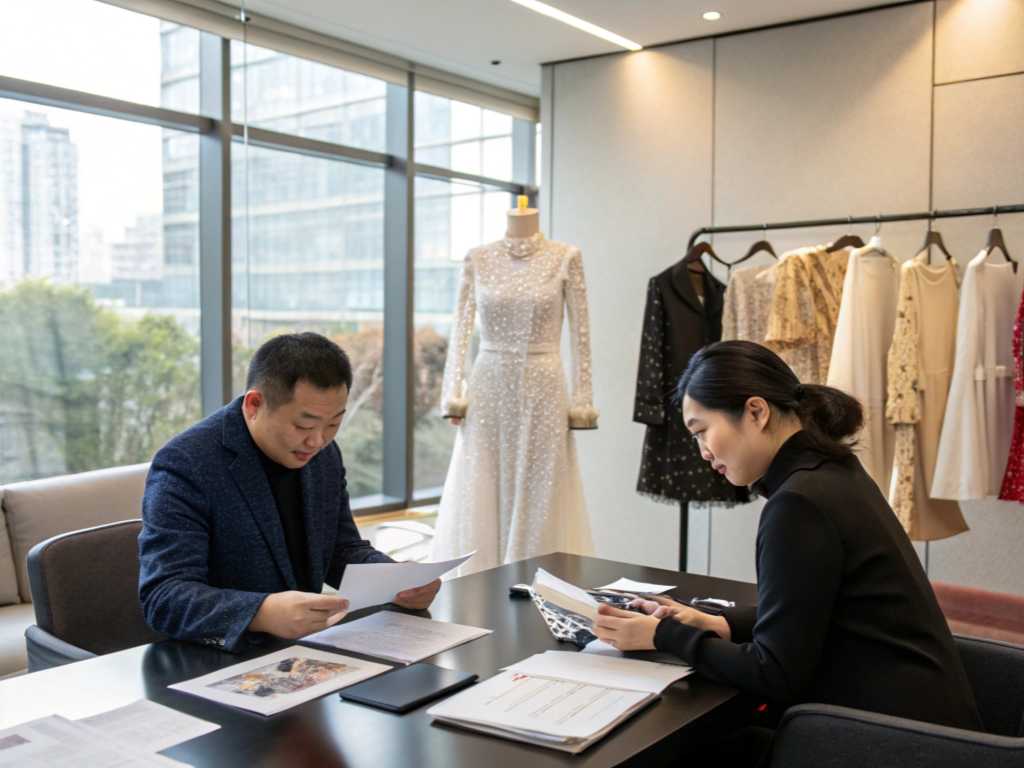
Office dresses look simple on a product page, but fabric choice is often the reason one style becomes a repeat bestseller while another quietly disappears after one season. A work dress has to survive the real office day: commuting, sitting, meetings, lunch breaks, air conditioning, body movement, washing, steaming, packing, and still looking polished at 5 p.m. For fashion brands, this means “best fabric” is not just about softness or price. It is about a full performance balance: structure, drape, breathability, opacity, wrinkle recovery, stretch, color stability, shrinkage control, and whether the fabric supports the exact dress silhouette being developed.
The best fabrics for office dresses are ponte, crepe, suiting fabrics, cotton blends, viscose blends, linen blends, polyester-spandex blends, and selected jersey or knit fabrics. The right choice depends on the dress type, season, target market, dress code, care expectations, and bulk production requirements.
A buyer once told us that her brand’s most returned office dress was not returned because of the design. The sketch was strong, the model photos looked beautiful, and the price was right. The issue was simpler: after sitting for two hours, the skirt wrinkled heavily across the lap. That is the hidden lesson behind office dress fabric selection. Customers do not judge fabric in the showroom only. They judge it during a full working day.
Jinfeng Apparel is a Guangdong-based premium custom women’s fashion manufacturer serving global fashion brands and mid-to-large apparel clients with OEM, ODM, private-label womenswear manufacturing, fabric sourcing, sampling, bulk production, quality control, packaging, and export delivery support. The company supports office dress development across woven, knit, stretch, suiting, crepe, ponte, cotton blend, viscose blend, linen blend, and private-label women’s fashion collections.
What Makes a Good Office Dress Fabric?
A clean modern office wardrobe scene with fabric swatches, ponte, crepe, suiting, cotton blend, viscose, and linen blend placed beside a tailored women’s office dress sample, neutral daylight, premium fashion manufacturing mood, realistic photography style.
A good office dress fabric should look polished, feel comfortable through a full workday, resist heavy wrinkling, provide enough opacity, and hold its shape after sitting. The best choice is rarely just the softest or cheapest fabric. For office dresses, fabric must balance appearance, movement, easy care, bulk production stability, and the customer’s real daily wearing environment.
Professional Appearance
Office dress fabric has to create trust at first glance. That usually means a clean surface, controlled drape, stable structure, and no unwanted transparency. A dress may have a beautiful design sketch, but if the fabric looks limp, shiny in the wrong way, or too thin under daylight, the final garment will feel less professional.
For workwear dresses, fabric surface matters more than many buyers expect. Crepe, ponte, suiting fabric, twill, and compact knits often look more office-ready because they hide minor wrinkles and hold a cleaner silhouette. Very thin jersey, overly glossy satin, or loose woven fabrics can work for other fashion categories, but they may look too casual or evening-focused for office settings.
Light colors require extra caution. White, cream, beige, pale blue, and blush fabrics should be checked under strong light because opacity can change dramatically between dark and light shades of the same fabric. A navy crepe dress may pass easily, while the same fabric in ivory may need lining, a denser construction, or a different fabric weight.
Comfort and Movement
An office dress is not worn for ten minutes in a fitting room. It is worn while commuting, sitting, walking, stretching, eating lunch, joining meetings, and sometimes traveling. That means the fabric must allow natural body movement without losing shape.
A small amount of elastane is often useful. For many woven office dresses, 2–5% spandex can improve comfort without making the dress look too casual. For knit office dresses, the key is not maximum stretch but stable recovery. A fabric that stretches easily but does not recover will bag out at the hip, seat, elbow, or waist.
Fabric weight also affects comfort. Lightweight fabrics can feel cool but may need lining. Heavy fabrics may look structured but can feel restrictive. For most office dress categories, the safest fabrics often sit in a medium-weight range, strong enough to provide coverage but not so heavy that the wearer feels trapped.
Real-World Wear Risk
The biggest office dress fabric problems usually appear after use, not during the first sample review. Wrinkling after sitting, shrinkage after washing, color fading, pilling, seam twisting, transparency, and poor stretch recovery are common reasons customers lose confidence in a dress.
Brands should test fabric in practical ways. Sit in the sample for 20–30 minutes. Hang it overnight. Fold it into a carton or suitcase. Steam it. Wash it if the care label says washable. Check how the dress looks after these simple tests. This is often more valuable than only judging fabric by hand feel.
Fabric Factor | Practical Target for Office Dresses | Why It Matters |
Fabric weight | Often 180–320 GSM for many structured office dresses | Helps balance comfort, opacity, and shape |
Spandex in woven blends | Commonly 2–5% | Improves sitting comfort and movement |
Shrinkage after wash | Ideally within 2–3% for washable styles | Reduces size complaints after care |
Colorfastness | Common target Grade 3–4 or above | Reduces fading and staining risk |
Pilling resistance | Common target Grade 3–4 or above | Keeps surface looking new longer |
Wrinkle recovery | Checked by sitting, folding, and packing tests | Protects office-ready appearance |
Production Consistency
A good office dress fabric must perform from sample to bulk. A fabric that looks beautiful in one sample but changes shade, stretch, shrinkage, or hand feel in bulk production can create serious problems for brands.
Production consistency includes roll-to-roll color control, fabric width stability, stretch direction, GSM variation, washing behavior, and seam performance. If a brand is producing multiple colors, each color should be checked separately. A black ponte dress may pass opacity easily, while the same fabric in cream may need lining. A navy crepe may look polished, while a pale pink version may reveal seam shadows.
For bulk orders, fabric should be approved together with the pattern, lining, trims, and care label. Office dresses are not just fashion items; they are repeat-wear products. Customers expect them to look neat many times, not only on the first try-on.
Which Fabrics Work Best for Office Dresses?
A professional fabric comparison layout showing ponte knit, stretch crepe, suiting fabric, cotton blend, viscose blend, and linen blend swatches arranged around office dress sketches, with labels, measuring tape, and fashion studio lighting.
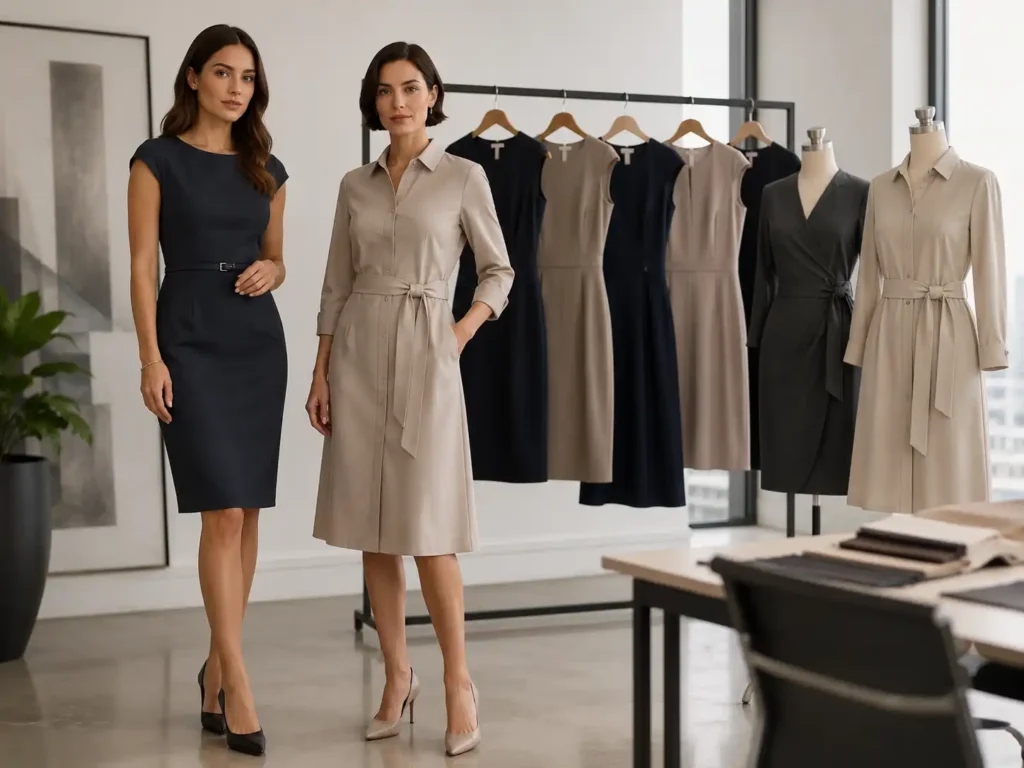
The best fabrics for office dresses are ponte, crepe, suiting fabric, cotton blends, viscose blends, linen blends, polyester-spandex blends, and stable jersey or knit fabrics. Each fabric serves a different purpose. Ponte gives comfort and structure, crepe looks polished, suiting fabric feels formal, cotton blends look crisp, and viscose blends add soft movement.
Ponte and Stable Knits
Ponte is one of the most reliable office dress fabrics because it gives structure, stretch, opacity, and comfort in one material. It is especially strong for sheath dresses, fitted midi dresses, pencil dresses, and modern bodycon office styles.
Unlike lightweight jersey, ponte has a denser double-knit construction. This helps the dress sit smoothly on the body without looking too thin or casual. It also reduces the need for heavy lining in many darker colors. For office customers who want comfort but still need a polished look, ponte is often a smart middle ground.
The main risk is quality variation. Low-quality ponte may pill, lose recovery, or feel too synthetic. A strong ponte should recover well after stretching, hold the side seams straight, and keep the hip and seat area smooth after sitting. For brands selling office dresses online, ponte can reduce fit complaints when the pattern and size grading are well developed.
Crepe and Stretch Crepe
Crepe works well for office dresses because it has a refined texture and elegant drape. It can look professional without being stiff, making it suitable for wrap dresses, midi dresses, belted dresses, shift dresses, and semi-formal workwear.
The slightly textured surface of crepe helps hide small wrinkles better than very smooth fabrics. Stretch crepe adds comfort, especially for commuting and long sitting hours. This is why many brands use crepe for dresses that need to move from desk to dinner, meeting to travel, or office to event.
The fabric must be chosen carefully. Very thin crepe may cling or become transparent in light colors. Heavy crepe may pull down a soft silhouette. Some crepes may pucker at seams if sewing tension is not adjusted correctly. For bulk production, crepe should be tested for drape, seam stability, shrinkage, and color consistency.
Suiting and Twill
Suiting fabric is ideal when an office dress needs a formal, tailored, or corporate appearance. It is commonly used for sheath dresses, blazer dresses, structured A-line dresses, pencil dresses, and sleeveless dresses designed to be worn with jackets.
A good suiting fabric gives the garment a strong line. It helps define the waist, smooth the hip area, and create a more serious workwear impression. Polyester-viscose blends, wool blends, stretch suiting, twill, and gabardine are all common choices.
The main question is comfort. A fabric that is too rigid may look sharp but feel uncomfortable when sitting. This is why stretch suiting is often preferred for modern office dresses. A small amount of elastane can improve movement while keeping the tailored look. Care requirements also matter. If the target customer expects easy-care workwear, dry-clean-only fabrics may reduce repeat purchase.
Cotton, Viscose, and Linen Blends
Cotton blends, viscose blends, and linen blends are useful for office dresses when the design needs breathability, softness, or a more relaxed business casual feel.
Cotton blends are excellent for shirt dresses, belted dresses, A-line dresses, and crisp summer workwear. Pure cotton wrinkles easily, so blended cotton is often more practical. Viscose blends offer softer drape and are good for wrap dresses, printed midi dresses, and relaxed office styles. Linen blends work best for warm-weather office dresses where natural texture is part of the look.
| Fabric Type | Best Office Dress Use | Strength | Main Caution |
| Ponte | Sheath, fitted midi, bodycon office dress | Stretch, coverage, shape | Check pilling and recovery |
| Crepe | Wrap, shift, midi, belted dress | Polished texture, drape | Check thickness and seam puckering |
| Suiting fabric | Formal sheath, blazer dress, structured dress | Tailored shape | May feel stiff without stretch |
| Cotton blend | Shirt dress, A-line, summer office dress | Crisp, breathable | Wrinkle and shrinkage control needed |
| Viscose blend | Wrap, printed midi, soft work dress | Soft drape, comfort | Shrinkage and shape stability |
| Linen blend | Summer office dress, resort workwear | Breathable, natural look | Wrinkle acceptance varies by market |
| Polyester-spandex | Travel, commuter, easy-care dress | Wrinkle resistance, recovery | Avoid cheap shiny hand feel |
| Compact jersey | Casual office dress, knit midi | Comfortable movement | Must avoid thin or clingy quality |
Which Fabrics Resist Wrinkles Best?
A realistic office commute scene with a woman wearing a wrinkle-resistant midi office dress, beside close-up fabric swatches of ponte, stretch crepe, polyester-viscose blend, and suiting fabric, polished but natural lifestyle photography.

Wrinkle-resistant office dress fabrics usually include ponte, stretch crepe, polyester blends, suiting blends, and compact knits. Pure linen and pure cotton wrinkle more easily, although they can still work when blended or intentionally styled. For officewear, the best wrinkle-resistant fabric should recover after sitting, packing, and normal daily movement.
Best Wrinkle-Resistant Choices
Ponte, stretch crepe, polyester-viscose blends, polyester-spandex blends, and stable suiting fabrics are usually strong choices for wrinkle resistance. These fabrics are commonly used for dresses that need to look neat after commuting, sitting, or traveling.
Ponte performs well because knit construction does not form sharp crease lines as easily as many woven fabrics. Stretch crepe performs well because its textured surface hides minor wrinkles. Polyester blends often recover better than natural fibers, especially when designed for easy-care garments.
However, wrinkle resistance is not only about fiber content. Fabric construction, weight, finishing, and garment design all matter. A poor-quality polyester dress may still crease badly or look cheap. A well-developed cotton blend may perform better than expected. This is why brands should test actual fabric samples rather than relying only on composition labels.
Sitting and Commuting Tests
Office dresses must be tested for sitting wrinkles. This is one of the most practical tests for workwear fabrics. A dress may look perfect on a hanger but crease heavily across the lap after a short meeting.
A simple sitting test can reveal a lot. Wear the sample or place it on a seated form for 20–30 minutes. Then check the front skirt, back hip, waist, and side seams. If the wrinkles are light and recover after hanging or steaming, the fabric may be suitable. If deep crease lines remain, the fabric may be risky for office customers.
Commuting adds another layer. Fabric rubs against bags, coats, car seats, subway seats, and office chairs. Knits and blends with good recovery usually handle this better than crisp natural fabrics. For travel-friendly office dresses, brands should also run a fold or packing test before confirming bulk fabric.
Travel-Friendly Fabrics
Travel-friendly office dresses should resist wrinkles, dry reasonably fast, recover after packing, and require limited ironing. Stretch crepe, ponte, polyester-viscose blends, compact jersey, and selected suiting blends are strong options.
Travel customers usually care about convenience. They may pack two or three dresses for business trips and expect them to be wearable after light steaming. Heavy linen, crisp cotton poplin, and delicate rayon may look beautiful but can disappoint if the dress needs constant ironing.
Fabric care claims should be honest. “Wrinkle-resistant” is safer than “wrinkle-free” unless the fabric has been properly tested. “Low-iron” is often more realistic than “no-iron.” Customers trust brands more when the care language matches the real garment experience.
When Wrinkles Are Acceptable
Not every wrinkle is a defect. Some fabrics, especially linen blends and natural cottons, are valued for their texture and casual elegance. In relaxed offices, creative workspaces, summer collections, and resort-inspired workwear, a small amount of natural wrinkling can feel acceptable.
The problem appears when the customer expects a sharp corporate dress and receives a fabric that wrinkles like vacation linen. Fabric must match the promise of the product. If the dress is marketed as polished, structured, or meeting-ready, wrinkles should be controlled. If it is marketed as breathable, natural, and relaxed, some texture may be part of the design.
For brands, the safest approach is to define the dress code first. A formal office dress requires stronger wrinkle control. A summer business casual dress can accept softer wrinkles if the overall look remains intentional.
How Should Brands Match Fabric to Dress Type?
Fashion product development board showing office dress silhouettes including sheath, shirt dress, wrap dress, midi dress, bodycon dress, and A-line dress, each matched with fabric swatches, technical sketch style mixed with realistic studio photography.
Brands should match fabric to dress silhouette before choosing color or price. Structured dresses need ponte, suiting, twill, or stable crepe. Fluid dresses need viscose, rayon, or soft crepe. Shirt dresses need crisp cotton blends. Wrap dresses need controlled drape. Fitted dresses need stable stretch and strong recovery.
Sheath and Pencil Dresses
Sheath and pencil dresses need fabrics that hold shape without restricting the body. The best options are ponte, stretch suiting, medium-weight crepe, compact jersey, and polyester-viscose-spandex blends.
These dresses are close to the body, so fabric quality is easy to judge. If the fabric is too thin, it may show undergarments, seam lines, or body marks. If it is too stiff, the wearer may feel uncomfortable when sitting. If it lacks recovery, the seat and hip area may bag out during the day.
For sheath dresses, stretch direction is important. The dress should move across the bust, waist, and hip without pulling. A back slit or side slit may improve movement, but it must be supported by stable fabric and clean sewing. The best sheath dress fabric creates confidence: smooth front, clean side view, stable hip area, and comfortable sitting.
Shirt and A-Line Dresses
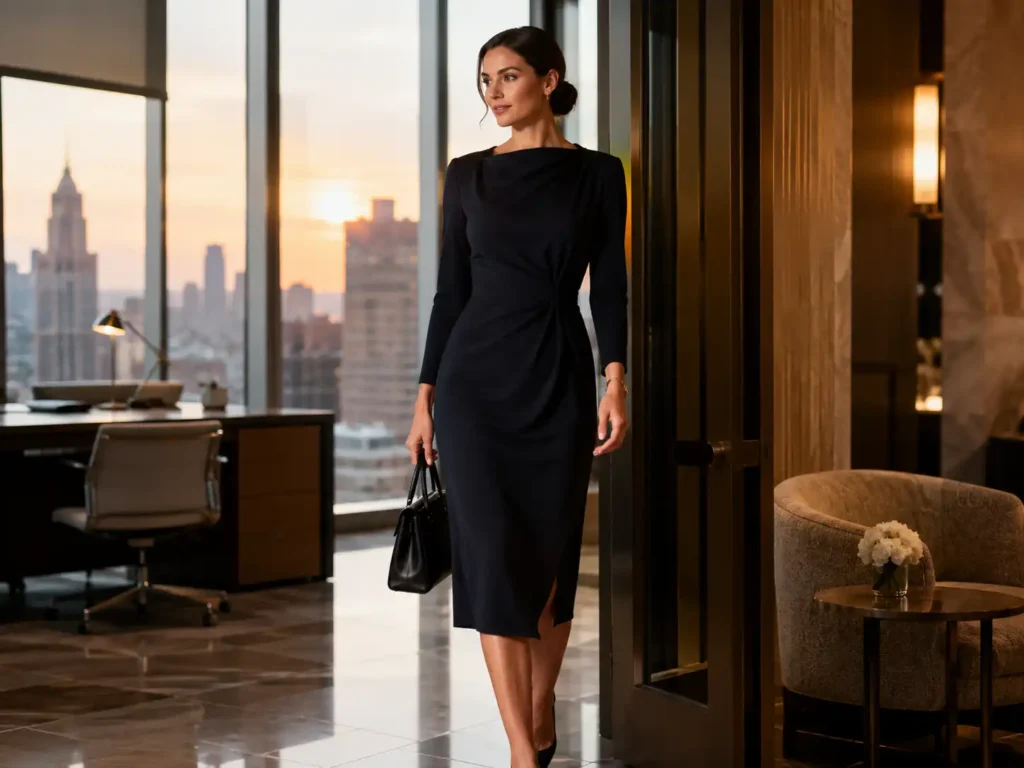
Shirt dresses and A-line office dresses usually work best with cotton blends, cotton poplin, cotton twill, Tencel blends, linen blends, light denim, and crisp viscose blends.
A shirt dress needs fabric that supports the collar, placket, cuff, and belt. If the fabric is too soft, the placket may collapse and the buttons may pull. If the fabric is too stiff, the dress may look boxy. Cotton blends are often the safest because they provide crispness and breathability while reducing some of the wrinkling problems of pure cotton.
A-line dresses need fabric that supports the skirt shape. Soft fabrics create relaxed movement, while twill, suiting, and cotton blends create a more structured look. The hem should hang evenly, and the side seams should not twist. For light colors, lining or higher fabric density may be needed.
Wrap and Midi Dresses
Wrap dresses and midi dresses depend heavily on drape. Good fabric choices include stretch crepe, viscose blends, rayon blends, soft polyester blends, and stable jersey.
A wrap dress needs enough movement to cross the body smoothly, but it should not be so slippery that the neckline opens too much. The front overlap must stay secure while sitting and walking. If the fabric is too thin, the overlap may look transparent. If it is too bulky, the waist tie can look heavy.
Midi dresses have another challenge: length balance. The fabric must hang well below the knee without dragging the dress down. A fitted midi needs recovery. A flowy midi needs graceful drape. A structured midi needs enough body at the hem. Brands should test midi dresses on real bodies, not only on flat patterns, because small fabric differences can change the entire proportion.
Bodycon and Knit Dresses
Bodycon office dresses need stable stretch fabrics such as ponte, compact jersey, rib knit with strong recovery, scuba, and polyester-spandex blends. The goal is not maximum tightness. The goal is a smooth, controlled fit suitable for work.
Office bodycon dresses should not look like clubwear unless the brand intentionally targets that crossover style. Fabric weight, opacity, neckline, sleeve design, and length all affect the final impression. A thicker ponte midi dress can feel confident and office-ready. A thin shiny stretch fabric may feel too casual or too revealing.
Dress Type | Best Fabric Choices | Useful Fabric Specs | Common Risk |
Sheath dress | Ponte, stretch suiting, crepe | Medium weight, 2–5% stretch in woven styles | Pulling at bust or hip |
Shirt dress | Cotton blend, poplin, twill, Tencel blend | Crisp hand feel, stable placket | Wrinkles and button gaping |
Wrap dress | Stretch crepe, viscose blend, jersey | Soft drape, controlled stretch | Neckline shifting |
Midi dress | Crepe, viscose, ponte, suiting | Balanced drape and hem weight | Uneven hem or heavy fall |
Bodycon dress | Ponte, compact jersey, scuba | Strong recovery, good opacity | Seat bagging or transparency |
A-line dress | Cotton twill, suiting, linen blend | Moderate body, clean hem | Skirt collapse or stiffness |
How Do Seasons Affect Fabric Choice?
Four-season office dress fabric moodboard showing summer cotton and linen blends, winter ponte and suiting fabrics, spring crepe, autumn compact knit, with office dress samples in neutral and seasonal colors, editorial flat lay photography.
Seasons affect office dress fabric through weight, breathability, warmth, layering, color, and care. Summer dresses need lighter breathable fabrics such as cotton blends, linen blends, viscose blends, and light crepe. Winter styles need ponte, suiting blends, wool blends, heavier crepe, and compact knits. Year-round fabrics should balance comfort and structure.
Summer Office Fabrics
Summer office dresses should feel breathable without looking too casual. Cotton blends, linen blends, viscose blends, Tencel blends, lightweight crepe, and selected light polyester blends can all work well.
The biggest summer challenge is balancing comfort and coverage. Very thin fabric may feel cool but become transparent. Pure linen may feel breathable but wrinkle quickly. Viscose may feel soft but needs shrinkage control. Cotton poplin may look fresh but crease after sitting.
For warm markets, partial lining is often better than full lining. A full lining can improve opacity but may make the dress too hot. Another solution is choosing slightly denser fabric in key colors or using double-layer construction only where needed. Summer office dresses should feel easy, but they still need enough structure to look intentional in meetings and customer-facing environments.
Winter Office Fabrics
Winter office dresses need warmth, structure, and layering compatibility. Ponte, wool blends, suiting fabric, heavy crepe, rib knit, compact jersey, and polyester-viscose blends are common choices.
Winter fabrics can carry deeper colors well. Black, navy, charcoal, chocolate, burgundy, forest green, and camel often look premium in heavier office fabrics. These colors also reduce transparency risk and usually photograph well for ecommerce.
The main winter risks are bulk, pilling, and static. A fabric may feel warm but create thick seams around the waist or sleeve. Knits may pill under coat friction. Some synthetic blends may create static in dry climates. For winter office dresses, fabric should be checked with the intended styling: blazer, coat, tights, boots, and inner layers. A dress that fits alone may feel too tight once layered.
Year-Round Core Fabrics
Year-round fabrics are valuable for brands because they support core styles, repeat orders, and stable product planning. Ponte, medium-weight crepe, stretch suiting, compact jersey, and polyester-viscose blends often work across multiple seasons.
A year-round office dress fabric usually sits in the middle: not too light, not too heavy, not too casual, not too formal. It should be wearable with bare legs in transitional weather and with a blazer or coat in cooler months. These fabrics are especially useful for black, navy, grey, and neutral office dresses.
However, year-round does not mean every market. A fabric that works in London may feel too warm in Singapore. A fabric that works for Australian summer may feel too light for Canadian winter. Brands should define sales regions before finalizing fabric weight.
Climate and Market Fit
Climate affects customer expectations. Hot and humid markets need breathable fabrics and lighter constructions. Cold markets need structure and warmth. Markets with heavy commuting need wrinkle recovery. Markets with strong online returns need stable sizing and easy care.
A practical officewear range may use different fabric groups by region. For example, a brand may use linen-viscose blends for summer Australia, ponte and suiting blends for the UK, and stretch crepe for US commuter dresses. Fabric strategy should follow customer lifestyle, not only seasonal trend boards.
For bulk orders, climate also affects packaging. Dresses that wrinkle easily may need better folding, tissue support, or hanging shipment for premium styles. Humid climates may require stronger moisture protection. These details are not glamorous, but they affect how the customer experiences the dress when it arrives.
Are Natural Fabrics Better Than Blends?
Close-up comparison of natural and blended office dress fabrics, cotton, linen, wool blend, viscose blend, polyester-viscose-spandex, and ponte, arranged with a professional women’s dress sample and care label details, realistic textile photography.
Natural fabrics are not always better for office dresses. Cotton, linen, wool, and silk can feel premium, breathable, and familiar, but blends often improve wrinkle resistance, stretch, durability, washability, and cost control. For officewear, the most practical fabric is usually the one that balances natural comfort with daily performance.
Cotton and Linen
Cotton and linen are loved because they feel breathable and natural. They are especially useful for summer office dresses, shirt dresses, relaxed midi dresses, and business casual collections.
Pure cotton can look crisp but wrinkles easily. It may also shrink if not properly treated. Pure linen is breathable and premium, but it develops visible wrinkles quickly. In the right market, this texture can look stylish. In formal corporate offices, it may look too relaxed.
This is why cotton blends and linen blends are often more practical. Cotton-spandex improves movement. Cotton-polyester improves wrinkle resistance. Linen-viscose softens the drape. Linen-cotton keeps natural texture while improving structure. Natural fibers are valuable, but they still need technical control when used for office dresses.
Wool and Wool Blends
Wool blends can work beautifully for formal office dresses, especially in cooler climates. They provide structure, warmth, and a premium feel. Wool-polyester blends, wool-viscose blends, and stretch wool blends are often more practical than pure wool because they improve durability and reduce cost.
Wool is most suitable for sheath dresses, tailored midi dresses, structured sleeveless dresses, and winter workwear. It is less suitable for hot climates or easy-care collections unless blended and finished for comfort.
The risks include dry-clean requirements, pilling, heat, and customer sensitivity to hand feel. Some customers love wool, while others find it too warm or itchy. For brands, wool blends should be used when the price point, season, and target customer justify the added cost.
Practical Blends
Blended fabrics are often the most realistic choice for office dresses. They allow brands to combine comfort, structure, stretch, wrinkle resistance, and cost control.
A polyester-viscose-spandex blend can create a smooth, easy-care office dress. A cotton-spandex blend can make a shirt dress more comfortable. A linen-viscose blend can soften summer tailoring. A ponte blend can deliver structure and movement. These fabrics may not sound as romantic as pure natural fibers, but they often perform better in daily office use.
The quality of the blend matters. A good blend should not feel cheap, overly shiny, or plastic-like. It should support the garment’s purpose. For many modern workwear customers, comfort and care are just as important as fiber origin.
Cost and Value
Fabric cost should be judged by garment value, not only price per meter. A cheaper fabric may increase return rates, require full lining, fail after washing, or make the dress look low quality. A slightly better fabric may reduce complaints, improve reviews, and support repeat orders.
Brands should compare fabric choices through practical questions. Does it fit the target retail price? Does it reduce production risk? Does it match the dress code? Does it improve product photos? Does it survive washing or dry cleaning? Does it support repeat orders?
For office dresses, fabric value comes from reliability. Customers want a dress they can reach for again and again. A fabric that helps the dress stay neat, comfortable, and flattering has more commercial value than a fabric that only looks good during sample approval.
How Do Manufacturers Test Office Dress Fabrics?
Apparel factory quality control scene showing office dress fabric testing, fabric roll inspection, shrinkage notes, measuring tape, approved swatches, sample dress on mannequin, and QC checklist, realistic premium manufacturing photography.
Manufacturers test office dress fabrics by checking hand feel, weight, stretch, recovery, opacity, shrinkage, wrinkle behavior, color consistency, seam performance, lining needs, and bulk roll stability. Testing should happen before sampling, during fitting, before PP approval, and during bulk production. This reduces returns, production defects, and bulk quality surprises.
Before Sampling
Before sampling, the fabric should be checked against the actual dress design. The key questions are simple: Is it the right weight? Does it drape correctly? Is it opaque enough? Does it stretch in the right direction? Does it match the target season, price point, and care expectation?
This early review prevents wasted samples. A fabric may be good in general but wrong for the silhouette. A soft viscose may not support a structured sheath dress. A heavy ponte may not suit a summer shirt dress. A crisp cotton may not work for a flowing wrap dress.
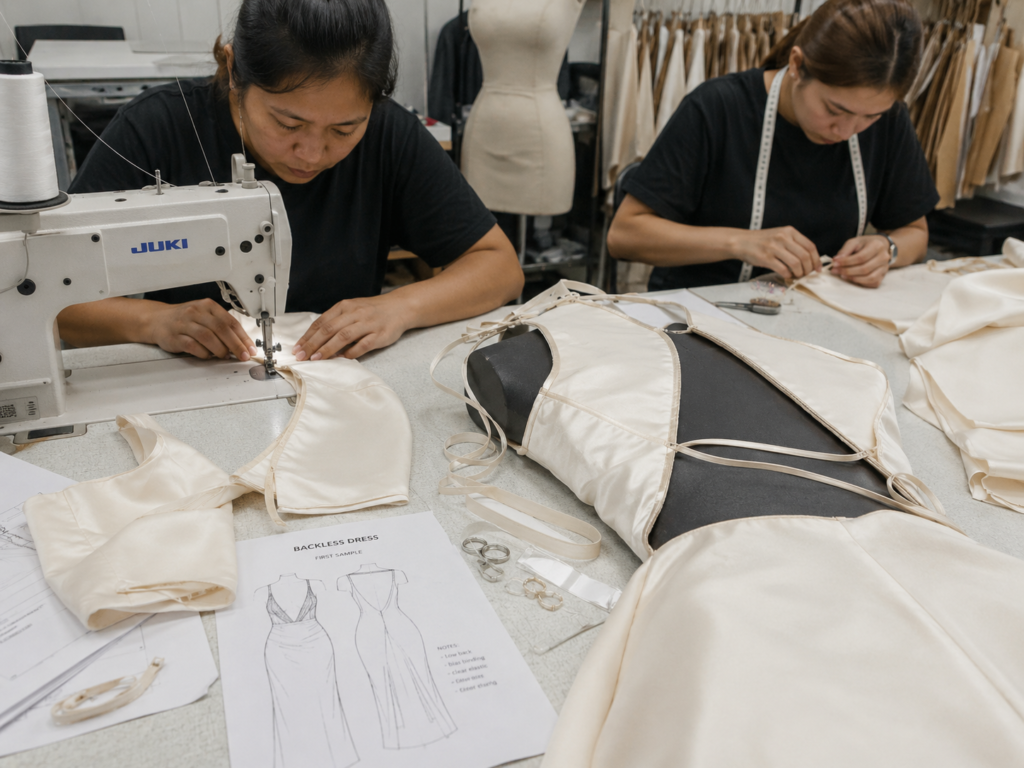
For custom office dress development, brands should provide clear starting materials: tech pack, reference photos, original sample, sketch, size chart, fabric preference, color plan, quantity plan, and target market. The more specific the information, the easier it is to choose a fabric that can move from sample to bulk production.
Fit and Wear Testing
Fit testing should check how the fabric behaves on the body, not just how the dress measures on a table. Office dresses should be reviewed while standing, sitting, walking, reaching, and turning.
The bust, waist, hip, back, armhole, neckline, slit, and hem all react differently depending on fabric. A stretch fabric can hide some fit issues but create recovery problems. A woven fabric can look sharp but restrict movement. A flowing fabric can flatter the body but shift at the neckline or waist.
Wear testing does not need to be complicated. A 30-minute sitting test, light movement test, and quick steam recovery review can reveal major risks. For fitted dresses, the seat and hip area are especially important. For wrap dresses, neckline security matters. For shirt dresses, button gaping must be checked.
Bulk Fabric Control
Bulk fabric control is where many office dress problems are either prevented or created. The approved sample fabric should be compared with bulk fabric rolls for shade, weight, width, stretch, hand feel, and defect level.
Roll-to-roll variation is common in apparel production. One roll may be slightly darker, stretchier, lighter, or more textured than another. If this is not caught before cutting, the final garments may show shade differences or size inconsistency. For multi-color orders, each color should be checked separately because fabric behavior can change after dyeing.
Test Point | Common Practical Check | Why It Matters for Office Dresses |
GSM / weight | Compare sample and bulk roll | Controls drape, opacity, and structure |
Width | Measure usable cutting width | Affects consumption and cost |
Stretch | Check stretch direction and recovery | Protects fit and comfort |
Shrinkage | Wash or steam test where needed | Prevents post-care size issues |
Opacity | Test light and skin-tone contrast | Avoids transparency complaints |
Color shade | Lab dip and bulk roll comparison | Maintains color consistency |
Wrinkle behavior | Sitting and folding test | Protects professional appearance |
Seam performance | Sample sewing test | Reduces puckering, twisting, and seam stress |
Quality and Repeat Orders
Quality control should not stop after the first sample. Office dresses need consistency across sizes, colors, batches, and repeat orders. This is especially important for brands that sell core workwear styles season after season.
A reliable production process keeps records of fabric references, color standards, patterns, size charts, trims, lining, sewing details, care labels, and packing methods. These records make repeat orders faster and more consistent. They also reduce the chance of small changes damaging a bestselling style.
For brands developing office dress collections, a strong supplier should be able to discuss fabric risk, sample correction, bulk consistency, measurement tolerance, private-label finishing, and repeat production planning. The best office dress is not only designed well. It is engineered to be worn, washed, shipped, restocked, and trusted by customers over time.
Conclusion: Choose Fabric for the Workday, Not Just the Sample Room
The best fabric for an office dress is the fabric that still looks right after the customer has lived in it for a full workday. Ponte is strong for fitted and comfortable office dresses. Crepe is excellent for polished work styles. Suiting fabric supports structured and formal silhouettes. Cotton blends create crisp shirt dresses and breathable summer pieces. Viscose blends bring soft movement. Linen blends work well for relaxed warm-weather officewear. Polyester-spandex and other performance blends can improve wrinkle resistance, stretch recovery, and care convenience.
For brands, the real decision is not “which fabric sounds best?” It is “which fabric will make this dress look professional, feel comfortable, survive daily wear, pass production checks, and support repeat orders?” That is where fabric sourcing, pattern development, sample fitting, PP approval, bulk fabric inspection, and quality control all work together.
Jinfeng Apparel supports custom office dress development for fashion brands and mid-to-large apparel clients through fabric sourcing, pattern development, sample making, fit adjustment, bulk production, quality control, private-label packaging, and export delivery. MOQ starts from 200 pcs per style/color, depending on fabric availability, color development, trims, construction complexity, and production schedule.
For your next office dress collection, send your tech pack, reference photos, target fabric direction, size range, color plan, quantity plan, and expected launch schedule. The team can help review fabric options, identify production risks, develop samples, and move from approved sample to bulk production with a clear, brand-focused process.
Share This Article :

Jerry Lee
Categories

Latest blogs


Table of Contents
Here, developing your OEM/ODM private label clothing collection is no longer a challenge—it’s an excellent opportunity to bring your creative vision to life.

