 Skip to content
Mesh Fabric Guide for Dress Manufacturing: What Should Fashion Brands Know Before Sampling?

Your trusted Women’s Apparel Manufacturer from China

Mesh can make a dress look lighter, sharper, more breathable, more feminine, and more visually memorable. It can also expose every weak point in development: poor lining choice, unstable stretch direction, wavy seams, uneven transparency, wrong needle selection, careless cutting, or a factory that treats mesh like ordinary fabric. For fashion brands, mesh is not just a decorative fabric. It is a product decision that affects fit, comfort, sampling cost, bulk production risk, return rate, and how the garment photographs on a model. A reference image may show a clean sheer sleeve or a smooth ruched bodycon panel, but the real production result depends on fabric behavior, pattern control, lining strategy, and sewing discipline.
Mesh fabric for dress manufacturing should be selected based on dress type, stretch recovery, transparency, weight, lining compatibility, sewing behavior, and bulk stability. The right mesh can support bodycon, party, evening, overlay, sleeve, and cut-out designs, while the wrong mesh can create sizing problems, distortion, poor coverage, and inconsistent production results.
A mesh dress often looks simple in a product photo. Then the first sample arrives: the sleeve twists, the side seam waves, the bust looks too sheer, and the hem no longer matches the design. That is why experienced brands do not only ask, “Can you make this mesh dress?” They ask, “Can you control this mesh dress from sample to bulk?”
What Is Mesh Fabric in Dress Manufacturing?
Mesh fabric in dress manufacturing is an open-structure textile used for sheer panels, overlays, sleeves, linings, shaping layers, and full dress construction. Its performance depends on fiber content, hole size, stretch, recovery, transparency, weight, and sewing behavior. For brands, mesh is not only a visual fabric; it directly affects fit, coverage, comfort, cost, and bulk consistency.
Mesh Is a Fabric Family
In dress production, “mesh” does not refer to one single fabric. It can mean soft fashion mesh, stretch mesh, power mesh, tulle, embroidered mesh, glitter mesh, sequin mesh, flocked mesh, fishnet, or technical support mesh. These fabrics may look similar in photos, but they behave very differently in cutting, sewing, fitting, and wearing.
A soft sheer mesh may be perfect for sleeves or overlays, but it may not have enough recovery for a tight bodycon dress. A power mesh may support the waist and bust, but it may feel too firm for a romantic evening dress overlay. A sequin mesh may photograph beautifully, but it can add weight, abrasion, and higher sewing difficulty.
This is why a professional dress manufacturer should not only ask, “Do you want mesh?” The better question is, “What does the mesh need to do in this dress?” If the mesh is decorative, the priority may be transparency, surface effect, and drape. If it is structural, the priority becomes recovery, seam strength, and support. If it sits directly on skin, hand feel and comfort become critical.
Mesh Changes the Dress Structure
Mesh often looks light and simple, but it can make a dress more complex to produce. The open-hole structure means the fabric may stretch, shift, snag, or distort more easily than many solid fabrics. Once cut, mesh panels can lose shape if the fabric is not handled properly. During sewing, too much tension can create wavy seams or stretched edges.
For example, a mesh sleeve is not just a sleeve made from a different fabric. It needs armhole stability, upper-arm comfort, seam smoothness, and clean finishing. A sheer waist insert must be strong enough to hold the dress together while keeping the intended transparent effect. A mesh overlay must sit smoothly over the lining without twisting or pulling.
Brands often focus on how mesh looks in a reference image, while factories must focus on how it behaves in real production. Good mesh dress development connects both sides: visual design and manufacturing control.
Mesh Needs Clear Specification
The word “mesh” is too broad for production. A useful specification should include fabric composition, stretch direction, weight, color, transparency level, hand feel, lining requirement, and end use. Without these details, the first sample may not match the design intention.
A simple line such as “black stretch mesh for fitted party dress sleeves” is much clearer than “use black mesh.” It tells the factory the mesh should stretch, sit close to the body, and work in a partywear context. If the design uses nude illusion mesh, the shade must also be discussed because “nude” can vary widely across markets and customer groups.
For mesh dresses, fabric approval should ideally happen before the pattern is finalized. The fabric’s stretch and recovery can change the size specification, seam construction, and lining plan. If the fabric is changed after sampling, the pattern may need adjustment again.
Mesh Works Best with Purpose
Mesh works best when every placement has a reason. Sheer sleeves can make a dress feel lighter. Power mesh can help support a fitted silhouette. Tulle can add volume. Embroidered mesh can create premium surface detail. Stretch mesh can help a bodycon dress move with the wearer.
Problems happen when mesh is added only because it looks trendy. A sheer panel in the wrong place can create coverage issues. A weak mesh in a high-tension area can tear. A stiff mesh near the neckline can feel uncomfortable. A mesh overlay without the right lining can look cheap rather than elegant.
For commercial dress manufacturing, mesh should be treated as a design and engineering decision at the same time. The best results usually come when the brand, pattern team, fabric sourcing team, and sewing team align before sampling starts.
Mesh Factor | Why It Matters in Dress Manufacturing | Production Risk If Ignored |
Stretch direction | Controls fit, comfort, and recovery | Size distortion, tight bust, twisting panels |
Hole size | Affects transparency, snagging, and seam strength | Too sheer, weak seams, easy damage |
Weight/GSM | Affects drape, support, and opacity | Cheap look, poor fall, unstable shape |
Recovery | Determines whether the dress returns after wearing | Bagging at waist, hip, sleeve, or neckline |
Hand feel | Impacts skin comfort and premium perception | Scratchy fit, customer complaints |
Lining match | Controls coverage and inner structure | Visible mismatch, poor support, high return risk |
Sewing behavior | Affects seam flatness and bulk consistency | Wavy seams, skipped stitches, puckering |
Which Mesh Fabric Is Best for Dresses?
The best mesh fabric for dresses depends on the silhouette, fit level, coverage, and wearing occasion. Stretch mesh suits bodycon and club dresses, soft mesh works for sleeves and overlays, tulle suits volume and eveningwear, power mesh supports shaping, while embroidered, glitter, or sequin mesh adds decorative value for party and occasion dresses.
Match Mesh to Dress Type
A mesh fabric should be chosen by dress type first, not by fabric name alone. A fitted mini dress, an evening gown, a sheer sleeve dress, and a ruched party dress may all use mesh, but they need different performance.
For bodycon dresses, recovery is usually more important than softness. The mesh needs to stretch over the bust, waist, and hip, then return without bagging. For party dresses, visual impact matters more. Glitter mesh, flocked mesh, ruched stretch mesh, or sequin mesh may create stronger shelf and photo appeal. For evening dresses, elegance, stability, and lining compatibility matter most. Fine tulle, embroidered mesh, or soft overlay mesh can create a refined look without making the dress feel heavy.
A common sourcing mistake is choosing mesh only by appearance. A swatch may look beautiful flat on a table, but it may not work after cutting, sewing, fitting, and wearing. The right mesh must look good and behave well.
Mesh Type | Common Weight Range | Stretch Level | Best Dress Uses | Key Production Concern |
Soft fashion mesh | 40-90 GSM | Low to medium | Sleeves, overlays, sheer panels | Easy to stretch or distort during sewing |
Stretch mesh | 80-160 GSM | Medium to high | Bodycon, club, ruched dresses | Recovery and size stability |
Power mesh | 120-220 GSM | Medium to high, firmer | Inner support, shaping panels | Comfort and pressure balance |
Tulle | 15-80 GSM | Low | Skirt volume, evening overlays | Layer control and hem balance |
Embroidered mesh | 80-250 GSM | Low to medium | Occasionwear, evening dresses | Placement, seam bulk, motif matching |
Sequin mesh | 120-350 GSM | Low to medium | Party dresses, statement pieces | Weight, abrasion, needle damage |
Glitter mesh | 60-180 GSM | Low to medium | Partywear, clubwear | Skin feel and glitter shedding risk |
Bodycon and Club Dresses
For bodycon and club dresses, stretch mesh is usually the safest starting point. These garments sit close to the body, so the fabric must allow movement while keeping the dress shape stable. Nylon-spandex or polyester-spandex mesh is often used when the design needs stretch, ruching, or a fitted sleeve.
The most important data point is not only stretch percentage, but recovery. A mesh that stretches easily but does not recover can look loose after wearing. Around the waist and hip, weak recovery may create bagging. Around the neckline, it can cause gaping. Around sleeves, it can create elbow growth after movement.
For fitted mesh dresses, brands should ask for fabric stretch direction and recovery checks before finalizing the size chart. The pattern may need negative ease, but that depends on the fabric. Too much negative ease can make the dress uncomfortable. Too little can make the dress look loose after one wear.
Party and Occasion Dresses
Party and occasion dresses often use mesh for surface effect. Flocked mesh, glitter mesh, printed mesh, embroidered mesh, rhinestone mesh, and sequin mesh can create strong visual identity. These fabrics are effective for social media-driven collections because they catch light and photograph well.
The challenge is balancing appearance with wearability. A glitter mesh may look attractive but feel rough under the arms. A sequin mesh may create beautiful sparkle but add weight and sewing difficulty. An embroidered mesh may look premium but require careful motif placement to avoid awkward cutting across the bust or waist.
For party dresses, it is important to test mesh under lighting, not only in daylight. Studio lights, flash photography, and evening lighting can change transparency and shine. The lining color also changes the final effect. Black mesh over nude lining feels different from black mesh over black lining. A small change in lining shade can make the whole dress look more expensive or less polished.
Evening and Overlay Dresses
Evening dresses often need mesh that looks delicate but behaves reliably. Fine tulle, soft mesh, embroidered mesh, lace mesh, and illusion mesh are commonly used for necklines, sleeves, bodice overlays, skirt layers, and back panels.
For overlays, the mesh should not fight with the base fabric. If the base is satin, the mesh should glide smoothly and avoid pulling. If the base is lining fabric, the mesh should not wrinkle or cling in an unattractive way. If embroidery is involved, the design placement should be checked before cutting.
Evening mesh also needs clean internal construction. A sheer neckline may require hidden support. A strapless mesh bodice may need cups or boning. A long tulle skirt may need multiple layers to create volume, but too many layers can increase weight and cost. The best evening mesh choices balance beauty, comfort, and construction stability.
Sleeves and Panels
Sleeves and panels are common mesh applications because they add design detail without changing the whole dress structure. Soft stretch mesh works well for fitted sleeves. Fine mesh or tulle can work for puff sleeves or romantic transparent sleeves. Power mesh may be useful for hidden support panels.
Mesh sleeves require special care because they move with the arms. The armhole, underarm seam, elbow area, and cuff opening are all stress points. If the mesh is too stiff, the wearer may feel restricted. If it is too weak, the underarm seam may tear or stretch. If the sleeve is cut off-grain, it may twist after sewing.
For mesh panels, especially waist cut-outs, illusion necklines, and side inserts, transparency and seam strength should be checked together. A panel can look correct in a flat sketch but become too revealing or unstable when worn. The best panels are designed with both the body and the sewing line in mind.
How Do Mesh Properties Affect Dress Fit?
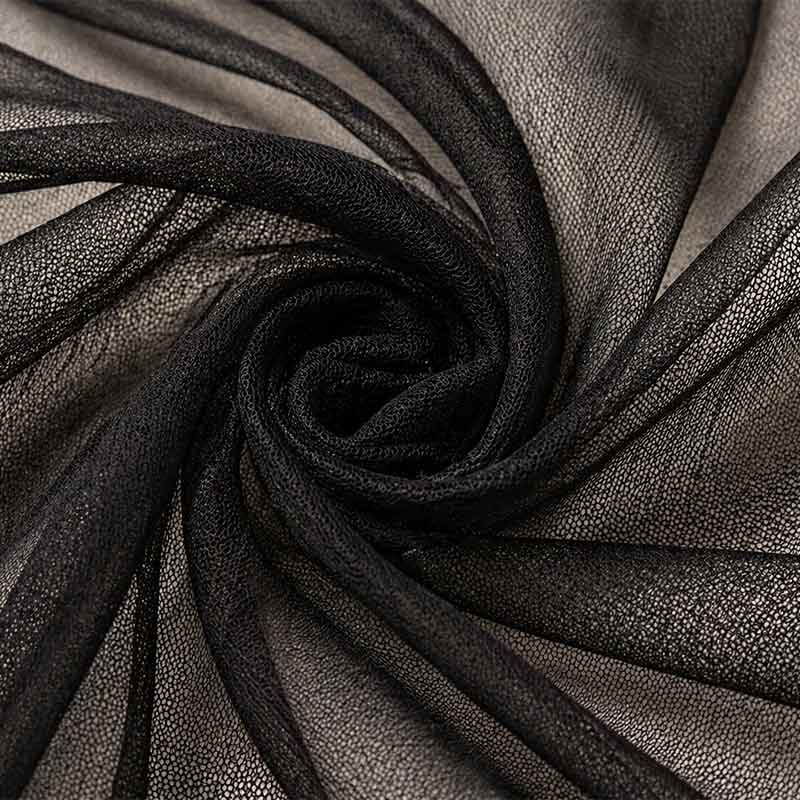
Mesh properties affect dress fit through stretch direction, recovery, weight, transparency, friction, and lining interaction. A mesh with strong stretch but poor recovery may lose shape, while a rigid mesh may restrict movement. Weight affects drape, transparency affects coverage, and lining compatibility determines whether the final dress sits smoothly on the body.
Stretch Direction
Stretch direction decides how the dress expands and recovers across the body. In fitted styles, the strongest stretch usually needs to run around the body, especially across the bust, waist, and hip. If the stretch direction is wrong, the dress can feel tight in one area and loose in another.
Two-way stretch usually stretches more in one direction, commonly across the width. Four-way stretch moves in both width and length. Four-way stretch can be useful for bodycon and dance-friendly styles, but it also requires better measurement control because the dress may grow vertically if the fabric is too soft.
Pattern makers need to know the stretch direction before finalizing the pattern. A woven dress pattern cannot simply be reused for stretch mesh. The amount of ease, seam placement, neckline shape, and sleeve fit may all need adjustment. In bulk cutting, stretch direction should be marked clearly so every panel follows the approved sample.
Recovery and Size Stability
Recovery is what separates a wearable stretch mesh dress from one that loses shape after a few hours. A fabric may stretch beautifully, but if it does not return well, the garment can bag at the hip, loosen at the waist, or grow around the neckline.
For fitted dresses, recovery affects the size chart. A strong recovery mesh can support a closer fit. A weak recovery mesh may need a looser pattern, a lining layer, or a different fabric. This is especially important for bodycon dresses, ruched dresses, off-shoulder designs, and fitted sleeves.
A simple production check is to stretch a fabric strip to a fixed length, release it, and observe how close it returns to the original length. The result helps the sample room decide whether the pattern needs more or less negative ease. It also helps avoid size complaints after bulk production.
Property | Common Check | Practical Target in Dress Production | Risk If Ignored |
Width stretch | Pull fabric across body direction | Important for bodycon and fitted sleeves | Tight bust, hip pressure, poor comfort |
Length stretch | Pull fabric vertically | Controlled stretch helps avoid length growth | Dress length may grow after hanging |
Recovery | Stretch and release test | Better recovery for fitted silhouettes | Bagging, neckline growth, loose waist |
Weight | GSM check | Light for overlays, medium for fitted mesh | Poor drape or weak support |
Transparency | Test over lining and under light | Must match market and design intent | Too sheer, return risk |
Surface friction | Touch and movement test | Smooth enough for skin contact | Scratchy feel, discomfort |
Layer compatibility | Mesh + lining test | Layers should move together | Pulling, twisting, bubbling |
Weight and Drape
Mesh weight affects whether a dress floats, clings, supports, or collapses. Lightweight mesh can look airy and feminine, but it may be harder to cut and sew cleanly. Medium-weight stretch mesh may be better for fitted dresses because it gives more control. Heavier embellished mesh may create a premium surface but can add bulk and weight.
For overlays, the mesh should drape smoothly over the base fabric. If it is too light, it may cling or wrinkle. If it is too stiff, it may lift away from the body. For long dresses, the weight of mesh layers can affect hem balance and skirt movement. For ruched dresses, fabric weight changes how the gathers look.
A practical fitting test is to hang the mesh over the intended lining and observe the fall. Then place it on a mannequin or model. Mesh often behaves differently when suspended, stretched, or layered. A fabric that looks fine on a table may not work once gravity and body movement are involved.
Transparency and Body Coverage
Transparency affects fit because it changes how the body is visually framed. A dress can technically fit correctly but still fail if the bust, hip, or waist area looks too exposed. This is especially important for e-commerce brands, where product photos must match customer expectations.
Mesh transparency should always be checked with the intended lining. A nude lining can create an illusion effect. Matching-color lining can create a softer and safer look. Contrast lining can create a stronger fashion statement. Light colors such as white, ivory, blush, champagne, and pastel tones need extra care because they can appear more transparent under lighting.
Coverage should be tested in movement, not only standing still. Sitting, walking, raising arms, and turning can change how mesh stretches over the body. For fitted dresses, transparency may increase when the fabric is under tension. That is why sample fitting is essential before bulk approval.
Do Mesh Dresses Need Lining?
Most mesh dresses need full lining, partial lining, cups, power mesh, or inner support depending on transparency, fit, and market positioning. Lining improves coverage, comfort, structure, and commercial wearability. However, too much lining can reduce the intended sheer effect, so the best solution is usually targeted lining rather than automatic full coverage.
Full Lining
Full lining is common for evening dresses, occasion dresses, formal mesh overlays, and styles aimed at a broader customer base. It gives better coverage, improves comfort, and makes the dress easier to wear. It also helps the garment feel more finished and premium.
A fully lined mesh dress is usually safer for retail because customers do not need to worry about what to wear underneath. It can reduce return risk caused by transparency. It also helps hide seam allowances, internal construction, and body lines that may not be intended to show.
The tradeoff is that full lining adds fabric consumption, cutting pieces, sewing time, and inspection points. It can also reduce the lightness of mesh. For example, a sheer mesh overlay may look too solid if the lining is too heavy or too close in color. Full lining works best when coverage and polish are more important than strong transparency.
Partial Lining
Partial lining is often used in party dresses, club dresses, cut-out styles, illusion dresses, and modern occasionwear. It allows some areas to remain sheer while keeping key body areas covered. Common lined areas include bust, hip, skirt body, and inner bodice.
Partial lining can look more fashionable than full lining, but it is not always simpler. In many cases, it is harder to produce because lining edges must be clean, balanced, and accurately placed. If the lining edge shifts, the dress can look uneven or cheap. If the lining is too short, the garment may feel risky to wear.
This type of construction requires clear communication before sampling. The brand should decide which areas are intentionally sheer and which areas require coverage. The factory should confirm how the lining edge will be finished, whether it will be visible, and how it will behave when the dress stretches on body.
Power Mesh and Inner Support
Power mesh is often used as an internal support layer in fitted dresses, corset-inspired dresses, and shaping areas. It can help hold the waist, smooth the body, or support areas where soft fashion mesh is not strong enough.
This does not mean every mesh dress needs power mesh. If the style is loose, romantic, or designed for light movement, power mesh may feel too firm. But for bodycon, clubwear, and structured party dresses, it can improve fit and help the dress hold shape.
Power mesh should be selected carefully. A very firm power mesh can feel uncomfortable, especially in warm climates or tight silhouettes. A weak power mesh may add cost without providing real support. It should be tested with the outer fabric, not approved alone. The wearer should be able to sit, walk, and move without feeling restricted.
Lining Color
Lining color can completely change the final look of a mesh dress. Black lining under black mesh creates a solid, slimming effect. Nude lining under black mesh creates an illusion look. Matching lining under pastel mesh creates softness. Contrast lining can make a design more dramatic.
For nude lining, brands should avoid thinking of nude as one universal color. Beige, sand, champagne, tan, mocha, and brown all create different results. The right shade depends on the target market, model photography, and brand style.
Lining color should be approved under realistic lighting. Studio lights can make mesh more transparent. Flash photography can reveal inner layers. Outdoor light can change the undertone. If the brand sells online, the dress should look consistent between product photos and real customer use.
How Are Mesh Dresses Manufactured?
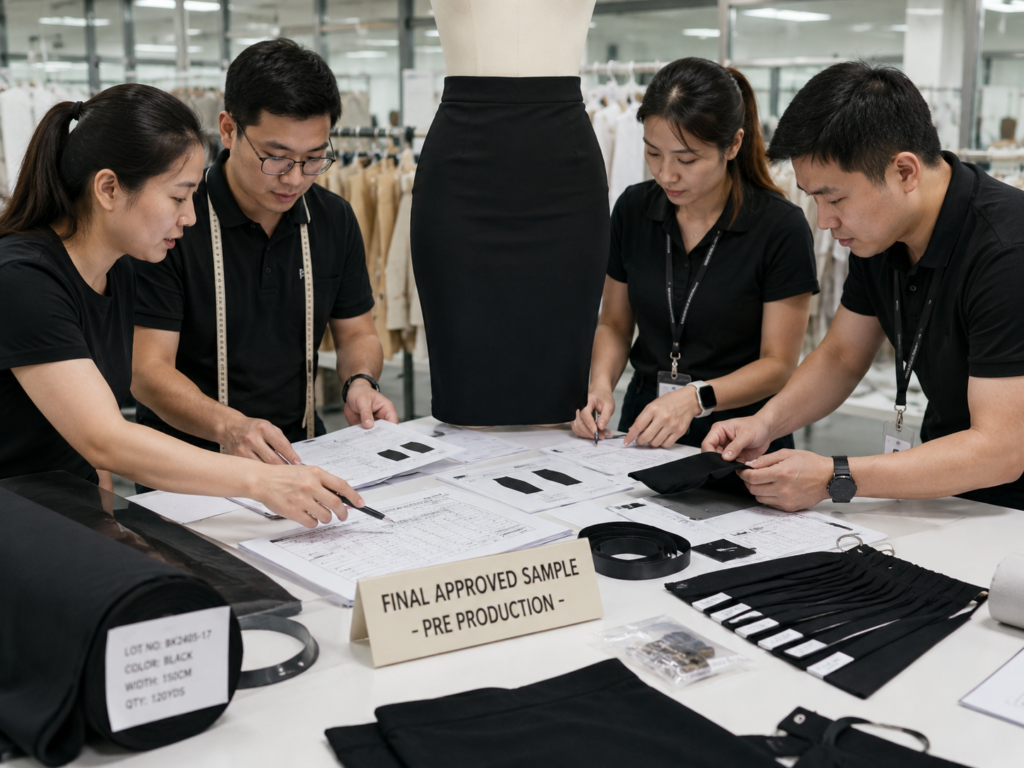
Mesh dresses are manufactured through fabric testing, pattern adjustment, controlled cutting, careful sewing tension, lining coordination, sample fitting, PP sample approval, and bulk quality inspection. Because mesh can stretch, shift, snag, and distort, the production process must control fabric direction, seam stability, transparency, measurements, and finishing from sample to bulk.
Fabric Review
Mesh dress manufacturing should begin with fabric review, not cutting. The development team needs to check composition, weight, stretch direction, recovery, transparency, color, hand feel, and surface stability. For embellished mesh, they also need to check sequin attachment, embroidery density, glitter shedding, and motif placement.
A reference photo is useful, but it is not enough. Two black mesh fabrics can look similar in a photo but behave completely differently in production. One may stretch well and recover. Another may grow after sewing. One may feel soft on skin. Another may scratch the underarm area.
The fabric review should also include lining compatibility. The mesh and lining should be placed together and checked under light. If the design is fitted, the two layers should be stretched together. If the mesh is an overlay, it should be draped over the base fabric. This early step reduces sample revisions and avoids expensive fabric changes after pattern work has started.
Pattern and Cutting
Mesh patterns need to reflect fabric behavior. For stretch mesh, the pattern may need negative ease, adjusted seam placement, or extra support in high-tension areas. For rigid mesh or tulle, the pattern may need enough allowance to avoid pulling. For sheer panels, seam placement must be visually clean because construction is more visible.
Cutting mesh requires more control than many solid fabrics. The fabric should lie flat without being stretched. Cutting layers should be limited when the mesh is very light or slippery. Stretch direction and grain direction should be marked clearly. For embroidered or printed mesh, placement should be checked before cutting to avoid awkward motifs on the bust, waist, or center front.
Production Stage | What to Check | Common Control Practice | Why It Matters |
Fabric inspection | Holes, snags, shade, stretch | Check bulk rolls before cutting | Prevents visible defects in sheer areas |
Stretch review | Width and length movement | Record direction before pattern finalization | Avoids fit and twisting issues |
Cutting | Layer stability | Use fewer layers for light or slippery mesh | Reduces panel distortion |
Sewing | Needle, stitch, tension | Test seam before bulk sewing | Prevents waves and skipped stitches |
Lining assembly | Layer match | Check stretch and length compatibility | Avoids pulling or bubbling |
Fitting | Bust, waist, hip, sleeve, length | Fit sample before PP approval | Confirms real body performance |
Bulk QC | Measurement and appearance | Inspect during sewing and final stage | Maintains consistency across sizes |
Sewing and Assembly
Sewing mesh requires controlled machine tension and careful operator handling. The fabric should be guided, not pulled. Pulling can stretch the seam and create waves. Fine mesh may need a smaller needle, while stretch mesh may require a needle suitable for knits. Embellished mesh may require slower sewing and surface protection.
Seam construction depends on the design. A visible sheer seam should be clean and narrow. A high-stress seam may need reinforcement. A neckline may need tape, binding, elastic, or clean lining. A side seam on stretch mesh may need enough elasticity to move with the body.
Mesh is often assembled with other fabrics, which makes sewing more complex. Joining mesh to satin, lining, jersey, lace, or sequins means the operator must control different fabric behaviors in one seam. If one layer feeds faster than the other, the seam may ripple or twist. Good sewing control is one of the most important differences between a nice sample and stable bulk production.
Sample Approval
Sample approval is critical for mesh dresses because many issues only appear on body. The sample should be checked on a mannequin or model, not just on a hanger. Bust coverage, waist fit, hip tension, sleeve comfort, neckline stability, and transparency should all be reviewed.
The brand should also check the dress under light. A mesh dress may look acceptable in office lighting but too sheer under studio lights or flash. If the style will be sold online, product photography conditions matter. The sample should also be tested through basic movement: sitting, walking, raising arms, and turning.
Before bulk production, the PP sample should confirm fabric, lining, color, stretch direction, measurements, seam finishing, label placement, packaging method, and final appearance. Once bulk mesh is cut, corrections become much harder. A clear approval process protects the collection schedule and reduces production risk.
What Quality Issues Happen with Mesh Dresses?
Common mesh dress quality issues include wavy seams, stretched necklines, holes, snags, skipped stitches, twisting sleeves, uneven transparency, lining mismatch, poor recovery, measurement instability, and inconsistent bulk appearance. Most problems come from wrong fabric choice, weak pattern adjustment, poor cutting control, excessive sewing tension, or insufficient inspection before bulk production.
Wavy Seams
Wavy seams are one of the most common mesh dress problems. They usually happen when the fabric is stretched during sewing or when machine tension is not suitable for the mesh type. Because mesh is open and flexible, it can easily grow along the seam if handled roughly.
Side seams, sleeve seams, necklines, hems, and waist seams are the most common areas for waves. In fitted dresses, the problem becomes more visible because the fabric sits close to the body. Pressing may hide the problem temporarily, but it does not solve the cause.
The control method depends on the fabric. The factory may need to adjust thread tension, reduce pulling, use suitable needles, change stitch type, stabilize the seam, or modify the pattern. In serious production, seam tests should happen before bulk sewing, especially for stretch mesh, soft mesh, and lightweight tulle.
Holes and Snags
Holes and snags happen easily because mesh has open spaces and fine yarns. The fabric can be damaged by rough cutting tables, broken needles, sharp trims, sequin edges, zipper teeth, packaging compression, or careless handling.
Fine mesh and tulle are especially sensitive. Embellished mesh can also create problems because sequins, beads, or glitter surfaces may rub against other panels. During sewing, the wrong needle can break yarns and create visible holes. During packing, too much compression can cause surface damage or permanent marks.
Factories should inspect mesh before cutting and again during sewing. Worktables should be clean. Needles should be changed regularly. Embellished mesh should be protected during storage and packing. For premium orders, tissue paper or individual garment bags may help reduce abrasion.
Quality Issue | Likely Cause | Where It Appears | Practical Prevention |
Wavy seams | Pulling, high tension, unstable stretch | Side seams, sleeves, neckline | Adjust tension, stabilize seams, train operators |
Holes | Wrong needle, rough handling | Fine mesh panels, seams | Use suitable needles, inspect panels |
Snags | Open structure, trims, sequins, rough surfaces | Outer panels and sleeves | Protect fabric during sewing and packing |
Neckline growth | Poor recovery, no support | Neckline, off-shoulder edges | Add tape, elastic, binding, or pattern control |
Twisting sleeves | Off-grain cutting or uneven feed | Sleeves and armholes | Mark stretch direction, control cutting |
Lining mismatch | Wrong color, stretch, or length | Bust, skirt, side seams | Approve mesh and lining together |
Measurement drift | Fabric stretch during cutting/sewing | Bust, waist, hip, length | Check during production, not only final QC |
Uneven transparency | Different fabric lots or lining shade | Sheer panels, front bodice | Inspect fabric rolls and light-test samples |
Neckline and Sleeve Problems
Necklines and sleeves often reveal mesh production quality. A neckline can stretch out if the mesh has poor recovery or if the edge is not stabilized. Off-shoulder, deep V, halter, and illusion necklines need extra care because they sit in high-visibility areas.
Sleeves are also high-risk because they move constantly. If the sleeve is cut in the wrong direction, it may twist. If the underarm seam is weak, it may tear. If the cuff is too tight, the wearer feels uncomfortable. If it is too loose, the sleeve looks poorly fitted.
Good control includes checking armhole shape, sleeve stretch, seam smoothness, cuff opening, and upper-arm comfort. Mesh sleeve fit should be tested with movement, not just standing still. A dress can look perfect in one front photo but fail when the model lifts her arms.
Bulk Consistency
Bulk consistency is difficult with mesh because small differences are easy to see. A slight difference in lining color, stretch direction, seam tension, or transparency can make pieces look inconsistent. This becomes more important when a brand produces multiple colors and sizes.
Larger sizes may place more tension on stretch mesh, so recovery and measurement control need attention. Light colors may reveal lining and seam issues more clearly. Embellished mesh may have placement differences if cutting is not controlled. Multi-batch production also needs fabric lot tracking to avoid shade or hand-feel variation.
The most effective approach is in-line inspection, not only final inspection. If measurement drift, seam waves, or lining issues are found early, they can still be corrected. Waiting until the final inspection may mean the same issue has already been repeated across the whole order.
How Should Brands Choose a Mesh Dress Manufacturer?
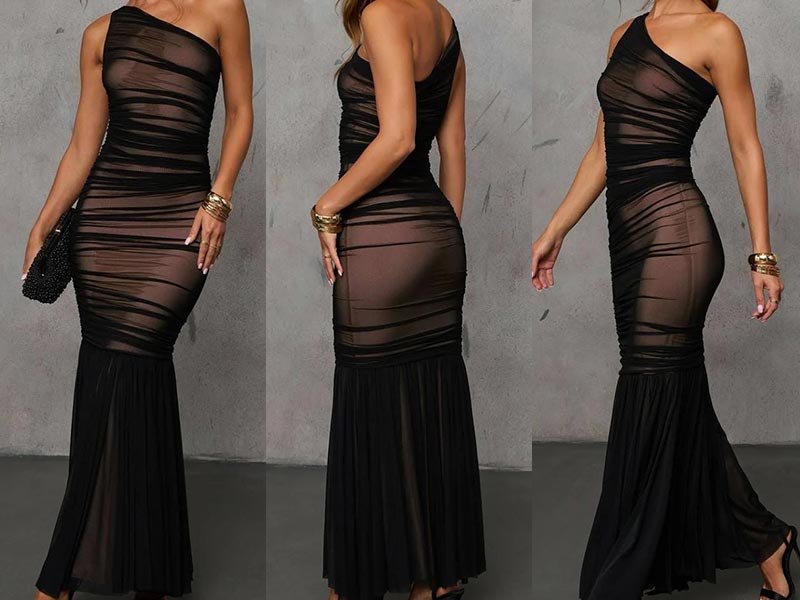
Brands should choose a mesh dress manufacturer by checking fabric knowledge, pattern ability, stretch recovery testing, lining control, sewing quality, sample fitting, bulk QC, OEM/ODM workflow, private-label support, and design protection. Mesh dresses require technical judgment, not just basic sewing capacity, because fabric behavior directly affects fit, comfort, transparency, and production consistency.
Technical Questions
A reliable mesh dress manufacturer should ask technical questions before quoting. If a factory gives a price immediately without discussing fabric type, lining, stretch, transparency, and construction, the quote may not reflect the real production risk.
Useful questions include: Is the dress fitted or loose? Does the mesh need stretch? Is the design fully lined or partially lined? Is the mesh decorative or supportive? What is the target market? Is there a tech pack, original sample, or only a reference photo? What size range and color plan will be produced?
These questions are not delays. They are signs that the manufacturer understands the product. A mesh dress that looks simple in a photo can become complex when it includes sheer panels, ruching, cut-outs, lining, cups, power mesh, or embellished surfaces. The better the early conversation, the fewer surprises during sampling.
Sampling Ability
Sampling ability is especially important for mesh dresses. The first sample should test the fabric, fit, transparency, seam construction, lining, and finishing method. It should not only copy the look of a reference image.
A strong sample room can identify problems early. If the mesh is too weak for a cut-out panel, they should flag it. If the lining is too rigid for stretch mesh, they should suggest alternatives. If the neckline may grow, they should recommend stabilization. If the fabric is too sheer, they should propose lining changes before bulk production.
Brands should also pay attention to sample review communication. A good manufacturer should be able to explain why a seam waves, why a lining pulls, or why a fabric substitution changes fit. Clear technical feedback is often more valuable than a fast but careless sample.
Bulk Control
Bulk control separates a professional mesh dress manufacturer from a basic sewing supplier. A sample may look good because it was handled by the most experienced workers. Bulk production requires the same standard across many pieces, sizes, and colors.
The manufacturer should control fabric inspection, cutting direction, sewing tension, lining assembly, measurement checks, and final appearance. For mesh dresses, in-line checks are very important. If seam waves or measurement drift appear early, the team can correct them before the full order is completed.
Brands should also ask how the manufacturer manages multi-style and multi-batch orders. Fast fashion collections often include several mesh styles at the same time: one bodycon dress, one sheer sleeve dress, one party mini, and one occasion dress. The factory must organize fabric, patterns, trims, labels, and QC so each style stays consistent.
Long-Term Fit
The best mesh dress manufacturer is not only able to make one style. It should help a brand build repeatable product standards. This includes keeping pattern records, fabric references, lining notes, trim details, measurement files, and packaging requirements for future orders.
For brands that release seasonal collections, this matters a lot. Once a mesh bodycon fit is approved, future styles can develop faster. Once a lining shade is confirmed, future illusion mesh styles become easier. Once a reliable seam method is tested, the risk of repeat production decreases.
A long-term manufacturer should also protect brand information. Mesh dresses often involve unpublished designs, tech packs, original samples, custom labels, and launch plans. NDA-based cooperation, sample protection, and controlled use of client materials are part of professional manufacturing.
Start a Mesh Dress Project
Jinfeng Apparel is a Guangdong-based custom women’s fashion manufacturer focused on dresses, skirts, jumpsuits, matching sets, and private-label womenswear for global fashion brands and mid-to-large custom apparel clients. The company supports OEM, ODM, private label production, dress development, fabric sourcing, sampling, bulk production, quality control, packaging, and export delivery.
For mesh dresses, party dresses, bodycon dresses, evening dresses, or seasonal women’s fashion collections, the most useful first step is to send reference photos, a tech pack, fabric preference, target quantity, size range, and launch schedule. This allows the development team to review fabric behavior, lining needs, construction risk, MOQ, sampling path, and bulk feasibility before production starts.
Share This Article :

Jerry Lee
Categories

Latest blogs

Table of Contents
Here, developing your OEM/ODM private label clothing collection is no longer a challenge—it’s an excellent opportunity to bring your creative vision to life.

