 Skip to content
Chiffon Dress Quality Control Checklist: What Should Brands Inspect from Fabric to Shipment?

Your trusted Women’s Apparel Manufacturer from China

Chiffon dresses look simple when they move well: the skirt falls cleanly, the lining stays where it should, the seams disappear into the silhouette, and the garment feels light rather than fragile. Reaching that result repeatedly in bulk production takes more control than the finished dress suggests. Chiffon is lightweight, often semi-transparent, easy to snag, sensitive to handling and frequently used in layered, gathered, ruffled or long-hem constructions. A small cutting shift, an uneven seam, or a lining that sits slightly too low can become much more visible than the same mistake on a heavier fabric.
A chiffon dress quality control checklist should cover approved samples and specifications, incoming shell fabric and lining, cutting accuracy, sewing construction, measurements, fit, finished appearance, pressing, labels, packaging and final inspection. Chiffon needs extra attention to transparency, snagging, panel movement, seam puckering, uneven hems, lining exposure, shade variation, print direction and transit creasing because small production errors can remain highly visible on a light, fluid garment.
The most useful way to think about chiffon QC is not as one final inspection but as a chain of control points. Final inspection can identify a defect, but it cannot economically undo hundreds of panels cut in the wrong direction or a whole sewing run built with the wrong lining length. Experienced production teams therefore try to catch each problem at the stage where it begins. A shipment that looks effortless at the end usually has a long trail of quiet decisions behind it, from fabric approval to the way the last dress is folded into its polybag.
What Should a Chiffon Dress QC Checklist Cover?
A practical chiffon dress QC checklist should connect the approved product standard with every production stage: material approval, cutting, sewing, in-line inspection, measurement, finished garment review, pressing, packing and final release. Each checkpoint should identify what is being inspected, which approved reference is used, and what action follows when the result falls outside the agreed requirement. That turns QC from a visual opinion into a repeatable production system.
Approved References
Inspection starts with a reference, not with memory. Before bulk production begins, the cutting room, sewing line, merchandising team and QC staff should all be working from the same approved version of the garment. The core references normally include the PP sample or sealed reference sample, final fabric and lining approval, BOM, size chart, measurement tolerance, sewing instructions, trim confirmation, label information and packing instructions. If those documents conflict, the safest action is to resolve the conflict before production moves forward rather than allowing each department to interpret the style independently.
Chiffon makes this discipline especially important because many quality expectations are visual and structural at the same time. Lining length, neckline depth, strap position, slit height, ruffle proportion, hem sweep, print direction and the amount of transparency may all influence whether a dress looks like the approved design. A reference sample communicates the target appearance, while written specifications make that appearance repeatable across sizes and production batches. The strongest checklist therefore asks three things at every control point: what is checked, what reference defines acceptance, and what corrective action is required if the result is not acceptable.
QC Gates
Quality control works best when production is divided into gates instead of relying on a single inspection at the end. Incoming QC keeps unacceptable fabric, lining, trims or labels away from the cutting room. Cutting QC verifies pattern version, fabric direction, panel accuracy and bundle identification before sewing. Sewing and in-line inspection catch construction problems while operators can still change their method. Finished garment QC confirms measurements, appearance, fit and function, while pressing and packing checks protect the presentation and order information before cartons are closed.
QC Stage | Main Reference | Typical Chiffon Risk | Release Decision |
Pre-production | PP sample, size chart, BOM | Wrong construction or lining standard | Approve before bulk starts |
Incoming material | Fabric and color approval | Shade, snags, holes, transparency | Accept, segregate or hold |
Cutting | Pattern and cutting instructions | Layer shift, wrong direction, print error | Correct before sewing |
Sewing / in-line | Sewing instruction, sealed sample | Puckering, twisting, lining error | Repair or adjust method |
Finished garment | Size chart, tolerance, sample | Hem imbalance, fit, visible defects | Pass or rework |
Packing | Packing and label instructions | Creasing, wrong SKU, wrong ratio | Correct before carton closure |
Final / AQL | Agreed quality standard | Shipment-level defect risk | Release, rework or hold |
The earlier a repeated problem is found, the smaller the affected quantity is likely to be. If seam puckering appears in the first few dozen finished units, the line can investigate machine tension, needle choice, handling or operation sequence. If the same problem is discovered only after several hundred dresses have been completed, the factory may face extensive rework with less consistent results. Early inspection is not only about catching more defects; it is about finding them while the process can still be changed efficiently.
Risk-Based Checks
A generic dress checklist is useful, but chiffon requires several additional controls because the material is light, fluid and often less forgiving of handling damage. Transparency must be judged together with lining coverage. Snags and pulled yarns can become highly visible under directional light. Long vertical seams need to hang smoothly, because even slight distortion can interrupt the drape. Printed chiffon may need one-way cutting or controlled placement, and long skirts may require extra attention after hanging because layered panels can settle differently after sewing and pressing.
Risk-based inspection means spending more attention where failure is both likely and commercially visible. A concealed zipper in a lined chiffon dress deserves more scrutiny than a decorative label hidden inside a seam because zipper stiffness can distort a light shell. A pale chiffon skirt deserves more transparency and stain checking than a dark fully lined sleeve. The objective is not to make the checklist longer for its own sake. The objective is to focus inspection time on the points most likely to affect fit, appearance, wearability, warehouse acceptance or customer perception.
Records for Repeat Orders
A checklist becomes more valuable when it produces usable records. For repeat orders, the factory should be able to refer back to approved fabric references, pattern versions, measurement files, construction notes, recurring defects, packing instructions and previous corrective actions. That reduces the risk that a successful first order has to be reinvented from memory when the style returns several months later or comes back in a new color.
This is also where quality control becomes a learning system instead of a defect-counting exercise. If one chiffon maxi dress repeatedly develops an uneven hem, simply instructing inspectors to “check the hem carefully” does not solve the root cause. The real issue may be cutting tension, panel direction, shell-lining interaction, sewing distortion, or insufficient settling before final hemming. Recording what caused the problem and what corrected it makes the next production run more stable and shortens the path from sample approval to repeat-order delivery.
How Do You Inspect Chiffon Fabric Before Cutting?
Inspect chiffon before cutting for shade consistency, holes, snags, pulled yarns, stains, weaving irregularities, usable width, transparency, drape, print direction and compatibility with the approved lining. Rolls should remain traceable by batch where shade differences are possible, and questionable material should be identified before cutting because fabric defects become far more expensive once defective panels have entered sewing and finishing.
Surface and Shade
Start with the defects that cannot be corrected after cutting. Chiffon should be examined under consistent lighting for stains, holes, pulled yarns, snag marks, weaving irregularities and obvious surface damage. Because the fabric is thin, defects that look minor on a folded roll may become much more obvious when the material is held against light or allowed to hang vertically. High-visibility areas such as front bodice panels and front skirts deserve particular attention because a small defect there can affect saleability even when the garment remains structurally sound.
Shade should be reviewed across rolls rather than only against one approved swatch. Two rolls may both appear close to the target color but still differ enough from one another to become obvious when large panels meet in the same dress. Maintaining roll or dye-lot traceability helps the cutting room avoid mixing visibly different shade groups. For light colors such as ivory, blush, cream or pale blue, the evaluation should also consider how multiple fabric layers change the visual depth, since the same shell color can look different when doubled at seams, gathers or layered skirt sections.
Transparency and Lining
Transparency is not simply a fabric property; on a finished dress it becomes a coverage decision. The same chiffon may be acceptable on a loose sleeve but unsuitable for an unlined skirt or fitted bodice. Inspection therefore needs to consider where the material is used and what the approved design is expected to cover. Pale colors tend to make the issue more obvious, but darker chiffon can also reveal underlayers under strong light, photography flash or tension around the body.
The lining should be evaluated together with the chiffon rather than treated as a separate material purchase. Its color, weight, hand feel, drape and length all influence the finished garment. A lining that is too stiff can remove the movement that made chiffon attractive in the first place, while a lining that is too light may not provide enough coverage. The relationship between shell and lining should be defined by the approved sample and size specification, especially at hems, slits, necklines, armholes and wrap openings where a small difference can become visible during movement.
Prints and Direction
Printed chiffon adds another layer of control before marker planning. The production team should establish whether the print is non-directional, one-way directional, position-sensitive, border-controlled or matched in selected areas. That decision affects both appearance and fabric consumption. A random micro-print may allow efficient marker placement, while a large one-way floral or border print may require more restrictive cutting to keep all panels visually consistent.
The risk is not limited to obvious upside-down motifs. A dominant flower placed at the center front on one size but disappearing under a seam on another can change the perceived balance of the style. Border prints can move too high or low if panel placement is not controlled, and ombré effects can look inconsistent when skirt panels are cut at different positions along the roll. These issues should be agreed before cutting because correcting them after sewing usually means replacing panels rather than simply adjusting workmanship.

Handling Before Cutting
Lightweight chiffon can move during spreading and cutting, and that movement can create a chain of later problems. Excess tension during spreading may cause panels to change dimension after they are released. Poorly controlled layers can slide relative to one another, so the top panel follows the marker while panels deeper in the stack drift gradually out of shape. The error may not become obvious until sewing, when operators have to stretch or ease mismatched edges together.
A short pilot cut can reveal whether the chosen spreading height and handling method are stable enough for the specific fabric. Representative panels from the top, middle and bottom of the stack can be compared with the pattern before the full quantity is released. The practical rule is simple: cutting fewer layers accurately is usually less expensive than cutting more layers quickly and spending the rest of production correcting seam distortion, measurement variation and uneven hems created by inaccurate panels.
Pre-Cut Check | What to Examine | Typical Hold Condition | Practical Record |
Roll identity | Color, batch, approved article | Unknown or mixed material | Roll / lot number |
Surface | Snags, holes, stains, yarn pulls | Repeated visible defects | Defect location |
Shade | Roll-to-roll visual consistency | Noticeable mismatch | Shade group |
Transparency | Shell alone and over lining | Coverage below approved sample | Shell-lining pair |
Direction and motif placement | Wrong orientation or border position | Marker instruction | |
Handling | Layer stability and panel shape | Panel shift after pilot cutting | Cut-panel check |
How Should Chiffon Be Checked During Cutting and Sewing?
During cutting and sewing, chiffon should be checked for correct pattern version, grain and print direction, panel accuracy, layer movement, seam allowance, stitch quality, puckering, seam distortion, zipper flatness, ruffle balance and lining attachment. Early in-line inspection is especially important because small construction errors can spread quickly across a production run if the sewing method is not corrected while the first units are still being made.
Cutting Accuracy
The first cutting control is pattern version. A cutting room can produce hundreds of panels accurately and still make the wrong garment if an outdated pattern is released. Each cutting order should identify the current pattern, style number, color, size range and quantity, and the team should confirm fabric direction before the marker is used. This sounds basic, but version control is one of the quiet differences between a stable production system and one that relies too heavily on verbal instruction.
Chiffon also needs representative cut-panel checks because layers can shift. Comparing panels from the top, middle and bottom of a stack can show whether slippage is occurring. Directional prints, asymmetrical skirts, shaped ruffles and layered panels need extra attention because a direction error may not prevent assembly but can still make the finished garment visually unacceptable. Clear bundle identification is equally important; many chiffon panels look similar once separated from the marker, and a mixed size or reversed panel can travel surprisingly far through sewing before someone notices.
Seam Quality
Chiffon seams have to be evaluated for both strength and appearance. A seam can be mechanically secure but still look poor if thread tension, stitch formation or operator handling produces visible puckering. Long side seams and center-back seams are especially revealing because even slight distortion becomes obvious when the dress hangs. Inspectors should check stitch consistency, skipped or broken stitches, seam allowance, loose thread ends, seam smoothness, needle damage and left-right symmetry rather than relying on one general “stitching OK” decision.
When the same defect appears repeatedly, repair should not be the first and only response. Recurring puckering may point to machine tension, needle selection, feeding, handling or operation sequence. Repeated stretching at a neckline may indicate that the sewing method is allowing the fabric to grow. Effective in-line QC therefore asks what the process is doing wrong, not only what the finished piece looks like. Correcting the cause early is much more reliable than trying to press or trim the symptom away later.
Zippers and Openings
Concealed zippers can be difficult on very light fabrics because the zipper tape is often firmer than the chiffon shell. If seam tension or construction balance is poor, the center-back or side seam may wave, bulge or stand away from the body. The zipper should lie flat, open and close smoothly, align at the top, and continue into a clean seam below. The lining should remain clear of the slider and should not be caught into the zipper tape in a way that restricts movement.
Other openings need the same practical testing. Hooks, loops, covered buttons, strap adjusters and ties should be checked physically rather than judged only by appearance. A strap adjuster that looks correctly attached but slips under light tension creates a fit problem once the garment is worn. A wrap tie positioned a little too high can change the balance of the neckline. Functional components are small compared with the full dress, but they often control how the garment sits on the body and how confidently the wearer can move.
Ruffles and Lining
Ruffles, gathers and layered details are common in chiffon because the fabric creates soft movement without excessive weight. Those same features, however, can become inconsistent in bulk production. A ruffle may have the correct cut length but still look wrong if the gathering is concentrated in one area. Inspectors should compare left and right sections, check distribution along seam lines, and review the height, angle and fall of layered details against the approved sample rather than looking only at numerical dimensions.
Lining should sit independently without dragging, twisting or pushing the shell out of shape. Check attachment points, side seams, waist seams, slit areas and the relationship between lining and outer hem. If the lining is secured too tightly, the chiffon may bubble or pull. If it is too loose, it may twist or become visible when the wearer moves. The aim is not merely to hide the lining; it should support coverage while allowing the outer fabric to retain the light, fluid behavior expected from the style.
Which Measurements and Fit Points Need Inspection?
Critical chiffon dress measurements usually include bust, waist, hip where applicable, dress length, strap length, neck drop, armhole, slit height, hem sweep and lining length. Measurements should follow the approved size chart and the same point-to-point method throughout production. Fit also needs visual review on a suitable form or wearer because a dress can meet flat measurements while still showing poor coverage, drape, balance or neckline stability.
Measurement Method
Measurement control works only when everyone uses the same method. The approved size chart should define the points of measurement, while the production team should place the garment consistently before measuring. Adjustable straps need a defined reference setting, elastic or gathered areas should not be stretched unless the method specifically requires it, and garments should not be pulled flat simply to make a dimension fall inside tolerance. Inconsistent measuring technique can create false failures just as easily as it can hide genuine variation.
Chiffon styles often combine fitted and fluid areas, so not every measurement carries the same visual risk. A small change in strap length or neck drop can alter coverage substantially, while a larger hem sweep measurement may have more room for variation without changing fit. The client’s approved tolerance remains the controlling specification. A factory should not invent a new tolerance during final inspection simply because the bulk result is inconvenient. Measurement decisions need to be locked before production, then applied consistently during in-line and finished garment checks.
Hem Balance
Hem balance deserves special attention on chiffon midi and maxi dresses because a flowing skirt makes horizontal irregularity easy to see. The garment should be allowed to hang naturally before the final judgment, particularly when long panels, layered skirts or bias-influenced sections are involved. Inspect front-to-back balance, left-to-right balance and the relationship between shell and lining. For high-low or deliberately asymmetrical styles, the reference is the approved shape rather than a perfectly level hem.
When several pieces show the same imbalance, trimming every dress is only a short-term correction. The production team should investigate whether the cause is panel distortion during cutting, inconsistent seam tension, incorrect fabric direction, shell-lining interaction or an operation that changes one side more than the other. A stable hem is the result of several earlier controls working together, which is why a hem problem can be a useful signal that the root cause sits upstream rather than at final finishing.
Bust and Coverage
Fit problems on chiffon dresses are often about coverage and stability rather than tightness. A loose dress can still fit poorly if the neckline falls open, the armhole exposes an undergarment, the strap position lowers the bodice, or the lining does not cover the same area as the shell during movement. Bust coverage, neck drop, armhole depth, strap length and back height therefore need to be judged as a connected group rather than as isolated measurements.
Movement matters. Wrap styles, deep V-necks, open backs, high slits and soft cowl constructions may look acceptable during a static standing fit but behave differently when the wearer walks, sits or raises the arms. A useful fit review includes normal movement so the team can see whether coverage changes in an unintended way. If the style is designed to be fluid or revealing, the objective is not to make it more conservative; it is to make the bulk garment behave consistently with the approved design.
Drape and Fit
Chiffon is chosen largely for movement, so measurement alone cannot confirm the product. Compare the finished garment with the approved sample from the front, side and back. Check whether the waistline sits at the intended level, whether gathers fall naturally, whether the skirt has the expected volume, whether the lining supports rather than restricts the shell, and whether the garment returns to a balanced position after normal movement.
A dress can meet every circumference measurement and still look wrong if the hem sweep has been reduced, the waist seam is visually misplaced or the lining is too stiff. The most useful question is therefore not only “Is the garment within tolerance?” but also “Does it still look and move like the approved product?” Combining numerical measurement with visual fit is especially important for chiffon because the material’s commercial value comes from how it behaves on the body, not just from the dimensions recorded on a table.
Measurement / Fit Point | What to Compare | Chiffon-Specific Risk | Check Stage |
Bust / waist / hip | Approved size chart | Pulling or unexpected looseness | In-line + finished |
Strap length | Approved setting | Neckline and armhole exposure | Sample + finished |
Neck drop | Approved measurement | Coverage changes | Sample + finished |
Dress length | Approved size spec | Inconsistent retail appearance | Finished garment |
Slit height | Approved position | Excessive or insufficient opening | In-line + finished |
Hem sweep | Approved silhouette | Loss of movement or volume | Finished garment |
Lining length | Shell-to-lining relation | Lining exposure | Finished garment |
Overall drape | Sealed reference sample | Twisting, pulling, restricted movement | Fit review |

What Defects Should Be Checked on Finished Chiffon Dresses?
Finished chiffon dresses should be checked for shade variation, stains, holes, snags, pulled yarns, loose threads, seam puckering, crooked stitching, asymmetry, zipper bulging, lining exposure, uneven hems, pressing marks and incorrect trims or labels. Inspect the whole garment first, then move into construction details and function. Repeated defects should trigger a production review rather than being treated as unrelated repairs on individual pieces.
Fabric and Appearance
Begin with the entire garment under consistent lighting. Chiffon can reveal defects differently when hanging than when lying flat, so both views are useful. Look for visible shade variation, stains, pulled yarns, snag marks, holes, excessive creasing, surface damage and panel distortion before becoming absorbed in small stitching details. The front bodice, front skirt and other high-visibility areas deserve the first attention because defects there affect the impression of the whole garment immediately.
Snags need careful review because the visible pull may distort a larger area around it. Pale shades often make stains and transparency more noticeable, while dark chiffon may show lint, pressure marks or surface shine differently. When several colors are produced, the inspection conditions should remain consistent so one color is not judged under stronger light than another. The purpose is not to create unrealistic perfection; it is to identify defects that change appearance, fit, function, saleability or the ability of the product to meet the agreed standard.
Construction
After the overall visual review, move closer to stitching and construction. Examine seams for puckering, twisting, skipped stitches, broken threads, unstable seam allowance and crooked stitching. Compare corresponding left and right areas such as straps, sleeves, ruffles, side seams and neckline edges. Long seams should hang smoothly, while curved edges should remain controlled rather than becoming stretched or wavy because the fabric was handled aggressively during sewing.
Construction defects often interact. A zipper that is too stiff for the shell can create bulging; that bulging may pull the lining; the lining tension can then affect the hem. Treating only the most visible symptom can leave the underlying problem in place. Common finished construction issues include uneven ruffles, misaligned layers, exposed lining, incorrect slit height, distorted necklines, twisted side seams and uneven hems. When the same issue appears repeatedly, the production team should trace it back to cutting, sewing method or material choice rather than relying only on final repair.
Function
Every functional component should be tested physically. Zippers should open and close smoothly without catching the shell or lining. Hooks and loops should align and remain secure. Buttons should be attached firmly. Adjustable strap hardware should move when intended but hold its position after adjustment. Ties, belts and wrap closures should be placed correctly and should support the intended fit without twisting or pulling the garment out of balance.
Movement can reveal problems that a table inspection misses. A slit may open farther than intended when walking, a wrap front may separate too easily, or a lining may shift into the zipper path when the garment is put on. These are still product defects even if the garment looks clean on a hanger. Functional checks are particularly useful on early finished units because they can reveal recurring construction problems while the line still has time to adjust attachment methods or operation sequence.
Pressing and Finish
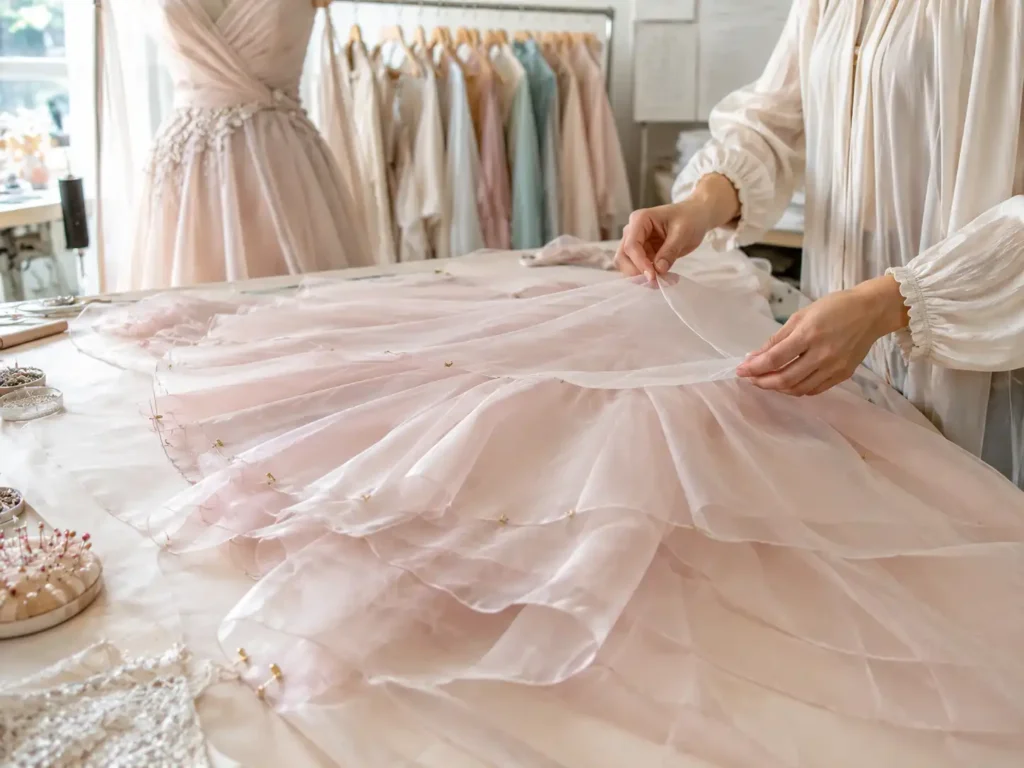
Pressing can improve a chiffon dress dramatically, but it can also create new defects if handled poorly. Inspect for unwanted shine, water marks, pressure marks, flattened ruffles, distorted seams and persistent creases. Printed, crinkled or specially finished chiffon may respond differently from a smooth lightweight polyester chiffon, so finishing methods should follow the approved material behavior rather than assume that all chiffon can be pressed in the same way.
The dress should be allowed to hang after final pressing before the overall drape and hem are judged. Freshly pressed lightweight fabric can temporarily hold shapes that relax later. Finishing also includes thread trimming, stain removal and final presentation. These operations may seem minor compared with sewing, but they strongly influence the first impression when the garment reaches a showroom, photography studio, retail floor or ecommerce customer. A structurally sound dress can still look poorly made if finishing and handling are rushed.
How Do You Approve Chiffon Dresses Before Shipment?
Chiffon dresses should be released only after measurements, workmanship, appearance, function, pressing, labels, barcodes, packaging and carton information are checked against the approved order standard. Where required, AQL or third-party inspection can provide a shipment-level sampling decision. AQL is not the same as 100% inspection, so defect classes, sampling method and acceptance criteria should be agreed before the final inspection begins.
Final Release
Final inspection should confirm that the production lot still matches the approved product after all operations are complete. Inspectors need access to the sealed sample, size specification, measurement tolerances, order details, label information and packing instructions. The final check should cover both garment quality and order accuracy because a shipment can contain well-made dresses and still fail operationally if the wrong size ratio, barcode, hangtag or carton mark reaches the warehouse.
A useful final release decision combines product inspection with process traceability. If several sampled dresses show the same seam distortion or shade mismatch, the question is not only how many defects were found. The team should consider whether the same condition could exist across the wider lot and whether additional sorting or reinspection is necessary. In Jinfeng Apparel’s documented production system, quality control is supported by 15+ QC inspectors, while 30+ finishing and packing staff handle trimming, pressing, labels, barcodes, folding and carton preparation. Those roles matter because final quality depends on both the garment and the condition in which it leaves the factory.
Defect Classification
Defects are commonly grouped into critical, major and minor categories, but the exact definitions should be agreed with the client or retailer because commercial impact varies by product and market. A critical defect generally relates to safety, legal requirements or essential use. A major defect may significantly affect appearance, fit, function or saleability. A minor defect is usually a smaller deviation that does not materially affect normal use but still falls outside the agreed workmanship standard.
Classification should be based on impact rather than how easy the defect is to repair. A wrong care label may be simple to replace at the factory but can be serious if it creates a compliance or warehouse problem. A small loose thread may take longer to trim across many garments but still remain minor if it does not affect function or appearance significantly. The key is consistency: the same defect should not be judged as major by one inspector and minor by another working on the same order without a clear reason.
AQL and Client Inspection
AQL sampling is often used for bulk apparel because checking every characteristic of every garment can be inefficient on larger production lots. The inspection plan links the lot, sample selection and allowable defect findings according to the client’s agreed standard. AQL should never be described as a 100% inspection; they are different methods with different purposes. A factory may perform in-process or piece-level checks during production and still use AQL sampling as an additional final shipment decision.
Client or third-party inspection can be useful for first orders, large programs, retailer-controlled orders, multi-batch shipments or projects where independent verification is required. The external inspector should receive the same approved sample, measurement specification, defect definitions and packing requirements used internally. Otherwise, disagreements can arise because the product is being judged against two different standards. A transparent manufacturer should be comfortable with clearly defined external inspection rather than treating it as a challenge to the factory’s own QC team.
Packing and Transit
Quality does not end when workmanship inspection is complete. Chiffon is especially vulnerable to creasing, compression and crushed decorative details during packing, so the folding method, polybag size and carton pressure should be checked before the packing configuration is approved. Long skirts should not be forced into unnecessarily small bags if the result is severe creasing, and ruffles or layered hems should be arranged so they are not trapped under heavy folds or hardware.
Labels and logistics information need equal attention. Main labels, size labels, care labels, hangtags, barcode stickers, SKU labels, polybags, size-color ratios and carton marks should match the confirmed order documents. Barcode readability should be checked where warehouse scanning is required. A well-made chiffon dress can still create a claim, receiving delay or poor unboxing experience if the final packing stage is treated as an administrative task rather than part of product quality. The product is only truly finished when it can survive the journey and arrive in the condition the brand approved.
Conclusion
A strong chiffon dress quality control checklist does more than help an inspector find defects at the end of production. It connects product development, material approval, cutting, sewing, fit, finishing and packing into one continuous system. Chiffon makes that discipline especially valuable because many of its most visible problems begin quietly: a shifted cutting layer becomes a twisted seam, a lining choice becomes a coverage problem, or a small handling mistake becomes a snag that catches the eye under retail lighting.
For brands developing chiffon collections, the most useful manufacturing conversations therefore happen before bulk production and continue throughout the order. Confirm the sample, fabric, lining, measurements, construction and packaging early; inspect the first production pieces while methods can still change; and use final inspection to verify a controlled process rather than discover one that was never controlled. When a manufacturer can explain not only what it checks but also when, against which reference, and how repeated problems are corrected, the quality system becomes much easier to trust and much easier to repeat across future styles and seasons.
Share This Article :

Jerry Lee
Categories

Latest blogs
Table of Contents
Here, developing your OEM/ODM private label clothing collection is no longer a challenge—it’s an excellent opportunity to bring your creative vision to life.

