Skip to content

A beautiful first sample can hide a weak production system. A low quotation can become expensive after fabric substitutions, repeated revisions, delayed launches, inconsistent sizing, rejected units, and emergency freight. Choosing a dress manufacturer is therefore not a simple price comparison. It is a risk-management decision that affects product quality, customer returns, launch timing, cash flow, and the reputation of the brand.
Choose a dress manufacturer by evaluating product specialization, pattern and fit capability, fabric knowledge, sampling discipline, production capacity, quality control, commercial transparency, compliance support, communication, and repeat-order reliability. The right partner should prove how it controls the complete route from tech pack and sample development to approved bulk production, private-label packing, inspection, and delivery.
Imagine approving a fitted satin dress that looks perfect on the sample model. Six weeks later, bulk production arrives with different waist stretch between colors, rippled concealed zippers, and linings visible below the hem. The supplier technically made the dress, but it did not control the product. The most useful factory questions are designed to expose that difference before fabric is cut, deposits are committed, and the launch calendar becomes difficult to recover.
What Does Your Brand Need?
Choose a manufacturer only after defining your dress categories, target market, quality level, order structure, development support, and delivery deadline. A clear manufacturing brief allows factories to quote the same product, exposes capability gaps early, and prevents expensive assumptions about fabric, fit, construction, packaging, and production volume.
Product Scope and Market
“Women’s dresses” is too broad for a useful factory assessment. A fitted jersey mini dress, a lined chiffon maxi dress, and a structured satin corset dress may be sold by the same brand, but they require different pattern knowledge, operators, finishing methods, and quality controls. Define the collection by both commercial category and technical construction.
Record the intended silhouettes, lengths, fabrics, linings, closures, support structures, decorative details, and wearing occasions. Then identify the target country, retail channel, customer profile, expected selling price, and return-risk sensitivity. A premium online occasionwear brand may prioritize photographic appearance, precise fit, smooth concealed zippers, clean lining, and crease-resistant packing. A large retail program may place greater emphasis on standardized measurements, testing documents, carton ratios, and reliable multi-batch delivery.
Market requirements also affect size ranges, grading rules, bust-to-waist proportions, coverage expectations, care-label language, fiber-content disclosure, barcode formats, packaging presentation, and acceptable workmanship. These details should be discussed before the factory quotes, because the same outward design can carry very different production requirements depending on where and how it will be sold.
| Requirement Area | Information to Record | Manufacturing Impact |
| Product range | Mini, midi, maxi, bodycon, corset, party, resort, evening | Determines factory specialization and construction skills |
| Target market | Country, channel, customer profile, retail price | Affects sizing, labels, quality, testing, and packaging |
| Materials | Composition, weight, stretch, color, lining, trims | Influences pattern, MOQ, cost, lead time, and sewing method |
| Size range | Base size, full range, grading rules, size ratio | Determines pattern work, fit approval, labels, and cutting |
| Order plan | Styles, colors, units, repeat potential, delivery batches | Affects line planning, fabric purchasing, and price |
| Launch date | Warehouse date, campaign date, retail release | Determines approval deadlines and production milestones |
Order Structure
Factories plan around styles, colors, sizes, operations, and delivery batches – not simply the total number of garments. An order of 3,000 units across one style and two colors is usually easier to manage than 3,000 units divided among fifteen styles, six fabrics, several linings, and many trim combinations. Both orders have the same total quantity, but the second creates far more development and production events.
Prepare an estimated order matrix before requesting prices. Show the number of styles, quantity by style and color, full size range, expected size ratio, shared fabrics, shared trims, delivery batches, and likely replenishment. Color and size fragmentation matters because the garment quantity may satisfy the sewing factory while failing the minimum required by a dye house, printer, lace mill, zipper supplier, or packaging printer.
Tell the manufacturer whether the project is a first-season development program, a repeat order, a replenishment run, or a seasonal collection. A new collection requires more technical review, sampling, material approval, and communication. A repeat order should benefit from approved patterns, retained material references, established measurement tolerances, known packaging instructions, and historical quality findings.
Service Model
The right service model depends on how complete the brand’s product information is. OEM manufacturing works best when the client provides a finished tech pack, size chart, construction details, fabric specifications, artwork, labels, and packaging instructions. The factory reviews manufacturability, develops the sample, and reproduces the approved standard in bulk.
ODM support is more suitable when the brand has a clear design direction but still needs help turning sketches, reference images, mood boards, line sheets, or original garments into production-ready products. Useful ODM work includes fabric recommendations, construction analysis, pattern development, trim options, and cost balancing. It should involve technical judgment, not merely selecting a similar-looking stock fabric.
Private-label production focuses on delivering the finished garment under the client’s brand identity. It may include main labels, size and care labels, hangtags, barcode and SKU stickers, polybags, cards, carton marks, warehouse labels, and packing lists. Clarify which party supplies the artwork, approves proofs, pays tooling charges, and controls unused branded materials after the order.
Launch Calendar
Build the calendar backward from the date the goods must reach the warehouse or distribution center. Include product review, initial costing, fabric sourcing, first sample, fitting, revisions, color approval, trim approval, pre-production approval, bulk material purchasing, cutting, sewing, finishing, inspection, packing, and transportation.
Separate development time, material-development time, sample-revision time, bulk-production time, inspection time, and freight time. Custom dyeing, printing, lace, logo hardware, molded cups, specialty zippers, certified materials, and custom packaging may follow separate schedules. A statement such as “production takes four weeks” is incomplete unless the starting event and all material assumptions are defined.
The brand’s approval dates belong on the same schedule as the factory’s milestones. Late fit comments, color decisions, label files, deposits, or packing instructions can shift the critical path. A reliable manufacturer does not protect a launch by making the shortest promise. It protects the launch by documenting dependencies, setting decision deadlines, and updating the plan when a critical input changes.

Which Dress Expertise Matters?
Relevant dress expertise means the manufacturer has proven experience with your silhouettes, fabrics, fit requirements, internal structures, and finishing standards. A factory that performs well with simple woven dresses may not be equipped for stretch bodycon styles, corset construction, delicate satin, positioned lace, or embellished occasionwear.
Product Specialization
Do not judge specialization by the number of dress photographs on a website. Look for technically comparable garments. For each key style, ask whether the factory has produced products with similar fabric behavior, fit profile, lining structure, closure method, bust support, surface decoration, seam construction, hem length, stretch level, and finishing standard.
A supplier experienced with relaxed rayon resort dresses may understand lightweight fabric handling and print placement but lack the skills needed for a fitted corset dress. A knit factory may control stretch and body fit very well but struggle with chiffon layers, lace placement, or smooth satin zippers. Product categories that appear similar in marketing can require very different production systems.
Ask the supplier to identify the highest-risk operations in one of your designs. Experienced teams often notice potential problems in the neckline, lining, closure, drape point, cup position, mesh tension, or hem before making the first sample. A factory that agrees with every instruction without technical discussion may be avoiding difficult questions rather than demonstrating capability.
| Dress Type | Main Technical Risks | Evidence to Request |
| Bodycon dress | Stretch recovery, seam waviness, negative ease, size variation | Comparable fitted samples and measurement reports |
| Corset dress | Cup position, boning, support, lining, top-edge stability | Internal construction samples and fitting records |
| Satin dress | Needle marks, seam puckering, zipper rippling, pressing damage | Bulk satin workmanship and pressing controls |
| Chiffon maxi | Layer balance, transparency, hem level, seam slippage | Long-dress samples and fabric-handling methods |
| Lace dress | Motif matching, seam visibility, edge finishing, lining placement | Lace-placement examples and cutting instructions |
| Sequin dress | Surface damage, missing sequins, seam comfort, needle breakage | Sequin samples and inspection methods |
| Resort dress | Print direction, shrinkage, lightweight seams, opacity | Printed woven samples and approval records |
| Evening dress | Bust support, drape, slit height, lining, packing | Occasionwear samples and final-inspection evidence |
Fabric Handling
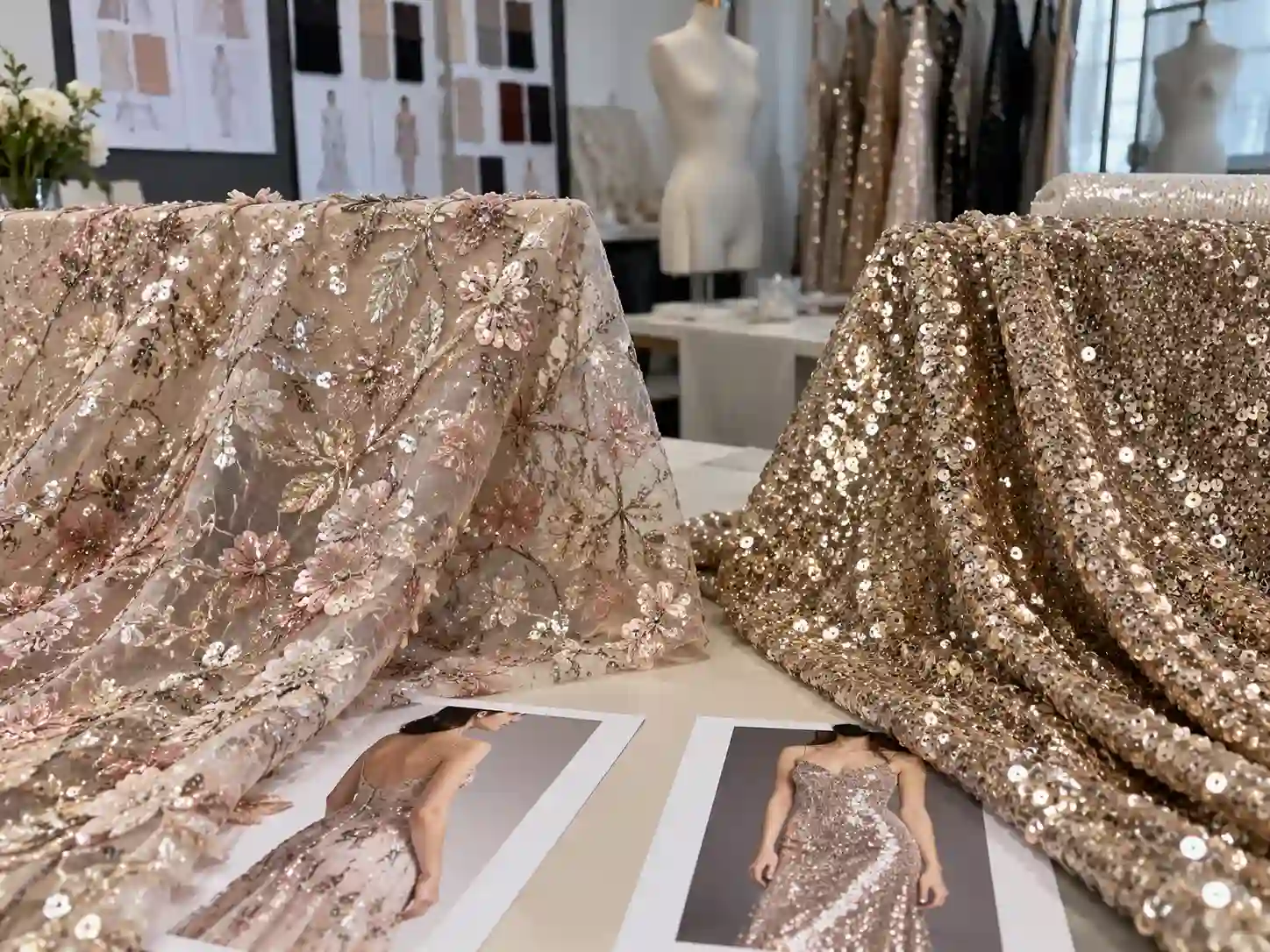
Fabric selection influences fit, cost, appearance, production stability, and customer satisfaction. Small differences in weight, stretch, recovery, surface finish, and drape can materially change the finished garment. For every proposed fabric, review the fiber composition, construction, usable width, weight, stretch percentage and direction, recovery, shrinkage, opacity, hand feel, drape, surface sensitivity, care method, supplier MOQ, and reorder availability.
Stretch fabrics require special attention. Two fabrics can contain the same percentage of elastane but behave differently because of yarn type, knitting structure, finishing, and weight. One may recover after wear; another may grow at the waist, neckline, or hip. Satin can show needle marks, puckering, pressing shine, or zipper distortion. Chiffon can shift during cutting and produce uneven hems. Lace may require motif matching. Mesh can distort when stretch direction is ignored.
When a material is substituted, compare more than color. Recheck fit, consumption, sewing behavior, lining compatibility, price, MOQ, and lead time. A replacement swatch may look close to the approved fabric but perform differently as a full garment. For fitted, draped, bias-cut, or structured dresses, a material change may justify a revised sample rather than a simple email approval.
Pattern and Fit
Pattern capability is one of the clearest differences between a development partner and a basic sewing supplier. A strong pattern team understands how fabric behavior, body proportions, construction, and styling interact. It should interpret the intended silhouette rather than simply place the measurement chart onto a pattern.
Important fit points include bust level and shaping, waist position, hip ease or compression, shoulder balance, armhole depth, neckline stability, strap length, cup position, torso length, side-seam direction, slit placement, lining dimensions, and hem balance. These points must be reviewed on the intended body profile and during movement, not only in a front-facing photograph.
Ask how the team handles grading. A design that fits the base size does not automatically grade well across the full range. Cups, straps, neckline depth, armholes, torso length, and skirt length may need controlled rules rather than simple proportional enlargement. The final tolerance should also reflect the fabric and construction; small points such as straps or cup positions normally need tighter control than flexible areas or long hems.
Complex Construction
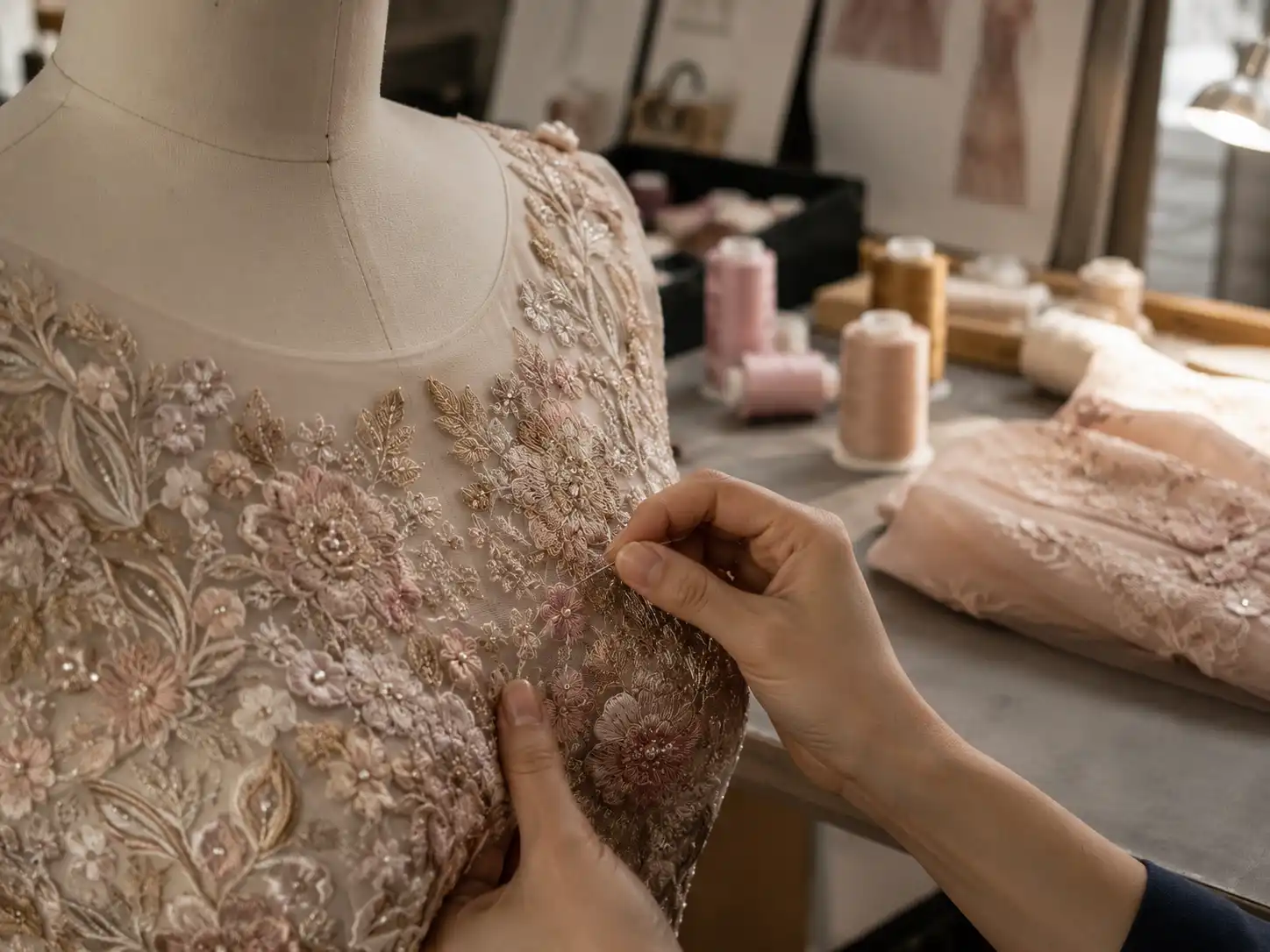
Complex dresses require control of visible details and hidden structures. A strapless style may need cups, boning, anti-slip tape, shaped panels, stable lining, and a secure top edge. A ruched mesh dress requires controlled gathering, consistent tension, lining balance, and accurate placement. A lace dress may require motif matching. A floor-length satin gown needs balanced drape, smooth closures, even hems, careful pressing, and protective packing.
During development, ask which operations require specialist machinists, which areas are likely to distort, which details may vary in bulk, which materials have longer lead times, and which checkpoints need special inspection. Complexity also affects real capacity. A line that produces thousands of simple dresses may complete far fewer structured or embellished garments in the same period.
The best technical recommendations preserve the design while reducing avoidable risk. Moving a seam, changing an internal lining, adjusting boning placement, selecting a more stable fabric, or simplifying an invisible operation can improve comfort and consistency without changing what the customer sees. A useful supplier explains the commercial effect of each option instead of presenting one unexplained solution.
How Should You Test Sampling?
Sampling should test the manufacturer’s technical thinking, fit control, material handling, documentation, and ability to reproduce an approved product. The goal is not merely an attractive prototype. It is a measurable production standard that can guide cutting, sewing, inspection, packing, and future repeat orders.
Sample Stages
Each sample should have a clear purpose. Repeated samples without defined approval objectives create cost, delay, and confusing version histories. The first development sample tests how the factory has translated the design. A fit sample concentrates on body balance, comfort, and measurements. A revised sample confirms agreed corrections. A size-set sample checks grading. A pre-production sample confirms the actual bulk standard, and a golden sample becomes the sealed reference for production and inspection.
Not every order needs every stage. A repeat order using unchanged materials may need fewer development samples than a new corset dress made with custom lace, molded cups, and a color-matched satin lining. The sample plan should reflect product risk rather than a fixed checklist applied to every style.
The pre-production sample must represent the intended bulk materials and construction. Temporary fabric, substitute trims, missing labels, or incomplete packaging should be recorded clearly. When a major material or structural detail changes after approval, decide whether another sample or focused production test is needed. The golden sample should be dated, identified, and available to production supervisors and QC staff – not stored only as a showroom garment.
| Sample Stage | Main Purpose | Approval Evidence |
| Development sample | Translate the design into the first physical garment | Construction review, measurements, fabric assessment |
| Fit sample | Correct balance, shape, comfort, and body proportions | Fit comments, photos, measurement report |
| Revised sample | Confirm agreed corrections | Updated pattern, tech pack, and change log |
| Size-set sample | Check grading across selected sizes | Measurements and fit review by size |
| Photo sample | Support campaign or ecommerce photography | Visual approval and presentation quality |
| Pre-production sample | Confirm final bulk materials and construction | Signed approval before cutting |
| Golden sample | Provide the sealed production and QC reference | Identified, dated, retained reference garment |
Fit Review
A useful fit review combines measurements, photographs, movement testing, and written comments. Measure according to agreed points of measurement rather than whichever points are convenient. Record the required specification, actual sample measurement, difference, and requested action.
Fit comments need to be specific. “Make the waist smaller” can be interpreted in several ways. “Reduce the finished waist circumference by 2 cm in the base size while maintaining the approved hip measurement” is measurable and easier to execute. Review the garment from the front, back, and both sides. Check garment balance, bust support, waist placement, hip fit, side-seam alignment, closure behavior, strap stability, lining movement, slit coverage, hem level, and comfort during movement.
For stretch dresses, allow the fabric to relax before measuring. For long dresses, check hem balance on a level surface and with the intended heel height. For strapless and corset designs, test whether the garment remains secure while the wearer sits, walks, turns, and raises her arms. The fit model should be reasonably aligned with the brand’s base-size measurements and body proportions, or corrections may address the wrong body.

Material Approval
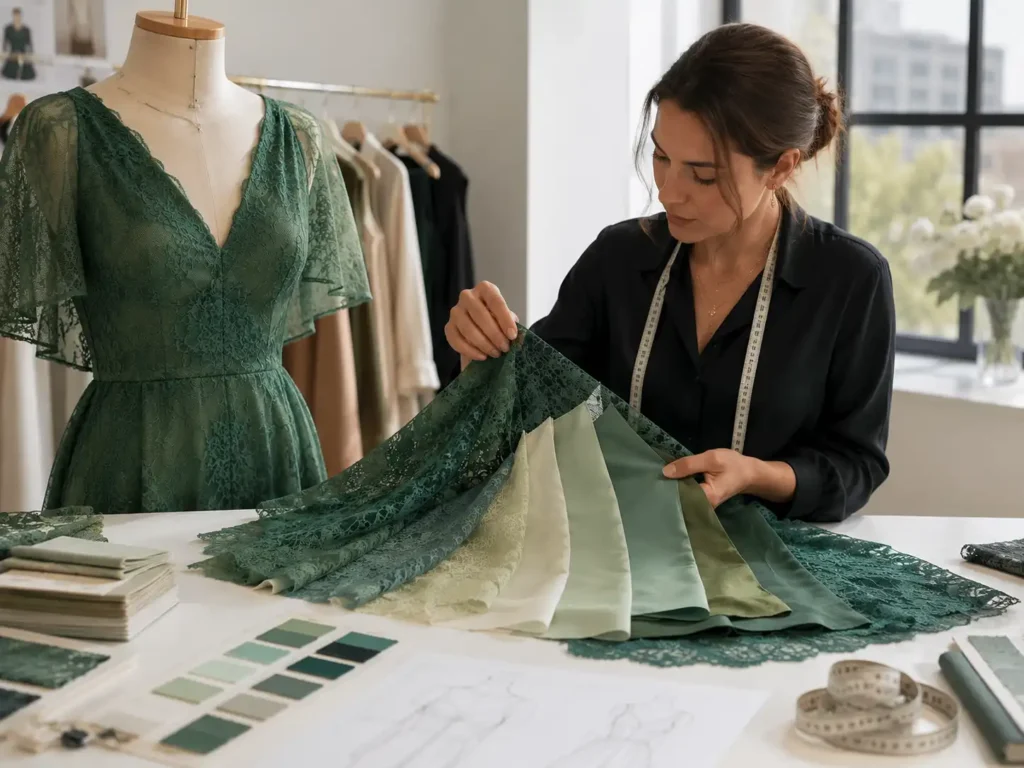
Approving the silhouette without approving the materials leaves the most important production variables unresolved. A complete material approval identifies the supplier, reference number, composition, weight, usable width, color, stretch, hand feel, surface appearance, and intended use. Keep a physical swatch or trim card whenever possible.
Review the main fabric, lining, zippers, hooks, elastic, boning, underwire, cups, buttons, lace, mesh, sequins, labels, hangtags, polybags, and cartons. Color approval needs special care because screens do not show shade, texture, stiffness, or surface quality reliably. Lab dips, strike-offs, printed panels, or physical swatches should be reviewed under appropriate lighting.
Confirm availability as well as appearance. A fabric may be approved but unavailable in the required quantity, color, or delivery window. Ask whether it is stock, custom-produced, reserved, or subject to a supplier minimum. When testing matters, agree on shrinkage, colorfastness, pilling, seam slippage, stretch recovery, or surface durability before bulk production, because results may affect pattern dimensions, care instructions, and the final commercial decision.
Revision Control
Sample revisions should create a clear engineering-style record of what changed and why. A practical change log identifies the style number, sample version, date, original specification, actual result, required correction, photo or drawing, pattern action, material action, cost impact, timing impact, and approval status.
Update the tech pack after each approved change. Do not allow the physical sample, pattern, measurement chart, bill of materials, sewing instructions, and packaging files to describe different versions of the product. Critical decisions should not remain buried in chat messages. The pattern maker, sample machinist, merchandiser, cutting team, production supervisor, and inspector must all be able to find the same confirmed information.
Version names should be unambiguous. “Latest sample” is not a reliable identifier; use V1, V2, Fit Sample 2, or Pre-Production Sample with an approval date. Before cutting starts, verify that the final pattern, size chart, grading, fabric, trims, construction, artwork, labels, packaging, and QC requirements match the approved garment. This final document check prevents an old comment, temporary material, or outdated pattern from entering bulk production.
How Do You Verify Production and Quality?
Verify how the manufacturer controls development, material approval, cutting, sewing, inspection, finishing, packing, and shipment. Factory size alone does not guarantee reliable production. The critical issue is whether the supplier can assign the right production unit, identify variation early, document corrective action, and reproduce the approved standard across the complete order.
Factory Structure
Ask which activities are performed by owned facilities, long-term production partners, and specialist subcontractors. External work is common in apparel manufacturing, particularly for printing, pleating, embroidery, washing, beading, or temporary capacity support. The risk is not outsourcing itself. The risk is unclear ownership, uncontrolled transfers, inconsistent files, and weak final responsibility.
Confirm where patterns are made, where samples are sewn, who purchases and approves materials, where bulk cutting occurs, which facility sews each style, who issues technical files, who performs in-line inspection, where finishing and packing take place, and who approves shipment. When several factories are involved, each production unit should work from the same approved sample, pattern version, size chart, bill of materials, sewing instructions, and QC checklist.
Jinfeng Apparel uses a network of six owned women’s fashion factories and more than ten long-term satellite production partners in mature apparel manufacturing regions. Orders can be allocated by dress category, fabric behavior, construction difficulty, quantity, and delivery schedule, while central project management controls technical files, key checkpoints, quality standards, private-label packing, and export coordination. The practical evaluation question remains the same for any supplier: who owns the final result when more than one facility is involved?
Capacity and Allocation
Capacity must be matched to the garment, not just the total quantity. A line suitable for jersey bodycon dresses may not have the operators or handling methods required for delicate satin, structured corsets, or embellished eveningwear. A factory experienced with simple woven dresses may become slow and inconsistent when several styles require lace placement, cups, boning, ruching, or handwork.
Discuss the number of styles running in parallel, available sample-room resources, relevant sewing-line availability, specialist operator capacity, expected output by style, peak-season workload, material arrival dates, inspection resources, finishing capacity, and replenishment capacity. Ask how the supplier decides where each style will be produced and whether a production location can change after approval.
For multi-style collections, every style needs its own production order, approved sample, pattern version, bill of materials, size chart, sewing instructions, QC checklist, and packing information. Do not rely on a large annual capacity figure without context. A manufacturer may have substantial total output but limited suitable capacity during the month your order must be completed, especially when the products require specialist workmanship.
Quality Control
Quality control begins before sewing. Final inspection cannot efficiently repair fabric defects, incorrect patterns, inaccurate cutting, or a repeated construction error found after thousands of units are complete. Incoming materials should be checked for shade, defects, width, weight, shrinkage, stretch, and trim accuracy. Different dye lots should be separated where visible variation could appear in the finished garment.
Cutting control should verify the pattern version, grain or stretch direction, print placement, nap direction, size quantities, and marker plan. The first cut should be reviewed before full cutting continues. During sewing, inspect first-off garments and high-risk operations such as zippers, cups, boning, straps, ruching, lace placement, lining, and hems. Finished-garment inspection should cover measurements, appearance, closures, labels, pressing, stains, damage, and packing accuracy.
Many commercial apparel programs use AQL-based final inspection, often with separate limits for critical, major, and minor defects. AQL 2.5 for major defects and 4.0 for minor defects are common reference points, but they are not universal requirements. The buyer and manufacturer should agree on the sampling plan, defect definitions, acceptance limits, and any zero-tolerance issues before production. Inspection is only useful when recurring defects trigger process correction rather than simple counting.
Bulk Consistency
Bulk consistency depends on controlled references. Before cutting, the production team should have an approved pre-production sample, sealed golden sample, final pattern, confirmed grading, measurement tolerances, approved fabrics and colors, approved trims, final bill of materials, sewing instructions, label files, packing instructions, and QC checklist.
Inspect early production rather than waiting until the order is complete. First-off and pilot units can expose pattern issues, operator misunderstandings, incorrect attachments, or measurement drift while correction is still practical. This is especially valuable for satin, sequins, stretch mesh, lace placement, corset structures, custom printing, and styles with several internal components.
Measurements should be monitored through production because fabric relaxation, pressing, operator handling, and repeated sewing operations can change dimensions. Track the most important fit points, not only total length. Bulk comparison should also include color, stretch, lining, internal construction, labels, pressing, folding, polybags, barcodes, and carton ratios. The customer receives a complete packed product, not only a garment displayed on a hanger.
What Terms Should You Compare?
Compare the complete commercial offer, including material assumptions, construction, MOQ, sampling costs, payment milestones, lead times, inspections, packaging, shipping responsibilities, and design protection. A low unit price can become expensive when essential fabrics, trims, testing, quality control, packaging, or delivery services are excluded.
Quotation Scope
A useful quotation clearly explains what product has been priced. Confirm whether it includes the main fabric, lining, zippers, buttons, hooks, cups, boning, elastic, decorative trims, pattern work, cutting, sewing, printing, embroidery, pleating, washing, labels, hangtags, barcodes, polybags, cartons, inspection, testing, export preparation, and freight responsibilities.
The quoted fabric should identify the quality or supplier reference, composition, weight or construction, color method, and sourcing assumption. “Satin included” is not precise enough because satin varies greatly in weight, width, surface, drape, opacity, and sewing behavior. Compare quotations only after confirming that they describe the same garment and service scope.
Ask how price changes when quantity, color count, size ratio, material, trims, construction, packaging, inspection, or delivery method changes. Professional cost optimization protects the intended customer value. Options may include sharing fabric across styles, selecting an available color, simplifying hidden construction, replacing a costly trim, improving marker efficiency, consolidating packaging, or adjusting the delivery plan. Unexplained price reduction often means the product specification has changed somewhere.
MOQ Logic
MOQ can come from several parts of the supply chain. The garment factory may accept a production quantity while the fabric mill, dye house, printer, lace supplier, zipper supplier, label maker, or packaging printer requires a different minimum. Clarify whether MOQ applies by style, color, fabric, dye lot, print, lace design, trim, label, packaging format, or total order.
A collection can sometimes reduce fragmentation by sharing fabric, lining, zippers, labels, or trims across several styles. Color consolidation can also make purchasing easier and reduce leftover materials. When the required material quantity is higher than the garments consume, discuss whether to increase the order, share the material across styles, purchase excess for future reorders, select stock fabric, or choose an existing supplier color.
Jinfeng Apparel’s standard MOQ starts from 200 pieces per style and color, depending on fabric availability, color development, trims, construction complexity, packaging, and production schedule. Custom weaving, dyeing, printing, special lace, sequins, hardware, certified materials, or custom packaging may require higher material commitments. MOQ should be confirmed before extensive sample work so a technically successful design remains commercially viable.
Lead Time and Payment
Break the schedule into phases rather than accepting one production estimate. A realistic project can include requirement review, material sourcing, costing, pattern development, first sample, fit comments, revised sample, color approval, pre-production approval, bulk material purchasing, production, inspection, packing, export preparation, and transport. Custom materials and testing may run on separate timelines.
Ask when the production clock starts. It may begin after the deposit, after the pre-production sample is approved, after all materials are available, or after labels and packaging files are complete. The trigger should be written into the order schedule. Payment terms should also state the sample fee, courier fee, deposit, material commitments, balance condition, inspection milestone, revision charges, cancellation terms, currency, bank fees, and approved beneficiary account.
The proforma invoice should match the style numbers, quantities, prices, Incoterm, delivery window, payment schedule, and company bank details. Changes to bank details should be independently verified. Payment terms cannot remove production risk, but clear milestones can ensure that both sides know what must be approved, purchased, inspected, and delivered before the next payment becomes due.
Packaging, Shipping, and IP
Packaging errors can delay warehouse receiving even when garment quality is acceptable. Confirm the main label, size label, care label, country-of-origin information, hangtag, barcode, SKU sticker, polybag, warning label, tissue, folding method, carton ratio, carton mark, packing list, and warehouse label. Run a packing pilot before the full order is packed so barcodes, size-color combinations, garment protection, and carton quantities can be verified.
Shipping responsibilities should be defined through the agreed Incoterm. Clarify who handles export clearance, freight booking, insurance, destination charges, duties, customs support, and final delivery. Delivery promises should identify whether the date refers to ex-factory completion, port departure, port arrival, or warehouse receipt.
Design protection should cover tech packs, original samples, patterns, artwork, custom materials, unreleased designs, labels, packaging, prices, quantities, and launch dates. An NDA provides a legal framework, but daily file control also matters. Clarify who can access the project, how samples are stored, whether product photographs may be used, who owns paid patterns or tooling, and what happens to unused branded materials after production. Jinfeng Apparel supports NDA-based cooperation and protection of unpublished client designs and private-label information.
How Do You Make the Final Choice?
Choose the manufacturer with the strongest overall ability to deliver the required product repeatedly, not the supplier with the lowest quotation or most polished presentation. Compare technical expertise, sample quality, quality systems, capacity, communication, commercial transparency, compliance support, and long-term production value through a documented decision process.
Questions and Communication
The questions a supplier asks often reveal more than its sales presentation. Before giving a reliable quotation, the team should clarify the product category, fabric, lining, construction, size range, measurements, quantity, colors, target market, labels, packaging, testing, launch date, and shipping destination. Immediate pricing from one reference image may indicate that the factory is filling gaps with assumptions.
Good communication is not simply fast communication. Look for organized, complete, and technically accurate responses. The team should separate confirmed facts from estimates, identify missing information, use style and sample references, record decisions, explain cost and timing consequences, and report emerging risks before they become delays.
Send several shortlisted manufacturers the same structured request and compare how each one handles it. Notice whether they answer every question, identify technical risks, and propose a practical next step. A capable supplier may challenge part of a design or timeline. That is often a positive sign: the team is considering fit, material behavior, cost, and bulk production rather than agreeing automatically.
Evidence and Red Flags
Ask for evidence related to the actual product. Useful evidence includes comparable dress samples, fabric approval records, measurement reports, revision logs, pre-production approvals, golden-sample procedures, in-line inspection records, final inspection reports, packing checklists, test reports, audit documents, anonymous production cases, and repeat-order records.
A factory certificate does not prove satin workmanship. An attractive showroom does not prove measurement consistency. Product-specific evidence is more valuable than broad statements such as “high quality” or “fast delivery.” Red flags include unusually low prices, no questions about construction, pressure to skip samples, unclear production locations, frequent contact changes, undocumented revisions, unapproved material substitutions, no in-line inspection, unrealistic schedules, vague defect responsibility, and payment requests to unrelated accounts.
Low price is not automatically a problem; the unexplained difference is the problem. It may result from a lighter fabric, simpler lining, cheaper closures, fewer sewing operations, less inspection, different packaging, or an incomplete quotation. The brand should be able to identify why one offer is lower and decide whether the trade-off is commercially acceptable.
Weighted Comparison
Use a weighted scorecard so one attractive factor does not control the decision. Score each area from one to five, multiply the rating by the assigned weight, and record the evidence behind the score. A premium occasionwear brand may increase the weight for fit and construction; a major retail program may increase the weight for capacity, compliance, and documented inspection.
The score is not a substitute for judgment. It makes judgment more consistent and easier to explain internally. A critical weakness in fit, material control, or quality management can disqualify a manufacturer even when the total score appears acceptable. The objective is to compare the probability of a successful commercial outcome, not to reward the supplier with the largest factory or lowest unit price.
| Evaluation Area | Weight | What to Review |
| Dress specialization | 15% | Comparable silhouettes, fabrics, and construction |
| Pattern and fit | 15% | Fit accuracy, grading, balance, and technical problem-solving |
| Sample performance | 15% | Accuracy, workmanship, documentation, and revision control |
| Quality system | 15% | Material, cutting, sewing, final, and packing controls |
| Fabric and trims | 10% | Sourcing, approval, testing, availability, replacement management |
| Capacity and delivery | 10% | Relevant production resources and schedule reliability |
| Communication | 8% | Clarity, organization, technical accuracy, risk reporting |
| Commercial transparency | 5% | Price scope, MOQ, payment, and change management |
| Compliance support | 4% | Audits, testing, labeling, and inspection support |
| Long-term support | 3% | Reorders, retained records, and seasonal development |
Long-Term Fit
The best supplier relationship becomes more efficient with each season. Ask whether the manufacturer retains patterns, grading rules, size charts, approved fabric references, color records, trim specifications, construction instructions, measurement history, QC findings, label files, packaging requirements, golden samples, and historical order information.
These records reduce communication time and help protect consistency during replenishment and repeat orders. Long-term suitability also depends on problem-solving behavior. No factory operates without occasional challenges. What matters is whether the team identifies issues early, explains the impact, proposes realistic options, documents the final decision, and applies the learning to future production.
Consider how the supplier would handle a sold-out style requiring replenishment, a discontinued fabric, peak-season capacity, a quality issue during sewing, a split shipment, a new size range, a tighter launch window, or a twenty-style seasonal collection. The final choice should give the brand confidence not only in the first sample, but also in the thousandth packed garment and the next collection that follows.
Build the Decision Around Evidence
Choosing a dress manufacturer means choosing a system of people, patterns, materials, approvals, production units, inspections, commercial terms, and responsibilities. The strongest decision is based on relevant product evidence, disciplined sampling, transparent production allocation, documented quality control, realistic schedules, and a clear plan for repeatable bulk production.
Jinfeng Apparel is a Guangdong-based custom women’s fashion manufacturer serving established fashion brands and mid-to-large apparel clients. Since 2008, the company has supported custom dresses, skirts, jumpsuits, matching sets, and private-label womenswear through OEM, ODM, pattern development, fabric and trim sourcing, sampling, bulk production, quality control, packaging, and export coordination. Its manufacturing network includes six owned women’s fashion factories and more than ten long-term satellite production partners.
The standard MOQ starts from 200 pieces per style and color, subject to fabric availability, color development, trims, construction complexity, packaging requirements, and production scheduling. The company is not positioned as a ready-stock wholesaler, dropshipping supplier, or no-MOQ workshop. It is structured for brands with clear product direction, professional sampling needs, bulk production plans, and long-term collection potential.
For a project review, prepare your tech pack, reference images or original sample, estimated quantities, size range, target market, fabric direction, packaging requirements, and required delivery date. The development team can then assess product structure, material risks, sample stages, production allocation, MOQ conditions, and quotation requirements before bulk production begins.