
How to Build Extended-Size Grade Rules for Womenswear

Your trusted Women’s Apparel Manufacturer from China

A grading spreadsheet can look perfectly organized and still create garments that fit badly. The problem usually becomes easier to see as a style moves farther away from its original base size. A shoulder begins to extend beyond the natural shoulder point, the upper arm becomes tight even though the bust measurement looks correct, or the front of a dress starts climbing while the back hem remains level. The numbers may be consistent, yet the fit becomes progressively less consistent.
To build extended-size grade rules, begin with a validated body chart and fitted base pattern, define size-to-size changes for individual points of measure, and introduce a grade break when the original proportions stop working. Adjust horizontal and vertical rules separately, account for fabric and silhouette, fit-test critical sizes, and lock the approved patterns, tolerances, size specifications, and reference samples before bulk production begins.
The most useful way to think about extended sizing is not “how can we make the pattern larger?” but “how can we preserve the same fit intention for a different body?” A fitted midi dress that looks balanced in M can behave very differently in 3X if shoulder width, bicep, front length, armhole depth, and waist-to-hip development have all been treated as one proportional enlargement. By the time the 3X sample fails, the real mistake may have been written into the original grade table several sizes earlier.
What Are Extended-Size Grade Rules?
Extended-size grade rules define how a garment changes from one size to the next while maintaining fit, proportion, mobility, coverage, and design intent. Instead of enlarging the entire garment uniformly, the rules control individual measurements and pattern points. Larger ranges may require revised increments, a grade break, or a separate fitted block when the original grading logic no longer represents the target body accurately.
What Does a Grade Rule Control?
A grade rule tells a pattern maker how much a pattern should change when moving from one size to another. On a specification sheet, those changes appear through points of measure such as bust, waist, hip, shoulder, bicep, armhole depth, body length, rise, thigh, sleeve length, or hem circumference. On the actual pattern, the same change is distributed through horizontal and vertical movements at selected grade points.
This distinction matters because a 2-inch increase in finished bust circumference does not mean every edge of a bodice moves outward by half an inch. The additional width may be distributed through side seams, princess seams, center panels, darts, or other construction lines depending on the style. A fitted corset dress and a loose shift dress could share the same finished bust measurement while requiring very different pattern movements.
A strong grading system therefore records not only how much a finished measurement changes, but also where that increase is placed. It also identifies areas that should change slowly or remain unchanged. Neckline openings, zipper lengths, decorative tabs, hardware dimensions, pocket openings, and certain trim positions do not always need to grow continuously simply because the garment size increases.
Area | What the Rule Controls | Common Risk if Oversimplified |
Bust / Waist / Hip | Circumference and shaping | Pulling, excess ease, lost silhouette |
Shoulder | Garment width and sleeve position | Dropped shoulder, oversized neckline |
Armhole | Width, depth, sleeve relationship | Gaping or restricted movement |
Bicep | Upper-arm comfort | Tight sleeve despite correct torso fit |
Front / Back Length | Vertical body balance | Front hem lifting or garment pitching |
Rise / Crotch | Torso and seated movement | Jumpsuit or trouser discomfort |
Neckline / Straps | Coverage and support | Gaping, slipping, excess exposure |
The important point is that grading is not one formula applied repeatedly. It is a coordinated collection of measurement relationships. When those relationships are designed carefully, the garment maintains its character across sizes. When they are simplified too aggressively, small errors accumulate until the largest sizes begin to look and feel like different products.
How Is Extended Sizing Different?
Extended sizing becomes more demanding because human bodies do not become larger in a perfectly geometric way. Bust, waist, hip, abdomen, upper arm, shoulder width, torso depth, and vertical length may all change at different rates. A grade rule that performs well over three nearby sizes can therefore become unreliable when it is extended through several additional sizes without being reconsidered.
Consider a shoulder rule that adds slightly too much width at every step. The error may be almost invisible one size away from the base, but after four or five grades the shoulder seam can sit noticeably outside the natural shoulder. If neckline width is connected to the same movement, the neckline may also become too open. Meanwhile, the sleeve can still feel tight if the bicep increment has not grown enough.
Vertical measurements create similar problems. If front length does not develop enough to accommodate increasing bust or abdominal projection, the waistline can rise and the front hem can become visibly shorter when the garment is worn. Simply adding more total dress length will not necessarily solve the problem because the missing length may need to be introduced above the waist rather than at the hem.
Extended-size grading therefore needs both mathematical discipline and physical validation. The goal is not merely to create a technically larger pattern. The larger garment should appear as though it was originally designed for that size, with its neckline, shoulder, waist position, skirt proportion, movement, and overall visual balance still intact.
Which Measurements Change Nonlinearly?
Circumference measurements are the most obvious grading variables, but many of the most expensive fit problems occur in measurements that receive less attention. Shoulder width usually develops more slowly than full torso circumference, while bicep, abdomen, thigh, or front-body length may require more development as the range expands. Treating these areas as if they shared one common growth rate can quickly distort a pattern.
The armhole is a good example. More upper-body circumference does not automatically mean the armhole should simply become deeper. Armhole width, armhole depth, across-front width, across-back width, sleeve-cap shape, and bicep circumference work together. Lowering the armhole too much may create visual looseness while actually making it harder for the wearer to lift an arm comfortably.
Front and back lengths also need independent consideration. Additional front-body projection can require more vertical development at the front without an equal change through the back. In dresses, this affects the waistline and hem. In jumpsuits, vertical errors can affect the entire torso, rise, crotch, and seated comfort.
Below the waist, high hip, full hip, thigh, front rise, back rise, and crotch extension deserve separate rules. A larger hip circumference does not automatically tell the pattern maker how much of that increase belongs at the side seam, center back, front body, or crotch extension. Extended grading is therefore better understood as controlled redistribution of size growth rather than simple enlargement.
Do Standard Grade Rules Still Work?
Standard grade rules can remain perfectly useful for part of a wider size range, so there is no reason to replace them simply because a garment reaches a particular label such as XL or 1X. The practical test is whether the resulting garments continue to fit consistently. If shoulder position, neckline control, armhole shape, waist placement, side-seam balance, movement, and garment length remain stable, the existing rules may still be doing their job.
Problems begin when the same corrections repeatedly appear in larger samples. One style requiring an armhole adjustment does not prove that the entire grading system is wrong because the fabric, sleeve shape, or construction may be responsible. However, if several styles built from the same block show increasingly wide shoulders, short front lengths, tight biceps, or weak waist-to-hip shaping, the block or grade architecture deserves review.
A particularly useful warning sign is the amount of manual repair required after grading. If technical teams consistently need to reshape the largest sizes after CAD grading, the system may already be telling them that the rules have reached their practical limit. Repeated manual corrections are not merely sampling inconvenience; they are evidence that the same technical problem is being paid for again on every new style.
For brands developing frequent collections, correcting that problem at block level can be much more valuable than continuing to repair individual patterns. Once the underlying rule is improved and validated, many subsequent styles can inherit a stronger foundation.

Which Base Size and Grade Break Should You Use?
Choose a base size that represents the body proportions and fit philosophy of the intended range, then establish a grade break where the existing increments stop producing reliable results. A separate block may become useful when shoulder, armhole, bust, waist, hip, or vertical relationships change enough that continuing from the original fitted base creates repeated corrections in larger sizes.
How Do You Choose a Base Size?
The base size is the fitted foundation from which neighboring patterns are created. Any error in its shape, balance, ease, or measurement relationships can travel through every graded size, which is why convenience should not be the main reason for choosing it. Selecting a smaller existing pattern simply because the file already exists can eventually create more development work than establishing the right base from the beginning.
A practical base usually represents the middle of the body profile covered by its block. If a core range covers several straight sizes, a centrally positioned size can reduce the grading distance to both ends. If the overall range later expands substantially, continuing every new size from that original smaller base can place the largest sizes many grading steps away from a garment that was ever physically fitted.
Distance matters because small assumptions accumulate. A shoulder movement that is slightly excessive may cause almost no visible issue after one grade but become obvious after five. A small shortage in front length can turn into a substantial balance problem. Similar compounding can occur at the bicep, armhole, rise, waist, and hip.
The strongest base-size decision therefore considers the target body measurements, target market, garment category, fit preference, fabric behavior, and the availability of an appropriate fit model. Size labels alone are weak technical information because one brand’s XL can have very different measurements and ease expectations from another brand’s XL.
What Is a Grade Break?
A grade break is the point in a size range where the grading behavior changes. It should not be understood as a switch that automatically makes every increment larger. More often, selected measurements begin following different rules while other measurements continue close to their previous progression.
For example, waist, hip, bicep, front-body length, or rise may begin increasing at a different rate while shoulder and neckline growth remain restrained. The purpose of the breakpoint is to respond to changing body relationships without creating a sudden visual or dimensional jump between two neighboring sizes.
The best place for a grade break comes from evidence rather than convention. Compare consecutive body charts and finished garment specifications. Look at the difference between bust and waist, waist and hip, shoulder and bust, bicep and armhole, and front and back length. When those relationships begin changing materially, continued use of the same grade increments deserves closer examination.
Physical fitting should confirm the decision. Samples immediately below and above a proposed grade break are particularly valuable because they show whether the transition feels smooth. A customer should not be able to tell that one internal block ended and another began. The size progression should still feel like one coherent product family.
Do Extended Sizes Need a New Block?
Not every extended range automatically needs a second block, but a new block becomes increasingly valuable when the original block requires repeated correction in larger sizes. The decision should be based on fit behavior, body relationships, and grading distance rather than on a universal statement that plus sizing begins at one particular label.
Several issues appearing together are a strong signal. Shoulder seams may move outward while biceps remain tight. Armholes may become too deep, front length may become short, waist placement may rise, and side seams may begin rotating. If the same group of corrections appears across several styles using the same foundation, those changes probably belong in the block rather than being recreated style by style.
A practical wide-range system can use one fitted block for the core range and a second fitted block for the extended range. Each block then grades several sizes around a physical reference that has actually been fit-tested. The two systems should meet smoothly at the transition so customers experience a continuous size range rather than two disconnected products.
A second block does require additional work. It may require another fit model, more sampling, another base pattern, separate grading logic, and additional size-set checks. However, once validated, it becomes a reusable technical asset. For a brand releasing many dresses, jumpsuits, skirts, or sets each season, that investment can reduce repeated fitting corrections across an entire product calendar.
How Do You Build Grade Rules by Measurement?
Build grade rules by connecting every important point of measure to body growth, garment ease, fabric performance, construction, and pattern geometry. Bust, waist, hip, shoulder, armhole, bicep, length, and rise should not automatically share one increment. Each rule should identify how much a measurement changes, where the change is distributed, and whether that behavior changes after a grade break.
Which POMs Need Grade Rules?
Begin with points of measure that directly influence fit, movement, coverage, support, and garment balance. A loose dress may need a relatively short critical-measurement list, while a fitted dress, corset style, or jumpsuit can easily require several dozen measurements once horizontal, vertical, and construction-related POMs are separated.
For fitted womenswear, common controls include full bust, upper bust, underbust, waist, high hip, full hip, shoulder width, across front, across back, armhole width, armhole depth, bicep, sleeve opening, neckline width, neckline depth, front body length, back body length, skirt length, hem circumference, strap length, slit height, and lining length.
Fit measurements are only part of the system. Design placement also matters. A cut-out, waist seam, corset cup, ruching point, decorative panel, slit, pocket, or trim may meet basic measurement tolerance and still look visually misplaced in a larger size. Those features need positional control when their location is important to the design.
Not every POM needs to grow. Some features should deliberately remain stable across several sizes. A useful test is to ask what would happen if the measurement were wrong by one full grade. If the result would affect comfort, exposure, movement, balance, construction matching, or the appearance of the design, the measurement deserves explicit technical control.
Jinfeng Apparel’s documented pattern-development scope includes bust, upper bust, underbust, waist, high and low waist, hip, front and back length, shoulder width, strap length, armhole, neckline depth, slit height, lining, and crotch length, supported by an in-house pattern and sampling structure.
How Should Bust, Waist, and Hip Grade?
Bust, waist, and hip grading should begin with the brand’s target body chart rather than a generic commercial size chart. The first step is to calculate how the intended body changes between consecutive sizes. The second is to decide how much garment ease, compression, or shaping the design requires. Only then can useful finished-garment targets and pattern movements be created.
Many commercial womenswear systems use circumference changes around 2 inches, or approximately 5 centimeters, through portions of their size range, but that number should be treated only as a familiar reference rather than a universal standard. Different brands, markets, silhouettes, and size blocks can require different increments, especially as the range becomes wider.
The following table illustrates how a hypothetical system might change its increments after a transition point. These figures are examples of grading logic rather than a size chart to copy directly into production.
Size | Bust | Waist | Hip | Bust Grade | Waist Grade | Hip Grade |
L | 40 in | 32 in | 42 in | — | — | — |
XL | 42 in | 34 in | 44 in | +2.0 in | +2.0 in | +2.0 in |
1X | 44 in | 36.5 in | 46.5 in | +2.0 in | +2.5 in | +2.5 in |
2X | 46.5 in | 39 in | 49 in | +2.5 in | +2.5 in | +2.5 in |
3X | 49 in | 42 in | 52 in | +2.5 in | +3.0 in | +3.0 in |
The useful lesson is not the specific numbers but the changing relationship among the measurements. A woven dress may then add positive ease to those body measurements, while a stretch bodycon style can use controlled negative ease. A corset dress might deliberately keep the waist very close while creating more sophisticated shaping through the bust.
Body grading and garment grading should therefore remain separate concepts. The body chart describes the person the garment is intended to fit. The garment chart adds the designer’s intended ease, silhouette, fabric behavior, lining, and construction. Confusing the two can create mathematically tidy specifications that do not perform correctly when worn.
How Should Shoulders and Armholes Grade?
Shoulder and armhole grading deserves particular attention because these areas connect the neckline, sleeve, bust, back width, upper arm, and overall mobility. When the shoulder grows too aggressively, the seam can move beyond the natural shoulder point and begin changing the visual proportion of the entire garment.
Neckline width often becomes affected at the same time because the neck and shoulder points are geometrically related. A torso may need several inches of additional circumference over a range while the neckline requires only a small change. Allowing neckline growth to follow torso growth can create unnecessary exposure, gaping, or weak strap placement.
Armhole width and armhole depth should also be considered independently. Lowering the armhole is an easy way to create apparent room, but an overly deep armhole can make the garment move more when the wearer raises an arm. Sleeve comfort may instead require changes to bicep width, sleeve-cap geometry, across-front distribution, or across-back width.
The most useful approach is to diagnose where the extra body dimension actually exists. If the upper arm is tight, investigate bicep and sleeve construction. If the garment pulls across the back, check across-back width and armhole shape. If the bust feels compressed, more side-seam width may not be enough because additional shaping or front-body development may be needed.
Good grading adds room where the body needs it rather than simply moving the outside perimeter farther away.
How Do Lengths Change Across Sizes?
Vertical grading can influence fit just as strongly as circumference grading. Front body length, back body length, bodice length, waist position, bust level, skirt length, rise, and crotch depth determine whether a garment remains visually balanced and physically comfortable as the size changes.
Front and back lengths should not automatically receive identical increments. Increasing bust or abdominal projection can create additional vertical distance over the front of the body, even when the wearer’s overall height remains similar. If the pattern does not account for that distance, the waist can rise and the front hem can appear shorter.
Mini dresses are especially sensitive because a relatively small change in length can noticeably affect coverage. Maxi dresses face a different challenge because excessive accumulated length can create an unnecessarily long hem for the target height range. A tall-size program and an extended-size program therefore solve different technical problems even when some customers belong to both groups.
Jumpsuits make vertical grading even more important. Torso length, front rise, back rise, crotch extension, waist position, and hip room must allow the body to sit, bend, and reach. A jumpsuit may look completely acceptable in a standing fit photo while becoming uncomfortable as soon as the wearer sits down.
If a larger sample develops vertical problems, simply increasing total length should not be the automatic correction. Technical teams need to identify exactly where the extra length belongs.
How Do Fabric and Style Change the Grade?
Fabric and silhouette influence grading because stretch, recovery, weight, drape, compression, lining, seam structure, and ease determine how a garment behaves on the body. A satin dress, power-mesh bodycon style, structured corset dress, and fitted jumpsuit can share identical size labels while requiring different finished measurements and pattern rules. Extended-size grading should therefore be adapted to the actual product rather than treated as one generic formula.
How Does Fabric Stretch Affect Grading?
Stretch changes the relationship between the wearer’s body measurement and the garment’s finished measurement. A woven fabric with almost no usable stretch needs enough physical room to be created in the pattern. A stretch knit can rely on the material to provide part of that room, which means the garment may measure smaller than the body while still fitting comfortably.
A simple development calculation for fabric extension is:
Stretch % = (Extended Length − Original Length) ÷ Original Length × 100
If a relaxed 10-inch sample can comfortably extend to 12 inches, the observed extension is 20 percent. That result is useful, but it does not mean the garment should automatically use 20 percent negative ease. Maximum fabric extension and comfortable wearable extension are not the same thing.
Seam strength, recovery, opacity, compression, wearer comfort, lining, and fabric weight all affect how much stretch can actually be used. Direction matters as well. A fabric may provide 25 percent stretch across the width and only 10 percent lengthwise, so incorrect grain placement can produce a garment that behaves differently from the approved sample.
Extended sizes can expose these problems more clearly because fitted areas may remain under sustained tension over a larger circumference. If a bodycon dress relies too heavily on fabric extension rather than adequate pattern development, the largest sizes may ride upward, distort at the side seams, or feel significantly tighter even though the garment technically stretches around the body.
How Does Fabric Recovery Affect Fit?
Stretch describes how far a fabric can extend. Recovery describes how effectively it returns toward its original dimension after the tension is released. Two materials can show almost identical stretch percentages and perform very differently once they are made into garments because one recovers quickly while the other gradually remains elongated.
Imagine two fabric samples that both extend from 10 inches to 12 inches. After release, the first returns close to 10 inches while the second settles around 10.5 inches. Their initial extension looks similar, but the second fabric is more likely to produce a waistband, neckline, bodycon skirt, or fitted dress that becomes looser during wear.
For extended-size fitted garments, this matters because the largest sizes may place greater sustained extension on the fabric at bust, hip, waist, or upper arm. A sample can look excellent during the first few minutes of a fitting and then lose shape after the wearer has been moving, sitting, and walking.
Development testing should therefore consider the relaxed fabric, controlled extension, immediate recovery, and recovery after a short resting period. When wash performance matters, the same assessment should be repeated after the intended washing or finishing process.
Jersey, rib, ponte, power mesh, stretch satin, and other elastane-containing fabrics can all show different combinations of extension and recovery. Grading decisions should reflect the tested fabric rather than rely only on a supplier’s general stretch description.
Which Styles Need Different Rules?
Silhouette determines where room, shaping, support, and movement are most important, so one generic “dress grading rule” is rarely sufficient for a diverse fashion collection. An A-line resort dress might need careful upper-body grading while allowing generous freedom through the skirt, whereas a fitted satin mini requires much tighter control of bust, waist, hip, zipper behavior, lining, and surface smoothness.
Corset dresses introduce structural measurements such as underbust position, cup width, cup depth, boning placement, waist suppression, top-edge tension, zipper length, and back coverage. Enlarging those elements proportionally can weaken support or move the cup and boning away from the anatomy they are intended to follow.
Bias-cut slip dresses create a different challenge. A woven fabric may have little direct stretch but considerable mechanical give on the bias. The garment can lengthen and narrow after hanging, which means fit and grading should be evaluated after the sample has had time to settle rather than immediately after sewing.
Ruching also changes the equation. Gathering can absorb or redistribute ease, but the gathering ratio itself needs attention. If body circumference increases while the ruched panel and gathered length remain almost unchanged, the visual density of the ruching can look noticeably different across sizes.
A stable brand sizing architecture provides the foundation, but blocks for different silhouettes still need their own technical logic.
How Do Bodycon Dresses Grade?
Bodycon dresses are particularly sensitive because body measurements, negative ease, fabric extension, recovery, lining, seam construction, and garment length all interact. A grading error can remain temporarily hidden because the fabric stretches enough to fit, even though the pattern has not provided sufficient room.
If hip growth is too small, for example, the fabric may simply stretch farther in the larger size. During actual wear, that additional tension can cause the skirt to climb, shorten visually, or pull side seams away from their intended position. The sample technically goes on the body, but the fit system is relying on material stress rather than balanced grading.
The waist must be considered together with the hip. Increasing hip room without controlling waist shaping can leave excess fabric above the hip, while keeping the waist too tight may create uncomfortable compression. Bodycon dresses with linings are even more sensitive because the lining becomes part of the stretch system. A highly elastic shell paired with a less flexible lining effectively reduces the usable stretch of the entire garment.
Corset-bodycon combinations require another level of coordination because the upper body relies on structural support while the lower body relies more heavily on stretch and recovery. These garments should be fit-tested through sitting, walking, reaching, and normal movement rather than assessed only in a standing photograph.
A successful fitted dress keeps its proportion after the wearer begins moving, not merely during the first minute of a fitting.
How Do You Validate Fit Across Extended Sizes?
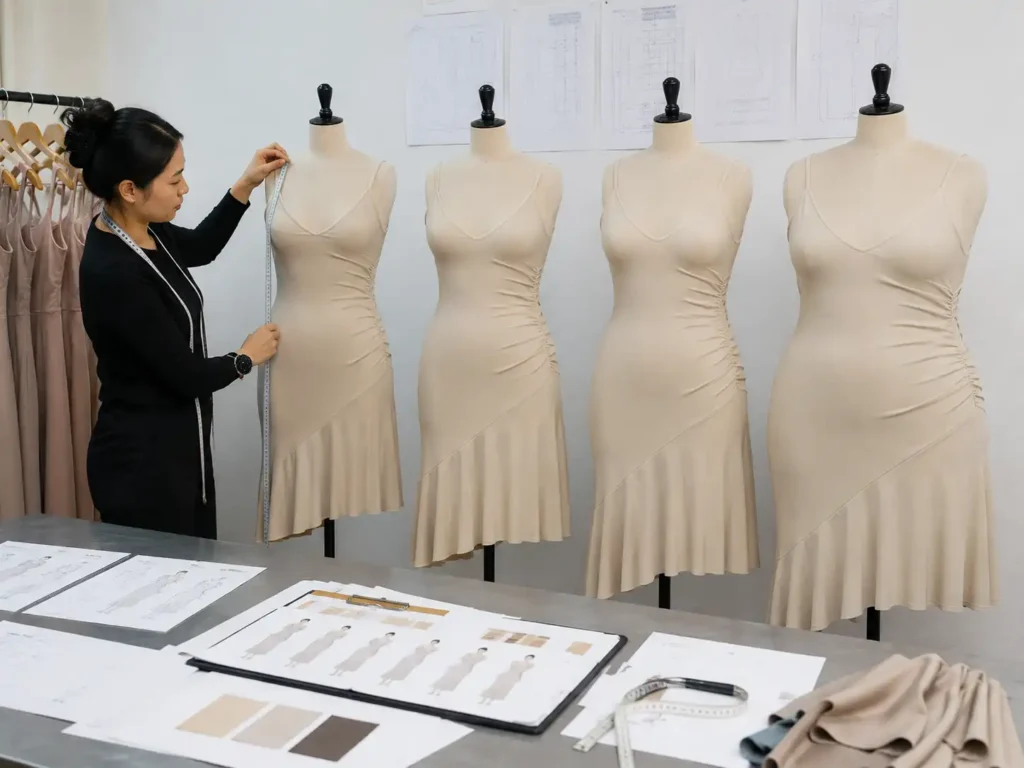
Extended-size grading should be validated by fitting more than the original base size. Test a size near the grade break and at least one size toward the upper end of the intended range, then compare measurements, balance, movement, and design placement. A mathematically correct CAD nest is not proof of successful grading; the system is validated when actual garments remain consistent across the range.
Which Sizes Should You Fit Test?
Fitting every size during early development can be expensive and unnecessary, but relying on only one base-size sample creates significant risk. A more efficient approach selects sizes that reveal different parts of the grading architecture, particularly the fitted base, the transition around a grade break, and a size far enough from the base to expose accumulated errors.
If a range uses two blocks, at least one representative size from each block should receive meaningful fit evaluation. A size near the transition is valuable because it confirms that the two rule sets connect smoothly. A sample near the top of a wide range is equally useful because repeated small grading errors become easiest to see there.
The amount of physical validation should also reflect product risk. A loose woven resort dress can tolerate more dimensional flexibility than a strapless corset mini, structured jumpsuit, fitted woven dress, or high-compression bodycon garment. A wide size range combined with high fit sensitivity deserves more checkpoints.
Validation Point | Main Purpose | Key Questions |
Core Base Size | Confirm original block | Is fit, ease, balance, and design correct? |
Grade-Break Size | Confirm transition | Does fit change abruptly between rule sets? |
Extended Base | Confirm larger block | Is the larger foundation balanced independently? |
Upper-Range Size | Expose accumulated error | Are shoulder, armhole, length, hip, and movement controlled? |
Size-Set Sample | Compare progression | Do POMs and visual details progress naturally? |
Sampling decisions should therefore be based on the information each size can reveal rather than on a fixed number of garments. A carefully selected set of four sizes can provide more useful evidence than producing six neighboring sizes that all sit close to the same fitted base.
How Do Fit Models Verify the Grade?
A measurement sheet confirms whether the garment matches numerical targets, while a fit model shows whether those targets work together on a living body. The distinction is important because a garment can measure completely within tolerance and still pinch, gape, shift, expose, or restrict movement once several measurements interact.
The fit model should be reasonably representative of the body profile used to develop the block. Full bust, waist, hip, height, upper arm, and relevant vertical measurements should be recorded. Body distribution and posture also influence fit, so two people with similar bust, waist, and hip measurements may experience the same garment differently.
Fitting conditions should be kept as consistent as practical. Record the sample version, fabric, model measurements, relevant undergarments, footwear for full-length styles, and whether the sample has been washed or finished. Photograph front, side, and back views in a consistent stance, then include normal movement such as sitting, walking, reaching forward, and raising the arms.
Subjective comments become valuable when they are translated into technical questions. “The sleeve feels tight” should lead to a review of bicep, armhole, sleeve cap, and fabric behavior. “The front feels short” should trigger analysis of front-body length and projection rather than an automatic increase to the entire hem.
The purpose of the fit session is to turn physical experience into repeatable pattern information.
Do You Need a Size Set?
A size set is one of the clearest ways to discover whether a grade system behaves consistently across multiple sizes before full production. It allows technical teams to compare actual garments instead of trusting that a correct-looking spreadsheet or smooth CAD nest automatically produces a correct physical progression.
It is not always necessary to sew every size. The selected samples should represent different parts of the range according to the width of the range, garment complexity, fabric risk, and customer requirements. High-risk styles generally justify more physical checkpoints than loose, forgiving products.
When reviewing the size set, look beyond the tape measure. Place garments in size order and compare shoulder position, neckline scale, waist seam, hip shaping, pockets, cut-outs, slit heights, straps, panel lines, trim positions, ruching density, and overall length. A decorative feature can remain technically unchanged but gradually look disproportionately small as the garment grows.
Pattern nesting is also useful to review because unexpected movement at one point can reveal a grading inconsistency. However, a visually smooth nest still needs physical validation. CAD software can reproduce an incorrect rule with perfect precision.
The size set is where body measurements, pattern geometry, fabric behavior, appearance, and production feasibility come together. It often provides the last affordable opportunity to correct systematic grading problems before hundreds or thousands of garments are cut.
Which Fit Problems Require Regrading?
Not every fit correction justifies rewriting a grade rule. A problem limited to one style may be caused by construction, lining, fabric behavior, design details, or an individual pattern error. Regrading becomes more likely when the same directional issue increases across consecutive sizes or appears repeatedly in different styles using the same block.
Common warning signs include:
- shoulder seams progressively moving outward;
- neckline gaping increasing as the size grows;
- sleeves becoming tighter despite adequate torso circumference;
- armholes becoming increasingly deep;
- front waistlines rising in larger sizes;
- side seams rotating toward the front or back;
- front hems becoming progressively shorter than back hems;
- jumpsuit rise becoming uncomfortable toward the upper range;
- waist-to-hip shaping weakening as size increases;
- cut-outs, slits, cups, or decorative features drifting away from the intended body position.
The pattern of repetition is more informative than a single failure. If three dresses built from the same block all need extra front length above the waist in extended sizes, repairing each style separately wastes development time. Moving the correction into the block or grading architecture creates an improvement that future styles can inherit.
That is one reason experienced technical teams keep systematic fit records instead of relying on memory. A correction that appears insignificant in one season can reveal a much larger block problem once the same issue is seen across several collections.
How Do You Control Grade Rules in Production?
Production control begins by locking the approved pattern, size chart, grade table, tolerances, fabric specification, and reference sample before bulk cutting. Measurements should then be monitored by size throughout production rather than only at final inspection. Accurate grading depends not only on CAD mathematics but also on version control, fabric handling, cutting, sewing, pressing, measurement methods, and disciplined quality control.
What Should a Grade Rule Table Include?
A production-ready grade table should contain enough information for another qualified technician to understand the size progression without relying on verbal explanation. At minimum, it should identify the style, base block, base size, full production range, unit of measurement, grade break, point of measure, and the size-to-size increment.
Where the company grades directly at pattern points, horizontal and vertical movements should be recorded when required. Where the company works mainly from garment specifications, the document should clearly state whether each POM is a full circumference, half measurement, flat measurement, or one-side measurement. Confusing those definitions can create a mistake several times larger than the intended grade.
Version control belongs in the same system. Record the pattern revision, date, technical owner or approver, and reference sample. When a fit session changes front length or bicep grading, the old file should no longer remain available as an active cutting reference.
Exceptions should always be visible. If neckline width remains unchanged through several sizes, document the zero grade. If front length receives additional growth after a breakpoint, show it explicitly. If a measurement changes by 2 inches for several grades and later changes by 2.5 inches, both rules should appear in the table.
A reliable technical system reduces the number of important decisions that exist only in someone’s memory.
How Do You Set Measurement Tolerances?
A grade rule and a tolerance solve different problems. The grade rule determines the intended measurement difference between sizes. Tolerance determines how far an individual production garment may vary from its target before it becomes unacceptable under the agreed quality standard.
Tolerance should reflect the measurement, fabric, construction, and customer’s specification rather than applying one universal figure everywhere. A long hem circumference can naturally have more manufacturing variation than strap length, a fitted waist, a top edge, or another critical fit point.
Many commercial garment programs work with finished measurement tolerances around ±1/4 inch to ±1/2 inch for selected critical dimensions, while larger or less sensitive measurements may allow more. These figures should be treated only as practical industry reference ranges. The customer’s approved specification and the behavior of the actual garment should always take priority.
Measurement technique must also be standardized. A stretch dress measured immediately after sewing may produce a different result after relaxation. A bias-cut garment may continue lengthening after hanging. A ruched panel may measure differently depending on how gathering is distributed before the tape is placed.
Technical instructions should therefore specify whether garments are measured relaxed, flat, straight across, along a curve, from a seam intersection, or after a defined resting period. Without a consistent method, two inspectors can obtain different numbers from the same garment while both believe they are measuring correctly.
How Do PP Samples Confirm the Grade?
A pre-production sample confirms more than appearance. It should represent the final combination of construction, approved materials, pattern, fit, trims, finishing, and relevant measurements before bulk production begins. Any fit corrections made during sampling must therefore be transferred into the correct pattern and specification versions before the order is released.
The most dangerous situation is an approved physical sample combined with outdated technical files. The garment in the meeting room can look perfect while the cutting room is working from an earlier pattern revision. Once bulk fabric has been cut, even a small version-control mistake can become expensive.
A practical approval sequence is:
- Fit approval and final comments are completed.
- Required pattern corrections are made.
- Measurement specifications are updated.
- Grade rules are updated where needed.
- The final pattern revision is generated.
- The PP sample is confirmed against those files.
- Production receives only the approved technical version.
When a Golden sample is also maintained, it can become a useful physical benchmark for silhouette, construction, trim position, finishing, and important measurements. The PP sample, size chart, grade table, BOM, construction information, and final CAD pattern should all refer to compatible revisions.
One correct sample is helpful, but one controlled technical system is much safer.
How Do You Control Bulk Size Consistency?
Bulk measurement control should begin early instead of waiting until final inspection. The first garments from the production line, selected in-line units, finished garments, and final inspection samples can all reveal whether the approved grading has survived cutting, sewing, pressing, and handling.
Measurements should be reviewed by size rather than only as one total production sample. A production lot can appear acceptable overall while the upper two sizes repeatedly fail the same POM. That pattern can indicate a cutting issue, excessive sewing tension, poor fabric relaxation, incorrect seam allowance, or an underlying grade problem that affects only part of the range.
Directional drift deserves attention even when individual garments remain within tolerance. If most measured waists are gradually sitting near the upper tolerance limit, the process is moving away from the target. Waiting until garments actually fail can allow a preventable process issue to spread through much more of the order.
Fabric behavior remains important during bulk production. Relaxation, shrinkage, spreading tension, grain direction, steaming, pressing, and sewing tension can all influence finished measurements. Stretch fabrics require particular care because measurements taken before adequate relaxation may not represent the stable finished garment.
Jinfeng Apparel’s documented production controls include size-chart confirmation, grade-rule review, pattern-version management, in-line measurement, finished-garment measurement, tolerance control, and comparison with PP or Golden samples. Its production process also requires base size, grade rule, and measurement tolerance to be confirmed as part of pre-production size control.
For repeat orders, the final pattern, size chart, grading record, fabric reference, approved sample information, fit comments, construction updates, and historical measurement results should remain accessible. A good extended-size system becomes more valuable over time because each successful season adds verified technical knowledge rather than forcing the brand to rebuild its sizing logic from the beginning.
Extended-size grade rules work best when they are treated as a product-development system rather than the final command entered into CAD software. The process begins with a clearly defined target body and a fitted base, continues through individual POM rules and deliberate grade breaks, and is challenged through real fabrics, fit models, size-set samples, movement testing, and production measurements. The arithmetic is important, but the garment ultimately has to work on a person.
For fashion brands developing wider ranges, the strongest technical package includes a target size chart, base size, approved block or original sample, target market, fabric direction, intended fit, measurement tolerances, and any useful historical fit feedback. A manufacturing partner can do much more with those inputs than with a list of size labels alone. Jinfeng Apparel supports extended and plus-size development according to client-specific size standards and target-market requirements, with documented pattern and sampling resources including 7+ senior pattern makers, 2 sample rooms, and 20+ sample machinists.
When the grading architecture is built carefully, wider sizing does more than add additional SKUs. It creates a repeatable fit language that can carry through dresses, skirts, jumpsuits, sets, seasonal collections, and future repeat orders. That consistency is difficult to create after production has already started, but it becomes a competitive product asset when the block, grading rules, fit feedback, and manufacturing controls are developed together from the beginning.

What is the difference between pattern grading and extended-size grading?
Pattern grading is the broader process of creating additional sizes from an approved base pattern using defined horizontal and vertical movements. Extended-size grading uses the same fundamental method but pays closer attention to the point where existing proportions may stop working reliably. It can require different POM increments, revised front-to-back distribution, additional vertical development, a grade break, or a separate fitted block. The difference is therefore not simply the number of sizes produced, but the amount of proportional change the grading system must manage.
Should plus sizes use the same grade rules as straight sizes?
They can share some rules, but it is risky to assume that every straight-size increment should continue unchanged through the entire extended range. Shoulder, neckline, bust, waist, hip, bicep, armhole, front length, rise, and other measurements may begin developing at different rates. The correct decision comes from the brand’s body chart and fit results. If larger samples repeatedly require the same corrections, the straight-size rules may have reached their practical limit and a revised breakpoint or additional block should be evaluated.
What is a grade break in apparel sizing?
A grade break is the point where selected measurement increments or pattern movements change because the previous grading relationship no longer produces the intended fit. It does not mean every measurement increases more after the breakpoint. Bust or hip growth may accelerate while shoulder and neckline growth remain restrained, for example. A successful grade break should be almost invisible to the customer because neighboring sizes still progress smoothly. The breakpoint is best chosen from body data, garment specifications, fit evidence, and the actual behavior of the intended size range.
How many sizes should be fit-tested for an extended-size range?
There is no universal number that works for every garment, but relying on only one base size creates unnecessary risk. A practical program normally tests strategically different parts of the range, such as the main base, a size around the grade break, an extended-size base when a second block is used, and an upper-range size where accumulated grading errors are easier to detect. High-risk products such as corset dresses, fitted jumpsuits, strapless styles, and bodycon garments usually justify more physical validation than loose silhouettes made from forgiving fabrics.
How does fabric stretch affect plus-size grade rules?
Fabric stretch changes the amount of room that needs to be built directly into the pattern, but the maximum stretch percentage should never be treated as the same thing as comfortable wearable stretch. Recovery, opacity, compression, seam strength, lining, fabric weight, and stretch direction all influence usable negative ease. Larger fitted sizes can place greater sustained tension on the material, making poor recovery or inadequate grading easier to notice. For this reason, extended-size rules for stretch garments should be developed from actual fabric testing and fit samples rather than from fiber-content labels alone.
What measurements are most important in extended-size grading?
Bust, waist, and hip remain fundamental, but successful extended sizing usually requires much more than those three circumferences. Shoulder width, across front, across back, armhole width and depth, bicep, front and back body length, neckline, strap position, high hip, thigh, rise, crotch extension, skirt length, slit position, and lining dimensions can all become important depending on the garment. The most critical POMs are the measurements whose errors would affect movement, coverage, support, balance, comfort, or the recognizable proportions of the design.
How can a brand reduce fit problems before extended-size bulk production?
The safest approach is to treat fit control as a sequence rather than a final inspection. Start with a clear target body chart and fitted base, establish documented grade rules and any required breakpoint, test representative sizes in the actual or closely matched production fabric, record fit-model feedback, review a size set where appropriate, and confirm the final pattern, specification, tolerance, and PP sample before cutting. During production, measure garments by size and monitor directional drift. Correcting the grading architecture before bulk cutting is far less disruptive than repairing a systematic fit problem after production is underway.
Share This Article :

Jerry Lee
Categories

Latest blogs
Table of Contents
Here, developing your OEM/ODM private label clothing collection is no longer a challenge—it’s an excellent opportunity to bring your creative vision to life.

