 Skip to content
Satin vs Charmeuse: What Is the Difference and Which Is Better for Dresses?

Your trusted Women’s Apparel Manufacturer from China

A satin swatch can look perfect under a showroom light and still produce the wrong dress once it is cut, sewn, lined, fitted, photographed, and packed. That happens because “satin” and “charmeuse” are often treated as two simple fabric names when they actually describe overlapping material concepts. A lightweight charmeuse may fall almost like liquid around the body, while a denser satin can hold a corseted waist, a sculpted neckline, or a fuller skirt. Both can look glossy. Both can be made from more than one fiber. Their real difference becomes obvious only when the fabric is connected to a specific garment.
Satin is the broader satin-weave category, while charmeuse is a lightweight, supple satin-weave fabric usually chosen for softer, more fluid drape. Neither term automatically means silk: charmeuse and satin can be made from silk, polyester, rayon, acetate, or blends. For dresses, charmeuse generally suits slips, cowls, and bias-cut silhouettes, while medium or heavier satin gives more options for structure, opacity, stretch, and shape retention.
That distinction sounds technical until a sample arrives with a neckline that collapses, a zipper that waves, or a pale skirt that turns unexpectedly transparent under studio lights. In those cases, the fabric may be attractive and correctly named, yet still be wrong for the design. The useful question is therefore not simply “Is satin better than charmeuse?” It is “Which construction gives this dress the movement, coverage, surface, fit, and production stability it actually needs?” The answer begins with terminology, but it quickly becomes a product-development decision.
What Is the Difference Between Satin and Charmeuse?
Satin is a broad weave and fabric family with a smooth, lustrous face, while charmeuse is a lighter, softer satin-weave construction known for fluid drape. Charmeuse is therefore related to satin rather than completely separate from it. The name alone does not reveal fiber content, so composition, weight, stretch, opacity, and finish should be checked before deciding whether either fabric suits a dress.
Is Charmeuse a Type of Satin?
Yes. Charmeuse belongs to the satin family, but the two terms do not sit at exactly the same level. Satin describes a weave structure in which longer yarn floats create a smooth surface with fewer visible interlacings. Those floats reflect light more continuously than a plain weave, producing the familiar satin sheen. Charmeuse uses the same basic principle but is normally constructed as a lighter, softer cloth with less body. When it is placed over a dress form, it tends to fall into narrow folds and follow the body’s curves instead of standing away from them.
This difference matters because “satin” can describe fabrics with very different physical behavior. A light polyester satin may behave much like charmeuse, while a dense satin can feel almost architectural by comparison. In Jinfeng Apparel’s internal satin-dress reference, commonly used satin options for dresses are documented across roughly 80-220 GSM, with lighter materials used for slips and summer styles and heavier constructions used for evening or more structured dresses. That range is broad enough to change a garment’s silhouette even when the paper pattern remains unchanged.
Are Satin and Charmeuse Made From Silk?
Neither term automatically means silk. Silk charmeuse is well known because silk naturally gives the fabric a soft hand, fluid fall, and nuanced luster, but charmeuse can also be woven from polyester, rayon, or other filament fibers. Satin is equally broad: polyester satin, acetate satin, silk satin, polyester-spandex satin, and silk-like synthetic satins are all common in the apparel market. Fiber therefore answers a different question from weave, and both need to be identified before a fabric is properly specified.
For a dress collection, fiber content affects more than perceived luxury. It can influence breathability, static, wrinkle behavior, care instructions, color saturation, durability, price, sourcing continuity, and repeat-order planning. A polyester charmeuse may be the better choice for a multi-color commercial program that needs stable availability, while silk charmeuse may be justified when tactile quality and premium positioning are central to the product. Treating silk as automatically “better” ignores the fact that performance must match the garment, target price, care expectation, and production scale.
Is Silk Charmeuse the Same as Satin?
Silk charmeuse is a type of silk satin, but not every silk satin should be called charmeuse. The phrase “silk satin” can cover several satin-woven silk fabrics with different weights, densities, and degrees of body. One silk satin may be light enough for a bias slip; another may be substantially firmer and more suitable for formalwear. The same naming problem appears in synthetic fabrics, where mills may use terms such as “poly charmeuse,” “light satin,” or “silk-touch satin” for articles that overlap in appearance but behave differently in production.
That is why a useful fabric approval needs more than a commercial name. A development team should record measurable and observable properties so that design, sampling, costing, and bulk production are discussing the same material. When a substitute is later proposed, those specifications give the team a real benchmark instead of relying on labels that vary from supplier to supplier.
Fabric Specification | Practical Purpose | Typical Dress Impact |
Fiber composition | Identifies silk, polyester, acetate, rayon, or blends | Changes hand feel, care, price, and labeling |
Weight/GSM | Measures mass per square meter | Influences drape, opacity, body, and consumption |
Stretch and recovery | Shows elastic behavior and shape return | Affects fit, pattern ease, seam choice, and zippers |
Surface finish | Defines matte, soft sheen, or high gloss | Changes visual positioning and photography |
Transparency | Shows how much coverage the fabric provides | Determines whether lining or extra layers are needed |
Drape | Describes how freely the cloth falls | Determines whether the silhouette is fluid or structured |
Approved color/swatches | Creates a physical bulk reference | Helps control shade, hand, and repeat-order consistency |
How Do Satin and Charmeuse Compare?
Charmeuse is usually lighter, softer, and more fluid than the broader satin category, while satin can range from delicate to substantial. In dress development, the clearest differences appear in drape, body, sheen, opacity, and sewing sensitivity. Weight helps narrow the choice, but it should never be used alone because yarn, density, fiber, finishing, and stretch can make two fabrics with similar GSM behave very differently.
Which Has More Drape?
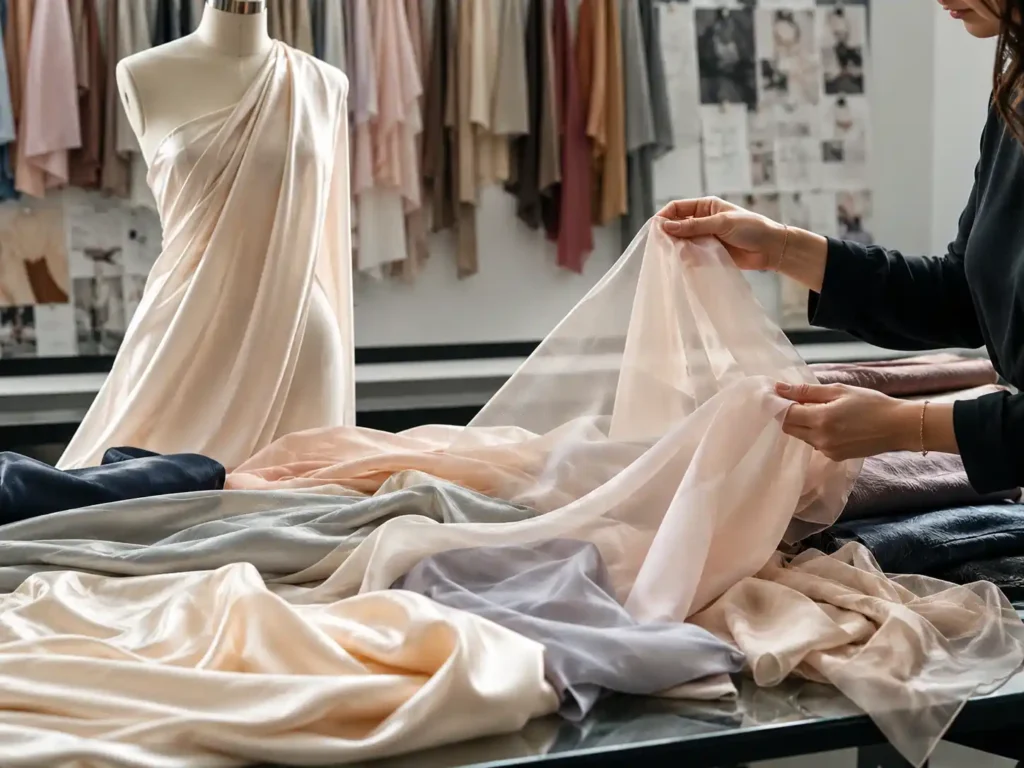
Charmeuse generally has stronger fluid drape. When lifted from one point, it usually falls into narrow, soft folds with relatively little resistance. This is one reason it works naturally for cowl necklines, slip dresses, draped backs, lingerie-inspired styles, and bias-cut evening dresses. The cloth responds quickly to movement and tends to follow the body, which can make a simple pattern look sophisticated without relying on heavy embellishment or complex seaming.
The satin category is less predictable because its weight and density vary so widely. A light satin can also flow beautifully, while a medium or heavy satin may form broader folds and project farther away from the body. This becomes particularly visible in long skirts: a light charmeuse maxi tends to fall vertically and move around the legs, while a heavier satin can create more sweep and volume. A reference photo rarely tells you the original GSM, which is why choosing a visually similar but substantially heavier fabric can make the final sample feel unexpectedly stiff even if every pattern measurement is correct.
Which Has More Structure?
Satin offers more structural options because it spans a wider range of weights and constructions. Charmeuse normally contributes very little architecture by itself; it is at its best when the garment should follow the wearer rather than hold a sharp shape. A corset dress, structured cocktail style, or formal gown often relies on boning, cups, interlining, seam shaping, and a stable closure. A very light charmeuse can be layered over this foundation, but the surface is unforgiving and may reveal boning channels, seam allowances, cup edges, or small differences in tension.
A medium or heavier satin can hide those internal transitions more effectively and create a calmer outer surface. It may also sit more cleanly around a zipper and provide enough body to support sculpted necklines or controlled pleats. The trade-off is movement: the more structure the face fabric contributes, the less it behaves like a liquid slip fabric. Experienced dress developers therefore ask how much shape should come from the outer fabric and how much should come from the internal construction. That question is more useful than deciding between fabric names in isolation.
How Do Sheen and Hand Feel Differ?
Charmeuse is often associated with a liquid-looking shine because its low weight allows the fabric angle to change constantly as the garment moves. Highlights travel across the body instead of remaining static, creating the flowing appearance seen in slips and draped eveningwear. Satin can range from high gloss to a quieter matte or silk-like finish. Polyester satin, matte satin, stretch satin, crepe satin, and silk-like satin may all sit within the same broad category while producing very different visual moods.
Surface shine affects both styling and defect visibility. A highly reflective satin can look dramatic under campaign lighting, yet the same reflectivity may emphasize wrinkles, seam tension, zipper waves, or underwear lines in ecommerce close-ups. Hand feel creates another layer of perception because a fabric that photographs well may still feel dry, stiff, or overly synthetic when handled. The most convincing result comes when surface, hand, and silhouette agree with each other. A soft bridesmaid dress, for example, usually benefits from controlled luster and enough density to remain smooth rather than simply maximizing shine.
How Do Weight and Thickness Differ?
Charmeuse normally occupies the lighter end of satin fabrics, while satin as a category can extend from very light materials into medium and heavier constructions. In practical womenswear development, a range around 80-220 GSM is common for satin dress options in our internal reference system, but those numbers should be treated as working guides rather than universal definitions. A tightly woven 150 GSM satin can feel firmer than another fabric at 170 GSM if the second has a softer finish or more flexible yarn structure.
Weight affects more than touch. It can change opacity, fabric consumption, seam behavior, zipper stability, hem treatment, packing volume, and the way a dress hangs after pressing. A 90 GSM satin may be suitable for a softly lined slip, while a 200 GSM satin may support a structured bodice but feel too heavy for the same bias-cut pattern. The table below gives a useful starting point for development, while physical sampling remains the final test.
Fabric Direction | Approx. Working Weight | Typical Drape | Common Dress Use |
Lightweight satin/charmeuse | 80-110 GSM | Very fluid | Slip dresses, cowls, summer dresses |
Light-medium satin | 110-150 GSM | Fluid with more coverage | Bridesmaid, midi, evening styles |
Medium satin | 150-180 GSM | Balanced drape and body | Party, cocktail, fitted dresses |
Heavier satin | 180-220 GSM | More structured | Formal gowns, corset styles, sculpted dresses |
Which Is Better for Different Dresses?
Charmeuse is usually the stronger choice for fluid, body-skimming silhouettes, while medium or heavier satin works better when a dress needs shape retention, opacity, or a more controlled surface. Stretch satin can be especially effective in close-fitting styles. The correct choice depends on the full garment design, including neckline, grain direction, internal structure, lining, length, fit, movement, and the way the dress will be photographed and worn.
Which Is Better for Slip Dresses?
Charmeuse is one of the most natural materials for a classic slip dress because the design depends heavily on fabric movement. A slip usually has few external distractions, so the material itself becomes a major part of the design. If the fabric is too rigid, the dress can stand away from the waist and hip instead of falling naturally. If it is too thin, it may cling excessively, reveal seam allowances, or become transparent across the bust and seat. The best result balances fluidity with enough density to remain smooth and wearable.
Light colors need particular attention. Ivory, champagne, blush, and pastel satin can appear adequately opaque on a table but become noticeably more transparent when stretched over curves or exposed to strong light. Lining may solve the coverage problem, but an overly stiff lining can destroy the very drape that made charmeuse attractive in the first place. Strap length and neckline stability also deserve careful fitting because much of a slip dress hangs from narrow shoulder straps. Small errors in strap position can change bust coverage, waist level, and overall length more than they would in a structured sleeved dress.
Which Is Better for Bias-Cut Dresses?
Charmeuse is particularly well suited to bias cutting because its light construction amplifies the natural flexibility of a woven fabric cut diagonally across the warp and weft. That diagonal orientation gives the material mechanical give even without elastane, allowing it to shape itself around the bust, waist, and hip with fewer darts. The result can look effortless, but the fabric is less dimensionally stable and may continue to lengthen or settle after cutting, sewing, and hanging.
For this reason, a bias dress should not be evaluated only during the first fitting. Long skirt panels can drop more than short bodice pieces, side seams can shift if the two sides were handled differently, and hems can become uneven after gravity has acted on the garment. When a fabric is changed, the same paper pattern may also produce a different final length because the new material has different weight and deformation behavior. An experienced sample room therefore reviews neckline stability, bust coverage, side-seam direction, hem balance, lining behavior, and overall length after the garment has had time to settle.
Which Is Better for Evening and Bridesmaid Dresses?
Both fabrics can perform well in evening and bridesmaid collections, but they create different visual language. Charmeuse suits softly draped columns, cowls, gathered necklines, halter styles, and dresses where movement is more important than volume. Medium and heavier satins are usually better for fuller skirts, shaped busts, controlled pleats, or formal styles that need stronger presence. The fabric is not merely an outer shell; it determines how the dress moves through event lighting, photography, and repeated wear over several hours.
Bridesmaid production adds another requirement: repeatability across sizes, colors, and multiple garments. A beautiful size-S sample is not enough if pale colors become transparent in larger sizes, seams pucker under different tension, or dye-lot differences become obvious when dresses are photographed side by side. For this reason, shade consistency, opacity, lining stability, wrinkle behavior, pressing, and packing all become part of the material decision. Satin-dress development records at Jinfeng Apparel specifically identify color variation, snagging, wrinkling, lining behavior, zipper smoothness, and pressing marks as recurring points that need control during sampling and bulk production.
Which Is Better for Structured Dresses?
Medium or heavier satin is generally more forgiving for structured dresses, particularly styles with boning, molded cups, corsetry, fitted waist panels, or sharply shaped seams. These dresses may look simple from the outside, yet the surface sits over a complex internal system. A lightweight charmeuse can reveal almost every transition underneath, including boning channels, seam allowances, cup edges, and zipper tapes. Achieving a perfectly smooth face in that situation is possible, but it requires more careful support, layering, and handling.
Stretch satin adds another option for bodycon and fitted party dresses because it combines a smooth satin appearance with controlled flexibility. The useful property is not stretch alone but stretch plus recovery. A fabric that stretches easily and recovers poorly can grow at the hip or seat during wear, while a fabric with moderate stretch and strong recovery may maintain the silhouette more effectively. This is why pattern ease, lining choice, zipper type, and seam construction should be approved using the actual bulk-intent fabric rather than copied from a non-stretch satin reference.
Dress Style | Often Suitable Direction | Main Reason | Key Development Check |
Minimal slip dress | Charmeuse/light satin | Fluid body-skimming drape | Opacity and strap balance |
Bias-cut maxi | Charmeuse | Soft diagonal give and movement | Settling and hem balance |
Cowl dress | Charmeuse/light satin | Natural soft folding | Neckline stability |
Bridesmaid slip | Light-medium satin | Fluidity with more coverage | Shade and lining consistency |
Bodycon party dress | Stretch satin | Fit plus movement | Recovery and zipper behavior |
Corset mini | Medium/stretch satin | Surface stability | Boning and cup show-through |
Cocktail dress | Medium satin | Controlled shape | Seam smoothness and pressing |
Structured evening gown | Medium-heavy satin | Volume and support | Weight, hem, and internal structure |
How Does Fiber Content Change the Choice?
Fiber content can change a satin fabric’s hand, breathability, static, wrinkle behavior, care requirements, price, dye response, and repeat-order stability even when the weave looks similar. Silk charmeuse and polyester charmeuse may both appear fluid and lustrous, yet they behave differently in wear and sourcing. For commercial dress development, fiber should be evaluated together with GSM, finish, stretch, opacity, construction, and the intended retail position.

How Does Silk Charmeuse Compare With Polyester Satin?
Silk charmeuse is often selected for its soft hand, fluid drape, and naturally complex luster. The surface tends to reflect light in a softer way than some highly polished synthetic satins, and that quality can support premium eveningwear or luxury positioning. Polyester satin offers a different set of strengths: a wide range of weights and finishes, easier integration of stretch, broad color possibilities, and generally stronger commercial flexibility when a collection includes several styles, colors, or repeat orders.
The useful comparison is therefore not “luxury versus cheap.” Quality exists within both categories. A poorly chosen silk charmeuse may be too transparent or delicate for the intended dress, while a well-developed polyester satin can have excellent density, restrained sheen, smooth drape, and stable bulk availability. Silk may be justified when fiber story, touch, and premium experience are central to the product. Polyester may be more suitable when the collection needs consistent replenishment, controlled target costing, and a wider choice of weights. The fabric that supports the whole product brief is usually the better commercial decision.
How Does Polyester Charmeuse Perform?
Polyester charmeuse is useful because it can deliver the lightweight satin character associated with charmeuse without automatically moving into silk pricing. It works well for slips, cowl dresses, draped tops, skirts, and softly shaped occasionwear. The quality range is wide, however. Lower-density articles may feel overly slippery, generate more static, or appear thin and shiny, while better constructions can have a softer surface, strong color depth, and enough density to look refined in motion and photography.
Digital images are particularly unreliable when evaluating this fabric because satin surfaces change dramatically with lighting angle. A swatch photographed under a direct LED lamp may look much brighter than it does in daylight, while diffused studio light can make the same article appear restrained and matte. Color also affects perception: black, navy, burgundy, and chocolate often look denser than ivory or pale champagne, where transparency and surface tension become more obvious. A physical swatch should therefore be draped, folded, viewed against light and dark backgrounds, and checked under several lighting conditions before final approval.
How Does Stretch Affect Satin Dresses?
Stretch changes the engineering of a dress, not just its comfort. A non-stretch satin relies on pattern shaping, darts, seams, and closures to create fit. Stretch satin allows the pattern to sit closer to the body while still providing movement, which is useful for bodycon dresses, fitted party styles, and some corset-inspired designs. Yet stretch percentage alone is not enough. Recovery matters just as much because the fabric needs to return to its original dimensions after sitting, walking, and bending.
The development team should record stretch direction, approximate stretch, recovery, fabric weight, lining stretch, pattern ease, seam choice, zipper requirement, and finished garment measurements. If the outer satin stretches substantially while the lining does not, the layers may fight each other around the bust, waist, or hip. A rigid zipper can also create waviness in a flexible back panel. For that reason, changing from standard satin to stretch satin after the fit is approved should be treated as a material change that may require another sample or at least a targeted fit review.
Does Fiber Matter More Than the Fabric Name?
In many sourcing decisions, fiber and measurable fabric behavior matter more than the commercial name. “Satin” is useful for narrowing the visual category, but it does not tell a pattern maker whether the fabric stretches, a sourcing manager whether it will be available next season, or a product developer whether a pale color will require lining. Even “polyester charmeuse” remains incomplete until weight, finish, stretch, transparency, and hand are understood.
A practical approval treats fabric as a system: fiber, weave, weight, finish, stretch, color, and garment construction work together. This becomes especially important when a supplier proposes a substitute. A replacement can look almost identical but weigh 20 GSM more, recover differently, or require an additional lining layer. Those changes can affect fit, labor, cost, and delivery. In Jinfeng Apparel’s fabric replacement process, changes in composition, weight, hand feel, stretch, recovery, drape, transparency, shine, MOQ, cost, and lead time are reviewed together because one material change can create several garment changes at once.
How Do Satin and Charmeuse Behave in Production?
Satin and charmeuse require careful handling because smooth, reflective surfaces reveal defects that textured materials often hide. Charmeuse is especially prone to slipping and distortion, while satin can highlight puckering, needle marks, shade differences, zipper waves, and pressing damage. Consistent bulk quality depends on grain control, accurate spreading and cutting, appropriate sewing settings, stable lining, careful pressing, and surface protection through final packing.
Are Satin and Charmeuse Difficult to Cut and Sew?
They can be more demanding than stable cotton, ponte, or medium-weight crepe, especially when the satin is light and slippery. The first risk appears during spreading because smooth layers can move against one another before cutting. Even a small shift may create mismatched panel lengths or grain inconsistency that becomes obvious only when the garment hangs. Satin also reflects light directionally, so a panel rotated simply to improve marker efficiency can appear to be a different shade even when it came from the same roll.
Sewing settings need to suit the actual fabric. A needle that is too large or slightly damaged can leave visible punctures, excessive thread tension can create puckering, and high presser-foot pressure can distort lightweight layers. Repeated unpicking is risky because needle holes may remain on the smooth surface. Charmeuse adds another challenge because its low body makes long seams easy to stretch or twist during handling. Good control is therefore less about owning one special machine and more about keeping spreading, grain, feeding, tension, and handling consistent from the cutting table through final assembly.
How Does Bias Cutting Affect Fit?
Bias cutting makes a woven fabric more flexible by placing the pattern diagonally relative to the stable warp and weft directions. That diagonal give is what allows a charmeuse slip to mold softly around the body without relying on conventional stretch yarns. The same property also makes the garment less dimensionally stable. Long panels can lengthen after assembly, necklines may stretch while sewing, side seams can shift, and the hem can become uneven after the dress has been hanging for a period of time.
A useful fit review therefore checks more than bust, waist, and hip measurements. Neckline position, strap length, side-seam direction, overall length, hem balance, and lining interaction should all be observed after the garment has settled. Movement matters too, because a bias dress that looks balanced on a static mannequin can rotate or pull when the wearer walks. If the fabric changes substantially in weight, density, or finish, the existing pattern should be reviewed rather than reused automatically, since the new material may settle and conform to the body differently.
Do Satin Fabrics Need Lining?
Not always, but lining is common in light colors, lightweight satin, formal dresses, and close-fitting styles. The need for lining is not determined by a single GSM threshold because color, weave density, stretch, and garment tension all influence transparency. A pale satin may look opaque while lying flat but become noticeably sheer when stretched across the bust or seat. Darker colors in the same article can provide more visual coverage, so lining decisions should be made on the actual approved shade whenever possible.
Lining can also improve comfort and hide internal construction, but it needs to move with the face fabric. A stiff lining under fluid charmeuse can restrict the skirt and destroy the soft fall that made the outer material attractive. A non-stretch lining under stretch satin may pull during wear and create unexpected wrinkles. For occasionwear, the sample should be checked under daylight, strong indoor lighting, and camera flash because transparency that seems minor in the sample room can become highly visible in wedding, party, or event photography.
How Can Snags and Puckering Be Controlled?
Satin surfaces need protection throughout the whole production chain because damage can occur during cutting, sewing, pressing, inspection, or packing. Snags may come from rough table edges, damaged needles, exposed zipper teeth, sharp metal trims, or abrasive packing surfaces. Once a filament is pulled, the defect is easy to notice because reflected light follows the damaged yarn. Puckering can come from thread tension, feeding differences, needle choice, seam construction, or incompatibility between the face fabric and lining.
Zipper areas are another common trouble point. A zipper seam may appear flat on a table yet form visible waves when the dress is worn because the satin was stretched during installation or because the zipper tape is much more stable than the surrounding fabric. The most reliable approach is prevention: appropriate needles, balanced tension, controlled feeding, clean surfaces, careful pressing, and minimal rework. Satin does not hide repeated repairs well, so every unnecessary stitch removal or extra press cycle increases the chance that the final surface will show evidence of correction.
How Can Bulk Consistency Be Controlled?
Bulk consistency starts with fabric inspection and roll management rather than waiting for final garment inspection. Shade differences can be more obvious on satin because directional reflection magnifies small color changes, and grain orientation can create a similar effect even within one dye lot. Roll grouping, panel direction, surface defects, snags, stains, seam quality, zipper shape, lining alignment, and pressing all need to be controlled before the garment reaches packing.
Packing deserves more attention than it often receives. Heavy folding pressure can create sharp creases, while rough hardware or decorative trims can rub against satin during transport. Pressing temperature and pressure also need control because excessive heat may change surface luster or leave imprints. Jinfeng Apparel’s satin QC reference specifically flags snagging, color difference, sheen direction, stains, zipper appearance, lining stability, pressing marks, and packaging creases as points that should be checked during satin dress production. These issues are small individually, but together they determine whether bulk garments still resemble the approved sample when they reach a brand’s warehouse.
How Should Brands Choose Satin or Charmeuse?
The most reliable way to choose satin or charmeuse is to work backward from the finished garment. Define the desired silhouette, drape, coverage, stretch, sheen, construction, care expectations, and target price first, then compare actual fabric specifications. A name such as “charmeuse” or “satin” should narrow the search rather than finish it. The decision should be validated through swatches, full samples, and bulk-fabric approval.
What Silhouette Do You Want?
Silhouette is the most useful first filter because it eliminates unsuitable fabrics before cost and color create distractions. If the design should skim the body, form soft folds, and move freely around the legs, a light charmeuse or fluid satin is a logical starting point. If the garment should hold a defined waist, support a sculpted bust, create controlled pleats, or maintain volume through the skirt, a more substantial satin usually gives the pattern more support.
A practical sequence is silhouette, drape, weight, stretch, opacity, sheen, fiber, and then cost. That order prevents a common development mistake: approving a fabric mainly because the color and shine look attractive. Photography should also be considered early because high-gloss satin can create dramatic campaign highlights while making wrinkles and seam tension more visible in close-up ecommerce images. For a multi-style capsule, fabric consolidation can be valuable as well. One well-tested satin shared across several coordinated silhouettes may simplify color control and repeat ordering, provided it performs correctly in each style.
What Fabric Specs Should You Confirm?
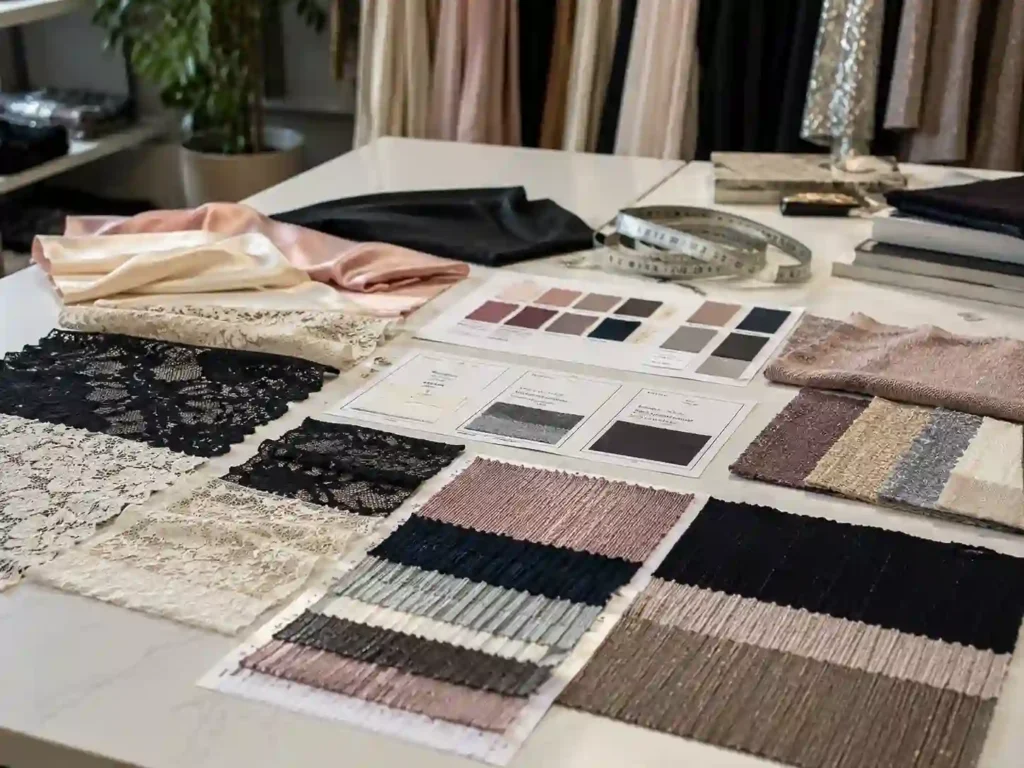
A production-ready fabric approval should contain enough information for sourcing, pattern, sampling, and bulk production teams to identify the same material consistently. The core data usually includes composition, GSM, width, stretch, recovery, hand feel, drape, transparency, surface finish, color standard, and known shrinkage or wrinkle behavior. For longer programs, supplier article number, dye-lot records, and approved swatch references become important because repeat orders may be placed months after the first production run.
Some of the least glamorous specifications have the greatest commercial impact. Width changes marker consumption and cost. Stretch affects whether an existing pattern can be reused. Transparency can add a full lining layer and extra sewing operations. A softer finish may improve hand feel while increasing production sensitivity. For that reason, experienced sourcing teams connect each material property to a garment consequence rather than evaluating numbers in isolation. The aim is not to find the most impressive satin swatch; it is to select the fabric that produces the intended dress consistently at the required quality and scale.
How Does Target Price Affect the Choice?
Fabric price matters, but it is only one part of garment cost. A lower-priced satin may need full lining, additional reinforcement, or slower handling. A delicate charmeuse may increase sewing sensitivity or rejection risk. A heavier satin may add fabric consumption or require more careful pressing. Those factors can reduce or erase the saving that appeared attractive when the team looked only at the price per meter or yard.
A useful commercial comparison includes face fabric, lining, trims, support materials, fabric consumption, sewing complexity, finishing, inspection, rework risk, and packing requirements. This is especially important when comparing silk with synthetic options. Silk may carry a higher material cost but support a premium retail story, while polyester may allow a brand to offer several colors and replenish successful styles more easily. Cost optimization works best when the desired product effect remains fixed and alternative fabrics are compared on drape, appearance, production stability, MOQ, lead time, and total garment cost rather than on raw fabric price alone.
What Should Be Approved Before Bulk Production?
Fabric approval should be treated as a sequence rather than a single yes-or-no decision. A small swatch can confirm color and basic hand feel, but it cannot fully reveal drape, transparency, seam behavior, lining interaction, or zipper performance. A larger cutting provides more information, and the garment sample shows how the material works with the actual pattern and construction. Bulk fabric then needs to match the approved reference closely enough for those sample results to remain valid.
Before production begins, composition, weight, color, surface finish, stretch, transparency, lining, and the fitted sample should all be confirmed. If a substitute is introduced, the change should trigger another technical review. In our development process, replacement fabrics are compared by composition, weight, stretch, recovery, hand feel, drape, transparency, shine, color, MOQ, cost, and lead-time impact, along with whether the pattern or sample needs adjustment. This discipline matters because a change that looks small on a swatch can change fit, silhouette, sewing behavior, and final cost once hundreds of garments are cut.
How Can Brands Reduce Fabric Risk?
The most effective way to reduce fabric risk is to make material approval part of product development rather than a late purchasing decision. Start with the intended dress effect, compare several realistic fabric options, and test the leading choice in a complete sample. If the style uses bias cutting, corsetry, pale colors, a low neckline, or a close fit, those features should be tested in the actual material instead of assumed to work because a swatch looks similar to a reference photograph.
Records also become valuable over time. Keeping approved fabric names, compositions, weights, colors, supplier references, stretch characteristics, fit observations, and production notes makes repeat orders easier to manage. When an original article becomes unavailable, historical data provides a benchmark for evaluating substitutes. For brands working with custom dress manufacturers, this is where a capable development partner adds value: not by simply sourcing “something satin,” but by connecting fabric behavior to pattern, sample, QC, and repeat production so that a successful material choice can be reproduced rather than rediscovered every season.
Conclusion
Satin and charmeuse are best understood as related fabric concepts rather than two completely separate materials competing for a single winner. Charmeuse sits toward the light, supple, highly draped end of the satin family, making it especially effective for slips, cowls, bias-cut dresses, and other silhouettes that depend on fluid movement. Broader satin constructions can offer more body, opacity, stretch, and structural support, which is useful for fitted party dresses, corset styles, cocktail dresses, and formal gowns.
For a fashion brand, the practical decision should always move beyond the fabric name. Fiber composition, GSM, stretch and recovery, drape, transparency, finish, lining, sewing behavior, target price, and bulk consistency all contribute to the final result. A fabric that looks ideal on a hanger can still fail once it is placed over the body or scaled into production. The strongest development process is therefore simple: define the silhouette, compare real specifications, test the fabric in a complete sample, approve the production reference carefully, and keep the records that make repeat orders predictable. That is how a beautiful satin dress remains beautiful when the project moves from one sample to hundreds or thousands of finished garments.
Share This Article :

Jerry Lee
Categories

Latest blogs
Table of Contents
Here, developing your OEM/ODM private label clothing collection is no longer a challenge—it’s an excellent opportunity to bring your creative vision to life.

