 Skip to content
Double-Layer Mesh vs Single-Layer Mesh: Which Is Better for Dresses?

Your trusted Women’s Apparel Manufacturer from China
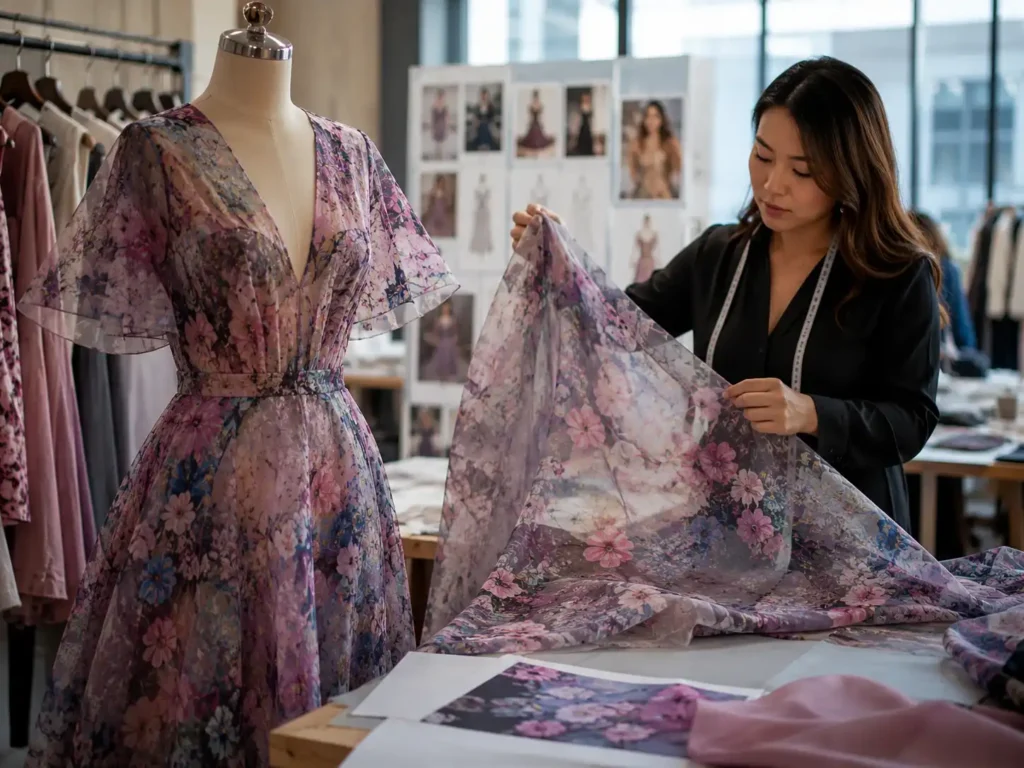
A mesh dress can look perfectly balanced on a hanger and behave very differently once it is stretched over the body. That is the point where the choice between one layer and two becomes more than a styling detail. Adding a second mesh ply changes opacity, color depth, stretch resistance, recovery, drape, seam behavior, ruching volume, neckline stability, fabric consumption, and the way the dress feels during movement. Single-layer mesh often gives a lighter, more transparent result, while double-layer mesh can create more coverage and a firmer visual surface. Neither option is automatically more premium. A beautifully engineered single-layer sleeve can look far more refined than an unnecessarily doubled sleeve, while a fitted body panel may need two layers to keep the intended coverage under real wearing tension. The practical question is not simply how many layers a designer prefers, but what each part of the garment must do when it is worn, photographed, washed, packed, and reproduced in bulk.
Double-layer mesh is generally the better choice when a dress needs more coverage, visual depth, fuller ruching, or greater stability, while single-layer mesh is usually better when deliberate sheerness, low weight, softness, and freedom of movement are priorities. The final decision should also consider mesh density, stretch direction, recovery, garment zone, lining, color, pattern fit, and the intended wearing occasion.
Experienced development teams rarely treat mesh layering as one decision for the whole dress. The bust can be doubled while the sleeves remain single; a ruched skirt can use two plies while a waist insert stays sheer; a body section can combine fashion mesh with lining while a neckline panel uses only one fine layer. That zone-by-zone approach usually produces a better balance between appearance and wearability. It also reduces the risk of solving one problem by creating another, such as adding coverage but making the dress too tight, stabilizing a cut-out but making the edge bulky, or improving opacity while losing the light, barely-there character that made the design attractive in the first place.
What Is the Difference Between Double-Layer and Single-Layer Mesh?
Single-layer mesh uses one mesh ply and normally gives greater sheerness, lower weight, softer movement, and less resistance to stretch. Double-layer mesh uses two overlapping plies, which usually increases coverage, color depth, body, and stability. The better construction depends on mesh density, elasticity, garment zone, fit pressure, lining, and the intended visual effect rather than simply choosing the thicker option.
Layer Structure
The easiest way to understand the difference is to stop thinking about double-layer mesh as merely a thicker version of single-layer mesh. A single mesh ply behaves as one textile structure, so its yarn spacing, knit construction, fiber content, stretch direction, and recovery determine how it reacts to the body. Once a second ply is added, the garment contains two elastic structures working together. They may extend almost equally, move slightly against one another, or create uneven tension if their orientations are not controlled. Visually, the openings of the two layers rarely align perfectly, so the yarns in one ply partially interrupt the open spaces in the other. That usually reduces direct skin visibility and deepens the apparent color. From a production point of view, a single front panel requires one cut component, while the same front panel in double mesh requires two, before any lining, reinforcement, or decorative overlay is added.
Construction Factor | Single-Layer Mesh | Double-Layer Mesh |
Mesh plies | 1 | 2 |
Base panel mesh use | About 1x panel area | About 2x panel area |
Visual transparency | Usually higher | Usually lower |
Color appearance | Lighter and clearer | Deeper and denser |
Stretch resistance | Usually lower | Usually higher |
Layer alignment risk | Low | Higher |
Seam bulk | Lower | Higher |
Handling time | Lower | Usually higher |
Weight and Hand Feel
Adding a second mesh layer nearly doubles the mesh mass in the covered area, but the wearer does not necessarily experience the garment as twice as heavy. Two very fine, soft meshes can still feel light, whereas one firm power mesh may already feel substantial. Hand feel changes because the surfaces interact: a single layer tends to feel immediate, airy, and fluid, while two plies often create a smoother and slightly more substantial surface. The effect is especially noticeable on ruched dresses, where two soft layers can produce fuller folds and deeper shadow than one layer stretched over lining. The opposite can happen with firmer qualities. If the base mesh already has strong resistance, doubling it can make the bust, underarm, waist, or hip feel noticeably tighter even when the paper pattern remains unchanged. For this reason, fabric approval should always be made in the intended layer configuration rather than from a single flat swatch alone.
Drape and Movement
Single-layer mesh generally follows body movement more freely, which makes it useful for sleeves, loose overlays, asymmetric hems, illusion panels, and sections where the fabric should appear almost weightless. Double mesh normally has more body because the second ply adds mass and friction. That can be helpful on fitted dresses, where the surface may look more controlled and less exposed, but it may reduce the floating quality expected from a light overlay. Layer friction is also important. Two very smooth meshes may move almost independently, while glittered, embroidered, textured, or rougher surfaces can catch against each other and create unexpected folds. Long skirts reveal this difference more clearly than short fitted dresses because the added material affects how the waist seam carries weight and how the hem moves around the legs. The correct construction therefore depends on whether the mesh is primarily decorative or also expected to provide coverage, volume, or structural control.
Cost and Production Impact
The fabric-cost difference is obvious, but the additional production handling is often underestimated. Two plies need to be spread, cut, identified, matched, and sewn without stretching one layer more than the other. If one ply is held under tension while the second remains relaxed, the finished panel can ripple even though both pieces were cut from the same pattern. Complex styles increase the handling challenge because ruched seams, twisted bust sections, asymmetric draping, narrow cut-outs, and curved necklines may need temporary joining or careful alignment before final assembly. Double layering can still be commercially sensible when it solves a defined problem, such as reducing unwanted transparency, hiding internal seams, giving ruching more body, or making the garment feel more substantial. The useful comparison is therefore not simply which option uses less material, but which construction reaches the approved look and fit with fewer sample corrections, fewer production risks, and fewer compromises for the wearer.
Which Mesh Gives Better Coverage and Sheerness Control?
Double-layer mesh normally provides greater coverage because two overlapping mesh structures reduce direct visibility through the openings. Single-layer mesh creates a stronger sheer effect. Layer count is only one opacity variable, however, because mesh density, yarn size, color, print coverage, stretch level, lighting, and lining can change how transparent the finished dress appears when it is actually worn.

Transparency Under Stretch
One of the most common mesh-development mistakes is approving opacity on a fabric that is lying flat. A mesh can appear reasonably covered in a relaxed state and become much more transparent when it is stretched across the bust, seat, upper thigh, or hip. As the textile extends, its yarn network spreads over a larger surface area and the openings become wider or more elongated, so less yarn covers the skin. A simple development calculation can help teams compare fabrics consistently: stretch percentage equals the extended length minus the original length, divided by the original length, multiplied by 100. If a 100 mm section extends comfortably to 150 mm, the calculated stretch is 50%. That number does not define quality by itself, but it creates a repeatable comparison point. Opacity should then be reviewed at realistic wearing extension because bodycon garments seldom use exactly the same tension at the waist, bust, hip, sleeve, and hem.
Density and Color
Mesh density can matter as much as the number of layers. A tightly knitted fine mesh may provide more coverage as one ply than a decorative mesh with large openings used in two layers. Yarn size, hole geometry, and knit density determine how much of the surface is actually occupied by textile. Color changes the visual result as well. Dark shades such as black, navy, or burgundy often appear denser because their yarns create strong contrast against skin, while pale nude or blush shades can visually disappear against similar skin tones. White and ivory meshes deserve special attention because they may look modest under soft front light and much more revealing under backlighting. Printed mesh adds another variable because the motif can provide strong local coverage while the transparent ground remains sheer. For production, each colorway should therefore be approved in its actual fabric and construction rather than assuming that one successful black sample proves the opacity of every lighter color.
Lighting Conditions
Mesh should not be judged under only one lighting condition because fashion photography, outdoor sunlight, fitting rooms, events, warehouses, and nightlife environments can produce very different levels of transparency. Backlighting is particularly revealing because light passes directly through the mesh openings and can make body outlines far more visible than they appear under soft front illumination. A useful development routine combines three fabric states with three lighting situations. The fabric can be viewed relaxed, at normal wearing stretch, and at a higher-stress fit zone, while lighting is varied between diffused front light, side or backlight, and direct photographic light. That creates nine practical observations without requiring a complex laboratory setup. It is not a formal test standard, but it exposes problems that a flat swatch can easily hide. For ecommerce-focused styles, a direct camera check is valuable because the product may look more transparent in photography than it does to the eye in the sample room.
Development Check | Condition A | Condition B | Condition C |
Fabric state | Relaxed | Normal wearing stretch | Higher-stress area |
Lighting | Diffused front light | Side/backlight | Direct photo light |
Viewing | Close inspection | Normal fitting distance | Camera distance |
Main concern | Base opacity | Skin visibility | Photo appearance |
Double Layer or Lining
Double mesh is not the only method for increasing coverage, and it should not be used automatically when a garment feels too sheer. If the design needs only a modest reduction in transparency, a second mesh ply can preserve the mesh-on-mesh appearance while creating more visual depth. If reliable coverage is more important, a stretch lining may be more effective because it can block visibility more consistently and provide a smoother interior. Many commercial designs use both approaches in different zones: sleeves remain single, the bust is lined, the waist stays sheer, the skirt is doubled, or a short lining stops above a transparent lower section. This zone-based approach gives much more control than applying one solution to the entire dress. The key is to define where skin should remain visible, where underwear must stay concealed, and where the design should read as opaque, semi-sheer, or intentionally transparent under normal movement and real lighting.
How Do Mesh Layers Affect Stretch and Fit?
Double-layer mesh usually makes a garment feel firmer because two elastic structures resist extension together. Maximum stretch may still be high, but greater force can be required to reach the same measurement. This changes bust, waist, hip, neckline, and armhole behavior, especially in bodycon dresses. Fit should therefore be approved using the final layer construction rather than a single mesh swatch.
Stretch Resistance
Maximum stretch and wearing resistance are not the same thing. Two mesh plies may both be capable of extending 50% or more, but the force required to reach that extension can be noticeably higher than with one ply. From the wearer’s perspective, the dress can therefore feel tighter even if the finished garment measurement has not changed. This is particularly important in negative-ease bodycon dresses, where the garment is intentionally smaller than the body in selected areas so the stretch textile creates a close fit. If a pattern was balanced for one mesh layer and the construction later changes to two, the negative ease may become too aggressive. Typical signs include compression across the bust, side seams pulling forward, necklines being dragged outward, ruching being stretched too flat, and hems riding upward. A change from single to double mesh should therefore trigger a fit review rather than being treated only as a transparency adjustment, especially when the inner and outer layers use different mesh qualities.
Stretch Direction
Many fashion meshes are not equally elastic in every direction. Some have much greater crosswise stretch, while others behave as four-way stretch fabrics with significant extension both horizontally and vertically. Pattern orientation must match the intended movement. For fitted dresses, the direction with greater stretch is commonly placed around the body because bust, waist, and hip circumference require more extension than garment length. If a panel is rotated incorrectly, the garment can become tight across the body while growing unnecessarily in length. Double-layer construction makes orientation control more important because the two plies can fight each other if they are cut in different directions. Printed mesh adds another requirement because the motif direction also has to remain visually correct. A reliable cutting specification should record fabric width, major and secondary stretch direction, comfortable extension, recovery, print orientation, and the approved direction for every major panel rather than simply describing the material as “stretch mesh.”
Body-Zone Fit
Mesh does not experience the same tension everywhere on the body, which is why one construction can perform well at the waist and still fail at the hip. The bust and full hip usually create high circumferential demand, while the waist relies heavily on recovery to avoid looseness. The seat and upper thigh add further tension when the wearer sits or walks. A fitted mesh dress should therefore be reviewed by zone, not only by total garment measurements. Useful control points include full bust, underbust, natural waist, high hip, full hip, upper thigh, armhole circumference, neckline opening, and any major cut-out dimensions. Movement is part of the fit test as well. Sitting increases demand across the seat, raising the arms changes underarm and neckline tension, and walking can reveal hem ride-up that is invisible during a static fitting. If the garment remains stretched after movement, the issue may involve recovery, pattern balance, or excessive negative ease rather than an incorrect labeled size.
Necklines and Armholes
Necklines and armholes are especially sensitive because their curves include sections that behave almost like bias edges. Soft mesh can lengthen during spreading, cutting, handling, or sewing, and once an opening is distorted it may not return neatly to the intended shape. A second layer can improve stability in some designs, but only when both plies are handled at the same tension. Several edge-control methods are used in practice, including narrow elastic, lightweight binding, stabilized seam allowances, controlled lining attachment, folded mesh edges, narrow tape reinforcement, and enclosed seams. The strongest method is not automatically the best because a delicate sheer neckline may need support without an obvious ridge. The approved sample should therefore record critical opening dimensions, and production pieces should be compared with those measurements before final assembly. Consistent operator handling is just as important as the pattern because pulling stretch mesh through the machine can enlarge an edge even when the paper specification is correct.
Which Layer Works Best for Different Dress Designs?
Single-layer mesh is usually best for intentionally sheer sleeves, illusion panels, lightweight overlays, and some cut-outs. Double-layer mesh is often more suitable for bodycon bodies, ruched panels, skirts, or areas needing additional coverage. Many successful dresses combine both constructions, allowing transparency, support, and movement to be controlled separately instead of forcing one layer strategy across the whole garment.

Bodycon and Ruched Dresses
Bodycon dresses make mesh problems easy to see because the textile operates under continuous tension. Single-layer mesh over lining can work very well when the inner layer already provides opacity and support, leaving the outer mesh to contribute texture, print, color, or ruching. Double mesh becomes useful when the visible surface needs more depth because two soft layers gathered together can create fuller folds and richer shadows than one ply. The difficulty is controlling the gathering relationship. If one mesh layer is ruched more aggressively than the second, the panel can twist or develop uneven fullness. Production instructions should state whether both layers are gathered together, only the outer layer is gathered, or the lining has its own independent ratio. Length control also matters because strong horizontal stretch can make a fitted skirt appear shorter when worn, while weak recovery can allow the garment to grow during movement. Ruching, pattern ease, lining, layer resistance, and recovery should therefore be approved as one system.
Sleeves and Sheer Panels
Single-layer mesh is often the natural starting point for sleeves because it keeps the garment light, mobile, and visibly sheer. Fine mesh sleeves can almost disappear against the arm while still carrying gathers, prints, embroidery, or decorative seams. Doubling them may make the upper body look visually heavier and can increase resistance around the upper arm and elbow, which may require a pattern adjustment. The same logic applies to illusion necklines, upper-back panels, shoulder inserts, and sheer waist sections where transparency is an intentional part of the design. The main technical concern is not necessarily layer count but edge stability. Narrow sheer panels can distort easily because a small dimensional change represents a large percentage of the finished width. Double layering becomes useful when the design calls for a semi-sheer rather than fully transparent appearance, but the transition into adjacent opaque or doubled sections still needs to be smooth so that differences in stretch resistance do not create puckering or pulling.
Cut-Out Styles
Cut-out dresses concentrate tension around small, highly visible areas. A narrow mesh bridge between two opaque garment sections may carry more structural load than its size suggests, and if that bridge stretches excessively, the cut-out can become larger, shift position, or expose more skin than intended. Single mesh works well when the panel is mainly decorative and maximum transparency is part of the look, such as a waist window, upper-chest illusion panel, or back section that is not holding major garment components together. Double mesh or firmer mesh may be safer when the insert helps stabilize the dress. The cut-out should be tested while standing, sitting, walking, raising the arms, and rotating the torso because exposure can change dramatically with posture. Edge construction is equally important. If the perimeter is unstable, adding another soft layer may not solve the problem; controlled elastic, reinforced seam allowances, or a stronger mesh may provide better support without unnecessarily increasing bulk.
Layer Zoning
Many refined mesh dresses use more than one construction because different body areas require different levels of exposure, support, and mobility. Layer zoning allows a designer to treat the bust differently from the sleeves, the skirt differently from the waist, and a high-stress side panel differently from a decorative neckline insert. The benefit is precision: extra fabric is used where it solves a problem rather than everywhere. The trade-off is technical complexity because seams joining single and double zones can behave differently under stretch. Tech packs should therefore specify layer count for each pattern piece, not simply list one mesh article for the entire style. This becomes even more important when one garment combines fashion mesh, power mesh, lining, elastic, and ruching, because the construction team needs to understand how each layer connects and which component is carrying the fit load.
| Garment Zone | Common Starting Option | Main Reason |
| Bust | Double mesh or mesh + lining | Coverage and stability |
| Waist illusion panel | Single mesh | Controlled skin visibility |
| Bodycon skirt | Double mesh or lined mesh | Coverage and surface depth |
| Long sleeves | Single mesh | Lightness and mobility |
| Side cut-out | Single or firm single mesh | Sheer effect with edge control |
| Ruched front panel | Double mesh | Fuller gathers |
| Upper-back panel | Single mesh | Illusion effect |
| High-stress support area | Power mesh or reinforcement | Recovery and support |
Do Mesh Dresses Need Lining or Double Layers?
Mesh dresses do not always need full lining, and double mesh is not automatically a replacement for lining. Double layering reduces transparency while preserving a mesh-on-mesh appearance. Lining provides stronger coverage, smoother internal contact, and more control over body exposure. Many dresses use a combination of single mesh, double mesh, and lining in different zones to achieve the intended result.
Double Mesh vs Lining
The difference begins with function. Double mesh is useful when the designer wants the garment to continue looking visibly like mesh because the second ply reduces sheerness while preserving depth and a degree of transparency. Lining is more effective when dependable coverage, smoother skin contact, or concealment of internal seams is required. A stretch lining can also create a clean base beneath ruching and prevent seam allowances, elastic edges, or construction details from showing through the outer fabric. There is no need to choose one method for an entire dress. A party style may use lined bust cups, double mesh across the torso, a short lining under the skirt, and single-layer sleeves. The development team should define the intended coverage before choosing the structure. “Make it less transparent” is too vague for production; the useful specification identifies exactly where skin should remain visible, where underwear must not show, and where the design should appear opaque, semi-sheer, or intentionally transparent.
Coverage Areas
Bust, seat, and upper-thigh areas normally deserve the closest coverage review because they are both sensitive zones and common high-stretch areas. The correct solution still depends on the product category. A beach cover dress can intentionally remain very transparent, a club dress may use strategic exposure, and an occasion dress may require considerably more coverage even when all three use similar-looking mesh. Lining length has a large visual effect as well. A mini lining beneath a midi or maxi mesh skirt creates a deliberate transition from opaque to sheer, while full-length lining produces a more conventional silhouette. Nude lining creates a skin illusion, whereas tonal lining makes the garment look denser. These boundaries should be checked on the body because a lining hem can ride upward under stretch, and bust coverage can shift during movement. Useful specifications include lining length from a defined point, bust coverage height, side-seam lining position, and whether the lining is attached or free-hanging.
Power Mesh
Power mesh should be treated as a separate material choice rather than as another name for doubled fashion mesh. Its main value is stronger support and recovery, which can make it suitable for fitted waists, internal support panels, corset-inspired dresses, structured bust areas, and other zones where the textile must return firmly after extension. Two soft fashion-mesh plies may increase coverage and resistance, but they do not automatically reproduce the modulus or recovery of a well-selected power mesh. The reverse is also true: using power mesh everywhere can make a light dress feel unnecessarily restrictive and can reduce softness and drape. A practical combination is a soft outer fashion mesh with strategically placed power mesh underneath, allowing the visible surface to keep the desired hand feel, print, or color while the inner layer supplies support. That approach can be more efficient than doubling every panel simply to obtain stability, especially when only certain body zones actually need reinforcement.
Lining Color and Appearance
Lining color can change the final garment almost as much as the mesh itself. Black mesh over black lining may appear nearly solid, while the same mesh over nude lining shows the open structure much more clearly. White mesh over white lining can look crisp and covered, whereas white or ivory mesh over nude creates a softer illusion effect. Printed mesh is even more sensitive because a pale backing can increase print clarity while a dark backing may suppress lighter motifs. Glitter, embroidery, and applique can also look more delicate or more graphic depending on the contrast beneath them. Lining approval should therefore be part of colorway development rather than treated as a generic internal component. Stretch compatibility matters too. If the outer mesh extends easily but the lining is much firmer, the lining may control the fit; if the lining is too loose, it may fail to support the outer layer or create excess fabric inside the dress. Both materials need compatible behavior in the finished construction.
How Should Mesh Layering Be Tested for Production?
Mesh layering should be tested in the complete garment using the actual mesh, color, stretch direction, layer count, lining, and seam construction planned for production. Sampling should review opacity, recovery, fit, neckline and armhole stability, cut-out exposure, layer alignment, seams, and damage. Final specifications should be based on an approved pre-production reference rather than on a loose fabric swatch.
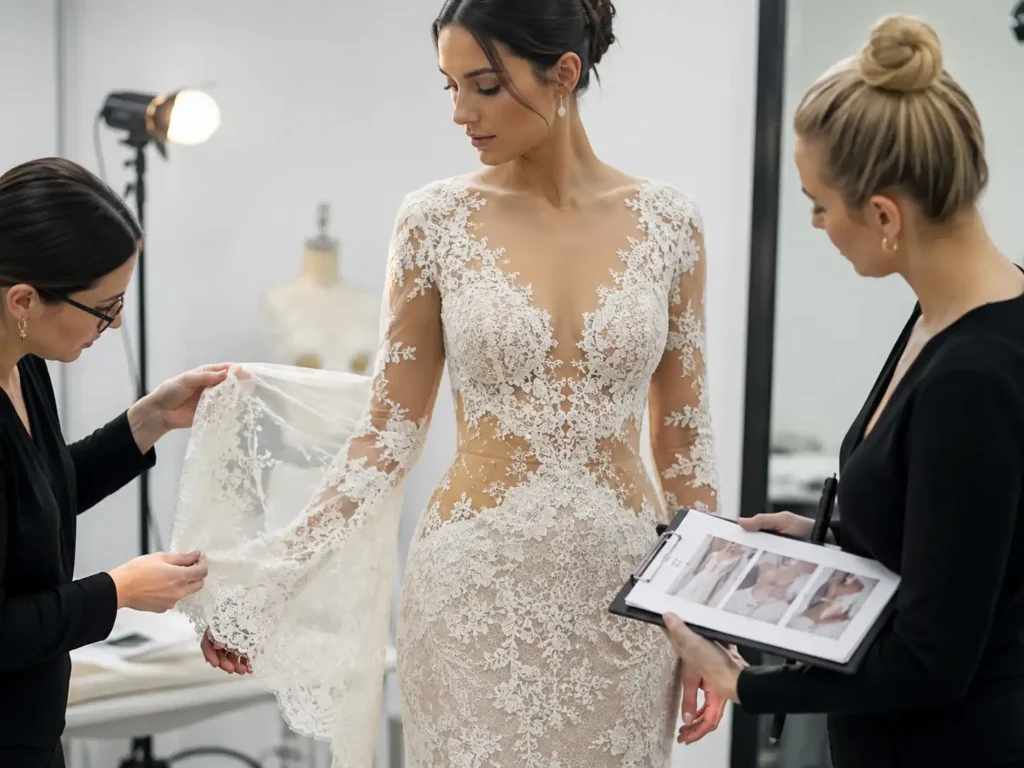
Sample Fitting
A mesh fitting needs to test appearance and mechanics at the same time. Basic bust, waist, hip, and length measurements are essential, but they do not show where the fabric is under the greatest tension. A dress can technically measure within tolerance while the mesh is excessively stretched over the bust or hip, producing more transparency or discomfort than intended. The sample should be viewed from the front, side, and back while standing, followed by sitting, walking, and raising the arms. For fitted styles, useful measurements include bust, waist, high hip, full hip, garment length, neckline opening, armhole, sleeve opening, lining length, and important cut-out dimensions. After movement, the garment should be removed and critical zones reviewed for recovery. A neckline that remains enlarged, a waist that stays stretched, or a skirt that has grown after fitting provides useful evidence that the issue is not simply visual. Photographs are helpful, but they should support measurements rather than replace them.
Stretch and Recovery Checks
Stretch comparison can be simple during development as long as the method is consistent. A team may mark a defined gauge length such as 100 mm, extend the fabric to a comfortable target, release it, and measure it again after the same rest period each time. If 100 mm extends to 150 mm, the calculated extension is 50%. The useful information comes after release: does the specimen return close to its original length, or does it remain noticeably longer? A basic in-house comparison is not a substitute for a laboratory method when formal test data is required, but it is helpful for comparing an approved sample fabric with a later lot under the same internal routine. Double mesh should also be checked as a construction because two plies may recover differently from one ply. If the outer layer relaxes more slowly than the inner layer, the garment can develop a loose or bubbled surface even though the individual mesh quality looked acceptable before assembly.
Layer Alignment
Layer shifting often begins before sewing because soft stretch mesh can distort during spreading and cutting. If one ply is slightly tensioned when cut and a second is fully relaxed, the components may share the same paper pattern but still behave differently during assembly. Accurate notches, stretch-direction marks, and clear panel identification help operators match the plies consistently. On complicated styles, temporary joining can allow two pieces to behave as one controlled unit before the final seam is sewn. Ruching instructions need particular clarity because the surface appearance changes dramatically depending on whether both mesh layers are gathered together, only the outer layer is ruched, the lining is gathered independently, or elastic controls the finished gathered length. Seam allowances also require attention because transparent fabric reveals internal construction that an opaque textile would hide. Curved seams and cut-outs should be checked on a form or body whenever possible because flat inspection may not show tension differences that appear only after the garment is stretched.
Bulk Production Control
Bulk production should begin only after the variables that created the approved sample have been fixed clearly enough to reproduce. The production specification should identify the exact mesh quality, color, layer count, lining, cutting direction, key seam methods, edge stabilization, ruching construction, and critical opacity zones. Incoming mesh should be checked for holes, pulled yarns, snagging, surface damage, color variation, and meaningful changes in stretch or recovery before cutting. High-risk areas such as necklines, armholes, cut-outs, side seams, and layered ruching should be inspected early in assembly rather than waiting until final inspection. In one documented mesh-dress program, nine bodycon, ruched mini, and cut-out styles totaling about 8,600 pieces used stretch mesh, power mesh, double-layer construction, lining, and elastic-edge details, with first sample, revised sample, and pre-production sample stages used to control transparency, recovery, neckline stability, cut-out exposure, and on-body appearance. That sequence illustrates the value of solving mesh behavior before production volume multiplies small inconsistencies.
Conclusion
The better choice between double-layer and single-layer mesh depends on what the garment is supposed to achieve, not on a rule that one construction is always more premium. Single-layer mesh remains the stronger option for sleeves, illusion sections, lightweight overlays, and other areas where deliberate transparency and easy movement are part of the design. Double-layer mesh becomes more useful when the dress needs greater coverage, deeper color, fuller ruching, or additional stability, while power mesh and lining offer different solutions when support or dependable opacity matters more than preserving an all-mesh appearance. The most reliable development method is to decide by garment zone, test the actual color and fabric under realistic stretch, review the result under several lighting conditions, and approve the complete construction on the body before bulk production begins.
For brands developing mesh bodycon, party, cut-out, ruched, or occasion dresses, the practical advantage comes from connecting fabric choice with pattern fit, stretch direction, lining, seam engineering, and production control. A second layer can solve the right problem very effectively, but it can also create unnecessary resistance, bulk, or handling cost when used without a clear purpose. When the mesh construction is decided through sampling rather than guesswork, the finished dress is more likely to keep the intended balance of sheerness, comfort, silhouette, and visual quality from the first approved sample through later production runs. Manufacturers with established mesh-dress development experience can help compare one-layer, two-layer, lining, and power-mesh options before the structure is locked into the final tech pack.
Share This Article :

Jerry Lee
Categories

Latest blogs
Table of Contents
Here, developing your OEM/ODM private label clothing collection is no longer a challenge—it’s an excellent opportunity to bring your creative vision to life.

