 Skip to content
Matte Satin vs Glossy Satin: Which Is Better for Dresses?

Your trusted Women’s Apparel Manufacturer from China

A satin decision can look surprisingly easy when two swatches are lying flat on a sourcing table. One catches the light; the other looks quieter. Once those same fabrics are turned into a fitted mini dress, a bias-cut slip, a corset dress, or a bridesmaid gown, the difference becomes much more consequential. Surface reflection changes how the eye reads color, curves, folds, wrinkles, seam lines, zipper areas, and even the apparent weight of a garment. It also changes how the dress behaves in campaign photography, smartphone flash, retail lighting, and customer-generated content. That is why experienced product teams rarely judge satin by shine alone. They look at the relationship between sheen, fiber, GSM, drape, stretch, opacity, grain direction, lining, sewing behavior, pressing, and the final silhouette. A fabric can be beautiful in the hand and still be wrong for the product if its surface exaggerates every construction line or if its soft matte finish removes the visual drama the design was supposed to create.
Matte satin is usually the stronger choice when a dress needs controlled sheen, softer light reflection, understated elegance, and less visual emphasis on wrinkles or body contours. Glossy satin is often better when the design depends on fluid highlights, glamour, movement, and stronger visual impact. Neither finish is inherently higher quality. The better option is the satin whose weight, drape, opacity, stretch, color, construction, and sheen work together for the intended dress and selling environment.
The most useful way to compare the two is to stop asking which satin is “better” in the abstract and instead ask what the finished garment needs to do. A glossy satin that looks dramatic on a bias-cut evening dress may become distracting on a highly structured corset bodice. A matte satin that seems almost too quiet in a swatch book can look exceptionally polished once it is cut into a clean column silhouette. In real development work, the expensive mistakes rarely come from choosing a universally bad fabric. They come from choosing a good fabric for the wrong dress, approving it under the wrong light, or discovering its production risks only after bulk cutting has started.
What Is the Difference Between Matte Satin and Glossy Satin?
Matte satin reflects light in a softer, more diffused way, while glossy satin creates brighter highlights and stronger contrast. The difference affects far more than appearance because sheen changes how color, wrinkles, seams, curves, and draping are perceived. Fiber type, filament smoothness, weave density, GSM, and finishing also influence the result, so two satins with similar shine can still behave very differently once made into a dress.
What Makes Satin Matte or Glossy?
Satin is better understood as a construction family than as one fixed material. Its characteristic smooth face comes from a weave structure that places relatively long yarn floats on the surface, allowing more uninterrupted yarn area to interact with light. The final level of shine then depends on the fiber and yarn system as much as the weave itself. Smooth filament polyester, acetate, silk-like filament yarns, and some stretch satin constructions can produce clear, sharp reflections, while duller filaments, higher yarn texture, different weave density, and finishing treatments can soften those reflections. This is why “matte satin,” “semi-matte satin,” and “glossy satin” are practical visual descriptions rather than universal technical grades. One mill’s matte satin may look almost semi-lustrous next to another supplier’s version. For development, an approved physical swatch is more reliable than a fabric name because it gives the factory a visible target for sheen, color, hand feel, and drape. Jinfeng Apparel’s documented satin system covers common constructions such as polyester satin, acetate satin, polyester-spandex satin, and silk-like satin, with dress-oriented weights broadly ranging from about 80 to 220 gsm depending on the intended product.
Is Matte Satin Completely Matte?
Usually not. Matte satin still retains the smooth face and directional reflection associated with satin, so it often develops a soft glow when the fabric curves toward a light source. The difference is that the highlight is broader and less mirror-like than on a glossy surface. This becomes obvious when the material is draped over a body rather than viewed flat. A swatch that looks restrained on a desk can develop visible highlights across the bust, waist, hip, and folds because every curved area changes the angle of reflection. For that reason, matte satin should not be treated as equivalent to a flat crepe or brushed woven fabric. It still has visual depth. A useful approval routine is to look at the fabric in indirect daylight, cool indoor light, warm ambient light, and phone-camera flash, then repeat the check while the fabric is shaped over a mannequin. That simple sequence often reveals whether the finish is truly appropriate for the intended sales environment.
Do Matte and Glossy Satin Feel Different?
They can feel different, but sheen alone does not determine hand feel. A lightweight glossy satin can feel fluid and almost liquid, while a heavier glossy satin can have enough body for structured occasionwear. Matte satin can range from very soft and drapey to dense and stable for exactly the same reason. Fiber, yarn size, yarn twist, weave density, finishing, and GSM all contribute to the final touch. Stretch introduces another variable because polyester-spandex satin must balance a smooth face with elongation and recovery. For sourcing teams, it is useful to separate surface appearance from mechanical performance and record sheen, weight, thickness, drape, stretch direction, recovery, opacity, wrinkle response, and snag sensitivity as independent attributes. A fabric can have a beautiful hand but poor recovery for a close-fitting dress, while another can have the ideal sheen yet be too transparent for a pale bridesmaid gown. The correct comparison is therefore about the total performance package rather than the finish name.
Does Gloss Mean Better Quality?
No. High gloss is a visual choice, not a quality grade, and the fashion market contains both excellent and poor examples at every sheen level. A glossy satin can look rich when the surface is even, the color has depth, the fabric has enough body, seams remain flat, and the garment has been pressed correctly. The same level of shine can look inexpensive when the fabric is too thin for the design, the surface is uneven, zipper areas ripple, or harsh highlights expose every sewing imperfection. Matte satin follows the same logic. A low-luster fabric only looks premium when its density, color consistency, drape, and construction support the design. Quality is therefore better judged through a chain of practical observations: consistent surface, stable color, suitable GSM, appropriate opacity, clean sewing, controlled pressing, and predictable behavior during wear and photography. Shine can enhance those qualities, but it cannot compensate for weaknesses underneath them.
| Comparison Point | Matte Satin | Semi-Matte Satin | Glossy Satin |
| Typical light reflection | Low to moderate | Moderate | Moderate to high |
| Highlight contrast | Soft | Controlled | Strong |
| Visual emphasis | Silhouette and color | Balanced | Movement and shine |
| Wrinkle visibility | Usually softer | Moderate | Often more obvious |
| Flash sensitivity | Relatively controlled | Moderate | Higher |
| Dress development focus | Drape, color, structure | Balance of finish and shape | Reflection, seam quality, photography |
| Useful GSM reference | Part of the broader 80-220 gsm dress-satin range | Part of the broader 80-220 gsm dress-satin range | Part of the broader 80-220 gsm dress-satin range |
How Do Matte and Glossy Satin Look on Dresses?
Matte satin usually gives a dress a softer, calmer, and more controlled appearance, while glossy satin makes folds, curves, and movement more visually pronounced. The difference becomes strongest across the bust, waist, hips, ruching, and draped areas because these surfaces catch light at changing angles. Gloss can create glamour and depth, but it can also make wrinkles, tension, and construction lines easier to notice.

Which Satin Looks More Luxurious?
Luxury is often confused with maximum shine, but experienced fashion teams know that premium appearance comes from balance. Glossy satin can look highly luxurious when the design is built around movement and light. Long bias-cut gowns, draped necklines, fluid skirts, and clean slip dresses give highlights room to travel across the body, which can make deep black, burgundy, emerald, navy, and jewel tones feel especially rich. Matte satin produces a different type of luxury. Its restrained reflection tends to support modern minimalism, polished bridesmaid collections, clean midi dresses, and structured occasionwear where the silhouette and color should carry more visual weight than the surface. Problems begin when the finish and design compete with each other. A very reflective satin on a dress with many darts, gathers, seams, and cup structures can create too much visual noise, while an extremely muted satin may flatten a design intended to look dramatic under evening lighting. The strongest choice is the one that supports the brand’s intended visual language rather than chasing shine as a shortcut to perceived value.
Which Satin Shows Body Contours More?
Glossy satin usually emphasizes body contours more strongly because it creates brighter highlights on areas facing the light and deeper shadows immediately beside them. On a fitted dress, that can increase visual attention around the bust, lower abdomen, high hip, full hip, and upper thigh. This effect is not automatically negative; many bodycon and partywear designs deliberately use reflection to celebrate shape. The risk appears when the fabric is too light, the fit is too tight, or the lining does not support the shell, because tension lines and underwear edges can then become part of the visible surface. Matte satin generally reduces highlight-to-shadow contrast and can make the same silhouette appear calmer, but it cannot hide incorrect fit. A matte dress stretched excessively across the hips will still show horizontal tension lines, while a glossy stretch satin with good recovery may sit smoothly. For sample review, front, side, and three-quarter photographs under both diffused and direct light are far more informative than a quick mirror check because they reveal how the surface behaves from the customer’s likely viewing angles.
Which Satin Shows Wrinkles More?
Glossy satin generally makes wrinkles appear more obvious because even a shallow crease changes the reflection angle. One side of the fold catches light while the other falls into shadow, creating stronger visual contrast than the same crease would produce on a softer finish. Matte satin can reduce that contrast, but it should not be mistaken for a wrinkle-resistant fabric. Satin dress materials can still have meaningful wrinkling risk depending on fiber, weight, finishing, packing pressure, and how long the garment remains folded. A practical pre-production check is to compress or fold the candidate fabric for a short controlled period, release it, and observe both recovery and the appearance of residual lines under directional light. This matters especially for ecommerce orders because garments may travel folded for days or weeks before reaching a customer. Jinfeng Apparel’s internal satin controls identify wrinkling, pressing traces, and packaging folds alongside snagging and color variation as recurring issues that need to be managed rather than treated as afterthoughts.
How Does Sheen Change a Silhouette?
Sheen changes the way the eye reads volume. A glossy gathered skirt can appear fuller because every fold creates its own highlight and shadow, while the same pattern in matte satin may look smoother and more architectural. On a bias-cut slip dress, moving highlights can make the garment appear more fluid because the reflected bands of light travel with the wearer. Structured corset dresses behave differently: a strong gloss can make cup seams, boning channels, and waist shaping more visible, which may be desirable for a sculptural look but distracting when the goal is a seamless surface. Designers should therefore judge sheen on a three-dimensional sample rather than a hanging swatch. The most informative test is simple: place the sample under one stable light source, rotate the dress form slowly, and watch where highlights form, disappear, or become too strong. That movement reveals whether the surface is helping the silhouette communicate its intended shape or exposing construction details that should remain secondary.
Which Satin Is Best for Different Dress Styles?
There is no single best satin for every dress. Slip dresses usually prioritize fluid drape and bias behavior, bodycon styles need stretch and recovery, corset dresses require surface stability over internal structure, and evening or bridesmaid collections must balance color, photography, movement, and consistency. Matte or glossy finish should therefore be selected only after the silhouette and practical performance requirements are clear.
Which Satin Is Better for Slip Dresses?
Slip dresses are unusually sensitive to fabric choice because their construction is simple enough that the satin becomes the main visual feature. Glossy satin gives a bias-cut slip a sensual, high-impact appearance because broad uninterrupted panels allow highlights to flow from shoulder to hem. Matte satin makes the same silhouette feel cleaner and more understated, which can suit contemporary occasionwear or brands that want satin fluidity without a lingerie-like shine. The surface decision must still be made alongside drape, opacity, bias growth, strap stability, neckline behavior, and hem balance. Satin may extend on the bias even when it contains no elastane because the yarns shift relative to the grain, so a sample can change length after hanging. Light colors also need careful opacity testing because seam allowances and underwear can become visible through a very fluid shell. The best slip-dress satin is therefore not simply the softest or shiniest option; it is the one that hangs smoothly, settles predictably, photographs well, and keeps the intended level of coverage.
Which Satin Works for Bodycon Dresses?
Bodycon dresses place much greater demands on stretch, recovery, and opacity because the fabric is working under continuous tension across the bust, waist, and hips. Stretch satin is often more practical than traditional non-stretch satin for these silhouettes, but finish still changes the visual result. Glossy stretch satin can produce dramatic highlights that emphasize curves and work well for partywear, while matte stretch satin creates a more controlled surface with less visual fluctuation. Recovery is one of the most important checks because a fabric that stretches comfortably during fitting may not return fully after wear, leading to bagging around the seat or hip. The sample should be assessed both relaxed and under body tension, with particular attention to side seams, zipper behavior, stitch appearance, and whether the surface lightens when stretched. Within Jinfeng Apparel’s documented material system, satin dress fabrics broadly span about 80-220 gsm, but GSM alone cannot determine suitability for bodycon use; the combination of stretch construction, opacity, recovery, and fit is far more decisive.
Which Satin Works for Corset Dresses?
Corset dresses need a satin that can sit over internal structure without revealing every hidden component. Bra cups, boning, underwire, seam allowances, lining, and waist reinforcement all create changes in surface height, and a very glossy face can turn those changes into strong highlights. That can be attractive in a deliberately sculptural design, but it can also expose cup edges or boning lines that the designer intended to keep visually smooth. Matte or semi-matte satin often gives the development team more tolerance, while a medium or more stable satin generally handles structured bodices better than an extremely light, fluid fabric. The challenge is avoiding the opposite problem: excessive thickness can create bulk where several layers meet. Sample fitting should therefore inspect cup symmetry, center-front alignment, waist-seam flatness, zipper behavior, underarm comfort, and lining tension. If the same satin is used for both bodice and skirt, the material must perform successfully in two very different structural zones rather than only looking good on one part of the garment.
Which Satin Is Better for Evening and Bridesmaid Dresses?
Eveningwear can support a wide range of satin finishes because the desired mood varies from restrained sophistication to high-impact glamour. Glossy satin performs strongly when movement and light are central to the design, especially in long skirts, draped necklines, and fluid gowns worn under evening lighting. Matte satin often works well when rich color, clean construction, or group consistency matters more. Bridesmaid programs deserve particular attention because several people wearing the same color may be photographed together from different angles. Glossy satin can make identical dye lots appear lighter or darker from one wearer to another simply because the dresses face the light differently. Matte satin usually reduces this effect, although dye-lot and grain-direction control are still necessary. For large color programs, the most reliable approach is to test the approved fabric on at least one representative silhouette, photograph it in daylight and event-style lighting, and confirm that the finish remains acceptable before extending the same quality across multiple styles.
| Dress Style | Main Fabric Priority | Matte Satin Tends to Support | Glossy Satin Tends to Support | Critical Sample Check |
| Slip dress | Drape, bias stability, opacity | Minimal, refined look | Fluid, sensual highlight | Bias growth and hem balance |
| Bodycon dress | Stretch, recovery, coverage | Controlled contour | Strong curve emphasis | Recovery and seam tension |
| Corset dress | Surface stability, structure | Smoother visual surface | Sculptural highlight | Cup and boning visibility |
| Bridesmaid dress | Color consistency, photography | Softer group appearance | Glamorous event look | Multi-angle photography |
| Evening gown | Movement, drape, color depth | Understated elegance | High-impact movement | Lighting and skirt reflection |
| Cocktail or party dress | Shape, shine, construction | Modern polish | Statement finish | Zipper, ruching, pressing |
How Do Color and Lighting Change Satin?
Color on satin cannot be judged separately from lighting. Glossy satin produces stronger highlight-to-shadow variation, so the same dye lot can look lighter, darker, or more saturated as the fabric moves. Matte satin usually appears more stable, but daylight, warm indoor light, phone flash, lining color, and grain direction can still alter perception. Reliable approval therefore requires physical color references and more than one lighting condition.
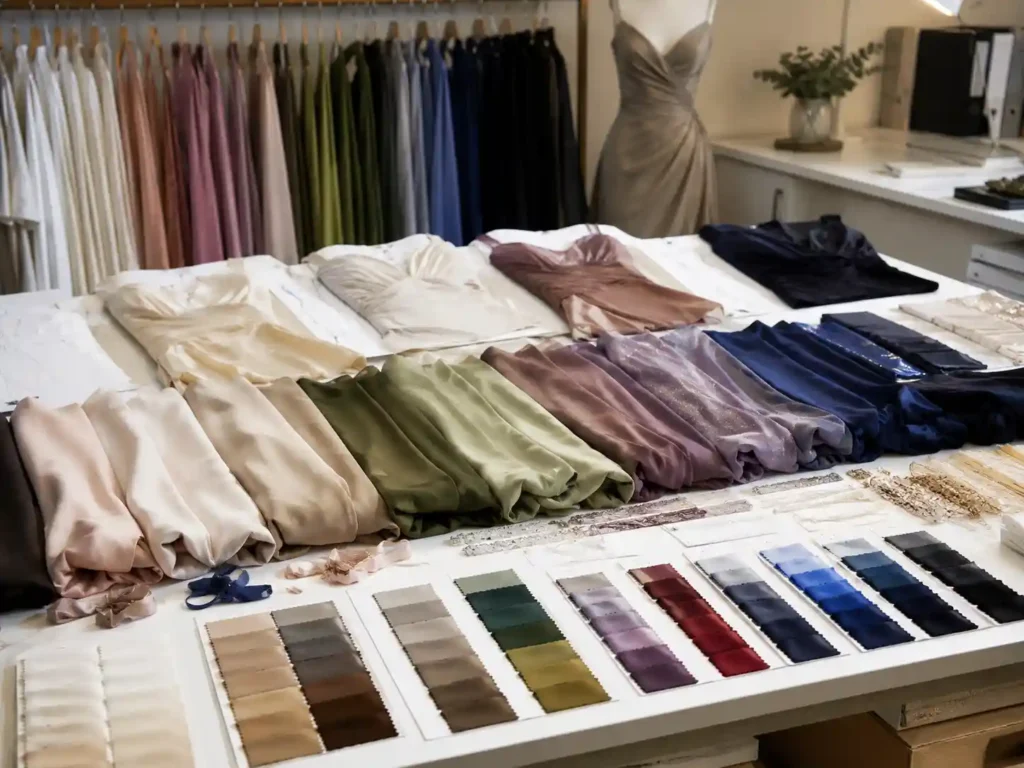
Do Colors Look Different on Matte and Glossy Satin?
Yes, sometimes dramatically, because people perceive color together with reflected light rather than as a flat dye value. A glossy burgundy satin may appear almost red where a strong highlight strikes the hip and much deeper around a fold, while a matte version of the same general shade often reads more evenly. Pale colors create different risks. Ivory, champagne, blush, and light blue can become visibly brighter under direct reflection, and a lightweight shell may allow the lining or skin tone to influence the final appearance. Dark glossy colors such as black and navy often produce impressive depth, but they can reveal lint, water spots, pressing marks, and creases more clearly. That is why color approval should include the actual satin finish rather than relying on a color chip alone. In Jinfeng Apparel’s documented process, color review can include Pantone or physical references, lab dips, fabric swatches, lighting conditions, fabric batch, dye lot, surface shine, and lining color before bulk confirmation.
Which Satin Photographs Better?
Neither finish photographs better in every situation. Matte satin is generally easier to control because it produces softer highlights and more predictable exposure, which can be useful for ecommerce photography, bridesmaid group images, and styles with complicated seam construction. Glossy satin can create stronger editorial impact because light travels across folds and curves, but it requires more deliberate lighting. Direct phone flash is especially revealing because a polished surface can create a bright hotspot that looks much lighter than the actual dye color, while large diffused light sources usually produce broader highlights and preserve more color information. A practical pre-production photography check should include at least four conditions: natural window light, indoor ambient light, smartphone photography without flash, and smartphone photography with flash. The test should be performed on the garment rather than only the swatch because bust curves, hip shape, folds, darts, and zipper areas alter reflection in ways that flat fabric cannot reproduce.
How Does Grain Direction Affect Sheen?
Grain direction is one of the most underestimated satin production issues because the surface is highly directional even though it does not have pile in the same way as velvet. Rotating one pattern piece can change how its floats meet the light, causing that panel to appear slightly lighter, darker, or glossier than the section beside it. On high-shine satin, the effect can resemble a dye-lot problem even when both pieces came from the same roll. Production teams therefore often treat satin as a one-direction fabric for visible panels, keeping paired pieces aligned and avoiding unnecessary 180-degree rotation in the cutting marker. This can reduce marker efficiency and raise fabric consumption, so the decision should be made during costing rather than after cutting. Replacement pieces also need special attention because a panel recut later can look inconsistent if its direction is reversed. For dresses with large uninterrupted skirts, bias sections, godets, or asymmetrical panels, directional control is a technical requirement as much as an aesthetic preference.
Are Light and Dark Colors Equally Sensitive?
No, because different color families reveal different weaknesses. Light satin is more likely to expose transparency, seam allowances, lining mismatch, and undergarment contrast, while ivory and champagne can shift noticeably between cool daylight and warm interior lighting. Dark glossy satin hides transparency more easily but can make lint, dust, creasing, water spotting, and pressure marks highly visible. Saturated colors such as emerald, cobalt, fuchsia, and burgundy often create dramatic highlight changes that can be desirable for occasionwear but should be understood before photography and bulk approval. Even when one satin construction performs well in black, it should not automatically be approved in a pale shade without review because opacity and perceived shine may change substantially. Multi-color collections benefit from treating each important color as its own visual case, especially when the same style will be sold online where customers compare product images side by side and expect consistent color representation across the range.
How Do Matte and Glossy Satin Behave in Production?
Both finishes require controlled cutting, sewing, pressing, handling, and packing, but glossy satin usually exposes production irregularities more clearly. Puckering, scratches, needle marks, zipper rippling, pressing traces, wrinkles, and inconsistent cutting direction can become obvious under reflected light. Matte satin may visually soften some issues, yet neither finish compensates for weak process control, especially in fitted or light-colored dresses.
Which Satin Shows Sewing Defects More?
Glossy satin is usually less forgiving because reflected light follows every change in the fabric surface. A slightly puckered seam creates alternating bright and dark lines, a needle mark can appear as a tiny change in reflection, and an invisible zipper installed under the wrong tension may produce a visible wave down the back of the dress. The fabric does not necessarily sew worse simply because it is glossy; the problem is that small defects are more visible. Before bulk production, the sewing team should trial the highest-risk constructions using the actual fabric, needle, thread, stitch settings, and machine conditions planned for the order. Straight seams, bias seams, darts, princess lines, invisible zippers, waist joins, narrow hems, and ruched sections deserve particular attention. The sample should then be reviewed under directional light and on a body or dress form, because some distortions only become apparent when the garment is under tension. Matte satin provides slightly more visual tolerance, but the same technical standards should still be applied.
How Do You Control Color and Sheen in Bulk?
A reliable satin program needs a physical approval chain because color and sheen must be controlled together. One practical sequence is fabric-quality approval, color reference, lab dip where required, approved swatch, garment sample, PP sample, bulk fabric check, and finished-garment comparison against the approved reference. At each stage, teams should review not only hue but also surface character, hand feel, GSM, grain direction, opacity, and any required stretch. Bulk rolls should be compared under consistent lighting before cutting, and roll or dye-lot information should be recorded where available. When several rolls are used for one order, highly visible panels should not be mixed casually if the lots show noticeable visual variation. This discipline matters because a bulk fabric can technically match a color target yet still make the finished dress look wrong if its gloss level differs from the approved sample. The commercial goal is not laboratory perfection; it is keeping natural textile variation within a range that still reproduces the approved garment appearance.
Do Lining and Zippers Change the Result?
They can change the result substantially because satin is often thin and reflective enough to reveal what is happening underneath it. Lining controls opacity, comfort, movement, and how smoothly the shell travels over the body. A lining that is too heavy can restrict a fluid skirt, while one that is too tight can pull the shell around the hips or zipper. Pale satin can also be influenced by lining color, making the outer fabric look warmer, cooler, darker, or more opaque. Invisible zippers create another common risk because zipper tape, seam allowance, and shell fabric respond differently to tension. If the seam is stretched during installation, the zipper area may ripple after the garment is released, and a glossy surface makes that distortion particularly obvious. For fitted dresses, the zipper should be evaluated on a body or dress form rather than only on a hanger, because tension changes once the garment is worn. The same principle applies to cups, boning, straps, and seam allowances in structured styles.
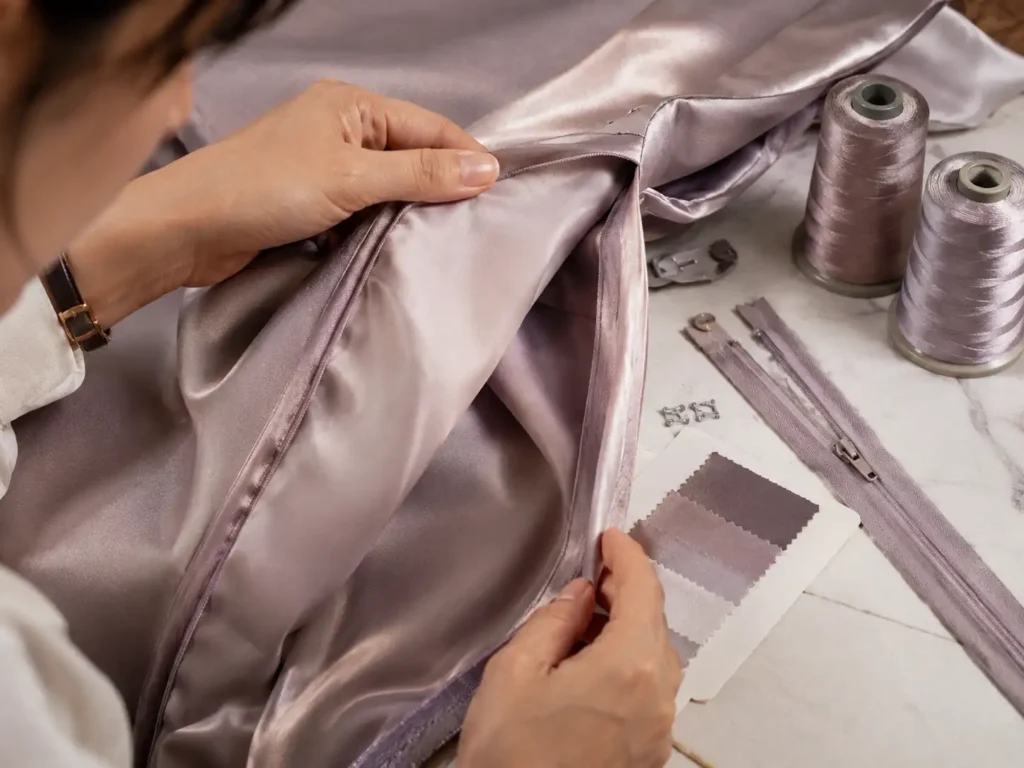
How Should Satin Be Pressed and Packed?
Pressing should be tested on offcuts from the actual bulk fabric before finished garments are exposed to production heat and pressure. Some satin surfaces can flatten, develop unwanted shine, or show seam impressions when the temperature, steam, or pressure is too aggressive. Thick seam allowances can also leave visible outlines on the face of the garment if pressing is not controlled. Packing then becomes the final risk point because satin can hold strong fold lines after long periods of compression, particularly on large uninterrupted surfaces such as maxi skirts and bias-cut gowns. Clean handling matters as well, since glossy dark satin can reveal lint and surface contamination quickly while pale satin can make stains highly visible. Jinfeng Apparel’s documented satin QC priorities include snagging, color variation, stains, zipper bowing, pressing marks, wrinkles, and inconsistent sheen direction, which is why finishing and packing should be considered part of fabric control rather than a separate logistics task.
Production Stage | Main Satin Risk | Practical Control | What to Check Before Approval |
Fabric inspection | Shade or sheen variation | Compare rolls in consistent light | Color, face direction, GSM, surface |
Cutting | Reversed directional sheen | Use one-way rules where needed | Paired panels and replacement pieces |
Sewing | Puckering, needle marks | Run seam trials on actual fabric | Straight, bias, dart and curved seams |
Zipper installation | Rippling or bowing | Control seam and tape tension | Check while garment is worn |
Pressing | Shine or seam impressions | Test heat, steam and pressure | Surface before and after pressing |
Finishing | Snags, stains, lint | Use clean handling surfaces | Front, back, hem and high-touch areas |
Packing | Compression creases | Control folds and packing pressure | Appearance after unpacking |
Final QC | Panel-to-panel variation | Inspect under directional light | Color, sheen, zipper, wrinkles, pressing |
A useful production example comes from an anonymized US occasionwear program documented by Jinfeng Apparel. The project covered 12 satin mini and midi dress styles and approximately 20,000 pieces using matte satin, stretch satin, and light lining. The development sequence moved through a first sample, revised sample, PP sample, and Golden sample, while the team focused on satin color consistency, zipper flatness, lining comfort, fit correction, and consistency across several colors. The value of this case is not the order size by itself; it shows how satin problems are reduced by locking multiple variables before bulk production rather than treating fabric approval, fit, sewing, and finishing as separate decisions.
How Should Brands Choose Matte or Glossy Satin?
Brands should work backward from the finished garment rather than forward from the fabric name. Define the desired silhouette, customer occasion, photography environment, target color, hand feel, price position, and production risk, then compare physical satin options for sheen, GSM, drape, stretch, opacity, recovery, and color. The final choice should be confirmed on a garment sample because flat swatches cannot reproduce body curves, seams, movement, or camera behavior.
Which Satin Fits the Collection Aesthetic?
Start with the emotion the collection needs to create. If the customer should notice silhouette, tailoring, and color before surface shine, matte or semi-matte satin often fits naturally. This is common in refined bridesmaid ranges, minimalist occasionwear, clean column dresses, and modern midi styles. If the collection is built around nightlife, partywear, fluid movement, and strong social-media imagery, a brighter satin can become part of the product identity rather than a technical side effect. The decision should also consider how satin sits beside the other fabrics in the range. A highly reflective style can feel disconnected if every neighboring product uses muted crepe, matte jersey, or textured woven cloth unless that contrast is intentional. Commercial reality matters as well. Two visually similar satins may have different availability, custom-dye requirements, cost, or lead-time implications. The strongest selection process therefore combines creative intent with sourcing feasibility instead of allowing either side to dominate the decision.
How Should You Compare Satin Swatches?
Use the same evaluation routine for every candidate so the final decision is based on comparable evidence rather than first impressions. Begin by recording composition, GSM, usable width, supplier reference, color standard, stretch direction if applicable, and any available lot information. Then assess sheen, drape, opacity, recovery, wrinkle response, snag sensitivity, and the way the fabric behaves on the bias. A swatch should be viewed flat, folded, and draped over a curved surface because each position reveals different reflection. Photograph it in daylight, indoor light, and flash, then compare it with the intended lining and trims. Avoid relying on supplier descriptions such as “luxury satin” or “premium matte satin,” because those phrases do not define performance. For ongoing seasonal development, keeping a physical fabric archive with style number, approved color, sample result, and bulk-production notes can reduce repeated sourcing work and make later reorders far more consistent.
Do You Need a Sample Before Bulk Production?
For satin dresses, a garment sample is one of the most useful approval tools because a flat swatch cannot reveal how the material behaves around the bust, waist, hip, zipper, lining, and hem. A sample shows whether glossy highlights become too strong on body curves, whether matte satin looks flatter than expected, whether a bias skirt grows after hanging, whether pale fabric provides enough coverage, and whether seam tension is visible. More complex styles may need a sequence such as first sample, revised sample, PP sample, and an approved Golden sample or equivalent reference, with each stage closing specific risks rather than repeating work without purpose. A well-managed sample process also helps the costing team because it reveals whether the original fabric choice requires extra lining, different sewing settings, one-way cutting, or more careful pressing. Those discoveries are far cheaper before bulk fabric is cut than after hundreds or thousands of garments have entered production.
How Should You Approve Bulk Satin?
Bulk approval should lock the complete appearance standard, not only the fabric name. Before cutting, the production team should know which satin quality is approved, what the accepted color and sheen look like, which direction visible panels must follow, what lining and zipper belong with the shell, and which sample represents the finished standard. A practical sequence is to confirm fabric quality and finish, approve color or lab dip where needed, record GSM and hand feel, define cutting direction, finalize lining and trims, approve the garment sample, approve the PP sample, and retain a sealed reference for bulk comparison. For repeat orders, preserve fabric references, patterns, measurement charts, trim specifications, packing instructions, and previous QC notes so every reorder does not become a new development exercise. If a brand is deciding between matte, semi-matte, stretch, and higher-gloss satin for a new dress program, sharing the silhouette, color, reference appearance, planned quantity, and price position with the manufacturer creates a much more useful fabric discussion than simply asking for the “best satin.”
Conclusion
Matte satin and glossy satin are not competing quality levels; they are different visual tools that behave differently once they become three-dimensional garments. Matte finishes tend to give color, silhouette, and construction more visual control, while glossy surfaces add movement, contrast, and drama. The best choice depends on how the dress is supposed to fit, photograph, move, and survive production, packing, and real-world wear. That is why successful satin development combines creative judgment with measurable checks such as GSM, opacity, stretch and recovery, grain direction, lining compatibility, color approval, seam trials, pressing tests, and sample sign-off. When those decisions are made early, satin becomes much easier to manage in bulk and much more predictable at retail. For brands developing satin-heavy collections, the most productive manufacturer conversations start with the actual garment objective rather than the finish name: silhouette, target color, desired reflection, fit, selling occasion, and approved reference should lead the material decision from the beginning.
Share This Article :

Jerry Lee
Categories

Latest blogs
Table of Contents
Here, developing your OEM/ODM private label clothing collection is no longer a challenge—it’s an excellent opportunity to bring your creative vision to life.

