 Skip to content
How Does Grain Direction Affect Satin Dresses?

Your trusted Women’s Apparel Manufacturer from China
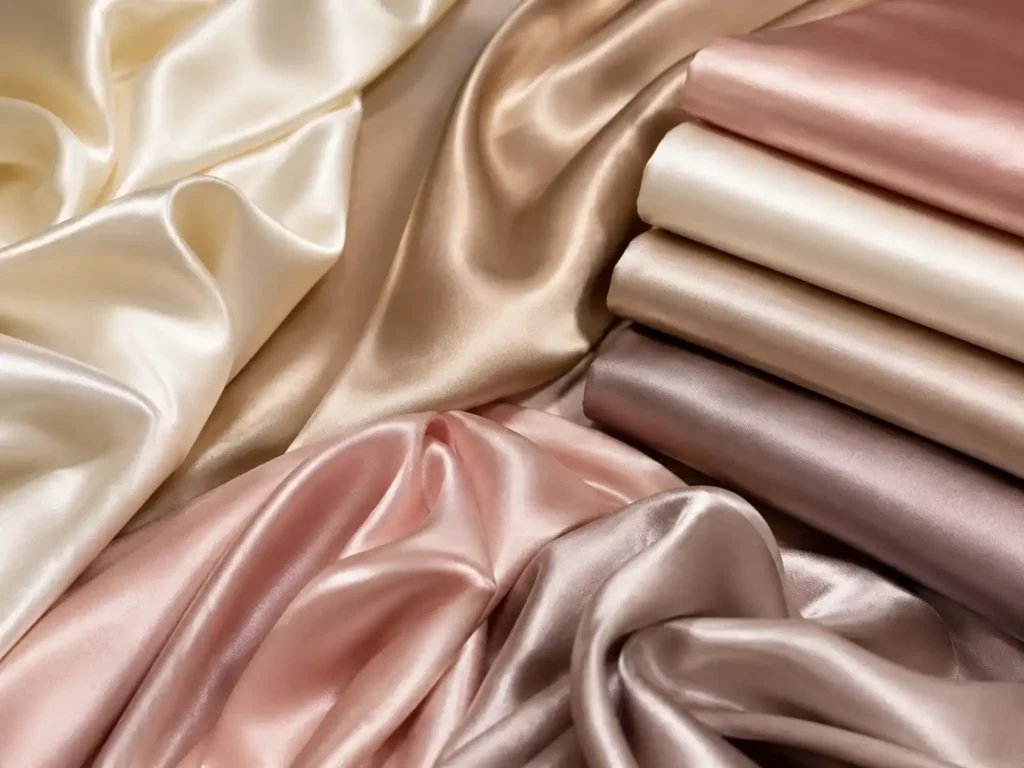
A satin dress can look perfectly balanced on a pattern table and behave very differently once it is cut, sewn, pressed, packed, and worn. Grain direction is one of the reasons. The grainline is not simply an arrow a cutter follows to keep pieces tidy on the marker; it changes how the woven yarn structure reacts to gravity, body curves, seam tension, movement, and light. Satin makes these effects especially easy to see because its smooth reflective surface shows drag lines, twisting, puckering, uneven drape, and changes in sheen more clearly than many matte fabrics. That is why two dresses made from the same satin and developed from nearly identical shapes can still look noticeably different if one is cut on straight grain and the other is cut on true bias.
Grain direction affects how a satin dress hangs, stretches mechanically, follows the body, reflects light, and holds its dimensions. Straight grain usually gives greater stability and a cleaner, more controlled fall, while true bias creates more diagonal give, fluid drape, and body-skimming movement. On satin, grain direction also influences seam balance, hem growth, twisting risk, and apparent color consistency because rotated panels can reflect light differently even when they come from the same dye lot.
The useful question, then, is not simply whether bias is more elegant or straight grain is easier to sew. The better question is what the design is asking the fabric to do. A fluid slip dress, a corset mini dress, and a softly draped evening gown may all use satin, yet they need very different relationships between pattern geometry, fabric weight, stretch, lining, and grain placement. Once that relationship is understood, many production problems that seem mysterious – a rotating side seam, a hem that drops after hanging, or a panel that looks like a different shade – become much easier to diagnose before they reach bulk production.
What Is Grain Direction in Satin Fabric?
Grain direction describes how a pattern piece is positioned against satin’s warp and weft yarns. Straight grain follows the lengthwise yarns, cross grain follows the width, and true bias runs at roughly 45 degrees to both. Because woven yarns resist and shift differently in each direction, grain placement changes satin’s dimensional stability, diagonal give, drape, sheen, fit, and response to gravity.
What Are Straight Grain, Cross Grain, and Bias?
Every woven satin is built from two main yarn systems. Warp yarns run along the length of the roll, generally parallel to the selvage, while weft yarns pass across the width. A pattern placed with its grainline parallel to the selvage is normally considered straight grain. Cross grain follows the weft direction, and true bias sits at approximately 45 degrees to the warp and weft. These are not just different positions on a cutting table. They create different mechanical conditions because the yarn network resists force most strongly along its main yarn directions and moves more freely when force is applied diagonally.
The practical difference becomes obvious when a non-stretch woven satin is handled by hand. Along straight grain, it may feel quite stable. Across the width, it may show slightly more give depending on construction. On true bias, the rectangular yarn grid can distort toward a diamond shape, creating noticeably more movement even though no elastane has been added. This is why a true bias garment can feel flexible and body-responsive while an accidentally off-grain garment simply becomes unpredictable. In professional pattern development, intentional bias is engineered; off-grain cutting is treated as a defect.
Grain Direction | Approx. Orientation | Typical Satin Behavior | Common Dress Use | Main Risk |
Straight grain | 0 degrees to selvage | Most stable lengthwise, controlled fall | Structured bodices, panel dresses, fitted skirts | Less diagonal give |
Cross grain | 90 degrees | Often slightly more widthwise give | Selected details or special layouts | Width instability or sheen mismatch |
True bias | About 45 degrees | Highest mechanical give and fluidity | Slip dresses, cowls, fluid skirts | Growth, twisting, uneven hems |
Off-grain | Unintended angle | Uneven and asymmetric response | None intentionally | Torque, seam rotation, distorted drape |
Is Satin More Sensitive to Grain Direction?
Satin often exposes grain-related problems earlier than a textured or matte fabric because its surface acts almost like a light map. Long floats on the face create a smooth reflective finish, so a slight change in panel angle can change the direction of the highlight. A small twist through the skirt may become more visible because the sheen bends with the distortion. A side seam that rotates only a little can create a bright streak on one side and a duller surface on the other, making a structural problem look like a color or pressing problem.
The effect is especially noticeable on clean, uninterrupted styles such as slip dresses, column dresses, fitted midi dresses, cowl-neck dresses, and long satin skirts. Fabric weight matters as well. In our satin development work, dress satins may span roughly 80-220 gsm, with lightweight constructions generally showing more movement and heavier constructions carrying more body. The range itself does not determine quality; it simply changes how strongly grain direction interacts with gravity, seam tension, opacity, lining, and the intended silhouette.
How Does Grain Direction Affect Satin Sheen?
Satin can appear lighter or darker when it is rotated because perceived color depends partly on the direction of reflected light. Two panels can be cut from the same roll and the same dye lot, yet one can look deeper, brighter, cooler, or warmer if its surface faces a different direction. This is particularly easy to notice on champagne, ivory, black, navy, jewel tones, and other colors used in eveningwear or occasionwear, where broad areas of uninterrupted satin are photographed under directional lighting.
That is why marker efficiency cannot be the only priority when laying out visible satin pieces. Rotating a princess panel, sleeve, skirt section, or replacement piece to save a small amount of fabric may produce a much larger visual problem in the finished garment. Before bulk cutting, the team should establish whether the fabric is visually two-way or effectively one-way. If direction matters, all visible panels need a consistent orientation, and any re-cut parts should be matched to the approved direction rather than simply cut from whatever space remains on the roll.
How Do Weight and Construction Change Grain Behavior?
Grain direction never works alone. A 90 gsm satin, a 150 gsm satin, and a 210 gsm satin can all be called satin, but they will not react the same way when cut on bias. Lighter fabrics usually show quicker movement, sharper sensitivity to handling, and more visible seam or lining impressions. Medium-weight fabrics often provide a useful balance between fluidity and control. Heavier satin can still drape on bias, but its greater mass and body may produce slower, broader folds instead of the very soft cling associated with lightweight slips.
Fiber content and stretch construction add another layer. A polyester-spandex satin already has engineered elastic movement, while a non-stretch polyester or acetate satin relies more on weave geometry and grain placement. A pattern developed in bias non-stretch satin should not be moved to straight-grain stretch satin without a new fitting simply because both fabrics feel flexible. The source, direction, and recovery of movement are different, so the same finished measurements can produce a very different silhouette once the dress is worn.
How Does Straight Grain Affect a Satin Dress?
Straight-grain satin generally gives a dress more predictable length, cleaner vertical balance, and greater dimensional stability than true bias. The fabric can still drape beautifully, but its movement comes mainly from weight, weave, and pattern volume rather than diagonal yarn shift. Close fit therefore depends more on accurate shaping, seams, darts, ease, internal structure, or elastane content.
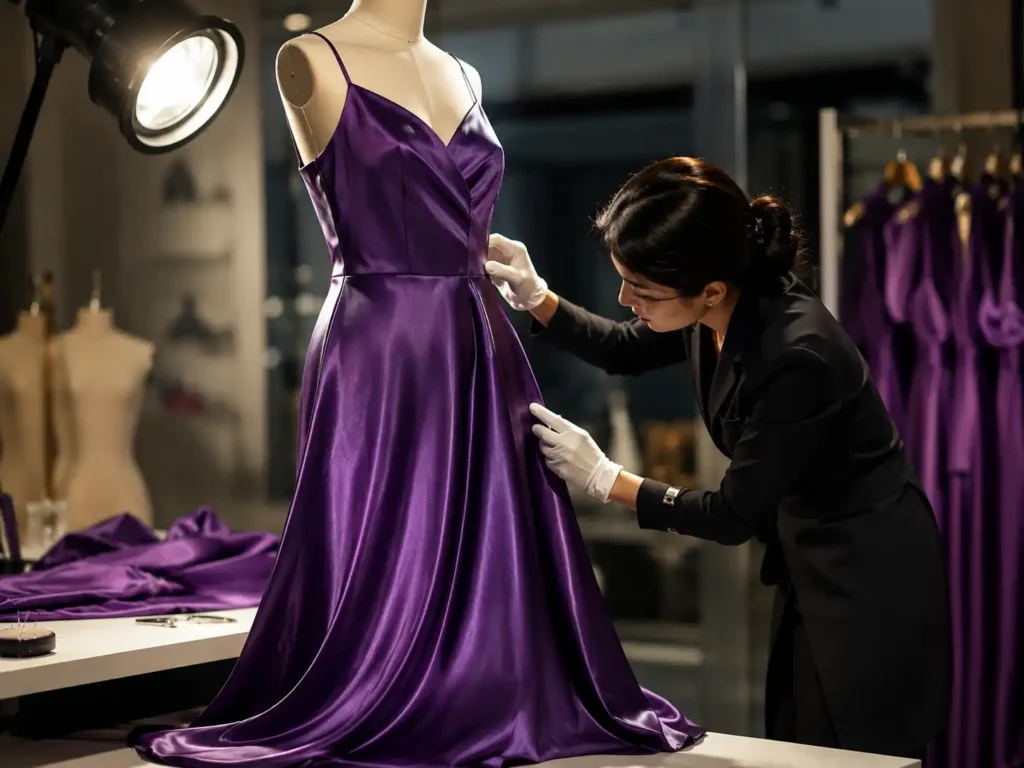
How Does Straight Grain Change Drape?
Straight grain is sometimes treated as another word for stiff, but that is not how satin behaves in practice. A soft lightweight satin can fall beautifully on straight grain because drape comes from several factors at once: yarn size, weave density, finishing, GSM, pattern width, seam placement, and the total weight of the garment. What straight grain changes is how much extra movement comes from yarn displacement. Because the lengthwise structure remains more stable, the silhouette usually falls in a more controlled and predictable way.
That predictability is useful when a design needs a clean vertical line. A straight-grain skirt is less likely to lengthen dramatically after hanging, and a shaped bodice is easier to evaluate against the original paper pattern. If a straight-grain sample feels too rigid, changing the grainline is not automatically the best correction. A softer satin, lower GSM, different finish, increased skirt volume, altered seam placement, or a lighter lining may produce the desired movement while preserving the dimensional control needed for bulk production.
How Does Straight Grain Affect Fit?
A close-fitting straight-grain satin dress asks the pattern to do most of the shaping work. Because the fabric offers limited diagonal accommodation, errors in bust, waist, hip, or seat volume tend to show clearly as drag lines, zipper tension, horizontal wrinkles, or side-seam displacement. This can seem less forgiving during sampling, but it is also useful because the problem is easier to isolate. When the fabric is stable, a fit issue is less likely to be hidden temporarily by diagonal movement.
For fitted styles, technicians usually review bust projection, waist suppression, front-to-back hip balance, seat allowance, neckline stability, zipper position, lining ease, and side-seam location together. A side seam moving forward does not always mean the fabric was cut off grain; it can also mean the back hip needs more volume. This distinction matters because the wrong correction can introduce a new problem. Good satin fitting starts with identifying whether the cause is pattern balance, grain placement, sewing stretch, or a combination of those factors.
Which Satin Styles Work Well on Straight Grain?
Straight grain is often the stronger choice when the silhouette depends on controlled construction rather than soft diagonal collapse. Structured satin minis, corset dresses, fitted cocktail dresses, panelled evening dresses, sharply shaped bodices, pleated skirts, and styles with precise waist seams all benefit from a stable base. In these garments, shape may come from darts, boning, cups, interfacing, princess seams, pleats, gathers, or carefully graded side seams, and uncontrolled bias movement can work against those features.
A corset-style satin mini is an easy example. The bodice needs a stable cup shape, predictable boning channels, a secure waist, clean zipper insertion, and consistent neckline placement. Those requirements usually favor straight grain for the main structural pieces. The dress can still use bias strategically in a cowl, binding, overlay, draped panel, or separate skirt section. Experienced pattern development is often less about declaring the whole garment “straight grain” or “bias cut” and more about assigning the correct grain to each component according to what that component needs to do.
How Does Straight Grain Help Bulk Consistency?
As a style moves from one approved sample to several hundred or several thousand pieces, small sources of variability become more important. Straight-grain construction usually reduces one of those variables because finished length and width remain closer to the pattern dimensions after cutting and hanging. This helps with size grading, waist placement, skirt length, zipper position, and left-right symmetry, particularly when a collection includes several colors or repeated orders produced from different fabric lots.
Straight grain does not guarantee consistency on its own. Fabric can still be spread under tension, layers can creep during cutting, or pattern pieces can shift away from the intended grainline. The advantage is that once the grain is controlled, the pattern behaves more predictably across the size range. For brands that need reliable ecommerce measurements, replenishment orders, or multi-color launches, that predictability can be more valuable than maximizing fluidity in a silhouette that was never intended to behave like a classic bias slip.
How Does Bias Grain Change Drape and Fit?
Bias grain gives woven satin more diagonal movement because warp and weft yarns can shift relative to each other. That movement lets the dress lengthen, narrow, contour more closely to body curves, and produce softer folds. The same behavior also increases sensitivity to cutting accuracy, seam handling, garment weight, settling time, and hem balance, so bias should be designed deliberately rather than treated as a styling shortcut.
How Does Bias Cutting Create More Drape?
The extra fluidity of bias comes from geometry rather than from the fabric suddenly becoming softer. Warp and weft yarns cross each other at approximately right angles. When tension is applied along those yarn directions, the structure resists extension relatively strongly. When the same fabric is loaded diagonally, the rectangular yarn grid can distort toward a diamond shape. The yarns shift relative to one another, allowing the fabric to extend diagonally and redistribute its width under gravity.
On a satin dress, that movement changes how the fabric negotiates body curves. Instead of hanging away from the hip like a relatively stable sheet, bias satin can move around the curve, narrow slightly, and then fall back toward the vertical line below it. The effect can look very fluid, but it is not unlimited or uniform. Fabric weight, weave density, panel size, seam direction, and total garment weight all influence how much movement occurs. A successful bias silhouette depends on the actual fabric and pattern working together, not on the 45-degree angle alone.
How Does Bias Affect Bust, Waist, and Hip Fit?
Bias changes the relationship between flat measurements and worn measurements. Two dresses can measure the same across the hip when laid flat, yet the bias version may feel more responsive because the yarn grid can shift around the body. At the same time, as the garment lengthens under gravity it may become slightly narrower, which can make the fit more body-conscious after the dress has been hanging for a while. This is one reason bias garments should never be judged only against a flat measurement chart.
During fitting, technicians watch whether the center front stays centered, the neckline remains symmetrical, side seams stay close to vertical, and the hip does not pull one side of the skirt upward. They also check whether the dress becomes visibly longer after rest and whether the back narrows more than intended. Bias can soften transitions between bust, waist, and hip, but it cannot rescue a fundamentally poor pattern. If the base proportions are wrong, the garment may simply distort in a more complicated way.
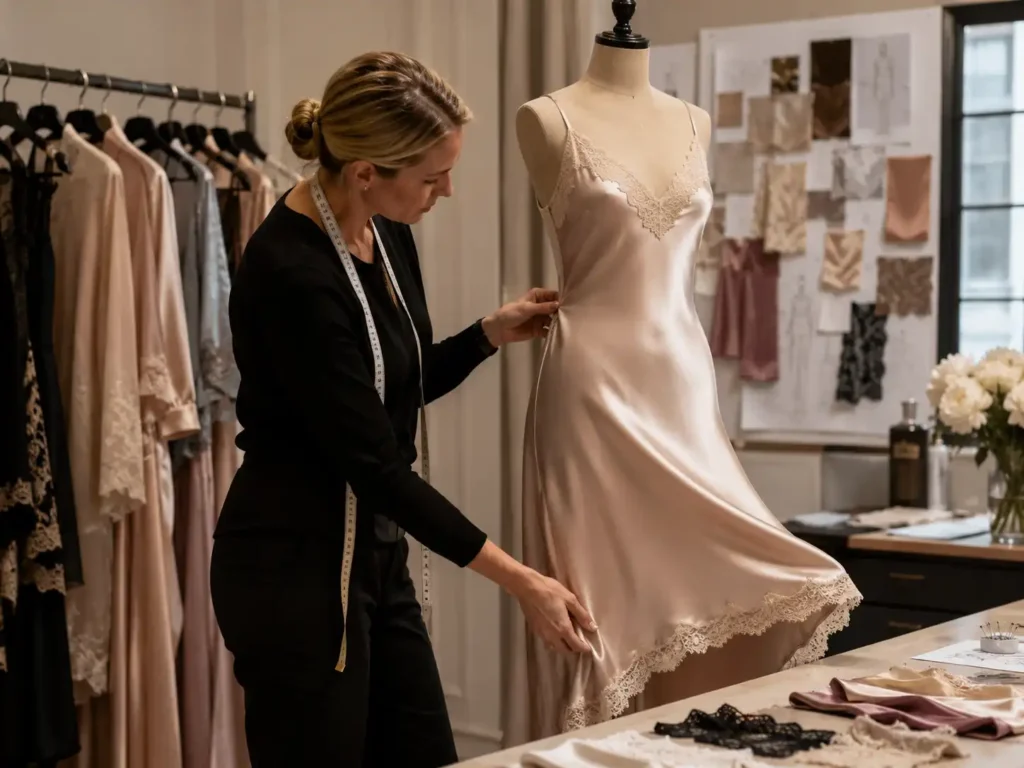
Does Bias Cutting Make Satin Stretch?
Bias cutting creates mechanical give, but it does not turn woven satin into a true stretch fabric. In a non-elastane satin, the extra movement comes from warp and weft yarns shifting diagonally. Recovery is usually more limited and less predictable than the recovery of a polyester-spandex satin, where elastic fibers are designed to elongate and return toward their original length. The wearer may experience both as “stretch,” but the pattern maker needs to treat them as different systems.
This distinction becomes important during fabric substitution. A bias pattern developed in non-stretch satin should not automatically be moved to straight-grain stretch satin because both fabrics appear to accommodate the body. The straight-grain stretch version may need different negative or positive ease, different seam stabilization, and different neckline control. Bias stretch satin adds both diagonal yarn movement and elastane, which can be useful for some designs but can also create excessive mobility. The right choice is the combination that produces the intended silhouette and remains repeatable in production.
Why Do Bias Dresses Grow After Hanging?
Bias growth happens because gravity continues to act on diagonally oriented yarns after the dress leaves the sewing machine. The effect is often more visible in long or full garments because a larger mass of fabric is pulling downward. Curved hems can also contain several grain angles at once, so one area may behave close to straight grain while another sits near true bias. Those sections do not necessarily lengthen by the same amount, which is why a hem that looked level immediately after assembly can become uneven later.
There is no single settling time that fits every satin dress. Lightweight slips, heavy evening dresses, lined styles, and dresses with embellishment can all stabilize at different rates. A better production practice is to compare actual length at defined points after assembly and again after the garment has rested under normal hanging conditions. Once repeated checks show that the shape has stabilized enough for the style, the hem can be balanced to the garment as it really hangs rather than to the theoretical paper pattern.
Which Satin Dresses Need Bias Cutting?
Bias cutting is most useful when the design depends on soft body contouring, fluid movement, and diagonal drape rather than firm structural control. Classic slip dresses, cowl-neck styles, softly fitted midi and maxi dresses, and some evening silhouettes often benefit from bias. Structured satin garments may perform better on straight grain, so the decision should follow the desired silhouette, fabric weight, stretch, lining, and fit strategy.
Do Slip Dresses Need a Bias Cut?
The classic slinky satin slip is strongly associated with bias cutting, but the style name alone does not determine the grainline. A traditional bias slip uses diagonal movement to skim the bust, waist, and hips with relatively few shaping seams. That creates the uninterrupted, liquid silhouette many people associate with 1990s-inspired slips, evening dresses, and modern occasionwear. When the fabric and pattern are balanced well, the garment can look close to the body without feeling as rigid as a straight-grain woven sheath.
Commercial slip dresses are also developed in other ways. Stretch satin can provide body movement on straight grain, while bust darts, shaped side seams, center-back seams, princess shaping, adjustable straps, or a slightly looser cut can create a clean slip silhouette without true bias. The reference sample should decide the method. If the design depends on soft diagonal folds and body-skimming movement, bias is likely central. If the brand needs tighter measurement control across many sizes, a stable grain with engineered shaping may be the better production decision.
Which Dress Styles Benefit Most From Bias?
Bias works best when movement itself is part of the design language. Satin slip dresses, cowl-neck dresses, fluid midi dresses, softly shaped evening gowns, column dresses, selected bridesmaid styles, and draped maxis can all benefit from diagonal give. Cowl necklines are a particularly clear example because bias lets fabric collapse into soft folds rather than breaking into hard creases. In skirts, bias can also make fullness move more smoothly over the thigh before releasing toward the hem.
The trade-off is that bias often uses fabric less efficiently and demands more controlled handling. Large pattern pieces sit diagonally across the usable width, which can reduce marker yield. Cut parts are more vulnerable to distortion, and seams may need more support during assembly. For a commercial collection, bias is most worthwhile when those production costs create a visible result that customers can actually see and feel. If the silhouette already flows well on straight grain, adding bias complexity does not automatically make the dress more premium.
Which Styles Are Better on Straight Grain?
Dresses that depend on precise shape, internal support, or stable measurements are usually stronger candidates for straight grain. Corset minis, tailored satin dresses, structured cocktail dresses, pleated skirts, fitted zip-back styles, and panelled occasionwear all need predictable alignment between fabric and pattern. A boned bodice is designed to resist movement; a sharply pleated skirt needs folds that stay where they were set; a defined waist seam has to align consistently across the size range.
Straight grain also becomes attractive when a brand expects repeat orders, multiple colorways, or frequent replenishment. Satin from different lots can vary slightly in hand and flexibility even when the specification is nominally the same. A stable construction reduces the chance that those differences will radically alter the silhouette. Mixed grain is often the best compromise: the main body can remain straight while a cowl, draped overlay, flare insert, bias binding, or separate skirt panel uses diagonal movement only where it adds a clear design benefit.
How Do Satin Weight and Stretch Change the Choice?
Weight and stretch can change the grain decision even when the design sketch stays the same. The ranges below are practical working categories rather than universal textile standards, because weave density, yarn type, finishing, and supplier construction can make two fabrics at the same GSM behave very differently. Still, the ranges are useful when discussing early development because they help explain why a lightweight slip satin and a substantial evening satin should not be expected to respond identically on bias.
| Approx. Satin Weight | Typical Hand | Bias Response | Common Development Focus |
| 80-120 gsm | Light and fluid | Strong movement, easier distortion | Opacity, seam marks, growth, lining |
| 120-170 gsm | Medium-light to medium | Balanced drape and control | Slip, midi, occasion styles |
| 170-220 gsm | Medium-heavy to heavy | More substantial, slower drape | Structured dresses, eveningwear, cleaner shape |
| Stretch satin | Variable | Depends on elastane plus grain | Recovery, ease, seam tension, neckline stability |
A light satin near the lower end can become extremely fluid on bias, which may be perfect for a delicate evening slip but difficult for a sharply fitted mini. A heavier satin may still contour the body on bias, yet the folds will generally look broader and more substantial. Stretch content adds another decision point. Before approving the grainline, the development team should measure which direction stretches, assess recovery after repeated extension, and review the finished sample on the body rather than choosing based on hand feel alone.
How Do Grain Errors Affect Satin Dresses?
Incorrect grain placement can make a satin dress twist, pull, shift at the side seams, develop an uneven hem, or appear to contain mismatched shades. These problems happen because different areas of the garment respond unevenly to gravity and tension. Satin makes them unusually visible because its reflective surface highlights changes in panel direction, surface strain, seam balance, and pressing more strongly than many textured fabrics.
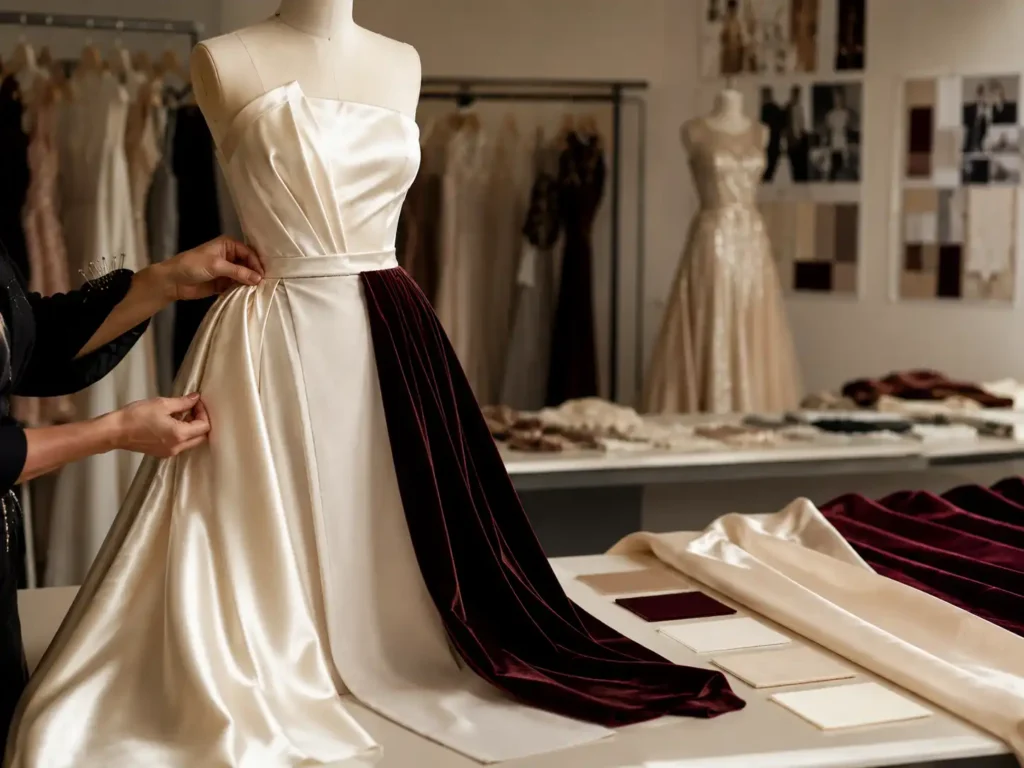
How Does Wrong Grain Cause Dress Twisting?
A dress can twist even when every seam is sewn with a straight stitch line. If a large panel is cut several degrees away from its intended grain, the two sides of that panel may not relax in the same way. One area can behave more like straight grain while another moves closer to bias, creating unequal response under gravity. The garment then develops torque, and a side seam, center seam, or skirt panel may begin to rotate around the body instead of hanging vertically.
The risk increases when satin is spread under uneven tension, multiple slippery layers creep during cutting, pattern pieces are rotated to improve marker yield, or large cut panels are stretched during bundling and transfer. Pressing can sometimes make a twisted garment look better for a short period, but it cannot permanently correct the yarn orientation inside the panel. If the problem originates in cutting, the reliable solution is to correct the grain alignment before more units are produced rather than trying to press the defect out at final finishing.
Why Do Satin Side Seams Move Forward or Back?
Side-seam rotation deserves careful diagnosis because grain is only one possible cause. If front and back panels have different grain behavior or have grown unequally, the seam may rotate under gravity. On a bias dress, that possibility is real. Yet a stable straight-grain dress can show the same symptom if the body needs more volume in one area. A fuller seat, prominent abdomen, or larger bust can pull fabric from another region and move the seam even when the cutting grain is correct.
A useful check is to observe the garment in three states. First, lay it flat and examine whether the seam is already distorted. Second, hang it without a body inside and see whether the seam rotates under its own weight. Third, fit it on the intended body or form and watch what changes only when body volume is introduced. If rotation appears mainly during fitting, pattern balance becomes a stronger suspect. This simple sequence prevents teams from moving grainlines to solve what is actually a fit problem.
Why Does a Bias Hem Become Uneven?
A flared or curved hem naturally includes several grain directions within the same garment. Some sections may sit near straight grain, while others approach true bias. Those areas do not lengthen equally once the garment is assembled and gravity begins pulling on the full dress weight. The result can be a hem that develops low points at the side, front quarter, back quarter, or other high-bias areas even though the original paper pattern was perfectly symmetrical.
The practical solution is to measure the sewn garment from a stable reference point – often the waist or another fixed seam – to the hem at several positions such as center front, side seam, and center back. The shell and lining should be reviewed together because they may grow at different rates. Final leveling should be based on the settled garment rather than the cutting pattern alone. On long satin dresses, this step is especially important because a small imbalance that is barely noticeable on a mini can become obvious near the floor.
Do Mismatched Grain Directions Change Satin Color?
Mismatched grain directions can change perceived color even when the dye has not changed at all. Satin reflects light directionally, so one panel may look darker or brighter simply because its surface is facing the opposite way. The effect becomes more obvious on symmetrical garments, where the eye immediately compares left and right panels, and under photography lighting, showroom spots, sunlight, or flash that produces strong directional highlights.
When a shade mismatch appears, quality teams should separate four possible causes before taking action: true dye-lot variation, directional sheen, pressing or glazing, and surface distortion from seam tension. Each requires a different correction. Dye-lot problems start with material control, grain-direction problems start with marker planning and cutting, pressing marks start in finishing, and tension-related shading starts in sewing. Treating every visual mismatch as a fabric-color problem wastes time and can lead to re-cutting or re-dyeing without fixing the real cause.
How Do Manufacturers Control Grain Direction?
Manufacturers control grain direction through the full development chain: patterns define the intended orientation, fabric is checked before spreading, satin is aligned and stabilized during cutting, samples are assessed for twisting and growth, bias-sensitive garments are allowed to settle before final hemming, and bulk QC checks panel direction, seam balance, sheen, measurements, pressing, and finished symmetry against the approved sample.
How Is Grainline Defined in the Pattern?
The cutting room should not be expected to invent grain placement. That decision belongs in product development and should be clear on every major pattern piece. Straight-grain components need an unambiguous grainline, true bias pieces need the intended 45-degree relationship, and one-way satin should be identified so marker planning does not reverse visible pieces simply to increase fabric utilization. The same discipline is needed when a dress mixes structures, such as a straight-grain bodice with a bias skirt, bias cowl, or diagonal overlay.
Grainlines also need to survive pattern revisions. When a technician changes a skirt panel, adds width at the hip, moves a seam, or adjusts a neckline, the grainline should be checked again rather than copied blindly from the previous version. By the PP sample stage, the orientation of every visible component should already be settled. At Jinfeng Apparel, satin dress development is handled through fabric review, pattern development, fit correction, sample revision, PP approval, bulk production, and quality control, which allows grain decisions to be checked at several stages instead of being left as a final cutting-room assumption.
How Is Satin Controlled During Cutting?
Satin needs disciplined spreading because smooth surfaces allow layers to slide against each other. A stack can appear aligned from above while lower plies have already moved several millimeters. That may be enough to change seam matching, left-right symmetry, or the effective grainline of a narrow panel. Cutting control therefore starts with fabric relaxation where appropriate, roll-direction identification, careful alignment to the marker, limited spreading tension, stable lay height, and a cutting method suited to the slipperiness of the specific satin.
For particularly mobile or bias-sensitive fabrics, lower-ply or single-layer cutting may be considered when quality requirements justify the additional time. Cut parts also need controlled handling after they leave the table. Large bias pieces should not be allowed to hang or stretch differently from the rest of the bundle, and left-right or directional parts should be identified clearly so operators do not reverse them during sewing. The most economical point to catch a grain problem is before sewing begins, because once hundreds of panels are cut at the wrong orientation there is no finishing process that can restore the original yarn geometry.
How Do Samples Reveal Grain Problems?
A satin fit sample is more than a preview of the style; it is a practical test of the relationship between fabric, pattern, grain, construction, lining, closures, and gravity. Once the dress is on a body, issues that were invisible on the table become easier to see. The team should look beyond bust, waist, and hip measurements and examine whether center front stays vertical, side seams remain balanced, the neckline sits symmetrically, the zipper lies flat, and the skirt rotates after the wearer walks or changes posture.
The sample should also be reviewed after it has rested. If a hem that was level immediately after sewing drops later, that information belongs in the production method. If one side seam starts correctly but rotates after hanging, the team should investigate grain balance before modifying fit. If the seam only shifts when worn, body-volume distribution becomes more relevant. This is where experienced manufacturing support adds value: the goal is not merely to copy the appearance of a reference image, but to identify the combination of fabric, grain, pattern, and construction that can reproduce that appearance reliably in bulk.
What Should QC Check Before Bulk Approval?
Grain-related quality control works best when it follows the garment from fabric approval through packing rather than relying on a single final inspection. Satin should be checked for roll direction, lot consistency, width, weight, stretch, and sheen before cutting. Pattern and marker review should confirm grainline and directional restrictions. During sewing, inspectors should watch for stretched seams, puckering, rotated panels, and left-right mismatch. After pressing, the garment should be viewed hanging naturally because a dress can pass flat measurements and still twist visually.
| Production Stage | Key Grain-Related Check | Useful Record |
| Fabric approval | GSM, width, stretch, sheen direction, lot consistency | Fabric and roll reference |
| Pattern and marker | Grainline, bias angle, one-way pieces | Approved pattern and marker version |
| Cutting | Alignment, layer creep, component direction | Cut-lot record |
| Sample fitting | Twist, drape, side seams, neckline, hip balance | Fit photos and comments |
| Settling and hemming | Length change and left-right balance | Before-and-after measurements |
| PP and bulk | Final silhouette, sheen, zipper, hem, seam behavior | Sealed sample and in-line QC |
| Final inspection | Measurements, twisting, pressing, packing wrinkles | Inspection report |
At Jinfeng Apparel, the documented QC flow includes incoming material inspection, cutting QC, sewing QC, in-line inspection, garment inspection, pressing review, packing QC, AQL inspection support, and repeat-order quality records. For satin specifically, the most useful checks include snagging, color and sheen consistency, zipper flatness, seam marks, wrinkles, pressing traces, lining behavior, and hem balance. These controls matter because a satin dress can meet the measurement chart and still fail visually if the grain, surface, and garment balance are not working together.
Conclusion
Grain direction is one of the quiet decisions that determines whether a satin dress feels effortless or technically troublesome. Straight grain gives stability, repeatable dimensions, and a controlled vertical fall, while bias introduces diagonal give, softer contouring, and the fluid movement associated with many slip and evening dresses. Neither is automatically superior. The best grainline is the one that matches the fabric weight, stretch, pattern structure, lining, body shape, intended silhouette, and production requirements of the specific style.
For brands developing satin collections, the practical advantage comes from making that decision early. Grain should be discussed during fabric and pattern development, tested in the sample, checked again after the garment has settled, and protected through marker planning, cutting, sewing, pressing, and bulk inspection. A satin dress that twists or changes shade under light is difficult to rescue at the end of production, but many of those problems are preventable when the grainline is treated as part of garment engineering rather than a simple cutting instruction. That approach also makes repeat orders easier because the approved grain, fabric behavior, pattern version, and QC findings can be carried forward instead of rediscovered every season.
Share This Article :

Jerry Lee
Categories

Latest blogs
Table of Contents
Here, developing your OEM/ODM private label clothing collection is no longer a challenge—it’s an excellent opportunity to bring your creative vision to life.

