 Skip to content
Lace Dress Quality Control Checklist: What Should You Inspect Before Bulk Production?

Your trusted Women’s Apparel Manufacturer from China

Lace has an unusual way of exposing manufacturing shortcuts. A satin dress can sometimes hide a small internal sewing variation, but lace puts the construction on display: the motif position, open ground, lining color, seam joins and decorative edge are all visible at once. That makes a lace dress especially sensitive to small production differences. A floral motif that shifts by only a few centimeters may change the visual balance of the entire bodice, while a lining that is slightly too short can suddenly make a carefully designed sheer area look accidental rather than intentional.
A reliable lace dress quality control checklist should verify the approved lace and lining before cutting, then control motif placement, panel symmetry, seam matching, edge integrity, measurements, fit, closures, pressing, labels and packing throughout production. Final inspection should compare finished garments with the approved sample and specifications, while any AQL sampling plan should be treated as shipment verification rather than a substitute for material, cutting, sewing and in-line quality control.
The expensive problems are rarely the dramatic ones spotted immediately. The harder problems are the small ones that repeat. One side seam with imperfect motif continuity may be repairable; the same mismatch repeated across an entire order becomes a collection-wide appearance issue. One different lace dye lot may seem harmless on the roll, yet mixed panels can show two tones under retail lighting. Strong QC works by catching those patterns before they become finished garments.
What Should Be Checked Before Production?
Before bulk cutting begins, confirm the approved lace, lining, color, stretch behavior, motif position, pattern version, trims, size chart, construction method and QC standard. Lace should be inspected before cutting because shade variation, damaged motifs, incorrect stretch direction or unsuitable lining can affect hundreds of garments once production starts. Final inspection cannot economically correct problems already built into every cut panel.
Lace Fabric Condition
The first decision is not simply whether a lace looks attractive. It is whether the bulk material reproduces the lace that was approved during development. Common dress laces include polyester, nylon, cotton, stretch, embroidered, floral and eyelash constructions, and the company knowledge base records a broad working range of roughly 60-250 gsm for lace used in womenswear. That range alone shows why one generic handling rule cannot fit every lace: a light open net behaves very differently from a dense embroidered lace with substantial motif coverage.
Incoming material inspection should compare color, usable width, hand feel, apparent density, motif scale, repeat direction, stretch, recovery, ground-net condition and decorative edges against the approved reference. Inspectors should also look for holes, broken embroidery, pulled yarns, snags and shade changes between rolls. Pale colors deserve particular attention because ivory, cream, blush and nude can shift visibly when placed over different linings. A lace that looks correct on a dark cutting table may appear much more transparent when stretched over a mannequin, so assessment should include the intended lining whenever transparency is part of the design.
Control Point | Practical Record | Main Risk if Missed |
Lace weight | Approximate gsm; common working range 60-250 gsm | Drape, opacity and structure change |
Usable width | Full width and defect-free width | Marker efficiency and panel placement change |
Stretch | Direction and recovery behavior | Fit, seam stability and panel distortion |
Shade | Roll or dye-lot reference | Panel-to-panel color mismatch |
Motif repeat | Repeat size and direction | Poor symmetry or seam matching |
Decorative edge | Scallop or eyelash condition | Uneven neckline or hem finish |
Lining | Color, stretch and opacity | Different appearance, comfort or coverage |
Defects Before Cutting
Lace is more difficult to inspect than a solid woven fabric because empty space is part of the design. An inspector has to understand the repeat before deciding whether an opening is intentional or a true hole. The most reliable method is comparison: find the same part of the motif in the next repeat and see whether the expected yarn, flower, leaf, connecting thread or mesh ground is present. A broken connection, incomplete embroidery or torn ground is very different from deliberate openwork.
Defect severity also depends on location. A minor irregularity hidden inside a seam allowance is not equivalent to the same problem at center front, across the bust, on an exposed sleeve or along a scalloped hem. Fabric intended for high-visibility panels should therefore receive stricter visual screening. It is usually better to isolate damaged areas before cutting than to rely on repairs after sewing. A repair can restore strength while still leaving a change in texture, stitch density or sheen that becomes visible in close-up product photography or under direct lighting.
Bulk Approval References
Production becomes inconsistent when each department is working from a different version of the product. Before bulk begins, the approved garment should be tied to the current pattern, fabric, trims, size chart, construction details and packing requirements. In the documented Jinfeng production system, PP sample approval and Golden Sample references are supported by production orders, sewing instructions, BOM information, measurement tolerances, fabric and trim approvals, QC checklists and packing instructions. The purpose is straightforward: the cutting room, sewing line and final inspector should be judging the same dress against the same standard.
For lace styles, the reference needs to be especially clear about visual decisions that cannot be described well with measurements alone. Which motif should sit near center front? Do the sleeves need mirrored placement? How much continuity is expected at the side seam? Is the natural scalloped edge forming the hem, or is the hem constructed separately? When these points are left vague, quality control becomes subjective. A useful rule is that if two experienced inspectors can reasonably reach opposite conclusions from the same garment, the approval standard probably needs more detail before production proceeds.
Lining and Trim Compatibility
A lace can be correct while the finished dress is still wrong because another component changes how it behaves. Lining should be checked for color, opacity, weight, stretch, recovery and attachment method. A rigid lining under highly elastic lace may restrict the body and create tension lines; a very elastic lining under stable lace can bunch or shift. In sheer styles, lining color also becomes part of the visible design, so a small undertone change can make the outer lace appear warmer, cooler, lighter or darker.
Closures deserve the same early review. Several layers often converge around a center-back or side zipper: lace, embroidery, lining, seam allowance and zipper tape. If a dense motif falls directly under the zipper seam, thickness can make the closure wave or become difficult to operate. Thread color, hooks, loops, decorative trims and labels should also be locked before bulk. Pre-production QC is most valuable when these interactions are resolved while changes are still relatively inexpensive, not after the first large cutting lay has already been completed.
Which Lace Defects Matter Most?
The most important lace defects are holes, torn netting, broken motifs, shade variation, damaged edges, distorted pattern repeats and poor stretch recovery. Their seriousness depends on location, visibility, structural effect and repetition. A small defect inside a hidden seam may be minor, while the same defect at the bust, neckline, center front or scalloped hem can make the garment commercially unacceptable.

Holes and Broken Motifs
The most common mistake in lace inspection is judging isolated openings without understanding the pattern. Floral and embroidered laces can have irregular negative spaces by design, so a gap should be compared with neighboring repeats before it is classified as a defect. Genuine problems include torn ground netting, broken connecting yarns, incomplete flowers, missing embroidered sections, pulled threads and scallops that have been cut or broken unintentionally. Damage near seams is particularly important because sewing tension can enlarge a weakness that initially looks harmless.
Location changes the commercial impact. Center-front bodice panels, bust areas, upper back, neckline edges and exposed sleeves are less forgiving than concealed internal areas. A good visual routine is to inspect at close range for structure, at arm’s length for workmanship, and several steps away for overall balance. The goal is not to reject every tiny natural irregularity in a complex textile. It is to prevent defects that make the garment look damaged, weaken the lace or create obvious inconsistency across an order.
Shade and Lot Variation
Shade variation is easy to underestimate because lace is visually influenced by whatever sits underneath it. The same ivory lace can look warmer over beige lining and cooler over a pale grey-nude lining, so shade approval should use a consistent background and, when possible, the intended lining. Roll-to-roll variation should be separated from panel-to-panel variation: a roll can be individually acceptable yet still be unsuitable for mixing with another lot in the same garment.
For pale pink, cream, champagne, nude, white and pastel occasion dresses, small shifts in undertone can become obvious when adjacent panels meet at a waist or side seam. If more than one dye lot must be used, material should be managed deliberately rather than mixed randomly. Keeping the panels of each garment within a consistent lot is often safer than combining visibly different batches. The practical lesson is simple: shade is cheaper to control as fabric. Once a lighter bodice has been sewn to a darker skirt, correction may require panel replacement rather than simple finishing work.
Stretch and Recovery Problems
Stretch lace creates quality risks that do not appear in the same way with stable lace. A material may meet the visual standard yet grow after sewing, pressing, hanging or fitting if recovery is weak. Inspectors should check the direction of stretch, the degree of recovery after extension, edge curling, motif distortion and whether different rolls behave similarly. Panels cut with inconsistent stretch orientation can create left-right differences even when the paper pattern is identical.
The relationship between lace and lining is just as important. If the lace stretches far more than the lining, the outer layer may bubble or look loose while the lining controls the actual fit. If the lining stretches more than the lace, the outer fabric can carry excessive tension and become uncomfortable or distorted. The company lace knowledge base specifically distinguishes stretch and non-stretch lace pattern behavior, which is a useful production reminder: replacing one lace with another because they look similar can still change fit, seam performance and long-term garment shape.
Edge and Surface Damage
Decorative edges are often one of the reasons lace was selected in the first place. A scalloped hem, eyelash neckline or shaped floral border can form the finished edge with very little additional trim, but that also means any damage remains visible. Inspectors should look for incomplete scallops, fraying, cut connecting yarns, inconsistent trimming, missing eyelash fibers and obvious left-right differences. When the natural edge forms the hem, the rhythm of the decorative repeat should feel deliberate around the whole garment.
Snags are another common surface issue. Fine lace can catch on rough worktables, machine parts, jewelry, storage bins or other decorated garments. A snag may not create an immediate hole, but it can pull a motif out of shape and weaken the ground. Clean handling surfaces and sensible separation of delicate garments often prevent more defects than extra end-of-line sorting. In practical factory work, prevention usually costs less than repair, and repaired lace can remain visible even when the structural damage has technically been fixed.
How Should Lace Motifs Be Aligned?
Lace motifs should be deliberately positioned around the areas people notice first: center front, bust, neckline, waist, sleeves, center back and hem. Exact matching is not necessary for every design, but important areas should look intentional. Symmetry, seam continuity and scalloped-edge balance should be confirmed during sampling because changing motif placement after bulk cutting usually requires recutting and additional material.
Center and Bust Placement
Large floral motifs behave almost like printed graphics once they are placed on the body. A dress can measure perfectly and still look awkward if one dominant flower sits directly over one bust point while the opposite side contains mostly open mesh. Before cutting, review center-front position, left-right bust coverage, neckline balance, waistline crossing, center-back placement and any transparent areas over sensitive parts of the body. These decisions are especially important in nude-lined or lingerie-inspired styles where opacity varies across the lace repeat.
The company lace-dress control notes specifically identify center motif position, left-right symmetry, front-to-back connection, side-seam continuity, chest coverage and hem-edge integrity as key considerations. In practice, the best time to settle those choices is the PP sample. Once the sample establishes the desired visual effect, the cutting room needs a clear reference rather than relying on personal taste for each garment. Visual quality becomes much more stable when motif placement is treated as a production specification rather than an informal aesthetic preference.
Left and Right Symmetry
Perfect mirroring is not always necessary, and sometimes it can increase fabric consumption significantly when the repeat is large. The important decision is where symmetry is essential and where controlled variation is acceptable. Bust panels, corset-style cups, shoulders, sleeves, neckline inserts and center-front details usually deserve stronger symmetry because the human eye compares the two sides immediately. Wide skirt panels can often tolerate more variation as long as the overall motif direction and visual weight remain balanced.
Garment Area | Alignment Priority | Main Check |
Center front | Very high | Dominant motif centered or intentionally offset |
Bust | Very high | Balanced coverage and similar visual weight |
Shoulders | High | Comparable motif scale and direction |
Sleeves | High | Similar focal motif position left to right |
Side seams | Medium-high | No awkward motif collision or sudden shift |
Skirt panels | Design dependent | Consistent direction and overall balance |
Scalloped hem | Very high when exposed | Complete and level decorative edge |
A useful inspection method is to lay the finished garment flat and compare both sides simultaneously. The eye often finds imbalance faster than a tape measure. Bulk inspectors do not need to compare every tiny flower; they need to confirm that dominant motifs create the same visual impression as the approved garment.
Seam Matching
Good cutting can be undermined during sewing if two accurately positioned panels feed through the machine at different rates. High-risk joins include side seams, princess seams, waist seams, center-back zipper seams and bodice-to-skirt connections. The finished seam should first be viewed from the outside. Does the main floral line continue naturally? Does a dense motif suddenly collide with another dense area? Does the seam create a dark patch that was not present in the approved sample?
The level of matching should reflect the design and price architecture of the product. Exact matching at every seam may increase material consumption because cutters lose freedom to nest pattern pieces efficiently. A sensible commercial standard often prioritizes perfect or near-perfect placement at center front and other high-visibility areas, controlled continuity at secondary seams, and reasonable variation where the repeat is visually quiet. These decisions should be made before final costing. Precise motif placement is achievable, but it should be treated as a real material and labor requirement rather than a free finishing detail.
Scalloped Hems
A natural scalloped lace hem can make a dress look refined with very little additional finishing, but only if the edge is planned from the start. Pattern placement should preserve complete scallop shapes, consistent vertical position and smooth transitions where the side seams meet. If the garment length is developed without considering the lace edge, the cutting room may be forced to trim through decorative motifs or create uneven scallop heights around the hem.
Flared and circular skirts need extra thought because a curved hem cannot always follow a straight scalloped fabric edge. Depending on the design, a separate lace border, applied motif or another construction method may give a better result than trying to force the natural edge around the curve. Lining length should be reviewed at the same time. A lining that drops below an exposed scallop immediately changes the design, while a lining that is too short may create more transparency than the approved sample. Outer lace and lining therefore need to be judged as one visual system.
How Do You Inspect Sewing and Lining?
Inspect lace sewing for stitch consistency, seam stability, puckering, symmetry, zipper flatness, motif movement and secure edges. Inspect the lining for twisting, pulling, exposure, incorrect length and incompatible stretch. Lace and lining must behave as one garment because even individually acceptable materials can create distortion when their stretch, weight or attachment points are poorly balanced.

Seam Quality
Lace seams are sensitive because stitches may pass through dense embroidery in one area and fine open netting a few centimeters later. That variation changes how the fabric feeds under the presser foot and how tension is distributed through the seam. Inspection should cover stitch consistency, seam allowance, skipped stitches, loose threads, puckering, twisting, excessive thickness, raw unstable edges and visible motif displacement. The outside appearance matters just as much as the internal construction because a strong seam can still look poor if it creates waves across the waist or pulls a flower out of shape.
The documented sewing QC system used by Jinfeng includes stitch density, seam quality, seam allowance, symmetry, zipper flatness, strap length, lace matching and lining attachment among its in-process checks. High-stress areas such as armholes, fitted side seams, bust seams, waist seams, zipper areas and slits deserve closer attention because they combine movement with visibility. The useful mindset is to look for repetition. One seam wave may be an isolated operator issue; the same wave appearing repeatedly usually points to machine setting, feeding, handling or construction method that needs correction before production continues.
Lining Balance
A well-made lining should support the dress without drawing attention to itself. It should not pull the lace upward, twist around the body, sag at the waist, show below the hem or create visible folds through transparent sections. Inspect attachment points at the neckline, armholes, bust, waist, side seams, zipper, slit and hem. Lining ease is particularly important in fitted garments: if the lining is smaller than the outer layer, it can become the part that controls the fit, while excessive lining volume may bunch underneath the lace.
Color should be judged after the garment is assembled because the finished appearance is created by both layers. Nude, beige, ivory, blush and tone-on-tone linings can change the perceived color and contrast of the same lace dramatically. For semi-sheer styles, a mannequin or fit model can reveal problems that a flat inspection cannot. Lace often opens over the bust and hip when tension increases, so areas that look sufficiently opaque on a table may appear considerably more transparent when the dress is worn.
Zippers and Closures
Zippers frequently reveal whether the construction has been engineered well. Lace, lining, embroidery, seam allowance and zipper tape can create substantial thickness at the center back or side seam, while elastic lace can be stretched accidentally as a non-stretch zipper is attached. The result is often a zipper that waves, twists, catches the lace or becomes difficult to close. Inspect zipper flatness, top-edge alignment, waist-seam matching, operation, the base of the closure and whether any lace has been trapped in the teeth.
The same attention applies to hooks, loops, covered buttons and other closures. A small hook that sits off-center or an unstable loop can reduce the perceived quality of an otherwise polished occasion dress. Functional inspection matters as much as appearance: open and close the zipper several times, then view the seam vertically while the garment is relaxed. On fitted dresses, the closure will be under tension during wear, so a slight wave on the table can become much more obvious on the body.
Comfort and Edge Finish
A lace dress can pass visual inspection and still generate returns if it scratches at the underarm, neckline or zipper. Some laces are naturally firm, and dense embroidered edges can become abrasive when seam allowances or decorative borders touch the skin repeatedly. Inspect exposed neckline edges, armholes, straps, bust edges, side seams, zipper tape and internal trim positions by touch as well as sight. Cut embroidery threads and stiff scallops are small details in the factory, but they can become significant discomfort after several hours of wear.
The best solution is not always more binding or heavier finishing. Adding a thick tape to delicate lace can make a neckline bulky and change the intended appearance. Sometimes better comfort comes from changing seam direction, lining placement, edge trimming or the position of a decorative motif. These adjustments are much easier during sampling than after bulk assembly. Comfort belongs inside the quality conversation because a garment that photographs well but feels unpleasant can still fail commercially through poor reviews, returns and low repeat purchase.
Which Measurements and Fit Points Need Checking?
Lace dresses should be measured against the approved size chart using clearly defined points of measure and agreed tolerances. Bust, waist, hip, total length, shoulder, sleeve, armhole, strap length, neckline depth, slit height, hem circumference and lining length are common checkpoints. Stretch lace also needs fit and recovery review because correct flat measurements do not always guarantee correct behavior once the garment is worn.
Key Measurements
The measurement list should follow the construction of the style rather than a generic dress template. Company inspection records include bust, waist, hip, total length, shoulder width, sleeve length, armhole, strap length, neckline depth, slit height, hem circumference and lining length as common garment checkpoints. A fitted lace mini dress may focus heavily on bust, waist, hip, armhole and strap position, while a floor-length occasion dress also needs careful control of slit height, overall length, lining length and hem balance.
The measuring method needs to be consistent. A specification called “dress length” is incomplete unless the starting and ending points are defined. High-point shoulder to hem, center-back neck to hem and waist seam to hem produce different numbers, and two teams can appear to disagree even when the garments are identical. Complex asymmetric necklines, shaped hems and corseted bodies benefit from diagrams or clearly described points of measure. Measurement records should also identify the size being checked because grading errors may appear only in larger or smaller sizes while the base size remains correct.
Tolerance Control
A tolerance is the permitted variation around a target measurement; it is not the target itself. This distinction matters in production because an order can technically remain within tolerance while consistently drifting toward one limit. If nearly every checked garment sits close to the maximum waist measurement, the pieces may individually pass, but the pattern or sewing process is clearly running larger than intended. Experienced QC teams watch the distribution of measurements, not just isolated pass-or-fail results.
There is no responsible universal tolerance for every lace dress. A small change at a fitted waist can affect comfort and silhouette more than the same numerical change in a wide skirt hem. The agreed sequence is therefore target measurement, defined measuring method, client-approved tolerance, actual garment measurement and recorded decision. Measurement checks are also more useful when they occur during production instead of only at final inspection. The documented quality system covers cutting QC, sewing QC, in-line inspection, garment measurement and final inspection, which helps identify systematic drift while correction is still practical.
Stretch Lace Fit
Stretch lace creates a useful reminder that measurements and fit are related but not identical. A dress can meet the flat size chart while behaving poorly on the body because the lace, lining and seams respond differently under tension. Inspect the relationship between the outer lace and pattern, the lace and lining, and the finished garment and approved fit. If the lining is less elastic, it may control the body fit while the lace bubbles. If the lining is more elastic, the outer lace may carry more tension and feel restrictive.
Fit review should look for side seams moving forward or backward, a waistline dropping, hip areas growing, necklines opening, armholes stretching and straps changing position after wear. Recovery should also be observed after fitting: the garment should return close to its intended shape rather than remaining visibly stretched. Flat measurement confirms whether the product was sewn to specification; fit testing confirms whether the chosen materials and construction behave correctly at those measurements. Strong apparel QC needs both views.
Hem and Lining Balance
Long lace dresses should be judged while hanging naturally as well as on the measuring table. Individual seam lengths may be correct while the finished hem still appears uneven because dense embroidered motifs, open net sections, lining tension or handling cause different areas to relax differently. Review front-to-back balance, left-to-right balance, scalloped-edge level, slit height, lining length and whether any heavy motifs are pulling local sections downward.
The lining should remain at the approved relationship to the lace. In dresses with an exposed sheer lower section, even a modest change in lining length can noticeably alter the visual proportion. A lining hanging below a decorative scallop is an obvious fault, but a lining that is too short can also create unintended exposure. Hem quality is therefore not just a tape-measure result. It is the combined outcome of pattern, fabric behavior, sewing tension, pressing and lining attachment. Final judgment should include both recorded measurements and a visual hanging check.
How Is Final Lace Dress Inspection Done?
Final lace dress inspection compares finished garments with the approved sample and specifications for style, color, measurements, motif placement, workmanship, lining, closures, pressing, labels and packing. Defects should be classified according to the agreed quality standard, while AQL sampling may be used for shipment acceptance. Final inspection should confirm earlier controls rather than become the first stage where systematic production problems are discovered.
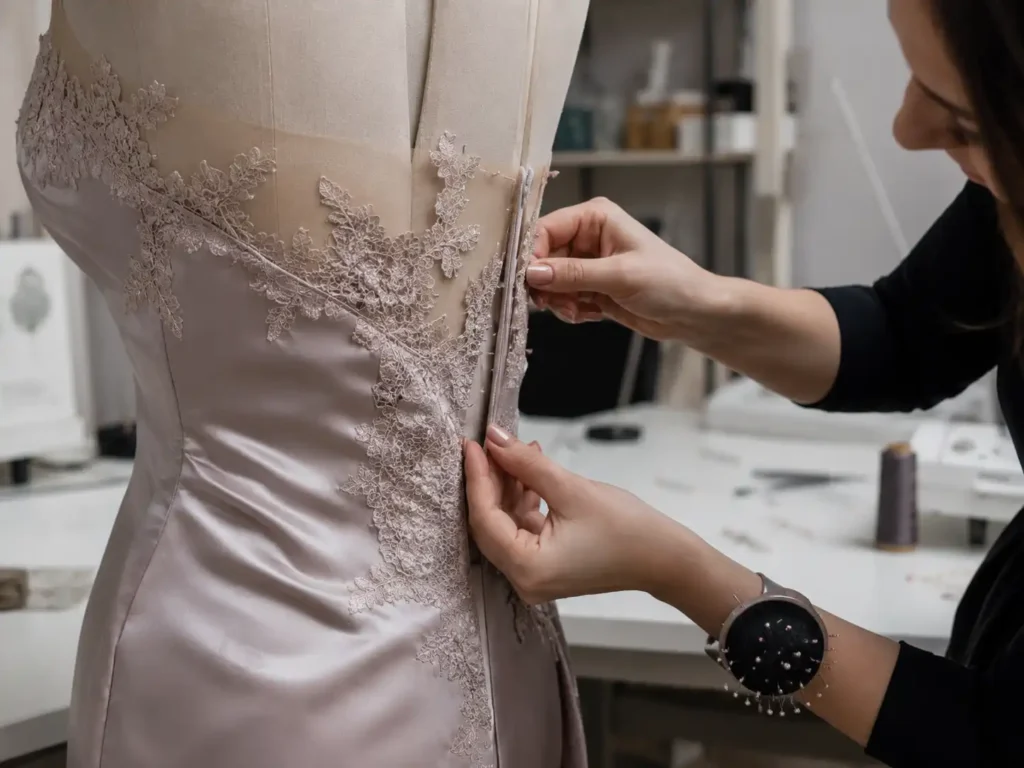
Finished Garment Review
Begin with the whole garment before looking for tiny faults. Place the dress in a natural position and compare its silhouette with the approved sample. Check whether dominant motifs sit correctly, whether the two sides feel balanced, whether the hem hangs naturally and whether the lining supports the intended shape. Only after the overall appearance looks right should the inspector move into detailed checks for seams, measurements, stains, snags, loose threads, zipper operation, lining exposure, pressing and labels.
The company’s finished-garment inspection framework includes color difference, stains, holes, snags, loose threads, asymmetry, crooked seams, zipper distortion, exposed lining and lace misalignment among its appearance checks. A consistent inspection sequence helps prevent attention from being consumed by small finishing defects while major construction issues are missed. One practical order is overall appearance, construction, measurements, cosmetic defects, labels and packing. The inspector should also separate repairable defects from structural ones. Loose threads can usually be corrected; a badly positioned center-front motif normally cannot be fixed without replacing a panel.
Defect Classification
Professional garment inspection normally separates defects by severity so that a small cosmetic deviation is not treated in the same way as a problem that affects safety, fit, function or saleability. The familiar categories are critical, major and minor, but the exact definitions should follow the client’s approved inspection standard. A visible hole at center front, a non-functioning zipper, a serious measurement failure and a small internal thread end do not have the same commercial effect and should not be evaluated as if they did.
For lace dresses, four practical questions help when judging severity: Is the problem visible during normal wear? Does it affect fit or function? Can it worsen with use? Would a reasonable shopper consider the garment defective? Location again matters. A small snag hidden inside a seam may have limited effect, while the same snag across the bust can be immediately noticeable. Consistent definitions are especially important when factory QC, client inspectors and third-party inspectors all participate in the same order. The approved sample, tech pack and written acceptance criteria should tell the same story.
AQL and Shipment Decisions
AQL is a sampling approach used to evaluate a production lot; it is not another term for inspecting every garment. The company’s documented QC rules specifically distinguish AQL sampling from 100% inspection and allow AQL inspection to be performed according to client requirements, with critical, major and minor defect categories used where applicable. The exact sample size and acceptance numbers should follow the client’s chosen sampling plan rather than a generic number copied from another product or order.
| Inspection Area | Typical Checks | Primary Reference |
| Lace | Holes, shade, motifs, snags | Approved fabric and sample |
| Construction | Seams, lining, zipper, edges | Approved/Golden Sample |
| Measurements | Bust, waist, hip, length | Size chart and tolerance |
| Appearance | Symmetry, pressing, hem balance | Approved garment |
| Labels | Main, size and care labels | PO and label file |
| Packing | Barcode, polybag, carton | Packing instruction |
| Lot decision | Critical, major and minor defects | Client AQL requirement |
Sampling works best when production has already been controlled. If a systemic problem affects most of the order, final sampling may identify it, but the cost of sorting, repair or remaking has already been created. Material inspection, cutting checks, in-line sewing QC and measurement control reduce the chance that final inspection becomes a crisis-management exercise.
Labels and Packing
Quality does not end when the garment leaves the sewing line. A correctly made dress can still cause receiving problems if the size label is wrong, the care label does not match the approved information, the barcode belongs to another SKU or the carton ratio is incorrect. Packing inspection should therefore confirm the main label, size label, care label, hangtag, barcode, SKU sticker, polybag, folding method, color-size ratio, carton quantity and carton marks against the order requirements.
Packaging must also protect the lace itself. Dense embroidery, natural scallops and structured areas should not be crushed in a way that creates permanent distortion or deep folds. The documented packing QC system covers hangtags, barcodes, size stickers, polybags, folding, carton marks, packing ratios, carton dimensions and weights, while final, client and third-party inspection support can be coordinated when required. For a brand, shipment readiness means more than “the dress looks good”: the correct style, size and color must arrive with the correct identification and in a condition suitable for the next step in the supply chain.
Conclusion
A strong lace dress quality control checklist is not a longer version of a generic garment checklist. Lace adds its own visual and structural risks: motif placement, open-ground damage, scalloped edges, shade interaction with the lining, stretch recovery and seam continuity. Those risks are easiest to control when inspection begins with incoming fabric and continues through cutting, sewing, measurement, finishing and packing rather than waiting for the finished shipment.
The most useful quality systems also make decisions repeatable. An approved sample, current pattern, size chart, measurement tolerances, material approvals, construction instructions and packing requirements give production teams and inspectors the same reference point. That matters even more when a collection contains several colors, sizes or related lace styles. For brands developing lace mini dresses, cocktail styles, wedding-guest dresses, eveningwear or other custom collections, discussing motif placement, lining behavior and inspection expectations during development can prevent far more cost than end-of-line sorting ever will.
A beautiful lace dress often looks effortless when it reaches the customer. Behind that appearance is a series of deliberate choices: where the flower sits, how two panels meet, how the lining moves, how the zipper lies and whether the finished garment still matches the approved sample after bulk production. When those choices are controlled consistently, quality stops being a final inspection event and becomes part of the way the product is made.
Share This Article :

Jerry Lee
Categories

Latest blogs

Table of Contents
Here, developing your OEM/ODM private label clothing collection is no longer a challenge—it’s an excellent opportunity to bring your creative vision to life.

