 Skip to content
What Is the Best Mesh for Bodycon Dresses? A Guide to Stretch, Recovery, Fit, and Lining

Your trusted Women’s Apparel Manufacturer from China

A mesh can look beautiful on a swatch card and still be the wrong fabric the moment it is stretched over a body. That is the central problem behind bodycon development. The fabric must follow the bust, waist, and hips, recover after sitting and walking, remain comfortable against the skin, and deliver exactly the level of transparency the designer intended. Choosing mesh only by softness, appearance, fiber content, or quoted price can therefore create expensive problems later in sampling and bulk production. A fabric that seems almost identical to another when relaxed may behave very differently once it is extended, layered, ruched, sewn into a neckline, or photographed under direct flash. For close-fitting dresses, the best material is not simply the prettiest mesh on the table; it is the one whose mechanical behavior supports the intended silhouette, lining system, and wearing experience.
For most bodycon dresses, the best starting point is a stretch mesh with reliable recovery, comfortable hand feel, controlled transparency, and enough stability for the intended silhouette. Power mesh is better when added support is needed, while softer stretch mesh suits ruched, sheer, or second-skin styles. The final choice must also match the lining, pattern ease, stretch direction, and construction method.
That distinction becomes even more important when a style moves from one sample to a full size range and then into repeated production. A ruched party mini, a printed mesh midi, an illusion-panel dress, and a sculpting bodycon style may all be described as mesh dresses, yet they can require very different fabrics and sewing decisions. Experienced product teams usually learn this after seeing a sample that looks perfect on a hanger but changes completely on the body: the hips become too sheer, the neckline grows, the lining stops the stretch, or the side seam twists forward. The rest of this guide focuses on those practical decisions, because the right mesh is ultimately the one that still behaves correctly after cutting, sewing, fitting, movement, photography, and repeat wear.
What Mesh Is Best for Bodycon Dresses?
For most bodycon dresses, a four-way or high-performance stretch mesh with dependable recovery is the safest starting point. Soft stretch mesh suits ruching, sheer overlays, and second-skin silhouettes, while power mesh is more useful when a style needs stabilization or shaping. Double-layer mesh can improve coverage without hiding the mesh effect. The final decision should follow fit pressure, transparency, lining, and construction.
The most useful way to compare mesh is by the role it plays in the garment rather than by commercial name alone. In practice, the same bodycon collection may use a soft mesh for ruching, a stronger mesh for internal support, and a double layer across high-extension areas. The table below summarizes the typical trade-offs. These are development categories rather than universal specifications; the approved sample should always remain the reference for the final fabric choice.
| Mesh Type | Typical Stretch Behavior | Support | Transparency | Common Bodycon Use | Main Risk |
| Soft stretch mesh | Medium to high | Low | High | Ruched, sheer, second-skin styles | Growth and edge instability |
| 4-way stretch mesh | High in both directions | Low to medium | Medium to high | Pull-on fitted dresses and sleeves | Overstretch if recovery is weak |
| Power mesh | High with stronger resistance | Medium to high | Medium | Sculpting panels and internal support | Excessive compression |
| Printed stretch mesh | Medium to high | Low to medium | Variable | Printed party and club dresses | Artwork distortion |
| Double-layer mesh | Depends on base mesh | Medium | Medium | Controlled-sheer bodycon styles | Layer shifting |
Stretch Mesh for Everyday Bodycon Styles
Stretch mesh is usually the most versatile option because bodycon garments need fabric to follow changing body dimensions during dressing, sitting, walking, and movement. The important word is not simply stretch. A mesh can extend dramatically and still perform poorly if it does not return close to its original dimensions after the load is removed. That is when waistlines loosen, hips develop bagging, or a neckline begins to wave even though the first fitting looked good. For development work, crosswise stretch is usually the first direction to examine because most tension sits around the bust, waist, and hips, but lengthwise behavior also matters in sleeves, midi lengths, maxi lengths, and pull-on constructions.
A simple comparison makes fabric behavior easier to discuss with a mill or factory. Mark a relaxed 10 cm section across the fabric, extend it to a comfortable working limit without forcing the yarns, and record the new length. If it reaches 14 cm, the extension is 40%; if it reaches 15 cm, the extension is 50%. These are comparison figures, not automatic quality grades. The useful question comes after release: does the sample return close to 10 cm, or does it remain noticeably longer? That residual growth is often more predictive of bagging than the maximum stretch number. A strong all-round mesh gives enough movement for the pattern while recovering consistently enough to preserve the silhouette through normal wear.
Power Mesh for Supportive Styles
Power mesh becomes useful when the dress needs more than visual transparency. It can provide controlled resistance at the waist, stabilize an underbust section, support a cut-out, or act as an internal layer beneath a softer fashion mesh. In these applications, the material is doing structural work as well as creating a sheer surface. A stronger recovery force can help the garment hold its intended line, especially when the outer fabric is soft, heavily ruched, or combined with stretch satin, jersey, lace, or another material that does not provide enough support by itself.
The common mistake is assuming that stronger automatically means better. If the resistance is greater than the pattern was developed for, the garment can feel like shapewear, side seams may pull out of position, and dressing over the hips can become unnecessarily difficult. A useful design brief should therefore define what the power mesh is expected to accomplish: gentle stabilization, neckline control, waist support, panel shaping, or genuine compression. Once the function is clear, the team can compare materials by usable extension and recovery rather than choosing the firmest option available. In many fashion collections, selective placement produces a better balance than covering the entire body with high-resistance mesh.
Soft Mesh for Ruched and Sheer Looks
Soft stretch mesh is especially effective when the design depends on fluidity rather than compression. It can collapse into fine folds, wrap around the body, and create the delicate surface associated with ruched party dresses, sheer sleeves, draped necklines, and second-skin overlays. A firmer power mesh may technically fit the body but can make those details look stiff or overly engineered. The softer option often produces a more natural fashion result because the mesh moves with the underlying body and lining instead of holding itself away from them.
Softness creates its own production risks. Very light mesh can stretch while being cut, grow at curved edges, distort under the presser foot, or lose shape around the neckline and armhole. That does not make the fabric unsuitable; it means the construction must compensate for the behavior. Controlled feeding, stable bindings, appropriate seam choices, careful grain orientation, and a compatible lining can make a soft mesh reliable in production. The practical question is not whether a fabric feels delicate in the hand, but whether it can remain predictable after cutting, sewing, fitting, washing, and wearing. A beautiful swatch is only the beginning of the decision.
Double-Layer Mesh for Controlled Sheerness
Double-layer mesh is useful when the design should still read visually as mesh but a single layer becomes too transparent when stretched. Two layers can soften the contrast between skin and fabric, deepen color, reduce the visibility of underwear or internal construction, and create a richer surface without replacing the mesh with a fully opaque lining. It is particularly useful across the bust and hips, where extension often opens the knit structure more than designers expect from a relaxed swatch.
The two layers should be treated as one material system during development. If their stretch and recovery differ too much, one layer may creep over the other and create twisting, drag lines, or an uneven hem. Layering also changes hand feel, heat, seam bulk, and how the garment returns after movement. The safest approach is to cut and sew the proposed layers together, then test the actual construction on a form or fit model rather than approving them separately. Double mesh works best when its visual benefit is intentional and the movement of both layers has been considered before the pattern is finalized.
Which Mesh Properties Matter Most?
The most important properties are stretch percentage, recovery, stretch direction, transparency, hand feel, weight, and dimensional stability. They should be evaluated together because one strong characteristic cannot compensate for several weak ones. A highly elastic mesh can still lose shape if recovery is poor, while a stable fabric may be unsuitable if it becomes scratchy, overly transparent, or restrictive once stretched over the body.

Stretch and Recovery
Stretch tells you how far a fabric can extend; recovery tells you how well it returns afterward. Bodycon garments need both because the mesh spends much of its life under tension. A fabric that extends easily over the hip but stays elongated after sitting may produce a loose waist, bagging around the seat, or a neckline that becomes wider during wear. For practical comparison, teams can use a measured gauge length and calculate extension as: stretch percentage = (stretched length – original length) / original length x 100. The method is simple enough to repeat during sampling and incoming-fabric checks.
Recovery should be observed immediately after release and again after a short resting period. If a 10 cm section returns to 10.1 cm, it has behaved very differently from one that remains at 10.8 cm, even if both reached the same maximum extension. The acceptable result depends on the design, so it is better to establish an approved-sample reference than to copy an arbitrary universal limit. Repeated extension is also useful because elastic fabrics can change after the first few cycles. The goal is not the highest stretch number; it is a fabric that delivers enough movement and then returns consistently enough to maintain the intended bodycon shape.
2-Way and 4-Way Stretch
Four-way stretch generally gives more freedom of movement because the material can extend both horizontally and vertically. That is useful in long fitted sleeves, pull-on dresses, highly contoured midi styles, and designs where the wearer needs to sit or bend without the garment fighting the body. Vertical extension can also reduce strain through the torso when a dress is very close fitting. However, four-way stretch is not automatically superior for every silhouette, because extra vertical movement can also contribute to length growth when the mesh is very soft or the garment is heavy.
Two-way stretch can be the better choice when the design benefits from stronger vertical stability. A mesh that stretches primarily across the body may help keep hem length more predictable and reduce downward growth. The critical issue is grain orientation. If the strongest stretch is accidentally placed vertically instead of around the body, a dress can become too tight across the bust and hips while growing unnecessarily in length. Cutting direction should therefore be locked during sampling and reproduced in bulk. A marker-efficiency decision that rotates panels without considering stretch direction can change fit even when every paper-pattern measurement remains identical.
Nylon and Polyester Mesh
Both nylon-spandex and polyester-spandex mesh can work well in fitted dresses. The better choice depends on the actual knit construction, finishing, elastane content, surface feel, dye or print process, and the role of the fabric in the garment. Nylon-based mesh is often selected when a softer, smoother next-to-skin feel is wanted, while polyester-based options can be practical for certain print programs, color developments, or sourcing requirements. Those tendencies are useful starting points, but they should not replace physical evaluation of the specific fabric lot.
Two meshes with the same nominal fiber composition can still behave differently because yarn size, knit density, finishing chemistry, and elastane distribution affect the final textile. A sourcing decision should therefore compare stretch, recovery, weight, openness, hand feel, transparency, and the response to the intended surface process. If the dress uses digital print, glitter, foil, embroidery, or another finish, evaluate the treated fabric rather than assuming the base mesh will behave identically afterward. Fiber content is one line on a specification sheet; the finished garment responds to the whole material construction.
Weight, Softness, and Transparency
Lightweight mesh usually creates a delicate, second-skin appearance and tends to form smaller, softer gathers. Firmer or denser mesh gives more control and can make cut-outs or panel lines look cleaner. Neither result is automatically more premium. The correct weight depends on the intended visual language and on how much work the lining or internal structure is expected to do. A fabric that looks sufficiently covered while relaxed may also become substantially more transparent at the bust or hip because stretching opens the knit structure.
Hand feel deserves equal attention, particularly around the underarms, neckline, sleeve cuffs, waist seams, and zipper edges where repeated friction occurs. A mesh that feels acceptable when rubbed between two fingers for a few seconds may become irritating after several hours of wear. Transparency should also be reviewed under multiple lighting conditions, including direct flash for party and clubwear products. For commercial collections, comfort and coverage are not minor finishing details. They influence product reviews, return behavior, photography, and whether the dress becomes something the customer wants to wear repeatedly rather than only once.
Do Mesh Bodycon Dresses Need Lining?
Many mesh bodycon dresses need lining, but not every design requires full coverage. Lining can control opacity, comfort, support, color, and internal construction, while selective unlined areas preserve the intended sheer effect. The key is compatibility: the lining must stretch and recover in a way that works with the outer mesh, otherwise it can restrict movement, create wrinkles, or distort the fit.
Lining decisions are easiest to manage when coverage is mapped by garment zone before the sample is finalized. A full lining, partial lining, nude base, double mesh, or intentionally unlined panel can all be valid, but each choice changes stretch, heat, seam bulk, and what the customer sees under different lighting. The following comparison helps clarify the most common construction options.
| Lining Construction | Coverage | Visual Effect | Best Use | Main Control Point |
| Full stretch lining | High | Smooth and more opaque | Core fitted silhouettes | Stretch and recovery compatibility |
| Partial lining | Medium | Strategic sheerness | Party, club, and cut-out styles | Clean transition edges |
| Nude lining | Medium to high | Illusion effect | Sheer fashion dresses | Color matching under stretch |
| Double mesh | Medium | Soft translucency | Layered bodycon designs | Layer movement and seam bulk |
| Selected unlined panels | Low | Strong sheer effect | Sleeves, backs, waist panels | Edge stability and coverage map |
Full and Partial Lining
A full stretch lining is useful when the outer mesh is highly transparent and the brand wants consistent coverage through the torso and skirt. It can also make internal seams feel smoother against the skin and create a more controlled base for a fitted silhouette. Partial lining produces a more fashion-led result because the designer can cover only the bust, seat, or upper thigh while leaving sleeves, waist panels, shoulders, or back sections deliberately sheer. This selective approach allows mesh to remain an active design element rather than something that must be completely hidden.
The transition between lined and unlined areas deserves careful development. If the lining finishes at an awkward body point, the edge may show through the mesh, create a pressure line, or interrupt the visual flow of the dress. A mini bodycon style may need enough lining length to protect seat coverage while still preserving a sheer lower section, whereas a cut-out style may require the lining edge to disappear precisely behind a seam or design line. Lining length, shape, and seam position should therefore be defined on the pattern and approved during fitting, not improvised near the end of sample development.
Stretch Matching
The lining should not become the hidden restriction point in a stretch garment. Imagine an outer mesh that can comfortably extend 50% crosswise but an inner lining that reaches its useful limit at 20%. Once those fabrics are sewn together, the wearer does not experience the flexibility of the mesh; the lining becomes the true fit limit. The reverse problem is also possible. A very loose, highly elastic lining with weak recovery can move independently inside the dress and create wrinkles or migration beneath a more stable outer layer.
The goal is compatible behavior rather than identical laboratory numbers. A useful development check is to test both materials separately, then stretch them together and watch whether one layer stops first, one recovers more slowly, or one forms wrinkles after release. The same check should be repeated in an actual seam or neckline sample because construction changes how the layers interact. If the lining is substituted later for cost, availability, or color reasons, the replacement should be rechecked. A visually similar lining can quietly alter fit when its stretch profile is different from the fabric used for the approved sample.
Color and Sheerness
Lining color changes the visual effect of mesh dramatically. Black mesh over black lining usually appears denser than the same mesh over nude lining, while a skin-tone base can create an illusion effect that makes the mesh seem almost suspended on the body. A close tonal match can reduce contrast, whereas a deliberately different color can emphasize texture or print. Because the mesh opens when stretched, the correct lining color should be judged at representative garment tension, not only with two flat swatches placed together on a desk.
Lighting is equally important. Daylight, retail lighting, studio lights, and direct phone-camera flash can expose different amounts of skin and internal construction. Party and club dresses are frequently photographed under strong point light, so flash testing can be surprisingly revealing. Coverage is better defined by body zone than by one general statement that the fabric is ‘not too sheer.’ The bust, hip, seat, and upper thigh often experience more extension than flatter areas, while sleeves or waist panels may intentionally remain much more transparent. That zone-based approach makes the design intent clearer and gives sampling teams something practical to evaluate.
Double Mesh or Traditional Lining
Double mesh is useful when translucency should remain part of the visual identity of the dress. Full lining is better when opacity, a smooth inner surface, or stronger coverage is the main priority. Double mesh still reads as mesh because both layers retain the open textile character, while traditional lining usually makes the main body appear more solid and leaves only selected areas visibly sheer. Some designs combine both strategies, using a fully lined torso with double-mesh sleeves or waist sections.
The construction consequences are different. Two mesh layers can be very soft, so curved edges and openings may still need stabilization. A conventional lining can give the pattern a more stable internal base but may increase heat, thickness, or resistance. The right decision starts with a coverage map: which areas should be opaque, semi-sheer, or fully sheer? Once those zones are defined, the development team can choose between full lining, partial lining, double mesh, or unlined sections in a deliberate way. This is much more reliable than adding a lining late in the process simply because the original mesh turned out more transparent than expected.
Which Mesh Works for Each Bodycon Style?
Different bodycon styles require different mesh behavior. Soft stretch mesh suits ruching and flowing overlays, stable stretch mesh works well for fitted shells, power mesh supports sculpting sections, and printed mesh needs controlled stretch plus accurate artwork placement. Cut-out panels require enough elasticity to move with the body but enough edge stability to hold the opening. The fabric should be chosen for its job within the design.

Ruched Mesh Dresses
Ruched bodycon styles usually need a mesh that is soft enough to form small folds but stable enough to keep the gathering pattern where the designer intended. The outer layer is often cut longer than the body section underneath, then controlled along side seams, center lines, or asymmetrical channels. Because the visual effect depends on distribution, the gathering amount should come from pattern length and reference notches rather than an operator being asked to gather ‘until it looks right.’ That approach can produce one dress with most of the fullness at the waist and another with it concentrated over the hip.
The lining decision also changes the result. A smooth inner layer can provide coverage and comfort while the outer mesh creates texture independently. Gathering the lining together with the mesh produces more thickness and can increase pressure at the seam. Front, side, and back photographs are valuable during fitting because ruching can change the apparent waist position and hip shape even when measurements are technically correct. When the style is graded, the location of control points should be preserved so the visual rhythm of the gathers stays consistent rather than becoming progressively crowded or sparse across sizes.
Cut-Out Mesh Dresses
Mesh used in a cut-out must be flexible enough to follow the body yet stable enough to keep the opening clean. A side-waist cut-out, underbust window, or sheer neckline creates concentrated tension around its perimeter. If the mesh is too soft, the opening can enlarge, ripple, or migrate when worn. If it is too firm, it may pull the surrounding main fabric inward. The problem is therefore not only the mesh itself; it is the relationship between the insert, the surrounding panel, the seam construction, and the way the pattern distributes tension around the opening.
The best test is a sewn sample using the actual main fabric. Stretch satin, jersey, ponte, lace, and woven fabrics can all react differently when joined to the same mesh. Check whether the seam remains flat, whether the cut-out changes shape, and whether the mesh pulls the main body panel out of alignment. Fit should be reviewed while the wearer stands, sits, raises the arms, and turns. A cut-out that looks clean in a static front photograph can become unstable during movement, especially near the bust or waist where the body changes shape significantly as posture changes.
Printed Mesh Dresses
Printed mesh introduces visual risks that plain mesh does not. A motif can look crisp while the fabric is relaxed and then widen, lighten, or bend when stretched over the body. Large graphics may distort across the hip, thin lines can change direction, and dark areas may lose density as the knit opens. Placement prints add another layer of difficulty because the artwork has to land at the intended bust, waist, hip, or hem position after cutting and sewing, not merely when the fabric is lying flat on the cutting table.
Approval should therefore include the print at representative extension, over the intended lining, and on the actual fit sample. High-contrast graphics and photographic prints deserve especially close review. Repeat prints are more forgiving, but matching requirements at side seams can increase fabric consumption, so the visual expectation should be clear before costing is finalized. For production, critical artwork points should be marked in the pattern or cutting instruction when placement matters. A print that is technically within repeat can still look wrong if a focal motif shifts several centimeters away from the position the design was built around.
Sculpting Mesh Styles
Sculpting bodycon dresses usually benefit from mesh with stronger resistance and recovery, but compression should be used selectively. Power mesh can stabilize the waist, support an underbust section, smooth a side panel, or reinforce an area where the visible outer fabric is too soft to hold the intended line. This targeted use often feels more comfortable than turning the entire garment into a high-resistance shell, and it gives designers more freedom to keep softer materials on the visible surface.
Panel geometry matters just as much as fabric strength. A strong mesh placed in the wrong direction can pull side seams forward, flatten an area the design intended to emphasize, or make the garment difficult to pull over the hips. A good fitting therefore includes movement, not only a front-view pose. The wearer should sit, walk, raise the arms, bend, and put the dress on and remove it without help. If the style looks sculpted but normal movement becomes a struggle, the material system is probably too aggressive. The goal is controlled shaping with wearable pressure, not maximum compression for its own sake.
How Does Mesh Affect Bodycon Fit?
Mesh affects bodycon fit through stretch direction, recovery, tension distribution, transparency, friction, and its interaction with the lining. Small changes in any of these can alter bust coverage, waist definition, hip tension, side-seam position, neckline shape, and comfort. A reliable bodycon pattern must therefore be developed around the actual approved mesh rather than transferred unchanged from another stretch fabric with different behavior.
Bust, Waist, and Hip Balance
The bust and hips often place the mesh under more extension than the waist, so one fabric can behave differently across three areas of the same garment. A style may fit correctly at the waist yet appear over-stretched at the hip, or it may keep enough hip room while the bust becomes more transparent than intended. Applying the same percentage of negative ease to every circumference is therefore not always the best approach. The pattern needs to consider the actual body proportions, the fabric’s working stretch, and how much visual tension the design should show.
Fit reviews should look beyond tape measurements. Bust coverage, waist suppression, hip tension, seat coverage, side-seam position, and transparency at maximum extension all matter. A mannequin can reveal balance, but a moving fit model shows much more because posture changes how the fabric is loaded. Grading also deserves attention. A sample size can look excellent while larger sizes become more sheer or stressed if the pattern increases circumferences mechanically without considering fabric behavior. The objective is a consistent silhouette across the size range, not simply a mathematically enlarged version of the first approved sample.
Recovery and Bagging
Weak recovery is one of the quickest ways for a fitted dress to lose its clean appearance. During wear, the mesh is repeatedly loaded and released: sitting stretches the seat and hip, walking changes tension at the waist and hem, and raising the arms loads the underarm and sleeve. If the fabric does not return well, those areas can become visibly looser even though the initial fitting was successful. The problem is especially noticeable in ecommerce because customers compare the worn garment with polished product photography that shows a sharp, close-fitting silhouette.
A simple development check is to mark a gauge length, stretch it to the same controlled length several times, release it, and record the remaining measurement after each cycle. The exact acceptable change should be set against the approved fabric and style rather than a universal number. What matters is repeatability. Keeping stretch and recovery references is particularly useful for repeat orders because a later fabric lot can look and feel similar in the hand while behaving differently under tension. When the garment relies on negative ease, even a modest change in recovery can affect waist fit, hip appearance, neckline shape, and the way the dress feels after an hour of wear.
Neckline and Armhole Stability
Mesh necklines and armholes are vulnerable because they are curved edges that are handled repeatedly during cutting, sewing, fitting, and dressing. Distortion can come from several sources at once: the pattern shape may be too open, the mesh may be cut with the wrong stretch direction, the binding may be unstable, the lining may provide too little support, or the operator may stretch the edge during sewing. Long-term hanging can add another source of growth in halter, off-shoulder, low-neck, and backless styles.
The solution should address the cause rather than simply shortening the binding. A stabilizing tape, elastic, lining seam, or controlled binding can help, but only when the underlying pattern is correct for the fabric’s recovery. After construction, compare the neckline or armhole circumference with the approved sample and check the shape on both a form and a fit model. Movement matters because an armhole that looks flat while the wearer stands still may pull or gape when the arms lift. Early production checks are valuable here; once hundreds of necklines have been sewn with the wrong feeding method, correction becomes much more expensive.
Side Seams and Garment Balance
A twisting side seam usually reveals a broader balance problem rather than a single careless sewing operation. Off-grain cutting, unequal stretch direction, different front and back tension, lining mismatch, or incorrect waist-to-hip shaping can all rotate the seam toward the front or back. The line should be reviewed from the underarm through the waist and hip while the wearer is standing naturally. If the seam begins correctly and then shifts around the fullest part of the hip, the pattern-fabric relationship deserves investigation.
Before bulk production, check grain direction, left-right panel symmetry, front and back widths, lining alignment, fabric relaxation, and sewing feed. Side-seam position is a useful diagnostic because it shows how the entire garment is distributing tension. A straight side seam does not guarantee perfect fit, but a consistently twisted one is strong evidence that something in the material, cutting, or pattern balance is wrong. Correcting the root cause often improves more than appearance; it can also reduce pulling at the hem, uneven ruching, and the sensation that the dress keeps rotating on the body during wear.
How Do You Test Mesh Before Production?
Before bulk production, mesh should be checked for stretch, recovery, transparency, hand feel, color, holes, seam stability, neckline and armhole performance, lining compatibility, and lot consistency. The most useful tests reproduce the real garment construction rather than judging only a flat swatch. The goal is to establish measurable references from the approved sample so incoming production fabric can be compared before large-scale cutting begins.
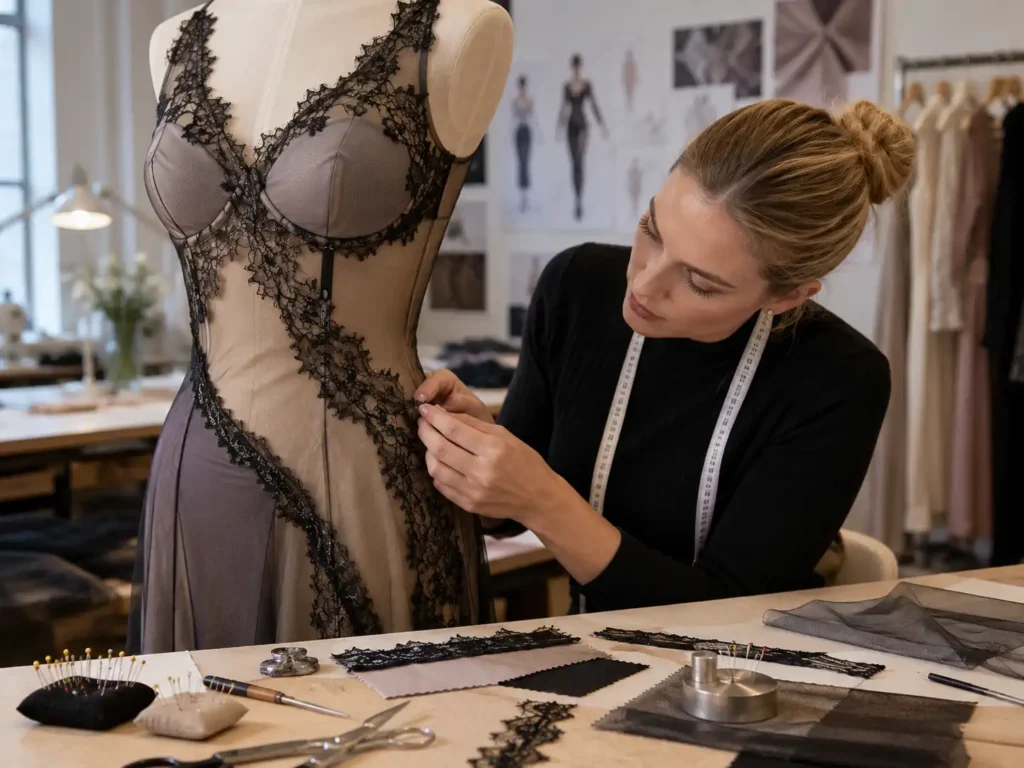
Stretch and Recovery Checks
Stretch testing should be repeatable enough that two people can compare results without relying on subjective pulling. Start with a measured section, such as 10 cm, and record both crosswise and lengthwise extension. If the section reaches 14 cm, the extension is 40%. After release, measure how closely it returns to the starting length. Repeat the cycle several times because some elastic materials change after their first extensions. The purpose is not to identify the fabric with the largest number; it is to understand whether the approved material provides the working movement that the pattern was designed around.
Recovery should be recorded with the same care. A mesh that stretches 60% but remains elongated after release may perform worse in a bodycon dress than a fabric with less extension and stronger dimensional return. The approved sample should establish the practical benchmark for the style. Incoming bulk lots can then be checked against that reference before cutting. If a new lot shows a meaningful difference, it is safer to investigate the effect on fit before thousands of panels are cut. Once the material has been converted into garments, a fabric-level inconsistency becomes a much larger production problem.
Transparency and Lining Checks
Transparency should be evaluated in relaxed and stretched conditions because the knit structure opens as the fabric extends. First view the mesh over light and dark backgrounds, then combine it with the intended lining and place the assembly over a curved form or fit model. Critical zones often include the bust, seat, hip, upper thigh, and the edges of cut-outs where local tension can be higher. The purpose is not to eliminate sheerness; it is to confirm that the level of sheerness matches the design intent in each body area.
Lighting changes the result, so a practical check can include daylight, indoor lighting, and direct camera flash when the product is intended for party, club, or event use. A fabric that appears sufficiently covered under factory lighting may reveal much more under a strong point light. If the lining color changes, the transparency review should be repeated because visual contrast is part of the system. This kind of checking is simple, but it is much more useful than approving mesh on a table and discovering after photography that the bust or hip looks completely different from the original design concept.
Seam and Edge Testing
Representative seam samples should be sewn before bulk approval using the actual needle, thread, stitch type, seam allowance, binding, lining, and machine setup intended for production. Mesh can show skipped stitches, puckering, seam growth, waviness, needle damage, or weak recovery along an edge even when a basic straight seam looks acceptable. The sample should be stretched in the direction it will experience during dressing and wear, then released to see whether the seam and surrounding fabric return smoothly without permanent distortion.
The most difficult construction is usually a better test than the easiest one. If the garment contains a low neckline, curved cut-out, ruched side seam, double-layer hem, or fine binding, build that exact structure rather than approving only a simple seam strip. Lightweight mesh often reacts differently to a narrow hem, coverstitch, binding, or lining clean-finish, so the chosen method should be checked for both appearance and comfort. Early confirmation of seam behavior also gives production teams time to adjust feeding, stitch settings, or handling before the style reaches high-volume sewing.
Bulk Consistency
Once a mesh has been approved, the production team needs a practical reference for comparing incoming material with the sample fabric. Useful records include supplier reference, color, usable width, crosswise and lengthwise stretch, recovery behavior, hand feel, transparency, and any print or surface treatment. Roll-to-roll comparison should happen before large-scale cutting because small variations become far more visible when a fitted garment stretches the fabric across the body.
The first finished production pieces should then be compared with the sealed sample for bust, waist, hip, length, side-seam position, neckline shape, transparency, visible holes, print placement, and lining behavior. This sequence turns fabric approval into a repeatable control process rather than a one-time subjective decision. For mesh bodycon projects, Jinfeng Apparel’s documented development controls include stretch direction, recovery, transparency, lining placement, neckline stability, hole inspection, print placement, and bulk consistency checks. Those points are useful precisely because they connect the fabric specification to what the customer finally sees and wears.
A practical test matrix does not need to be complicated to be useful. The value comes from making the same checks on the approved sample fabric and on incoming bulk material, then investigating meaningful differences before large-scale cutting. The table below turns the most important mesh characteristics into repeatable development checks without pretending that one numerical limit fits every design.
| Control Point | Simple Check | What to Record | Typical Garment Risk |
| Crosswise stretch | Measure 10 cm and extend | Extension % | Tight or loose bust/hip fit |
| Lengthwise stretch | Repeat along length | Extension % | Length growth or restricted movement |
| Recovery | Measure after release | Residual length after set time | Bagging and neckline growth |
| Transparency | View relaxed and stretched | Coverage by body zone | Unexpected sheerness |
| Lining compatibility | Stretch layers together | Relative movement/recovery | Pulling, wrinkles, migration |
| Seam trial | Sew actual construction | Puckering, growth, damage | Wavy or weak seams |
| Neckline test | Build finished edge | Shape and circumference | Gaping or distortion |
| Hole inspection | Controlled light check | Defect location | Visible damage after stretch |
| Lot comparison | Compare rolls with approval | Shade, hand, stretch | Bulk inconsistency |
Conclusion
Choosing mesh for a bodycon dress is really a decision about how the finished garment should behave on a moving body. Soft stretch mesh can create fluid ruching and a second-skin look, power mesh can add controlled support, double-layer mesh can moderate sheerness, and printed mesh can deliver strong visual impact when placement and distortion are controlled. None of these options should be evaluated independently from pattern ease, lining, stretch direction, seam construction, and the size range. A fabric that performs beautifully in one design can be the wrong choice in another because the mechanical job has changed.
For a brand moving from a reference image, original sample, or tech pack into development, the most useful information to define early is the intended silhouette, target transparency, lining direction, size range, closure method, and whether the dress is meant to feel soft, supportive, or sculpting. Sharing those details gives the development team a much better basis for fabric comparison and sample decisions. When those choices are documented before bulk production, the result is not only a better first sample; it is a more repeatable fit, more predictable QC, and a clearer path to future repeat orders or seasonal extensions of the same bodycon concept.
Share This Article :

Jerry Lee
Categories

Latest blogs
Table of Contents
Here, developing your OEM/ODM private label clothing collection is no longer a challenge—it’s an excellent opportunity to bring your creative vision to life.

