Skip to content

A fashion design can look completely resolved on a screen and still be surprisingly difficult to manufacture. The problem is often not the idea itself, but the information that travels with it. Designers think in silhouette, proportion, color, and detail. Sourcing teams think in fabric codes, component specifications, quantities, and lead times. Pattern makers think in measurements, balance, ease, and construction. Production teams need all of those decisions translated into instructions they can repeat hundreds or thousands of times without guessing.
A BOM lists the materials and components required to manufacture a garment, while a tech pack defines the garment as a complete technical product. The BOM controls fabrics, trims, quantities, specifications, and sourcing information. The tech pack also covers measurements, technical drawings, construction, fit, colorways, labeling, packaging, and revisions. In apparel production, the BOM normally works as one controlled part of the wider tech pack.
The difference becomes clear when something changes during sampling. Imagine approving a fitted satin dress after three rounds of development. The new sample uses a heavier lining and a longer invisible zipper, but those changes remain buried in an email instead of being added to the production documents. The approved sample looks right, yet purchasing orders the original components. Nothing dramatic happened during design, but a small documentation gap has quietly become a bulk-production risk. Understanding how BOMs and tech packs work together is what prevents that gap from reaching the cutting table.
What Is the Difference Between a BOM and a Tech Pack?
A BOM defines what materials and components must be sourced for a garment, while a tech pack defines how the complete garment should be made. The BOM focuses on fabrics, trims, quantities, specifications, and sourcing references. The tech pack combines those material requirements with technical drawings, measurements, construction instructions, fit standards, colorways, labeling, packaging, and revision control.
| Production Area | BOM | Tech Pack | Main User |
| Shell and lining fabrics | Defines material and quantity | Shows usage and construction context | Sourcing / Production |
| Zippers, buttons, elastic, hardware | Defines specification and quantity | Shows location and application | Sourcing / Sample Room |
| Finished measurements | Normally not primary control | Defines POM, size and tolerance | Pattern / QC |
| Garment construction | Limited material references | Defines seams, assembly and finishing | Sample Room / Production |
| Technical flats | No | Yes | Pattern / Production |
| Colorways | Component colors | Complete garment combinations | Development / Production |
| Labels and packaging | Lists physical components | Defines placement and packing method | Production / Packing |
| Costing | Major material input | Adds construction and labor context | Merchandising / Costing |
| Repeat production | Recreates approved materials | Recreates the complete product | Production / QC |
Is a BOM Part of a Tech Pack?
In most professional apparel development systems, a BOM is best treated as a controlled section of the wider tech pack rather than as a completely separate alternative. The tech pack describes the entire garment, while the BOM concentrates on the physical ingredients needed to make it. A design may show an invisible zipper, for example, but sourcing still needs to know its length, tape color, slider type, supplier reference, and quantity before the component can be purchased correctly.
The distinction becomes increasingly important as product complexity increases. A simple jersey top may have only a few material lines, while a structured party dress could require shell fabric, lining, fusible, molded cups, boning, elastic, zipper, hook-and-eye components, decorative hardware, thread, labels, hangtags, barcode stickers, polybags, and cartons. The drawing explains where these elements belong, but the BOM must make each component commercially identifiable.
Different companies organize their files differently. Some place the BOM directly inside a PDF tech pack, while others maintain it in a linked spreadsheet, PLM system, or product-development platform. The file format matters less than synchronization. Style number, colorway, revision status, and material approval must agree across all production records. A beautifully formatted BOM that belongs to an older version of the sample is still the wrong BOM.
The development standards supplied for Jinfeng Apparel follow this same relationship: a tech pack is treated as a source containing style information, measurements, BOM data, construction requirements, and labeling or packaging instructions, while more complete technical information allows the project to move more efficiently into structure review, material confirmation, costing, and pattern development.
Which Document Controls Materials, Fit, and Construction?
The simplest working rule is to separate the questions each document must answer. When the team asks, “What exactly must we purchase?” the BOM should provide the answer. When the question becomes, “How should this garment fit, measure, and be assembled?” the wider tech pack becomes the primary control document. That distinction helps sourcing, technical development, sampling, and production teams work from the same information without duplicating responsibility unnecessarily.
Fit belongs mainly in the tech pack because finished measurements, points of measurement, tolerances, grade rules, balance, garment length, neckline depth, strap length, and other dimensions determine the geometry of the finished product. Construction instructions also sit primarily within the tech pack because they explain seam methods, lining attachment, closures, edge finishing, gathering, pleating, boning channels, reinforcement, and other assembly details needed to turn pattern pieces into a finished garment.
Materials belong primarily in the BOM. A corset-inspired dress might require outer fabric, lining, fusible, cups, boning, elastic, zipper, hooks, labels, and packaging. The tech pack can show exactly where those components are positioned and how they are sewn, but the BOM should identify what specification purchasing must actually order. This is why the two documents work together rather than competing with one another.
Some information naturally appears in both places. A zipper may be listed in the BOM and also shown on a construction drawing. A woven label may appear as a material component and again on a placement page. Duplication is not the problem. Conflict is. When the BOM says a zipper is 35 cm and the construction page says 40 cm, the production team has no objective way to know which instruction reflects the latest approval.
What Happens When the BOM and Tech Pack Do Not Match?
Documentation problems usually begin as small inconsistencies rather than obvious failures. A new fabric may be approved during the second sample but never replace the original fabric code in the BOM. A revised waist measurement may reach the pattern maker but not the grading sheet. A lining may be extended for additional coverage while consumption remains based on the previous pattern. Each change looks minor, but together they create competing versions of the same garment.
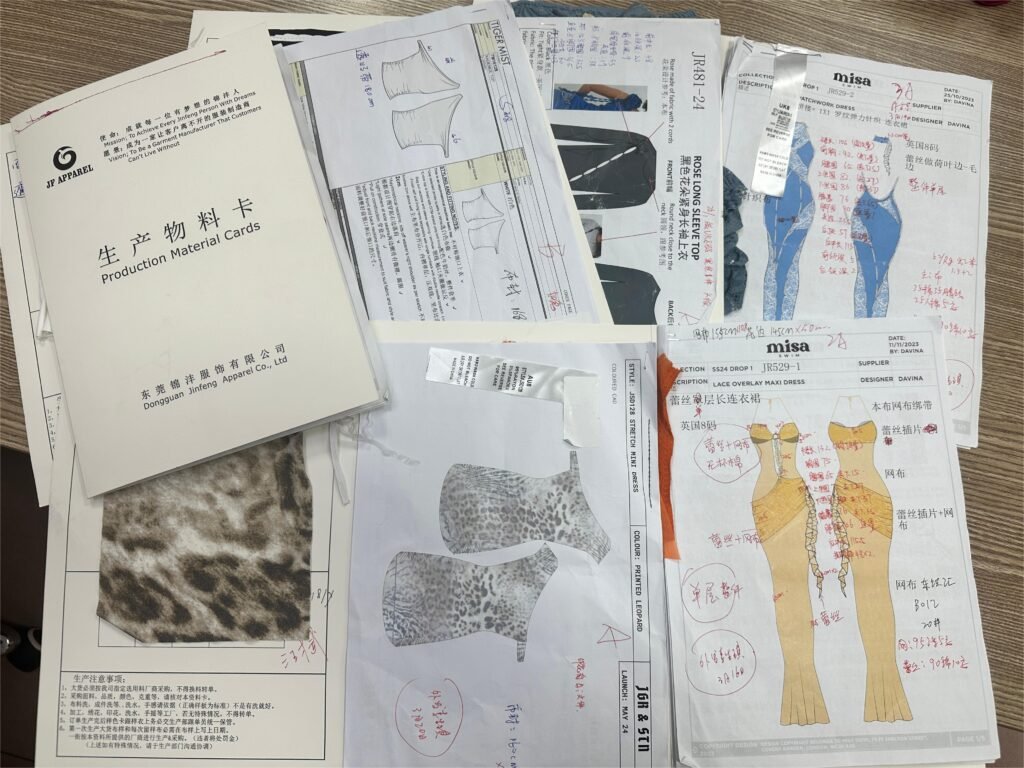
Common warning signs include:
- The approved physical sample uses a different fabric from the active BOM.
- A trim appears in technical drawings but is missing from the material list.
- Zipper length or hardware finish differs between documents.
- Fit measurements were revised without updating grading information.
- Lining coverage changed without updating material consumption.
- Colorway changes were made without revising thread or zipper colors.
- Packaging artwork references an older SKU or barcode.
- Sample comments remain only in email, messaging apps, or annotated photographs.
- Different departments are working from different revision dates.
The most reliable solution is version control rather than additional paperwork. Each significant revision should identify what changed, when it changed, which document was affected, and whether the new version has been approved. The physical sample, BOM, measurement chart, construction notes, and colorway information should eventually describe the same approved product before materials are committed and bulk cutting begins.
This discipline becomes even more important when a brand develops several styles at once. Fast-moving collections often reuse similar fabrics, trims, colors, and silhouettes across multiple products. Without clear style numbers and revision control, an instruction intended for one dress can easily migrate into another. Good documentation is therefore not administrative overhead; it is one of the mechanisms that protects product identity while the collection moves quickly.
What Is an Apparel BOM?
An apparel BOM, or Bill of Materials, is a structured record of the fabrics, trims, components, labels, and packaging required to manufacture a garment. A useful BOM identifies every item clearly enough for sourcing, costing, purchasing, sampling, production, and repeat orders by recording details such as material description, code, color, placement, consumption, quantity, unit of measure, supplier reference, and approval status.
What Does an Apparel BOM Include?
A weak BOM might say “black mesh” or “silver zipper,” which is enough to remind the original designer what was intended but not enough for a production team to reproduce the garment reliably. A stronger BOM allows someone who did not attend the development meeting to identify the approved material without asking which of several similar fabrics, trims, or finishes the team originally selected.
A practical BOM for womenswear can include shell fabric, lining, interfacing, fusible materials, mesh panels, lace, elastic, bra cups, boning, zippers, buttons, hooks, decorative trims, hardware, thread, labels, care labels, size labels, hangtags, barcode labels, polybags, and carton requirements. Not every garment needs every field, but every component that affects appearance, fit, function, cost, or delivery should be sufficiently controlled.
| Component | Useful BOM Specification | Common Unit |
| Shell fabric | Code, composition, weight, width, color | meter / yard |
| Lining | Type, color, width, coverage area | meter / yard |
| Mesh or lace | Structure, stretch, transparency, color | meter / yard |
| Invisible zipper | Type, length, tape color, slider finish | piece |
| Boning | Material, width, rigidity, cut requirement | meter / piece |
| Bra cup | Shape, size, thickness, color | pair |
| Elastic | Width, stretch behavior, color | meter |
| Decorative hardware | Dimensions, base material, plating | piece / set |
| Main label | Dimensions, fold, artwork reference | piece |
| Care label | Content, language, material, print method | piece |
| Polybag | Dimensions and customer specification | piece |
| Carton | Dimensions, strength, marking requirement | piece |
Exact consumption values should be confirmed from the approved pattern, fabric width, marker layout, size ratio, and production method rather than copied from another style. Two dresses that appear nearly identical can have noticeably different material consumption if one uses a narrower fabric, directional print, large lace repeat, asymmetric pattern pieces, or extended size range.
How Does a BOM Support Costing and Sourcing?
The BOM is one of the most useful bridges between creative development and commercial reality because a garment cannot be costed accurately until its major materials and components are sufficiently defined. Fabric price is important, but actual garment cost also depends on consumption, usable width, shrinkage, cutting waste, print direction, matching requirements, supplier MOQ, dyeing requirements, and whether the material can be consistently replenished for bulk and repeat production.
A lower price per meter does not automatically produce a lower garment cost. Suppose one fabric is wider and allows more efficient marker planning while another is cheaper but substantially narrower. The second fabric may require greater consumption per garment. Lace with a large motif repeat can also increase cutting loss because pattern pieces must be aligned visually. Velvet requires attention to nap direction, while engineered prints can restrict the way pieces are placed on the marker.
Trims create similar commercial questions. Custom logo hardware may require mold charges or supplier minimums. A custom zipper pull can create a separate development lead time. Dye-to-match elastic, lining, or zipper tape may have a minimum quantity that exceeds the garment order. When those details are missing from the BOM, the quotation can look precise while still depending on assumptions that may change once real suppliers are contacted.
A mature costing review therefore examines material price, consumption, waste, supplier MOQ, color MOQ, development charges, custom dyeing or printing, testing requirements, lead time, availability, and possible alternatives. The objective is not simply to reduce cost. It is to understand which elements create cost and decide where changes can be made without damaging the appearance, fit, durability, or positioning of the product.
Which BOM Fields Matter Most for Bulk Production?
The most valuable BOM fields are those that allow the purchasing and production teams to identify the approved component months after the initial development conversation has ended. A description such as “soft black satin” may feel obvious during the sample stage, but six months later several similar satins may exist in the supplier library. A material code, composition, weight, width, color reference, supplier, and approval status make the decision traceable.
Useful bulk-production fields commonly include:
- Style number and colorway
- BOM revision number
- Material category
- Supplier or internal material code
- Material description
- Fiber content
- Fabric weight or construction
- Usable width
- Approved color reference
- Placement or usage area
- Consumption or quantity
- Unit of measure
- Supplier
- Supplier MOQ
- Expected lead time
- Approval date
- Approval status
- Approved substitute, where applicable
Consumption should not be treated as a fixed number too early. Prototype fabric may be manually cut, while bulk consumption is normally refined after the production pattern, fabric width, shrinkage allowance, and marker efficiency are confirmed. The final average may also change according to the size ratio ordered by the brand. A range weighted heavily toward larger sizes can consume more fabric than an order concentrated around the base size.
This information becomes particularly valuable for replenishment. A bestseller reordered after several months should not require the team to search old messages for the phrase “the softer black mesh from the second sample.” A controlled BOM lets sourcing identify the original approved material quickly, confirm whether it remains available, and document an alternative if the supplier has discontinued it. The company fact sheet also identifies BOM, fabric, color, trim, packaging, QC, and Golden Sample records as useful information for repeat orders.
How Should BOM Changes Be Version-Controlled?
A BOM is most useful when it reflects the latest approved product rather than the first idea. Apparel development naturally involves change: fabric may be replaced after drape testing, a zipper may become longer after fitting, lining coverage may increase, hardware may change to meet cost targets, or packaging may be updated after warehouse requirements are received. Each confirmed change should move from conversation into the controlled BOM.
A simple revision system can work well even without sophisticated PLM software. Each version should carry a revision number or date, a brief description of the change, the affected colorway or component, and approval status. The team should also make it clear which version is active. Saving files as “final,” “final 2,” and “final really final” creates confusion because the name does not explain the development history or identify the approved production release.
Revision control becomes especially important when material orders start before the entire garment is finished. Brands sometimes need to reserve fabric or place long-lead trim orders while fitting continues. In those situations, the purchasing team must know which BOM lines are already locked and which remain open. A change log can separate commercially committed components from elements that are still being evaluated during sampling.
The same discipline applies to substitutions. When an original material becomes unavailable, the substitute should receive a clear approval reference rather than simply replacing the old description without history. Maintaining that trace gives future production teams a record of what changed and why, which becomes useful during replenishment, quality investigations, or seasonal extensions of the same style.
What Is a Tech Pack?
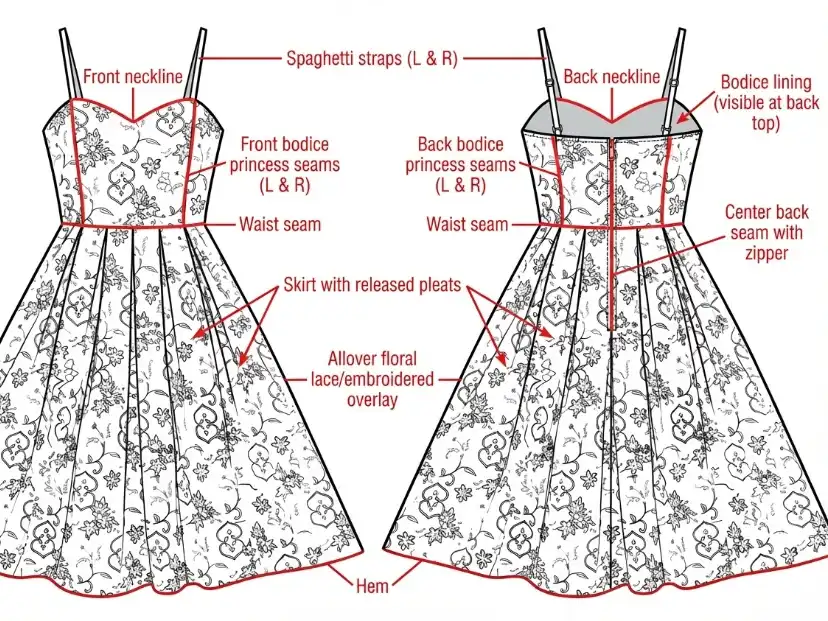
A tech pack is the controlled technical specification used to translate a fashion design into a garment that can be sampled, approved, produced, inspected, and reordered consistently. It combines visual design information with measurements, construction details, material references, colorways, artwork, labels, packaging requirements, fit updates, and revision history so development, sourcing, pattern, production, and quality teams work from one product definition.
What Does a Complete Tech Pack Include?
There is no ideal page count for a tech pack because the amount of information should reflect the complexity of the garment rather than a template target. A simple knitted top can be communicated with relatively few pages, while a lined occasion dress with structured cups, boning, mesh panels, decorative hardware, an asymmetric skirt, and custom packaging needs more technical detail to remove ambiguity.
A production-ready tech pack commonly includes:
- Style name and style number
- Front and back technical flats
- Detail drawings and callouts
- Base-size measurement specification
- Points of measurement
- Measurement tolerances
- Grading or size specifications
- BOM
- Fabric and trim references
- Construction instructions
- Stitch and seam requirements where important
- Colorways
- Print, embroidery, or embellishment placement
- Label information and placement
- Packaging instructions
- Fit comments
- Sample revision history
- Approval status
The goal is not to make the document look complicated. A ten-page file can still be weak if the important production decisions remain unclear, while a shorter document can work well for a simple product when it communicates every critical requirement. Strong technical documentation focuses on the areas most likely to affect appearance, fit, wearability, cost, or repeatability.
Complex womenswear often needs more information because multiple systems interact. A corset dress may require cup position, boning layout, neckline stability, lining structure, zipper insertion, and fit to work together. A mesh dress may need clear lined and unlined zones. A satin dress may require attention to grain direction, seam puckering, zipper behavior, handling, pressing, and surface damage. These are precisely the details that can look small on a sketch but become significant once fabric reaches the sample room.
How Do Pattern Makers and Sample Rooms Use a Tech Pack?
Pattern makers do not simply copy measurements from a table. They interpret the relationship between the desired silhouette, body proportions, fabric behavior, construction, and finished dimensions. A 70 cm waist specification does not mean the same thing on a rigid woven dress and a high-stretch bodycon garment. One may require wearing ease, while the other may intentionally use negative ease and rely on stretch recovery to create the intended fit.
The pattern maker converts those requirements into pattern shapes that can be cut, sewn, fitted, graded, and reproduced. The sample room then tests whether the specification works in real material. This is where interactions that were invisible on screen become obvious. Satin may ripple beside an invisible zipper, a mesh neckline may stretch during sewing, boning may alter the shape of a bodice seam, or an apparently elegant slit may open too aggressively when the wearer sits or walks.
A first sample therefore does more than show whether the garment resembles the original sketch. It tests whether the design can exist as a reliable physical product. The team should evaluate silhouette, measurements, movement, coverage, fabric behavior, trim performance, construction quality, comfort, and whether the chosen method can be repeated consistently during bulk production.
The development process recorded in the supplied company documentation follows this practical sequence: requirements are reviewed, structure and materials are assessed, costing is considered, patterns and first samples are developed, measurements and fit are checked, customer comments are incorporated, and the style moves through revised samples toward PP and Golden Sample confirmation.
Which Tech Pack Details Reduce Sampling Errors?
The most valuable technical instructions are usually the ones that replace subjective language with something measurable or clearly observable. “Make the neckline lower” leaves the pattern maker to interpret the request. “Lower center-front neckline by 1.5 cm while keeping the shoulder point unchanged” creates a repeatable adjustment. “More ruching” is equally vague unless the gathering area, start point, end point, and finished seam length are defined.
Useful technical details can include:
- Slit height measured from a defined reference point
- Finished strap width and length
- Lined and unlined mesh zones
- Boning positions and channel lengths
- Cup position and attachment method
- Gathering start and stop locations
- Finished neckline depth
- Zipper type, length, and placement
- Hem construction
- Artwork dimensions and placement
- Label distance from a seam or neckline
- Critical finished measurements and tolerances
Measurement tolerances also require product judgment. A critical bust or waist measurement on a fitted style usually deserves tighter control than a sweeping hem circumference, but there is no single tolerance that should be copied across every category. Fabric stretch, garment structure, size, sewing process, washing treatment, and brand fit standards all influence what is technically realistic. A tolerance should therefore be established as part of the product specification rather than assumed from a generic chart.
After each fitting, the approved changes need to return to the document. Otherwise, the physical sample becomes more current than the tech pack. That creates what many production teams experience as an invisible second specification: everybody who handled the sample knows what changed, but the official file does not. When the order moves to another production line or is repeated months later, those undocumented decisions disappear.
How Is a Tech Pack Updated After Fit Review?
Fit review should convert observations into controlled technical changes. Comments such as “the waist feels loose,” “the neckline is pulling,” or “the skirt rides up” are useful starting points, but each observation needs to be diagnosed before the pattern is changed. The cause may be a measurement, pattern balance, fabric recovery, seam construction, lining behavior, or even the way several of those elements interact.
A practical revision flow is:
- Record the fit or workmanship issue.
- Identify whether the cause is pattern, material, construction, or trim.
- Define a measurable or clearly observable correction.
- Update the measurement specification where required.
- Update the BOM if a material or trim changed.
- Update construction notes if assembly changed.
- Produce the revised sample.
- Re-measure and inspect the sample.
- Record the approval decision.
- Release the new controlled revision.
Photographs, video calls, annotated screenshots, and messaging apps remain valuable tools because apparel development is visual. The mistake is allowing those tools to become the only record of the decision. Once an adjustment is approved, the measurement chart, pattern, BOM, construction note, or colorway should reflect the new state so the next person does not need to reconstruct the history from conversation threads.
This becomes particularly important for fashion brands developing ten, twenty, or more styles in parallel. Similar fabrics, shared trims, related silhouettes, and repeated colors are efficient from a collection perspective but increase the risk of cross-style confusion. Strong style codes, revision dates, sample status, and approval records keep the changes attached to the correct product.
Which Information Belongs in a BOM and Tech Pack?
Material identity, specification, quantity, and consumption primarily belong in the BOM, while measurements, technical drawings, fit requirements, construction methods, tolerances, and assembly instructions belong in the wider tech pack. Colors, trims, labels, artwork, and packaging often appear in both because sourcing and production need different details about the same component. Repetition is acceptable when every repeated instruction remains synchronized.
Which Fabric and Trim Details Belong in the BOM?
Fabric information should be detailed enough for sourcing to identify the material without relying on a visual memory of the sample. Depending on the product, a useful material record may include supplier code, fiber content, fabric construction, weight, width, stretch direction, finish, color reference, approved lab dip, consumption, supplier, MOQ, expected lead time, and final approval status.
For a mesh dress, the word “mesh” is far too broad to predict performance. Development may need to know whether the fabric stretches primarily across the width or in multiple directions, how strongly it recovers, how transparent it becomes under tension, and how the appearance changes when it is doubled. Those details influence fit, lining decisions, seam methods, coverage, and whether the garment can be reproduced consistently across a size range.
Satin creates different concerns. Two polyester satins can have very different weight, drape, shine, snagging behavior, and seam response. A lightweight satin may look fluid but reveal seam puckering more easily, while a heavier satin may support a structured silhouette better but change the way gathers or drape behave. Recording the actual approved fabric prevents a later replacement from being selected only because it shares the same general fiber description.
Trims need comparable precision. A metal ring may require an outside diameter, inside diameter, thickness, base material, surface finish, and plating color. A zipper may require length, tape color, tooth type, slider finish, and puller specification. Once a trim influences function or visible styling, it should be treated as part of the product standard rather than a minor purchasing item.
Which Measurements Belong in the Tech Pack?
Measurement information belongs in the tech pack because it defines the geometry and fit of the finished garment. Typical womenswear points of measurement may include bust, underbust, waist, high hip, full hip, shoulder width, armhole, sleeve opening, neckline depth, strap length, front body length, back body length, garment length, slit height, rise, inseam, and lining length, depending on the product.
Not every style needs the same measurement list. A slip dress may depend heavily on bust, waist, hip, strap length, neckline position, and garment length. A jumpsuit requires careful rise, torso length, and inseam control. A structured corset dress may need underbust, cup position, bodice length, neckline depth, and internal seam relationships that would be unnecessary on a loose woven dress.
Points of measurement should also be defined clearly. “Dress length” can mean different things depending on where the measurement begins. One team may measure from high shoulder point while another measures from center front. Without a defined POM method, two people can measure the same garment correctly according to different assumptions and still report different numbers.
The measurement specification should therefore be read together with the technical drawing and fit intent. Numbers alone cannot explain whether a garment is intended to skim, compress, drape, or hang away from the body. Good technical information connects the dimension with the silhouette the designer is trying to create.
Which Construction Details Belong in the Tech Pack?
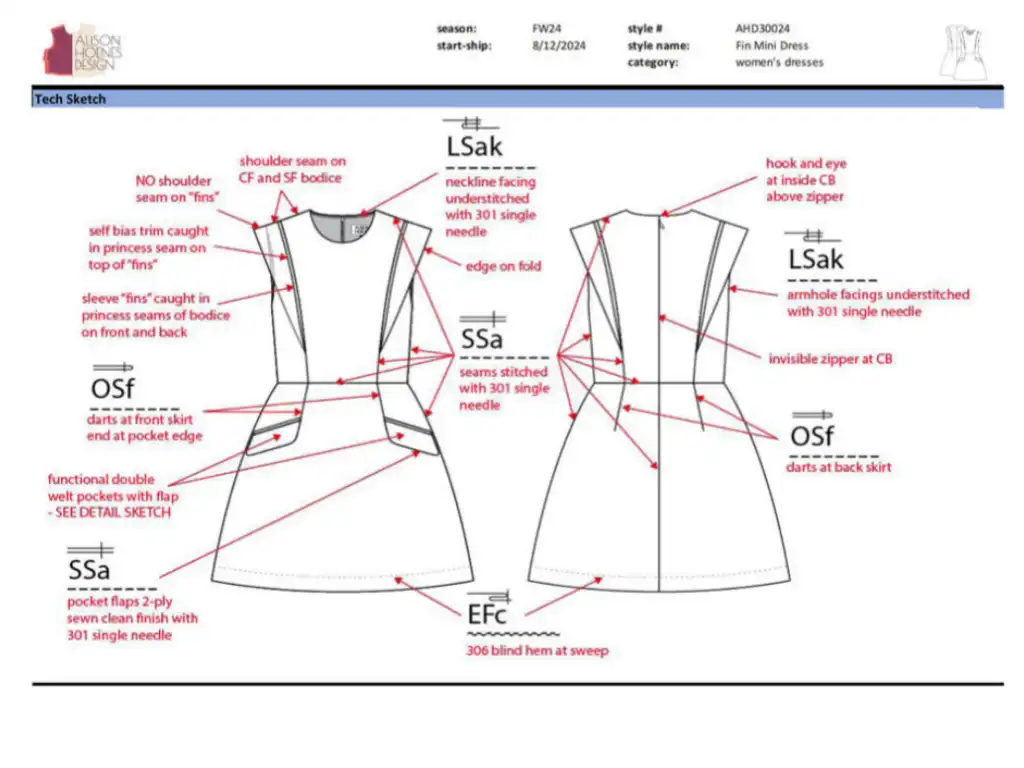
Construction information explains how pattern pieces and BOM components become a finished garment. Depending on style complexity, the tech pack may define seam type, seam allowance, hem construction, edge finishing, lining attachment, zipper insertion, elastic application, boning channels, cup attachment, facing, binding, gathering, pleating, reinforcement, topstitching, or special handling requirements for delicate materials.
The strongest construction notes focus on details where multiple technically valid methods could produce visibly different results. If a neckline must remain clean and soft, the specification should clarify whether it is faced, bound, bagged with lining, or stabilized in another approved way. If an invisible zipper runs through a waist seam, the document should make the alignment and finishing expectation clear rather than leaving the sample room to choose.
Construction and measurements should never be considered completely separately. Adding a firmer lining or changing to a thicker seam finish can affect finished dimensions even if the paper pattern remains unchanged. Switching from a stable fabric to a high-stretch material can change how a neckline, waist, or armhole behaves. Product development therefore needs to consider pattern, fabric, construction, and measurement as one connected system.
This is particularly relevant in fast-fashion womenswear, where visual details can be structurally demanding. Deep necklines, low backs, cutouts, sheer panels, corset-inspired bodices, asymmetric shapes, high slits, and fitted silhouettes often require hidden engineering to remain wearable. A clean finished photograph may show none of the internal support that made the result possible.
Where Do Colorways, Labels, Artwork, and Packaging Belong?
These categories often cross the boundary between BOM and tech pack because each contains both a physical component and an application requirement. A woven label is a BOM item because it must be sourced or produced. The tech pack then shows exactly where the label belongs, which direction it faces, and how it should be attached. The same principle applies to zippers, artwork, hangtags, and packaging.
Colorways need especially careful control when a style is offered in several colors. A red dress may require a matching lining, zipper tape, thread, elastic, and label combination, while the black version may use a different hardware finish. Treating the garment color as the only color instruction can result in components being mixed across variations even when each individual material is technically correct.
Artwork also needs two kinds of information. Sourcing may need the process, material, thread, ink, or transfer reference, while the technical page should control dimensions, orientation, position, and relationship to seams or garment features. A print that is shifted by several centimeters can change the appearance of the product even when the correct print process was used.
Packaging follows the same logic. The BOM can identify the polybag, barcode label, tissue, sticker, hanger, or carton, while the packing specification explains folding method, barcode position, size-ratio packing, carton assortment, and other customer-specific requirements. A useful working rule is straightforward: the BOM identifies the item, while the tech pack explains how that item interacts with the garment or finished delivery.
How Do BOMs and Tech Packs Work Through Production?
BOMs and tech packs evolve with the garment from quotation and sourcing through sampling, fitting, pre-production approval, bulk manufacturing, QC, and repeat orders. Early versions support feasibility and costing, while later approved versions become production-control records. Every confirmed change to materials, measurements, construction, color, labeling, or packaging should be transferred into the correct controlled document before the next production decision is released.
How Do Factories Review Them Before Quotation?
A responsible factory quotation should begin with technical feasibility rather than a unit price. Before the number can be meaningful, the manufacturer needs to understand product structure, material requirements, quantity, construction complexity, expected quality, packaging, delivery timing, and any technical uncertainty that could change the eventual production method. A quote based only on a photograph can be useful as an early estimate, but it should not be treated as equivalent to costing a fully defined product.
The BOM allows sourcing and merchandising teams to investigate fabric price, component availability, supplier MOQ, color MOQ, custom development, expected consumption, and lead time. The wider tech pack gives production teams the information needed to estimate pattern development, sewing operations, lining, special construction, embellishment, pressing, quality-control effort, and packaging labor.
A bodycon jersey dress and a satin corset mini dress may consume similar amounts of outer fabric, yet their manufacturing costs can be very different. The corset style may require cups, boning, lining, multiple shaped seams, more fitting work, additional pressing, and a longer sampling process. Comparing only the main fabric price would therefore miss much of the real production cost.
Before confirming a quotation, experienced teams normally ask whether all critical materials are identifiable, whether the requested fabric is commercially available, whether supplier minimums fit the planned quantity, whether custom colors or trims are required, whether construction is compatible with the material, and whether the requested launch timing leaves enough time for development and procurement. The fewer assumptions hidden inside the quote, the fewer surprises appear later.
How Do They Guide Fabric and Trim Sourcing?
Once the BOM is sufficiently defined, sourcing can move from searching for something visually similar to locating materials that satisfy measurable requirements. The team can compare composition, weight, width, stretch, finish, hand feel, color, supplier availability, MOQ, price, and lead time against the product objective. When the original material cannot meet the commercial requirements, alternatives can be evaluated in a controlled way rather than chosen solely because they look similar on a hanger.
A replacement material should be judged in the garment, not only on a swatch. Changing from one stretch mesh to another can alter negative ease, neckline stability, transparency, and seam recovery. Replacing a heavy satin with a lighter one can change drape, zipper behavior, seam appearance, and how much internal support the bodice needs. A material substitution may therefore require new sampling or pattern adjustments even when the color and surface appearance seem close.
Trims require similar attention because their commercial minimums can affect the entire program. A custom logo puller, plated ring, molded buckle, or branded snap may require tooling and a supplier quantity that does not align neatly with the garment order. Identifying those constraints early gives the brand time to decide whether the custom detail is commercially justified or whether a stock alternative can preserve the design language.
This is also a point where an experienced manufacturing partner can provide useful product-development input. For custom womenswear projects, Jinfeng Apparel’s documented workflow allows projects to begin from tech packs, reference images, original samples, sketches, and line sheets, while its development and material teams can review product structure, fabrics, trims, and missing technical information before a project proceeds further.
How Are Changes Managed During Sampling?
Sampling creates new information, which means the documents should become more accurate with every round rather than gradually drifting away from the physical garment. A first sample may reveal that the original fabric lacks recovery, the neckline needs additional stabilization, the waist should be reduced, the zipper needs greater length, or the lining should extend into an area that was originally intended to remain sheer.
The most common weak workflow is to leave these decisions scattered across emails, screenshots, video calls, and instant messages. Those tools are useful because fashion development is highly visual and collaborative, but they should not become the final technical archive. A photograph marked “move this higher” can help during today’s fitting, yet a production team several weeks later needs to know the approved measurement or position rather than interpret an old annotation.
A controlled revision process normally follows a practical sequence:
- Record the problem observed in the sample.
- Identify whether the cause is pattern, material, construction, or trim.
- Agree on the correction.
- Update measurements if fit changed.
- Update the BOM if materials changed.
- Update construction notes if sewing or structure changed.
- Produce the revised sample.
- Re-measure and inspect it.
- Record customer or internal approval.
- Release the new revision to the relevant teams.
This discipline becomes even more valuable for collection development. When twenty styles are moving at once and several share similar satin, mesh, zippers, labels, or hardware, verbal memory is not a reliable control system. Style codes, revision numbers, sample status, and clearly maintained records allow teams to move quickly without losing track of which decision belongs to which garment.
How Do PP and Golden Samples Lock Production Details?
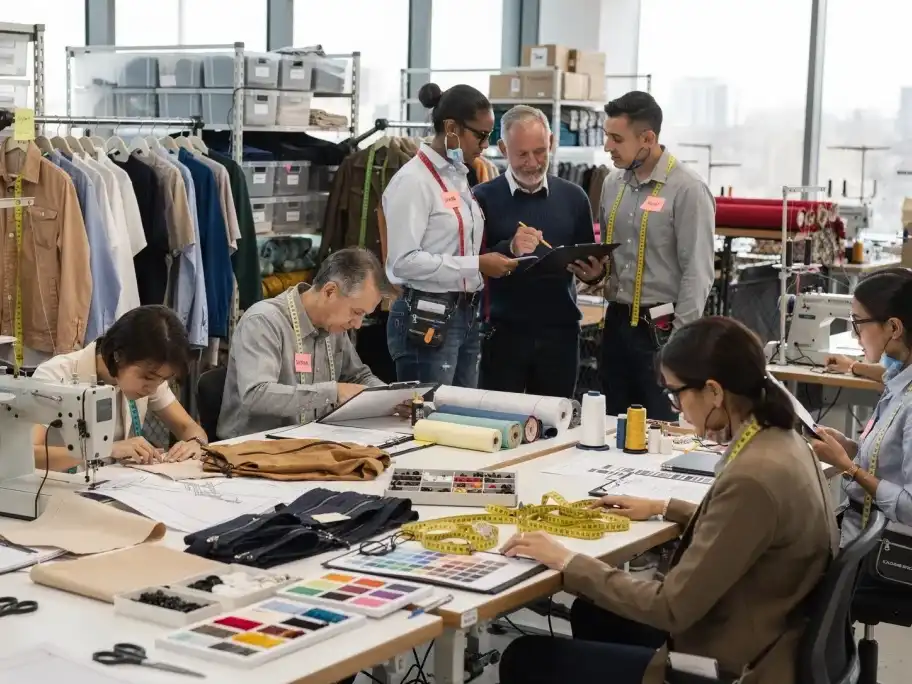
A pre-production sample, commonly called a PP sample, should represent the garment that the factory intends to reproduce in bulk. Major decisions involving fabric, color, measurements, construction, trims, labels, and packaging should therefore be substantially resolved before PP approval. If significant elements are still changing after the PP stage, production risk increases because purchasing, cutting, and production planning may already be moving forward.
The Golden Sample becomes the physical reference that complements the written documents. A measurement sheet can record a waist dimension precisely, but it cannot fully communicate fabric hand feel, drape, pressing quality, or the visual balance of a finished garment. A physical sample communicates those characteristics naturally, but it cannot preserve supplier codes, size grading, tolerances, material quantities, or revision history as reliably as controlled files.
Used together, the approved sample and production documents provide a much stronger reference. The company process supplied for this article describes the Golden Sample as a benchmark used for production-line comparison, in-process QC, final QC, packaging confirmation, third-party inspection, repeat orders, and quality-dispute evaluation. It also notes that material, color, trim, measurement, or structural changes require renewed confirmation rather than silently altering the approved reference.
For a repeat order, an effective archive can include the final pattern, approved measurement specification, final BOM, fabric references, color records, trim references, construction notes, packaging instructions, QC checkpoints, and Golden Sample status. That record allows a replenishment program to begin from an established product definition rather than rebuilding the garment from photographs and memory.
Do You Need Both Before Working With a Clothing Manufacturer?
You do not need a perfectly finished BOM and complete tech pack simply to start a conversation with a clothing manufacturer. A development-capable factory may begin from a reference image, sketch, original sample, partial specification, or line sheet. However, before bulk production, materials, measurements, construction, colors, trims, labels, packaging, tolerances, and approval status should be documented clearly enough to remove major production assumptions.
Do You Need a Complete Tech Pack for a First Sample?
Not necessarily. The answer depends on how mature the design is and what the brand expects the manufacturer to contribute. A company with an internal technical design team may send a complete tech pack, BOM, graded measurements, artwork, fabric swatches, and packaging requirements. The factory can then focus on feasibility review, sourcing confirmation, pattern development, and executing the first prototype against an already defined target.
Another brand may have a strong concept but only a sketch, reference photograph, or mood board. In that case, more product-development work is required before a meaningful sample can be produced. Measurements must be established, materials selected, construction interpreted, and details converted into something a pattern maker and sample machinist can actually build. That is development work, even if the first input is visually clear.
An original garment provides more information because it can be measured, examined, tried on, and analyzed for fabric behavior, seam construction, fit, and finishing. Even so, the new product still needs its own specification if the brand intends to change fabric, sizing, neckline, length, color, hardware, packaging, or other elements. The physical reference is an input, not a substitute for defining the new garment.
The important distinction is between starting development and authorizing production. A first sample can contain open questions because its job is partly to discover them. Bulk production should not. Before cutting large quantities, the product definition needs to be stable enough that purchasing, pattern, sewing, QC, and packing teams are all working toward the same approved result.
Can a Manufacturer Work From a Reference Photo or Original Sample?
Yes, provided the manufacturer has product-development capability rather than only basic sewing capacity. A photograph communicates silhouette, proportion, styling, color direction, and visible details, but it rarely reveals exact finished measurements, fabric weight, internal structure, seam allowance, lining, closures, grading, or the support required to make the garment behave correctly on the body.
An original sample contains more technical evidence. Pattern makers can measure it, study seam positions, inspect internal construction, evaluate ease, examine fabric stretch, and understand how components interact. However, even an original sample should be translated into a controlled specification if the style is going into commercial production. The new brand may use a different size chart, fabric, target price, label system, packaging requirement, or quality standard.
A practical development path often follows this sequence:
Reference or sample → structure review → material direction → measurement definition → pattern development → first sample → fit review → revised specification → PP approval → bulk production
That sequence explains why two factories can produce very different garments from the same photograph. The photograph is only the starting point. The final result depends on the technical decisions made while translating the visual idea into fabric, pattern, construction, fit, and production standards.
Jinfeng Apparel’s documented process allows development to begin from a tech pack, reference image, original sample, sketch, line sheet, size information, fabric direction, and related product inputs, while projects with fuller documentation can move more directly into technical review and development.
Which Files Are Needed for an Accurate Quotation?
An early quotation can sometimes be prepared from a good product image, expected quantity, fabric direction, color count, size range, basic construction, packaging level, and target delivery period. The fewer technical details available, however, the more assumptions must be built into the figure. Brands should therefore distinguish between an indicative estimate and a confirmed production quotation based on approved materials and construction.
For a more reliable quotation, useful files and information can include:
- Tech pack
- Technical flats
- BOM
- Size chart
- Reference sample or clear reference photographs
- Fabric swatch or defined fabric specification
- Trim card or trim references
- Colorways
- Expected order quantity
- Size ratio where known
- Label artwork
- Packaging requirements
- Testing requirements where applicable
- Target launch or delivery date
- Shipping destination when logistics are being evaluated
The goal is not to overwhelm the factory with files. It is to provide the information that materially changes cost. A decorative trim, double-layer mesh construction, molded cup, full lining, custom hardware, special packaging, or complex print placement can change the commercial result enough that excluding it from the quotation creates a misleading comparison between suppliers.
A professional supplier should also identify assumptions instead of hiding them. If the exact fabric has not been selected, the quote can state which material level was assumed. If packaging is unknown, the figure can separate garment manufacturing from final packaging. Clear assumptions make later price adjustments understandable and allow the brand to compare quotations on a more equal basis.
What Should You Confirm Before Bulk Production?
Bulk production should begin only after the product has moved from a creative concept into a sufficiently controlled manufacturing specification. That does not mean every garment needs a massive technical manual, but the decisions that affect materials, fit, appearance, cost, quality, branding, and delivery should no longer depend on informal interpretation.
A practical pre-production check should confirm:
- Final style number and current revision
- Approved technical drawings
- Final base-size measurements
- Approved grading or size specifications
- Measurement tolerances
- Final BOM
- Approved shell fabric
- Approved lining
- Approved trims and hardware
- Approved colorways
- Final construction instructions
- Label artwork and placement
- Packaging requirements
- Barcode and SKU requirements where applicable
- PP sample approval
- Golden Sample or equivalent reference
- QC checkpoints
- Order quantity and size ratio
- Delivery and packing requirements
The value of this control is larger than avoiding one wrong zipper or one inaccurate measurement. Clear technical records make quotations easier to compare, samples easier to evaluate, revisions easier to track, quality expectations easier to communicate, and repeat orders easier to reproduce. They also reduce dependence on individual employees remembering what happened during development.
For brands developing custom womenswear, the ideal relationship with a manufacturer is therefore not simply “send a picture and hope the factory understands it.” The stronger model is a controlled conversion of design intent into measurable, sourceable, testable, and repeatable manufacturing information. That is where the BOM and tech pack become commercially useful rather than just technical paperwork.
Conclusion
A BOM and a tech pack solve different parts of the same manufacturing problem. The BOM defines the physical ingredients of the garment, while the tech pack defines the finished product those ingredients must become. When the two remain aligned through sourcing, sampling, fitting, PP approval, production, QC, and repeat orders, they create a shared language between design teams and factories that is far more reliable than photographs, memory, or scattered messages.
For fashion brands, better documentation does not mean removing creativity from product development. It creates room for creativity to survive production. Designers can make changes, manufacturers can recommend more workable fabrics or construction, and sourcing teams can respond to commercial realities without losing track of what has actually been approved. Whether a project begins with a complete tech pack or only a strong reference concept, the goal should eventually be the same: one clearly defined product that everyone involved can understand, reproduce, inspect, and reorder.