 Skip to content
What Is the Asymmetrical Dress Trend and How Is It Manufactured?

Your trusted Women’s Apparel Manufacturer from China
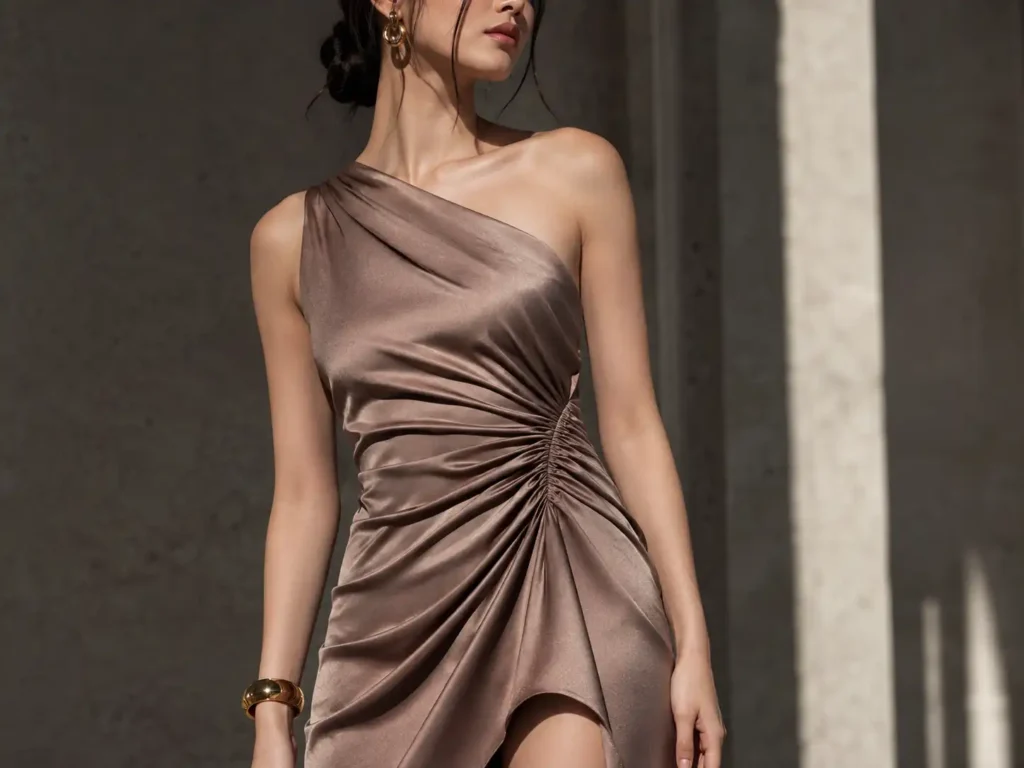
Asymmetry has become one of the most useful ways to make a familiar dress silhouette feel new without turning it into an unwearable runway experiment. A single shoulder, a diagonal waist, a side-dropped hem, or an off-center drape can change how a mini, midi, or maxi reads in a product grid and on the body. The attraction is visual, but the manufacturing challenge is structural: once the left and right sides stop mirroring each other, pattern balance, fabric direction, support, lining, grading, and inspection all become more demanding.
An asymmetrical dress uses deliberately unequal design lines, such as one-shoulder necklines, diagonal waists, uneven hems, side draping, offset panels, or asymmetric cut-outs, to create movement and visual tension. Manufacturing it reliably requires the design to be converted into measurable pattern geometry, stable fabric behavior, controlled fit points, documented grading rules, repeatable sewing operations, and production-stage quality checks rather than relying on the sample maker’s eye alone.
That distinction matters because the trend is commercially visible in 2026 fashion coverage, with asymmetrical silhouettes, handkerchief hems, one-shoulder shapes, and artful draping appearing in seasonal dress reporting. The interesting story starts after the moodboard is approved. A line that looks effortless in a sketch can move a shoulder load, add bias growth, expose a lining edge, reduce marker efficiency, and create new inspection points. The rest of this guide explains how experienced development teams keep the drama while making the dress fit, grade, sew, and repeat like a real product.
What Is Driving the Asymmetrical Dress Trend?
Asymmetrical dresses remain commercially relevant because they add movement and a recognizable visual signature to familiar silhouettes. One-shoulder necklines, diagonal waist seams, offset draping, handkerchief hems, and uneven panels can refresh established mini, midi, and maxi categories while still fitting clear use cases such as occasionwear, partywear, resort, evening, and going-out collections for modern seasonal ranges.
Visible Design Value
The strongest commercial advantage of asymmetry is that customers can see the difference quickly. On an ecommerce product grid, a conventional straight-neck midi may compete with dozens of similar shapes, while a clean one-shoulder neckline or a diagonal waist line gives the garment a recognizable outline at a glance. The effect also reads well in three-quarter photography and movement video, which makes it useful for collections sold through visual-first channels where a product has only a few seconds to earn attention.
That does not mean every irregular line creates value. Deliberate asymmetry has a focal point and a controlled relationship to the body. Random unevenness can look like poor cutting or a twisted garment. The strongest commercial styles usually make one feature dominant, such as the shoulder, waist, drape, slit, or hem, while keeping the rest of the construction calm enough that the customer reads the design as intentional rather than unstable.
Occasion and Customer Use
Asymmetry changes meaning depending on the occasion. A one-shoulder satin midi can feel polished enough for cocktail or wedding-guest dressing, while a ruched asymmetric mini has a more natural place in party and date-night ranges. A light chiffon side-drop maxi can work for resort or destination collections because the uneven hem creates movement without relying on heavy embellishment. Formal evening styles can carry more architectural draping, but the structure, lining, and hem control usually become more demanding as the silhouette grows longer and more dramatic.
This occasion logic should influence manufacturing decisions from the start. A party dress may prioritize stretch recovery, secure exposure, body fit, and photo-ready details. Occasionwear usually puts more pressure on fabric quality, drape, color consistency, zipper finish, and lining. Resort dresses need movement and packability, but still require transparency control and stable hems. Treating all of these products as one generic “asymmetric dress” category misses the details that drive fit, returns, and repeat orders.
Trend Versus Product
A trend only becomes useful when it survives the transition from image to product. A dramatic sketch may look compelling on a moodboard but become commercially weak if it needs excessive fabric, several hand-positioned drapes, difficult lining, awkward grading, or a sewing sequence that cannot be repeated consistently. Product teams therefore need to separate visual importance from manufacturing burden before they commit to a full seasonal range.
A practical review asks whether the asymmetric feature is visible enough to justify the extra work, whether it remains flattering across the intended size range, and whether the effect can be measured. If the garment only looks correct when one particular sample maker arranges it by hand, the design is not yet scalable. If a hem, drape, or neckline can be located with clear pattern points, finished measurements, and construction references, the design has a much stronger foundation for bulk production.
Commercial Filters
Experienced teams rarely judge an asymmetrical style on aesthetics alone. They look at visual impact, fit risk, marker efficiency, sewing difficulty, grading behavior, and inspection needs together. A one-shoulder dress may add meaningful identity with moderate complexity once the bodice is engineered. A multi-layer cascade can create more editorial impact but may also require more unique pattern pieces, more fabric, more hemming, and more visual inspection. The right choice depends on the collection’s role, price architecture, and planned volume rather than on a universal rule.
One useful collection strategy is to let a small number of hero styles carry the highest complexity while keeping the rest of the range easier to repeat. That allows a brand to use asymmetry as a signature without making every SKU difficult to produce or replenish. The objective is not to remove fashion risk entirely; it is to spend development effort where customers will actually notice the result.
Which Asymmetrical Styles Scale Best?
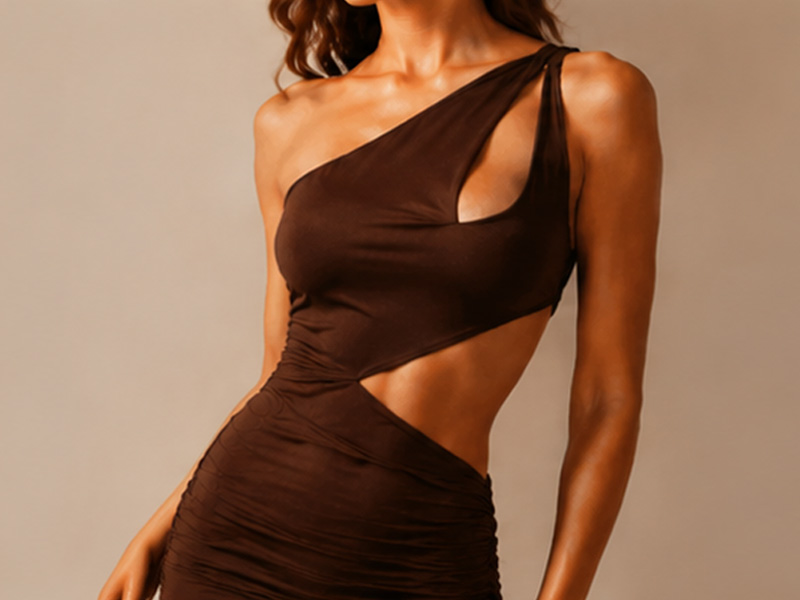
The most scalable asymmetrical dresses usually have one dominant asymmetric feature, stable anchor points, clear pattern geometry, and measurable construction references. One-shoulder bodices, controlled diagonal hems, fixed side ruching, asymmetric wraps, and engineered waist seams generally repeat more reliably than free-form draping or multi-layer constructions whose appearance depends heavily on manual positioning during sewing and finishing.
One-Shoulder Construction
One-shoulder dresses scale well because the asymmetric idea is obvious while most of the garment can remain structurally familiar. The main engineering challenge sits in the upper body. Removing one shoulder changes how tension travels through the neckline and bodice. The supported side may carry more load, while the open side has less structure holding the garment against the chest. Bust coverage, underarm height, neckline tension, lining, elastic, boning, or internal support may therefore need to work together.
The common mistake is to treat the design as a normal bodice with one strap removed. A reliable pattern considers shoulder slope, bust shape, front and back balance, and movement. During fitting, the wearer should raise both arms, rotate the shoulders, sit, walk, and lean slightly forward. A neckline that looks stable in a static photograph can still gape or migrate during movement, especially when the outer fabric is slippery or the garment is fitted.
Diagonal and Irregular Hems
A diagonal hem is relatively easy to control when the geometry is fixed. The pattern can define the shortest point, longest point, side-seam transitions, center-front length, center-back length, and the relationship between outer fabric and lining. Complexity rises when the design adds handkerchief points, multiple layers, bias sections, narrow hems, or cascading panels because more of the skirt is exposed to grain-direction differences and uneven hanging behavior.
The more visually important the hem becomes, the more precise the measurement system should be. A generic “dress length” is not enough for a garment whose selling point is an intentionally uneven lower edge. Development teams often need several reference lengths, and the final sample should be checked after the fabric has had time to hang if bias growth is likely. The intended asymmetry can be dramatic, but the production tolerance around that geometry still needs to be disciplined.
Controlled Draping
Draping becomes scalable when appearance is translated into construction. Side ruching, fixed pleats, twist details, wrap overlays, and gathered panels can work well in bulk if the start point, end point, fullness, direction, and securing method are documented. Free-form draping is more difficult because small differences in fabric weight, operator handling, or gather distribution can noticeably change the silhouette from one garment to another.
The practical solution is to turn the approved sample into instructions that another team can repeat. Mark where gathering starts and ends, define the ungathered length and finished gathered length, specify pleat depth and direction, add notches at major fold points, and record tack locations. Photographs of the approved drape can support the specification, but they should not replace measurable information. The artistry remains visible to the customer while the manufacturing method becomes controlled behind the scenes.
Complexity Limits
A garment becomes difficult to scale when several asymmetric systems interact at once. A one-shoulder neckline, diagonal corset seam, side cut-out, ruched hip, chiffon overlay, and irregular hem may all be manufacturable individually, yet combining them changes fabric consumption, pattern count, lining, cutting, sewing order, grading, inspection, and packing. The difficulty comes from interaction rather than from any single detail.
A useful rule is to separate signature details from supporting details. Keep the elements customers will recognize immediately and simplify hidden construction where doing so does not weaken the appearance. This is especially important for seasonal collections that may need replenishment. A design that can only be repeated by the original sample maker is fragile; a design that has clear geometry, anchor points, and reference standards has a much better chance of surviving a second production run months later.
Asymmetrical Feature | Typical Relative Complexity | Main Control Points | Common Commercial Use |
One-shoulder neckline | Medium | Shoulder load, bust stability, neckline tension | Cocktail, occasion, party |
Diagonal waist seam | Low-Medium | Waist placement, seam matching, grain direction | Midi, bodycon, occasion |
Fixed side ruching | Medium | Gather ratio, anchor points, side-seam balance | Party, bodycon, date night |
High-low hem | Medium | Front-back balance, lining, hem finishing | Occasion, resort |
Handkerchief hem | Medium-High | Grain direction, multiple hem points, hanging | Resort, occasion |
Multi-layer cascade | High | Panel orientation, narrow hemming, drape, fabric use | Evening, statement styles |
Free-form hand drape | High | Manual placement, repeatability, final visual inspection | Statement pieces |
Which Fabrics Work Best?
The best fabric depends on what the asymmetrical design needs to do. Chiffon, satin, crepe, jersey, rayon, viscose, and stretch satin support fluid movement and draping, while ponte, suiting, organza, and other stable fabrics can hold sharper lines. Weight, drape, stretch, recovery, transparency, grain behavior, lining, shrinkage, finishing, and bulk consistency matter more than fiber name alone.
Drape and Weight
Fabric weight changes asymmetry more noticeably than many design teams expect because the material often becomes part of the structure. A side cascade in lightweight chiffon may float away from the body and create a soft broken line, while the same pattern in heavier satin may fall closer to the hip and pull more strongly on the waist or shoulder. Weight should therefore be considered together with where the extra fabric is concentrated and how the garment is supported.
Satin can make diagonal seams and folds visually strong because reflected light changes across the surface, but that same shine reveals puckering, zipper distortion, poor pressing, and seam tension. Chiffon gives movement to layered and handkerchief hems but introduces transparency, narrow-hemming, and bias-growth concerns. Crepe often provides controlled drape with less shine. Rayon and viscose can work well in soft resort silhouettes, while jersey can produce body-following drape but brings stretch and recovery into the pattern equation.
Stretch and Recovery
Stretch improves comfort, but it can also shift asymmetric geometry. In a fitted one-shoulder jersey dress, tension may travel diagonally across the torso between the supported shoulder and the opposite side of the body. If recovery is weak, the neckline can gradually open, the side seam can rotate, or the hem can climb. Two fabrics that feel similarly stretchy in the hand may behave very differently after repeated extension or several hours of wear.
It helps to separate stretch percentage, recovery, and stretch direction. Stretch percentage describes how far the fabric extends, recovery describes how well it returns, and stretch direction describes whether the behavior differs across the width and length. These characteristics affect pattern ease, neckline stabilization, seam selection, and grading. Fitting should therefore include movement and a short wear period rather than checking the sample immediately after it is put on the model.
Lining Decisions
Lining in an asymmetrical dress can provide coverage, structure, comfort, or all three, but it should support the outer design rather than simply copy it. A chiffon dress with an uneven hem may use a shorter, simpler lining so the outer movement remains visible. A one-shoulder satin bodice may need a more engineered lining because the upper body requires stability. Mesh or lace styles may use selective lining to control exposure while keeping the intended sheer areas.
Problems appear when shell and lining behave differently. A lining that is too tight can restrict the outer drape, a heavy lining can pull against a light shell, and a low-stretch lining can distort a stretch outer fabric. Length is particularly important around asymmetric hems because the lining can become visible at the short side when the wearer walks or sits. The lining specification should therefore include coverage, finished length at critical points, stretch requirement, attachment method, and color relationship to the outer fabric.
Fabric Approval
Fabric substitution is not a simple purchasing decision for asymmetrical styles because a material change can effectively change the garment. If weight increases, a side drape may hang lower. If stretch increases, neckline and side-seam stability can change. If transparency changes, lining coverage may need revision. If shine changes, the garment can photograph differently even when the color standard is technically similar.
A practical approval compares composition, weight, hand feel, drape, stretch, recovery, transparency, surface shine, shrinkage risk, color, available width, supplier minimums, cost, and lead time. The team should then decide whether the pattern or sample needs to be updated. Jinfeng Apparel’s documented fabric system covers chiffon, satin, stretch satin, lace, mesh, power mesh, jersey, rib knit, ponte, crepe, velvet, sequin fabric, organza, tulle, rayon, viscose, linen, denim, suiting, and blended fabrics, with material-specific review of drape, stretch, transparency, lining, and bulk-production risk.
Fabric Type | Typical Drape | Typical Stretch | Suitable Asymmetrical Use | Main Production Risk |
Chiffon | High | Low | Cascades, handkerchief hems, layered maxi styles | Transparency, bias growth, narrow hemming |
Satin | Medium-High | Usually low | One-shoulder midi, draped occasion dress | Snagging, shine direction, seam puckering |
Stretch satin | Medium-High | Medium | Fitted asymmetric party or occasion styles | Recovery, seam tension, distortion |
Crepe | Medium-High | Low-Medium | Wraps, midi dresses, controlled draping | Hand-feel and batch variation |
Jersey | High | Medium-High | Ruched bodycon, twists, asymmetric necklines | Recovery, seam rotation, length change |
Power mesh | High | High | Fitted sheer overlays and cut-outs | Transparency, recovery, edge stability |
Organza | Low-Medium | Low | Structured asymmetric volume | Fraying, stiffness, visible seam allowances |
Ponte | Low-Medium | Medium | Structured fitted asymmetry | Seam bulk, recovery balance |
How Are Asymmetrical Patterns Developed?
Asymmetrical patterns are developed by establishing a stable body fit first and then engineering the unequal neckline, waist, seam, drape, panel, or hem around that base. Left and right components may require separate pattern pieces, while grainline, notches, seam matching, lining, hem references, and grading rules must be documented so the design remains consistent from sampling through bulk production.
Start With Fit
Intentional visual imbalance works best when it is built on structural balance. Bust position, waist position, hip allowance, shoulder angle, and garment ease still need to function correctly even if the visible lines on the left and right sides are different. Experienced pattern makers therefore solve the base body relationship before spending too much time refining dramatic hem or drape details. Otherwise, a team may keep adjusting asymmetry when the underlying fit is actually the source of the problem.
Consider a one-shoulder satin midi with side ruching and a diagonal hem. The upper body needs single-shoulder stability, the waist needs controlled fullness, and the skirt needs engineered hem geometry. If the bust and waist relationship is already wrong, changes to the shoulder or drape can become a series of compensations rather than a true correction. Jinfeng Apparel’s pattern team includes 7+ senior pattern makers and documents controls across bust, waist, hip, length, neckline, straps, slits, lining, and hem sweep for production-ready patterns.
Left and Right Pieces
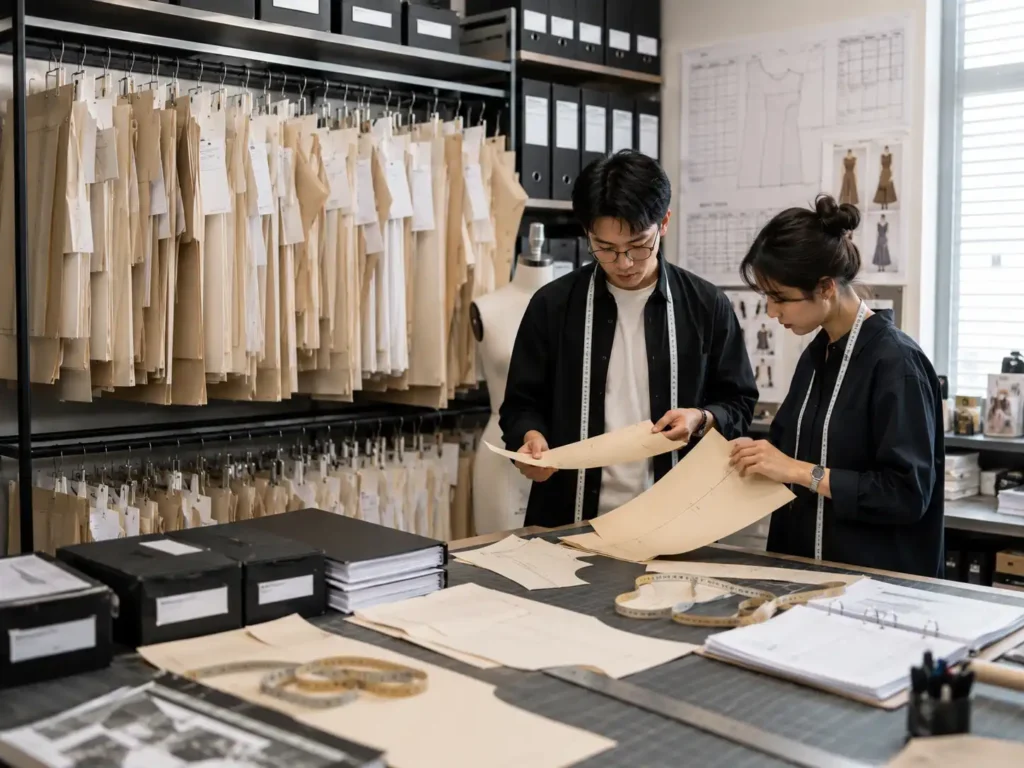
True asymmetry often removes the efficiency of mirrored pattern pieces. A full front may be required instead of a half-front pattern, and left and right bodice or skirt pieces can have completely different shapes. That makes piece identification more important during cutting and sewing, especially when the fabric has directional shine, nap, prints, lace motifs, sequins, or another surface that changes visibly when orientation changes.
Each unique piece should carry a clear style reference, piece name, left or right orientation, cut quantity, grainline, seam allowance, notch positions, material designation, and revision version. This is not administrative detail for its own sake. A mislabeled piece can shift an asymmetric seam, reverse a drape, or change how satin reflects light. Once multiple unique panels are involved, clean pattern management becomes part of visual quality and production efficiency.
Grainline and Hanging
Grain direction is one of the most underestimated variables in asymmetric development. Fabric behaves differently on straight grain, cross grain, and bias. When a seam or hem travels diagonally, some areas may naturally contain more bias than others, which can cause uneven growth after cutting or hanging. A garment can therefore look correct immediately after sewing and change after gravity has acted on the fabric for several hours or days.
This is particularly relevant for satin slips, chiffon maxis, scarf hems, handkerchief hems, and soft draped skirts. The pattern maker should anticipate where growth is likely, and the sample room should allow the garment to settle when necessary before the final hem is judged. A dramatic asymmetric line can be intentional, but the production process should still control which point is supposed to be longest, which point is supposed to be shortest, and how the line transitions between them.
Measure the Asymmetry
The most useful improvement a development team can make to an asymmetric tech pack is to replace visual instructions with coordinates. “Make the left side longer” depends on interpretation. A finished longest-hem measurement taken from a defined body point is much easier to reproduce. “Add a side drape around the hip” is subjective; a start point, end point, fullness quantity, and tack location provide a production reference that can be checked during sampling and in-line inspection.
Measurements will vary by design, but the principle is consistent: if a feature influences the customer’s impression, it deserves an objective reference. That may include one-shoulder width, neckline depth, underarm height, left and right waist-seam positions, gather length, slit height, shortest hem point, longest hem point, cascade attachment point, or cut-out location. The specification does not need to measure every decorative curve, but it should control the features that would look wrong if they moved.
Design Feature | Useful Production Reference | What It Prevents |
One-shoulder neckline | Shoulder width, neckline depth, underarm height | Gaping, slipping, inconsistent coverage |
Diagonal waist | Left and right waist-seam reference points | Uneven waist angle between garments |
Side ruching | Start, end, pre-gather length, finished length | Random gather distribution |
Asymmetric slit | Finished slit height and horizontal position | Excess exposure or inconsistent placement |
Diagonal hem | Shortest point, longest point, CF and CB references | Hem drift and side-seam rotation |
Side cascade | Attachment point, panel length, tack locations | Different drape shape from garment to garment |
Cut-out | Width, height, distance from waist or side seam | Unstable exposure across sizes |
Lining | Finished length at critical visible points | Lining showing below outer hem |
How Is Fit and Quality Controlled?
Fit and quality control for an asymmetrical dress should verify both standard garment measurements and the stability of the asymmetric design. Shoulder load, bust coverage, neckline position, side seams, waist placement, drape location, slit height, shortest and longest hem points, lining exposure, fabric recovery, and cross-size consistency all need to be reviewed from sampling through in-line and final inspection.
First Sample Review
The first sample is a problem-finding tool, not a promise that the style is already production-ready. Asymmetrical garments should be reviewed on a body or suitable fit form because flat measurements alone cannot reveal how unequal tension, drape, and gravity interact during wear. Front, back, side, and movement views all matter, particularly when one shoulder, a side drape, or a short hem point is central to the design.
A practical fitting checks bust, waist, hip, neckline security, shoulder load, underarm coverage, side-seam position, drape location, slit height, lining visibility, zipper flatness, shortest and longest hem points, walking ease, sitting comfort, and fabric recovery. Video is useful when development teams are in different countries because it exposes slipping, twisting, gaping, or bouncing that a static image can hide. The review should generate specific pattern and construction corrections rather than vague comments such as “fit better” or “make the drape nicer.”
Sample Timing and Revision
Development time should follow complexity rather than a single promised calendar for every dress. Jinfeng Apparel’s documented reference cycle lists approximately 7-10 days for simple first samples, 10-15 days for ordinary dresses, 12-18 days for medium-complexity dresses, sets, or jumpsuits, and about 15-25 days for more complex corset, strapless, lace, mesh, or sequin styles. Special fabrics or trims can extend the cycle, while revised samples depend on the scope of the requested changes.
An asymmetrical dress can fall anywhere within that range. A clean one-shoulder jersey mini may be relatively direct once the base fit is established, while a lined satin gown with a structured one-shoulder bodice, cascading skirt, and difficult surface finish needs more development. The useful metric is not how quickly the first sample appears; it is whether each revision moves the design toward a documented production standard that can be used by pattern, sewing, QC, and future repeat-order teams.
Size Grading
An asymmetric base-size sample can fit beautifully and still fail after grading because design details do not always scale in the same way as body measurements. A short diagonal mini may need more than width adjustment as hip circumference increases. A one-shoulder neckline may require changes in coverage. A cut-out can become visually larger or smaller relative to the body if its position is not graded intentionally. The objective is consistent visual proportion, not blind numeric enlargement.
Important checks include bust coverage, shoulder position, armhole depth, waist angle, cut-out position, side-ruching length, slit height, short-side safety, long-side balance, and lining relationship. Pre-production documentation should identify the base size, grading rules, and measurement tolerances. When the asymmetrical feature is central to the design, reviewing at least one additional graded size can reveal problems that the base sample cannot show, especially in fitted or highly exposed styles.
Production QC
Final inspection alone is too late to discover many asymmetric construction problems. If the wrong left panel is cut, grain direction is reversed, gather notches are misplaced, or a side seam begins twisting during sewing, waiting until the garment is fully finished makes correction expensive. Quality control is more effective when the design’s critical points are checked while the product is being built.
Jinfeng Apparel’s documented QC process covers incoming-material inspection, cutting QC, sewing QC, in-line inspection, garment inspection, pressing review, packing QC, AQL inspection, client inspection support, and repeat-order records. For asymmetrical dresses, the style-specific checklist should include left-right piece orientation, drape and gather placement, neckline stability, key length measurements, lining visibility, zipper flatness, and final visual balance. These points should be tied to the approved sample and current pattern revision rather than judged against memory.
How Do Brands Scale to Bulk?
Brands scale asymmetrical dresses by converting visible design details into measurable specifications, approving fabric and fit before cutting, validating grading, setting a clear PP standard, controlling critical points during production, and retaining pattern and material records for repeat orders. The objective is not to eliminate complexity, but to make every important asymmetric feature reproducible across sizes, colors, production batches, and replenishment orders.

Pre-Production Control
Bulk production should start with fewer unanswered questions than sampling. Before cutting, the factory should know which pattern revision is approved, which fabric and lining are authorized, which color standard is current, which trims are correct, which grading rule applies, and how the finished garment will be packed. Asymmetrical dresses add several style-specific controls, including left and right piece orientation, diagonal seam position, gather distribution, slit or cut-out placement, and short-long hem references.
A disciplined pre-production gate prevents development information from competing with production information. Jinfeng Apparel’s documented process includes PP sample approval, fabric and trim confirmation, size chart and grading confirmation, packaging and label approval, production-order review, sewing instructions, BOM review, delivery timing, measurement tolerances, appearance standards, and critical QC points before bulk production. This kind of structure is particularly valuable when a fashion-forward style contains details that cannot be safely interpreted from a reference image alone.
Tech Pack Precision
A strong tech pack reduces interpretation. Words such as “deep,” “dramatic,” “soft,” or “irregular” may describe the mood, but they do not tell a production team where a neckline should end or how much fullness belongs in a drape. For an asymmetrical style, the document should identify the measurable points that define the design and clearly distinguish approved information from superseded sampling comments.
Annotated photographs of the approved sample can be extremely useful, especially for draping, but they should support measurements rather than replace them. Front, back, left, right, and detail images help the sewing and QC teams understand the intended appearance. Revision discipline matters equally. Old sketches, outdated size charts, and later fitting comments should not circulate as competing instructions. The final production package needs one clear current revision so the pattern room, cutting team, sewing line, and inspectors are working from the same standard.
Cost and Efficiency
Asymmetry does not automatically make a dress expensive. Cost rises when the design adds fabric consumption, unique pattern pieces, poor marker efficiency, extra layers, complex gathering, hand positioning, slower sewing, special hemming, additional pressing, or more inspection. A clean one-shoulder neckline may add relatively little fabric, while a multi-layer handkerchief skirt can increase both material usage and labor because the pieces are irregular and the exposed edge requires more finishing.
The right approach is to simplify what customers do not see before simplifying the feature they are paying to notice. If the signature is a diagonal drape, an internal seam may be optimized without weakening the look. If a four-layer cascade creates excessive weight and cost, a development team may test whether three layers preserve the same visual rhythm. Cost engineering is most effective before the final sample is approved, because later changes can force new patterns, new samples, and a new round of fit confirmation.
Manufacturer Readiness
A manufacturer suitable for asymmetrical dresses needs more than sewing capacity. The team must be able to explain how a fabric change affects drape, whether the pattern needs correction, how a one-shoulder neckline stays stable, which pieces require single-layer cutting, how the asymmetric feature will be graded, and which measurements belong on the QC checklist. Those answers reveal whether the supplier is developing a product or simply attempting to copy a picture.
Jinfeng Apparel’s objective fact file records 6 owned women’s fashion factories, 10+ long-term satellite production partners, 18+ sewing lines, 6+ flexible production lines, 2 sample rooms, and dedicated pattern, sampling, merchandising, QC, and packing functions. Its standard custom-production MOQ starts from 200 pieces per style and color, subject to fabric, trims, color development, construction complexity, packaging, and scheduling. The useful point behind these numbers is the operating chain: design review, fabric approval, pattern, sample, revision, grading, PP approval, cutting, sewing, in-line control, final inspection, packing, and retained repeat-order records.
The best asymmetrical dress does not look technically difficult when someone wears it. It looks intentional, balanced in the places that matter, and deliberately unbalanced in the places that create personality. Reaching that result requires design, fabric, pattern, sampling, production, and QC decisions to support the same visual idea. When those decisions are made early, brands can use one-shoulder lines, diagonal waists, asymmetric hems, ruching, and draping as repeatable product tools rather than one-off sample-room effects.
For a collection team, the practical next step is to review the design before the tech pack is frozen. Confirm what the customer should notice first, identify which points must remain stable across sizes, choose fabric for the intended drape rather than surface appearance alone, and decide how the approved effect will be measured in production. A development partner that can challenge risky construction while protecting the visible design can save more time than a supplier that simply agrees to every detail and discovers the problems after cutting begins.
Share This Article :

Jerry Lee
Categories

Latest blogs
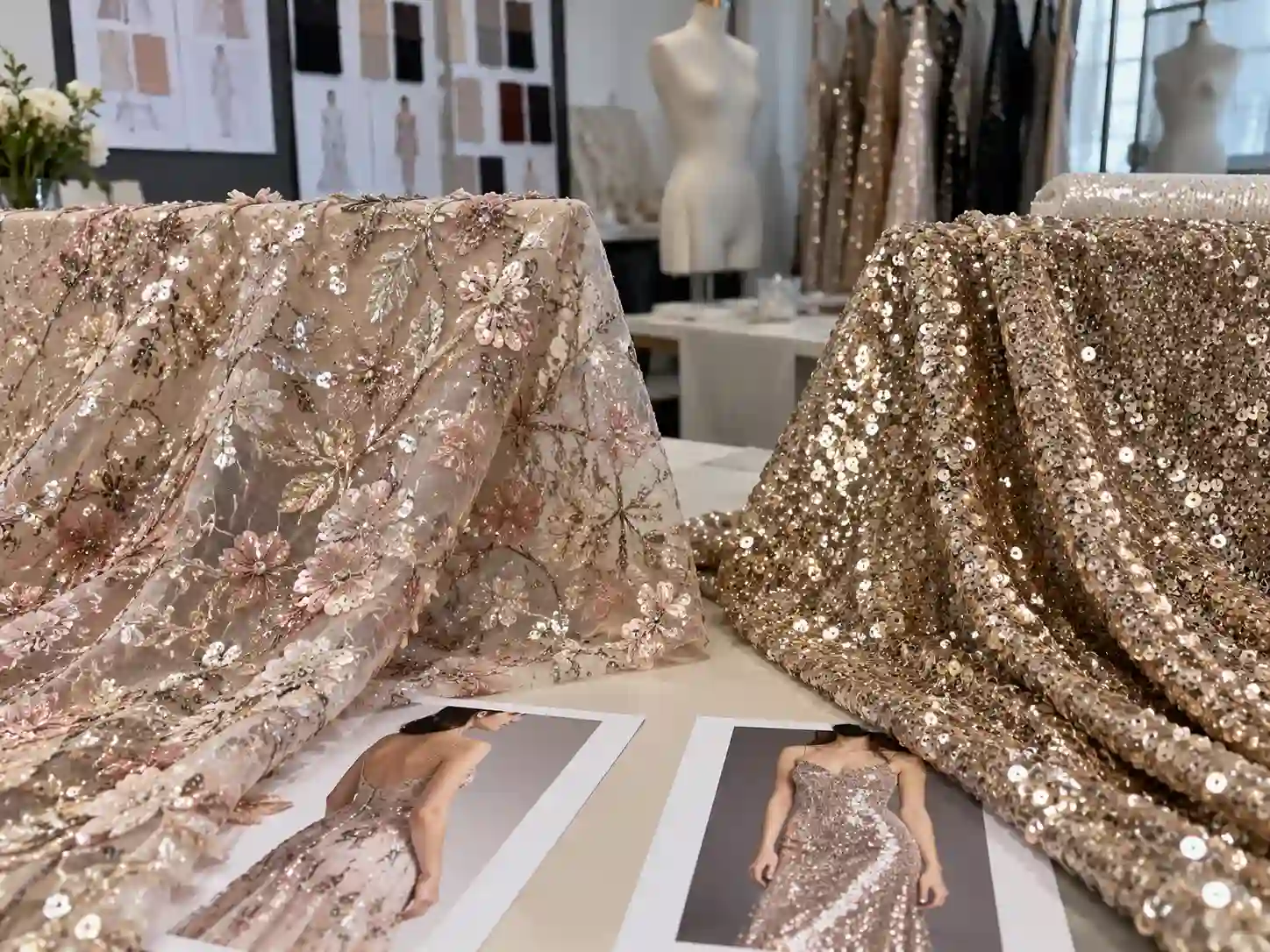
Table of Contents
Here, developing your OEM/ODM private label clothing collection is no longer a challenge—it’s an excellent opportunity to bring your creative vision to life.

