 Skip to content
What Are US Care Label Requirements? A Practical Guide for Fashion Brands

Your trusted Women’s Apparel Manufacturer from China

What Are US Care Label Requirements?
US care label requirements are FTC rules that require covered apparel manufacturers and importers to provide accurate care instructions for ordinary garment use. For fashion brands, the label must tell customers at least one safe cleaning method and must not hide warnings that could prevent damage during washing, drying, ironing, bleaching, or dry cleaning.
FTC Rule Basics
The FTC Care Labeling Rule is the main U.S. rule covering care instructions for textile wearing apparel and certain piece goods. It requires manufacturers and importers to provide regular care instructions to purchasers through care labels or other accepted methods, and it prohibits misleading omissions when care information is needed for normal use.
For fashion brands, this rule is not only a legal topic. It is a product management topic. A dress may look perfect in the campaign shoot, but if the care label is wrong, the customer may shrink it, stain it, melt decoration under heat, or damage the lining after the first clean. In womenswear, the risk is especially high because one collection can include satin, mesh, lace, sequins, rayon, rib knit, denim, lining, boning, elastic, rhinestones, and metal trims.
The care label should be decided with the garment, not after the garment. A safe instruction is based on fabric behavior, construction, trims, colorfastness, and the final PP sample. When brands treat the label as a quick artwork task, mistakes usually appear later in returns, reviews, customer complaints, or warehouse claims.
Legal Point | Practical Meaning for Apparel Brands | Production Checkpoint |
Care instructions are required for covered apparel | The consumer must know how to clean the garment safely | Confirm at tech pack and PP sample stage |
Manufacturer/importer responsibility applies | Overseas production does not remove U.S. market responsibility | Brand approves final label wording |
Instructions must reflect ordinary use | The label should match real garment performance | Test fabric, lining, trims, and decoration |
Warnings cannot be omitted when needed | Wash separately or do not tumble dry may be necessary | Review risky colors, trims, and finishes |
Care information must be easy to find | Label should be visible or care info shown outside packaging when needed | Check label placement and retail packaging |
Covered Apparel
The rule applies to textile wearing apparel, which covers many ordinary clothing products sold to consumers. For a women’s fashion brand, this usually means dresses, skirts, tops, jumpsuits, matching sets, pants, and similar garments made from textile materials. Unusual product categories should always be reviewed separately, especially when they include special materials, performance features, children’s use, or non-standard construction.
In fast fashion womenswear, the covered product range can become complicated quickly. A simple jersey dress, a lined satin maxi dress, a lace cocktail dress, and a sequin party dress may all need care labels, but they should not all use the same instruction. A basic knit top may tolerate machine washing. A structured corset dress with boning, lining, mesh panels, and decorative trim may not.
The safest mindset is simple: if the product is textile wearing apparel and will be sold in the U.S., do not assume the label can be copied from a previous style. Check the final garment, not just the fabric name.
Responsible Parties
FTC guidance identifies manufacturers, importers, and parties that direct or control manufacturing or importing as covered by the Care Labeling Rule. That means U.S. apparel brands, importers, and private-label sellers should not treat care labeling as something the factory alone takes care of.
In real production, the work is shared. The brand usually provides or approves label content. The manufacturer checks whether the proposed instruction matches the fabric, trims, construction, and production reality. The QC team verifies that the correct label is attached to the correct style, color, size, and shipment batch.
This shared workflow matters because the same dress can change during development. A buyer may approve a rayon fabric first, then switch to a viscose blend. A strap may change from self-fabric to elastic. A lining may be added. A rhinestone trim may be replaced with hot-fix decoration. Each change may affect care performance. When label approval is separated from product changes, risk increases.
Brand Risk
Care labels matter because they protect the garment after the sale. They help customers clean the product correctly, reduce avoidable damage, support customer service, and protect brand trust. In ecommerce fashion, the care label also affects reviews. A customer may not understand why a satin dress lost shine, why a black mesh top transferred color, or why a lined skirt twisted after washing. She will usually blame the brand, not the missing warning.
This is why experienced production teams review care labels together with fabric sourcing, trim selection, sample testing, and final packing. The label is small, but it reflects whether the whole product team understood the garment before shipping it.
What Must a Care Label Include?
A care label must state the regular care needed for ordinary use of the garment. In practical apparel production, it should give at least one safe care method, such as washing or dry cleaning, and include necessary instructions for washing, bleaching, drying, ironing, and warnings when those steps affect garment safety.
Cleaning Method
Clothing labels generally need washing instructions or dry-cleaning instructions. If a garment can be both washed and dry-cleaned, the label needs only one of those instructions, although brands may provide both if useful for the consumer. The stronger choice is not the longest label; it is the safest and clearest method that a customer can actually follow.
A clear label for a washable knit dress may say: machine wash cold, gentle cycle, wash with like colors, do not bleach, line dry. For a delicate embellished dress, professional dry clean only may be more appropriate if washing could damage trims, structure, or surface appearance.
The key word is safe. If the label provides a washing method, the brand should have a reasonable basis that the garment can survive that method. If the label says dry clean only, the brand should also avoid using it as a lazy default when the garment can be washed safely and the customer expects easier care.
Washing Language
Good washing instructions are specific. They usually cover water temperature, hand or machine method, cycle type, color separation, bleach limits, drying method, ironing conditions, and special warnings. Vague wording like wash carefully does not give the customer enough information to prevent damage.
In womenswear, washing language should reflect the weakest part of the garment, not the strongest. A polyester shell may be stable, but the lining may shrink. A jersey bodycon dress may be washable, but the foil print may crack under heat. A red satin dress may keep its shape but bleed onto lighter garments. A lace panel may snag if machine washed with rough items.
Garment Type | Common Care Risk | Practical Label Detail to Review |
Satin dress | Shine loss, water marks, heat damage | Hand wash cold or dry clean; cool iron on reverse if allowed |
Mesh dress | Snagging, stretching, seam distortion | Gentle wash bag, no tumble dry, avoid rough items |
Lace dress | Lace distortion, snagging, trim damage | Hand wash or dry clean depending on construction |
Sequin dress | Sequin loss, scratching, heat damage | Dry clean or spot clean; do not iron decoration |
Rayon/viscose dress | Shrinkage, twisting, color change | Cold wash, reshape, line dry; shrinkage review needed |
Dark denim/skirt | Dye transfer | Wash separately; color may transfer |
Corset dress | Boning distortion, cup deformation | Dry clean or hand wash depending on structure |
Dry Cleaning
Dry-cleaning instructions should be used when dry cleaning is a safe and intended method for the finished garment. In occasionwear, dry cleaning is common for structured pieces, delicate lace, embellished dresses, lined satin gowns, velvet dresses, sequined styles, and garments with boning or internal shaping.
The phrase dry clean only has a strong meaning for consumers. It tells them the garment should not be washed safely by ordinary washing methods. If a brand uses that phrase, it should be confident that washing creates unacceptable risk. If the garment can also be safely washed, a less restrictive instruction may be more customer-friendly.
In fast fashion, the care decision also has a commercial side. A premium evening dress customer may accept dry cleaning. A casual summer dress customer may not. The label should protect the garment, but it should also fit the product’s price point, wearing occasion, and customer expectation.
Warnings
Warnings are needed when part of the care process could damage the garment or other garments. Common apparel warnings include wash separately, wash with like colors, do not bleach, do not tumble dry, dry flat, do not wring, do not iron decoration, and remove detachable belt before cleaning.
Warnings are especially important for trend-driven womenswear. Cut-out dresses, contrast color panels, rhinestone trims, bonded decorations, feather trims, pleats, velvet surfaces, and sequin fabrics may all need extra care notes. In many cases, the warning is the difference between a customer using the garment correctly and unknowingly damaging it.
Are Care Symbols Enough?
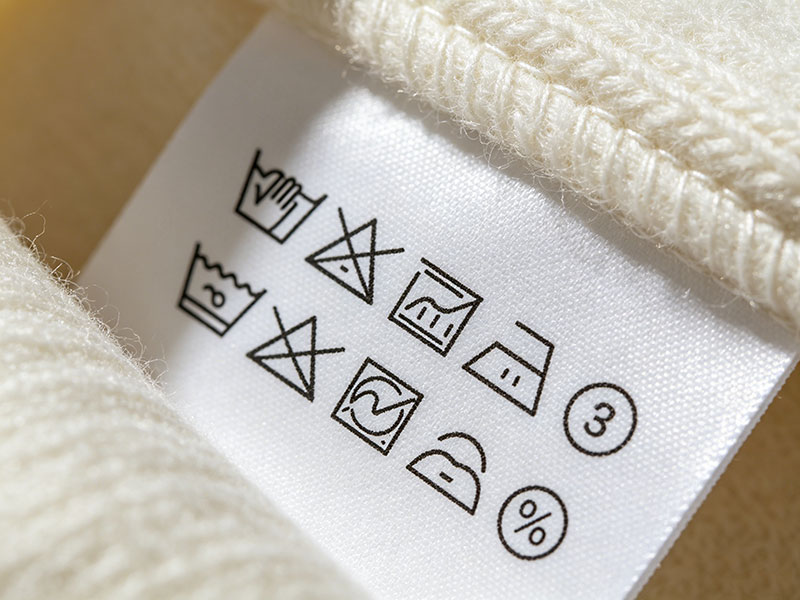
Care symbols can communicate garment care, but brands should not rely on them casually. Symbols must accurately describe the care method, and many U.S. fashion brands still combine symbols with short written instructions so customers, warehouses, and customer service teams can understand the label quickly.
Symbol Meaning
Care symbols are visual marks that explain how to wash, bleach, dry, iron, or dry clean a garment. They are useful because garments move across languages, markets, warehouses, and retail channels. A symbol system can reduce label length and make small garments easier to label.
For women’s fashion, this is practical. A mini dress, crop top, bodysuit, or fitted mesh style may not have much space for a long label. A thick label can feel uncomfortable, and customers may cut it out. Symbols help keep the label compact.
But symbols are only useful when chosen correctly. A tumble-dry symbol on a garment that should be line dried can cause real damage. An ironing symbol without a decoration warning can lead customers to melt prints, flatten sequins, or damage surface finishes. The symbol must match the final garment, not only the fabric supplier’s care suggestion.
Written Instructions
Many brands use written instructions together with symbols because written wording is easier for ordinary consumers and customer service teams. This is especially helpful for ecommerce brands selling to a broad U.S. audience.
A good combined label may be short: hand wash cold, do not bleach, line dry, cool iron if needed, do not iron decoration. The symbols reinforce the same message, while the words reduce confusion.
For high-risk garments, words are often safer. A sequin dress may need turn inside out or do not iron decoration. A dark denim skirt may need wash separately. A dress with detachable accessories may need remove belt before cleaning. Symbols alone may not communicate these details clearly enough.
Label Durability
A care label should remain readable during the normal useful life of the garment. That means the label material, print method, heat resistance, wash resistance, sewing position, and comfort all matter.
In womenswear production, label comfort is often underestimated. If the care label is stiff, scratchy, too large, or placed in an irritating position, customers may cut it out. Once removed, the garment loses its care instructions. For lightweight satin, mesh, jersey, or lace styles, a soft satin label, printed label, or suitable heat-transfer solution may work better than a heavy woven label.
Jinfeng Apparel supports custom label womenswear production, including woven labels, satin labels, printed labels, heat-transfer labels, size labels, and care labels for dresses, skirts, jumpsuits, matching sets, and private-label women’s fashion collections.
Digital Labels
Digital labels can add value, but brands should not assume a QR code can fully replace physical care information unless the applicable rule clearly allows it. For now, a physical care label remains the safer production approach for U.S.-bound apparel.
Digital tools are still useful. A QR code can link to extended care videos, fabric stories, recycling information, repair guidance, multi-language care pages, or customer support. This can improve customer experience without removing the core sewn or attached label.
For private-label fashion, the practical solution is to use physical labels for required information and digital tools as an extra layer. That gives the customer information at the point of use while still supporting a modern brand experience.
Which Labels Are Not Care Labels?
Care labels are different from fiber content labels, country of origin labels, RN or business identity labels, size labels, brand labels, barcodes, hangtags, and warehouse stickers. U.S. apparel labeling often requires several information types, and having one label does not automatically mean the whole garment is properly labeled.
Fiber Content
Fiber content labeling tells the customer what the garment is made of. For most textile and wool products sold in the United States, brands normally need to disclose fiber content, country of origin, and the identity of the responsible company. Care labels for clothing serve a different function: they explain how to clean the garment.
Fiber content and care instructions are connected, but they are not the same. A label saying 95% polyester, 5% spandex does not tell the customer whether to machine wash, hand wash, line dry, tumble dry, or dry clean. The care method depends on the finished garment.
Two garments can have similar fiber content and very different care requirements. A plain polyester-spandex jersey dress may be washable. A polyester-spandex dress with foil print, rhinestones, mesh cut-outs, and delicate straps may need much stricter care. The fiber label gives material identity; the care label gives cleaning behavior.
Label Type | Main Purpose | Common Content | Why It Is Not the Same as Care Label |
Care label | Explains safe cleaning method | Wash, dry, iron, bleach, dry clean, warnings | Focuses on garment care behavior |
Fiber content label | Discloses material composition | Fiber names and percentages | Describes material, not cleaning method |
Country of origin label | Shows where product was made | Made in China, Made in Vietnam, etc. | Supports origin disclosure, not care |
RN/business identity | Identifies responsible company | Company name or RN | Identifies marketer, manufacturer, or importer |
Size label | Shows fit size | XS-XL, US 2-12, brand size codes | Helps fit and selling, not cleaning |
Barcode/SKU sticker | Supports inventory control | SKU, color, size, barcode, PO | Warehouse and retail function |
Country of Origin
Country of origin labeling tells consumers and trade parties where the garment was made or processed under applicable rules. For brands importing garments into the U.S., origin wording should be checked early because it may appear on sewn labels, hangtags, polybags, cartons, invoices, and customs documents.
The most practical issue is consistency. If the sewn label says one origin, the carton mark says another, and the commercial documents use different wording, the problem becomes bigger than a label artwork issue. It can delay receiving, create customs questions, or cause retail compliance problems.
For private-label womenswear made in China, the brand should approve the exact origin wording and ensure it is used consistently across garment labels, packing files, barcode stickers, carton marks, and shipping documents.
RN or Business Identity
An RN, or Registered Identification Number, is used by some businesses as identification on textile, wool, and fur product labels. For private-label brands, RN or business identity should come from the brand’s approved compliance files. The manufacturer should not guess it, replace it with another company’s number, or reuse old label artwork from a different order.
This is why label files need version control. A brand should clearly identify which business name or RN belongs on each style, market, and shipment. If the brand sells through multiple entities, retailers, or regions, the label identity may vary by program.
Size and SKU Labels
Size labels help customers choose fit and help warehouses sort products, but they do not replace care labels. A size label may show XS, S, M, L, XL, US numeric sizes, EU sizes, or custom brand sizing. It may also connect to color-size packing and SKU tables.
In women’s fashion, size label mistakes are common when orders include many styles, colors, and sizes. A 12-style dress collection with 4 colors and 6 sizes creates 288 possible style-color-size combinations before even adding packaging variations. If the care label, size label, barcode sticker, and carton mark are not linked correctly, errors can spread quickly.
Jinfeng Apparel supports private-label womenswear production with woven labels, size labels, care labels, hangtags, hang strings, barcode stickers, SKU labels, polybags, stickers, thank-you cards, cartons, carton marks, and warehouse labels.

How Do Brands Avoid Label Mistakes?
Brands avoid label mistakes by checking care instructions during tech pack review, validating them with fabric and trim behavior, approving them at PP sample stage, and controlling label-to-SKU matching during bulk production and packing. The safest system is test, approve, record, inspect, and keep the label file consistent.
Fabric Testing
Fabric tests guide care instructions because the label should reflect what the fabric can actually tolerate. Important checks may include shrinkage, colorfastness to washing, colorfastness to rubbing, appearance after cleaning, seam stability, stretch recovery, pilling, and heat sensitivity.
A fabric supplier’s general care note is useful, but it is not enough for a finished garment. The finished product may include lining, elastic, print, bonding, sequins, lace, boning, padding, metal trims, or decorative stitching. These details can change the safest cleaning method.
For fast fashion brands, testing should focus on risk. New fabrics, dark colors, bright reds, contrast panels, viscose, rayon, pleats, trims, printed surfaces, and decorated garments deserve more attention than repeated low-risk basics. If a brand changes fabric after sample approval, the care label should be reviewed again.
Trim Review
Trims often decide the final care method. A fabric may be washable, but the zipper tape may wave, metal trim may rust, rhinestones may loosen, printed decoration may crack, elastic may lose recovery, or boning may bend.
This is a common source of care label errors. Product teams approve the main fabric and forget that the garment is a system. A satin dress with no decoration and a satin dress with rhinestones, cups, boning, lace-up back, lining, and metal eyelets are not the same care problem.
Trim review should happen before bulk production. If the brand wants a washable garment, trims should be selected with that goal in mind. Sometimes the best care-label decision is made before the label is written: choose a more durable trim, change the attachment method, or simplify a risky decoration.
PP Sample Check
The PP sample is the best time to freeze the care label. At that stage, the garment should represent bulk production in fabric, color, lining, trim, construction, measurements, label placement, and packing method.
A useful PP sample review should check care wording, care symbols, fiber content, country of origin, RN or business identity, main label, size label, hangtag, barcode sticker, SKU label, polybag sticker, carton mark, and warehouse label if required. The reviewer should also check whether the care label is readable, soft enough, correctly placed, and consistent with the tech pack.
If the care label is not approved at PP sample stage, the production line may use an outdated file. That is how small wording errors become bulk shipment problems.
Production Stage | Label Control Target | Practical Check |
Tech pack review | 1 approved label section per style | Care wording, fiber, origin, RN/business identity, label placement |
Sample stage | Confirm risky cleaning behavior | Wash, dry, iron, colorfastness, trim reaction where relevant |
PP sample stage | Final label approval before bulk | Correct wording, symbols, material, placement, comfort, readability |
Bulk sewing | 100% correct label type by style/color/size | Sewing-line label bundle check and random in-line verification |
Final inspection | Label matches garment and packaging | Style, size, color, barcode, hangtag, polybag, carton mark |
Repeat order | Use stored approved label file | Check if fabric, trim, origin, or packaging changed |
Common Errors
The biggest risk is an inaccurate care instruction. If a label says machine wash but the garment shrinks, bleeds, twists, or loses decoration under ordinary washing, the problem is not only a customer complaint. It may also show that the instruction was not supported by the finished product.
Other common errors include missing warnings, wrong care symbols, unreadable print, wrong fiber content, inconsistent origin wording, outdated RN information, wrong size labels, barcode mismatch, and label files copied from previous styles. Multi-style orders are especially vulnerable because similar garments may need different labels.
A clean label system should include one approved file per style, one SKU table, one packing instruction, one PP approval record, and one final QC checklist. When the garment changes, the label should be checked again.
How Can Manufacturers Support Compliance?
Manufacturers support care label compliance by reviewing tech packs, checking fabric and trim risks, developing label samples, controlling label placement, verifying labels during QC, and matching labels with the correct SKU during packing. A manufacturer does not replace legal review, but it can prevent many avoidable production errors.
Tech Pack Review
A tech pack should guide the care label by connecting the garment’s fabric, trim, construction, label artwork, placement, and packaging requirements in one controlled file. Without this connection, the factory may receive care wording but not know how it relates to the finished garment.
A strong tech pack label section includes care wording, care symbols, fiber content, origin statement, RN or business identity if used, label artwork, label material, label size, label placement, barcode requirements, SKU table, and packing instructions. It should also show whether different colors or sizes need different labels.
Jinfeng Apparel supports OEM and ODM womenswear development based on tech packs, reference photos, original samples, line sheets, or sketches, with fabric sourcing, trim sourcing, pattern making, sampling, bulk production, QC, and private-label packing.
Private Label Checks
Private labels should be checked at artwork stage, sample stage, PP sample stage, bulk sewing, final inspection, and packing. A private-label garment often includes more than one label: main brand label, size label, care label, hangtag, barcode sticker, SKU sticker, color sticker, polybag sticker, and carton mark.
For ecommerce and retail-ready womenswear, the label system must support both the customer and the warehouse. The customer needs care, size, fiber, and brand information. The warehouse needs barcode, SKU, color, size, PO, carton mark, and receiving label consistency.
Individual garment packing can include folding, main label, size label, care label, hangtag, barcode, size sticker, color sticker, thank-you card, sticker, polybag, warning text, and SKU label, with checks for correct garment-label matching, scannable barcode, clean garment appearance, and correct folding.
Bulk Label Control
Bulk label control should be organized by style, color, size, SKU, and shipment batch. The larger the order, the more important this becomes. A 10-style dress program with 5 colors and 6 sizes creates 300 style-color-size combinations. If labels are not controlled by SKU, mistakes can appear even when sewing quality is good.
A practical bulk process includes incoming label inspection, label quantity check, line-side label distribution, in-line verification, final garment inspection, packing inspection, carton-level verification, and record keeping for repeat orders. If the label file changes, old labels should be removed from the production area.
Jinfeng Apparel controls carton-level quantity, SKU, color, size, barcode, and carton mark consistency before shipment, and supports private-label dress manufacturing with custom labels, care labels, hangtags, barcode stickers, polybags, SKU packing, carton marks, and repeat-order records.
Jinfeng Apparel Support
A reliable manufacturer helps brands turn label requirements into production reality. That means reviewing label files early, checking whether care instructions match fabric and trims, preparing correct label samples, sewing labels in the approved position, checking label comfort, and verifying label-to-SKU accuracy during final packing.
Jinfeng Apparel is a Guangdong-based premium custom women’s fashion manufacturer serving global fashion brands and mid-to-large custom apparel clients with OEM, ODM, private label, dress development, sampling, bulk production, quality control, packaging, and export delivery support. The company operates 6 owned women’s fashion factories and works with more than 10 long-term satellite production partners. MOQ starts from 200 pcs per style/color, depending on fabric availability, color development, trims, construction complexity, and production schedule.
For U.S.-focused womenswear brands, this support is practical. Care labels, size labels, brand labels, hangtags, barcodes, SKU packing, carton marks, and warehouse labels all need to work together before the shipment leaves the factory. When label control is built into sampling, PP approval, bulk sewing, QC, and packing, brands reduce preventable mistakes and deliver garments that are easier to sell, receive, clean, and reorder.

Final Thoughts
US care label requirements are not just a compliance checkbox. They are a practical bridge between product development, customer use, quality control, and brand reputation. A good care label tells the customer how to keep the garment wearable. A good label process tells the brand that its supplier understands the real risks behind fabric, trims, construction, SKU control, and private-label delivery.
For fashion brands selling into the United States, the strongest approach is to build care labeling into the production workflow early. Confirm the care method during development. Test risky fabrics and trims. Review labels at PP sample stage. Match labels to style, color, size, and SKU during bulk production. Check packaging and carton information before shipment.
Jinfeng Apparel supports custom womenswear brands with OEM, ODM, private-label production, dress development, fabric and trim sourcing, sampling, bulk production, QC, care labels, hangtags, barcodes, SKU packing, carton marks, and export delivery support. For U.S.-market dresses, skirts, jumpsuits, matching sets, partywear, occasionwear, mesh dresses, satin dresses, lace dresses, and sequin dresses, the team can help turn your design files into production-ready, brand-ready garments.
To discuss your next private-label womenswear collection, send your tech pack, reference images, line sheet, target quantity, size range, fabric direction, and label or packaging requirements to Jinfeng Apparel for a custom quotation.
Share This Article :

Jerry Lee
Categories

Latest blogs

Table of Contents
Here, developing your OEM/ODM private label clothing collection is no longer a challenge—it’s an excellent opportunity to bring your creative vision to life.

