
Nylon vs Metal Zippers for Fashion Dresses: Which One Should Brands Choose?

Your trusted Women’s Apparel Manufacturer from China

A zipper looks small on a fashion dress, but in real dress development it can decide whether the garment feels polished or problematic. Many brands spend weeks choosing fabric, neckline, silhouette, lining and color, then treat the zipper as a last-minute trim decision. That is where trouble often begins. A zipper that looks fine on a trim card can become too stiff on the body, too heavy for soft fabric, too visible on a clean evening dress, or too weak for a fitted bodycon style. For fashion brands developing dresses at scale, the question is not simply nylon or metal. The better question is: which zipper supports the design, fabric, fit, customer comfort and bulk production standard?
For most fashion dresses, nylon coil zippers are the safer choice when the goal is lightweight closure, smooth flexibility, invisible finishing and better compatibility with soft fabrics. Metal zippers work best when the zipper is part of the design, such as exposed front zippers, denim dresses, structured dresses, utility styles or statement hardware looks. The right choice depends on fabric weight, zipper placement, dress fit and production testing.
Think about a satin midi dress that looks elegant in the sample room. The first sample uses a heavy exposed zipper because the puller looks premium. On the mannequin, it seems attractive. But after fitting, the center back seam starts pulling downward, the fabric ripples around the zipper tape, and the wearer feels the metal teeth against the skin. The design did not fail because of the dress concept. It failed because the closure was not chosen as part of the garment system. That is why zipper selection deserves serious attention before sampling and bulk production.
What Is the Difference Between Nylon and Metal Zippers?
Close-up studio photo of three fashion dress zipper samples on satin, chiffon, and denim swatches: invisible nylon coil zipper, regular nylon coil zipper, and exposed metal zipper. Neutral background, clean product photography, garment development mood, no logos.
Nylon zippers are usually lighter, softer, and more flexible, which makes them easier to use in many fashion dresses. Metal zippers are heavier, more rigid, and more visually noticeable, so they work better when the zipper is part of the design. For dresses, the real difference is how each zipper affects fit, drape, comfort, sewing stability, and bulk production consistency.
In dress production, the zipper is not just a closing device. It is a trim, a functional part, a structural line, and sometimes a visual design detail. Nylon and metal zippers behave differently because their teeth, tape, slider, puller and stiffness interact with fabric and body movement in different ways. A zipper that works beautifully on denim may feel heavy on chiffon. A zipper that disappears inside a satin dress may look too quiet for a front-zip utility dress.
The most common mistake is comparing nylon and metal zippers only by strength. Strength matters, but fashion dresses require more than strength. The zipper also needs the right weight, flexibility, color match, tape thickness, slider smoothness, sewing stability and comfort against the body. In a fitted party dress, a hard zipper line can ruin the back view. In a denim mini dress, a fine invisible zipper may look underpowered and inconsistent with the design language.
For brands, the right way to evaluate zippers is to think about the whole garment. What fabric is used? Is the dress fitted or relaxed? Is the zipper hidden or exposed? Does the customer need easy entry over the hips? Will the zipper sit against skin? Will it be photographed from the back? Will the same trim need to repeat across several colors and sizes in bulk production? These questions are more useful than asking which zipper is generally better.
What is a nylon coil zipper?
A nylon coil zipper is made with a continuous spiral-like coil sewn onto fabric tape. In fashion dress production, this structure gives the zipper more flexibility than metal teeth. It can bend more naturally with the body, which is why nylon coil zippers are commonly used in fitted dresses, soft woven dresses, satin dresses, mesh dresses, lace dresses and many invisible zipper applications.
For brands, the main advantage is that a nylon zipper does not usually dominate the garment. It can sit quietly in a center back seam or side seam without adding too much weight. This is important when the dress fabric is light, fluid, stretchy or delicate. A chiffon dress, satin midi dress or stretch bodycon dress often needs a closure that supports the garment without changing the way the fabric falls.
Nylon zippers also offer practical production advantages. They are easier to color match, easier to conceal and usually more compatible with clean dress silhouettes. When a collection includes several colors, a nylon zipper can often be selected in a matching tape shade so the closure does not distract from the garment.
What is a metal zipper?
A metal zipper uses individual metal teeth fixed onto zipper tape. The teeth create a stronger visual effect and a firmer structure. In fashion dresses, metal zippers are often used when the zipper is designed to be seen, such as on denim mini dresses, utility dresses, leather-look dresses, exposed front-zip styles and certain statement party dresses.
The main benefit of a metal zipper is its presence. It can make a dress look more structured, edgy or hardware-driven. A metal zipper can add character to a plain dress if the fabric and silhouette are strong enough to carry it. However, this strength can also become a problem. Metal teeth add weight and stiffness. On soft fabrics, they can pull the seam down, create visible ripples or make the garment uncomfortable.
A metal zipper should be treated as a design decision, not just a closure decision. If it is added late in development without checking fabric weight, seam construction and fit tension, it may create problems during sampling or bulk production. It works best when the whole dress is designed around the hardware.
Are invisible zippers usually nylon?
Most invisible zippers used in dresses are nylon coil zippers. The coil teeth are turned inward and hidden behind the seam when the zipper is sewn correctly. This makes invisible zippers popular for cocktail dresses, evening dresses, bridesmaid dresses, satin dresses, lace dresses and other styles where the designer wants a clean back or side seam.
Invisible zippers are not chosen because they are weak or cheap. They are chosen because they protect the visual line of the garment. A clean center back seam can make a dress look more refined, especially when the fabric has shine, transparency or a smooth surface. For fitted dresses, an invisible zipper also helps keep the closure discreet.
However, invisible zippers require careful sewing. If the seam is stretched, the zipper is inserted under uneven tension, or the fabric is not stabilized properly, the zipper may wave, twist or become difficult to close. This is especially common with satin, stretch mesh, lightweight crepe and lace overlays. The zipper may be invisible in theory, but poor sewing makes it very visible in reality.
How do zipper parts affect dresses?
A zipper is more than teeth. The tape, slider, puller, stopper and sewing method all affect how the dress performs. In a fashion dress, even a small mismatch can cause visible problems. A tape that is too stiff can make the seam stand away from the body. A puller that is too heavy can create a bump. A slider that catches can make the customer feel the dress is low quality.
For dress development, the zipper tape deserves special attention. The tape sits inside the seam and directly affects seam flatness. If the tape color does not match the shell fabric or lining, it may show through light-colored or sheer fabrics. If the tape width is not suitable for the seam allowance, sewing becomes less stable. If the tape is too thick, it can create bulk at the waist or underarm.
The slider and puller affect both function and appearance. A delicate dress may need a small, quiet puller. A front-zip dress may need a decorative puller. A fitted party dress may need an auto-lock slider to prevent slipping. These details should be confirmed before sampling, not left to the factory’s default trim choice.
Zipper Type | Common Dress Use | Approx. Feel | Best Fabric Match | Main Risk |
Invisible nylon zipper | Back or side closure | Very light to light | Satin, chiffon, lace, crepe, mesh, occasionwear fabrics | Waves if sewing tension is poor |
Regular nylon coil zipper | Hidden or semi-hidden closure | Light to medium | Casual woven, knit, bodycon, lined dresses | May look too casual if exposed |
Exposed metal zipper | Decorative closure | Medium to heavy | Denim, structured woven, leather-look, utility styles | Too heavy for soft fabrics |
Decorative zipper | Design feature | Varies | Party dresses, statement mini dresses | Puller weight or color may disrupt balance |
Heavy-duty zipper | Functional high-stress closure | Heavy | Rare for fashion dresses, more common in outerwear | Overbuilt for most dress fabrics |
Which Zipper Is Better for Fashion Dresses?
Fashion design worktable showing four dress sketches with zipper placement notes: chiffon maxi dress, satin midi dress, bodycon dress, denim mini dress. Include swatches, measuring tape, and zipper samples. Professional apparel development scene, clean natural light.
Nylon zippers are better for most fashion dresses because they are lighter, more flexible, easier to hide, and more compatible with soft or fitted garments. Metal zippers are better when the zipper is intentionally exposed or when the fabric is structured enough to support hardware. The best choice depends on fabric weight, dress fit, zipper placement, and the intended look.
There is no single best zipper for every dress. The correct zipper depends on the relationship between fabric, design, fit and use. A lightweight resort dress does not need the same closure as a denim front-zip mini dress. A clean satin evening dress does not need the same zipper as a utility-inspired woven dress. When brands treat one zipper type as a universal solution, sample revisions usually increase.
In practice, nylon zippers are the safer default for many fashion dresses because they support softness, concealed finishing and body movement. Metal zippers are more selective. They can create strong visual value, but they need compatible fabric weight and construction support. The wrong metal zipper can turn a dress from premium to uncomfortable very quickly.
The best decision is made before the first sample. If the zipper is meant to disappear, nylon or invisible is usually the direction. If the zipper is meant to communicate hardware, structure or attitude, metal can be explored. If the dress is fitted, the closure must be tested under body tension. If the dress is lightweight, the closure must not drag the fabric down.
Which zipper works best for lightweight dresses?
Lightweight dresses usually work best with nylon coil or invisible zippers. Fabrics such as chiffon, georgette, lightweight satin, rayon, viscose, soft crepe and thin mesh are sensitive to weight and stiffness. A heavy zipper can pull the seam downward and make the dress lose its natural movement.
The closure should follow the fabric, not fight against it. On a chiffon maxi dress, the back seam should fall softly. On a satin slip dress, the zipper should not create a hard vertical ridge. On a lace cocktail dress, the closure should not interrupt the surface design. A nylon zipper gives the factory more control because it is lighter and easier to integrate into the seam.
For lightweight dresses, zipper length also matters. A zipper that is too short can make the dress hard to put on, creating stress at the waist or hip. A zipper that is too long may affect the flow of the skirt. During sampling, the dress should be tested on the body, not only checked on a hanger. If the fabric drags, ripples or pulls around the zipper, the trim may need to be changed before bulk approval.
Which zipper works best for structured dresses?
Structured dresses can handle stronger zippers, including metal zippers when the design supports them. A denim mini dress, tailored suiting dress, utility dress or structured front-zip dress may benefit from a zipper that adds firmness and visual detail. In these cases, a metal zipper can look intentional and balanced.
Still, structure does not automatically mean metal is the best choice. A corset dress may need strong closure, but the brand may still want a clean back seam. A satin corset mini dress may look better with a strong concealed zipper and internal reinforcement rather than a visible metal zipper. The zipper must support both function and style.
The key is matching zipper strength to fabric strength. A 10-12 oz denim dress can usually carry hardware better than a 90-120 gsm chiffon dress. A lined mini dress with firm panels can carry more zipper weight than a soft bias-cut midi dress. When the fabric and zipper are out of balance, the zipper becomes the first thing the customer notices – and not in a good way.
Which zipper is better for bodycon dresses?
Bodycon dresses usually need flexible nylon zippers because the garment sits close to the body and experiences higher tension. The zipper area must stay flat while the wearer walks, sits, turns and moves. A stiff zipper can create a hard line down the back or side, especially on stretch fabrics.
Bodycon fabrics often include jersey, ponte, rib knit, stretch mesh, stretch satin, scuba, polyester-spandex or nylon-spandex. These fabrics stretch, but the zipper does not stretch in the same way. That difference must be managed through pattern adjustment, seam stabilization and correct zipper choice. If the dress is tight at the hip but the zipper is short or stiff, the customer may struggle to close it.
A good bodycon sample should be checked in motion. The model should sit, turn and walk. The zipper should remain smooth. The seam should not split open or ripple. The slider should not press into the lower back. For fitted dresses, a small zipper issue can make the whole garment look poorly developed, even when the fabric and pattern are strong.
Which zipper is better for satin, chiffon, lace, and mesh dresses?
Satin, chiffon, lace and mesh often perform best with nylon or invisible zippers, but each fabric has its own risk. Satin shows every ripple because of its reflective surface. Chiffon is light and easily pulled by zipper weight. Lace may have uneven thickness and open areas. Mesh can stretch or distort during sewing.
For satin dresses, a concealed nylon zipper is usually preferred, but sewing tension must be controlled. If the zipper is stretched during insertion or pressed poorly, the satin will show waves immediately. For chiffon dresses, a lightweight zipper is safer because the fabric has little structure to carry hardware. For lace dresses, the zipper should often be placed in a way that protects the lace pattern and avoids bulky seams. For mesh dresses, seam reinforcement is often needed to stop stretching.
Brands should not approve a zipper only from a trim card. The zipper must be tested in the real fabric, with the real lining, on the real dress pattern. Fabric behavior changes after cutting, lining, sewing, pressing and fitting.
Dress Fabric | Common Weight Range | Safer Zipper Choice | Practical Reason |
Chiffon / georgette | 60-100 gsm | Lightweight invisible nylon | Keeps soft drape and avoids seam drag |
Satin / stretch satin | 90-180 gsm | Invisible nylon or fine coil | Reduces visible interruption on shiny surface |
Lace / lace overlay | 100-250 gsm | Concealed nylon with careful placement | Avoids disrupting lace pattern |
Mesh / stretch mesh | 60-160 gsm | Nylon coil with stabilization | Controls stretch and seam distortion |
Ponte / scuba | 220-350 gsm | Nylon coil or stronger concealed zipper | Handles bodycon tension better |
Denim | 250-400+ gsm | Metal or stronger coil zipper | Matches fabric structure and casual styling |
Suiting fabric | 180-300 gsm | Concealed nylon or metal if exposed | Depends on clean vs statement design |
Sequin fabric | 180-350 gsm | Concealed or protected zipper | Prevents teeth and slider from catching decoration |
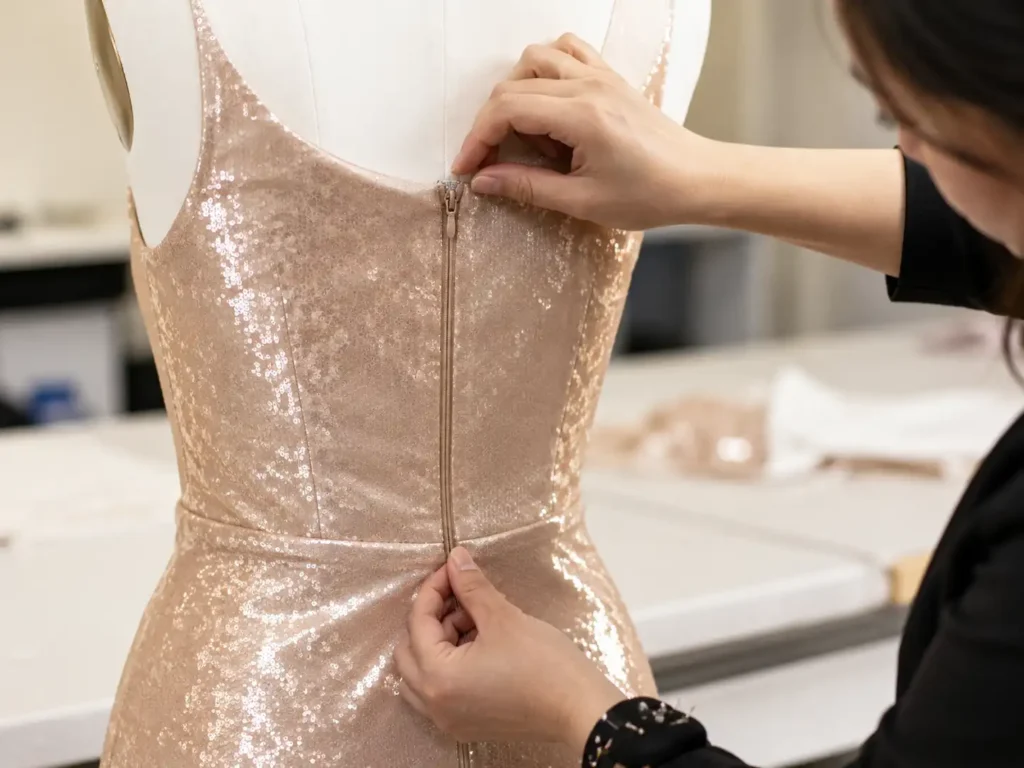
How Do Zippers Affect Dress Fit and Drape?
Side-by-side professional fitting room comparison of a satin dress back seam: one clean invisible zipper and one wavy zipper seam. Show garment technician checking seam flatness on dress form, soft studio lighting, realistic fashion production environment.
Zippers affect dress fit and drape by adding a fixed line of weight, stiffness, and tension to the garment. A suitable zipper supports wearing and closure without changing the silhouette. A wrong zipper can cause pulling, waves, bulging, twisting, seam stiffness, or discomfort, especially in fitted dresses, lightweight fabrics, shiny satin, and clean center back designs.
A dress is a moving product. It is worn over curves, pulled over the body, zipped under tension, photographed from several angles, packed, shipped and worn again. The zipper sits inside all of that movement. When the zipper does not match the fabric and silhouette, it changes how the dress behaves. The problem may appear as a wavy seam, a hard vertical line, a pulling point at the hip or a bulky top stop at the neckline.
Fit and drape issues are often blamed on sewing, but sewing is only one part of the answer. A zipper can be sewn neatly and still be wrong for the dress. A stiff zipper on a soft fabric may never sit naturally. A short zipper on a fitted style may force the wearer to pull too hard. A heavy puller can drag down a lightweight seam. A tape color that shows through can make a clean design look unfinished.
For brands, this is why sample review must include movement. A dress should be checked while standing, sitting, turning and walking. The zipper should not only close. It should support the garment’s shape without calling attention to itself unless it is intentionally part of the design.
How does zipper weight affect fabric drape?
Zipper weight can change the way a dress falls. This is especially obvious in lightweight or fluid fabrics. A heavy zipper may pull the fabric downward, making the seam look longer, straighter or stiffer than the rest of the garment. On a soft dress, this can make the back or side seam look visually heavy.
Drape is not only about fabric. It is about how fabric, lining, zipper, seam allowance, thread tension and pressing work together. A chiffon dress with a heavy zipper may lose its soft fall. A satin dress with a stiff zipper may show a vertical ridge. A mesh dress may stretch around the zipper if the seam is not supported.
In sampling, the dress should be checked from several distances. Close-up inspection shows stitching quality, but a one-meter view shows whether the zipper changes the garment’s overall balance. If the eye immediately goes to the zipper line on a dress that should look clean, the zipper may be too heavy, too stiff or too visible.
How does zipper stiffness affect the back seam?
The center back seam follows a curved area of the body. It passes through the upper back, waist and sometimes hip. A stiff zipper does not naturally follow these curves. It may stand away from the body, form a ridge or create buckling when the wearer moves.
This is one reason nylon zippers are commonly used for fitted dress closures. They offer more flexibility and can sit closer to the body. Metal zippers are more rigid and need more careful placement. On a structured mini dress, that rigidity may look sharp. On a soft satin midi dress, it may look awkward.
Back seam quality also matters in ecommerce. Many dresses are sold through model photos, videos and social content. A rippled back zipper can make the product look lower quality even if the front view is beautiful. For party dresses, cocktail dresses, bodycon dresses and evening dresses, the back view is part of the selling image. If the zipper line is not flat, customers will notice.
How do zippers affect tight-fitting dresses?
In tight-fitting dresses, the zipper is one of the highest-stress areas. The fabric pulls around the bust, waist and hip, while the zipper remains a fixed non-stretch line. If the pattern, fabric and zipper are not balanced, the zipper area can become the first place where the dress fails.
Common problems include zipper waves at the lower back, teeth showing under tension, the slider sticking at the waist, fabric pulling beside the tape or the seam twisting toward one side. These issues are not always caused by poor sewing. Sometimes the dress simply needs more ease, a longer zipper, a softer zipper, stronger seam stabilization or a better position.
For fitted dresses, the zipper should be tested while worn. A flat garment on a table does not show body tension. A dress may close perfectly on a hanger but pull badly on the body. That is why fitting review is essential before approving bulk production. The zipper must support real movement, not just sample-room appearance.
How can the wrong zipper cause waves or bulging?
Waves and bulging often appear when the zipper and fabric behave differently. If the fabric stretches during sewing but the zipper tape does not, the seam may ripple. If the zipper is too stiff, it may push away from the body. If the dress is too tight, body tension may pull the zipper area open. If the seam allowance is uneven, the zipper may twist.
Satin makes this problem very visible because light catches every uneven surface. Stretch mesh can also expose zipper waves because the fabric moves easily. Lace can create bulk if the zipper crosses thick motifs or layered seams. In bodycon dresses, the hip and waist area are especially sensitive because the zipper is under pressure during wearing.
A professional production team should check zipper flatness after sewing, after pressing and after fitting. If the zipper looks flat before fitting but waves on the body, the issue is not solved. The correction may involve pattern balance, zipper length, seam stabilization or a different zipper type.
Visible Problem | Common Cause | Practical Correction |
Back seam waves | Fabric stretched during zipper sewing | Reduce sewing tension, stabilize seam, reinsert zipper |
Zipper bulges outward | Zipper too stiff for body curve | Use softer nylon zipper or adjust placement |
Teeth show on invisible zipper | Garment too tight or zipper poorly inserted | Add ease, improve sewing, check zipper size |
Side seam twists | Zipper placement fights body tension | Rebalance side seam and test fit again |
Fabric pulls down | Zipper too heavy for fabric | Use lighter zipper or reinforce design panel |
Slider jams at waist | Seam intersection too thick | Reduce seam bulk or change construction |
Tape shows through fabric | Tape color or thickness unsuitable | Match tape better or add lining/facing |
Skin discomfort | Exposed teeth or puller touches body | Add guard, lining, facing, or change zipper type |
Do Metal Zippers Work for Fashion Dresses?
Editorial product image of structured fashion dresses using exposed metal zippers: denim mini dress, utility dress, black structured bodycon, and leather-look dress on mannequins. Focus on zipper hardware details, premium studio lighting, no brand logos.
Metal zippers work for fashion dresses when the zipper is meant to be seen and the fabric can support its weight and stiffness. They are suitable for denim dresses, utility dresses, leather-look dresses, structured mini dresses, and exposed front-zip designs. They are less suitable for delicate, lightweight, highly fluid, or very fitted dresses unless carefully engineered.
Metal zippers have a strong place in fashion, but they are not a universal upgrade. They can make a dress look sharper, tougher, more urban or more hardware-driven. They can also make a soft dress look heavy, uncomfortable or unfinished. The difference comes down to whether the fabric and construction were designed to carry metal.
A metal zipper should be selected for a reason. If the zipper is hidden, nylon is often more practical. If the zipper is exposed and part of the visual identity, metal may be the right choice. But the style must be developed around it. The seam line, tape exposure, puller shape, metal finish and garment balance should all be considered before sampling.
For mid-to-large fashion brands, metal zipper decisions also affect sourcing and consistency. Different finishes can vary slightly across batches. Custom pullers may require additional development time. Some metal finishes may not suit every colorway in a collection. These details should be settled before bulk trim purchasing.
Do metal zippers make dresses look more premium?
Metal zippers can make a dress look more premium when they match the design language. A polished gold zipper, antique brass zipper, nickel zipper or gunmetal zipper can add a strong hardware detail. On the right dress, this can make the garment feel more designed and less basic.
However, metal hardware does not automatically create a premium product. Premium appearance comes from balance. If the fabric is soft and elegant but the metal zipper is heavy and loud, the garment may look forced. If the zipper puller is too large or the teeth color clashes with the fabric, it can cheapen the dress instead of improving it.
The metal finish should also match the brand’s styling. Gold may look glamorous on a black structured mini dress. Antique brass may suit denim or utility dresses. Silver may work for modern clubwear. Matte black may feel cleaner on streetwear-inspired designs. But each finish should be tested with the actual fabric color, not chosen from a catalog alone.
Are metal zippers too heavy for soft fabrics?
Metal zippers are often too heavy for soft dress fabrics. Chiffon, lightweight satin, thin crepe, tulle, delicate lace and stretch mesh do not usually have enough structure to carry metal teeth cleanly. The zipper may pull the seam downward, create ripples or make the garment feel stiff against the body.
Soft fabrics are chosen for movement, comfort and flow. A heavy zipper can interrupt all three. For example, a chiffon maxi dress should move gently when the wearer walks. If a metal zipper is placed at the center back, it may act like a rigid spine. A satin slip dress may show a hard zipper line under light. A mesh dress may stretch around the zipper and distort.
There are cases where contrast can work. A designer may want delicate fabric with exposed metal hardware for a bold look. But that choice needs engineering. The zipper area may need facing, lining, reinforcement or a panel structure that carries the zipper weight. Without this support, the sample may look interesting but perform poorly in real wear.
Which dress styles can use exposed metal zippers?
Exposed metal zippers work best when they are designed into the dress from the start. They should not be added only because the brand wants a premium detail at the last minute. The pattern, seam line, topstitching, zipper length and garment balance must all support the exposed zipper.
Suitable styles include denim mini dresses, front-zip utility dresses, leather-look dresses, structured bodycon dresses, corset-inspired mini dresses, moto-inspired dresses, panelled mini dresses and statement party dresses. In these styles, the zipper can act as a visual line. It can lengthen the front body, define the center or create a bold back detail.
For exposed zippers, sewing quality becomes highly visible. The topstitching must be straight. The tape width must look balanced. The zipper stop must finish cleanly. The puller should sit neatly when closed. If one side of the zipper tape is slightly higher than the other, the defect is easy to see. Bulk production must therefore include clear sewing standards for exposed zipper styles.
How should brands avoid metal zipper discomfort?
Metal zipper discomfort usually comes from rough teeth, hard edges, heavy pullers, poor placement or no protection between the zipper and body. The dress may look stylish in photos but feel uncomfortable during sitting, walking or dancing. For fashion dresses, comfort is part of quality.
A front metal zipper should not press sharply into the stomach when the wearer sits. A back metal zipper should not dig into the spine. A side metal zipper should not rub under the arm. If the zipper touches skin, a guard, facing, lining or soft backing may be needed. The puller should also be checked. Large ring pullers and decorative charms may look attractive, but they can swing, hit the body or catch fabric.
Fit testing should include real movement. The wearer should sit, turn, bend slightly and walk. If the zipper feels cold, scratchy or bulky, customers may return the dress even if the design looks good online. Metal hardware must be both visual and wearable.

How Should Brands Choose Zippers Before Sampling?
Flat lay of a professional dress tech pack page with zipper specification callouts, zipper length ruler, swatches of satin and mesh, and trim cards. Clean apparel sourcing office scene, realistic, high-resolution, no logos.
Brands should choose zippers before sampling by checking fabric weight, dress fit, zipper placement, target appearance, body entry, trim color, puller style, and bulk feasibility. The zipper should be clearly listed in the tech pack with type, size, length, tape color, teeth finish, placement, and sewing method. Good zipper decisions reduce sample revisions and production risk.
The best zipper decision is made before the first sample is cut. Once the sample is sewn, changing the zipper can affect pattern balance, seam allowance, lining, costing and even the overall look of the dress. A zipper is not a small afterthought when the garment depends on clean fit and comfortable entry.
A professional brand should treat the zipper as part of the tech pack. The factory should not have to guess whether the zipper is invisible, exposed, metal, nylon, contrast, matching, decorative or functional. Clear zipper instructions help the sample room choose the right trim, cost the garment correctly and avoid unnecessary revisions.
Before sampling, brands should also consider bulk production. A beautiful zipper choice is not helpful if the trim is hard to source in all colors, too expensive for the target price, too heavy for the fabric or unstable in production. The best zipper is the one that fits the design and can be repeated reliably.
What should be checked in the tech pack?
A tech pack should not only say back zipper or invisible zipper. That leaves too much room for interpretation. A professional dress tech pack should define the zipper type, size, length, tape color, teeth color, slider, puller, placement and construction method.
This matters because a zipper affects costing, sourcing, sampling and bulk quality. A standard invisible nylon zipper is different from a custom color zipper. A decorative metal zipper with a special puller may have higher trim cost, longer lead time and minimum order requirements from the trim supplier. If the zipper is unclear, the first sample may use a default option that does not match the brand’s product image.
The tech pack should also include zipper placement measurements. For example, a center back zipper should have clear start and stop points. A side seam zipper should show whether it starts under the arm or lower at the waist. A front exposed zipper should specify topstitching width and whether the zipper tape is fully visible or partly covered.
Which zipper size should be selected?
Zipper size should match the dress’s fabric, stress level and design purpose. Smaller zippers look cleaner but may not be strong enough for high-tension garments. Larger zippers are stronger and more visible but may be too stiff for delicate dresses. Choosing the right size is about balance, not simply choosing the strongest trim.
For lightweight dresses, a fine invisible zipper is usually enough. For lined cocktail dresses, a standard invisible zipper may work if the seam is stable. For fitted bodycon dresses, the zipper must handle repeated tension. For denim dresses or exposed front designs, a larger metal zipper may be part of the look.
Zipper length also affects wearing. If a dress is hard to put on, customers will pull harder. That creates stress on the zipper, seam and fabric. A longer zipper may improve entry, especially on fitted dresses with narrow waists or hips. During sampling, the wearer should be able to put on and remove the dress without forcing the closure.
How should zipper color and tape be matched?
Zipper color should be matched under the same lighting conditions used for fabric approval. A tape that looks acceptable in the office may look obvious in daylight or studio photography. Light-colored dresses, satin fabrics, mesh panels and lace overlays are especially sensitive to zipper color.
For invisible zippers, the tape should usually match the shell fabric as closely as possible. For lined dresses, the developer should decide whether the zipper should match the outer fabric, lining or contrast design. For exposed metal zippers, the metal finish should match other garment hardware, such as buckles, rings, hooks or decorative trims.
Multi-color collections need early zipper planning. Black and white are easy. Champagne, ivory, blush, sage, chocolate, pale blue or seasonal colors may require more careful sourcing. If exact matching is not available, the best option should be approved with the actual fabric swatch before sample sewing. A small mismatch on one sample can become a serious visual issue across hundreds or thousands of garments.
How should zipper placement be tested?
Zipper placement should be tested according to how the customer wears the dress. The closure must support entry, fit, appearance and comfort. A center back zipper is common, but it can affect the back view. A side zipper can preserve a clean back, but it may twist if the dress is tight. A front zipper can create a strong design statement, but it changes the entire look of the garment.
Testing should include standing, sitting, walking, turning and opening or closing the zipper several times. The zipper should not pull the fabric, press into the body or distort the seam. The wearer should be able to get into the dress without forcing the zipper over the bust, waist or hip.
Placement is especially important for fitted dresses. A zipper that is too short may make entry difficult. A zipper placed too close to a high-tension curve may ripple. A side zipper placed poorly may rotate toward the front or back. The right placement is confirmed through fitting, not guesswork.
Tech Pack Item | What to Specify | Why It Matters |
Zipper type | Invisible nylon, nylon coil, metal, decorative | Controls look, feel, and garment compatibility |
Zipper size | Fine, medium, or heavier gauge | Balances strength and appearance |
Zipper length | Exact length or measured placement | Affects dressing ease and seam tension |
Tape color | Match shell, lining, or contrast | Prevents visible mismatch |
Teeth finish | Nylon color or metal finish | Supports design consistency |
Puller style | Standard, auto-lock, ring pull, branded | Affects comfort and visual identity |
Placement | Center back, side seam, front, shoulder | Affects fit, entry, and body comfort |
Sewing method | Concealed, exposed, lapped, faced | Controls final appearance and bulk quality |
Reinforcement | Fusing, stay tape, facing, lining | Reduces waves, stretching, and distortion |
What Should Be Checked Before Bulk Production?
Garment factory quality control scene showing a QC technician checking zipper smoothness and seam flatness on satin and bodycon dresses before packing. Include measuring tape, inspection checklist, and finished dresses on rack. Realistic apparel production photography.
Before bulk production, brands should check zipper smoothness, seam flatness, fit tension, color matching, zipper length, puller comfort, sewing consistency, and garment movement. A zipper should not only close; it should perform after sewing, fitting, pressing, packing, and repeated use. Bulk approval should be based on a sealed sample and clear inspection standard.
Bulk production is where a zipper decision proves itself. One sample can look acceptable, but the real question is whether the same zipper can be sewn, pressed, fitted and inspected consistently across every size, color and batch. This matters even more for dress collections with multiple fabrics, because each fabric reacts differently around the closure.
Before bulk approval, the brand and manufacturer should review the zipper as part of the sealed sample. The approved zipper type, tape color, teeth finish, puller style, length and placement should not be changed casually. Even a similar-looking replacement can affect the final garment. A slightly different tape thickness can cause seam waves. A different slider can catch at the waist. A different puller can change the back view.
Good zipper control is practical, not complicated. Check the trims when they arrive. Check the zipper after sewing. Check the seam on the body. Check the garment after pressing. Check again before packing. These steps prevent small trim problems from becoming customer complaints.
Is the zipper smooth after sewing?
A zipper may work well before sewing but become difficult after it is inserted into the garment. Fabric thickness, lining, seam intersections, stitch distance, pressing and zipper alignment can all affect slider movement. This is why zipper smoothness should be checked on the finished sample, not only on loose trim.
The slider should move smoothly from top to bottom with normal hand pressure. It should not catch at the waist seam, lining join, lace layer, boning channel or thick seam intersection. If the slider sticks, the problem may be construction rather than zipper quality. The stitch line may be too close to the teeth, the seam allowance may be bulky, or the zipper may have been inserted slightly twisted.
In bulk production, workers should not force difficult zippers. Forced closing can damage teeth, fabric, stitching or sliders. If several pieces show the same issue, production should pause and the construction should be corrected. A smooth zipper is a basic customer expectation, especially for dresses sold online where returns can be costly.
Are the seams flat after fitting?
Seam flatness must be checked on the body. A zipper seam can look acceptable on a table but fail during fitting. The body adds real tension, especially around the bust, waist, hip and back curve. If the seam waves, twists, pulls or stands away from the body, the dress is not ready for bulk production.
This is especially important for bodycon dresses, corset dresses, satin dresses, mesh dresses, lace dresses and occasionwear. In these styles, the back or side zipper is often visible in product photos and worn close to the body. If the zipper creates a ridge or ripple, customers may read it as poor quality.
The correction should be based on the cause. A wavy seam may need better sewing tension. A bulging zipper may need a softer zipper or adjusted pattern. A tight hip area may need more ease. A side zipper twist may need placement correction. Seam flatness is not just a sewing issue; it is a fit, fabric, trim and pattern issue.
Do zippers pass pull and wear checks?
Pull and wear checks help predict real customer use. A dress zipper is opened and closed every time the garment is tried on, worn, returned or resold. In partywear and occasionwear, the zipper may also experience pressure from sitting, dancing, bending and repeated try-ons.
A practical check should include repeated opening and closing, light pull testing, stopper security, puller strength, teeth alignment and seam strength beside the zipper. The lining should not catch in the slider. The fabric should not snag. The puller should not feel weak or sharp. For metal zippers, skin comfort should be checked carefully.
Fitted dresses need extra attention. A zipper may perform well when the garment is loose but become harder to close under body tension. If a customer needs help closing the zipper, the design may need a longer opening, improved pattern balance or a stronger closure solution. Good zipper performance reduces complaints that sound simple but damage product trust: hard to zip, feels cheap, zipper stuck or uncomfortable at the back.
How should zipper quality be controlled in bulk production?
Bulk zipper quality control should start when trims arrive and continue through sewing, fitting review, finishing and packing. The approved sample should define the standard. Production should not replace zipper type, tape color, puller or length without approval, even if the replacement looks similar.
Incoming trim inspection should check zipper type, size, length, color, tape quality, slider movement, puller strength, teeth alignment and quantity. During sewing, inline QC should check zipper position, seam straightness, stitch distance, tape flatness and smooth opening. Final inspection should check function, appearance, pressing, thread trimming and packing condition.
Consistency is the main challenge in bulk production. One clean sample does not guarantee that 1,000 pieces will perform the same. Different colors, sizes and fabrics may behave differently. A black ponte bodycon dress and an ivory satin midi dress should not automatically use the same zipper standard. The factory should keep approved trim cards, sealed samples, measurement records and inspection notes for repeat orders.
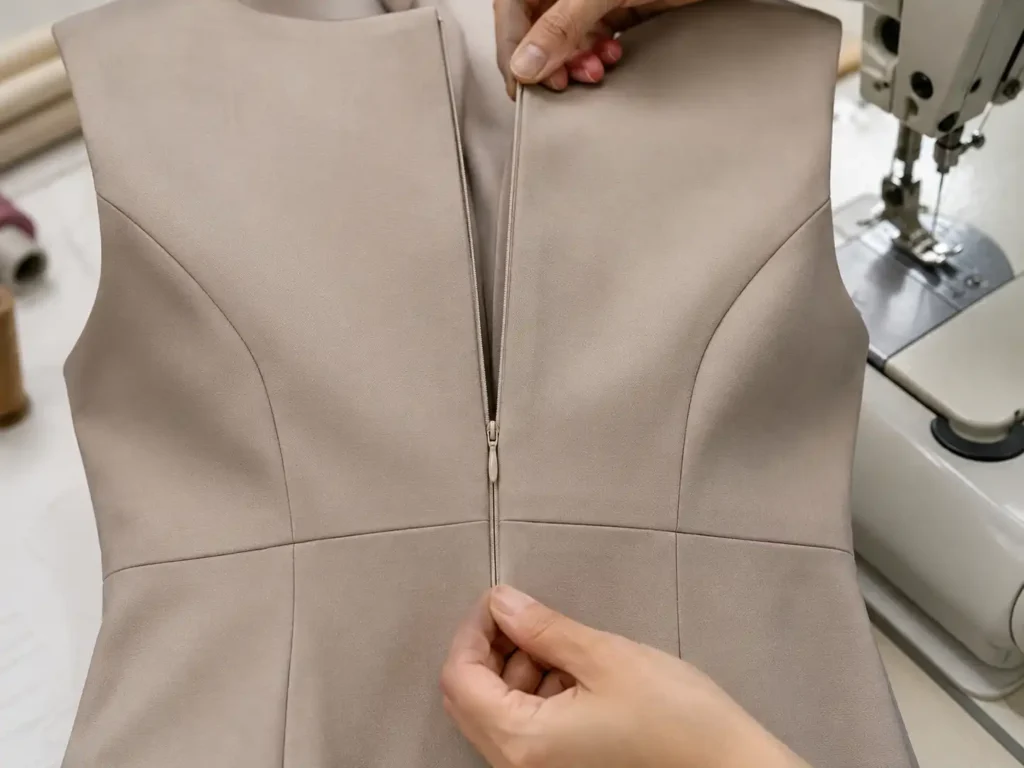
Final Recommendation for Fashion Brands
Choose nylon zippers when your dress needs softness, flexibility, invisible finishing, lightweight movement, or clean fit. Choose metal zippers when your dress needs visible hardware, structure, contrast, or a bold design identity. Avoid choosing a zipper only because it looks good in a trim card. Always test it on the actual fabric, in the actual placement, on the actual body.
If you are developing satin dresses, mesh dresses, lace dresses, bodycon dresses, corset dresses, party dresses, evening dresses, resort dresses or private-label dress collections, the zipper should be reviewed together with fabric, lining, pattern, fit and bulk QC. That is where a professional manufacturing partner adds real value.
Jinfeng Apparel supports custom fashion dress development from product idea, tech pack, reference sample, fabric sourcing, trim selection, sample making, sample revision, bulk production, quality control, private-label packaging and export delivery. For brands planning seasonal dress collections, multi-style orders or long-term private-label womenswear production, our team can help evaluate zipper choice, fabric behavior, dress construction and production risk before bulk manufacturing begins.
To start your custom dress project, send your tech pack, reference images, target fabric, size range, zipper preference and estimated order quantity to Jinfeng Apparel. Our team will review the structure and help you build a dress that looks good in photos, feels right on the body and performs better in bulk production.
Share This Article :

Jerry Lee
Categories

Latest blogs

Table of Contents
Here, developing your OEM/ODM private label clothing collection is no longer a challenge—it’s an excellent opportunity to bring your creative vision to life.

