Skip to content

In modern fashion, speed, precision, and consistency define whether a brand survives or disappears in a highly competitive market. Behind every successful dress collection sold in stores or online, there is usually a structured manufacturing system that transforms sketches, inspiration images, or tech packs into wearable garments at scale. Among all production models, OEM dress manufacturing plays a critical role in enabling fashion brands to move from concept to reality without building in-house factories.
Many brands underestimate how much technical coordination is required before a single dress is produced. Fabric behavior, stitching methods, grading accuracy, and even trimming details can completely change the final product outcome. An OEM dress manufacturer acts as the execution engine that converts design intent into repeatable production results, ensuring every unit in a bulk order maintains consistency.
An OEM dress manufacturer is a production partner that manufactures garments based on a brand’s designs, tech packs, or reference images without owning the design. It handles sampling, fabric sourcing, pattern making, and bulk production while ensuring consistent quality and scalable output for fashion brands.
However, OEM manufacturing is not simply “making clothes.” It is a structured system involving technical interpretation, production planning, and risk control. A well-organized OEM factory can reduce sampling errors, shorten lead time, and stabilize cost efficiency—while a weak one can create repeated delays and quality inconsistency.
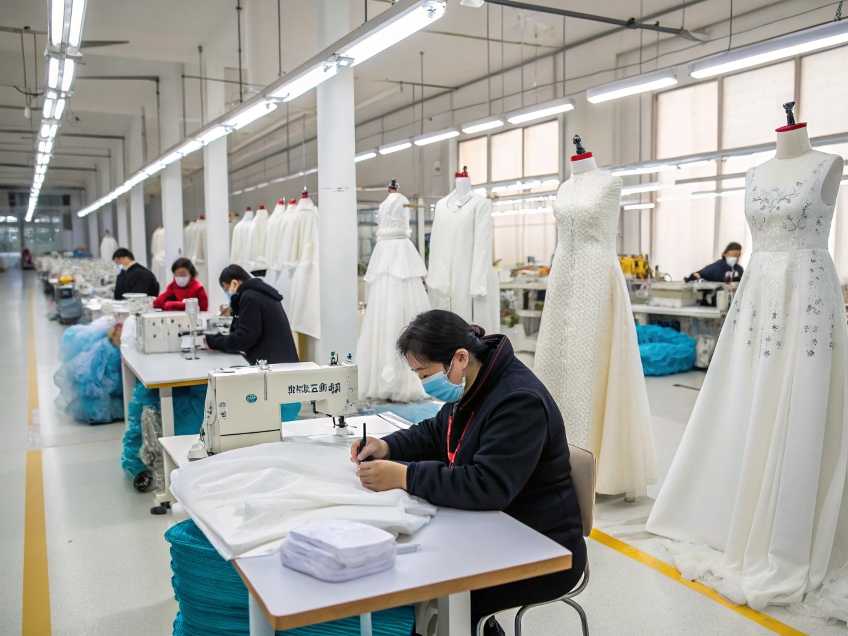
To understand why global fashion brands rely on OEM manufacturing, it is necessary to break down its structure, workflow, and decision logic. The following sections explain how OEM dress manufacturing operates from both a technical and business perspective—and why it remains one of the most important foundations in global apparel production today.
What Is an OEM Dress Manufacturer in Fashion Industry?
OEM dress manufacturing refers to a production system where a factory converts external design input into finished garments under strict specification control. The factory does not originate the design; instead, it executes production based on technical documents, reference images, or structured development files.
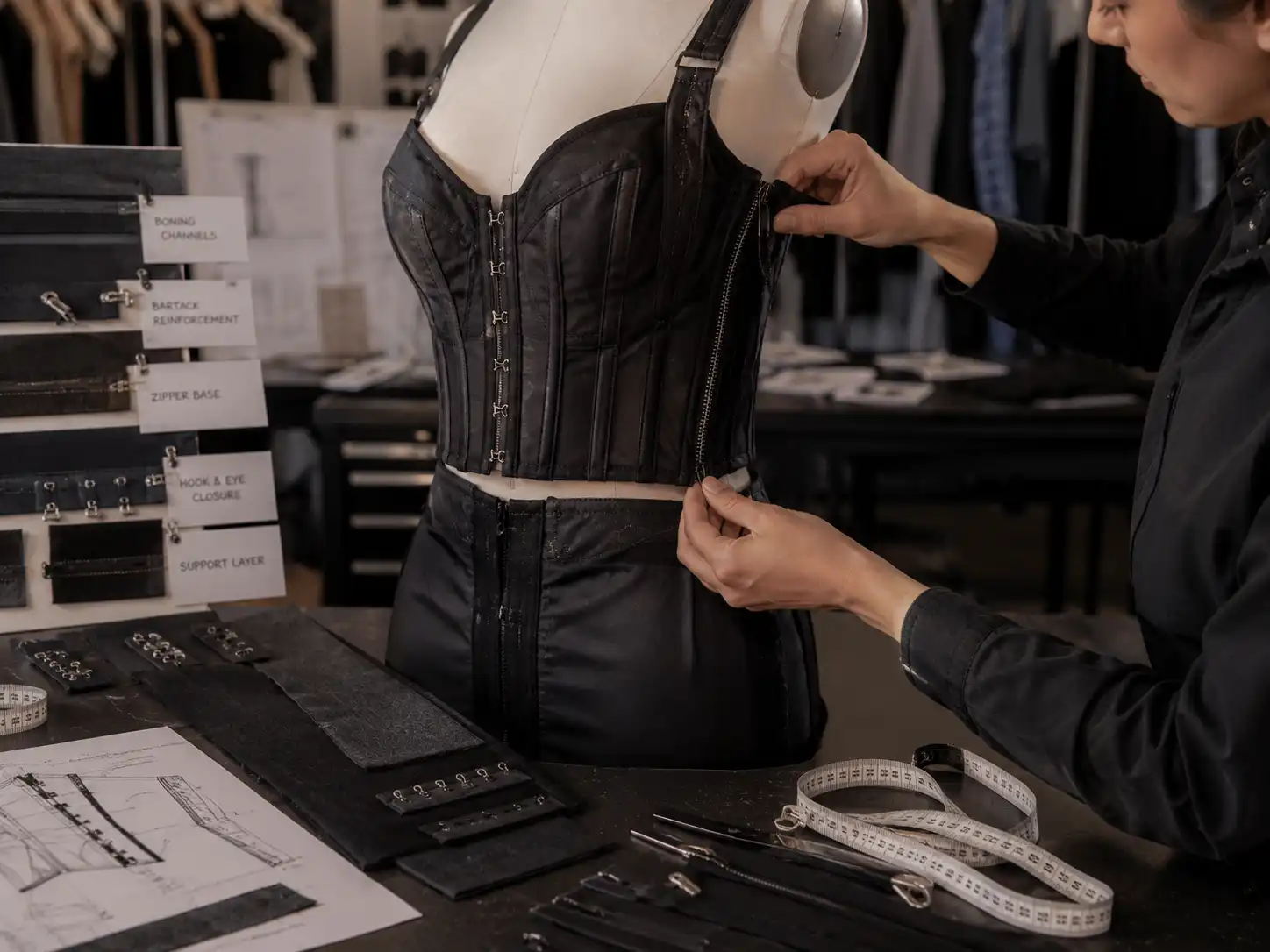
In real dress production, the OEM role goes far beyond sewing. It includes pattern interpretation, fabric behavior testing, construction feasibility analysis, and production engineering. A professional OEM factory ensures that a dress design is not only visually accurate but also structurally stable when scaled into bulk production.
In practical workflows, OEM manufacturers typically handle:
- Pattern creation from sketch or reference image
- Fabric sourcing and substitution suggestions
- Sample development and fitting correction
- Size grading across multiple ranges (XS–XL or customized systems)
- Bulk production with controlled tolerance standards
- Final inspection and packing coordination
Core operational responsibilities of an OEM dress manufacturer
OEM factories act as the technical bridge between design intent and mass production. Their responsibility is to ensure reproducibility—meaning the first sample and the 1,000th piece must maintain the same structure, fit, and visual proportion.
A reliable OEM system usually integrates three layers:
- Development layer: pattern making, fabric testing, sample creation
- Production layer: cutting, sewing, finishing, ironing
- Control layer: QC inspection, measurement checking, defect correction
Each layer directly impacts the final garment outcome. Weakness in any one stage can lead to size deviation, fabric distortion, or inconsistent stitching quality during bulk production.
What input materials are required before OEM production starts?
OEM production depends heavily on clarity of input. The more structured the information, the more stable the final output.
Common required inputs:
- Design sketch or reference image
- Measurement chart (standard or customized size set)
- Fabric specification (composition, GSM, stretch ratio)
- Trim requirements (zipper, lining, lace, buttons, labels)
- Construction notes (lining structure, seam type, finishing method)
A missing or unclear input often leads to repeated sampling cycles, which increases both time and cost.
OEM dress manufacturing capability breakdown (real production standard)
| Capability Area | What It Controls | Why It Matters in Dress Production |
|---|---|---|
| Pattern Engineering | Silhouette accuracy, fit stability | Determines whether dress matches body proportions |
| Fabric Management | Shrinkage, elasticity, drape behavior | Prevents distortion after washing or wear |
| Sampling System | First prototype accuracy | Reduces revision cycles |
| Bulk Production Control | Stitch consistency, sizing accuracy | Ensures repeatable quality across thousands of pieces |
| QC Inspection | Defect rate, measurement tolerance | Protects brand consistency in retail |
Why OEM interpretation quality determines final dress outcome
In real production environments, most quality issues do not come from sewing mistakes—they originate from interpretation gaps during development. A reference image might look simple, but it can contain hidden structural complexity such as dart placement, tension balance, or layered fabric support.
For example, a satin slip dress and a knit bodycon dress require completely different engineering logic. Satin needs structure control to avoid slipping or wrinkling, while knit requires elasticity calibration to avoid overstretching after wear.
Factories with strong OEM capability actively detect these risks before sampling begins. They adjust construction methods, recommend fabric substitutions, and refine pattern logic to ensure production feasibility.
OEM as a scalable production system for fashion dresses
OEM manufacturing is designed for scalability. Once a dress style is approved, the system ensures that it can move from 100 pieces to 10,000 pieces without structural deviation.
Scalability depends on:
- Standardized sewing instructions
- Locked fabric and trim specifications
- Controlled production line workflows
- Repeated QC checkpoints during mass production
Without this system, scaling often leads to inconsistent sizing, uneven stitching, or fabric variation across batches.
How Does OEM Dress Manufacturing Work Step by Step?
OEM dress manufacturing follows a structured production path that converts design input into scalable garment output. Each stage is interconnected, and small deviations in early steps directly affect fit, fabric behavior, and final production stability. A reliable workflow reduces sampling waste, shortens development cycles, and stabilizes bulk consistency.
In real production environments, the process is not linear only—it includes feedback loops between sampling, pattern correction, and material adjustment until the garment reaches production-ready status.
Typical full cycle:
Design input → Technical review → Pattern making → Sample development → Fit adjustment → Production approval → Bulk cutting → Sewing → QC inspection → Packing & shipping
Stage-by-stage OEM dress manufacturing workflow
| Stage | Key Output | Main Risk Controlled |
|---|---|---|
| Design intake | Style interpretation file | Misunderstanding of silhouette |
| Technical review | Feasibility confirmation | Fabric mismatch, construction issues |
| Pattern making | First garment structure | Fit distortion |
| Sample development | Physical prototype | Design deviation |
| Fit revision | Corrected sample version | Size inconsistency |
| Production approval | Final confirmed sample | Bulk variation risk |
| Bulk production | Mass garments | Quality inconsistency |
| QC & packing | Final inspection result | Defect rate control |
What happens during the initial design intake stage?
At this stage, the factory receives design input such as sketches, reference images, or tech packs. The main task is not production, but interpretation and feasibility confirmation.
Key actions include:
- Identifying garment silhouette and structure
- Clarifying fabric direction (stretch, woven, heavy, lightweight)
- Checking construction complexity (lining, boning, pleats, draping)
- Confirming measurement system and sizing range
- Estimating production difficulty and cost level
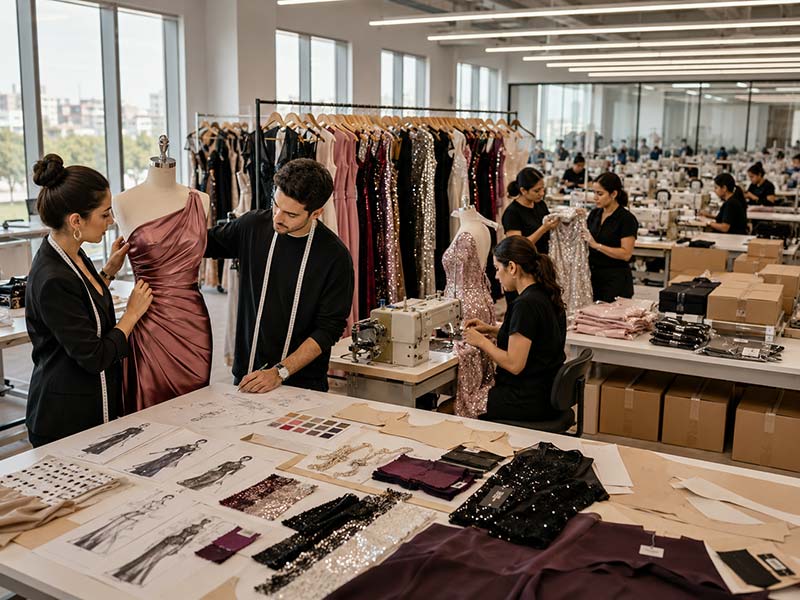
A clear intake reduces sampling cycles by 30–50% in typical development projects.
How do factories evaluate whether a dress can be produced correctly?
Before cutting fabric, a technical review is conducted to identify production risks. This stage is critical for avoiding sample failure.
Common checks include:
- Fabric shrinkage and elasticity compatibility
- Stitch method suitability (flatlock, overlock, invisible seam)
- Structural support requirements for fitted or corset styles
- Trim compatibility (zipper strength, lace flexibility, lining weight)
- Color matching feasibility for bulk dyeing
If risks are detected, factories may suggest fabric substitution or construction adjustment before sampling begins.
How is a dress pattern created from a design idea?
Pattern making converts visual design into measurable garment structure. This stage determines silhouette accuracy and fit behavior.
Core tasks:
- Drafting base pattern from reference or sketch
- Adjusting proportion for target size range
- Adding seam allowance and construction margins
- Planning dart positions, pleats, or draping lines
- Preparing grading rules for multiple sizes
Pattern accuracy directly influences fit consistency in bulk production.
What happens when the first sample is made?
The first sample is the physical validation of the design. It is used to test whether structure, fabric, and construction align with expectations.
Key outputs:
- First physical dress sample
- Initial fit evaluation report
- Construction adjustment notes
- Fabric behavior observation (stretch, drape, recovery)
Typical revision rate in complex dress styles: 1–3 rounds before approval.
Why are multiple sample rounds often required?
Fit adjustment ensures that the garment performs correctly on the body. Even small deviations in seam placement or fabric tension can change overall silhouette.
Common revisions include:
- Tightness or looseness adjustment
- Length correction (bodice, sleeve, hemline)
- Structural reinforcement for fitted designs
- Fabric replacement if behavior is unstable
| Issue Type | Example | Correction Action |
|---|---|---|
| Fit imbalance | Waist too loose | Pattern reduction |
| Fabric instability | Stretch distortion | Fabric swap |
| Seam distortion | Uneven stitching line | Construction change |
What defines a production-ready sample?
Once revisions are completed, a final approved sample is locked as the production standard. This becomes the reference for all bulk production units.
Approval criteria:
- Stable fit across sizes
- Confirmed fabric and trim selection
- Final stitching method locked
- Measurement tolerance approved
- No structural risks remaining
After this stage, no design changes are allowed without restarting approval.
How is mass production executed after approval?
Bulk production begins with fabric cutting based on approved patterns. Production lines then execute sewing in standardized steps.
Main process:
- Fabric relaxation before cutting
- Automated or manual cutting based on order size
- Line-based sewing operations
- In-process quality checks
- Semi-finished garment inspection
Efficiency depends heavily on production line organization and worker specialization.
How is consistency maintained in final production?
Final QC ensures all garments match the approved sample in structure and measurement.
Inspection points:
- Measurement tolerance check (±1–2 cm standard)
- Stitch density and seam strength
- Fabric defect inspection
- Ironing and shape correction
- Labeling and packaging verification
| QC Area | Standard Check | Acceptable Tolerance |
|---|---|---|
| Measurement | Size chart comparison | ±1–2 cm |
| Stitching | Seam strength test | No loose threads |
| Fabric | Visual defect check | No visible flaws |
| Packaging | Label accuracy | 100% match required |
What services are typically covered in OEM dress manufacturing?
OEM dress manufacturing services cover the full production lifecycle from early-stage garment development to final packing. A complete OEM system is not limited to sewing garments; it integrates technical development, material coordination, production execution, and quality assurance into one structured workflow.
In real production practice, service coverage directly determines product stability, cost control, and delivery reliability. Strong OEM systems reduce communication gaps by centralizing all key production processes under one factory structure.
Core service scope generally includes:
- Design interpretation and technical conversion
- Pattern making and sample development
- Fabric sourcing and material testing
- Trim development and accessory coordination
- Bulk production planning and execution
- Quality control and defect management
- Finishing, labeling, and packaging
OEM dress manufacturing service breakdown
| Service Category | What It Includes | Production Impact |
|---|---|---|
| Development | Pattern making, sample creation | Defines fit and silhouette accuracy |
| Material sourcing | Fabric + trims selection | Controls cost and garment behavior |
| Production | Cutting, sewing, finishing | Ensures scalability and output speed |
| Quality control | Inspection, measurement checks | Reduces defect rate |
| Logistics prep | Packing, labeling, carton loading | Supports retail readiness |
What happens during garment development stage?
Development services focus on converting design input into production-ready structure. This stage determines whether a design can be manufactured at scale without distortion or inconsistency.
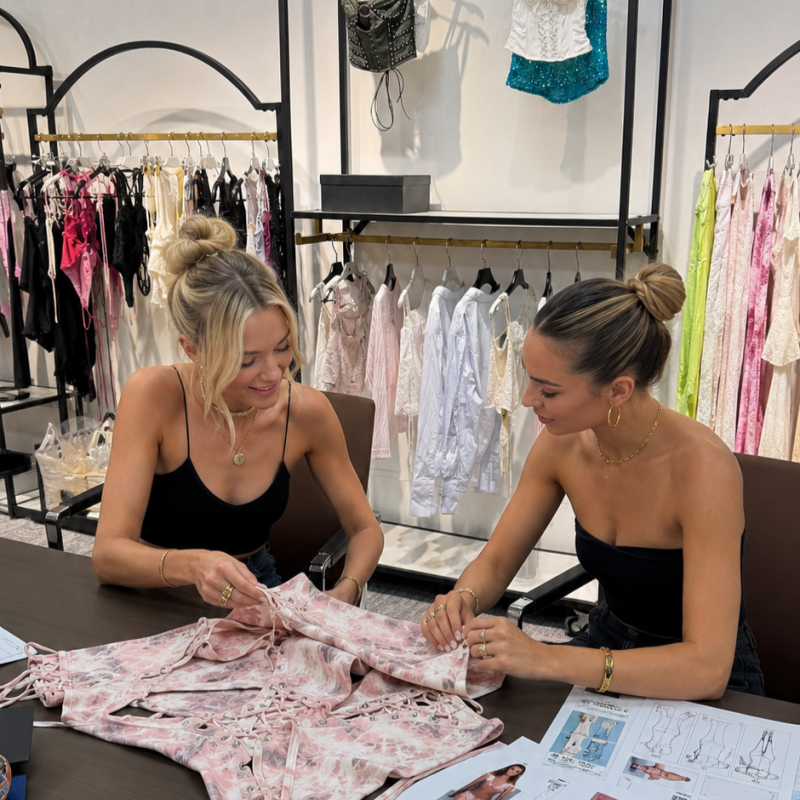
Key development actions include:
- Translating sketches or reference images into patterns
- Creating first physical prototype samples
- Adjusting fit, proportion, and silhouette balance
- Testing fabric compatibility with garment structure
- Refining construction details such as seams and lining
A strong development system typically reduces bulk production error rate by 20–40% compared to weak sampling systems.
Pattern making and sample engineering in real production
Pattern making is the foundation of OEM production. A correctly built pattern ensures that garments maintain proportion across all sizes.
Key responsibilities:
- Base pattern construction from design input
- Size grading across multiple measurements
- Adjustment for stretch or woven fabrics
- Dart placement and structural shaping
- Seam allowance and production margin setup
Sample engineering then validates whether the pattern performs correctly in real fabric conditions before scaling.
How do OEM factories manage fabric selection and sourcing?
Fabric selection directly affects garment performance, cost, and customer perception. OEM factories typically maintain fabric sourcing networks to match different dress categories such as satin, chiffon, knit, lace, and structured blends.
Material management includes:
- Fabric recommendation based on design structure
- GSM and composition matching
- Stretch and recovery testing for fitted styles
- Shrinkage and colorfastness evaluation
- Bulk dye consistency checks
| Fabric Type | Key Risk | OEM Control Method |
|---|---|---|
| Satin | Wrinkling, slippage | Stabilized cutting + lining support |
| Knit | Overstretching | Elastic ratio control |
| Chiffon | Seam tearing | Reinforced stitching |
| Lace | Pattern mismatch | Careful panel alignment |
Fabric decisions at early stage significantly reduce production failures later in bulk manufacturing.
Trim and accessory coordination in dress production
Trims are small components but have high impact on garment durability and aesthetics.
Common trim elements include:
- Zippers (invisible, metal, nylon)
- Buttons and hooks
- Lace and decorative edges
- Labels and care tags
- Linings and interfacing materials
Incorrect trim selection can lead to functional issues such as zipper breakage, seam tension imbalance, or discomfort during wear.
How is large-scale dress production organized?
Bulk production converts approved samples into mass output using standardized production lines. The goal is to maintain consistency across all units while controlling cost efficiency.
Main production stages:
- Fabric relaxation and pre-shrinking
- Precision cutting based on approved patterns
- Line-based sewing operations (multi-step assembly)
- Mid-line inspection for defect prevention
- Final assembly and finishing
Production efficiency depends heavily on workflow organization and operator specialization.
Production stability and scaling logic
OEM production systems are designed to scale without quality loss. Once a style is locked, factories replicate the same process across thousands of units.
Stability depends on:
- Standard operating procedures for sewing
- Locked fabric and trim specifications
- Operator training consistency
- Real-time QC checkpoints during production
- Batch-to-batch comparison systems
Without these controls, scaling often leads to size deviation and stitching inconsistency.
How is garment quality controlled in OEM production?
Quality control ensures that final garments match approved samples in both appearance and structure.
Inspection points include:
- Measurement accuracy across all sizes
- Stitch density and seam strength testing
- Fabric defect identification
- Color consistency across batches
- Functional testing of closures and trims
| QC Stage | Focus Area | Acceptance Standard |
|---|---|---|
| Inline QC | Sewing accuracy | No major defects |
| Mid QC | Measurement stability | ±1–2 cm tolerance |
| Final QC | Visual inspection | No visible flaws |
| Packaging QC | Label correctness | 100% accuracy |
How do OEM, ODM, and Private Label differ in real dress production?
OEM, ODM, and Private Label represent three different production structures in the fashion supply chain. The key difference lies in design ownership, development responsibility, and level of customization. In real dress manufacturing, these three models determine how much control a fashion brand holds over design, speed to market, and production flexibility.
OEM focuses on manufacturing based on provided design input. ODM involves factory-developed styles that can be modified. Private Label uses ready-made designs that are simply branded and sold under a different name.
Understanding these differences helps avoid mismatched expectations during production planning, especially for dresses where fabric behavior, fit precision, and silhouette structure directly affect final product success.
Comparison overview of OEM vs ODM vs Private Label
| Model | Design Ownership | Customization Level | Development Speed | Ideal Use Case |
|---|---|---|---|---|
| OEM | Brand-provided design | High | Medium | Custom dress collections, signature styles |
| ODM | Factory-developed design | Medium | Fast | Trend-based collections, seasonal launches |
| Private Label | Pre-made design | Low | Very fast | Entry-level collections, fast market testing |
What defines OEM manufacturing in fashion dresses?
OEM manufacturing is a production model where garments are made strictly according to external design input. The factory does not create original styles but focuses on converting sketches, reference images, or tech packs into finished dresses.
Key characteristics:
- Full control of design direction remains on brand side
- Factory handles pattern making, sampling, and bulk production
- High level of customization in silhouette, fabric, and construction
- Suitable for structured dresses like corset, bodycon, satin gowns
OEM is commonly used when design identity and fit precision are critical for market positioning.
Real production logic behind OEM workflow
In real manufacturing environments, OEM is not just execution—it is technical reconstruction. A design image must be translated into measurable garment structure, including:
- Pattern engineering from scratch
- Fabric behavior testing (stretch, drape, shrinkage)
- Stitch method selection based on garment tension
- Size grading across multiple measurement systems
For example, a ruched mini dress and a structured evening gown require completely different engineering approaches even if visually similar.
OEM success depends heavily on communication accuracy and technical documentation quality.
What is ODM in fashion manufacturing?
ODM refers to a production model where the factory provides pre-designed styles that can be modified and branded by fashion labels. Unlike OEM, design originates from the factory’s internal development team.
Key characteristics:
- Factory owns base design and pattern library
- Brands select and adjust styles (color, fabric, minor structure)
- Faster development cycle compared to OEM
- Limited uniqueness compared to fully custom design
ODM is often used for trend-driven collections where speed is more important than full design originality.
Why ODM is used for fast fashion dress collections
ODM works well when speed-to-market is a priority. Factory-ready designs can reduce development time by 30–60% compared to OEM.
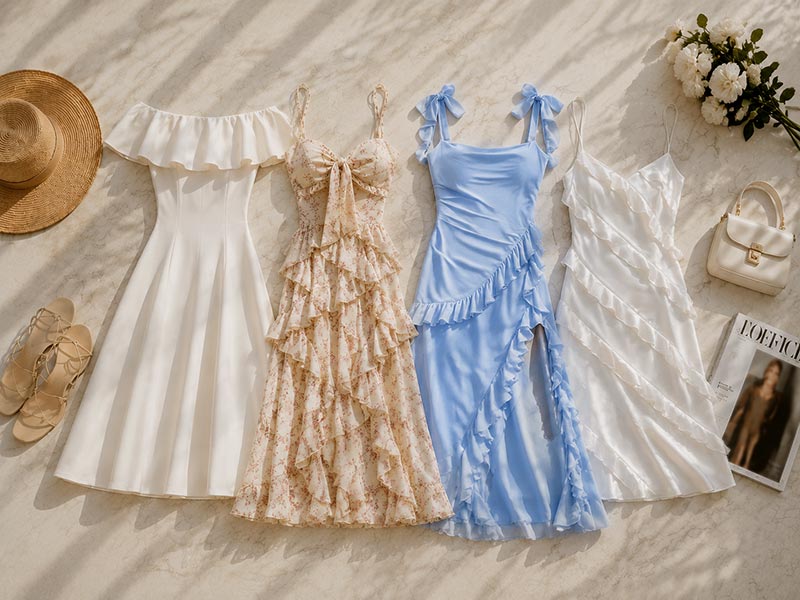
However, limitations exist:
- Restricted silhouette customization
- Similar designs may be used across multiple labels
- Less control over structural uniqueness
ODM is efficient but not ideal for brands building strong design identity in competitive dress categories.
What is private label production in clothing industry?
Private Label refers to purchasing ready-made garments from factory catalogs and rebranding them under a different label. There is minimal or no design modification involved.
Key characteristics:
- No design development required
- Fastest production and delivery cycle
- Lowest customization level
- Focus on branding and marketing rather than design engineering
This model is often used for entry-level collections or rapid product testing in new markets.
Private label production structure in real operation
In practice, private label workflow is highly standardized:
- Select existing dress style from factory catalog
- Choose fabric color or minor variation
- Apply brand label and packaging
- Proceed directly to bulk order production
| Factor | Private Label Impact |
|---|---|
| Design flexibility | Very low |
| Development time | Extremely short |
| Cost efficiency | High for small entry tests |
| Brand differentiation | Limited |
While private label reduces risk and speed, it limits long-term brand identity development.
How to choose the right manufacturing model for dress collections?
Selection depends on brand maturity, design capability, and market positioning strategy.
Key decision factors:
- Level of design control required
- Time available for development
- Budget per style and MOQ structure
- Brand differentiation strategy
- Target market competition level
OEM is preferred for unique, high-identity dress collections. ODM fits fast seasonal updates. Private label suits quick entry or low-risk testing.
Risk and control comparison across three models
| Aspect | OEM | ODM | Private Label |
|---|---|---|---|
| Design control | High | Medium | Low |
| Speed to market | Medium | Fast | Very fast |
| Brand uniqueness | Strong | Moderate | Weak |
| Production risk | Medium | Low–Medium | Low |
| Cost efficiency | Medium | High | High |
How Do Fashion Brands Choose the Right OEM Dress Manufacturer?
Choosing an OEM dress manufacturer is a technical and operational decision rather than a simple price comparison. In real dress production, the right factory determines fit accuracy, sampling efficiency, bulk consistency, and long-term scalability of collections.
A reliable OEM partner is evaluated based on measurable production capability, not promotional claims or isolated sample quality. Strong manufacturers show consistency across multiple styles, fabric types, and order volumes.
Key evaluation dimensions include:
- Sampling accuracy across repeated revisions
- Fabric knowledge for different dress categories
- Pattern engineering capability for complex silhouettes
- Bulk production consistency under volume pressure
- Communication clarity during development cycles
- Quality control structure and defect handling system
OEM manufacturer evaluation framework
| Evaluation Area | What to Check | Practical Indicator |
|---|---|---|
| Sampling system | Number of revisions needed per style | 1–3 rounds acceptable |
| Pattern capability | Fit accuracy across sizes | Stable grading without distortion |
| Fabric handling | Experience with satin, knit, chiffon, lace | No fabric-related deformation |
| Bulk stability | Consistency across 500–5000 pcs | Minimal variation between units |
| Communication | Response speed and clarity | Clear technical feedback within 24–48h |
| QC system | Inspection process structure | Inline + final inspection present |
Why sampling performance reflects factory strength
Sampling is the most direct indicator of OEM capability. A strong manufacturer can translate a design into a near-final garment within limited revisions, while weak systems often require multiple corrections due to pattern or fabric misinterpretation.
Key evaluation points:
- First sample accuracy compared to reference design
- Number of revision cycles required
- Fit stability after adjustments
- Fabric behavior under real construction
- Alignment between sketch and final sample
In structured dress categories like corset dresses or satin bodycon styles, even a 1–2 cm deviation can change silhouette balance significantly.
Factories with strong technical teams usually achieve production-ready samples within 1–3 rounds.
How pattern capability impacts dress production quality
Pattern engineering determines whether a dress maintains consistent proportions across all sizes. It is one of the most critical technical areas in OEM manufacturing.
Strong pattern systems ensure:
- Accurate body proportion translation from design
- Stable grading across XS–XL or custom size sets
- Controlled dart placement and seam balance
- Correct fabric tension distribution
- Minimal distortion during movement or wear
| Pattern Factor | Impact on Dress Outcome |
|---|---|
| Dart positioning | Controls waist shaping accuracy |
| Seam alignment | Affects visual symmetry |
| Grading logic | Ensures size-to-size consistency |
| Ease allowance | Determines comfort and fit stability |
Poor pattern systems often lead to bulk production issues even if samples look correct.
Why fabric knowledge defines production stability
Fabric behavior directly affects dress appearance, durability, and fit performance. OEM manufacturers must understand how different materials react during cutting, sewing, and wearing.
Key fabric management capabilities include:
- Stretch ratio control for knit and bodycon dresses
- Draping stability for chiffon and satin gowns
- Shrinkage control during washing or steam finishing
- Seam reinforcement for delicate fabrics
- Color consistency across dye batches
For example, satin requires internal stabilization to prevent slipping seams, while knit fabrics require elasticity balance to avoid overstretching after repeated wear.
How to evaluate mass production stability
Bulk production consistency determines whether a design can scale without quality loss. Many factories perform well in sampling but fail during high-volume production.
Key indicators include:
- Consistency between first and last production batch
- Defect rate per 1000 pieces
- Measurement tolerance control (±1–2 cm standard)
- Stitch uniformity across production lines
- Operator standardization level
| Production Volume | Acceptable Variation Level |
|---|---|
| 100–500 pcs | Minimal variation allowed |
| 500–3000 pcs | ±1–2 cm measurement tolerance |
| 3000+ pcs | Strict QC segmentation required |
Factories with stable systems maintain identical output quality regardless of order size.
Why communication structure affects production success
In OEM production, communication quality directly influences speed, accuracy, and revision efficiency. Miscommunication often leads to sampling delays or incorrect production interpretation.
Strong communication systems include:
- Clear technical feedback loops during sampling
- Structured revision documentation
- Fast response during production clarification
- Visual confirmation (photos/videos) of progress
- Transparent reporting of production risks
Factories that lack structured communication often create hidden delays or repeated sample corrections.
How QC systems determine final production reliability
Quality control is not a final step—it is a continuous system embedded throughout production. Strong OEM manufacturers apply multi-stage inspection rather than single-point checking.
Typical QC structure includes:
- Incoming fabric inspection
- Inline sewing inspection
- Mid-production measurement checks
- Final garment inspection
- Packaging verification
| QC Stage | Focus Area | Purpose |
|---|---|---|
| Fabric inspection | Defects, color accuracy | Prevent material issues |
| Inline QC | Stitching accuracy | Early defect detection |
| Mid QC | Size consistency | Control measurement deviation |
| Final QC | Overall appearance | Ensure retail readiness |
Factories with weak QC systems often show increasing defect rates during bulk scaling.
Why Do Global Fashion Brands Use OEM Dress Manufacturing?
OEM dress manufacturing is widely used in global fashion supply chains because it separates design creation from production execution, allowing brands to scale collections without building internal factories. In real production practice, OEM systems provide control over design while ensuring technical execution, cost efficiency, and stable quality output across large volumes.
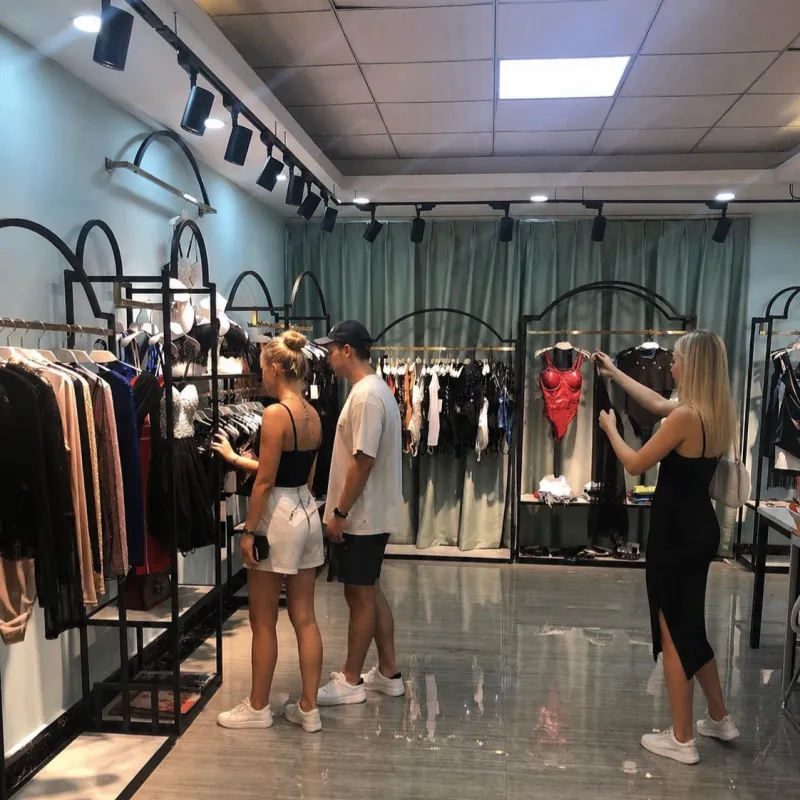
Instead of managing cutting, sewing, fabric sourcing, and QC internally, fashion labels rely on OEM factories to handle full production cycles. This structure reduces operational complexity and improves speed-to-market, especially in categories like dresses where fabric behavior and fit precision are highly sensitive.
Key reasons for OEM adoption include:
- Ability to scale designs from small batches to large production runs
- Stable replication of sample quality in bulk orders
- Access to specialized garment engineering capability
- Reduced capital investment in production infrastructure
- Faster development cycles for seasonal collections
OEM usage breakdown in global dress manufacturing systems
| Production Need | OEM Contribution | Result for Fashion Production |
|---|---|---|
| Design execution | Converts sketches into garments | Accurate product realization |
| Sample development | Builds prototypes for validation | Reduced design risk |
| Bulk production | Large-scale manufacturing | Stable supply output |
| Fabric management | Material sourcing & testing | Consistent garment behavior |
| Quality control | Multi-stage inspection | Lower defect rate |
| Production scaling | Volume replication system | Fast expansion capability |
How OEM systems shorten fashion production timelines
Speed is critical in fashion cycles, especially for seasonal dress collections. OEM manufacturers already maintain ready infrastructure, production lines, and technical teams, which significantly reduces setup time.
Instead of building internal sampling and production departments, brands can move directly into development with OEM partners.
Typical timeline advantage:
- In-house setup cycle: 60–120 days
- OEM production cycle: 15–45 days for first sample series
Time reduction is achieved through:
- Existing pattern libraries and technical experience
- Pre-established fabric sourcing networks
- Standardized sampling workflows
- Integrated production planning systems
This allows faster response to market trends and seasonal demand shifts.
How OEM manufacturing reduces overall production cost pressure
OEM systems eliminate the need for factories to maintain internal production assets, reducing fixed costs and converting them into variable production costs.
Cost efficiency is achieved through:
- Shared production lines across multiple orders
- Bulk fabric purchasing power
- Optimized labor allocation per production stage
- Reduced sample wastage through technical accuracy
| Cost Factor | OEM Model Impact | Result |
|---|---|---|
| Fabric procurement | Bulk sourcing channels | Lower material cost |
| Labor utilization | Shared production lines | Higher efficiency |
| Sampling waste | Fewer revision cycles | Reduced development cost |
| Infrastructure | No internal factory setup needed | Lower capital investment |
For dress categories with high style variation, OEM reduces financial risk during early-stage product development.
How production consistency is maintained across thousands of units
One of the strongest advantages of OEM manufacturing is repeatability. Once a sample is approved, OEM systems lock technical specifications to ensure identical output across bulk production.
Consistency is maintained through:
- Standard operating procedures for sewing operations
- Locked fabric and trim specifications
- Multi-stage QC inspection systems
- Measurement tolerance control (±1–2 cm standard range)
- Production line segmentation for complex garments
For dresses such as bodycon, satin gowns, or corset styles, even small inconsistencies in stitching or fabric tension can change garment appearance. OEM systems minimize this risk through structured production control.
How OEM enables production growth without quality loss
Scaling fashion production is not only about increasing quantity—it requires maintaining identical quality across all units. OEM factories are designed for this transition.
Scaling capability includes:
- Replication of approved sample into mass production
- Multi-line production capacity for parallel manufacturing
- Controlled batch production to avoid deviation
- Standardized training for production operators
- Continuous QC monitoring during scaling phases
| Production Stage | OEM System Function | Output Stability |
|---|---|---|
| Sample stage | Design validation | High accuracy |
| Small batch | Process testing | Controlled variation |
| Mass production | Full replication | Stable consistency |
This structure allows brands to move from 100 pieces to 10,000+ pieces without redesigning production systems.
Why structured dresses require OEM-level engineering
Dress categories such as corset dresses, evening gowns, and structured bodycon designs require advanced garment engineering. These styles involve complex fabric behavior, internal support structures, and precise fit control.
OEM factories provide:
- Pattern engineering for complex silhouettes
- Fabric compatibility testing for stretch and drape balance
- Structural reinforcement design (boning, lining, interfacing)
- Fit adjustment across multiple body types
- Technical correction during sampling stage
Without OEM-level capability, complex dresses often face issues such as distortion, uneven fit, or fabric collapse during wear.
How OEM systems control uncertainty in dress manufacturing
Fashion production carries multiple risks, including fabric failure, size inconsistency, and production delays. OEM systems reduce these risks through structured processes.
Risk control mechanisms include:
- Pre-production feasibility analysis
- Fabric and trim testing before sampling
- Multi-stage QC checkpoints
- Standardized communication workflows
- Locked production specifications after sample approval
| Risk Area | OEM Control Method | Outcome |
|---|---|---|
| Fabric mismatch | Pre-sourcing validation | Reduced production failure |
| Fit inconsistency | Pattern standardization | Stable sizing |
| Bulk defects | Inline QC inspection | Lower rejection rate |
| Delivery delays | Structured production scheduling | On-time output |
This structured system is a major reason OEM remains dominant in global apparel manufacturing.
What Questions Do Buyers Ask Before Starting OEM Dress Production?
Before starting OEM dress production, the main focus is not execution but clarification. In real production workflows, early-stage questions determine cost accuracy, sampling efficiency, and final product stability. Most delays in garment development come from unclear expectations at this stage.
Typical questions are structured around five core areas: product definition, cost structure, production timeline, sampling process, and production risk control.
Key questions include:
- Minimum order quantity requirements per style or color
- Sample development cost and revision cycle
- Fabric availability and sourcing lead time
- Production timeline from sample approval to bulk shipment
- Quality control system and defect handling process
Pre-production question framework used in real OEM dress projects
| Category | Key Questions | Why It Matters |
|---|---|---|
| Product scope | Style complexity, fabric type, design details | Determines production feasibility |
| Cost structure | Sample cost, bulk price, cost breakdown | Controls budget planning |
| Sampling process | Number of revisions, sample lead time | Affects development speed |
| Production timeline | Bulk lead time, shipping schedule | Impacts launch planning |
| Quality control | Inspection method, tolerance range | Ensures final consistency |
Why MOQ is one of the first production questions
Minimum Order Quantity (MOQ) defines the lowest production volume per style or color. It directly affects pricing, fabric sourcing, and production scheduling.
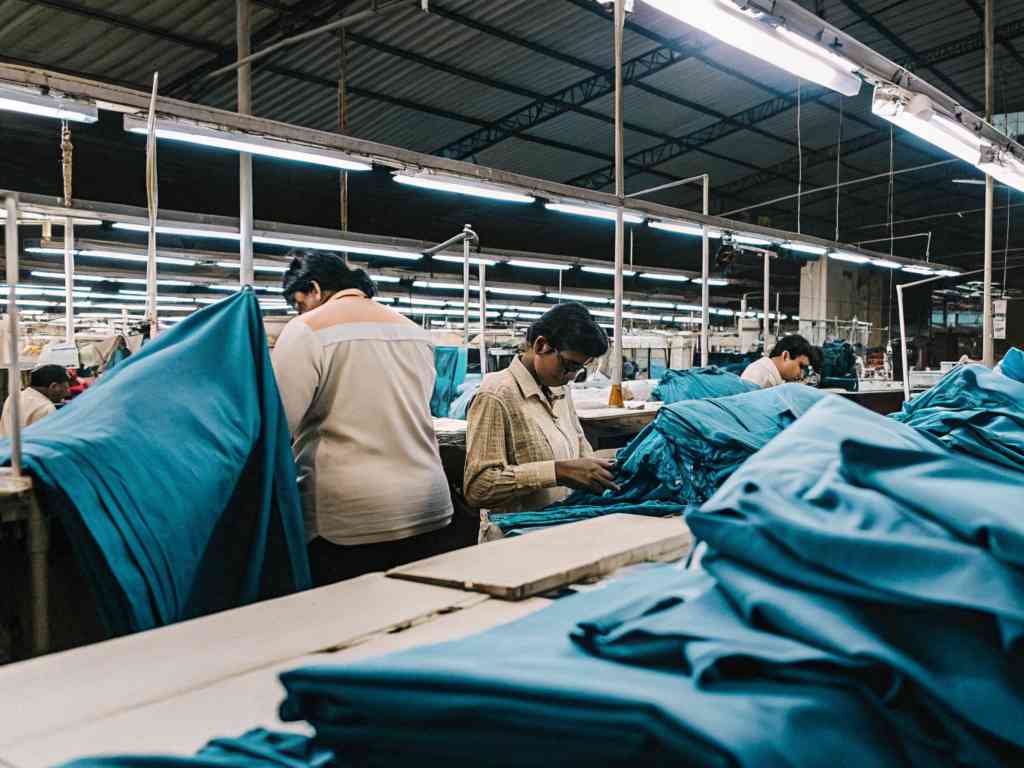
In OEM dress manufacturing, MOQ is influenced by:
- Fabric type and availability
- Complexity of design and construction
- Printing or embroidery requirements
- Production line setup efficiency
Typical MOQ ranges:
- Basic knit dresses: 100–300 pcs per style
- Satin or structured dresses: 200–500 pcs per style
- Complex embellished dresses: 300–800 pcs per style
Lower MOQ usually increases unit cost due to reduced production efficiency.
What determines production lead time in real manufacturing
Lead time is a critical planning factor for seasonal fashion collections. It includes sampling, revision, approval, and bulk production phases.
Typical timelines:
- Sample development: 7–15 days
- Sample revision cycles: 5–10 days per round
- Bulk production: 15–35 days depending on complexity
| Stage | Average Time | Key Influencing Factor |
|---|---|---|
| Sampling | 7–15 days | Fabric availability |
| Revisions | 5–10 days | Design complexity |
| Bulk production | 15–35 days | Order volume |
| Shipping prep | 3–7 days | Packaging requirements |
Complex dress designs such as corset or multi-layer gowns often require longer timelines due to additional structural work.
What factors determine final production cost per dress
Pricing in OEM production is not fixed and depends on multiple technical and material factors.
Key cost drivers include:
- Fabric cost per meter
- Garment construction complexity
- Labor intensity (stitch count, detailing level)
- Trim and accessory selection
- Order volume and repeat efficiency
Example cost structure (simplified):
| Cost Element | Impact Level | Explanation |
|---|---|---|
| Fabric | High | Major cost driver in dresses |
| Labor | Medium–High | Depends on complexity |
| Trims | Medium | Zippers, lace, buttons |
| Sampling | Fixed cost | Paid per style development |
| QC + packaging | Medium | Based on order size |
Higher complexity dresses such as embellished evening gowns can increase production cost by 30–80% compared to basic knit styles.
Why early risk identification reduces production failure
Risk evaluation is a critical step before confirming production. Many issues appear only during scaling, not during sampling.
Common risk areas include:
- Fabric mismatch between sample and bulk order
- Size inconsistency across grading system
- Stitching instability in complex designs
- Delayed material sourcing or substitution issues
- Miscommunication in technical specifications
| Risk Type | Cause | Prevention Method |
|---|---|---|
| Fabric mismatch | Wrong sourcing batch | Pre-production fabric approval |
| Size deviation | Weak pattern grading | Standardized measurement system |
| Production delay | Material shortage | Early sourcing confirmation |
| Quality inconsistency | Weak QC system | Multi-stage inspection |
Factories with structured risk control systems significantly reduce production failure rates during bulk manufacturing.
Why communication clarity affects production stability
Clear communication is essential for avoiding misinterpretation during production. Most production errors originate from unclear technical instructions or delayed feedback.
Key communication expectations:
- Clear technical confirmation before sampling
- Visual updates during production stages
- Documented revision records for each sample round
- Fast response cycle for production queries (24–48h standard)
- Final approval confirmation before bulk production
Without structured communication, even well-designed garments can face execution errors during scaling.
Conclusion
For brands looking to develop custom dresses with structured OEM manufacturing support, Jinfeng Apparel provides end-to-end production capability—from sampling and fabric sourcing to bulk manufacturing and quality control.
Whether developing new collections or scaling existing designs, the focus remains on consistency, precision, and production reliability.
Send your design references or tech pack to Jinfeng Apparel to start OEM dress development and receive professional production evaluation and quotation support.