Skip to content


A stretch dress can look polished on a mannequin and still disappoint the first time someone wears it. A side seam pulls across the hip, an apparently neat hem refuses to stretch, or the stitching makes small popping sounds when the dress is pulled over the shoulders. None of these faults necessarily appears in product photography. For a fashion brand, however, they can turn a promising design into customer complaints, costly alterations, and avoidable returns. The finish on the inside is part of the experience on the outside.
For most stretch-knit dresses, a properly adjusted four-thread overlock is the best starting point for joining main panels because it combines flexible stitching, edge coverage, and reliable seam security. Three-thread overlock can finish lightweight edges or join suitable areas, while coverstitch is often preferred for hems. The final choice depends on fabric stretch, recovery, seam location, garment fit, and verified sewing performance.
At Jinfeng Apparel, we develop custom dresses in jersey, rib knit, ponte, mesh, and other fabrics with different demands on fit and construction. One sample can reveal more than a row of impressive stitches: a dress may hang straight before fitting, then twist at the side seam after sitting and walking. The interesting question is not simply which machine made that seam. It is what the fabric, pattern, thread, and sewing process did together, and whether the result will still look right after repeated wear.
What Makes a Good Stretch Seam Finish?
A good stretch seam finish lets the garment move without broken stitches, uncomfortable bulk, or obvious distortion. It must provide the right amount of extension while maintaining joining strength, a tidy edge, and a smooth appearance against the body. The correct solution also depends on whether a seam joins panels, prevents fraying, stabilizes a neckline, or finishes a hem; those tasks are not identical.
What Is a Stretch Seam Finish?
In everyday clothing discussions, “seam finish” often means everything done to a stitched edge. In technical production, it helps to be more precise. Seam construction joins two or more panels; seam finishing treats the exposed allowances so they remain tidy or resist fraying. A four-thread overlock can perform both jobs in one operation, whereas an overlocked edge added after a separate joining seam performs a different function. Both may look neat, but they do not necessarily stretch or carry load in the same way.
That distinction matters when a fashion team sends a tech pack to a manufacturer. Saying “use overlock” does not identify the stitch class, joining purpose, allowance, thread choice, or required appearance. A jersey bodycon dress may need an elastic structural seam, while a stretch-woven occasion dress might need a different joining method followed by edge finishing. The best instruction describes what the seam must accomplish, then identifies a construction proven on the actual fabric rather than relying on a generic label.
How Does Seam Elasticity Affect Dress Fit?
Stretch fabric does not guarantee a comfortable dress. If the seam restricts the area that must expand, the wearer feels tightness or the thread takes the strain. For example, a marked 100 mm section extended to 125 mm has experienced 25% extension. That calculation is easy; deciding whether the garment actually needs that much movement at its waist, hip, or hem requires a fitting and an understanding of its design ease. A fitted pull-on mini dress and a zip-back ponte dress may demand very different movement from their seams.
Recovery matters just as much as extension. A seam might reach the required length without breaking yet remain visibly stretched afterward, leaving waviness or a loose-looking line beside otherwise resilient fabric. Patterns, grain direction, lining, seam placement, and the stretch of the sewing threads all influence the result. Rather than assigning one universal stretch percentage to every dress, Jinfeng Apparel assesses the intended movement and compares the behavior of the sewn sample with the garment’s approved fit and appearance.
Is Seam Finishing Different From Seam Construction?
Seam joining and edge protection should be specified separately when they involve separate operations. On a stable stretch woven, a suitable joining stitch may carry the load while a three-thread overlock covers the two raw allowances. On a soft knit, a four-thread overlock may join the panels and wrap their edges at the same time. The second option can save an operation, but its convenience is not proof that it will perform better on every fabric. Transparency, thickness, and appearance may make the separate construction preferable.
Some knits resist fraying well enough that they do not need an additional anti-fray operation. That does not mean they can be sewn with any stitch. The joining seam still needs the correct elasticity and security, especially where a customer pulls the dress on or sits in a close-fitting silhouette. A useful tech pack therefore records the seam’s purpose, stitch construction, width, thread, and approved appearance. It also makes clear which details are design choices and which must remain consistent in future bulk orders.
What Makes a Seam Strong and Comfortable?
Strength and comfort are not competing qualities, but they need to be balanced. Too little seam security risks popped stitches; too much bulk can form a raised ridge that shows through lightweight jersey or rubs against the skin. A thick ponte dress may conceal a construction that looks heavy on a fine mesh panel. The correct seam is strong enough for the expected loads and unobtrusive enough to preserve the design. More thread, more stitches, or a wider allowance is not always an improvement.
Thread texture and balance also affect how a seam feels. Suitable textured looper threads can create a softer hand in some overlock constructions, but the needle thread and machine settings must still deliver dependable performance. Jinfeng Apparel checks visible appearance and on-body feel alongside workmanship, because a beautiful seam on the sewing table may become uncomfortable against a hip or under an arm. A successful finish should preserve the silhouette after extension, not merely survive a single pull test.

Which Seam Finish Is Best for Stretch Dresses?
Four-thread overlock is often the best starting choice for the principal joining seams of stretch-knit dresses. It combines a flexible construction with edge coverage and additional seam security. Three-thread overlock is useful for lighter seams and edge finishing, zigzag can work where its performance is verified, and coverstitch is commonly preferred for hems. Fabric behavior and seam location must decide the final specification.
Is Overlock the Best Choice?
Overlock is widely used in knitwear because its interlooped threads can accommodate movement while covering the cut edge. When the machine’s cutting and feeding systems are properly adjusted, it can also produce a consistent seam with relatively little handling. That makes a four-thread overlock a sensible first trial for jersey side seams or many conventional rib-knit dress constructions. It is not automatically right for a transparent mesh inset, a heavily structured panel, or a fabric that is damaged by an unsuitable needle.
The real comparison is between finished samples, not machine names. A well-balanced overlock seam should have secure interlooping, smooth fabric on both sides, and enough elasticity for the garment’s intended movements. Poor differential feed can stretch one panel, and excessive thread tension can make an otherwise suitable stitch restrictive. At the sample stage, inspect the seam flat, then on a wearer, and again after controlled extension. Those observations reveal whether the construction supports the design or merely looks efficient on the production line.
How Do 3-Thread and 4-Thread Overlock Compare?
A conventional three-thread overlock, stitch type 504, uses one needle thread and two looper threads. It can finish an edge and can join suitable fabrics where testing supports that use. Four-thread type 514 uses two needle threads and two looper threads, offering an additional joining element that is often appropriate for fitted knit garments. The difference is a construction choice rather than a simple ranking: a fine three-thread finish may be more suitable for a delicate edge, while a main side seam may benefit from four-thread security.
Industry guidance provides useful starting numbers without setting universal garment requirements. AMANN describes approximately 4 stitches per centimeter as a common apparel overedging reference and notes that some combined joining-and-overedging operations may use around 4–6 stitches per centimeter, depending on the application. Those settings must be verified for fabric weight, stitch balance, and the required seam extension. Increasing density can improve edge coverage but also changes thread consumption and may affect fabric appearance. Stitch class and density belong in approved sewing instructions, not in assumptions.
| Stitch construction | ISO stitch type | Typical role in a stretch dress | Key limitation to check |
| Three-thread overlock | 504 | Edge coverage; selected lightweight joining seams | Joining strength and suitability for the load |
| Four-thread overlock | 514 | Main joining seams on many stretch knits | Bulk, feed balance, and sufficient extension |
| Zigzag lockstitch | 304 | Alternative joining stitch or detail sewing | Raw-edge treatment and repeatability |
| Two-needle coverstitch | 406 | Stretch hems and selected topstitching | Tunneling, hem bulk, and extension |
| Five-thread safety seam | 516 | Selected woven constructions | May be too bulky or restrictive for soft knits |
Can Zigzag Stitches Replace Overlock?
Zigzag stitching is a valid option when its extension and appearance suit the garment. The lateral needle movement gives the thread path more room to accommodate stretch than an ordinary straight lockstitch in comparable conditions. It can be useful in development, specialist operations, or certain stretch-woven constructions. A narrow zigzag is often less visually prominent, but its width and length must be tested together. A stitch that looks discreet may still crack under the extension required by a pull-on bodycon dress.
The practical difference is that zigzag does not automatically trim and wrap raw edges like an overlocker. Some knitted fabrics can tolerate that unfinished edge, but a fabric prone to fraying may require a separate operation. Production repeatability also matters. If a zigzag option is approved, the sewing specification should record the machine setup and acceptable appearance so later operators do not change it by eye. There is no advantage in switching constructions solely because one seems easier if the finished garment becomes less comfortable or less reliable.
When Should Coverstitch Be Used?
Coverstitch is especially useful where the dress has a folded hem that must extend and return without looking distorted. The common two-needle type 406 creates two parallel rows on the outside with looper thread underneath. It is familiar on jersey hems, sleeve openings, and selected decorative details, although it is not generally a substitute for a structural side seam. A bodycon hem needs to stretch when the wearer walks or sits, so good appearance while the garment is hanging is not enough.
The hem depth and fabric thickness can matter as much as the stitch. On a fine jersey, an excessively deep turn-up may feel heavy or show through; on thicker ponte, it can create a ridge where several layers intersect. A development team might compare a 15 mm and a 25 mm turn-up on sample garments as alternative design choices, rather than treating either as an industry rule. Check for tunneling, curling, even feeding, and the way the hem hangs after washing. The best-looking coverstitch is the one that remains unobtrusive during wear.
Which Finish Suits Each Stretch Fabric?
Seam selection must change with fabric structure, thickness, extension, and recovery. Soft jersey and rib knits often need elastic seams with minimal bulk; ponte and scuba need careful control at thick intersections; stretch mesh calls for fine, low-damage stitching; and stretch wovens may need additional edge protection. Fabric names provide a starting clue, but the approved swatch and garment sample determine the specification.
What Works Best for Jersey and Rib Knits?
Jersey is commonly soft and drapey, while rib knit can offer pronounced stretch across its raised structure. Both work well for fitted dresses, but they are sensitive to handling. Jersey edges may curl; rib-knit panels may extend differently across their width than along their length. Jinfeng Apparel’s internal fabric reference describes approximately 140–240 gsm as a common jersey range within its womenswear development materials. That is a sourcing reference, not a prescribed weight for every style. Even two fabrics with the same weight can behave differently after sewing.
A balanced four-thread overlock is a reasonable starting trial for joining these knits. Before approving it, check feed settings, panel alignment, and recovery after extension. A lightweight jersey may wave if the operator pulls it through the machine, while a rib knit may produce a different problem: enough stretch to sew easily but insufficient stability when the finished dress hangs. Patterns and cutting direction need the same attention as stitching. A clean seam cannot compensate for a panel cut against the wrong intended stretch direction.
Which Finish Suits Ponte and Scuba?
Ponte usually has more body and structure than fine jersey, making it popular for smoother, shaped dresses. Scuba-like fabrics can have a substantial hand and behave differently under heat and pressure. Their common difficulty is not always a lack of seam elasticity; it may be thickness where allowances cross, a visible ridge along the hip, or a finish that will not lie flat. A four-thread overlock may work well, but its width and thread choice must be judged on the folded and intersecting areas, not just a single flat seam.
For a dress with princess panels or a waist seam, build and assess the actual seam intersections early. Reducing unnecessary bulk may improve the silhouette more than increasing stitch density. Careful pressing is important, especially with synthetic fabrics whose surface can be changed by excessive temperature. If a seam looks raised, investigate allowance arrangement, thread balance, and construction before trying to flatten it aggressively. The approved sample should show the dress in motion and under realistic lighting, where ridges become easier to see.
How Should Stretch Mesh Be Finished?
Stretch mesh is unforgiving because the seam often remains visible through the fabric. A bulky edge can spoil a sheer panel, and an unsuitable needle can damage the fine structure. Decorative mesh also differs from power mesh, which is often selected for support. The same machine setting may not suit both. Fine overlock stitching can be effective on some meshes, but the seam width, thread shade, needle point, and feeding conditions require close review before the design is approved.
The mesh may be only one part of the construction. A lining that stretches less than the outer material can restrict the whole dress, even if its visible seam performs well. Check joined layers as an assembly, including the junction between mesh and jersey, satin, or other materials. On-body inspection is essential because transparency and tension can make a seam far more prominent than it appears on the table. The goal is a secure, soft finish that does not turn the construction into an unwanted visual feature.
Do Stretch Wovens Need Different Seams?
Stretch woven fabrics contain a woven structure even when elastane or another factor provides extension. They may fray at the edge, show seam slippage, or carry loads differently from knits. A separately joined seam with overlocked allowances may be appropriate, and an ordinary lockstitch should not be rejected automatically where movement requirements are modest. A pull-on fitted design, however, may need a more extensible solution. The correct decision depends on garment ease, closure design, extension direction, and the actual fabric’s behavior.
When the concern is woven seam strength or slippage, technical teams can refer to ASTM D1683/D1683M as a relevant sewn-seam test method, while remembering that a laboratory result does not directly predict every wearing condition. The selection should include both practical fit checks and any agreed laboratory tests. It is also worth examining raw-edge coverage after washing because a seam can remain joined while its allowance deteriorates. A woven stretch dress and a knitted bodycon dress should never receive identical instructions merely because both are advertised as stretchy.
| Fabric family | Common development concern | Useful initial seam approach | Approval focus |
| Lightweight jersey | Waviness and edge curling | Fine, balanced four-thread overlock | Smoothness after sewing and recovery |
| Rib knit | Large directional extension | Flexible overlock with controlled feeding | Extension and side-seam alignment |
| Ponte knit | Thicker allowances | Four-thread overlock with bulk management | Intersections and visible ridges |
| Scuba-style knit | Bulk and heat sensitivity | Controlled seam width and careful pressing | Surface changes and hem shape |
| Stretch mesh | Needle damage and transparency | Narrow, low-bulk tested construction | Holes, visibility, and joined-layer behavior |
| Stretch woven | Fraying and possible slippage | Suitable joining stitch plus edge coverage | Seam strength, slippage, and wash behavior |
How Should Different Dress Seams Be Finished?
A stretch dress rarely needs one seam finish everywhere. Side seams often need structural extension; shoulder seams may need controlled stability; waist seams balance support with the ability to put the garment on; and necklines, armholes, and hems need clean edges that move naturally. Choosing each treatment by its function gives a better result than applying a single machine setting throughout the entire style.

Which Finish Works for Side Seams?
Side seams run through areas that change shape when the wearer sits, walks, or bends. A good joining seam must remain secure without creating a visible ridge or shifting away from the intended silhouette. For jersey and rib-knit dresses, four-thread overlock is often the first construction worth evaluating. But if one panel feeds faster than the other, the finished line may twist even though the stitches look neat. Side-seam performance therefore begins with fabric relaxation, accurate cutting, and matched panel lengths.
Inspect the seam on the wearer as well as on a flat table. A side seam may appear straight before fitting and then move toward the front of a dress when the hip stretches. That can point to pattern balance or fabric torque rather than a simple tension error. Jinfeng Apparel includes side-seam control and bust-waist-hip proportions in its bodycon development work. Recording the actual cause before making changes avoids repeated samples that look better in one position but still fail during movement or after washing.
How Should Shoulder and Waist Seams Be Secured?
Shoulder seams sometimes need stabilization because garment weight can gradually pull the neckline and shoulder out of shape. A suitable tape or reinforcing component may prevent unwanted lengthening when placed and sized correctly. Yet reinforcement must be selective. If a stretchy panel is stabilized without considering how it is worn, the rigid area can transfer strain to nearby stitching or make the garment uncomfortable. The aim is to preserve the approved shape, not to remove all movement from the upper dress.
Waist seams face a different demand. A fitted pull-on dress may need to stretch substantially as it passes over the shoulders or hips, while a zip-back structured dress may need more shape control and less extension at the waist. Both can look similar in photographs. Construction should therefore be confirmed against the actual opening method, lining, intended ease, and fitting movements. At Jinfeng Apparel, a change in fabric elasticity or major construction details is treated as a reason to reconsider the sample rather than simply keeping the previous seam specification.
What Works for Necklines and Armholes?
Necklines and armholes are highly visible and close to the skin, so finish quality is immediately noticeable. A neckline can be technically secure yet gape, roll, or feel tight if the binding length and fabric recovery are poorly matched. Self-fabric binding, folded elastic, narrow overlock, and suitable topstitching can all work, but their suitability depends on fabric thickness and design. A jersey neckband often behaves differently from a narrow finish on stretch mesh, even when the openings have the same shape on the pattern.
The finish should be assessed after the garment has been put on and moved in. Lifting an arm may expose armhole tension that is not present when standing still. Pulling the neckline over the head may reveal a stitch that is too restrictive. The sample should also be examined for edge growth after removal, especially where the fabric has modest recovery. These observations are more useful than choosing a finish for visual neatness alone, and they should be reflected in the final pattern and sewing instructions.
Which Hem Finish Is Best for Stretch Dresses?
A two-needle coverstitch is a common first choice for a stretch hem because it offers a clean outside appearance while permitting movement. It can be especially effective on jersey mini and midi dresses whose hem must extend during sitting and walking. It does not solve every hem issue, however. If the turn-up is too deep for a fine material, the lower edge may feel heavy; if the thread balance is wrong, the fabric can tunnel between the two visible stitch lines.
Compare hem depth and appearance on the actual approved fabric. A 15 mm and a 25 mm turn-up can serve as useful sample alternatives, but neither is a universal standard. Evaluate the hem crossing a side seam, where several fabric layers create extra thickness, and check the garment after laundering. For some designs, a different narrow hem or carefully tested alternative stitch will preserve the intended drape better. The best finish is the one the wearer barely notices and the brand can reproduce consistently.
How Can Stretch Seam Defects Be Prevented?
Most stretch seam defects can be reduced by matching the stitch construction, needle, thread, feeding system, and fabric handling to the actual dress. Popped stitches suggest insufficient extension or a weak stitch system; waviness often involves feeding and stretching; puckering can reflect thread balance; and twisting may begin during cutting or fabric relaxation. Correct diagnosis is more reliable than blindly tightening tension or adding stitches.
What Causes Popped Stitches?
Popped stitches occur when one or more threads break during extension or use. The seam may have insufficient elasticity, incorrect thread tension, poor stitch balance, or a thread that has been damaged during sewing. Increasing thread strength alone is not a guaranteed fix, because a stronger thread may still follow a construction that cannot extend enough. For a fitted dress, inspect the location of the break and consider the movement that produced it before changing machine settings.
American & Efird’s technical bulletin on sewing stretch knits identifies thread type and size, stitch count, stitch balance, and seam margin among the factors influencing stitch cracking. Its examples include lighter thread sizes for some lightweight knits and larger sizes for certain medium-weight applications; they are starting references rather than mandatory choices. The useful lesson is to treat the whole stitch system as one variable set. Test the seam under the movement relevant to the garment, then confirm that improved performance has not introduced bulk or fabric damage.
How Can Wavy Seams Be Avoided?
Wavy seams often appear when a knit panel is stretched as it passes through the machine and does not recover evenly. Pulling the fabric, using unsuitable presser-foot conditions, or setting differential feed incorrectly can all contribute. Soft jersey and rib knits are especially sensitive because small handling forces can move them. A smoother seam generally begins with consistent fabric relaxation, panel preparation, and feeding, not with an effort to flatten the finished garment through repeated pressing.
Differential feed helps on suitable overlock machines, but there is no single setting that works on every knit. Make controlled comparisons on strips from the actual approved fabric and record the configuration that produces the best result. Inspect the seam before and after normal handling; a temporary improvement from steam is not proof that the sewing problem has been solved. Where the fabric contains heat-sensitive fibers, aggressive pressing can introduce its own damage. Consistent handling and documented machine setup are safer foundations for repeat production.
What Causes Seam Puckering and Twisting?
Puckering is a collection of small wrinkles along the stitching line, while twisting occurs when the seam or panel rotates away from its intended position. Their appearances may overlap, but the causes can be different. Puckering can result from thread tension, feeding imbalance, or fabric displacement. Twisting may involve knit torque, cutting alignment, pattern shape, or unequal dimensional change after washing. A seam that twists after laundering is not automatically a machine-tension problem.
When troubleshooting, review the fabric and pattern before making repeated sewing changes. Compare panels before joining, check grain or wale orientation, and look for unequal lengths. A side seam that moves toward the front of a fitted dress may be responding to panel balance or directional stretch, even when the seam line itself is perfectly stitched. Jinfeng Apparel’s development records emphasize recovery, cutting direction, side-seam balance, and post-wash measurements for bodycon styles. That combined review helps locate the cause and prevents cosmetically neat but unreliable corrections.
How Do Needles, Threads, and Tension Affect Quality?
Needle type and size affect whether a knit is penetrated cleanly or damaged. Ballpoint and suitable stretch needles are often considered for knitted materials, but selection depends on yarn structure, fabric thickness, machine system, and thread size. Too much thread tension can restrict extension; too little can create unstable stitch formation. On fine mesh, visible needle holes or skipped stitches can spoil the fabric even if the finished seam appears secure at first glance.
An industrial setup should be evaluated as a combination, not through isolated rules. AMANN describes about 4 stitches per centimeter as a common apparel edge-finishing reference, while combined joining operations may require different densities depending on their load and fabric. A change in density affects edge coverage, thread use, and sometimes appearance. Check needle damage, looper balance, and seam extension on the same sample, then record the approved configuration. This is more dependable than copying settings from a different dress simply because both fabrics contain elastane.
How Are Stretch Seams Tested Before Production?
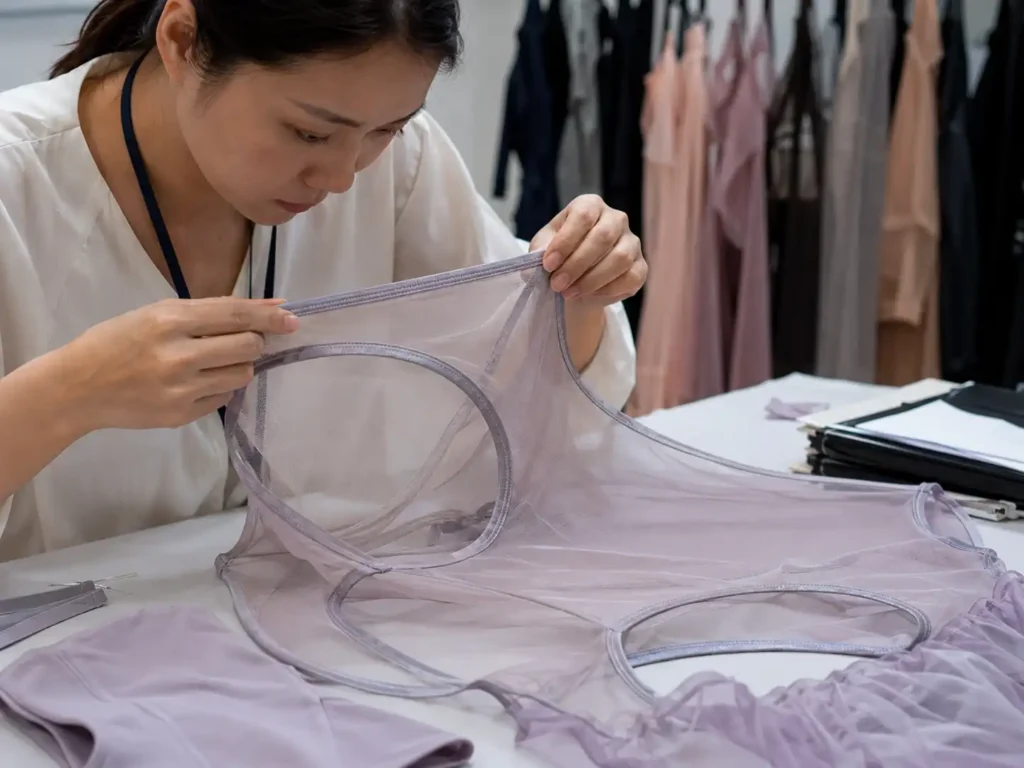
Stretch seams should be checked through controlled extension, recovery observation, fitting, washing, and approved-sample comparison before bulk production. Testing must show that the seam accommodates the garment’s expected movement without broken threads, unacceptable shape change, or visible damage. The test method and acceptance criteria should be agreed for the particular fabric and style, then carried into sewing instructions and production inspection records.
How Is Seam Stretch and Recovery Checked?
A practical development check begins by marking a measured seam section and observing how it behaves during controlled extension. If an original 100 mm section reaches 125 mm, its extension is 25%. If it later measures 104 mm after the specified recovery period, its residual growth is 4% relative to the starting length. These values are calculation examples, not claimed test results or universal acceptance limits. The meaningful question is whether the actual garment needs that extension and whether its appearance remains acceptable afterward.
Fabric tests and sewn-seam tests should not be confused. ASTM D2594/D2594M covers stretch properties of certain low-power knitted fabrics; it is not a universal method for every sewn-seam failure. Woven-seam strength and slippage may call for a different method, such as ASTM D1683/D1683M where appropriate. For meaningful repeat comparisons, document direction, specimen size, loading, recovery period, washing or conditioning, and acceptance criteria. An unrecorded hand stretch can reveal a concern, but it cannot replace a repeatable approval procedure when production decisions depend on the result.
What Do Fit and Wash Tests Reveal?
Fit tests reveal how the garment behaves on a moving body. A dress that looks smooth while standing may strain over the hips when sitting, pull at the underarm when reaching, or ride upward while walking. These are not always sewing faults; fit ease, fabric recovery, hem construction, and pattern balance can all be involved. Test the movements that customers will actually perform, then assess whether the seams remain secure and the silhouette returns to an acceptable appearance afterward.
Wash testing exposes another set of risks: seam puckering, twisting, shrinkage, and unequal changes between fabric and thread. A garment measurement changing from 50.0 cm to 49.0 cm represents a 2% reduction, but that figure alone says nothing about acceptance. The brand must define the washing procedure and tolerance for the measurement. Record what was measured, how the garment was cleaned and dried, and which change occurred. This gives designers and production teams evidence they can use instead of relying on phrases such as “looks okay after wash.”
How Are Seam Finishes Approved in Sampling?
Seam finishes should be agreed during sample development rather than chosen casually after production begins. At Jinfeng Apparel, the documented process includes first and fit samples, revisions, a pre-production sample, and an approved Golden sample reference. Changes affecting fit, fabric, or construction are translated into updated patterns, measurement charts, sewing instructions, and quality checkpoints. That record matters when a style is repeated across colors, sizes, or future collections and the original operator is no longer the person sewing it.
A new fabric may require renewed approval even if the pattern remains unchanged. Stretch direction, recovery, and thickness can alter seam appearance and the way the dress fits. In the company’s recorded development work, bodycon programs using jersey, rib knit, and ponte required attention to recovery, side-seam twisting, and after-wash stability rather than focusing only on a neat stitch line. Before releasing the order, the brand and manufacturer should identify the accepted sample, construction, fabric reference, and any critical movement or appearance requirements.
What Should Bulk Production QC Check?
Bulk quality control checks whether the approved seam can be reproduced consistently, not merely whether a few completed garments look good. Inspectors can verify stitch type, seam position, allowance, skipped stitches, needle damage, thread balance, edge coverage, and visible waviness. Where a style has high-movement areas, appropriate extension or fit checks should be part of the agreed inspection plan. Problems should be investigated early, because a minor setup error repeated across hundreds of garments becomes a costly repair issue.
Jinfeng Apparel’s company fact sheet describes six owned womenswear factories, more than ten long-term satellite production partners, and over eighteen sewing lines within its coordinated production system. Those resources support multi-style work, but capacity alone is not evidence of seam quality. The more useful evidence is an approved sample, controlled sewing instructions, in-line inspection, defect records, and corrective action. The goal is for the dress made later in the production run to behave like the dress that the brand originally approved, without relying on guesswork or individual operator memory.
| Development or QC check | Worked example or reference | What it tells the team | How to decide acceptance |
| Stitch classification | 504, 514, 304, 406 | Which construction was actually used | Match the approved operation |
| Overedge stitch density | Around 4 stitches/cm is a general apparel reference | Edge coverage and thread placement | Adjust for the specific material and seam purpose |
| Seam extension | 100 mm to 125 mm = 25% | Ability to reach a defined length | Compare with expected garment movement |
| Residual growth | 100 mm to 104 mm = 4% | Remaining length after recovery | Use a specified recovery period and tolerance |
| Dimensional change | 50.0 cm to 49.0 cm = -2% | Change after a defined wash process | Compare with brand measurement limits |
| Visual seam condition | No unacceptable holes, waves, or twisting | Appearance and possible workmanship defects | Compare with Golden sample and defect criteria |
These numbers are illustrative calculations or general supplier references, not internal laboratory results and not universal pass thresholds. Stitch classifications and application guidance are available in Coats’ Basic Stitch Types, AMANN’s overlock processing guidance, and American & Efird’s apparel technical bulletins. Using the right source for the right question makes production decisions clearer and avoids giving a single reference value more authority than it deserves.
A reliable stretch dress is not defined by one impressive stitch. Its seams have to work with the chosen fabric, the shape of the pattern, the way the garment is worn, and the practical demands of production. For many knit dresses, four-thread overlock provides a strong starting point for joining panels, while coverstitch makes sense at many hems and narrower finishes suit particular delicate areas. Every choice still needs to earn its place on the approved sample rather than being copied automatically from another style.
Jinfeng Apparel develops custom womenswear through fabric selection, pattern work, sampling, production preparation, and quality control. Brands planning jersey, rib-knit, ponte, or mesh dress collections can begin with their tech pack, reference sample, target fit, material specifications, and production expectations so that construction decisions are evaluated in context. The company’s published project baseline starts at 200 pieces per style/color, subject to fabric availability and complexity. Good seam finishing is rarely the feature a shopper notices first; it is one of the reasons the dress continues to feel right after the first fitting.
Frequently Asked Questions
1. Is a four-thread overlock always best for a stretch dress?
No. Four-thread overlock is a useful starting point for joining many stretch-knit panels, but it is not automatically the best finish for every fabric or garment area. A lightweight sheer mesh may need a narrower construction, a stretch woven may require a separately finished seam, and a folded knit hem often suits coverstitch. The decision should reflect seam function, fabric stretch, bulk, comfort, and what happens when the finished garment is worn and washed.
2. Can I sew a stretch dress without a serger or overlocker?
Yes, suitable stretch fabrics can be sewn with a conventional sewing machine using a correctly selected zigzag or other appropriate stretch-capable stitch. The seam must still have enough extension for the garment, and fraying edges may need additional finishing. A good result depends on needle, thread, stitch settings, and fabric handling. For commercial production, the alternative should be tested and documented so its performance and appearance can be reproduced rather than relying on a single successful trial.
3. What is the difference between overlock and coverstitch on a dress?
Overlock wraps thread around fabric edges and can also join panels, depending on the stitch type. Coverstitch, particularly the common two-needle type 406, forms parallel rows on the outside with looper thread beneath and is often used on folded knit hems. Neither stitch is universally better; they usually serve different jobs. A well-constructed jersey dress may use four-thread overlock for side seams and coverstitch at the hem, with other treatments for its neckline or special panels.
4. How do I stop stretch-dress seams from popping when worn?
Start by checking whether the seam can extend as far as the garment needs during dressing and movement. Then examine stitch class, thread type and size, needle damage, stitch balance, tension, and seam margin. Adding stronger thread alone may not solve a construction that cannot stretch sufficiently. Make comparison samples on the actual fabric and test the finished dress in realistic positions. The improvement is only reliable when it fixes the breakage without introducing distortion, stiffness, or new damage.
5. What causes wavy side seams on jersey or rib-knit dresses?
Waviness commonly comes from the fabric stretching during sewing, uneven feeding, or poor control of the knit panels. The problem may be made worse by handling fabric before it has relaxed or by pulling material through the machine. Check differential feed, panel alignment, thread balance, and operator technique before using pressing as a correction. If the seam twists rather than simply waves, also investigate cutting direction, pattern balance, and fabric torque, especially if the defect becomes more obvious after washing.
6. How should a brand approve seam quality before bulk production?
Approval should combine a finished sample, documented stitch construction, fit checks, relevant extension and recovery observations, and wash or dimensional testing where required. The brand and manufacturer should agree which areas are critical, what constitutes an unacceptable defect, and how the approved result will be checked in production. Keeping the Golden sample linked to the fabric reference, pattern, sewing instruction, and inspection records makes repeat orders easier to control and reduces the risk of changes made without approval.