Skip to content


What Are Snaps and Hooks?
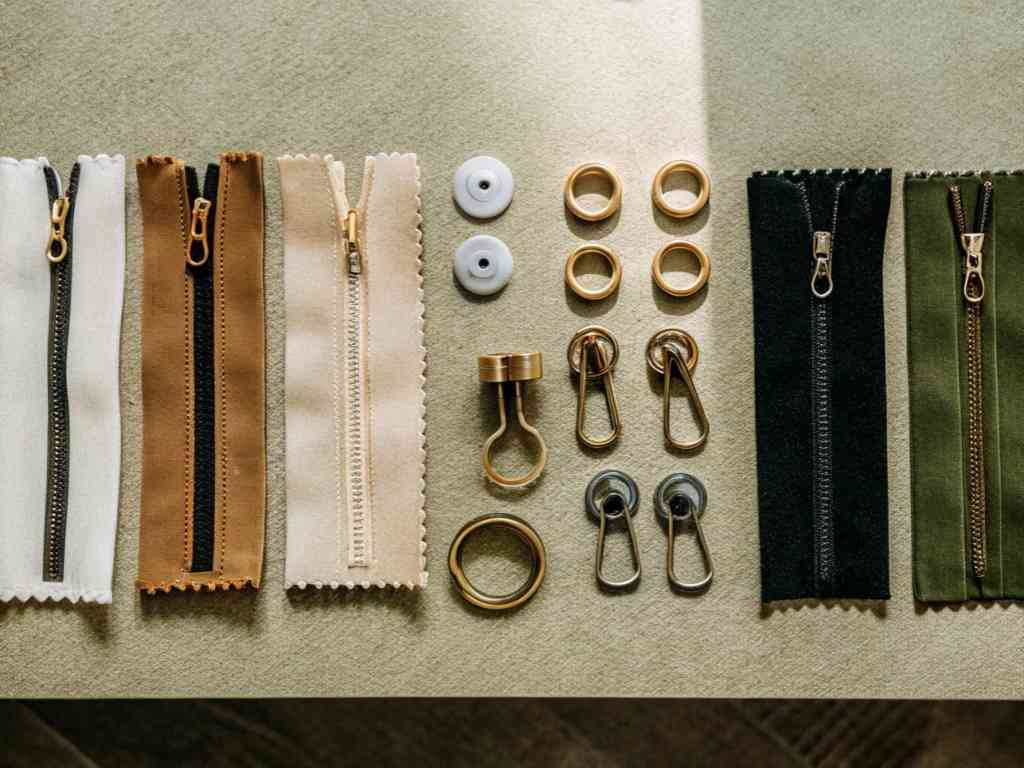
Snaps and hook-and-eye fasteners are both compact dress closures, but they work differently. Snaps lock two mating parts together through pressure, while hooks secure one garment edge to an eye or loop. Snaps favor quick fastening and concealed overlaps; hooks are often preferred where the opening carries more concentrated tension. The correct choice depends on closure type, fabric strength, garment structure, reinforcement, wearing movement, and the intended visual finish.
Snap Closures
A snap closure is not one single piece of hardware. In dress production, the term can refer to small sew-on snaps hidden inside an overlap or multi-part metal snaps pressed mechanically through the fabric. The distinction matters because these constructions behave very differently in use.
Small sew-on snaps are common where the closure mainly keeps two fabric layers aligned rather than carrying the full load of a fitted garment. They can work well at wrap necklines, lightweight plackets, discreet overlapping panels, and secondary openings. Because the hardware sits between fabric layers, the finished garment can look very clean from the outside.
Pressed snaps are a different category. Depending on the hardware system, they may consist of a cap, socket, stud, and post. Common commercial snap diameters can fall around the 13-18 mm range, although much smaller or larger products exist. A 15 mm metal snap on denim is therefore not comparable with a tiny hand-sewn snap used inside a satin wrap dress.
When specifying snaps for production, the development team should establish at least:
- Snap construction
- Diameter
- Metal or resin composition
- Surface finish
- Color
- Attachment method
- Intended opening force
- Reinforcement method
- Exact garment position
A frequent production mistake is approving the appearance of a snap without checking how much force is needed to open it. If the snap is too weak, it can release during movement. If it is too strong, the wearer may pull the surrounding fabric aggressively every time the garment is opened.
Hook-and-Eye Closures
A hook-and-eye closure joins a shaped hook on one side of an opening to an eye or loop on the other. It is one of the oldest and simplest hidden fastening systems in apparel, but that simplicity is exactly why it remains useful in modern dresses.
Hooks are particularly effective where the opening needs a small, low-profile closure that can resist concentrated tension. Common applications include corset dresses, bustier tops, fitted waistbands, strapless dresses, evening dresses, skirts, and the area immediately above a zipper. In practical trim control, fastening strength, position, comfort, symmetry, and visibility are all important QC points.
The eye can also be constructed in different ways. A metal eye may be used when the garment edges overlap or meet in a defined position, while thread loops can be useful where a softer and less visible receiving point is required. The exact choice depends on fabric weight, seam construction, expected load, and the desired appearance.
Hooks are inexpensive compared with many decorative trims, but their low component cost should not lead teams to treat them casually. A hook sewn 3-4 mm out of position can change how two garment edges meet, create gaping, expose the zipper top, or produce a pressure point against the skin.
How Their Mechanisms Differ
A snap and a hook fail in different ways because the load travels through them differently.
A snap is held closed by the retention force between its two mating parts. When the fabric pulls apart, the force acts directly against that retention. Once the applied force exceeds the resistance of the snap, the two parts separate. This is why a snap that feels secure on a hanger can sometimes open when the wearer bends or sits.
A hook behaves differently. The hook remains engaged with the eye while the surrounding fabric, stitching, seam allowance, and reinforcement carry the load. Provided the hook does not deform and the opening does not move in a direction that allows disengagement, it can remain stable under continuous garment tension.
The comparison should therefore never be reduced to “hook equals strong, snap equals weak.” A heavy-duty industrial snap may outperform a tiny hook, while a badly sewn hook may fail before a properly reinforced snap.
The practical comparison is the whole system:
| Closure Variable | Snap | Hook-and-Eye | Production Impact |
| Engagement method | Press-fit connection | Hook into eye/loop | Changes failure mode |
| Typical low-profile use | Overlaps, plackets, wrap areas | Waist, zipper top, bodice | Affects placement choice |
| Opening speed | Fast | Slightly slower | Affects wearer convenience |
| Load sensitivity | Depends heavily on retention force | Depends heavily on stitching and alignment | Requires sample testing |
| Fabric support | Often needed | Often needed | Prevents distortion |
| Common failure | Pops open or pulls through fabric | Bends, disengages, or stitches loosen | Requires different QC |
What Matters More Than the Hardware Name
In commercial dress development, the closure itself is only one part of the engineering decision. The same snap or hook can perform perfectly in one dress and fail in another because the surrounding construction has changed.
Fabric thickness, stretch recovery, lining, seam allowance, facing, interfacing, zipper placement, and body tension all affect performance. A hook sewn into a firm waistband has a very different support structure from the same hook sewn directly into lightweight mesh. Likewise, a snap hidden inside a reinforced woven placket behaves differently from the same snap attached to a soft stretch knit.
This is why trim selection should happen while the garment structure is being reviewed, not after the sample is nearly finished. A professional trim-development system evaluates specification, color, durability, comfort, MOQ, lead time, cost impact, and QC risk according to the individual style.
A closure that looks insignificant on a bill of materials can become one of the most visible defects when it fails.
Which Closure Holds Better?
Hook-and-eye closures are usually the stronger starting choice for concentrated tension at fitted waists, structured bodices, and zipper tops. Snaps are often better for low-to-moderate-load overlaps and quick secondary fastening. However, neither category has a fixed universal strength. Actual performance depends on component size, attachment quality, reinforcement, fabric strength, opening direction, and how much tension the finished garment creates during wear.
Higher-Tension Areas
The first question is not “Which fastener is stronger?” but “How much load is this exact closure expected to carry?”
A back-neck snap on a loose chiffon dress may experience very little continuous tension. A closure at the top of a fitted corset dress can experience repeated outward force every time the wearer breathes deeply, twists, sits, or raises her arms. The hardware specification should reflect that difference.
Hooks are commonly preferred in concentrated high-tension areas because the load can be transferred through the hook, eye, stitching, and reinforced garment edge rather than relying solely on snap retention. This is particularly useful at:
- Fitted waistbands
- Corset-style bodices
- Bustier constructions
- Strapless back openings
- Fitted skirt waists
- Zipper tops
That does not mean a stronger hook should be used to compensate for an undersized garment. If the waist or bust is too tight, the closure is only the first component to reveal the fit problem. Increasing fastener strength can transfer excessive force into the zipper tape, seam, lining, or shell fabric.
A professional fit review therefore asks two separate questions: Is the closure suitable? and Is the garment itself generating reasonable tension?
Both must be answered before bulk production.
Accidental Opening
One of the most frustrating snap failures is not breakage but unexpected release. The snap may work perfectly when opened and closed by hand, yet release during normal movement because the dress applies a peeling or twisting force rather than a simple straight pull.
Wrap garments are a good example. When a wearer walks, sits, or crosses her legs, the two overlapping panels can move in different directions. If the snap is positioned too close to the point of maximum movement, the repeated separation force can gradually overcome retention.
A hook typically avoids the characteristic “pop” of a snap, but it has its own failure modes. A hook can:
- Open slightly under repeated load
- Slip out of the eye
- Rotate because of loose stitching
- Scratch the wearer
- Distort the garment edge
- Pull the eye out of alignment
The best wear test is simple and surprisingly revealing: fit the finished sample on the intended body shape and repeat real movements. Sit, bend, twist, reach, walk, and open and close the garment several times. A closure that survives static inspection but fails during movement is not ready for bulk production.
Zipper-Top Security
Many fitted dresses use a zipper as the primary opening but still benefit from an auxiliary closure above it. The purpose is often misunderstood.
A small hook above the zipper can help align the two edges before the zipper is operated. It can also reduce the amount of outward force acting directly on the zipper slider at the highest-stress point of the opening. On fitted bodices, this can make dressing easier and help the top of the zipper remain flatter.
The closure becomes particularly useful where the zipper ends below a neckline or at the top of a structured bodice.
In corset-style construction, the hook should be considered together with:
- Invisible zipper
- Boning
- Bra cups
- Lining
- Anti-slip tape
- Back height
- Bust tension
- Waist shaping
A hook is not automatically required on every zipper. Loose dresses and low-tension openings may not need one. Adding unnecessary hardware can increase bulk and create an avoidable pressure point.
Placement and Reinforcement
A technically strong closure can perform badly when it is placed incorrectly.
If one side is positioned even slightly higher than the other, fastening the dress can pull the opening diagonally. On a fitted satin dress, this may show as rippling or a twisted zipper top. On a waistband, it can shift one edge upward and make the waist seam look uneven.
The attachment area should also be strong enough to absorb repeated force. Lightweight fabric often needs support from:
- Facing
- Interfacing
- Lining
- Reinforced seam allowance
- Binding
- A structural inner layer
For production, closure position should be referenced to measurable construction points rather than operator judgment. Useful references include the top zipper stop, neckline seam, waist seam, center-back edge, or marked overlap line.
That level of control becomes more important as order quantity rises. A difference that seems insignificant on one sample can become obvious when hundreds of garments are packed side by side.
Which Closure Fits Each Dress?
Hooks work particularly well in structured, fitted, or higher-tension openings, while snaps are often effective for discreet overlaps and low-load secondary fastening. Corset dresses, strapless dresses, wrap dresses, waistbands, and necklines should not share one default closure specification because each area experiences different tension, movement, visibility requirements, and skin contact. The best closure follows the construction and wearing behavior of the specific dress.
Corset and Bustier Dresses
Corset dresses are among the least forgiving garments when closure engineering is poor.
The bodice may combine boning, cups, lining, an invisible zipper, anti-slip material, seam reinforcement, and deliberate waist shaping. These components work together to keep the garment stable. A closure at the back or top of the zipper therefore sits inside a system that may be carrying significant body tension.
Hooks are commonly a good choice here because they can provide positive engagement without adding a wide visible fastener. They are especially useful as secondary support at the zipper top or in areas where the bodice edges need to meet securely before the zipper is fully closed.
For corset construction, useful control points include:
- Boning position and length
- Cup shape and symmetry
- Lining fit
- Anti-slip placement
- Invisible zipper flatness
- Hook security
- Bust coverage
- Waist tension
- Left-right symmetry
- Wearing comfort
This illustrates an important point: if a hook is failing repeatedly on a corset dress, the hook may not be the real problem. Incorrect cup volume, an overly tight waist, poor back width, or zipper distortion may be creating abnormal tension.
Closure failure can therefore be a symptom of a fit problem rather than a trim problem.
Strapless Dresses
A strapless dress has fewer ways to stabilize itself because there are no shoulder straps carrying part of the garment weight.
The top edge must stay in position through a combination of bust shaping, waist fit, boning, lining, anti-slip treatment, elastic recovery where applicable, and the back opening. As a result, the closure often experiences more meaningful structural load than it would in a loose day dress.
Hooks work well near structured zipper tops because they can help hold the two sides together while the zipper is closed. They also reduce dependence on the zipper slider as the only point resisting outward force.
The hook itself, however, must remain comfortable. A back hook that projects inward can become irritating after several hours of wear. This matters in eveningwear, party dresses, bridesmaid dresses, and occasionwear, where a garment may be worn continuously through sitting, eating, dancing, and travel.
A snap can still be useful in lower-tension strapless constructions, but it needs careful testing. If the entire upper bodice is trying to pull apart at the closure, a small concealed snap should not be treated as the primary structural solution.
Wrap Dresses
Wrap dresses create a very different fastening problem.
The objective is often not to carry concentrated waist tension but to keep overlapping fabric from opening beyond the intended amount. A small snap can be ideal because it is fast, discreet, and easy to hide between the overlapping panels.
The key variable is placement.
A snap positioned too close to an area of high movement can pull the fabric inward or release repeatedly. A snap positioned too far away from the opening edge may do little to control exposure. For wrap skirts and wrap dresses, the best position is usually confirmed on a worn sample rather than by looking at the flat pattern alone.
The fitting should include:
- Walking with a normal stride
- Sitting
- Crossing the legs
- Climbing a step
- Bending
- Rotating the torso
The overlap should remain secure without feeling rigid.
Hooks can also work in wrap garments where a more secure engagement is required, especially at the waist. In some designs, the most practical solution is not choosing one closure exclusively but combining a waist tie or primary fastening system with a small secondary snap or hook at the exposure point.
Waistbands and Necklines
Waistbands and necklines may use similarly small pieces of hardware, but the mechanical demands are very different.
A fitted waistband can remain under near-continuous tension while the garment is worn. It may also experience sudden force when the wearer sits. A hook is usually a strong candidate because it can provide compact engagement without the sudden release behavior associated with small snaps.
A neckline closure often has a lighter job. It may simply:
- Close the final opening above a zipper
- Align two neckline edges
- Hold a small keyhole opening
- Keep a back-neck seam flat
In those cases, either a hook or a small snap can work.
Comfort should drive the final decision. A hook placed at the back neck must not scratch. A snap should not create a bulky disc that presses against the skin. On lightweight fabrics, both may require reinforcement to prevent the attachment point from pulling or becoming visible from the outside.
The useful rule is to classify the function first:
Waistband = load management.
Neckline = alignment and finishing in many designs.
Using the same trim specification for both simply because they are both small closures is rarely good production practice.

How Do Fabric and Construction Affect the Choice?
Fabric can completely change closure performance. Lightweight satin, chiffon, mesh, stretch jersey, denim, and corset structures distribute force differently and tolerate different levels of hardware pressure. Before choosing a snap or hook, evaluate fabric strength, stretch, thickness, transparency, lining, seam allowance, reinforcement, and surface sensitivity. The best closure is the one the complete garment construction can support repeatedly without distortion, discomfort, or premature failure.
Lightweight and Delicate Fabrics
Lightweight fabrics are less tolerant of concentrated mechanical force.
A small sew-on snap may work very well in chiffon, georgette, fine woven fabric, or lightweight satin when it is placed inside a reinforced overlap and carries limited load. The same snap can become problematic if it is expected to hold a tight fitted opening.
The surrounding fabric should be monitored for:
- Pull marks
- Small tears
- Stitch elongation
- Visible dimpling
- Surface shine
- Distortion
- Fraying
- Local stretching
Satin deserves special attention. Because its surface reflects light smoothly, a fastener can be completely hidden yet still show through as a round bump or local ripple. This is one reason satin samples should be checked under side lighting rather than only directly from the front.
Mesh presents another challenge. Conventional interfacing can be visible through transparent fabric, so reinforcement may need to be built into a seam, binding, facing, or lining rather than applied as a standard opaque patch.
For delicate fabrics, the best fastener is often the smallest closure that safely performs the required job while allowing the reinforcement to remain invisible.
Structured Fabrics
Structured woven fabrics usually provide a better foundation for hooks and heavier snaps because the garment edge is less likely to stretch immediately around the attachment point.
That makes them suitable for:
- Fitted waist seams
- Structured bodices
- Suiting dresses
- Denim dresses
- Utility-style dresses
- Corset-inspired pieces
However, fabric weight alone does not guarantee a strong closure. The internal construction matters more.
A 250 gsm woven fabric with an unsupported raw edge can still distort, while a much lighter fabric backed by a properly engineered facing may hold the closure securely.
Hooks are particularly useful where a defined reinforced edge exists. They can be sewn into the waistband, facing, or structured bodice layer so the load is distributed through the garment rather than isolated around a few surface threads.
Pressed snaps can also perform well on structured fabric, especially when the hardware is visible and part of the design. Denim dresses, rompers, utility dresses, and casual jumpsuits often use metal snaps successfully because the fabric can support the installed components and the visual bulk is appropriate for the style.
Stretch, Lining, and Recovery
Stretch fabrics introduce another problem: the garment body elongates while the metal hardware does not.
If a snap or hook is attached directly to a high-stretch area, the fabric can pull away from the hardware every time the garment is worn. Over time, the surrounding area may wave, stretch permanently, or tear.
The development team should check:
- Fabric stretch percentage
- Recovery after stretching
- Direction of stretch
- Stability of the seam
- Lining stretch
- Reinforcement elasticity
- Whether the opening itself should stretch
A fitted knit dress may need a stable closure zone even though the rest of the garment stretches. This can be created with a stabilized seam, facing, binding, or supportive lining.
Lining can help distribute force, hide hardware backing, and improve comfort, but it should not automatically be treated as structural. A soft stretch lining may provide almost no resistance to the load placed on a closure.
For dresses using satin, stretch satin, mesh, power mesh, jersey, ponte, crepe, velvet, lace, and blended fabrics, closure selection should be matched to the actual approved fabric, not the generic fabric name written at the beginning of development.
Reinforcement Requirements
Reinforcement is one of the most overlooked closure decisions.
A fastener concentrates force into a small area. Without enough internal support, the closure can remain intact while the fabric around it fails.
Typical reinforcement options include:
- Fusible interfacing
- Sew-in interfacing
- Additional seam allowance
- Facing
- Stable lining
- Twill tape
- Binding
- Reinforced waistband construction
The material chosen should support the fastener without creating an unwanted visible hard patch.
A heavy fusible may be mechanically effective but unacceptable under a fluid satin shell. A thin knit fusible may preserve appearance but provide insufficient support for a high-tension hook. The correct solution needs to balance strength and visual effect.
| Fabric / Construction | Closure Starting Point | Reinforcement Focus | Main Risk |
| Lightweight satin | Small snap or small hook | Soft, low-profile support | Show-through and puckering |
| Chiffon / georgette | Small concealed closure | Facing, seam or lining support | Pull-through |
| Stretch jersey | Compatible snap or stabilized hook | Control stretch locally | Edge growth |
| Ponte / firm knit | Snap or hook depending on tension | Stable seam or facing | Local distortion |
| Structured woven | Hook or press snap | Seam/facing support | Stitch failure |
| Corset bodice | Hook often preferred at stress point | Multi-layer structural support | Excess body tension |
| Denim | Press snap often practical | Correct installation | Fabric crushing or loose hardware |
How Do They Compare in Wear, Finish, and Cost?
Snaps are generally faster to operate, while hooks often provide better security in concentrated high-tension areas. Both can be concealed successfully, but their finished thickness and visibility vary by hardware size, fabric, and reinforcement. Cost should include more than unit price: trim MOQ, custom finish, attachment labor, equipment, reinforcement, QC, rejection risk, and repeat-order availability all influence the commercial result.
Ease of Use
Snaps usually win on speed.
The wearer aligns the two components and presses them together. Opening is equally intuitive. This can make snaps a strong choice for garments where convenience matters and the closure does not carry excessive tension.
That includes:
- Wrap overlaps
- Small internal plackets
- Casual styles
- Bodysuit openings
- Secondary neckline fastening
Hooks require a little more precision. The wearer must locate the eye and engage the hook, which can be awkward when the closure is behind the neck or high on the center back.
However, easy opening is not always an advantage. A snap that opens too easily may become unreliable. A snap that is specified with very high retention can create the opposite problem: the customer may pull directly on the fabric to release it.
That can damage delicate materials faster than normal wear.
The ideal closure force is therefore not the highest available. It should be sufficient to remain secure during intended use while still allowing a person to operate the garment without excessive pulling.
Fit samples should always be opened and closed several times by someone who has not sewn the garment. Production staff often know exactly where the closure is and how it works, while the end customer does not.
Concealment and Bulk
Both closures can be almost invisible when engineered properly.
A tiny sew-on snap can disappear inside an overlap. A small hook can sit flat behind a zipper or neckline edge. The difference often appears not in visibility of the hardware itself but in how the hardware changes the surface of the garment.
Snaps create thickness where the two components meet. On lightweight satin, that can show as a small circular impression. Larger press snaps are even more visible and are normally chosen deliberately when hardware forms part of the design.
Hooks have a narrower profile, but they can produce a hard point if the hook projects inward or if the eye sits directly beneath a smooth outer layer.
The finished closure should be reviewed from:
- Front
- Back
- Side
- Close range
- Normal viewing distance
- Direct lighting
- Side lighting
This is particularly important for photo-led fashion categories. E-commerce photography can make small puckers or bumps more obvious than they appear during a quick factory inspection.
A closure that looks technically “hidden” from the inside can still damage the clean visual line of a fitted dress.
Cost and Lead Time
Component price is only one part of closure cost.
For standard hooks, material cost is usually low. Custom metal snaps can become more expensive because color, logo, plating, die requirements, component size, and supplier MOQ all affect procurement.
As a practical production reference, standard hook-and-eye components are generally treated as low-cost trims with a typical 3-10 day development window, while customized four-part snaps commonly involve 500-1,000 pieces and approximately 7-20 days, depending on specification. These figures are planning references rather than universal industry standards.
For a fashion collection, color count can have a larger impact than the component price itself. If one style is offered in six colors and each requires a special plated snap, minimum quantities can quickly become inefficient.
A concealed standard hook may be easier to share across multiple colors because it is hidden inside the garment.
Cost analysis should therefore include:
- Component cost
- MOQ
- Number of colorways
- Custom plating
- Logo development
- Reinforcement
- Labor
- Pressing equipment where required
- QC time
- Replacement rate
- Repeat-order availability
The cheapest trim at sample stage can become the more expensive option once bulk constraints are included.
Repeated Wear
Durability depends as much on installation as on hardware quality.
A snap can gradually lose retention because of socket deformation, incorrect pressing pressure, fabric compression, or repeated pulling. A hook can bend, open slightly, or become loose when its securing stitches weaken.
The surrounding fabric should also be treated as part of the durability test.
A metal component can remain perfectly functional while the attachment area fails. Common signs include:
- Enlarged holes
- Loose stitching
- Local fabric shine
- Torn reinforcement
- Distorted lining
- Permanent puckering
- Misalignment after washing
Repeated-opening tests are useful during development even when the customer has not specified a formal test method. The purpose is not to claim a universal cycle requirement but to compare the approved trim options under the same conditions.
For repeat orders, retaining the exact approved trim specification is especially important. Switching to a visually similar hook or snap can change dimensions, opening force, plating quality, or durability.
A structured trim-record system that retains specifications, colors, suppliers, and related trim details helps support repeat production consistency.

How Should Closures Be Tested Before Bulk Production?
Closures should be approved on the finished garment rather than from loose hardware samples. Testing should cover attachment strength, opening and closing behavior, garment alignment, wearer movement, comfort, surface appearance, reinforcement, zipper interaction, and repeat use. After approval, the closure type, size, finish, position, attachment method, and reference sample should be documented so bulk production can reproduce the same result consistently.
Sample Review
A loose hook or snap can tell the development team very little about actual garment performance.
The same closure may behave differently once it is attached to satin, stretch mesh, denim, or a multilayer corset bodice. Sample review should therefore take place on the completed garment using the approved or closest-possible production fabric.
The review should answer practical questions:
- Does the closure lie flat?
- Does the garment edge align correctly?
- Can the wearer close it easily?
- Does the closure remain secure during movement?
- Does it create visible puckering?
- Does it touch the skin?
- Does it affect zipper operation?
- Does it distort the lining?
- Does the attachment remain stable after repeated opening?
A robust trim-development workflow identifies the required trim, confirms specification, color and quality, uses the selected trim during sampling, evaluates its effect on fit and structural stability, finalizes the trim before bulk, inspects incoming materials, and communicates the approved details to production and QC.
That sequence matters because changing the closure late can also require changes to reinforcement, seam allowance, pattern markings, or lining construction.
Holding and Movement Tests
Static strength alone does not reproduce real wear.
A fitted waist may experience greater force when the wearer sits than when standing. A wrap closure may be challenged by twisting. A strapless bodice may be stressed when the arms are raised. A neckline closure may experience repeated rubbing rather than high outward load.
The test should match the garment.
For a fitted dress, a useful movement sequence includes:
- Close the garment normally.
- Stand for several minutes.
- Sit fully.
- Bend forward.
- Rotate the torso.
- Raise both arms.
- Walk with a normal stride.
- Open and refasten the closure repeatedly.
- Reinspect the attachment area.
The aim is not to invent an arbitrary universal pull-force number. Without a brand-specific test method or recognized component standard, a single force value can be misleading.
Instead, compare closure options consistently and document what is acceptable for the project.
A failed test should also distinguish hardware disengagement from fabric failure. If the snap remains closed but tears the fabric, stronger retention is not the answer. If the hook remains intact but the stitch attachment pulls out, sewing reinforcement needs correction.
Alignment and Comfort
Alignment should be reviewed before strength.
A closure that is slightly misplaced can create artificial tension and make perfectly good hardware appear unreliable.
When the dress is closed, check whether:
- Center-back edges remain level
- Waist seams meet correctly
- The zipper top stays flat
- Neckline edges align
- Overlaps remain even
- The garment does not twist
- The closure remains concealed
Comfort should be tested separately.
For hooks, inspect the tip, eye, stitching, and any metal edges that can contact skin. For snaps, inspect the backing and surrounding seam thickness. In corset or strapless dresses, also consider whether boning, lining, zipper, and hook layers are stacking into one uncomfortable hard area.
In professional hook QC, security, position, comfort, symmetry, and visibility should all be checked. A closure is not acceptable simply because it stays closed.
A dress designed for an evening event may be worn for six or eight hours. A small sharp pressure point that seems insignificant during a two-minute fitting can become a major customer complaint later.
Bulk QC and Tech Pack Control
Once the sample works, the challenge changes from development to repetition.
The tech pack or production specification should remove unnecessary operator interpretation. Writing “add hook” or “use snap” is not enough.
Useful closure information includes:
- Closure type
- Size
- Material
- Finish
- Color
- Quantity per garment
- Exact location
- Orientation
- Attachment method
- Reinforcement method
- Stitch requirement where applicable
- Approved supplier or equivalent
- Approved sample reference
For snaps, the specification may also need to identify the component construction and diameter. For hooks, eye type and exact position should be recorded.
Bulk QC then checks whether production matches the approved standard.
| QC Item | Snap Check | Hook Check | Acceptable Production Condition |
| Position | Both parts align | Hook meets eye without pulling | Garment edges remain level |
| Attachment | No loose stitching or weak pressing | No loose securing stitches | Hardware does not move |
| Operation | Opens and closes smoothly | Engages without forcing | Normal wearer effort |
| Fabric condition | No crushing, tearing or distortion | No pulling around stitches | Surface remains clean |
| Comfort | Backing does not press or scratch | Hook tip does not contact skin | No obvious pressure point |
| Appearance | No visible bump beyond approved level | Closure remains concealed | Garment lies flat |
| Consistency | Same size, finish and retention | Same size, finish and placement | Matches approved sample |
Incoming trim inspection is equally important. Components should be checked for color, dimensions, surface condition, quantity, and basic operation before they reach sewing or attachment lines.
For long-running styles, maintaining approved trim records becomes valuable. A good trim workflow archives specifications and production information so repeat orders can reference the same approved component rather than restarting the decision from memory.
A snap or hook is a tiny part of a dress, but once production reaches hundreds or thousands of pieces, tiny inconsistencies become visible very quickly. The strongest closure decision is therefore the one that works on the wearer, looks clean on the garment, can be sourced reliably, and can be reproduced accurately from sample through bulk production.