 Skip to content

How to Develop a Bodycon Dress Pattern for Fit, Stretch, and Production

Your trusted Women’s Apparel Manufacturer from China

A bodycon dress can look almost effortless when photographed on a model: smooth curves, clean side seams, a stable neckline, and a hem that appears to stay exactly where the designer intended. Developing the pattern behind that appearance is far less simple. The pattern has to work with an elastic material that changes shape as the wearer breathes, walks, sits, bends, and moves. A few millimeters of imbalance can become visible pulling, twisting, gaping, or ride-up once the garment is placed under tension.
A bodycon dress pattern is developed by combining accurate body measurements with a reliable fitted block, measured fabric stretch, controlled negative ease, fabric recovery, balanced seam placement, and repeated fit testing. The approved pattern is then corrected, graded, checked in the intended material, and converted into a production pattern with documented measurements, construction details, tolerances, and sample approvals.
The challenge is that bodycon fit is not created by making every measurement smaller. Two dresses can share nearly identical sketches yet behave completely differently after thirty minutes of wear. One stays smooth and balanced; the other gradually twists around the body, climbs several centimeters at the hem, or becomes loose through the waist. The difference usually comes from a series of small technical decisions made long before bulk cutting begins.
What Makes a Bodycon Pattern Work?
A bodycon pattern works when body shape, fabric stretch, recovery, negative ease, seam balance, and movement are treated as one connected system. The purpose is not maximum tightness. A successful pattern follows the bust, waist, and hip closely while keeping the neckline stable, side seams balanced, hem controlled, fabric comfortable, and the intended silhouette consistent during normal wear.
Fit Is About Controlled Tension
One of the most common mistakes in bodycon development is assuming that more reduction automatically creates a cleaner silhouette. In practice, the best bodycon patterns distribute tension instead of maximizing it. The fabric needs to stretch enough to follow the body while still retaining sufficient recovery to return toward its original dimensions after movement. When the garment is reduced too aggressively, tension concentrates around the fullest parts of the body and creates problems elsewhere.
The bust, waist, and hip reveal this quickly. Too much reduction at the bust can flatten the chest and create diagonal drag lines toward the armhole or side seam. Excessive waist compression can produce horizontal wrinkles and encourage the entire dress to migrate upward. Too little room through the hip or upper thigh can force the skirt toward a narrower part of the body, which is one of the reasons a fitted dress begins to ride upward during walking.
The goal is therefore not the smallest garment the fabric can stretch over. The goal is a finished dimension that creates the intended contour without pushing the fabric beyond a comfortable working range. Opacity, seam appearance, surface shine, recovery, movement, and wearing comfort should remain acceptable at the same time.
Fabric type changes the answer. Soft jersey, rib knit, ponte, stretch satin, power mesh, and dense compression knits can all produce close-fitting dresses, yet each fabric creates a different level of pressure at the same finished measurement. Jinfeng Apparel’s documented bodycon development process treats stretch recovery, bust-waist-hip balance, side-seam stability, dress length, and post-wash dimensional behavior as connected fit controls rather than simply making a conventional dress smaller.
Pattern Balance Comes Before Styling
Before adding ruching, cut-outs, asymmetric necklines, mesh inserts, hardware, or dramatic slits, the base silhouette should already sit correctly on the body. Decorative details can disguise a balance problem in a photograph, but they rarely solve it. In many cases they increase the technical difficulty because removing fabric, changing seam direction, or adding a second material changes how tension travels through the garment.
A balanced base pattern should keep its side seams reasonably vertical, maintain a stable waist position, provide consistent bust coverage, and allow front and back hems to remain visually level. The neckline should sit close enough to the body to feel secure without cutting in, while the armhole should remain stable during arm movement. These checks sound basic, but bodycon garments make small errors much more visible than loose silhouettes.
Vertical balance deserves particular attention. A fuller bust requires additional front-body length because the fabric has to travel farther over the chest. A fuller seat can require additional back length for the same reason. If the pattern does not provide that length, the fabric borrows it from lower areas of the dress, raising the hem at the front or back even when the nominal garment length appears correct on the specification sheet.
A useful development check is to establish horizontal reference lines at the bust, waist, high hip, and full hip. When the sample is worn, these lines help reveal whether the pattern is being pulled upward or downward. A dress can have correct circumferences and still fit poorly because the waist is positioned 20 millimeters too high or the hip depth does not correspond to the wearer’s actual proportions.
Bodycon Is Not the Same as Bandage Fit
Bodycon describes a close silhouette rather than one specific fabric or construction method. A bandage-style dress generally uses a denser, more structured elastic material and often creates stronger compression. A lightweight jersey bodycon mini, a ponte midi, and a dense compression dress can look similar from a distance, but the pattern reductions needed to create those silhouettes can be very different.
Fabric Type | Typical Stretch Behavior | Structure | Main Pattern Concern |
Single jersey | Moderate to high | Soft | Growth, transparency, seam waviness |
Rib knit | High | Soft to medium | Vertical growth and recovery |
Ponte / Roma | Low to moderate | Firm | Mobility, seam strain, ride-up |
Power mesh | High | Light but firm | Transparency and edge stability |
Stretch satin | Low to moderate | Smooth | Tension marks and seam visibility |
Compression knit | Moderate to high | Dense | Comfort, zipper load, pressure |
A soft jersey can accommodate body volume through fabric extension, but it may reveal underwear lines and seam allowances more easily. A firm ponte can create a cleaner surface but may restrict sitting or walking if the hip and thigh are reduced too aggressively. Stretch satin often requires even more care because surface shine makes tension differences visible under strong lighting.
For commercial development, the silhouette should be treated as the creative goal and the pattern as a material-specific technical solution. If a brand changes from rib knit to ponte while keeping the same visual style, the new fabric should be fitted rather than assuming the original pattern can move directly into production.
Fit Problems Leave Useful Clues
A fitting defect is valuable information because the direction and location of wrinkles often reveal where the pattern or fabric is under stress. Moving a seam or increasing circumference without understanding the source may temporarily improve appearance while creating another problem somewhere else.
Diagonal lines running from the bust toward the side seam often indicate missing bust volume or length. Horizontal tension lines across the hip can signal excessive reduction or incorrect hip placement. A front hem that lifts more than the back can be related to insufficient front length over the bust, while a raised back hem may indicate inadequate room for seat projection.
Side-seam twisting requires similar diagnosis. The seam may shift forward because the back body needs more room, but twisting can also be caused by fabric torque, incorrect grain direction, uneven stretch between panels, or sewing-feed tension. A correction to the paper pattern alone will not solve fabric torque.
Bodycon development becomes much more efficient when the fitting process is treated as diagnosis rather than trial-and-error alteration. The pattern maker reads the garment like a map of tension, identifies the likely cause, changes one controlled variable, and then verifies whether the correction improved the overall balance.
Which Measurements Control Bodycon Fit?
Bust, upper bust, waist, high hip, full hip, front length, back length, hip depth, and finished dress length control most bodycon fit decisions. These measurements need to be interpreted together because close-fitting garments expose proportional errors quickly. Correct circumference cannot compensate for an incorrect waist level, insufficient front length, poor seat allowance, or misplaced hip shaping.
Measure More Than Bust, Waist, and Hip
Bust, waist, and full hip are essential measurements, but relying only on those three values leaves important information missing. Close-fitting garments need a better understanding of where body volume occurs vertically and how it is distributed between the front and back.
Upper bust helps explain whether neckline and upper-chest fit will remain secure. Underbust becomes important when the style includes shaped cups, internal support, deep necklines, or corset-inspired details. High hip identifies the transition between waist and full hip, while front and back waist lengths show whether the pattern has enough vertical space for bust and seat projection.
Measurement | Main Fit Function | Common Risk if Incorrect |
Upper bust | Upper chest and neckline stability | Gaping or pressure |
Full bust | Volume and projection | Flattening or drag lines |
Waist | Silhouette definition | Loose waist or excess compression |
High hip | Waist-to-hip transition | Wrinkles or abrupt shaping |
Full hip | Seat and lower-body fit | Riding, pulling, twisting |
Front waist length | Front-body balance | Front hem lifting |
Back waist length | Back-body balance | Horizontal back folds |
Hip depth | Placement of maximum hip | Poor contour position |
Dress length | Coverage and proportion | Unstable or unsafe hem |
Measurement methods should be standardized as carefully as the measurements themselves. If one technician measures hip at the fullest seat level while another uses a fixed distance below the waist, the resulting data may not be comparable. The same applies to garment specifications. A measurement chart should define the exact position, garment state, and measuring method for critical points.
Jinfeng Apparel’s pattern documentation identifies bust, upper bust, underbust, waist, high waist, low waist, hip, skirt length, front length, back length, neckline depth, and additional proportional measurements as separate pattern controls.
Body Ratios Matter as Much as Individual Measurements
A bodycon dress follows transitions between body zones, so the relationships between measurements are often more useful than individual figures. Two wearers can have an identical full-hip measurement and still require very different waist-to-hip shaping.
Consider two fit profiles with 100 cm hips. One has a 72 cm waist and the other an 82 cm waist. Applying the same reduction percentage to both waist and hip would create different levels of compression and different visual effects. The first profile requires a sharper waist transition, while the second requires a smoother curve.
Bust proportions create similar differences. Two wearers with a 92 cm full bust may have different upper-bust measurements and different bust projection. A pattern based only on full bust circumference can fit one well while creating neckline gaping, armhole distortion, or side-seam pulling on the other.
Useful relationships include the difference between full bust and upper bust, bust and waist, waist and full hip, waist-to-high-hip depth, and front versus back length. These relationships help define the shape of the pattern rather than simply its circumference.
For brands building a consistent fit identity, those ratios are particularly important. A bodycon collection should feel recognizably related from one season to the next. Preserving the approved bust-waist-hip relationship in the base block often creates more consistency than beginning each style from an unrelated generic pattern.
Vertical Measurements Control More Than Length
Vertical measurements are frequently underestimated because bodycon fit appears to be mainly about circumference. In reality, a large number of riding, pulling, and hem-level problems originate from vertical imbalance.
A fuller bust consumes more front length. When the front pattern is too short, the garment can pull upward until it finds enough length, raising the front hem and shifting the waist. The same effect can occur at the back when the pattern does not provide sufficient seat length. Strong horizontal compression at the hip can intensify both problems.
Waist-to-hip depth also affects where the dress applies pressure. If full-hip shaping is positioned 30 or 40 millimeters too high, the garment can feel excessively tight above the actual hip even when the circumference at the specification point is technically correct.
During sample fitting, horizontal reference lines are useful. The bust, waist, high-hip, and full-hip lines should remain reasonably level. When the front waist rises, check bust projection and front length before simply lowering the entire waist. When the back waist rises, examine seat projection and back length.
Adding length only at the hem is rarely a complete solution for a dress that continually rides upward. The extra fabric needs to be added where the pattern is actually losing length.
Size Labels Are Not Technical Measurements
US, UK, EU, and AU size names should be treated as labeling systems rather than universal body dimensions. Two brands selling garments marked with the same nominal size can use noticeably different bust, waist, and hip specifications.
Before development begins, the product team should confirm the actual body or finished-garment measurement chart, the base sample size, and the relationship between internal size codes and market-facing labels. These references should remain consistent from initial pattern development through grading, sampling, and production.
For an XS–XL range, a central size such as S or M is often practical for initial development because the grading distance is reasonably balanced in both directions. A different base may be more suitable if the brand has a specific customer profile, while a wide extended-size range can sometimes benefit from more than one development block.
Jinfeng Apparel’s documented pattern system supports US, UK, EU, AU, alpha sizing, extended sizing, plus-size development, and petite or tall adjustments when the customer’s measurement standards are defined.
The strongest approach is to establish a clear house fit rather than trying to make a garment conform to an abstract idea of what a particular international size label should mean.
How Do Stretch and Negative Ease Work?
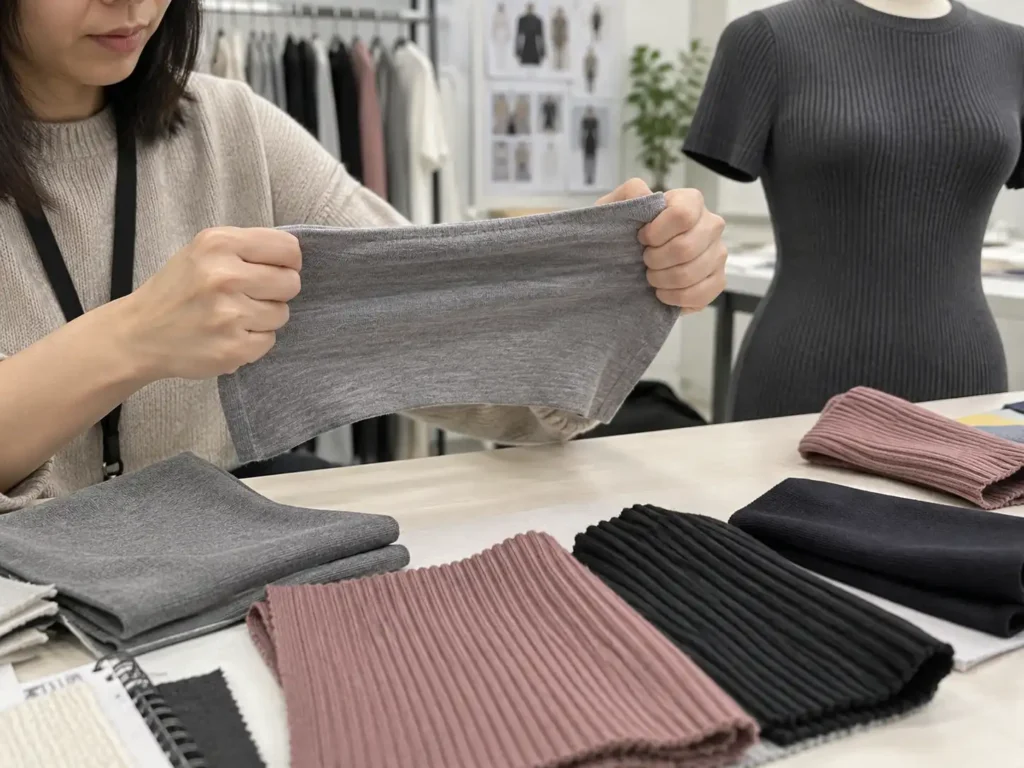
Stretch describes how far fabric can extend, while negative ease describes how much smaller the finished garment is than the body. The two measurements must be evaluated with recovery, weight, opacity, construction, and comfort. High stretch does not automatically justify aggressive reduction. Good bodycon fit comes from using enough negative ease to create contour without destabilizing the fabric.
Measure Stretch and Recovery Separately
A simple stretch test begins with a known relaxed fabric length. If a 100 mm section stretches comfortably to 140 mm, the usable stretch is approximately 40 percent.
Stretch % = (Stretched Length − Original Length) ÷ Original Length × 100
Using the same example, the calculation is (140 − 100) ÷ 100 × 100 = 40%. The test should represent comfortable garment extension rather than the maximum force a technician can apply. A fabric that technically reaches 70 percent stretch only under heavy force will not behave like a soft knit that reaches the same extension with minimal resistance.
Crosswise and lengthwise stretch should be recorded separately. A jersey may have approximately 50 percent crosswise stretch but only 15 percent vertical stretch. That combination can work well for a bodycon dress, but it behaves differently from a four-way rib knit that stretches strongly in both directions.
Recovery is a separate property. After the 100 mm sample has been stretched and released, measure it again. If it settles at 103 mm, the sample retained 3 mm of growth during that cycle. Repeated testing gives a better indication of whether the material will gradually become looser through the waist, seat, or other high-tension areas.
Maximum stretch often gets more attention in fabric descriptions, but recovery can be more important for the way a bodycon dress looks several hours after it is put on.
Negative Ease Should Vary by Fabric and Body Zone
Negative ease means the finished garment is smaller than the corresponding body measurement. If a wearer has a 100 cm hip and the finished garment hip is 92 cm, the garment contains 8 cm of negative ease at that level, equivalent to an 8 percent reduction.
There is no single negative-ease percentage that works for every bodycon dress. The figures below are useful only as prototype starting ranges because actual reduction depends on fabric force, recovery, lining, construction, intended compression, and sample testing.
Fabric Behavior | Approx. Crosswise Stretch | Possible Trial Reduction | Main Development Risk |
Firm ponte | 20–30% | 3–6% | Restricted movement |
Mid-stretch jersey | 30–50% | 5–10% | Growth and transparency |
Rib / spandex knit | 50–70% | 7–12% | Relaxation after wear |
High-stretch mesh | 60%+ | 8–15% | Opacity and edge distortion |
Stretch satin | 15–30% | 2–5% | Tension marks and seam stress |
These values should never be interpreted as automatic production formulas. A fabric with 50 percent stretch does not justify reducing a body circumference by 50 percent. Stretch capacity and comfortable garment reduction are different concepts.
The body also requires different amounts of reduction in different areas. A brand may want stronger waist definition while preserving more room through the hip to control ride-up. The bust may need enough circumference and length to prevent flattening even when the waist is deliberately sculpted.
Fabric Weight Changes the Feel of the Same Percentage
Two fabrics that both measure 40 percent stretch can feel completely different on the body. Stretch percentage records distance, but it does not describe how much force is required to reach that distance.
A lightweight jersey may reach 40 percent extension easily and feel soft against the body. A dense ponte can reach the same percentage only under greater force, creating substantially stronger compression at identical finished dimensions. The heavier fabric may also hold its shape better and show fewer underwear lines, while the lighter fabric can become more transparent as it stretches.
Fabric weight and structure also influence vertical behavior. Heavy four-way knits can grow downward under their own weight, particularly in midi and maxi lengths. Rib structures sometimes relax with wear. Dense compression materials can place more stress on zipper seams and neckline finishes.
Fabric selection should therefore be made with the pattern rather than before or after it. Hand feel, recovery, drape, opacity, seam behavior, and dimensional stability all affect the amount of usable reduction.
The company’s fabric system covers jersey, rib knit, ponte, stretch satin, power mesh, and spandex blends among other womenswear materials, with development checks covering stretch, transparency, lining, shrinkage, sample behavior, and bulk-production risk.
Lining Changes the Effective Stretch System
When a stretch shell is lined, the dress no longer behaves according to the shell alone. The least elastic layer can become the limiting factor in the complete garment.
A shell with 55 percent stretch paired with a lining that stretches only 25 percent can feel much firmer than expected. If both layers are cut using the same aggressive negative ease, the lining may carry most of the load and restrict sitting, walking, or hip movement even though the shell appears highly elastic.
Possible solutions include selecting a lining with more compatible stretch, reducing the lining less than the shell, using partial lining, shortening the lining so it does not control the hem, or using a second layer of the same or a closely related stretch fabric.
Mesh bodycon dresses require particular attention because the outer fabric often depends on the lining for coverage and visual smoothness. If the two layers recover at different rates, one can creep or wrinkle against the other during wear.
A fit sample should therefore be made in the same lining structure intended for production. Testing an unlined shell and adding a low-stretch lining later can invalidate earlier negative-ease decisions.
How Do You Draft the Pattern?
A bodycon pattern is drafted from a reliable fitted block by confirming the fabric, removing unnecessary positive ease, distributing negative ease by body zone, and reshaping the bust, waist, and hip. Grainline, stretch direction, neckline, armhole, darts, and style details are then adjusted around the core fit. The first draft is a test that must be verified on the body.
Begin With a Block That Already Fits the Target Customer
Starting from a reliable fitted block is more efficient than beginning with a loose dress pattern that contains generous woven ease. The block should already establish credible bust, waist, high-hip, full-hip, shoulder, armhole, and vertical proportions for the intended customer.
The first drafting stage is not simply shrinking the pattern. Conventional positive ease is removed, and then additional reduction is introduced according to the fabric and intended silhouette. It is useful to divide the pattern into functional zones rather than applying one percentage across the entire body.
The upper bust and neckline need stability. The full bust needs enough projection and front length. The waist provides shaping. The high hip manages the transition between waist and full hip. The full hip needs close fit without creating excessive upward pressure, while the lower skirt and hem need enough room for normal movement.
A brand’s approved house block is especially valuable because it already reflects preferred proportions. Some labels favor a dramatic waist and fuller hip, while others use softer contouring. When a proven fit reference exists, it should guide development more strongly than a generic commercial pattern.
Jinfeng Apparel’s pattern team is documented as working with bodycon, mini, midi, maxi, corset, slip, halter, strapless, backless, jumpsuit, skirt, and matching-set patterns using customer designs, measurement charts, samples, and other product references.
Shape Bust, Waist, and Hip Independently
The side seam of a bodycon pattern may look like one continuous curve, but technically it is connecting several different body volumes. Treating bust, waist, and hip as independent control zones makes fitting more predictable.
Bust fit requires both width and length. A pattern can contain the correct bust circumference and still flatten the body if the front length or projection is insufficient. Waist shaping can usually be stronger, but excessive reduction creates compression lines and encourages migration toward a narrower part of the body. Hip fit requires attention to both total circumference and the way that circumference is divided between front and back.
During fitting, side-seam movement provides useful information. A seam that shifts forward around the seat can suggest insufficient back volume. A seam that moves backward can indicate excess tension through the front. If the seam remains straight while the front hem rises, vertical front balance may be a more likely cause.
Product teams developing a recognizable hourglass silhouette should also resist the temptation to use the same percentage reduction everywhere. Strong waist definition can be maintained while allowing a more forgiving hip reduction, which often improves walking comfort and reduces ride-up without visibly weakening the bodycon look.
Darts May Disappear Visually but Their Shaping Still Exists
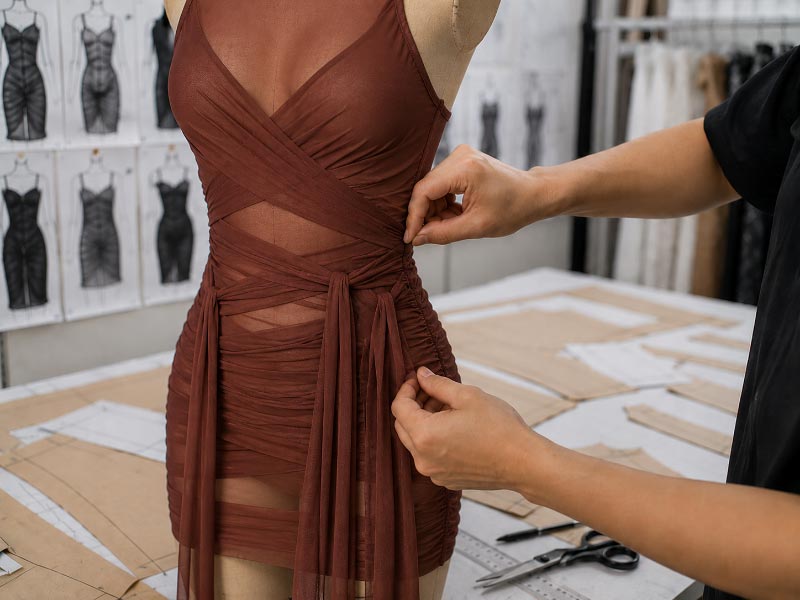
Many stretch bodycon patterns contain fewer visible darts than woven dresses because the fabric can absorb some three-dimensional shaping. Removing the drawn dart does not eliminate bust projection or waist shaping; it simply transfers those requirements into the side seam, panel seams, fabric extension, or another part of the pattern.
Soft jersey may allow bust shaping to be absorbed through stretch and side-seam contouring. A firm ponte dress may work better with princess panels or more structured shaping. Stretch satin can require a visible or transferred dart because its surface often shows tension marks more clearly than a textured knit.
Before removing a dart, examine what volume it controls. If the fabric folds beneath the bust, the neckline opens, the armhole pulls away from the body, or diagonal lines appear from bust to side seam, the pattern may need additional shaping rather than a smaller circumference.
The cleanest bodycon surface is created by distributing body volume intelligently. A pattern with no visible darts is not automatically more advanced than one that uses them. The choice depends on fabric, silhouette, neckline, construction, and the visual language of the garment.
Design Details Change the Tension Map
Once the underlying fit works, style details can be added and evaluated individually. Each addition changes the way the garment carries tension.
A waist cut-out removes material that previously connected the upper and lower torso. Ruching adds fabric length and redistributes tension. A one-shoulder neckline places more load on one side of the garment. A back slit releases movement through the lower skirt, while a power-mesh panel can recover more strongly than neighboring jersey.
The key questions are practical. Which seam now carries more load? Has structural fabric been removed? Will an open edge remain flat? Does the new panel stretch in the same direction as the main garment? Will the detail remain correctly positioned when the style is graded?
A cut-out that looks balanced in the sample size can become disproportionately large in extended sizes if its grade rule simply follows surrounding seams. A metal ring can distort an elastic opening because it concentrates force at one attachment point. Heavy rhinestone or chain trim can pull an elastic neckline downward.
For complex bodycon products, a reliable development sequence is core fit first, styling second, and fit verification again after the style details are introduced. This keeps the technical cause of each correction visible instead of allowing several variables to change at once.
How Do You Test and Grade Fit?
Bodycon fit should be evaluated in the intended fabric while the wearer stands, walks, sits, raises her arms, and changes posture. Corrections should be documented numerically before grading. The graded pattern must preserve the silhouette, waist-to-hip relationship, neckline, garment length, openings, and tension across sizes rather than simply enlarging or reducing every pattern edge equally.
Fit the Sample in Conditions That Resemble Real Wear
The first sample should be made in the intended production material whenever possible. When the exact fabric is unavailable, the substitute should be close in stretch, recovery, weight, drape, and hand feel. A convenient fabric with significantly different recovery can lead to corrections that become invalid once the actual material arrives.
Start the fitting by looking at the overall garment rather than immediately measuring individual points. Check whether the dress appears centered, whether the side seams fall vertically, whether the waist is at the intended level, whether the neckline remains secure, and whether the hem is reasonably balanced.
Movement comes next. A useful basic test can include walking approximately twenty to thirty steps, sitting normally, standing again, lifting both arms, turning the torso, and bending slightly forward. The purpose is not to simulate athletic activity. It is to recreate the movements a wearer makes at dinner, in a car, on stairs, at an event, or during ordinary social activity.
After the movement test, observe whether the dress has returned to position. Measure how much the hem has moved, whether the waist has climbed, whether the side seam has rotated, and whether the neckline has opened. Jinfeng Apparel’s internal product criteria for going-out styles include close-fitting comfort, bust coverage, hip fit, dress-length safety, stretch recovery, and comfort during walking and sitting.
Diagnose the Cause Before Altering the Pattern
Fit correction is most effective when each visible problem is traced to a likely cause before the pattern is changed.
A dress that rides upward does not necessarily need a longer hem. The pattern may be too tight around the full hip or upper thigh, the lining may restrict the shell, the fabric may have strong vertical recovery, or the front and back lengths may not accommodate bust and seat projection.
Side-seam twisting has a similarly broad range of causes. Front-to-back volume imbalance can move the seam, but fabric torque, cutting off grain, inconsistent relaxation, or unequal sewing feed can produce similar visual results.
Wrinkle direction provides useful clues. Horizontal lines usually indicate horizontal tension or excess vertical fabric. Diagonal drag lines often point toward a location that needs additional volume or length. A hem that tilts suggests a balance problem. A neckline that opens away from the body can indicate excess edge length, inadequate contour removal, or weak stabilization.
Changes should be recorded numerically. A comment such as “fix the hip” cannot be reproduced reliably. A note such as “add 6 mm to the back full hip, blending to zero 80 mm above and below” creates a correction that can be checked, graded, and traced to the next sample.
Stretch Recovery and Wash Stability Need Verification
Bodycon dresses should not be approved solely on the way a fresh sample looks immediately after sewing. Some fabrics change after several hours of tension, steaming, pressing, or laundering.
A useful wear test records critical measurements before wear, after a defined wear period, and after the garment has relaxed. The waist, hip, dress length, side-seam length, and hem width are particularly informative. Even a 10 mm increase in waist width can visibly soften the silhouette of a close-fitting garment.
Wash testing should follow the care method intended for the finished product. Compare the same measurement points before and after the care cycle and inspect side seams for torque. Rib knits can show noticeable vertical change, while some jerseys grow in width. Other materials shrink enough to increase compression after laundering.
A documented European premium bodycon program developed with Jinfeng Apparel included ten jersey, rib-knit, and ponte styles totaling approximately 16,000 pieces. The project identified recovery, bust-waist-hip proportion, side-seam twisting, ride-up, and post-wash size stability as key challenges. Fabric relaxation, cutting-direction control, fit-pattern adjustment, and garment measurement QC were used together rather than relying on pattern alteration alone.
The case reflects an important principle: a pattern and its fabric cannot be separated when diagnosing dimensional instability.
Grade the Silhouette Rather Than Mechanically Scaling It
Grading should preserve the visual and functional relationship between the garment and the body. Bust, waist, and hip increments are rarely identical, while neckline width, neckline depth, armhole depth, strap length, waist position, hip depth, slit height, and garment length may all require separate grade rules.
At minimum, the smallest size, base size, and largest size should be reviewed carefully. Wider size ranges benefit from additional physical samples because mathematical grading can produce unexpected proportion changes at the ends of the range.
Look for silhouette drift. The waist should not become noticeably straighter in larger sizes unless that change is intentional. The smallest size should not become disproportionately short. A cut-out should not become too open in the largest size, and a slit should not move to an unsafe position simply because the surrounding pattern pieces have increased.
Bodycon products with cut-outs, asymmetric necklines, corset panels, or multiple fabrics generally deserve more size validation because the location of each element is closely linked to body landmarks.
The aim is for every size to look like the same design adapted to a different body. A successful grade preserves the character of the garment instead of making the range look like one sample mechanically enlarged or reduced.
How Is the Pattern Prepared for Production?
A production-ready bodycon pattern contains the approved fit, final grade rules, seam allowances, notches, grainlines, stretch direction, construction references, and critical measurement controls. It must match the approved sample and technical specification closely enough that cutting, sewing, finishing, and quality teams can reproduce the garment without interpreting or recreating earlier fit decisions.
Lock the Approved Pattern Version
Bodycon development often involves several small pattern corrections, which makes version control particularly important. A neckline may be reduced by 8 millimeters in one sample, the back hip may be adjusted in another, and the dress length may change after movement testing. If several versions remain active, an earlier correction can accidentally return during bulk preparation.
Each final pattern should identify the style number, piece name, size, pattern version, revision date, cut quantity, grainline, direction of greatest stretch, seam allowance, notches, and relevant placement marks. Any special cutting requirements should be stated clearly.
Fit changes should also be recorded in measurable language. A useful revision note might state that 8 millimeters were removed at the center-front neckline and blended gradually toward the strap. Another might state that 6 millimeters were added at the back full hip with an additional 10 millimeters of back length through the seat.
The company’s pattern team is documented as converting customer designs, size charts, reference samples, and garment structures into patterns that can be fitted, revised, graded, and used for production.
When a version is approved, obsolete files should be clearly archived instead of remaining in active cutting or sampling folders where they could be mistaken for the current pattern.

Connect the Pattern to the Approved Physical Sample
The paper or digital pattern is only part of the finished fit. Fabric stretch, seam construction, sewing tension, lining, pressing, zipper behavior, and finishing can change the actual measurements of the garment.
Production records should connect the master pattern, graded pattern, measurement specification, fabric approval, trim approval, bill of materials, construction details, fit comments, and final approved sample. The approved garment itself should be measured so the team understands the real finished dimensions achieved after sewing and finishing.
Sample stages help separate different types of risk. The first sample checks whether the design has been interpreted correctly. The fit sample tests balance on the body. Revised samples confirm corrections. The PP sample checks whether production-intent fabric, trims, and construction reproduce the approved result. A golden sample, when used, becomes a physical reference for later production and inspection.
Jinfeng Apparel’s documented sample system includes first samples, fit samples, revised samples, photo-ready samples, salesman samples, PP samples, and golden samples, supported by two sample rooms and dedicated sample-making personnel.
This staged approach is particularly useful for bodycon products because a small fabric or construction change can noticeably affect tension and fit.
Set Tolerances Around Fit-Sensitive Measurements
Not every garment measurement deserves the same level of tolerance. Close-fitting styles are particularly sensitive at the bust, waist, hip, neckline, strap, armhole, and dress length because modest variations can change wearing pressure or visual balance.
Common production control points include half bust, half waist, half hip, high hip, front length, back length, side-seam length, neckline width and depth, armhole dimension, strap length, slit height, and hem circumference.
Tolerance should be determined according to fabric behavior, construction difficulty, fit sensitivity, and how consistently the point can be measured. A loose dress can absorb more variation without a visible change, whereas a small waist difference in a fitted mini may immediately alter the silhouette.
Measurement methods must also be standardized. An instruction that simply says “measure waist” may produce different results between inspectors. A stronger specification defines where the waist is located, whether the garment is measured relaxed, whether the tape is placed straight or along a curve, and what tolerance is allowed.
Consistent measurement technique is particularly important with highly elastic fabrics because pulling the garment slightly while measuring can create misleading results. The specification should therefore describe the relaxed measurement state wherever relevant.
Confirm the Pattern Through PP Samples and Bulk QC
The pre-production sample is the final practical opportunity to confirm that the pattern, fabric, trims, construction, and finishing work together before the style is reproduced at scale.
The PP sample should use production-intent materials whenever possible. Check the stretch and recovery of the actual fabric, correct grain orientation, lining, zipper or closure, finished bust-waist-hip dimensions, neckline stability, side-seam position, dress length, slit height, and hem behavior. Any significant material substitution at this stage should trigger another fit review rather than being treated as a purchasing detail.
Bulk control begins before sewing. Stretch fabrics may need controlled relaxation before cutting, and pattern pieces must be placed according to the approved direction of greatest stretch. During production, garment measurements, seam balance, neckline shape, hem position, and recovery should be checked at appropriate stages rather than waiting until finished inspection.
Jinfeng Apparel’s documented bodycon production controls include stretch direction, recovery stability, bust-waist-hip dimensions, dress-length changes, side seams, neckline deformation, wash-related dimensions, and bulk size consistency.
A bodycon pattern is therefore not truly complete when one sample looks attractive on a fitting model. It is complete when the approved shape can be communicated, cut, sewn, graded, measured, inspected, and reproduced repeatedly without losing the intended relationship between fabric and body.
Final Thoughts
Developing a reliable bodycon dress pattern requires more judgment than simply applying a reduction percentage to a basic block. The strongest patterns begin with accurate body proportions, a fabric whose stretch and recovery are understood, and a clear idea of how much compression the finished style actually needs. From there, fitting becomes a process of reading tension, correcting balance, and confirming that the dress remains stable during real movement rather than only in a static fitting photograph.
For fashion brands, the production stage is where the value of disciplined pattern development becomes especially visible. A beautiful first sample is useful, but the commercial goal is a repeatable fit across different sizes, fabric lots, production lines, and repeat orders. When pattern development, fabric evaluation, sample fitting, grading, PP confirmation, and bulk quality control are connected, a bodycon silhouette becomes much easier to reproduce consistently. That is the difference between developing one attractive sample and building a reliable bodycon product that can support a complete collection.
Share This Article :

Jerry Lee
Categories

Latest blogs
Table of Contents
Here, developing your OEM/ODM private label clothing collection is no longer a challenge—it’s an excellent opportunity to bring your creative vision to life.

