
What Is the Best Zipper for Satin Dresses? A Guide to Types, Sizes, Fit and Quality

Your trusted Women’s Apparel Manufacturer from China

A zipper is a small component, but on satin it can decide whether a dress looks refined or strangely unfinished. Satin reflects light across a smooth surface, so construction defects that disappear on crepe, denim, or textured knit can become obvious as soon as the garment moves. A slightly wavy center-back seam, a thick zipper base, uneven tension around the waist, or zipper tape showing through a pale shell can interrupt the entire silhouette. For that reason, choosing a zipper for satin should never be reduced to “use an invisible zipper and move on.” Fabric weight, fit, lining, seam direction, zipper length, body pressure, and pressing all affect the result.
For most satin dresses, a well-matched invisible or concealed nylon-coil zipper is the best starting choice because it keeps the closure visually discreet and adds relatively little bulk. The final specification should still match satin weight, dress structure, lining, zipper length, placement, and body tension. Structured gowns or tightly fitted designs may need a stronger concealed zipper than lightweight slip or cocktail dresses.
The difference becomes very clear in production. In one documented Jinfeng Apparel satin occasionwear program, 12 satin mini and midi styles totaling around 20,000 pieces required control of satin color consistency, invisible-zipper flatness, lining comfort, and multi-color bulk stability. Zipper specification was reviewed together with satin weight, lining color, waist-to-hip fit, PP approval, and Golden Sample standards before bulk production. That is the useful way to think about this subject: the best zipper is not the one that looks right on a trim card, but the one that still looks right after fitting, pressing, photography, packing, shipping, and repeated wear.
What Is the Best Zipper for Satin Dresses?
For most satin dresses, a concealed nylon-coil zipper is the most practical choice because it hides the closure, limits visible bulk, and works across many lightweight-to-medium dress constructions. The best option is still garment-specific: zipper strength, tape stiffness, length, placement, fabric stability, lining, and fit pressure must work together if the finished satin seam is expected to stay smooth.
Is an Invisible Zipper Best for Satin?
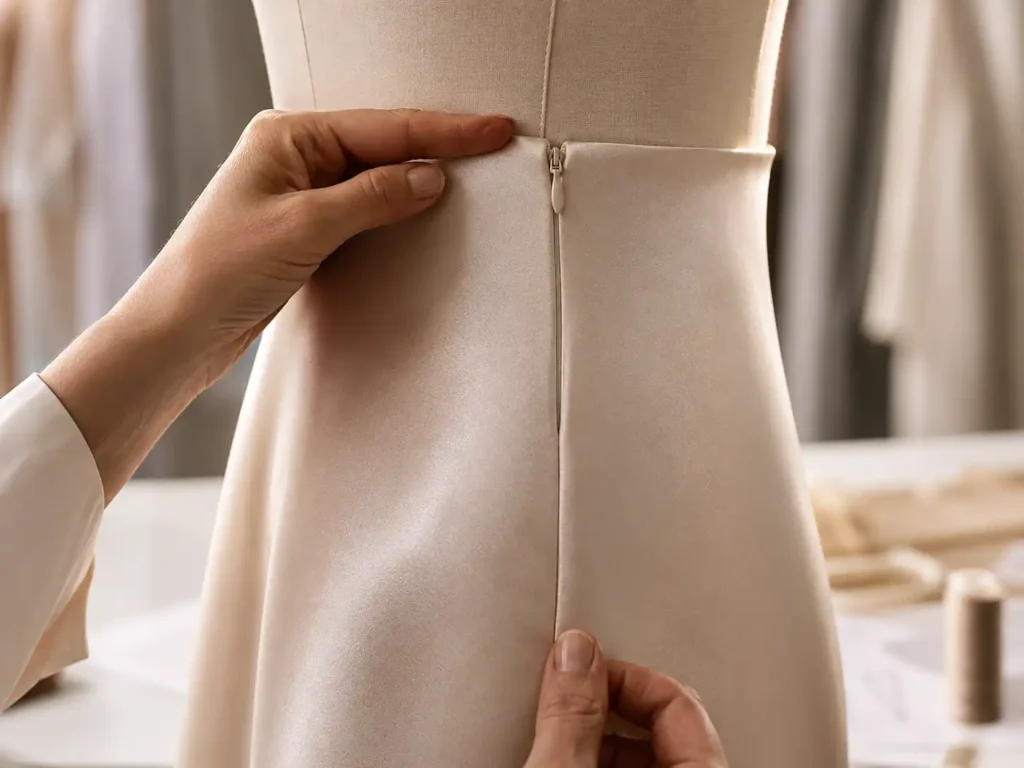
An invisible zipper is usually the first choice when the dress design depends on an uninterrupted satin surface. When it is installed correctly, the coil turns toward the back of the tape and sits close to the seam line, so the closed zipper looks much more like a conventional seam than an exposed fastening. YKK describes its CONCEAL line as an invisible zipper suited to dresses and skirts because the element does not disturb the garment design. That visual advantage matters on satin because light travels across the face of the fabric and makes ridges, bubbles, and crooked seam lines easier to notice.
The common mistake is to treat “invisible zipper” as a complete specification. It is only the zipper category. YKK currently lists several CONCEAL sizes, including 2CC, 3CC, and 5CC, while its Americas guidance describes a light #2 option, a medium #3 option, and a stronger #5 option for more demanding applications such as evening or wedding gowns. A lightweight satin slip dress and a structured satin gown can therefore both use invisible zippers while still requiring very different zipper constructions.
A successful invisible zipper also needs to disappear structurally, not only visually. If the teeth are hidden but the seam forms a wave, the lower stop kicks outward, or the tape creates a stiff line through a fluid skirt, the closure is still wrong for that garment. During development, check the zipper on the body as well as on the hanger. Waist pressure, hip movement, and cross seams can change a closure that looked perfect when the sample was flat on a table.
Are Nylon Coil Zippers Suitable for Satin?
Nylon or synthetic coil construction is well suited to many satin dresses because the coil can remain flexible while the closure stays low profile. That flexibility matters on dresses designed to follow the body rather than stand away from it. A fluid satin dress should not suddenly become rigid along one seam because the zipper assembly is substantially stiffer than the surrounding shell. Coats also maintains invisible zipper systems specifically for dresses, skirts, and women’s apparel, with different tape constructions for lighter and heavier garments.
The zipper tape deserves as much attention as the coil. Coats distinguishes knitted polyester tape for lighter applications from woven polyester tape for heavier uses, which shows that two zippers that both look “invisible” from the face can behave differently once sewn into a garment. On a soft satin slip, a very firm tape may create a straight vertical line that fights the intended drape. On a fitted midi dress, a more stable tape may be useful because the closure has to tolerate repeated body tension and seam intersections.
For that reason, approve the zipper after it has been sewn into the actual production satin. Holding a loose zipper beside a swatch is useful for checking color, but it does not tell you whether the seam will ripple around the hip, whether the slider will pass the waist seam, whether lining will catch in the coil, or whether the lower zipper end will remain flat after pressing. Those are garment questions, not trim-card questions.
Are Metal or Molded Zippers a Good Choice?
Metal and molded-tooth zippers are not poor products; they simply solve different design problems. They are rarely the default answer for a conventional satin evening, cocktail, bridesmaid, or wedding-guest dress when the design expects the closure to disappear. A metal zipper introduces visible teeth, a more pronounced slider, and usually greater structural presence. On smooth satin, those details become part of the design whether the designer intended them to or not.
There are cases where that is exactly the point. A satin corset mini, utility-inspired party dress, or fashion-forward exposed-back style may intentionally use polished metal hardware as a decorative element. In that case, zipper finish, tooth size, puller shape, and metal color belong to the visual design language. The design decision changes from “how can the zipper disappear?” to “does the hardware proportion and finish strengthen the style?” The answer can be yes, but it should be deliberate.
Choosing a heavier visible zipper simply because it feels stronger is less convincing. Extra strength is useful only when the garment needs it. An unnecessarily heavy closure can create a thicker seam, a larger slider, a stiffer vertical line, and more visible buildup at the bottom stop. On pale satin, that can be difficult to hide. The better rule is to use the least bulky closure that safely handles the garment’s actual load, unless the zipper is intentionally meant to be seen.
What Makes a Zipper Suitable for Satin?
A suitable satin-dress zipper works as part of a system rather than as an isolated accessory. The shell fabric, lining, zipper tape, coil, slider, seam allowance, pattern ease, and pressing method all influence one another. A zipper can be technically strong enough and still be wrong because it is too rigid for the fabric. It can also be visually delicate yet too weak for a tightly fitted bodice. Compatibility is therefore more useful than any one-size-fits-all rule.
Four checks reveal a poor match quickly. First, see whether the zipper line stays flat when the dress is worn rather than only when it hangs. Second, check whether the slider crosses waist seams or layered areas without excessive force. Third, inspect pale or lightweight satin for tape show-through. Fourth, look carefully at the lower zipper end from the side; local bulging is often more visible in profile than from the back. These checks take little time during sampling and can prevent a repeated defect in bulk production.
The same satin can require different closures depending on silhouette. A relaxed A-line midi may place little horizontal load on a center-back zipper, while a fitted bodycon style made from the same fabric can create much more waist and hip pressure. That practical difference is reflected in Jinfeng Apparel’s documented satin work, where zipper flatness was reviewed together with satin weight and waist-to-hip fit rather than treated as a separate trim issue.
Which Zipper Size Is Best for Satin Dresses?
There is no single zipper size that suits every satin dress. Lightweight satin usually benefits from a lighter, lower-profile invisible zipper, while medium or heavy satin, fitted designs, and multilayer constructions may need a stronger specification. Supplier size codes are not universal, so fabric weight can guide initial selection, but the final zipper should always be tested in the actual dress construction before bulk production.
Which Size Works for Lightweight Satin?
Lightweight satin creates a balancing problem: the zipper needs enough strength for normal wear but should add as little unnecessary structure as possible. This is particularly important for slip dresses, bias-influenced silhouettes, lightweight bridesmaid dresses, and fluid occasion styles. YKK Americas describes its lightest #2 CONCEAL option for products including sheer gowns and knit dresses, while Coats lists its S43 #2 invisible zipper for fabrics below 100 g/m² and its S44 #2 for light fabrics below 140 g/m².
Those numbers are useful reference points, but they should not be treated as a universal sizing law. They belong to specific supplier product systems. A #2 designation from one company should not be assumed to have exactly the same tape, coil profile, strength, or sewing behavior as another supplier’s #2. What the published ranges really show is that lighter garments benefit from zipper systems designed to reduce bulk and stiffness rather than simply using a standard dress zipper for every style.
During a lightweight satin trial, inspect the zipper under angled lighting and while the dress hangs freely. Look for a visible tape shadow, local puckering, a stiff vertical line, or a lower stop that pushes away from the body. Pale champagne, ivory, blush, and pastel colors deserve extra attention because the tape may be easier to detect through the shell. A zipper can pass a basic strength check and still fail the visual standard expected from a satin dress.
Which Size Works for Medium-Weight Satin?
Medium-weight satin usually gives the developer more tolerance, but it also appears frequently in fitted cocktail, wedding-guest, and evening dresses where body pressure becomes more important. Coats lists its S54 #4 invisible zipper for fabrics of roughly 140-220 g/m², while YKK describes its #3 CONCEAL option as a medium-weight invisible zipper used for applications including eveningwear. The supplier systems are different, so these sizes should be used as application references rather than direct equivalents.
Fabric weight by itself does not determine the closure. Consider two dresses made from the same 180 g/m² satin. One is a relaxed A-line midi with generous hip ease. The second is tightly fitted through the waist and hip with a long center-back opening and a waist seam crossing the zipper. The second dress creates a much more demanding environment even though the fabric weight is identical. That is why experienced sample rooms judge zipper selection alongside silhouette, body ease, lining, and seam buildup.
The table below is useful for development discussions because it links published Coats fabric ranges with the practical questions a dress team should ask. It does not replace supplier confirmation or garment testing, but it gives pattern makers, developers, and sourcing teams a common starting language when a satin dress moves from sketch to sample.
Garment / Fabric Condition | Coats Reference Example | Published Fabric Range | Main Development Focus |
Very light dress fabric | S43 #2, knitted tape | <100 g/m² | Minimum bulk, soft drape, low show-through |
Light dress fabric | S44 #2, woven tape | <140 g/m² | Flatness with slightly more stability |
Medium fabric | S54 #4, woven tape | 140-220 g/m² | Fit pressure, waist seams, slider clearance |
Heavy fabric | S64 #5, woven tape | >220 g/m² | Multilayer load, strength, structured construction |
Do Structured Satin Dresses Need Stronger Zippers?
Often they do, because the completed garment can place far more load on the closure than the shell fabric alone suggests. A satin corset dress may contain cups, boning, fusible support, underlining, lining, and several shaped seams. A heavier evening dress may also carry skirt weight or multiple layers through the bodice. YKK describes its #5 CONCEAL zipper as much stronger than its #2 and #3 options and names evening and wedding gowns among the applications where that added strength may be useful.
Strength should still be increased only when the construction needs it. Choosing the largest zipper available can solve one problem while creating another. A heavier zipper may produce more visible tape, a larger slider, and greater stiffness along a seam that is supposed to look clean. The goal is therefore adequate strength with the least unnecessary structure. This is especially important when the satin is smooth, pale, or fitted closely enough that internal bulk becomes visible from the outside.
Structured dresses should be tested on the intended fit model in real movements. Close the garment, stand naturally, sit, walk, and operate the zipper several times. If it repeatedly stalls at one point, check whether the cause is the zipper, a thick waist seam, internal boning, lining buildup, or insufficient body ease. A stronger zipper should not be used to disguise a pattern that is simply too tight. Correct load distribution begins with the garment structure itself.
How Does Zipper Tape Affect the Dress?
Zipper tape is often overlooked because shoppers mainly notice the slider and teeth, but the tape is the component stitched directly into the garment seam. Coats uses knitted and woven polyester tapes across different invisible zipper applications and specifically recommends lighter tape constructions for lighter apparel and woven tapes for heavier garments. That distinction matters because tape stiffness can alter how the satin hangs, especially when the surrounding fabric is fluid.
A tape that is too firm can hold one vertical seam straighter than the rest of the dress, producing a visible mismatch in drape. A tape that is too soft for a highly fitted style can struggle to stabilize the closure area. Tape width, thickness, and color also affect the finished appearance, particularly where a zipper crosses a waist seam, ruching, lining, pleats, or layered construction. Coats warns that adequate space should be allowed for slider movement at such intersections.
Color is equally practical. On white, ivory, champagne, pale pink, and other light satin shades, a darker or more opaque zipper tape can create a shadow through the shell even when the zipper teeth themselves are hidden. For production approval, tape hand, thickness, color, and slider clearance should therefore be checked in a sewn garment section using the actual shell and lining rather than judged from a detached zipper sample alone.
How Does Dress Construction Affect Zipper Choice?
Dress construction can change the correct zipper even when the satin fabric stays the same. Bias direction, close body fit, lining, corset reinforcement, seam intersections, and zipper placement all change the forces acting on the closure. A fluid slip dress and a structured fitted midi may therefore need different zipper strength, tape, placement, or seam stabilization despite using similar-looking satin.
What Zipper Works for Bias-Cut Satin?
Bias-cut satin needs particular care because the fabric can extend and shift along the bias while zipper tape remains comparatively stable. A seam that stretches during handling or sewing can be locked into that changed length once the zipper is installed, which is one common route to a wavy closure. Coats identifies feed differences, sewing tension, component compatibility, and fabric structure among the mechanisms that can create seam puckering. On bias satin, those mechanisms become especially visible because the garment depends on controlled drape.
The first step is to control the seam before blaming the zipper. If the cut panel has already lengthened while hanging, being handled, or passing through the sewing process, inserting a perfectly straight zipper will not restore the original geometry. The seam may need controlled stabilization, careful feeding, and enough relaxation time before final balance is assessed. Any reinforcement should be tested because too much stability can create a rigid strip that looks just as wrong as a wave.
Fit matters too. A bias dress should rely on cut and drape rather than excessive zipper tension to create its shape. If the waist or hip is so tight that the zipper is pulling the panels into position, the pattern may need correction before the closure is changed. For development, check zipper flatness together with side-seam balance, waist level, and hem hang. Bias problems often interact, so fixing one area in isolation can shift distortion somewhere else.
Which Zipper Works for Fitted Satin Dresses?
Fitted satin dresses need a closure that remains discreet while handling body pressure around the waist, ribcage, or hip. This is where a zipper can be blamed for a problem that actually begins in the pattern. A closure that glides smoothly on the hanger but becomes difficult when the dress is worn may be too light for the application, but the garment may also have insufficient ease, a tight lining, or an overly bulky waist seam.
Before changing the zipper specification, compare the finished garment measurement with the approved size chart and fit-model body measurement. Then inspect the exact point where resistance starts. If the slider struggles only at a waist seam, seam buildup may be the problem. If the entire zipper is difficult to close from the hip upward, circumference and body ease deserve attention. Coats specifically notes that slider clearance should be considered where side seams, layers, pleats, or other construction features meet the zipper.
A useful diagnostic sequence is simple: confirm waist and hip measurements, check seam allowance and lining tension, inspect cross-seam thickness, operate the zipper several times on the fit model, and only then decide whether a stronger zipper is needed. Jinfeng Apparel’s documented satin project followed this product-level logic by confirming zipper specification together with waist-to-hip fit before bulk production.
Do Corset Satin Dresses Need Stronger Zippers?
Corset-style satin dresses often need a stronger closure because the bodice is designed to hold shape rather than simply follow the body. Boning, cups, underlining, interfacing, and reduced ease can concentrate force around the opening. A stronger invisible zipper can therefore be appropriate, particularly where the closure crosses several structured layers. YKK’s published guidance positions its #5 CONCEAL option as the stronger member of the range for demanding applications such as evening and wedding gowns.
The zipper should not carry the entire job of the corset, however. A good bodice distributes force through its pattern, seams, boning, internal support, and lining. If nearly all horizontal tension is transferred to the zipper, the slider can become difficult to move and the surrounding satin may show strain even if the zipper itself does not fail. Depending on the style, a hook-and-eye or other top security treatment may help align the opening before the slider begins carrying load.
Cross seams deserve special attention because layered waist areas can become the point where a smooth zipper suddenly jams. During sampling, check the exact path of the slider through seam allowances, boning ends, lining, and any waist stay or reinforcement. If the zipper needs excessive force at one location, reduce unnecessary bulk or adjust construction before assuming that a still larger zipper is the best solution.
How Should Zippers Work With Dress Linings?
Lining should support the dress without creating a second source of tension around the zipper. If the lining is shorter, tighter, or attached with uneven feed, it can pull the zipper seam inward, distort the satin, or become caught in the slider. The external shell may appear correct during an early fitting, but the completed lined garment can behave differently because the extra layer changes thickness, friction, and the way the dress moves over the body.
A clean zipper-and-lining construction keeps the lining secure while leaving enough clearance for the slider. From the outside, check whether the seam remains flat, whether lining shows at the opening, and whether the waist is being pulled toward the zipper. From the inside, inspect whether the lining seam is smooth, whether it is close enough to finish neatly but far enough from the coil to avoid catching, and whether seam allowances have been controlled without creating a ridge.
This connection is practical rather than theoretical. Jinfeng Apparel’s documented satin occasionwear project treated lining comfort and invisible-zipper flatness as related development concerns, with both verified through sample stages and bulk standards. When the outside of a satin dress must look very clean, internal lining construction becomes part of the closure system rather than an invisible afterthought.

How Do You Prevent Zipper Puckering on Satin?
Preventing zipper puckering on satin requires control of the whole seam system: fabric feeding, sewing tension, needle and thread size, tape behavior, seam stability, fit, and pressing. A wavy zipper should not automatically be blamed on the zipper itself. Technical guidance from Coats identifies tension, structural jamming, feed differences, and dimensional incompatibility among the main mechanisms that can create seam puckering.
What Causes a Wavy Zipper?
A wavy zipper often begins with unequal behavior between the zipper tape and the satin. If the satin is stretched while the relatively stable tape is sewn in, the fabric may relax after stitching while the zipper keeps its original length. The result is a captured mismatch that appears as waves along the seam. Coats describes this type of problem under feed pucker and notes that unequal feeding can occur through machine settings, excessive presser-foot pressure, or operator handling.
Thread tension can create a different-looking wave. Excessive tension stretches the sewing thread during stitch formation; as the thread relaxes afterward, it can gather the seam. Fine, densely constructed synthetic fabrics can also suffer structural or inherent puckering when there is insufficient space for the needle and thread without disturbing surrounding yarns. Coats therefore recommends considering finer needles and threads, reduced stitch density where appropriate, and the lightest practical balanced sewing tension.
The timing of the defect helps diagnose the cause. If the zipper waves immediately after sewing, investigate feeding, seam stretch, and machine settings. If it looks flat on the table but waves on the wearer, check body tension and fit. If it changes after finishing, examine pressing and component compatibility. That timing question can save hours of random trial-and-error because it tells the sample room which part of the process to test first.
How Do You Prevent Zipper Bulging?
Bulging is usually a local problem rather than a continuous wave. It commonly appears near the lower zipper end, a waist seam, or an area where lining, seam allowances, ruching, facings, and zipper tape stack together. Even when every individual layer is thin, the combined thickness can become visible through smooth satin. This is one reason the defect may look insignificant on the sewing table but very obvious from the side when the dress is worn.
Start by checking what is physically occupying the bulky area. Seam allowances may be wider than needed, lining and shell seams may stack directly on top of each other, or the zipper bottom may sit at a highly fitted point where the body pushes the assembly outward. Coats specifically warns that slider room must be considered where dresses have layers, pleats, ruffles, side seams, or other intersections along the zipper path.
Fit should also be part of the diagnosis. If the garment pulls horizontally across the zipper end, trimming bulk alone may not solve the problem. Jinfeng Apparel’s documented satin program recorded zipper bulging and flatness as development concerns and responded by reviewing zipper specification, satin weight, waist-to-hip fit, PP approval, and pressing in combination. That combination is more reliable than treating the defect as a single sewing operation.
Does the Zipper Seam Need Stabilizing?
Sometimes it does, particularly when the satin edge is likely to stretch or shift during handling. Bias-oriented zipper seams, very fluid satin, long openings, and areas receiving meaningful body tension can benefit from controlled stabilization. The purpose is not to make a soft dress rigid; it is to maintain the intended seam length while the zipper is installed. Coats also notes that stabilizers can be useful in reducing puckering when fabric stretch is part of the problem.
Stabilization has to be tested because it can create its own defect. A strip that is too stiff may solve the wave while leaving a visibly hard zipper line through an otherwise fluid dress. On pale satin, an opaque or thick reinforcement can show through the shell. Adhesive behavior under pressing can also change the hand of the fabric. For those reasons, use the minimum reinforcement that controls the seam rather than assuming that stronger stabilization always produces a better result.
A representative trial is more useful than a tiny swatch. Sew a zipper section using the actual satin, lining, seam allowance, thread, needle, stabilizer, and pressing process planned for production. Then hang and wear the sample section if possible. The finished garment is a composite system, so the most useful test is the one that recreates the same combination of materials and processing conditions.
How Do Needle, Thread and Pressing Affect Flatness?
Needle, thread, stitch density, and machine tension can materially change the appearance of a satin zipper seam. Coats identifies thread and needle size, feed control, and sewing tension as contributors to puckering, and recommends keeping tension as low as practical while maintaining a balanced stitch. Fine satin generally does not benefit from an unnecessarily heavy needle-thread combination because larger penetrations and more thread displacement can make the seam more visible.
Stitch density needs the same balance. Adding more stitches per inch does not automatically make a delicate seam stronger or cleaner. More penetrations and more thread are being placed into the same length of fabric, which can increase structural disturbance on pucker-sensitive woven satin. If a seam is visibly drawing up, test one variable at a time: needle size, thread size, tension, feed, or stitch density. Changing everything together makes it difficult to understand what actually solved the problem.
Pressing is the final part of the equation. It can settle a zipper seam, but satin can show shine changes, pressure marks, and impressions from underlying components. Heat, steam, pressure, protection, and cooling time should be established for the actual fiber content and finish. The goal is to settle the seam without flattening the fabric excessively or printing zipper tape through the shell. A process that looks good on the development sample should be reproducible on the bulk pressing line.
Visible Defect | First Area to Check | Practical Trial |
Continuous waves after sewing | Feed difference or fabric stretch | Reduce handling tension and compare feed settings |
Fine puckering along stitches | Thread tension or structural jamming | Test lighter tension, finer needle/thread, lower stitch density |
Bulge at zipper bottom | Layer buildup or fit pressure | Reduce seam bulk and review zipper-end position |
Distortion only when worn | Pattern ease, lining tension, body pressure | Recheck waist/hip measurements and fit |
Distortion after pressing | Heat, pressure, component response | Modify temperature, steam, pressure, or protection method |

How Should Zippers Be Tested Before Bulk Production?
A zipper should be approved as part of the finished dress, not as a loose trim. The first sample establishes type and placement, revised samples resolve fit and construction, and the PP sample should represent intended bulk materials and workmanship. Coats recommends trials before bulk production so zipper applications can be checked against end-use requirements and internal processing conditions.
What Should Be Checked on the First Sample?
The first sample is the point where a written zipper specification meets a real garment. A designer may have specified an invisible zipper with a certain length, but only the completed sample can show whether the opening is sufficient for dressing, whether the slider crosses the waist seam smoothly, and whether the chosen tape behaves well with the satin. The goal at this stage is not simply to confirm that the factory followed the tech pack; it is to test whether the original decision actually works.
Review both function and appearance. Confirm zipper type, placement, opening length, color, slider movement, top-edge alignment, seam flatness, bottom-stop appearance, lining clearance, and the wearer’s ability to enter and exit the dress comfortably. If the style is fitted, put it on the intended fit model. A flat sample cannot reproduce horizontal pressure around the bust, waist, or hip, and those pressures are often where zipper problems become visible.
If resistance occurs, record the exact location rather than writing a vague comment such as “zipper hard to close.” A waist seam with several layers may obstruct the slider, a lining may be too tight, or the garment may need more ease. Early diagnosis is valuable because changing zipper length, placement, seam allowance, or construction is far less disruptive before bulk fabric is cut and production instructions are finalized.
What Should Be Confirmed on the PP Sample?
By the PP stage, the zipper should have moved from a general idea to a controlled production component. Supplier or approved equivalent, construction, size, length, color, tape, slider, placement, shell fabric, lining, and sewing method should correspond closely to what the bulk line is expected to use. Approving a closure on substitute fabric or with temporary lining may prove that the sample can be assembled, but it does not prove that the final satin combination will remain flat.
A useful PP review checks the dress after normal production-style pressing as well as before it. Confirm that the zipper remains visually concealed, that the lower end does not bulge, that the lining stays clear of the slider, that the top edges align, and that the zipper can be operated repeatedly without snagging. The garment should also be measured and tried on so the team can distinguish zipper resistance from a fit problem.
Jinfeng Apparel’s documented satin occasionwear program used the sequence First Sample → Revised Sample → PP Sample → Golden Sample before bulk production, with zipper flatness, satin weight, lining, and waist-to-hip fit among the controlled points. That sequence is useful because each stage answers a different question instead of expecting one sample to prove design, fit, trim, and production consistency all at once.
How Do You Check Zipper Flatness and Operation?
Zipper flatness should be inspected in several conditions because a closure can pass one view and fail another. Start with the garment lying flat, then hang it, place it on a dress form, and finally inspect it on the fit model. Satin should be viewed under angled light rather than only straight on because reflected light makes small waves, ridges, and lower-end bulges easier to see than ordinary overhead factory lighting.
Look beyond the zipper line itself. Inspect roughly 20-30 mm of satin on both sides of the closure. A zipper can appear perfectly straight while the adjacent shell fabric forms ripples, which still creates an unacceptable result. Then operate the slider repeatedly, paying attention as it crosses waist seams, lining junctions, ruched areas, panel intersections, or top-edge finishing. Coats specifically advises allowing enough room for slider movement at multilayer seam positions.
Do not normalize excessive pulling. A wearer should not have to fight the zipper every time she puts on the dress. If resistance appears consistently at one position, investigate seam thickness, fit, lining, and zipper specification before approval. A zipper that works only when the operator holds the garment in a special way is not a robust production solution.
How Do You Check Bulk Consistency?
Bulk zipper control starts before sewing. Incoming trims should be checked against the approved reference for construction, supplier code, length, color, and major visual details. If a collection contains several satin colors, pale and dark shades should be reviewed separately because tape show-through or color mismatch may appear in one shade and remain invisible in another. That variation is one reason a single sample cannot represent every color automatically.
Once sewing begins, zipper checks should occur at more than one stage. An in-line inspector can catch waves, alignment problems, and slider resistance before pressing. Finishing staff can identify shine, tape imprint, or lower-end distortion introduced during pressing. Final inspection can then evaluate the complete garment, including operation, lining, appearance, measurement, and packing. Waiting until final QC makes every correction more expensive because the same defect may already exist across a large batch.
The scale of commercial production makes this discipline important. Jinfeng Apparel’s documented US satin occasionwear program covered around 20,000 pieces across 12 styles, while another documented private-label womenswear program covered 18 styles and around 28,000 pieces with fabric-and-trim tracking, sample-version control, and multi-style coordination. At that volume, repeatability is as important as the appearance of the first approved sample.
What Zipper Specifications Should a Satin Dress Tech Pack Include?
A satin-dress tech pack should specify more than “invisible zipper.” It should identify construction, supplier or approved reference, supplier size code, finished length, color, tape and slider details, placement, opening format, and relevant workmanship standards. Clear specifications reduce interpretation between design, sourcing, sample room, and bulk production, especially when several satin colors or different dress structures share one collection.
Which Zipper Details Should Be Specified?
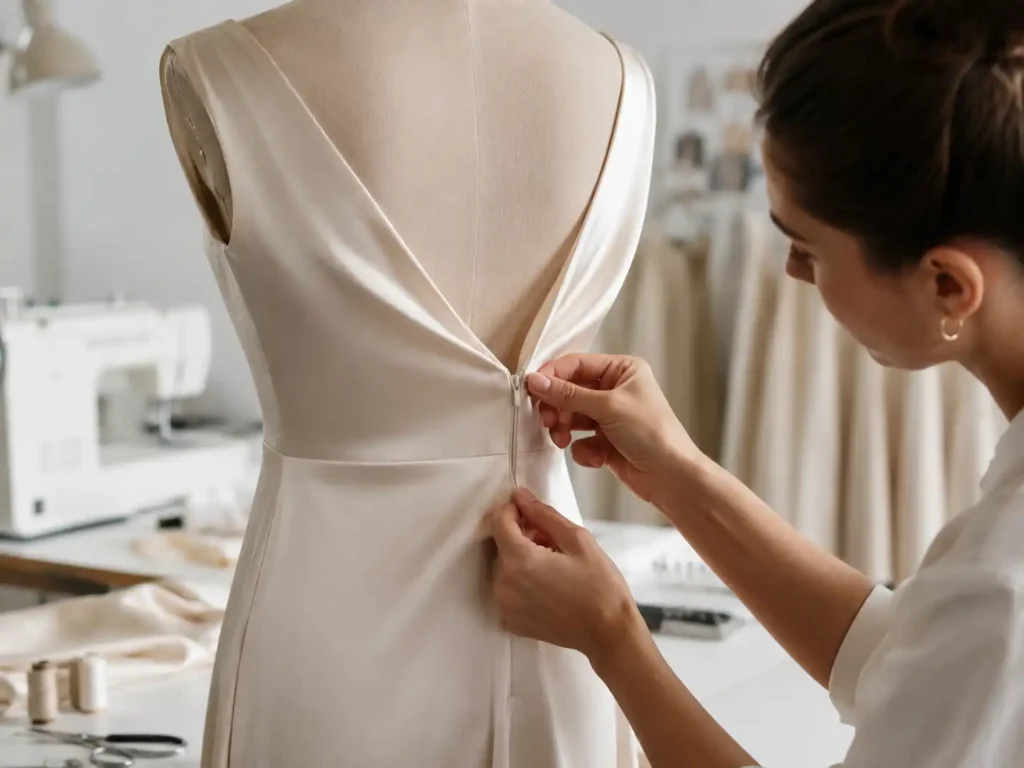
A production-ready tech pack should start with a precise zipper category and application. “Back zipper” leaves too much interpretation. “Concealed coil zipper, closed end, center back” is better, but larger programs usually need more detail, including supplier or approved equivalent, supplier model, size or gauge code, finished length, color, tape requirements, slider or puller reference, and exact placement. The objective is not paperwork for its own sake; it is to make the same decision reproducible across sampling, sourcing, and production.
Supplier-specific references matter because nominal sizing is not perfectly interchangeable. YKK lists CONCEAL variants such as 2CC, 3CC, and 5CC, while Coats uses its own product designations including S43 #2, S44 #2, S54 #4, and S64 #5. Writing only “#3 invisible zipper” can therefore create ambiguity if the sourcing team changes vendor or factory. A product code tied to an approved sample gives the technical team a much stronger reference.
The tech pack should also state the zipper position and construction relationship to the pattern. A center-back zipper, side zipper, or closure crossing a waist seam may require different seam allowances, lining methods, and assembly order. When that information is left informal, the sample room may make a reasonable decision that differs from what the brand expected, and the misunderstanding may not become obvious until the style reaches PP stage.
What Size and Length Should Be Listed?
Zipper size and zipper length perform different jobs, so both should be controlled. Supplier size or model usually relates to the physical zipper construction and strength, while finished length determines how far the garment opens. A strong zipper that is too short can still make a fitted dress difficult to put on. An unnecessarily long zipper can add cost, seam bulk, and a more visible lower-stop area without improving wearability.
Finished length should therefore be based on body entry and dress construction rather than copied from a previous style. A fitted side-zip dress may need enough opening for the hip or bust to pass comfortably. A corset bodice may need careful positioning so the zipper does not terminate in a highly stressed or bulky section. If the closure crosses a waist seam, the developer should also check whether the slider can move through that intersection without requiring excessive force.
Once the correct length is approved, record it with the pattern and trim specification. That information becomes especially valuable for repeat orders or new colorways because the brand does not need to rediscover the same solution each season. Jinfeng Apparel’s company facts describe long-term production support that retains pattern, fabric, trim, measurement, and packing records for repeat and seasonal production, which is the kind of continuity that reduces avoidable development variation.
How Should Color, Tape and Slider Be Controlled?
Zipper color should be approved against the actual production satin whenever possible because satin and zipper tape are different textile structures and can reflect light differently. YKK Americas notes that its CONCEAL range is offered in hundreds of colors and supports dye-to-match capability, showing how important color choice can be in apparel applications. The practical target is not merely matching a color name; it is making the closed seam visually unobtrusive in the finished garment.
Light colors need the most scrutiny. White, ivory, cream, champagne, blush, pale blue, and light grey satin can reveal a zipper tape that is slightly darker or more opaque than expected. Inspect the sewn zipper under daylight-like lighting and photography lighting rather than only under one factory lamp. If a collection contains multiple shell colors, decide whether each color needs its own zipper reference or whether a shared tape color is genuinely acceptable after sewing.
Tape construction and slider details should be controlled when they affect performance. Coats offers both knitted and woven tapes for different invisible zipper applications, so substituting models can change stiffness as well as the product code. Puller size also matters: an oversized puller can remain visible above a supposedly concealed closure, while a poorly matched slider can make operation inconsistent. For sensitive satin styles, the approved trim card is more useful when it includes shell, lining, and zipper together.
What QC Standards Should Be Defined?
The most useful tech packs describe the expected finished result rather than listing only raw materials. For satin-dress zippers, workmanship standards can require smooth opening and closing, a visually concealed seam, no persistent zipper-line waves, no obvious lower-end bulging, lining kept clear of the slider, aligned top edges, acceptable color match, and no avoidable satin snagging or pressing marks around the closure. An approved PP or Golden Sample photo can help make those expectations easier to interpret on the production floor.
The table below turns a vague “invisible zipper” note into a practical control sheet. Brands do not need to fill every field for every simple style, but the more visually sensitive and fitted the satin dress is, the more useful this level of clarity becomes. Coats recommends application trials before bulk production, and Jinfeng Apparel’s documented satin program shows the practical value of linking zipper specification to actual PP and Golden Sample approval.
Tech-Pack Field | Useful Production Detail | QC Question |
Zipper type | Concealed coil / approved supplier reference | Correct construction used? |
Supplier size | Exact manufacturer model or code | Correct strength and profile? |
Finished length | Approved measurement | Opening long enough and correctly placed? |
Color | Supplier code or approved physical swatch | Visually acceptable against shell and lining? |
Tape | Approved material, width, or construction if critical | Flat, discreet, and compatible with satin? |
Slider / puller | Approved reference and finish | Smooth operation without excessive visibility? |
Placement | Center back, side seam, or other | Matches pattern and tech pack? |
Workmanship | Approved seam, top edge, lower-end finish | No persistent waves, bulges, or misalignment? |
Lining | Attachment and clearance requirement | Slider stays clear of lining? |
Approval reference | PP / Golden Sample or approved photo | Bulk result matches agreed appearance? |
For a custom satin dress program, zipper selection is therefore best handled together with satin weight, pattern fit, lining, seam construction, and the intended production volume. That is also where an experienced manufacturer adds the most value: not by choosing the most expensive zipper, but by identifying the lightest, cleanest, and sufficiently strong specification that can be reproduced across sizes, colors, and repeat orders. Jinfeng Apparel’s documented manufacturing model covers trim sourcing, sampling, bulk production, quality control, and long-term record retention, allowing the closure decision to remain connected to the rest of the garment rather than being treated as a last-minute accessory.
A satin dress rarely fails because somebody did not know what a zipper was. Problems appear when a technically reasonable component is matched to the wrong fabric weight, the wrong amount of body tension, an unstable seam, a bulky lining intersection, or a production process that was never tested under realistic conditions. The best zipper for satin is usually an invisible nylon-coil construction, but the useful answer goes one step further: choose the specific zipper by garment load, then prove the choice on the real sample. When the closure lies flat, moves smoothly, stays discreet under light, and can be reproduced in bulk, it has done its job.
Share This Article :

Jerry Lee
Categories

Latest blogs

Table of Contents
Here, developing your OEM/ODM private label clothing collection is no longer a challenge—it’s an excellent opportunity to bring your creative vision to life.

