
Best Chiffon for Dresses: Which Type Should You Choose?

Your trusted Women’s Apparel Manufacturer from China

Chiffon is one of those fabrics that looks simple until you try to turn it into a finished dress. Two rolls can both be labeled 100% polyester chiffon, yet one falls into soft, narrow folds while another feels dry, looks overly shiny, puckers at the seams, or becomes unexpectedly heavy after gathering. For a dress collection, fiber content alone does not tell you enough. The finished result depends on weight, weave density, yarn twist, finishing, transparency, color, lining, pattern shape, layer count, and the way the garment will actually be worn.
The best chiffon for dresses is the chiffon that matches the intended silhouette, drape, transparency, hand feel, care needs, and production conditions. Silk chiffon is well suited to refined premium styles; polyester chiffon is often the most versatile option for repeatable fashion production; viscose chiffon can offer softer fluidity; and crepe chiffon adds texture and slightly more visual body. Weight and lining should always be selected together with the design.
A fabric therefore should not be approved because a small swatch feels beautiful between two fingers. Imagine a floor-length dress with a lined bodice, two gathered skirt layers, and flutter sleeves. A chiffon that looks perfect in a ten-centimeter sample can become too heavy across several meters, too transparent under studio lighting, or too soft to hold the intended ruffle shape. The useful question is not simply which chiffon is best, but which chiffon still looks right after the entire dress has been cut, sewn, lined, pressed, photographed, packed, and worn.
What Is the Best Chiffon for Dresses?
The best chiffon for dresses is the fabric that produces the required movement, coverage, hand feel, and finished shape without creating unnecessary production risk. A fluid evening gown may need a fine, soft chiffon, while a tiered mini dress can benefit from slightly more body. Fiber, GSM, weave density, transparency, color, surface finish, lining, and construction should be evaluated together rather than separately.
What Makes Chiffon Good for Dresses?
Good dress chiffon needs a controlled balance between lightness and stability. It should move easily without collapsing into a flat, lifeless surface, and it should form soft folds rather than stiff angular ridges. When a larger piece is held vertically, a suitable chiffon normally falls into narrow, fluid ripples. When gathered, it should create volume without becoming bulky around waist seams, sleeve heads, tier joins, or ruffle attachments. These qualities matter most in maxi dresses, occasion dresses, flutter sleeves, scarf details, layered skirts, and other designs where movement is a visible part of the product.
Transparency deserves equal attention because “sheer” covers a surprisingly wide range. One chiffon may reveal only a soft outline in a single layer, while another exposes seam allowances, lining edges, cups, or internal construction very clearly. Pale shades such as ivory, nude, blush, and pastel blue generally show more than black, navy, burgundy, or deep green in similar constructions. The practical evaluation is therefore not just softness. Composition, GSM, width, drape, opacity, surface, static, snagging sensitivity, lining compatibility, and repeatability all contribute to whether a chiffon is genuinely suitable for a dress.
Is Chiffon Suitable for Every Dress?
Chiffon works best when a design needs movement, softness, layering, or controlled transparency. Flowing maxi dresses, bridesmaid dresses, evening dresses, resort styles, wrap dresses, pleated skirts, cape details, balloon sleeves, flutter sleeves, and ruffle dresses often benefit from chiffon because the fabric creates visible motion without the physical weight of denser woven materials. It is much less convincing when used alone in silhouettes that depend on compression, sharply defined tailoring, or strong architectural support.
A fitted corset dress, sculpted bodycon style, or highly structured mini dress normally needs a more stable foundation. Chiffon may still appear as an overlay, draped bust panel, sleeve, scarf, ruffle, or outer skirt, but another material usually carries the mechanical load through lining, underlining, boning, cups, interfacing, or a stronger shell. Thinking of chiffon as a movement fabric rather than a structure fabric prevents a common development mistake: choosing it for its appearance and then expecting it to behave like crepe, satin, ponte, or suiting once the pattern reaches the sample room.
Which Chiffon Gives the Best Drape?
Silk chiffon is often associated with the finest, most responsive drape, but composition alone does not decide how a fabric hangs. Yarn fineness, twist, weave density, weight, finishing, and surface treatment can change the result dramatically. A well-finished polyester chiffon can fall more cleanly than a silk quality that is too crisp for the silhouette, while viscose chiffon may create a slightly heavier, more fluid drop. Crepe chiffon often adds surface texture and a little more body, which can help gathered or ruffled details stay visually defined.
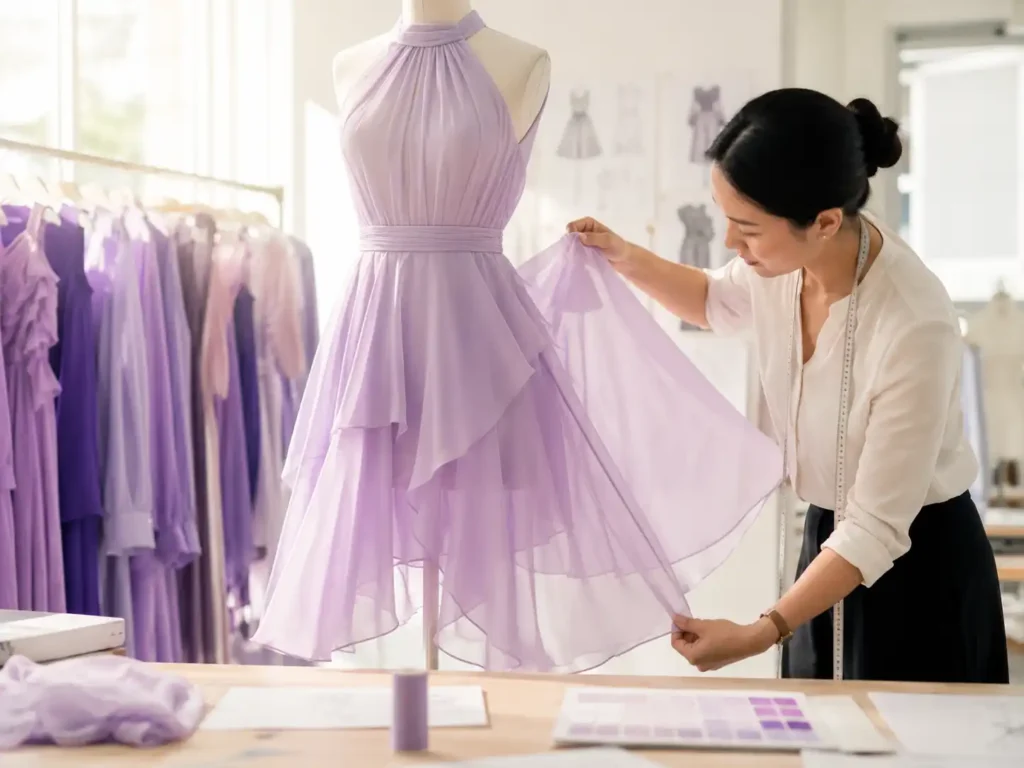
The most reliable test is physical rather than descriptive. Hang a reasonably large piece vertically, gather it at approximately the ratio planned for the garment, place it over the intended lining, and view it under both natural and indoor light. Then repeat the evaluation on the actual sample because several meters of fabric behave differently from a swatch. A chiffon that seems almost too soft on the table may become ideal after three skirt layers are assembled, while a fabric sold as “heavy premium chiffon” may lose the floating quality the design was intended to have.
Which Chiffon Feels Most Premium?
Silk chiffon usually has the strongest natural-fiber luxury positioning, but premium perception comes from the complete garment rather than fiber content alone. An expensive silk chiffon can still look ordinary when paired with a stiff lining, mismatched undertone, visible seam allowances, uneven hems, or poorly balanced gathers. High-quality polyester can look considerably more refined when it has a clean matte surface, smooth movement, controlled transparency, quiet handle, and a lining that lets the outer layer move instead of catching against it.
It helps to separate material luxury from garment luxury. Material luxury comes from fiber, touch, luster, fineness, and the inherent character of the cloth. Garment luxury is created by how the chiffon works with pattern shape, color, lining, seams, fit, pressing, and finishing. For many fashion collections, the second measure matters more because the wearer experiences the assembled dress, not the fabric specification sheet. The most expensive chiffon is therefore not automatically the most premium choice if its advantages disappear after dense gathering, printing, heavy lining, or multiple opaque layers.
Which Types of Chiffon Are Best for Dresses?
Silk, polyester, viscose, and crepe chiffon can all make successful dresses, but they suit different product positions. Silk favors delicate premium movement, polyester offers broad commercial versatility and repeatability, viscose can provide softer fluidity, and crepe chiffon adds texture and visual body. The right choice should follow silhouette, target retail level, care expectations, color program, print requirements, and production volume.
Chiffon Type | Typical Character | Common Dress Uses | Main Points to Check |
Silk chiffon | Very light, soft, refined drape | Evening dresses, premium occasionwear, delicate overlays | Cost, handling, shade consistency, care |
Polyester chiffon | Stable, versatile, broad color availability | Maxi, bridesmaid, party, resort and printed dresses | Static, finish, snagging, bulk consistency |
Viscose chiffon | Soft, fluid, more natural hand | Summer dresses, flowing midi and maxi styles | Shrinkage, dimensional stability, wet behavior |
Crepe chiffon | Textured, slightly fuller appearance | Ruffles, tiers, occasionwear, printed dresses | Surface consistency, weight, texture variation |
What Is Silk Chiffon?
Silk chiffon is a lightweight woven fabric valued for its fine hand, subtle surface character, and responsive drape. It works particularly well in garments where fabric movement carries much of the visual value, including evening gowns, layered occasion dresses, soft sleeves, scarf details, delicate overlays, and premium bridesmaid styles. Silk chiffon may be specified in momme rather than GSM. As a rough conversion, one momme is approximately 4.34 grams per square meter, so 6 momme is about 26 GSM and 10 momme is about 43 GSM.
Those numbers are useful references, not universal quality grades. Extremely light silk chiffon can be beautiful but more difficult to cut, sew, and control, particularly around curved seams, narrow hems, or bias areas. Silk also changes the commercial requirements of a dress because fabric cost, care labeling, handling, pressing, and shade control become more important. It makes the most sense when the garment’s retail position allows the material value to remain visible. If the fabric is heavily printed, densely gathered, hidden over opaque layers, or used only in small details, the extra cost may not create an equally visible improvement in the finished product.
What Is Polyester Chiffon?
Polyester chiffon is often the most practical starting point for commercial dress collections because it combines broad color availability, repeatable sourcing, useful durability, and compatibility with printing, gathering, pleating, layering, and many common dress constructions. Dress-quality polyester chiffons frequently fall somewhere around 45–80 GSM, although lighter and heavier constructions are widely available. The lower end generally feels airier and appears more transparent, while medium-weight options often provide stronger ruffle definition and slightly easier production handling.
The important point is that “100% polyester chiffon” is not a complete specification. Two fabrics can have the same fiber content and nominal GSM yet feel completely different. One may have a soft matte face, another a dry crepe texture, and another an obvious artificial shine. During sourcing, check surface luster, hand feel, static, snagging, dye-lot consistency, drape, transparency, pressing response, and reorder availability. For collections with several related styles, one well-chosen base polyester chiffon can sometimes support dresses, skirts, sleeves, ruffles, and coordinated tops, which helps create consistent color and surface appearance across a seasonal range.

What Is Polyester Chiffon?
Polyester chiffon is often the most practical starting point for commercial dress collections because it combines broad color availability, repeatable sourcing, useful durability, and compatibility with printing, gathering, pleating, layering, and many common dress constructions. Dress-quality polyester chiffons frequently fall somewhere around 45–80 GSM, although lighter and heavier constructions are widely available. The lower end generally feels airier and appears more transparent, while medium-weight options often provide stronger ruffle definition and slightly easier production handling.
The important point is that “100% polyester chiffon” is not a complete specification. Two fabrics can have the same fiber content and nominal GSM yet feel completely different. One may have a soft matte face, another a dry crepe texture, and another an obvious artificial shine. During sourcing, check surface luster, hand feel, static, snagging, dye-lot consistency, drape, transparency, pressing response, and reorder availability. For collections with several related styles, one well-chosen base polyester chiffon can sometimes support dresses, skirts, sleeves, ruffles, and coordinated tops, which helps create consistent color and surface appearance across a seasonal range.
What Is Viscose Chiffon?
Viscose chiffon can offer a softer, more fluid, and sometimes slightly weightier hand than many standard polyester chiffons. It is useful when a designer wants a less synthetic-feeling surface while keeping the lightweight woven character associated with chiffon. The fabric can work especially well in flowing midi and maxi dresses, relaxed summer dresses, resort styles, and silhouettes that need to fall close to the body before opening into a wider skirt. Its movement often feels smooth rather than crisp, which can give simple shapes a more elevated appearance.
The main technical concern is dimensional stability. Viscose fibers can react more noticeably to moisture than polyester, so shrinkage and post-care behavior deserve attention before pattern measurements and finished lengths are locked. This is especially important for long skirts, asymmetric hems, bias sections, or garments combining viscose chiffon with a lining that behaves differently after washing or steaming. Measure test pieces before and after the intended care treatment and compare length, width, hand, and surface. Care labels should be based on the actual tested fabric and construction rather than on a broad assumption about viscose as a fiber category.
Which Chiffon Suits Each Dress?
Dress category is usually a better starting point than fiber name because the silhouette determines how much fabric is used, how it is loaded at seams, and how the material will be seen in motion. Evening dresses often need fluid vertical drape and a refined surface. Bridesmaid collections need dependable color consistency across several dresses that may be worn together. Maxi dresses need movement over a large fabric area without becoming too heavy, while ruffle dresses usually benefit from slightly more body so the edges remain visible instead of collapsing into each other.
Printed chiffon adds another layer because print clarity depends on surface texture, weave openness, color depth, and how many transparent layers overlap. Tiered dresses also magnify weight: a single 55 GSM layer feels light, but multiple heavily gathered tiers can create much more physical and visual density. The same fabric that works beautifully as a single-layer sleeve may feel too dense as a double-layer skirt. A reliable selection sequence is silhouette, required movement, transparency, weight, lining, and then sample validation. Starting with the dress rather than the fabric name reduces unnecessary revisions later.
Is Silk or Polyester Chiffon Better?
Silk chiffon is usually better when natural-fiber value, delicate hand, and refined movement justify higher cost and more careful handling. Polyester chiffon is usually better when a collection needs broad color options, easier care, reliable sourcing, repeatable quality, and stronger cost control. Neither is universally superior because the final choice should reflect garment design, retail positioning, wear conditions, and production scale.
Which Has Better Drape?
Silk chiffon often creates finer, softer folds, especially in very lightweight constructions. Its movement can appear subtle and less mechanically uniform, which is one reason it remains attractive for premium eveningwear and delicate occasion garments. Polyester chiffon, however, spans a very broad quality range. Modern soft-finish polyester constructions can drape extremely well when yarn fineness, twist, density, and finishing are properly matched to the silhouette, and some will perform better in a particular dress than a silk quality that is too crisp or too heavy.
The more useful comparison is whether the drape remains correct after the fabric has been gathered, layered, lined, steamed, packed, and allowed to hang. A floor-length dress may include bias areas that settle after construction, so hem balance should not always be judged immediately after sewing. Dense gathering also changes the visual character because several meters of fabric create stronger downward pull and deeper color. Drape is therefore part of garment engineering, not merely a decorative fabric property. The winning fabric is the one that produces the right silhouette after all of those forces are present.
Which Feels More Luxurious?
Silk generally carries stronger luxury associations because of its natural fiber origin, fine touch, and established position in premium apparel. In a high-end occasion dress, those characteristics can support a higher retail story and give the garment subtle depth in movement and surface. Yet wearers experience the inside and outside of a dress together. Silk chiffon with a rough lining, bulky seam finish, or poorly balanced construction will not feel luxurious simply because the fiber label says silk.
A carefully selected polyester chiffon can feel much more refined than a low-grade synthetic stereotype suggests. Look for controlled matte or low-luster surfaces, quiet movement, reduced static, smooth layer separation, and a hand that does not feel excessively dry or plastic. The lining matters just as much because a heavy or rough lining can stop the chiffon from moving freely. Fiber value tells the customer what the cloth is made from, while garment value tells the customer how good the finished dress actually feels. Strong product development makes sure those two ideas support the same price position.
Which Is More Durable?
Polyester generally offers stronger resistance to routine wrinkling, everyday handling, and repeated wear than silk chiffon, which can be an advantage for ecommerce fashion, bridesmaid programs, travel-oriented resort styles, and dresses that will be packed, returned, tried on, or worn several times. That does not make polyester chiffon resistant to all damage. It remains a fine woven material, and sharp jewelry, rough work surfaces, fingernails, zipper teeth, bag hardware, sequins, or rhinestone trims can pull yarns and create visible snags.
Silk chiffon usually needs more careful handling during sewing, pressing, storage, cleaning, and wear. The correct durability standard should therefore reflect the intended life of the garment. A special-occasion gown worn a few times can support a more delicate material strategy than a resort dress expected to be folded into luggage, washed more often, and worn repeatedly in warm conditions. The strongest material is not automatically the right material, but expected use should always be considered before fabric approval because after-sales problems often begin with a mismatch between fabric delicacy and real wearing behavior.
Which Works Better for Production?
Polyester chiffon usually provides the easier path for repeatable medium- and larger-volume fashion production. Standard colors are widely available, reorders are generally easier to coordinate, care is simpler, and one base cloth can often support several styles within a collection. That creates practical advantages when a successful dress needs new colors, when multiple silhouettes share one fabric, or when a replenishment order must stay visually close to the original release months later.
Production control is still necessary because bulk lots can differ in shade, finish, width, drape, surface texture, and transparency even when the purchase description looks identical. Approval records should therefore include supplier article, composition, GSM, usable width, color reference, approved lining, and a physical fabric standard where possible. Chiffon makes shade variation especially visible because transparent layers deepen color wherever they overlap. Silk can also be produced at scale, but sourcing, handling, care, and cost need tighter management. Production suitability should follow the collection’s business model rather than the assumption that the more expensive fiber is automatically the better choice.
How Do You Choose Chiffon Weight and Drape?
Choose chiffon weight according to the required movement, opacity, layering, gathering, and silhouette rather than treating GSM as a quality score. Around 45–75 GSM is a useful working range for many polyester dress chiffons, while fine silk constructions may be lighter. The correct weight also depends on weave density, finishing, number of layers, lining, and total fabric consumption in the finished dress.
Indicative Weight | Typical Appearance | Common Applications | Main Risk |
30–45 GSM | Very light and sheer | Sleeves, overlays, delicate layers | Handling difficulty and high transparency |
45–60 GSM | Light, fluid | Maxi, bridesmaid, layered dresses | Lining often required |
60–75 GSM | More controlled body | Ruffle, resort, party dresses | Reduced floating movement if over-layered |
75–90 GSM | Fuller and more stable | Defined tiers, textured chiffon styles | Can become heavy in gathered or multilayer designs |
What GSM Is Best?
For many polyester chiffon dresses, the broad 45–75 GSM range offers enough options to balance fluidity, transparency, and manufacturing stability, but it should never be treated as a fixed industry rule. A 45 GSM chiffon may be excellent for sleeves and overlays yet too sheer for a single-layer pale skirt. A 70 GSM fabric may hold ruffles beautifully but feel heavy in a three-tier maxi dress. Higher GSM does not automatically mean higher quality, just as lower GSM does not automatically mean more luxurious.
Silk chiffon may be specified in momme, and a useful approximate conversion is 1 momme equals 4.34 GSM. Even so, the number tells only part of the story because weave density and finishing can make two fabrics of similar weight behave differently. Record GSM together with composition, usable width, drape, transparency, surface character, and intended layer count. For repeat orders, that combination provides a much stronger reference than a vague description such as “soft lightweight chiffon,” which is too subjective to reproduce consistently across suppliers or seasons.
How Does Weight Change Drape?
Very light chiffon reacts quickly to airflow and body movement, creating the floating character associated with romantic maxi dresses, scarf panels, and soft sleeves. The trade-off is greater transparency and more sensitivity during cutting and sewing. As weight increases, folds generally become more stable, gravity creates stronger vertical pull, and ruffles or tiers can hold a clearer visual outline. If the fabric becomes too heavy, however, the garment can lose the airy movement that made chiffon attractive in the first place.
Gathering ratio and layer count magnify this effect. A skirt gathered at approximately 3:1 places roughly twice as much fabric into the same seam length as a 1.5:1 gather, so the resulting area feels fuller, darker, and heavier even though the chiffon itself has not changed. Two layers of 50 GSM chiffon also do not behave exactly like one 100 GSM fabric because the separate layers can slide and move independently. Weight must therefore be tested under the same structural conditions planned for the finished dress rather than judged by a swatch alone.

How Sheer Should Chiffon Be?
There is no single correct transparency level because each part of a dress serves a different visual and functional role. Sheer sleeves, cape panels, overlays, and selected waist details may intentionally reveal skin, while skirts and fitted bodices normally need enough coverage to conceal underwear, cups, zipper tape, or internal seam construction. A simple but useful test is to view the chiffon in one, two, and three layers over the proposed lining under daylight, indoor light, and stronger front-facing light.
Color changes the result noticeably. Pale shades usually reveal more of what sits beneath them, while darker colors often appear more opaque in the same construction. Studio photography can expose another issue because bright lights may make a garment look more transparent on an ecommerce product page than it does during normal indoor wear. The final level of coverage is therefore created by fabric, color, layer count, lining, gathering, and lighting together. Approving transparency from one flat swatch under office lighting is rarely enough for a dress that will be photographed, sold online, and worn in different environments.
How Does Hand Feel Matter?
Hand feel affects both perceived value and production behavior. A soft chiffon is usually comfortable around the neck, shoulders, and arms, while a slightly crisper quality can give ruffles, bows, or tiered skirts better definition. Very dry surfaces can create friction between layers, causing the outer skirt to cling to the lining instead of moving freely. Extremely slippery surfaces create the opposite challenge because panels can shift during cutting and sewing, making accurate seam matching and grain control more demanding.
Finishing can also vary between development yardage and bulk fabric. If the approved sample is made from a very soft lot and the production material arrives noticeably stiffer, the garment can lose its approved drape even when composition and GSM remain nominally unchanged. An approved physical swatch and finished sample are therefore more useful than subjective descriptions such as “premium,” “flowy,” or “silky.” Those words help during early sourcing conversations, but repeatable production needs measurable specifications and a tactile reference that can be compared against incoming bulk fabric.
Does a Chiffon Dress Need Lining?
Most chiffon dresses need lining in areas where coverage, comfort, or structural support is required, while sleeves, overlays, ruffles, and selected panels may remain intentionally sheer. The lining should complement the chiffon in weight, stretch, color, surface, and movement. A lining that is too heavy, stiff, shiny, or incompatible with the pattern can change the finished dress as much as the outer chiffon itself.
When Does Chiffon Need Lining?
Chiffon generally needs lining when transparency would expose underwear, internal seams, cups, boning, zipper tape, or body areas the design does not intend to reveal. Pale colors and very light constructions usually need more coverage than dark colors. A typical chiffon maxi dress may use an opaque lining through the body and skirt while leaving the sleeves unlined, allowing the same fabric to provide both modest coverage and intentional transparency in different areas of one garment.
Lining also supports comfort and structure. It can keep seam allowances away from the skin, stabilize fitted waist or bust areas, and create a clean internal base for zippers, cups, boning, or other construction elements. It is useful to divide the garment into three functional zones during development: areas that need privacy, areas that need structure, and areas intended to stay sheer. That simple distinction prevents over-lining, which can make a chiffon dress unnecessarily heavy, and under-lining, which often becomes visible only after the sample is worn under strong light or photographed from certain angles.
Which Lining Works Best?
A good chiffon lining should provide enough coverage without overpowering the outer fabric. Lightweight woven or knitted linings can both work depending on stretch, fit, and silhouette. A lining that is too stiff can stop the chiffon skirt from moving naturally, while one that is too heavy can pull the garment downward and change the intended proportion. Very slippery linings can improve movement but may create sewing or twisting challenges, especially in long skirts where two layers need to remain balanced during wear.
Color should be approved with the chiffon rather than independently because transparent fabric filters the appearance of whatever sits beneath it. Tone-on-tone lining creates a more uniform result, a slightly darker lining can deepen the outer color, and nude lining can create a controlled illusion effect where the design calls for it. Stretch compatibility also matters. A non-stretch chiffon shell over a highly elastic lining can move differently across the body and distort fit. The best lining is therefore the one that supports opacity, comfort, pattern behavior, and movement without announcing itself as a separate visual layer.
Can Chiffon Be Double Layered?
Double chiffon is a useful way to reduce transparency while keeping the dress lighter and more fluid than some conventional linings. It works particularly well for gathered skirts, overlapping ruffles, soft panels, and styles where the designer wants both layers to move with a similar texture. The second layer also deepens color because overlapping sheer fabric increases optical density, which is one reason a single swatch often looks lighter than the finished skirt once several folds and layers are present.
Double layering also increases fabric consumption, seam bulk, and construction complexity. If both layers are heavily gathered, the amount of material concentrated at the waist can become substantial. Independent movement between layers may create a beautiful effect, but it can complicate hem alignment because one layer may settle or stretch differently after hanging. Two layers are not automatically equivalent to an opaque lining, either. Very pale or open constructions may still remain transparent under strong light. The intended number of layers should be built into the sample before the fabric and color are approved for production.
How Can You Control Transparency?
Transparency can be controlled through weave density, fabric weight, color, layer count, lining, print, gathering, and pattern placement. Selecting a denser chiffon is one option, but increasing weight too much can change the drape. Adding a second chiffon layer preserves more of the original texture, while a dedicated lining can give stronger coverage with less outer-layer bulk. Prints can reduce perceived transparency because pattern interrupts the view through the fabric, although they do not change the physical openness of the weave.
Gathering also creates local opacity because several folds overlap. A gathered skirt may look much less transparent than a flat bodice made from exactly the same chiffon, which means one area of a dress can pass a coverage review while another fails. Before bulk approval, inspect flat single-layer areas, gathered areas, seam zones, double layers, lined areas, and the garment under strong light. Controlling transparency is not about making chiffon opaque everywhere; it is about making the level of sheerness intentional and consistent with the design rather than accidental.
How Do You Test Chiffon Before Production?
Chiffon should be tested as part of the finished dress system before bulk production. Confirm composition, GSM, width, color, drape, transparency, lining compatibility, shrinkage, snagging, and seam behavior, then validate the material through an actual garment sample. Incoming bulk fabric should be compared with the approved reference before cutting so differences are found while they are still inexpensive to correct.
Stage | Main Checks | Practical Decision |
Swatch review | Composition, GSM, width, surface, transparency, hand | Shortlist fabric |
Development sample | Drape, fit, gathers, seams, lining, color | Keep, adjust, or replace |
Revised or PP sample | Corrected construction and approved material | Establish production reference |
Bulk fabric receipt | Shade, width, GSM, defects, hand, lot consistency | Release or hold fabric |
In-line production | Seam quality, puckering, measurements, appearance | Correct before completion |
Final inspection | Finished appearance, measurements, pressing, packing | Approve shipment |
What Should a Fabric Swatch Show?
A useful swatch should communicate much more than color and softness. Start with measurable information such as composition, GSM, usable width, supplier article, and color reference, then evaluate the material physically. Hold it vertically to study drape, fold it into several layers to see how the shade deepens, place it over the intended lining, and gently handle the surface to observe static, snag sensitivity, and wrinkle response. A small hanger chip is convenient for color selection but gives a limited picture of real garment behavior.
A larger piece, around 50 by 50 centimeters or more, gives a better first impression of hanging behavior and transparency, although it still cannot replace a complete sample. Check both grain directions, and test bias behavior separately when the pattern uses bias-cut panels because lightweight woven fabrics can elongate differently off grain. For repeat orders, keep the approved supplier, article number, composition, GSM, width, color code, lining reference, and physical swatch wherever possible. Good records turn a successful fabric choice into something that can be reproduced rather than rediscovered from the beginning.
What Risks Should You Check?
Chiffon has predictable production risks, and most are easier to control when they are found before cutting. Snagging is one of the most visible because fine yarns can be pulled by rough worktables, jewelry, damaged machine surfaces, zipper teeth, sequins, or rhinestone trims. Seam puckering is another common issue, particularly when needle size, thread tension, stitch density, or fabric feeding is not suitable for a lightweight woven construction. Bias areas, narrow hems, and curved seams may also distort if handled aggressively.
A practical pre-production review should compare GSM, usable width, shade, shrinkage, snagging response, seam quality, transparency, drape, printing where applicable, surface defects, hand feel, and pressing behavior. Shrinkage should reflect the intended care method rather than a generic wash test that the finished garment will never experience. The purpose is not to eliminate every natural characteristic of chiffon. It is to identify which characteristics could become visible defects in the chosen dress construction and to decide how the pattern, sewing method, lining, finishing, and production handling will manage them.
How Do You Approve Bulk Fabric?
Bulk fabric should be compared directly with the material used for the approved garment rather than accepted from a generic description such as “blue polyester chiffon.” The incoming lot can differ in shade, width, finish, hand, transparency, or drape even when the composition and nominal GSM match. Several rolls should be checked rather than only the first roll opened because variation may occur across dye lots or finishing batches. Shade differences deserve particular attention when chiffon panels overlap and intensify color visually.
The strongest production reference combines an approved physical swatch, color standard, lining combination, and approved sample dress. GSM and usable width should also be confirmed because width changes affect consumption and cutting efficiency, while meaningful weight changes can alter opacity and movement. When one chiffon is used across several styles, approval should consider the most demanding construction, not just the simplest garment. A fabric that performs well in a loose maxi dress may still cause problems in a fitted bodice, narrow ruffle, bias panel, or style with multiple transparent layers.
How Do You Keep Bulk Consistent?
Bulk consistency depends on keeping fabric, pattern, construction, and process references connected throughout production. Where shade variation exists, rolls should be grouped and cutting plans should avoid mixing incompatible shades within the same garment. Needle, thread, seam type, pressing method, and machine settings established during sampling should be communicated clearly because chiffon can reveal small sewing differences more readily than heavier fabrics. In-line inspection is especially valuable for catching puckering, uneven gathers, twisted linings, damaged surfaces, distorted necklines, or length problems before hundreds of garments are completed.
Repeat orders need the same discipline. Keep the approved fabric reference, lining, pattern, measurements, construction notes, trims, and approved sample so a successful dress can be reproduced months later with less guesswork. Jinfeng Apparel’s documented fabric process covers chiffon sourcing and evaluates composition, GSM, hand feel, drape, transparency, lining suitability, snagging and shrinkage risk, as well as sample validation and bulk fabric control. For brands developing custom chiffon dresses, sharing the silhouette, tech pack or reference images, color direction, quantity, and intended product position makes fabric evaluation more precise and reduces preventable development rounds.
Conclusion
The best chiffon for a dress is not defined by one fiber, one GSM figure, or one supplier description. It is the fabric that continues to support the design after the pattern, lining, gathering, seams, color, sample fitting, pressing, photography, and bulk-production conditions are all introduced. Silk can be the right choice for delicate premium movement, polyester can be the smarter choice for scalable and repeatable collections, viscose can deliver soft fluidity, and crepe chiffon can give ruffles and tiers more visual body. When material selection starts from the finished garment rather than from a fabric name, the result is easier to wear, easier to produce, and much more likely to remain consistent when the style moves from sample to bulk.
Share This Article :

Jerry Lee
Categories

Latest blogs
Table of Contents
Here, developing your OEM/ODM private label clothing collection is no longer a challenge—it’s an excellent opportunity to bring your creative vision to life.

