
What Is Satin Fabric? A Practical Guide to Satin for Dress Manufacturing

Your trusted Women’s Apparel Manufacturer from China

Satin is one of those fabrics that can make a relatively simple dress look immediately more polished, but it can also expose weak manufacturing faster than almost any matte woven fabric. The smooth face catches light, gives movement to a skirt, and creates the visual depth associated with slip dresses, cocktail dresses, bridesmaid dresses, eveningwear, and occasion collections. That same reflective surface also highlights problems that might stay hidden on crepe or jersey, including seam puckering, uneven grain direction, zipper waves, pressing marks, small snags, stains, and visible packing creases. For a fashion team developing satin styles, the useful question is therefore not only what satin is, but how its weave, fiber, weight, shine, stretch, lining, and production method will behave after the design leaves the sketch and enters sampling and bulk production.
Satin is a fabric defined mainly by its weave rather than by one specific fiber. It can be made from silk, polyester, viscose, acetate, nylon, or blends. In dress manufacturing, the most important variables are fiber content, GSM, drape, shine, stretch, opacity, grain direction, lining, seam behavior, pressing response, and bulk consistency because each one changes the finished garment.
A satin swatch can look perfect on a desk and still be wrong for the dress. A soft quality selected for a fluid slip silhouette may collapse when a structured bodice needs support, while a heavier satin that looks expensive in hand may make a bias-cut skirt feel stiff. The real work begins when a development team has to translate a mood board, reference image, or tech pack into a fabric specification that can be repeated across several colors, multiple sizes, and hundreds or thousands of garments without losing the effect that made the original concept attractive.
What Is Satin Fabric?
Satin is a fabric defined primarily by its weave structure, not by one fixed fiber. Its longer yarn floats create a smooth, reflective face that can be woven from silk, polyester, viscose, acetate, nylon, or blends. For dresses, this matters because fiber content and weave together influence drape, shine, strength, snagging, opacity, care, cost, and production stability.
Satin Is a Weave
The most useful starting point is to separate fiber from construction. Cotton, silk, polyester, and viscose describe what yarns are made from, while satin describes how those yarns are interlaced. In a satin weave, yarns pass over several opposing yarns before interlacing again. Those longer exposed sections, often called floats, reduce the number of visible intersections on the surface and create the smooth, light-reflective face that most people recognize immediately as satin.
That construction also explains many of satin’s production strengths and weaknesses. The surface can look exceptionally clean and fluid, but the exposed floats are more vulnerable to snagging than tightly interlaced plain weaves. Directional reflection makes grain mistakes obvious, and small seam distortions can become highly visible under strong light. This is why a manufacturing specification should go beyond the word satin and confirm fiber content, weight, width, finish, stretch, opacity, grain direction, drape, shrinkage behavior, and bulk availability before the pattern is treated as production-ready.
What Satin Is Made Of
Satin can be woven from several fibers, and the choice changes much more than the raw-material price. Silk satin is valued for its natural luster, soft hand, and fluid movement. Polyester satin is common in commercial fashion because it offers broad sourcing options, strong color-development flexibility, and cost structures that can work across larger production programs. Viscose-based satin can feel softer and more fluid, while acetate, nylon, or blended constructions may be selected for specific hand feel, durability, stretch, or appearance targets.
A sourcing team should therefore avoid approving satin from a photograph alone. Two swatches can look nearly identical when they are flat on a table yet behave differently after cutting, pressing, sewing, washing, or wearing. One may crease easily, another may recover better; one may look opaque until it is stretched over the hip, while another remains stable. The practical question is not whether one fiber is universally better, but whether the chosen construction creates the right silhouette, customer experience, repeat-order stability, and cost position for the intended dress.
Satin vs Silk
Satin and silk are not interchangeable terms. Silk is a natural protein fiber, while satin is primarily a weave. Silk yarn can be woven into satin, but satin can also be produced from polyester, viscose, acetate, nylon, or blends. Silk itself can also be woven into fabrics that do not use a satin construction. This distinction matters whenever a mood board or product brief casually describes a glossy dress as a silk dress without confirming the actual material specification.
When a reference is vague, the development team should compare practical properties rather than chase a fabric name. Fiber content, GSM, width, stretch, recovery, opacity, hand feel, luster, care requirements, color, and bulk availability usually tell more about manufacturing suitability than a label such as silk-look or silky satin. A commercially successful premium dress does not automatically require silk, and a polyester satin is not automatically an inferior choice. The correct option is the one that supports the intended design while remaining workable through sampling, production, shipping, wear, and future reorders.
Why Satin Looks Different
Satin changes appearance as the viewing angle changes because the surface reflects light directionally. That is one reason the fabric photographs beautifully, but it is also why cutting mistakes are easy to see. Two neighboring panels can appear to be different shades when one is rotated against the approved direction, even if both came from the same roll and the actual dye is identical. The effect becomes particularly noticeable on large skirt panels, princess seams, sleeves, or bodice sections under studio lighting.
Color review should therefore include both dye consistency and visual direction. A champagne satin can look balanced in daylight and noticeably warmer under indoor lighting, while dark satin may look richer from one angle and flatter from another. Before bulk cutting, manufacturers should confirm fabric face, grain, shine direction, panel orientation, dye lot, and the physical color standard. Satin can be technically correct and still look inconsistent when worn, photographed, or displayed, so visual control needs to begin before the first production marker is finalized.
Which Satin Is Best for Dresses?
No single satin is best for every dress. The right choice depends on silhouette, drape, body, shine, stretch, opacity, lining, intended use, and target cost. Lightweight satin generally suits fluid slip and bias-cut styles, heavier satin supports structured evening silhouettes, matte satin softens reflection, and stretch satin helps fitted designs move while maintaining a close shape.

Common Satin Types
Commercial dress development uses several satin categories, and each produces a different silhouette. Lightweight charmeuse-style satin is usually chosen when soft movement matters more than structure, making it a natural option for slip dresses, cowl necklines, fluid midi dresses, and bias-oriented skirts. Heavier satin, including duchess-style qualities, offers more body and can support structured bodices, fuller skirts, occasion dresses, and evening styles that need to hold a cleaner architectural shape instead of falling closely against the body.
Matte satin reduces strong surface reflection while retaining the depth and smoothness associated with satin, which can work well for bridesmaid, wedding guest, and refined occasion collections. Stretch satin introduces controlled elasticity and can be useful for bodycon dresses, fitted partywear, or corset-inspired styles where movement and recovery must work with close measurements. In current Jinfeng Apparel satin development records, the commonly handled range includes standard polyester satin, heavy satin, matte satin, stretch satin, crepe satin, and silk-like satin, with working weights around 80-220 gsm depending on the design.
Match Satin to Silhouette
A strong fabric decision starts with the silhouette rather than the swatch name. A slip dress needs material that can fall close to the body without becoming rigid, while a structured evening dress needs enough body to support seams, panels, and internal shaping. A fitted mini dress introduces another requirement: the outer fabric must work with the pattern’s ease, zipper, and lining so the garment can move without producing severe horizontal strain lines or becoming uncomfortable after several hours of wear.
Details such as gathers, pleats, cowl necklines, ruching, slits, and corset structures also change the choice. A fabric that forms beautiful soft gathers may not produce crisp pleats, and a satin that supports a sculpted bust may feel too stiff in a long flowing skirt. When development begins from a reference image, experienced teams look beyond color and shine to study how the fabric hangs from the waist, how it behaves around the bust and hip, whether the skirt carries visible weight, and how much movement the design needs in real use.
Weight and Drape
GSM gives the team an objective way to compare satin, but it should be treated as a starting point rather than a complete answer. Within the documented 80-220 gsm working range used across different satin dress projects, qualities at the lighter end are more likely to suit slip, summer, and fluid silhouettes, while qualities toward the heavier end are more useful when an evening or structured design needs greater body. The actual result still depends on fiber, yarn size, density, finishing, and stretch.
Two satin fabrics with similar GSM can hang very differently, which is why physical swatches and sample draping remain important. A lightweight satin may photograph beautifully but reveal seam allowances, lining transitions, or underwear lines. A heavier satin may improve opacity and structure but create more volume at gathers and become bulkier when packed for ecommerce. The best choice is therefore not simply the lightest or heaviest option; it is the weight that supports the design, construction, packaging method, and customer experience without creating new problems elsewhere in the product.
Shine and Positioning
Shine changes how a dress is perceived and how forgiving the fabric will be during manufacturing. High-gloss satin creates dramatic highlights that can work very well for partywear, eveningwear, and fashion photography, but it also acts like a spotlight on seam puckering, dart impressions, zipper waves, and uneven pressing. Matte satin produces a quieter surface and can make the same silhouette feel more restrained, which is often useful for bridesmaid, wedding guest, or occasion collections that need depth without an aggressively glossy finish.
More shine does not automatically mean more luxury. The right level depends on the target customer, retail price, styling, photography, garment shape, and intended occasion. A premium collection can use a controlled matte surface to communicate sophistication, while a clubwear mini may rely on strong reflection as part of its visual identity. Fabric approval should therefore include real viewing conditions: daylight, indoor lighting, flash or studio lighting where relevant, and movement on a mannequin or model rather than only a flat swatch under one office light.
Satin Type | Typical Character | Common Dress Use | Main Development Concern |
Lightweight satin | Soft, fluid, lower body | Slip, summer, bias-cut dresses | Opacity, seam show-through, distortion |
Matte satin | Controlled shine, refined surface | Bridesmaid, occasion, wedding guest | Shade consistency, pressing response |
Stretch satin | Elastic, body-following | Bodycon, fitted party, corset styles | Recovery, strain lines, lining compatibility |
Heavy satin | More body and support | Evening, structured dresses | Bulk, seam thickness, silhouette stiffness |
Crepe satin | Smooth face with more textured character | Midi, occasion, draped styles | Surface consistency, seam handling |
Silk-like polyester satin | Smooth commercial satin appearance | Party, cocktail, fashion dresses | Hand feel, shine level, bulk consistency |
How Does Satin Affect Dress Design?
Satin affects the whole silhouette, not only the surface. Its weight, drape, stretch, opacity, and shine influence neckline behavior, waist definition, hip fit, skirt movement, seam visibility, and internal construction. A satin that looks attractive as a swatch can still fail in a dress when its mechanical behavior does not match the pattern, lining, fit, or intended wearing conditions.
Drape and Structure
Drape describes how the fabric falls under its own weight and around the body. Lightweight satin usually follows curves and reacts strongly to movement, which makes it attractive for slip dresses, bias skirts, soft ruching, and cowl necklines. Heavier satin creates cleaner planes and can hold more volume, allowing a structured bodice or fuller skirt to keep its intended shape. The same pattern can therefore look like a completely different product when the satin changes, even if the measurements stay identical.
Pattern development should respond to that behavior rather than force every fabric into the same construction. A satin with more body may need fewer gathers to create volume, while a very fluid satin can require more careful seam placement because internal construction may show through the face. Designers should also assess how the dress behaves when the wearer walks, sits, turns, and raises her arms. A garment that looks beautiful on a static mannequin can still feel heavy, twist at the side seams, or collapse at the neckline once movement is introduced.
Stretch and Fit
Traditional woven satin may have little intentional stretch, while stretch satin is engineered to provide controlled elasticity. That difference affects pattern ease, zipper requirements, lining, seam construction, and size grading. In a close-fitting dress, the team should confirm not only whether the fabric stretches, but also the direction of stretch and how well it recovers. A satin that extends easily but returns slowly can grow around the hips, seat, or waist during wear and make an initially clean fit look loose after several hours.
The outer fabric and lining must also work together. If the shell stretches across the body but the lining is rigid, the layers can fight each other and create pulling, bunching, or restricted movement. If the pattern uses too much negative ease, the satin may show horizontal tension lines or become more transparent over the bust and hip. Fitted satin development works best when fabric, lining, pattern, zipper, and seam construction are treated as one system rather than five independent choices that are only combined at the end.
Opacity and Lining
Not all satin is opaque, and pale colors deserve particular attention. A lightweight ivory, champagne, blush, pale pink, or light blue satin may appear solid on a cutting table but reveal seam allowances, underwear lines, or changes between single and double layers when placed on the body under stronger light. Close-fitting areas can become even more transparent because the fabric structure is under tension, so opacity should be checked on a mannequin or fit model rather than judged from a relaxed swatch alone.
Lining is one of the most effective ways to manage opacity and comfort, but the lining itself needs a clear specification. Its color should not visibly alter the outer satin, its weight should not destroy the intended drape, and its stretch should be compatible with the shell where necessary. Light-colored, lightweight, formal, and fitted satin dresses commonly require lining review during development. The most useful question is not simply whether the dress needs lining, but what problem the lining must solve: coverage, comfort, structure, seam concealment, or smoother movement over the body.
Design Decision Matrix
A fabric choice becomes easier when the team evaluates the design against a short set of functional requirements instead of comparing swatches only by touch. The matrix below is not an industry standard or a replacement for sampling; it is a practical development checklist that connects common satin dress goals with the properties that deserve the most attention. Used early, it can reduce the number of samples made with fabrics that were visually attractive but mechanically unsuitable for the intended silhouette.
The most important habit is to test the property on the garment, not just on the roll. A fabric can have enough opacity when relaxed but fail once it is stretched over the hip. It can feel fluid in hand but become heavy when gathered into a full skirt. It can look smooth under office lighting but show every seam under flash photography. When a dress is intended for ecommerce, events, or strong artificial lighting, the development sample should be reviewed in those conditions before the team considers the satin fully approved.
Design Requirement | Satin Property to Prioritize | What to Test on the Sample |
Fluid slip silhouette | Soft drape and controlled opacity | Hem fall, side seam, bust movement, lining show-through |
Fitted bodycon style | Stretch and recovery | Hip strain, waist recovery, skirt ride-up, seam stress |
Light-colored dress | Opacity and lining compatibility | Underwear visibility, seam allowance show-through |
Structured bodice | Body and stability | Neckline shape, zipper area, seam definition |
Bias-cut skirt | Controlled diagonal movement | Length growth, twisting, hem balance |
High-gloss party dress | Surface consistency | Seam puckering, pressing, directional shine |
Multi-color collection | Dye-lot and finish consistency | Shade under daylight and artificial light |
How Is Satin Cut and Sewn?
Satin requires controlled cutting and sewing because its smooth surface, directional shine, and exposed floats make small mistakes highly visible. Manufacturers need to manage grain direction, fabric movement during spreading, needle condition, thread tension, seam feeding, zipper installation, and pressing. Successful satin production depends less on complicated machinery than on consistent handling, tested settings, and clear production standards.

Grain Direction
Grain direction matters in almost every woven garment, but satin makes mistakes easier to see because the surface reflects light according to yarn orientation. A panel rotated against the approved direction can appear darker or lighter than the panel beside it even when both pieces came from the same roll. For that reason, marker planning should consider visual direction as well as fabric utilization, particularly on large skirt panels, bodice sections, sleeves, princess seams, or any part where two broad satin surfaces meet.
This sometimes means accepting slightly higher fabric consumption instead of turning pieces simply to improve marker efficiency. Saving a small amount of material is rarely worthwhile if the finished garment looks mismatched under retail lighting or in campaign photography. Before cutting starts, the production team should confirm fabric face, grain line, shine direction, stretch direction where relevant, color lot, and visible surface defects. Once hundreds of panels have been cut with the wrong orientation, final inspection cannot restore the lost visual consistency, so this is a control point that belongs in the cutting room.
Bias Cutting
Bias cutting places key pattern directions diagonally across the woven fabric instead of directly along the lengthwise grain. Satin responds especially well because the diagonal direction allows more movement and can create the close, fluid fall associated with classic slip dresses. The benefit comes with additional sensitivity. Bias panels can lengthen after cutting, hanging, sewing, or pressing, and two pieces that have been handled differently may not settle to exactly the same length before the hem is finished.
A bias-cut dress therefore needs more than a conventional pattern rotated on the marker. Pattern shape, seam placement, handling time, sewing sequence, hanging behavior, hem balancing, and grading all deserve review. In some styles, partially assembled garments may need time to relax before the final hem level is confirmed. The real production challenge is repeatability: a careful sample machinist can make one bias dress look beautiful, but bulk manufacturing must reproduce the same controlled movement across several sizes and a much larger number of garments without twisting seams or uneven hems.
Seam Control
Satin makes seam quality highly visible because directional reflection highlights even minor puckering. Excess thread tension can pull the seam inward, uneven feeding can stretch one layer more than the other, and an unsuitable or damaged needle can disturb the yarns and leave marks that remain visible even after the stitching is corrected. The approved bulk fabric should therefore be tested directly, because a machine setting that works on a heavy matte satin may create obvious distortion on a lighter, glossier quality.
Construction order and internal layers matter as well. Facings, lining seams, boning channels, zipper allowances, or thick seam junctions can create pressure that becomes visible through a smooth outer face. As a general trial starting point, lightweight satin is often tested with fine sharp or Microtex-style needles around 60/8 to 70/10 and moderate stitch lengths near 2.0-2.5 mm, while heavier qualities may require a larger needle; actual settings should always be validated on the approved fabric before line production. The sample is useful only when its sewing method can be translated into repeatable instructions.
Zipper Flatness
Invisible zippers are a common trouble point in satin dresses because the fabric around the zipper can stretch or distort during installation. A zipper that looks completely flat on a stable woven fabric may form waves on satin if the seam tension, zipper tape stiffness, stabilization, pressing, or pattern fit is not compatible with the material. Treating every zipper wave as operator carelessness can lead to repeated repair work without addressing the real cause of the distortion.
During sample review, the zipper should be checked while the garment is hanging and while it is worn. A center-back zipper may look fine on the table but buckle when body tension changes the seam line around the waist or hip. The team should confirm zipper type, color, seam allowance, sewing method, stabilization where needed, and pressing before bulk production. Zipper bulging and flatness are documented recurring control points in satin dress development, especially when the style also uses lining, ruching, or close body shaping that adds tension around the closure.
What Problems Occur in Satin Dresses?
Common satin dress problems include shade variation, directional shine mismatch, snagging, seam puckering, zipper waves, stains, lining movement, pressing marks, and packing creases. Many are connected rather than isolated defects. The most effective control comes from finding their causes during fabric approval, sampling, cutting, sewing, pressing, and packing instead of relying on final inspection to catch finished-garment problems.
Color Variation
Satin color is influenced by both dye and reflected light, which makes shade evaluation more complicated than it is with many matte fabrics. Genuine dye-lot differences can occur between batches, while reversed shine direction can create an apparent color difference even when the dye is the same. Lighting adds another variable. A fabric approved under daylight may look noticeably warmer or cooler under shop lighting, studio flash, or evening event lighting, especially in champagne, ivory, blush, jewel tones, and very dark shades.
A disciplined review therefore compares more than a digital image. Useful references include the approved physical swatch, Pantone or another agreed color standard, lab dips where required, fabric batch, dye lot, lining color, shine direction, and the lighting conditions used for evaluation. Internal development records for satin color troubleshooting also include these factors before bulk color approval. Phone photographs are useful for communication, but they should not become the only standard because camera white balance, screen calibration, and surrounding light can materially change how a satin color appears to each person.
Snagging and Puckering
Satin’s long surface floats create smoothness, but they can also catch on rough work surfaces, damaged machine parts, sharp trim edges, jewelry, fingernails, or neighboring embellishments. Snagging can happen in cutting, sewing, finishing, inspection, or packing, which means protecting the garment only at final packing is too late. Worktables, machine beds, storage baskets, hangers, tools, and accessories should be checked whenever repeated snags appear in the same area of multiple garments.
Puckering has different causes but is just as visible. Thread tension, feed balance, seam construction, needle choice, fabric handling, and pressing can all contribute. The most productive approach is to look for patterns instead of repairing each garment individually. If several zippers show the same waves, the problem may lie in the material combination or sewing method. If a row of side seams shows identical puckering, the team should review the operation and machine setting. Correcting the process prevents more defects than repeatedly fixing finished dresses after the same issue has already spread through production.
Pressing Marks
Pressing should improve the garment’s shape without changing the satin surface. Excess heat, pressure, steam, or direct contact can flatten the finish, create unwanted shine, leave seam impressions, or mark a panel in ways that are difficult to remove. The safe method depends on fiber composition and finish, so polyester satin, silk satin, viscose satin, and blended qualities should not be assumed to respond identically. Pressing trials on the approved fabric are a practical part of pre-production preparation, not an optional finishing detail.
Seam impressions are especially noticeable on smooth satin. A thick allowance or zipper seam pressed directly against the outer face can create a visible ridge that looks worse under side lighting. Controlled temperature, protective pressing cloths or surfaces where appropriate, and careful positioning help reduce the risk. Final pressing should be reviewed from several angles because a panel can look acceptable from the front and reveal a sudden shine change from the side. When a fabric’s finish is particularly sensitive, the pressing standard should be documented before bulk finishing begins.
Packing Creases
A satin dress can pass sewing and finishing inspection in excellent condition and still arrive at the warehouse with visible damage if packing is treated as a routine last step. Tight folding, undersized polybags, high carton compression, or contact with hard zipper pulls, buckles, rhinestones, or embellishments can create deep creases and pressure marks during international transport. Lightweight satin may show sharp fold lines, while highly polished surfaces can record the shape of trims or seams pressed against them for days or weeks.
Packing trials are particularly useful for styles that will travel long distances or remain boxed before launch. The fold should avoid putting strong pressure across important front panels, and protective tissue or barriers may be useful when trims can rub against the satin face. Polybag size, garment density per carton, and carton compression should be checked against the actual style rather than copied automatically from another dress. In satin programs, packing quality is part of garment quality because the customer sees the dress after transportation, not at the moment it leaves the pressing table.
How Is Satin Controlled in Bulk Production?
Satin bulk production is controlled by locking the approved fabric, shade, shine direction, lining, trims, measurements, pattern, construction, and PP sample before cutting begins. Quality control then follows the garment through incoming materials, cutting, sewing, in-line inspection, pressing, final inspection, and packing. Preventing repeatable defects early is usually far more efficient than repairing finished garments after production has scaled.
Pre-Production Approval
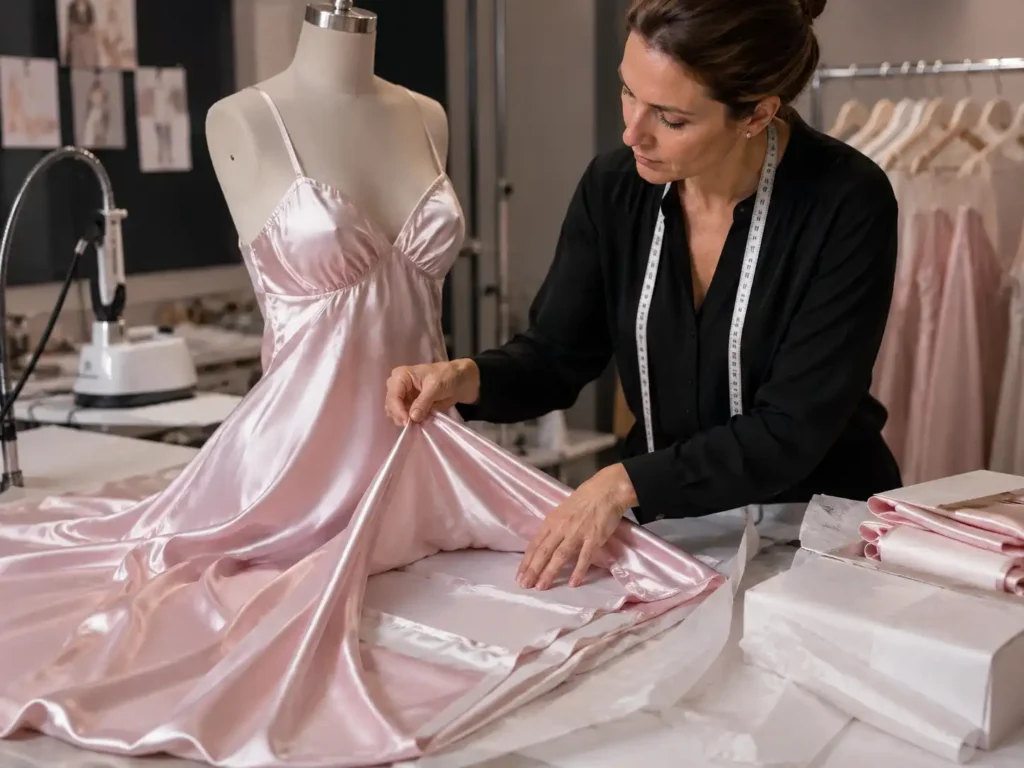
A good sample is not automatically a complete production standard. Before bulk manufacturing, the approved development result has to be translated into clear specifications that pattern makers, merchandisers, cutting teams, sewing operators, quality inspectors, finishing staff, and packing teams can follow consistently. For satin, the pre-production review normally covers the final sample, pattern, measurement chart, fabric quality, weight, stretch, color, shine direction, lining, zipper, trims, construction details, labels, packaging, and order information rather than relying on a visual sample alone.
The documented Jinfeng Apparel bulk process requires confirmation of the PP sample, main fabric, lining, color, weight, stretch, fabric batch, trims, size chart, packaging, labels, BOM, sewing instructions, and quality requirements before formal production. The purpose is traceability. If the first production units differ from the approved sample, the team should be able to identify whether the cause comes from a new fabric lot, cutting direction, construction, fit, pressing, or another variable. A physical approved sample and swatch are usually much more useful than a message saying simply to make it the same as last time.
In-Process QC
Final inspection alone is too late for many satin defects. Mixed shine direction is created in cutting, repeated seam puckering begins during sewing, and lining mismatch is built into the garment well before packing. Effective control therefore follows the product through the factory. Incoming material inspection looks at the fabric before it enters cutting; cutting QC confirms direction and panels; sewing and in-line inspection watch for repeated construction issues; garment and pressing review check the finished appearance; packing QC protects the surface before shipment.
This staged approach is especially important when the order contains several colors or styles because one small setup problem can affect a large number of garments before it becomes obvious. The documented womenswear QC sequence used by Jinfeng Apparel covers incoming material inspection, cutting QC, sewing QC, in-line inspection, garment inspection, pressing review, packing QC, and final or AQL inspection. The value of the sequence is not the terminology itself; it is the ability to stop a repeatable problem while the affected quantity is still small enough to correct efficiently.
Bulk Consistency
Consistency becomes harder as order size, style count, and color count increase. One dress may look acceptable by itself, yet a group of units placed side by side can reveal shade differences, inconsistent shine direction, different zipper behavior, or uneven pressing. Pale colors can expose lining and internal construction more clearly, very dark colors can show dust and oil marks, and high-gloss shades can magnify panel orientation. Bulk review therefore needs to consider the collection as a group rather than inspecting every garment only in isolation.
A documented satin program for an anonymous US occasionwear brand involved 12 satin mini and midi dress styles totaling about 20,000 pieces. The program used matte satin, stretch satin, and light lining, with ruched waists, invisible zippers, slits, and adjustable straps. The main challenges were color consistency, zipper flatness, lining comfort, and consistency across several colors. Development moved through first sample, revised sample, PP sample, and Golden Sample stages before bulk production, illustrating how formal approval checkpoints become more valuable as a satin program grows in size and complexity.
Final Release
Final satin inspection should verify technical compliance and the visual quality that made the fabric attractive in the first place. Measurements, construction, labels, and packaging remain important, but inspectors also need to look carefully for stains, snags, pulls, seam puckering, directional shade mismatch, zipper waves, incorrect lining position, pressing impressions, hem irregularities, and packing damage. Good lighting and more than one viewing angle are useful because directional reflection can hide a defect from one position and make it obvious from another.
The strongest final inspection is one that confirms an already controlled process rather than acting as the first serious quality check. Fashion teams can help the factory reach that point by providing practical development inputs early: target silhouette, preferred satin character, color direction, expected quantity, market, fit requirements, lining expectations, packaging needs, reference imagery, and a tech pack or clear measurement information where available. The clearer those inputs are, the easier it becomes to select a satin that can survive sampling, repeatable production, packing, international shipping, photography, retail presentation, and real customer wear.
|
QC Stage |
Main Satin Checkpoints |
Main Risk Prevented |
|
Incoming material |
Shade, surface defects, weight, stretch, fabric lot |
Wrong or inconsistent fabric entering production |
|
Cutting |
Grain, shine direction, panel orientation, visible defects |
Directional shade mismatch and wrong panels |
|
Sewing |
Seam appearance, zipper, lining, tension |
Puckering, waves, distortion |
|
In-line inspection |
Repeated defects, measurements, construction |
Large-scale rework |
|
Finished garment |
Snags, stains, fit, dimensions, hem |
Visible garment defects |
|
Pressing |
Shine change, impressions, wrinkles |
Surface damage |
|
Packing |
Folding, trim protection, labels, polybag fit |
Creases, abrasion, packing errors |
|
Final / AQL inspection |
Overall appearance, measurements, shipment condition |
Unacceptable goods leaving the factory |
Final Takeaway
Satin remains one of the most commercially powerful dress fabrics because it can turn a clean silhouette into a garment with strong visual depth, movement, and perceived value. The successful result rarely comes from choosing the brightest or most expensive swatch. It comes from matching the weave, fiber, weight, shine, stretch, opacity, and lining to the design, then protecting that decision through cutting, sewing, pressing, inspection, and packing. When a brand and manufacturer align those details early, satin becomes easier to scale across colors, sizes, seasonal collections, and repeat orders without losing the character of the approved sample. For custom satin dress development, the most useful starting package is a clear style direction, reference image or tech pack, target fit, color expectations, quantity plan, and desired fabric hand; those inputs give the development team enough context to recommend and test the right satin rather than guessing from appearance alone.
Share This Article :

Jerry Lee
Categories

Latest blogs
Table of Contents
Here, developing your OEM/ODM private label clothing collection is no longer a challenge—it’s an excellent opportunity to bring your creative vision to life.

