 Skip to content
Satin vs Stretch Satin: Which Fabric Is Better for Dresses?

Your trusted Women’s Apparel Manufacturer from China

Two rolls of satin can look almost identical on a fabric rack and behave completely differently once they become dresses. One may fall beautifully from the waist but offer almost no room through the hips. Another may feel slightly firmer in the hand yet follow the body much better in a fitted mini. That difference matters long before a garment reaches the sewing line, because changing from regular satin to stretch satin can affect the pattern, zipper, lining, seam behavior, sizing, pressing, packing, and even the way the surface catches light when the dress is worn.
Regular satin is usually the better choice when a dress needs fluid drape, a clean fall, or a classic slip-dress look. Stretch satin is usually better when the garment must follow the bust, waist, and hips while allowing more movement and recovery. Neither is universally better; the right choice depends on silhouette, GSM, stretch behavior, lining, construction, and the final appearance expected in production.
The expensive mistake happens when fabric approval stops at color, shine, and hand feel. A brand developing a bias-cut slip dress and another developing a sculpted corset mini may both request “premium satin,” yet they should not necessarily approve the same fabric. The useful question is what that satin will do after it is cut into a real pattern, fitted on a moving body, pressed, packed, shipped, and worn. That is where the differences between regular satin and stretch satin become practical rather than theoretical.
What Is the Difference Between Satin and Stretch Satin?
Regular satin emphasizes a smooth surface, fluid drape, and pattern-controlled fit, while stretch satin adds measurable elasticity and recovery so the fabric can follow the body more closely. That difference affects more than comfort. It changes how ease is calculated, how seams and zippers behave, how lining is selected, how sizing is controlled, and which dress silhouettes the fabric can support reliably.
What Is Satin?
Satin describes a fabric construction and surface effect rather than one single fiber. Its smooth, often lustrous face comes from longer yarn floats across the surface, so satin can be made from polyester, acetate, silk-like synthetics, or blended yarns. That is why two fabrics both sold as satin can behave very differently in a finished dress. For product development, the name is only the starting point; weight, fiber content, density, finish, shine level, drape, and surface stability still need to be checked.
In the working fabric range used for fashion dresses at Jinfeng Apparel, regular satin is commonly seen around 80-220 gsm. Lighter constructions are often more suitable for slip dresses, summer dresses, soft cocktail styles, and garments where movement matters, while heavier constructions can provide more coverage and a cleaner line for evening or structured occasionwear. Regular satin normally offers little mechanical stretch, so close fit must come mainly from pattern shaping, seams, darts, openings, or a zipper rather than from the fabric itself.
What Is Stretch Satin?
Stretch satin combines the familiar smooth satin face with engineered elasticity. Common constructions include polyester-spandex, nylon-spandex, and polyester blends containing elastane. In our development references, stretch satin commonly falls around 120-250 gsm, although actual market fabrics can sit outside that range. Compared with regular satin, it usually has a little more body and a stronger tendency to follow the bust, waist, and hips, which is why it is often selected for bodycon, corset, fitted cocktail, party, and mini dresses.
The important point is that “stretch satin” is not a complete technical specification. Two rolls carrying the same commercial name can differ in stretch direction, extension, recovery, thickness, surface finish, and stability after repeated tension. One fabric may stretch comfortably across the width and recover quickly, while another may feel soft and elastic at first but relax after wear. For fitted products, approval should therefore be based on the actual swatch and garment sample rather than on composition wording alone.
How Does Elastane Change Satin?
Elastane changes how satin responds to tension, which means it can influence nearly every stage of garment development. When the material stretches across the bust or hips, the pattern can sit closer to the body while still allowing movement. At the same time, the sewing line has to manage more variables: seam extension, zipper stability, lining compatibility, size recovery, and the way shine changes where the fabric is pulled over curved areas. Stretch is useful only when those variables remain controlled.
A simple development test is to mark a known length of fabric, stretch it in the intended direction, measure the extended length, and calculate stretch percentage as (stretched length – original length) / original length x 100. The fabric should then be released and measured again to assess recovery. Repeating the cycle is often more revealing than a single pull. Composition alone cannot tell a brand whether a fabric will recover well enough for a fitted dress after several hours of movement.
How Do Satin and Stretch Satin Compare?
The most important differences appear in stretch, recovery, drape, body cling, and construction behavior. Regular satin generally falls more freely and relies on the pattern for fit, while stretch satin accommodates closer silhouettes and movement. Both can look premium, and both can wrinkle, show shade differences, snag, or develop zipper and pressing problems if fabric weight, cutting direction, sewing tension, and finishing are not controlled.
How Do Stretch and Recovery Compare?
Regular woven satin gives the pattern maker relatively little mechanical stretch to work with. If a close-fitting dress is too small through the bust or hip, the fabric usually will not compensate; instead, tension appears as diagonal drag lines, stressed seams, zipper distortion, or restricted movement. That is why regular satin dresses need carefully planned wearing ease unless the style relies on bias behavior. A soft hand feel should never be mistaken for useful mechanical stretch.
Stretch satin changes that calculation because part of the movement can come from fabric extension. The real performance measure, however, is recovery. A fabric can stretch a long way and still recover poorly, leaving the seat, waist, neckline, or hip looser after wear. In commercial production, lot-to-lot consistency matters just as much. If the approved sample fabric and bulk fabric recover differently, garments with identical finished measurements can still feel different on the body.
How Do Drape and Body Cling Compare?
Drape is where many fabric comparisons become too simplistic. Stretch satin is not automatically a better version of satin because it feels more comfortable. Regular satin often works better when gravity is part of the design: a cowl neckline that falls softly, a slip skirt that moves away from the hip, or an evening gown that forms long vertical folds. The fabric is free to skim the body instead of constantly pulling back toward its original shape.
Stretch satin is usually more useful when the silhouette is deliberately controlled around the body. A fitted mini, ruched party dress, corset style, or close cocktail dress can benefit from the fabric returning toward the waist and hips after movement. The useful distinction is between skimming and holding. Neither effect is inherently more flattering; the correct choice depends on whether the design language is fluid and relaxed or shaped and body-conscious.
How Do Shine and Hand Feel Compare?
Both fabric groups can range from restrained matte surfaces to strong glossy finishes. Fiber type, yarn structure, weave density, finishing, color, and tension all change how light travels across the cloth. Stretch adds another variable because the surface angle changes when the fabric is pulled over the bust or hip. On a pale glossy style, that tension can make local shine differences or fit lines more obvious, even when the garment looks smooth on a hanger.
Hand feel also needs context. A very soft regular satin may feel luxurious but move aggressively during cutting and show seam impressions easily. A slightly firmer stretch satin may feel less fluid in the hand yet perform better in a fitted mini because it offers mild support and recovery. The strongest evaluation is not “Which feels nicer?” but “Which hand feel produces the silhouette, movement, and surface quality the dress is supposed to have after construction?”
Do Satin and Stretch Satin Wrinkle Differently?
Neither fabric should be described as wrinkle-free. In Jinfeng Apparel’s internal fabric references, regular satin is treated as having medium-to-high wrinkle risk, while stretch satin is generally treated as medium risk. That difference is useful, but it should not be overinterpreted. Weight, finish, color, fold pressure, carton density, and time in transit can matter just as much. Lightweight glossy satin can show creases quickly after shipping even when it looked perfect after final pressing.
Snagging deserves equal attention because satin’s smooth face makes local damage very visible. Rough tables, unfinished zipper edges, sharp embellishments, or abrasive packing materials can disturb surface yarns. Stretch satin may recover from some minor deformation better, but it can still show pressure marks and abrasion. For both fabrics, wrinkle and snag control needs to continue from the cutting room through sewing, finishing, folding, packing, and warehouse handling rather than being treated as a final-ironing problem.
Fabric Factor | Regular Satin | Stretch Satin | Development Meaning |
Typical working weight | 80-220 gsm | 120-250 gsm | Weight changes drape, opacity, structure and sewing behavior |
Mechanical stretch | Low or none | Medium | Affects ease, movement and pattern dimensions |
Drape | Medium to high | Medium | Regular satin often falls more freely; stretch satin follows the body |
Wrinkle tendency | Medium to high | Medium | Packing and pressing still require control in both |
Color/shine variation | Medium to high risk | Medium to high risk | Direction and fabric lot can change visual appearance |
Typical dress use | Slip, evening, bridesmaid, cocktail | Bodycon, corset, fitted party, mini | Silhouette should drive material selection |

Which Satin Is Best for Different Dresses?
Choose satin according to silhouette rather than using one fabric for an entire collection. Regular satin is usually stronger for slip dresses, fluid evening gowns, and designs built around drape. Stretch satin is generally better for bodycon, corset, fitted cocktail, and party dresses that need recovery and mobility. GSM, opacity, lining, shine, zipper structure, and fit can still change the final decision.
Which Is Better for Slip Dresses?
Regular satin is usually the natural starting point for a classic slip dress because the shape depends on fluid movement rather than controlled compression. Cowl necklines, narrow straps, side slits, and bias-cut skirts work best when the cloth can fall and shift around the body. In our satin-dress development work, recurring sample issues include bust coverage, strap length, bias drape, waist-to-hip ease, lining movement, fabric thickness, and the way the hem settles after the garment has been hanging.
Stretch satin can still be useful for a more modern fitted slip dress, especially when the brand wants the skirt to stay closer through the hip. The risk is that too much recovery changes the character of the style from softly draped to visibly body-hugging. A practical fitting should therefore judge the dress after it has rested on a hanger and after the wearer has walked and sat in it. Hem balance, side seams, cowl depth, strap length, lining movement, and hip release tell more than a swatch ever can.
Which Is Better for Bodycon Dresses?
Stretch satin is usually the more practical option for a bodycon dress because it can follow the bust, waist, and hips while allowing normal movement. The key specification is not simply “stretchy.” The material needs reliable recovery so the garment returns toward its intended shape after sitting, walking, or bending. A fitted sample should be checked for bust tension, waist pressure, hip stretch, seat recovery, side-seam twisting, hem riding, zipper flatness, and whether the lining is restricting the shell.
Grading deserves particular attention. A sample approved in one size does not prove that the fabric will behave the same way across the full size range. Larger sizes can place greater tension on the cloth, and smaller sizes can expose excess recovery or looseness in unexpected areas. Stretch satin should therefore be tested against the brand’s real size chart rather than treated as an automatic solution to fit variation. Fabric elasticity is part of the sizing system, not a substitute for good pattern development.
Which Is Better for Corset Dresses?
Corset dresses need a more layered decision because the outer satin and the internal support structure perform different jobs. Stretch satin can create a smooth fitted shell that follows the bust and waist, but boning, bra cups, interfacing, underwire, lining, and zipper structures may need far less stretch. If the outer fabric moves significantly while the internal body stays rigid, the layers can fight each other and create rippling, exposed seam tension, or a zipper that no longer lies flat.
The pattern should separate support zones from movement zones instead of treating the whole garment as equally elastic. A center-front area may need more stability while side panels can use controlled give. The exact solution depends on neckline, cup construction, waist reduction, and closure type. Stretch satin is often a strong choice for corset minis and fitted party dresses, but only when shell fabric, internal support, lining, and pattern have been developed as one garment system rather than as independent components.
Which Is Better for Evening and Bridesmaid Dresses?
Evening and bridesmaid dresses cover such a broad range of silhouettes that the occasion label alone does not determine the fabric. A flowing floor-length gown often benefits from regular satin because the skirt can fall cleanly and move naturally. A fitted bridesmaid or cocktail-inspired style may benefit from stretch satin because comfort and close fit become more important. A heavier regular satin can also create a structured formal look without introducing stretch, which can be valuable in cleaner architectural silhouettes.
Multi-garment programs create another challenge: several people may wear the same color in the same lighting, making shade and shine inconsistencies much easier to see. Fabric lots, directional luster, lining color, opacity, recovery, and fit across sizes should therefore be controlled at program level, not only style level. For bridesmaid collections in particular, a comfortable sample is not enough if different production batches appear slightly different when the dresses are standing together in photographs.
| Dress Style | Stronger Starting Point | Useful Weight Reference | Main Approval Focus |
| Slip dress | Regular satin | Lighter area within 80-220 gsm range | Drape, bias growth, opacity, lining |
| Bodycon mini | Stretch satin | Often within 120-250 gsm range | Recovery, hip fit, seam stability |
| Corset dress | Stretch or structured satin | Mid to heavier construction | Support layers, shell tension, zipper |
| Flowing evening gown | Regular satin | Style-dependent mid weight | Drape, shine, hem balance |
| Fitted cocktail dress | Stretch satin | Mid weight | Mobility, recovery, sizing |
| Bridesmaid dress | Depends on silhouette | Style-dependent | Shade, comfort, opacity, repeatability |
| Party mini | Often stretch satin | Mid weight | Recovery, lining, surface finish |
How Does Stretch Change Fit and Construction?
Stretch changes the relationship between pattern measurements and body measurements. It affects ease, bust-waist-hip tension, seam length, zipper behavior, lining compatibility, and sometimes cutting direction. A pattern developed for non-stretch satin should not automatically be transferred to stretch satin, because the same paper dimensions can create a noticeably different silhouette once elasticity and recovery become part of the garment.
How Does Stretch Affect Ease and Sizing?
In regular satin, most wearing ease has to be designed into the pattern. The garment needs enough room for the wearer to move, sit, and put the dress on without overloading seams or closures. Stretch satin allows some of that movement to come from the fabric, which can support a closer silhouette. The danger is assuming that added elasticity gives permission to reduce pattern measurements aggressively. Excessive negative ease can make a fashion dress feel like compression wear and can exaggerate surface tension lines.
The useful relationship is among body measurement, finished garment measurement, fabric extension, fabric recovery, and the intended pressure against the body. These variables need to be considered together during fitting. Size grading also becomes more sensitive because tension changes across the size range. A fabric that feels comfortable in a medium sample may behave more aggressively in a larger size or look too relaxed in a smaller one. Testing fit across more than one representative size is especially valuable for close stretch-satin styles.
Do Zippers and Seams Need Different Control?
Yes. The zipper is often one of the first places where poor stretch control becomes visible. The satin beside an invisible zipper may extend under tension while the zipper tape remains relatively stable. If the pattern, seam allowance, stabilization, feed, or thread tension is wrong, the zipper area can wave or bulge even when the rest of the dress looks smooth. Regular satin can show the same problem because its surface highlights puckering, but stretch satin adds a stronger mismatch between elastic fabric and stable zipper tape.
Seams can develop similar problems. If stretch satin is pulled during sewing, the stitched edge may become longer than the surrounding fabric. When released, the cloth attempts to recover while the seam restricts it, creating rippling. Side seams on fitted dresses can also twist when panel direction or feeding is inconsistent. Development teams should therefore review needle suitability, stitch length, thread tension, seam elasticity, zipper stabilization, pressing, and seam recovery after the garment has been worn under realistic tension.
How Do Linings and Support Layers Change?
Lining can either support a stretch-satin design or quietly cancel the reason the shell fabric was selected. A rigid lining inside a close-fitting stretch dress may restrict movement so strongly that the wearer never benefits from the outer fabric’s elasticity. In other areas, that same stability may be intentional. Corset panels, cup structures, waist sections, and some zipper zones can require firmer internal materials to keep the silhouette controlled and prevent the shell from carrying too much load.
The lining decision should therefore consider stretch compatibility, weight, opacity, color, surface friction, recovery, seam bulk, and placement. Light-colored satin deserves particular attention because a shell that looks opaque on the cutting table may become more transparent when stretched over the body. A full or partial lining can solve coverage, comfort, and structure problems, but the exact shell-and-lining combination should be tested as a sewn garment. Evaluating the two materials separately often hides interaction problems that appear only after assembly.
Is Bias Cutting Suitable for Stretch Satin?
Bias cutting can work with stretch satin, but it introduces more variables than bias cutting a conventional woven satin. A traditional bias cut already creates diagonal give because the pattern sits away from the straight grain. If the fabric also contains engineered stretch, the garment can gain flexibility from both the cutting direction and the fiber blend. The result may be beautiful, but it can also create greater vertical growth, more body cling, neckline distortion, side-seam movement, and an uneven hem drop.
The garment should be allowed to hang before final hem confirmation, and the development team should compare side seams and total length after resting. For commercial production, repeatability is the real test. A dramatic bias sample is not a success if each production piece settles to a different length. Stretch satin is therefore not automatically unsuitable for bias cutting, but it needs more testing and tighter control than a straightforward straight-grain fitted style, particularly when the dress has a long hem or asymmetric panels.
How Do These Fabrics Behave in Production?
Both satin and stretch satin demand disciplined handling because their smooth surfaces reveal mistakes quickly. Regular satin needs careful control of grain, shine direction, snagging, seam marks, pressing, and shade. Stretch satin adds recovery, side-seam stability, and size consistency. Fabric approval, cutting, sewing, PP sample confirmation, in-line QC, finishing, and packing should be managed as one connected production process.
How Should Satin Be Cut and Sewn?
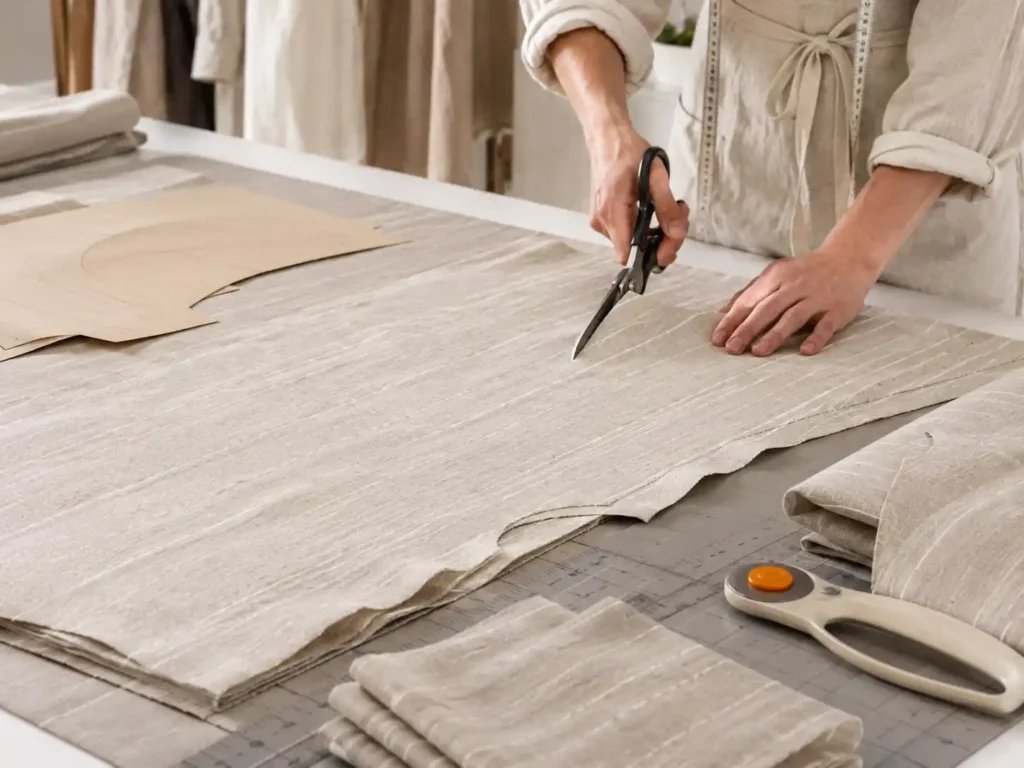
Satin can move on the cutting table more than its polished appearance suggests. Lightweight constructions may shift between layers, which affects panel symmetry, neckline shape, and finished seam alignment. Direction is equally important because satin reflects light differently depending on orientation. Two panels cut in opposite directions can appear to be different shades even when they came from the same roll, so face direction and nap-like shine direction should be established before bulk cutting starts.
Before cutting, a team should confirm fabric width, GSM, shade lot, surface defects, grain direction, and panel orientation. During sewing, needle condition and thread tension need attention because puncture marks and puckering can remain visible on the smooth face. Pressing should be conservative: excessive heat, pressure, or direct contact can alter shine or leave impressions. Packing should avoid heavy localized pressure and sharp accessories rubbing against the satin surface, especially on light colors where marks are easy to see.
How Should Stretch Satin Be Sewn?
Stretch satin adds the challenge of controlling extension during feeding and stitching. If an operator pulls the fabric even slightly, the sewn edge can become longer than intended. When the material relaxes, the seam may ripple or twist. On a fitted dress, small distortions become obvious because the garment is already under body tension. Stretch direction should therefore be clearly identified before cutting, and matching panels should be kept consistent so the left and right sides respond similarly when worn.
Sample review should cover seam recovery, side-seam balance, bust tension, waist tension, hip tension, zipper flatness, hem stability, and any restriction created by lining. In our stretch-satin development references, key bulk risks include batch differences in elasticity, unstable sizing, side-seam twisting, and zipper bulging. Those risks are best managed by linking the approved fabric reference to the approved garment sample, rather than allowing bulk teams to work from finished measurements without knowing the behavior of the material behind them.
How Should Color and Shine Be Controlled?
Satin’s reflective face can exaggerate small differences that would barely register on a matte fabric. Shade control should begin when fabric arrives, with meaningful lot differences separated before cutting. Shine direction needs the same discipline. A skirt panel rotated against the rest of the garment can appear darker or lighter under retail lighting or photography, even though a colorimeter might not suggest a dramatic difference. Consistent directional cutting is therefore both a technical and visual requirement.
Stretch satin adds one more question: what happens to the color and shine when the surface is under tension? Pale or glossy fabrics can look slightly different across the bust, hip, or seat because stretching changes the surface angle and yarn spacing. Useful checks include fabric-lot comparison, directional shine review, color under more than one lighting condition, appearance after stretching, lining-color compatibility, stains, and pressing marks. These controls become particularly important in bridesmaid or multi-piece programs where several garments may be photographed together.
How Should Bulk QC Be Managed?
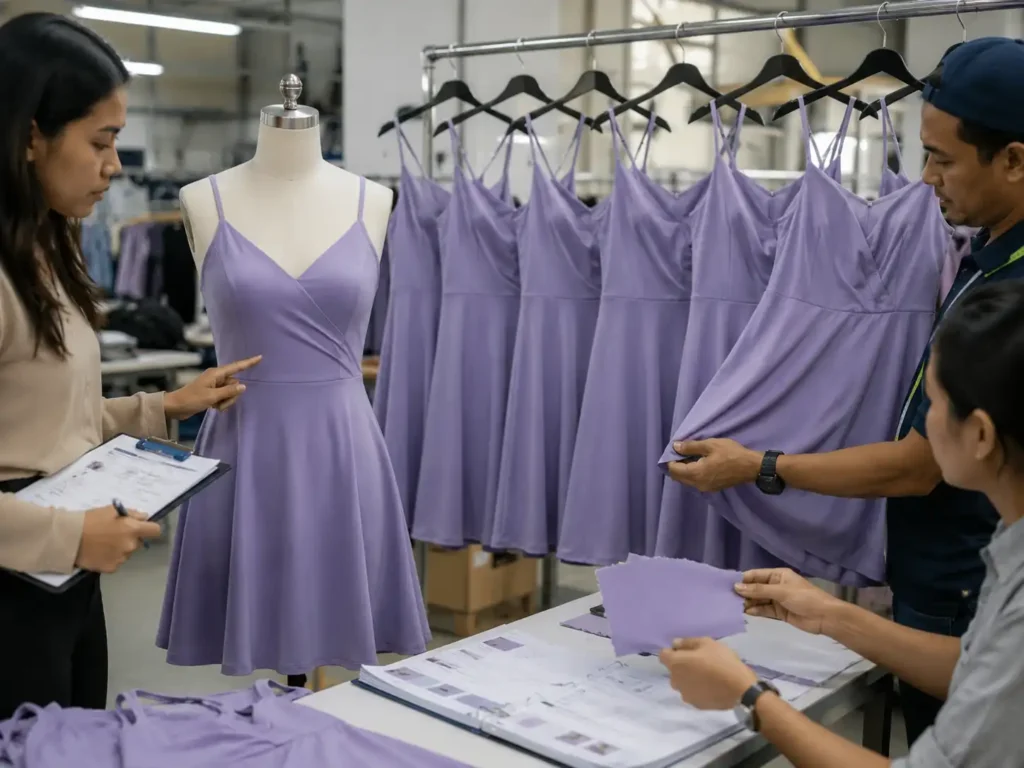
Bulk QC should begin before bulk sewing, not after hundreds of dresses are already finished. A practical control chain starts with incoming fabric review, continues through cutting and in-line sewing checks, and ends with measurement, appearance, finishing, and packing inspection. Satin problems are connected: a fabric-lot difference can become a shade issue, a cutting-direction mistake can look like a color issue, and poor handling at the zipper can turn into a fit issue. Waiting until final inspection makes those problems much harder to correct.
One internal case illustrates the point. An anonymous US occasionwear program covered 12 satin mini and midi styles and roughly 20,000 pieces using matte satin, stretch satin, and lightweight lining. The main challenges were shade consistency, invisible-zipper flatness, lining comfort, and consistency across several colors. Development moved through first sample, revised sample, PP sample, and Golden sample before bulk production. The value of that sequence was not bureaucracy; it created practical reference points for fabric, fit, construction, and finishing before volume increased.
| QC Stage | Regular Satin Focus | Stretch Satin Focus | Useful Check |
| Fabric receiving | Shade, GSM, shine, surface defects | Shade, GSM, stretch, recovery | Compare against approved swatch and lot |
| Cutting | Grain, shine direction, panel stability | Grain, stretch direction, panel stability | Keep matched panels in consistent direction |
| Sewing | Puckering, snagging, needle marks | Seam elongation, recovery, twisting | Inspect under light tension, not only flat |
| Fitting | Drape, balance, zipper | Bust-waist-hip tension, zipper | Use approved size chart and fitting sample |
| Finishing | Pressing marks, stains | Pressing marks, dimensional recovery | Allow fabric to relax before final measurement |
| Final QC | Shade, snags, lining, creases | Same plus stretch consistency | Compare with PP/Golden sample |
| Packing | Abrasion and fold marks | Fold marks and shape distortion | Avoid excessive pressure and sharp contact |
Which Fabric Should Fashion Brands Choose?
Choose regular satin when the design depends on fluid fall, bias movement, or a less body-hugging silhouette. Choose stretch satin when close fit, mobility, and recovery are central to the product. The strongest decision comes from an approved fabric specification and garment sample, not from fabric name, shine level, softness, or elastane content alone. Repeatable garment performance matters more than a perfect-looking swatch.
Is Stretch Satin Better Than Regular Satin?
Stretch satin is better only when its elasticity solves a real design problem. In a fitted party dress, controlled give can improve mobility and help the garment sit close to the body. In a flowing slip dress, the same recovery may reduce the relaxed fall that gives the style its character. A useful rule is simple: regular satin is usually stronger when the fabric should fall, while stretch satin is usually stronger when the fabric should follow. That is a design distinction, not a quality ranking.
High-quality regular satin can outperform poor stretch satin, and a well-developed stretch satin can outperform an unsuitable non-stretch fabric. The material has to be judged in the intended pattern, with the intended lining, zipper, support structure, and size range. Brands often lose time by approving a beautiful swatch first and trying to force the garment to work around it later. Reversing that sequence – defining the silhouette and performance needs first – usually leads to fewer sample corrections and more predictable bulk production.
What Fabric Specifications Should Be Approved?
A fabric name is not a commercial specification. Before bulk development, the approval record should identify enough information that the same material can be recognized and evaluated again. For regular satin, that normally includes fiber composition, GSM, usable width, color reference, surface finish, shine level, hand feel, drape, opacity, lining requirement, supplier reference, and an approved garment or swatch. Stretch satin should add stretch direction, tested extension, recovery, and fit notes from the bust, waist, and hip.
This becomes especially important for repeat orders. “Use the same black stretch satin” is not a reliable instruction six months after the first launch if the original mill lot is no longer available. A retained PP or Golden sample, fabric card, and documented construction notes give the development team something concrete to compare against. That reduces the risk of approving a technically similar fabric that produces a noticeably different drape, shine, pressure against the body, or response around the zipper.
How Do GSM and Composition Affect the Choice?
GSM can change the personality of satin even when the fabric category stays the same. In our regular sourcing references, satin used for dresses often sits around 80-220 gsm, while stretch satin commonly sits around 120-250 gsm. These are working ranges rather than universal market limits, but they show how broad the category is. A lighter satin generally offers more fluid movement and can show more transparency or seam impression; a heavier satin offers more coverage and body but may reduce the floating effect expected from a slip dress.
Composition changes hand feel, recovery, surface character, and care behavior as well. A polyester satin and a polyester-spandex satin can look similar from a distance while behaving very differently in fitting. GSM and composition should therefore be read together, not separately. Two fabrics with nearly the same weight can still drape differently because yarn size, weave density, finishing, and elastic construction differ. The safest development process is to compare the actual swatches in the intended garment rather than predict performance from the specification sheet alone.
How Do Cost and Bulk Risk Affect the Choice?
Fabric cost should not be reduced to price per meter. A cheaper satin can become expensive if it creates additional sample rounds, unstable sewing, shade claims, zipper rework, inconsistent sizing, or returns. A more expensive cloth is not automatically safer either if its weight, finish, or stretch is wrong for the silhouette. For a commercial collection, the more useful metric is repeatable garment performance: can the approved look and fit be reproduced across colors, sizes, production lots, and repeat orders?
That is also where manufacturer experience becomes valuable without needing to turn fabric selection into a sales pitch. A team that can connect fabric sourcing, pattern development, sample revision, PP approval, bulk sewing, QC, pressing, and packing is better positioned to catch problems before they become volume problems. When a satin project is being developed for multiple styles or colors, sharing the tech pack, target fit, reference garment, launch quantities, and fabric expectations early makes it easier to recommend whether regular satin, stretch satin, or another satin construction is the safer route.
Regular satin and stretch satin can both produce excellent dresses, but they solve different problems. Regular satin is strongest when the garment needs fluidity, bias movement, and a clean fall; stretch satin becomes more useful when the dress must follow the body while maintaining movement and recovery. The final choice should be made through the garment, not the swatch alone. A fabric that survives fitting, grading, sewing, pressing, packing, and repeat production is far more valuable than one that simply looks beautiful under showroom lighting.
For brands developing satin collections, the practical advantage comes from connecting fabric choice to the full product system: silhouette, GSM, pattern ease, lining, zipper, support layers, shade direction, recovery, and bulk-control standards. When those elements are approved together, satin becomes much more predictable. When they are separated, the same smooth surface that makes satin attractive can expose every small inconsistency. The best fabric is ultimately the one that delivers the intended look and fit consistently from sample to production and from the first order to the repeat order.
Is stretch satin more comfortable than regular satin?
Stretch satin can feel more comfortable in close-fitting dresses because the fabric moves with the bust, waist, and hips instead of relying entirely on pattern ease. That advantage is strongest in bodycon, corset, fitted cocktail, and party styles. Comfort still depends on recovery, lining, seam construction, and fit. A rigid lining or overly tight pattern can make a stretch-satin dress feel restrictive even when the outer fabric itself has useful elasticity.
Does stretch satin look different from regular satin?
It can, but the difference is not always obvious on a swatch. Both fabrics can be matte, semi-lustrous, or glossy depending on yarn, weave, color, and finish. Stretch satin may look slightly more body-conforming, and its shine can change where the cloth is pulled over curved areas. The best comparison is a sewn sample under natural and studio lighting, because surface appearance can change once the fabric is under tension.
Is regular satin or stretch satin better for a bodycon dress?
Stretch satin is usually the stronger starting point for a bodycon dress because controlled elasticity can improve movement and help the garment recover around the waist and hips. The fabric should still be tested for extension, recovery, seam stability, zipper flatness, and lining compatibility. A high-stretch fabric with weak recovery can produce a worse result than a firmer stretch satin that holds its shape consistently through several hours of wear.
What GSM satin is best for dresses?
There is no single best GSM because the correct weight depends on the silhouette. In our dress-development references, regular satin commonly falls around 80-220 gsm and stretch satin around 120-250 gsm. Lighter satin is often more suitable for fluid slips and summer styles, while mid-to-heavier constructions can add opacity and structure to cocktail, evening, corset, or fitted dresses. Weight should always be judged together with drape, finish, and composition.
Does stretch satin need a lining?
Sometimes. Stretch satin does not automatically eliminate the need for lining. Light colors can become more transparent when stretched, fitted dresses may need smoother internal coverage, and corset styles often require support layers for structure. The lining should be compatible with the design: a rigid lining can restrict an elastic shell, while a stretch lining may be more suitable in movement zones. The final decision should be made on the sewn sample rather than the fabric alone.
Can stretch satin be cut on the bias?
Yes, but it requires more testing than regular bias-cut satin because the garment combines diagonal fabric give with engineered stretch. That can increase vertical growth, body cling, neckline movement, and hem instability. A bias-cut stretch-satin sample should be allowed to hang before final hemming, and side-seam balance should be checked after resting. For bulk production, repeatable length and shape are more important than achieving a dramatic one-off sample effect.
How can brands reduce satin problems in bulk production?
The most reliable approach is to control satin from fabric approval through packing rather than relying on final inspection. Confirm the fabric lot, GSM, shade, shine direction, stretch and recovery where relevant, then lock the approved pattern, lining, zipper, PP or Golden sample, and key measurements. During production, monitor cutting direction, seam quality, size stability, stains, snagging, pressing marks, and packing pressure. Most expensive satin problems begin earlier than the final QC table.
Share This Article :

Jerry Lee
Categories

Latest blogs
Table of Contents
Here, developing your OEM/ODM private label clothing collection is no longer a challenge—it’s an excellent opportunity to bring your creative vision to life.

