Skip to content

A dress that looks effortless in a campaign image is usually the result of dozens of controlled decisions made long before the photo shoot. Designers define the visual direction, product developers protect the calendar and commercial plan, technical specialists turn the design into measurable instructions, and the factory tests whether the style can be cut, sewn, fitted and repeated at scale. When any one of those links is weak, the problem rarely stays small. A neckline that is only slightly unstable in a sample can become hundreds of inconsistent garments once production begins.
Product development teams work with dress factories by converting creative direction into technical requirements, reviewing construction and material risks, developing patterns and samples, approving fit and workmanship, confirming costs, locking pre-production standards and monitoring bulk production. The brand controls product direction and final approval, while the factory turns those decisions into a repeatable manufacturing process.
The best collaborations are not built on constant agreement. They are built on clear questions, documented decisions and early warnings. A factory that identifies a difficult zipper position or unstable satin seam before sampling is more valuable than one that accepts every request and explains the problem after cutting. The following workflow shows how experienced teams keep design intent, fit, cost, timing and quality moving in the same direction.
What Does Each Team Manage?
The brand team owns product direction, commercial targets and final approvals, while the factory owns technical translation, material coordination, patterns, samples and production execution. Responsibilities may overlap, but each decision needs one named owner. Clear ownership prevents conflicting comments, repeated sample rounds, hidden cost changes and delays before bulk production.
Product Direction

The product developer connects design, merchandising, technical design, sourcing and production. This person is responsible for keeping the style commercially realistic while preserving its intended look. Before a factory starts work, the developer should be able to explain the wearing occasion, target customer, price position, launch date, expected order scale and the features that cannot be changed. Without that context, technical teams are forced to make decisions without understanding which details carry the most value.
A fitted party dress, a fluid resort maxi and a structured office dress may all begin as attractive sketches, yet they require different fabrics, pattern balance and inspection priorities. The product team therefore needs to define the intended silhouette in practical language. Terms such as “body-skimming,” “firmly fitted through the waist,” or “relaxed over the hip” are more useful when supported by measurements, reference garments and fit photographs.
Commercial priorities also need to be ranked. A designer may consider the gathered waist essential, while the sourcing team may be more flexible about the lining construction. When the target cost becomes difficult, those priorities help the factory suggest changes that protect the product’s identity instead of reducing quality randomly. A mature team decides what must remain, what may be adjusted and what can be removed before repeated sampling consumes time and budget.
Technical Ownership
Technical designers turn a visual concept into information that can be checked. They prepare or review measurement charts, construction details, seam types, stitch requirements, grading rules, tolerances and fit comments. Their role is especially important in dresses because small changes around the bust, waist, neckline, armhole or strap can alter both appearance and wearability. A garment may match the total bust measurement and still gape because the neckline contour or cup position is wrong.
Tolerance planning should reflect the effect of variation rather than applying one number to every measurement. Narrow straps, small openings and fitted bodice points often need tighter control than a full skirt sweep. As a working reference, brands may set approximately 0.5 cm tolerance for narrow components, around 1.0 cm for key body measurements and 1.0 to 1.5 cm for longer vertical measurements, then adjust the limits according to fabric behavior and construction.
The technical team also decides how sample feedback is written. “Make the waist smaller” is incomplete because it does not say where the reduction should be taken or how the hip transition should change. A better instruction identifies the exact point of measurement, the current result, the revised target and any shape requirement that must remain. Good comments reduce interpretation and make each sample round more useful.
| Decision Area | Brand Team | Factory Team | Approval Record |
| Silhouette and styling | Designer and product developer | Feasibility and construction feedback | Approved sketch or reference |
| Fit and measurements | Technical designer | Pattern maker and sample room | Fit comments and size chart |
| Fabric and color | Design or sourcing | Material sourcing and testing | Approved swatch, lab dip or lot |
| Construction | Technical team | Development and production engineering | Tech pack and approved sample |
| Cost | Product development or sourcing | Consumption and labor calculation | Confirmed quotation |
| Production timing | Production manager | Capacity and line planning | Critical-path calendar |
| Packaging | Brand operations | Packing and labeling team | Approved packing file |
| Bulk release | Authorized approver | Project and production teams | Written PP approval |
Factory Execution
A capable dress factory has several technical functions behind the main contact person. Merchandisers coordinate files and timing, fabric teams source and test materials, pattern makers build the garment shape, sample machinists test construction, production planners assign capacity, and quality inspectors prepare checkpoints for bulk. The factory’s value is not simply that it can sew a sample. It is that information from development can be transferred into repeatable cutting, sewing, finishing and packing instructions.
Jinfeng Apparel’s documented development system includes two sample rooms, more than 20 sample machinists and seven or more senior pattern makers. Its wider production network includes six owned women’s fashion factories, more than ten long-term satellite partners, 18 or more sewing lines and dedicated teams for merchandising, quality control and finishing. That structure supports woven dresses, stretch styles, occasionwear, satin, lace, mesh, sequins, sets and other fashion-focused womenswear programs.
The production route should match the style. A corset mini with boning and cups should not automatically be placed on the same line as a simple jersey dress. Similarly, a chiffon maxi and a sequin party dress require different cutting control, operator skill and inspection attention. Product teams should ask how the factory assigns styles, how technical records reach each production unit and who has authority to stop work when an approved standard is not being followed.
Decision Control
Many delays begin with conflicting approval rather than poor workmanship. A designer may approve the appearance, a technical specialist may request more fit changes, and a sourcing manager may reject the cost. If those messages reach the factory separately, the next sample may satisfy one department while disappointing another. One consolidated decision file is therefore more valuable than a long email chain.
Every approval should show the style number, sample stage, date, version and responsible person. “Looks good” is not enough to release a fitted dress into production. The approval should confirm whether fit, measurements, fabric, trims, construction, labels and packaging are accepted, and it should list any remaining corrections that must be made without another full sample.
The factory also has a responsibility to challenge unclear instructions. When a request changes after approval, the team should explain the effect on pattern work, materials, price and timing before continuing. Clear control protects both sides: the brand knows which standard production must follow, and the factory is not expected to reconcile several unofficial versions during cutting or sewing.
What Information Starts Development?

Development should start with enough information to understand the product, commercial objective and delivery conditions. A useful package includes a tech pack or clear reference, size chart, material direction, trims, estimated quantities, target market, target cost, color plan, branding requirements and launch date. Unknown details should be recorded as open decisions rather than silently assumed.
Core Development Pack
A useful tech pack explains how the dress should look, fit, function and be assembled. It does not need decorative presentation, but it must provide controlled information. Front and back technical drawings, style identification, base-size measurements, points of measurement, construction callouts, seam details, main fabric, lining, trims, labels and packaging instructions form the practical core. Internal details that photographs cannot show should be drawn or described clearly.
Construction language should separate appearance from execution. “Low back” describes a look, while a measured back-neck drop creates a standard. “Soft ruching at the waist” still leaves questions about the gathering ratio, the length of the gathered section, the location of the seam and whether elastic or fixed gathering controls the shape. Factories need enough information to reproduce the feature across sizes without relying on the judgment of each sewing operator.
The bill of materials should identify not only visible components but also fusible materials, cups, boning, underwire, elastic, stay tape, thread, labels and packing items. A missing internal component can change fit, cost and lead time as much as an incorrect visible trim. Each item should have a description, color, supplier code when available, intended position and current approval status.
Commercial Inputs
Technical information alone cannot determine the correct production solution. The factory also needs planned quantity, color and size breakdown, target market, cost position, required sample dates, ex-factory timing, testing expectations and shipping format. A style intended for 400 pieces may need available fabric and standard trims, while a program of 20,000 pieces may justify custom dyeing, dedicated hardware or more extensive production testing.
Target cost should be discussed early, but it cannot replace a specification. A factory cannot responsibly confirm a precise price from one photograph because fabric weight, usable width, lining, internal support, embellishment, workmanship and packaging may still be unknown. An early estimate should state its assumptions, and the final quotation should follow the approved bill of materials and construction.
The delivery plan also affects development. A brand may need a photo-ready sample before bulk materials are available, a full size set for retailer approval or several shipment waves for different warehouses. These dates should appear in one critical-path calendar. When fitting, material approval, photography and production are managed in separate calendars, the same style can appear on time in one department and late in another.
| Development File | Minimum Content | Common Failure if Missing |
| Tech pack | Sketches, construction, measurements, revision date | Factory interprets design differently |
| Measurement chart | Base size, points of measurement, tolerances | Fit comments cannot be checked objectively |
| BOM | Fabric, lining, trims, labels, packaging | Cost and materials change late |
| Commercial brief | Quantity, market, target cost, delivery date | Wrong material or production route is proposed |
| Fit comments | Photos, exact location, revised target | Repeated sample rounds without closure |
| Approval log | Version, approver, date, status | Outdated instructions reach production |
| Packing file | SKU, barcode, folding and carton rules | Warehouse and allocation errors |
| Confidentiality record | NDA scope and authorized access | Unreleased information is poorly controlled |
Working from References
Not every project begins with a complete tech pack. Development may start from an original sample, sketch, line sheet, moodboard, fabric swatch or reference photograph. This is common in ODM projects and in brands with strong creative teams but limited in-house technical resources. The factory can propose construction, measurements and materials, but it should make clear which decisions come from the reference and which are new technical recommendations.
A photograph communicates visual direction but hides the inside of the garment. A strapless satin mini may need cups, boning, power mesh, non-slip tape, lining and a specific zipper structure, none of which can be confirmed from the front image. The factory should therefore issue a development summary that lists the known design features, open questions, proposed construction and any decisions required before pattern work begins.
An original sample gives more information, but it should not be copied without review. It may have been altered by hand, made in another fabric, fitted to a different body or produced through a method unsuitable for the planned quantity. Measurements should be taken systematically, construction should be opened or inspected where permitted, and any protected design should be adapted only with proper authorization and for the client’s own product direction.
Version and Confidentiality
Development files change quickly. A revised waist measurement may sit in an email while the original tech pack remains in the shared folder. A new zipper may be approved in a message but never added to the BOM. Every controlled file should therefore show the style number, version, date, author and approval status, and the team should identify one location as the source of truth.
Practical file names such as “D418_Fit_Comments_V03_16Jul2026” are safer than “final-new-latest.” Comment sheets should be consolidated before they reach the factory, and superseded files should remain archived but clearly marked. The production team should never need to guess whether the attachment in an old email is newer than the file in the main folder.
Confidentiality covers more than the final design. Tech packs, patterns, samples, custom fabrics, target costs, order quantities, labels, barcodes, packaging and launch dates may reveal an entire commercial plan. NDA-based cooperation should define access, storage and permitted use. Jinfeng Apparel supports NDA protection for client tech packs, samples, patterns, trims, private-label details and unpublished styles throughout development and production.
How Do Factories Review a Dress Design?
A dress factory reviews feasibility by examining fit, internal structure, fabric behavior, trims, sewing methods, cost, timing and repeatability. The goal is not to remove creative detail. It is to identify which features are ready, which need clarification and which may create unstable fit, inconsistent workmanship, excessive cost or delays during bulk production.
Fit and Structure
A flat sketch cannot show how a dress carries weight, stretches on the body or behaves during movement. Factory review begins by identifying the entry point, tension areas, support requirements and balance of the garment. Bust coverage, waist position, hip ease, neckline stability, armhole depth, strap strength, zipper access, slit height, lining and hem balance should be considered together rather than as isolated details.
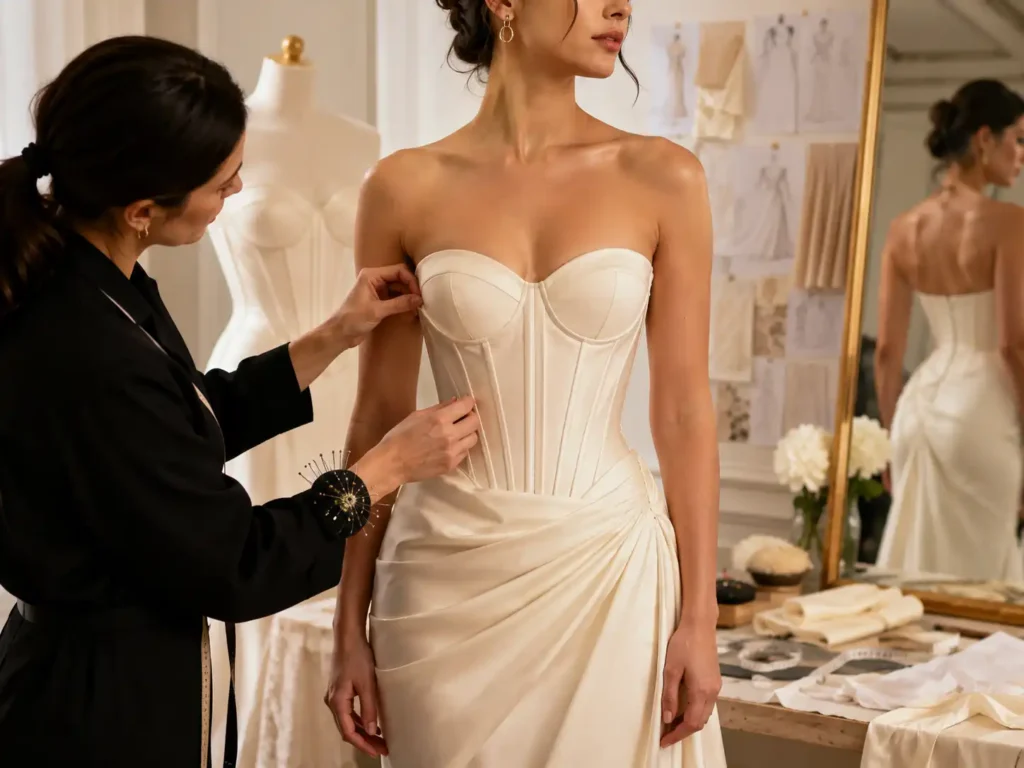
Complex structures need additional attention. A corset dress requires cup shape, boning placement, underbust support and controlled tension around the top edge. A cut-out dress needs stable exposed edges and enough support elsewhere. A bias-cut slip dress must account for fabric growth and twisting. A jumpsuit adds torso length and crotch depth to the usual bust, waist and hip controls.
Useful feedback explains consequences. Instead of saying that a neckline is difficult, the factory should explain that the current curve may gape in larger sizes or that the chosen fabric lacks enough recovery to hold the edge. That information allows the brand to decide whether to change the pattern, add internal support, select another material or accept controlled variation.
Fabric Behavior

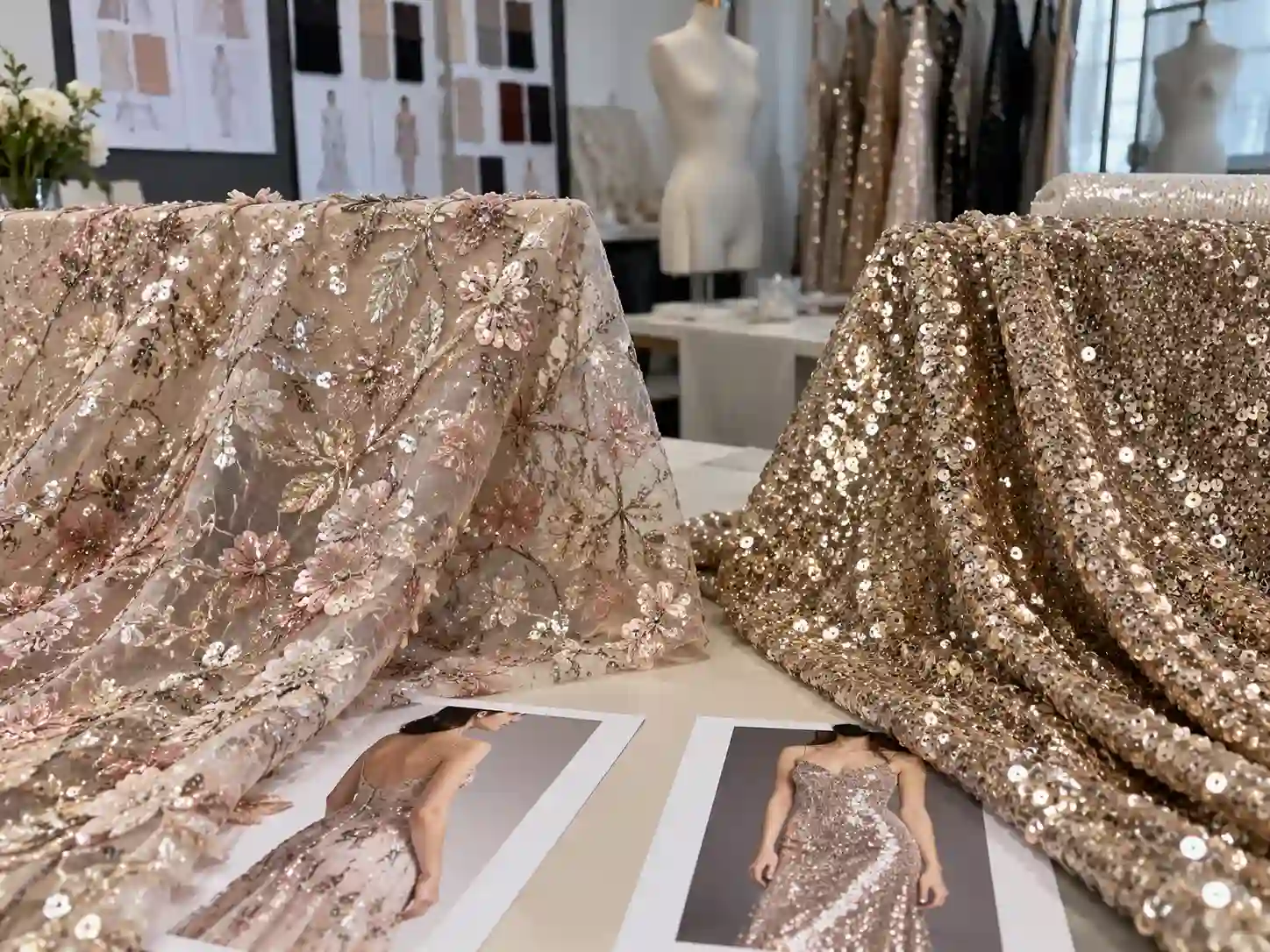
Fabric selection changes pattern shape, sewing method, appearance and fit. Satin can expose seam puckering, needle marks and pressing damage. Chiffon shifts during cutting and may need time to relax before final hemming. Stretch mesh becomes more transparent under tension. Lace requires motif placement and careful edge treatment. Sequins thicken seam allowances, damage needles and may scratch the wearer if not cleared from internal seams.
Material review should go beyond fiber composition. Width, usable width, weight, drape, stretch direction, recovery, shrinkage, transparency, seam slippage, colorfastness and lot variation can all affect the finished dress. A 2% dimensional change equals 2 cm across a 100 cm measurement. That may be unimportant in a full skirt but serious at a fitted bust or waist.
Testing should reflect the actual design. Stretch mesh needs to be viewed at the expected body extension, not only in a relaxed swatch. A satin seam should be sewn with the planned needle, thread and seam construction. Lace placement should be checked against the full pattern and size range. Material decisions become reliable when the factory tests how the fabric behaves in the garment rather than relying only on supplier descriptions.
| Material or Detail | Main Risk | Practical Review |
| Satin | Snagging, seam puckering, shade variation | Needle and seam trial, lot comparison, pressing test |
| Chiffon | Cutting movement, transparency, uneven hem | Controlled spreading, lining review, hanging test |
| Lace | Motif inconsistency, damaged edges | Placement map, repeat analysis, cutting inspection |
| Stretch mesh | Transparency and poor recovery | Test at intended body stretch and after recovery |
| Sequins | Loss, scratching, thick seams | Clear seam allowances, abrasion and attachment review |
| Jersey or ponte | Growth and unstable fit | Stretch-recovery, relaxation and shrinkage checks |
| Corset structure | Slipping, weak support, cup distortion | Bodice mock-up, boning and cup-position review |
| Invisible zipper | Bulging or breakage at thick seams | Zipper-weight and seam-thickness test |
Trims and Workmanship
Trims may occupy little space on the BOM, yet they often determine whether a dress functions. An invisible zipper that is too light can distort at a thick waist seam. Boning that is too soft may not support a strapless bodice. A strap slider can slip on smooth satin. Elastic may lose recovery after repeated extension, and decorative chains may pull away if the attachment method does not distribute weight.
The factory should confirm the size, color, finish, position and attachment method of every functional and decorative component. Small construction trials are often more efficient than making a complete dress. A zipper test through the final seam thickness, a boned bodice mock-up, a seam-puckering trial or a trim pull check can reveal problems before the first full sample.
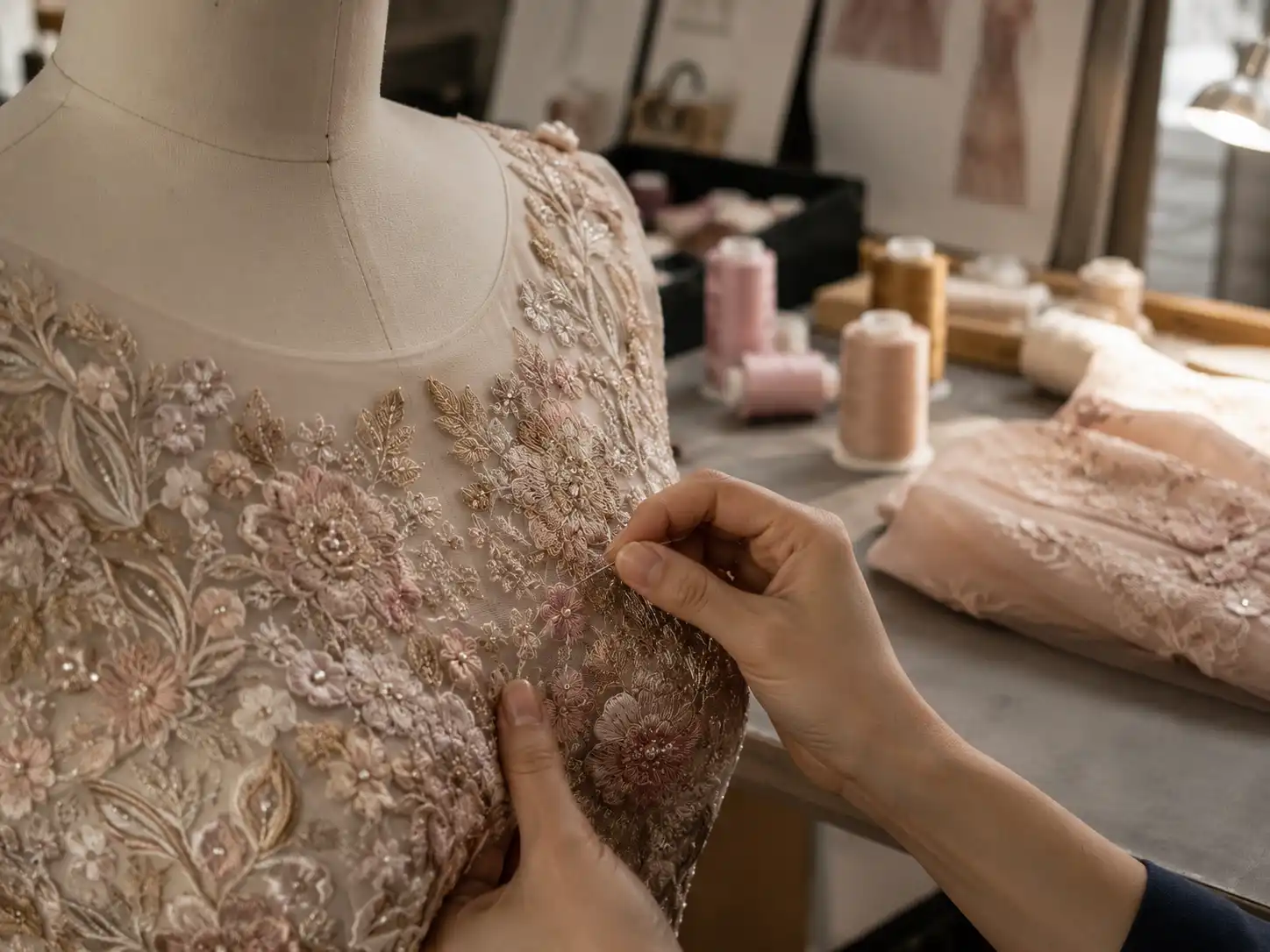
Decorative workmanship also needs repeatable rules. Ruching should be controlled by notches, measured gathering ratios or elastic length rather than adjusted by eye. Lace appliqué needs placement guidance and edge-finishing standards. Hand-applied rhinestones require a template and attachment specification. The aim is to preserve the design while reducing variation between operators, sizes and production batches.
Cost and Schedule Risk
Cost is influenced by more than the price per meter of fabric. Consumption, usable width, lining, internal support, number of pattern pieces, cutting difficulty, sewing time, handwork, trim minimums, color quantity, size range, quality checks, packaging and delivery urgency all contribute. Early cost review prevents a style from reaching the third sample before the brand discovers that it cannot support the planned margin.
Timing risks should be reviewed at the same stage. Custom dyeing, printed fabric, special lace, molded cups, custom hardware and retailer testing can extend the calendar. Highly structured dresses may need several focused fit rounds. When a key material arrives late, it can delay not only sampling but also costing, photography, PP approval and production allocation.
A useful risk note states the current requirement, technical concern, likely effect, recommended options, required decision and deadline. Experienced product teams usually prefer early bad news to late reassurance. A factory that explains a limitation before sampling gives the brand room to protect the launch; a factory that accepts everything without testing may simply move the risk to bulk production.
How Are Patterns and Samples Developed?
Patterns and samples turn design information into a garment that can be measured, fitted, costed and reproduced. The pattern maker builds the base shape, the sample room tests construction, and the brand reviews fit and appearance. Each revision should resolve documented issues, while later samples confirm grading, production materials, workmanship and bulk readiness.
Pattern Engineering
Pattern development converts a three-dimensional design into individual pieces that can be cut and sewn. The pattern maker must understand body measurements, visual proportion, seam construction, grain direction and fabric behavior. In a fitted dress, bust, waist and hip cannot be treated as isolated numbers because the curve between them controls how the garment sits on the body.
Different dress types require different pattern logic. A bodycon style relies on negative ease and fabric recovery. A corset dress relies on cup shape, support panels and controlled tension. A bias-cut slip depends on grain direction and allowance for growth. A chiffon maxi needs balanced volume and hem control, while a ruched style requires a defined gathering ratio that can be reproduced across sizes.
The base pattern should anticipate grading from the beginning. Automatic enlargement does not work for every feature. Neckline depth, strap width, cut-outs, cup position, slit height and decorative placement may need separate rules. A sample that looks balanced only in the base size is not ready for a full size run, particularly when the design exposes skin or depends on precise support.
Sample Stages
Every sample should answer a defined question. A development sample tests the initial structure, a fit sample checks the body relationship, a revised sample confirms corrections, a photo sample supports campaign work, a size set evaluates grading, and a PP sample confirms the production standard. Using one garment to approve all of those points at once makes it easy to overlook an important risk.
Not every program requires every sample type. A straightforward repeat style may move through fewer stages, while a structured dress with cups, boning, lace placement and a new fabric may need additional mock-ups and fit rounds. The development calendar should state which sample is being made, which materials are final or temporary, what the team must review and who has approval authority.
A photo-ready sample should not automatically become the production standard. It may be adjusted for a particular model or made before the final fabric is available. Likewise, a fit sample in substitute fabric can approve pattern direction but not the exact drape, transparency or recovery of the bulk material. Each sample is useful only when its limitations are understood.
| Sample Stage | Main Question | Typical Approval Focus | Common Misuse |
| Development sample | Does the design work? | Shape, structure, basic feasibility | Treated as final production standard |
| Fit sample | Does it fit the target body? | Balance, measurements, comfort | Reviewed only on a hanger |
| Revised sample | Were comments corrected? | Closure of previous issues | New styling changes added without record |
| Photo sample | Is it suitable for campaign use? | Visual finish and model fit | Used to approve bulk measurements |
| Size set | Does grading work? | Selected sizes and proportions | Base-size approval assumed to cover all sizes |
| PP sample | Is production ready? | Bulk fabric, trims, construction, labels | Approved with verbal corrections only |
| Golden sample | What controls production? | Sealed visual and workmanship standard | Not linked to the final files |
Fit Review
A productive fit session combines visual observation, garment measurements and movement. The fit model or form should represent the intended base size, and current body measurements should be recorded before the garment is judged. The dress should be viewed from the front, side and back, then tested while walking, sitting and raising the arms when the style requires normal movement.
Comments should identify the exact location, current problem and desired result. “Fix the bust” gives the pattern maker little information. “Remove 1 cm at each upper-bust side seam, retain cup volume and reduce center-front gaping” provides a workable instruction. Photographs, arrows, revised measurements and construction notes make the comment easier to understand across languages and time zones.
Teams should distinguish measurement failure from shape failure. A bust measurement can match the specification while the neckline still gapes because the contour, cup position or fabric tension is wrong. Similarly, a side seam may twist even when both side lengths match because the grain direction or pattern balance is incorrect. Correcting the cause prevents the same defect from returning in another size or fabric.
Revision and Approval
The number of sample rounds depends on design complexity, input quality, fabric behavior and decision speed. A clear conventional dress may be approved after one or two focused revisions, while a corset, draped satin or layered occasion style may require more. The meaningful measure is not the smallest number of samples; it is whether each round closes defined issues without introducing uncontrolled changes.
Brand comments should be consolidated before they reach the factory. When design, technical and commercial teams disagree, the product developer should resolve the conflict internally. Sending several separate messages forces the factory to choose between priorities it does not own. One controlled comment sheet, with mandatory and optional changes clearly separated, makes the next sample more accurate.
Approval should cover silhouette, base-size fit, measurements, movement, fabric, lining, trims, construction, workmanship, labels and remaining corrections. The status should be written as approved, approved with listed corrections or not approved. A physical sample alone is not enough because it may stretch, shrink or be altered during handling. The approved pattern, measurement chart, BOM and comments form the complete production record.
How Do Teams Move into Bulk Production?
Bulk production begins only after the product standard is locked. The approved BOM, measurements, graded patterns, fabric, trims, construction, labels, packaging, quantities and tolerances must agree. The factory then confirms a PP sample, seals the production reference, inspects incoming materials and controls cutting, sewing, finishing and packing against the approved records.
Cost and BOM Lock

Final costing should follow stable patterns, materials and construction. An early estimate is useful for range planning, but it often changes when fabric consumption, lining, internal support, trims, embellishment, workmanship and packing are confirmed. Two fabrics with the same price per meter may create different garment costs if one has narrower usable width, one-way print, motif placement or higher cutting waste.
The final BOM should identify the approved main fabric, lining, fusible materials, cups, boning, underwire, elastic, closures, decorative trims, thread, brand labels, care labels, hangtags, barcode stickers, polybags and carton marks. Each change should be linked to its effect. If a revised neckline needs additional support or a new fabric requires full lining, the product team should see the cost and timing impact before bulk release.
Cost optimization should protect the purpose of the product. A factory may suggest an equivalent fabric, a simpler internal seam, shared trims across a collection, fewer color splits or better marker efficiency. Removing support from a strapless dress or using an unstable zipper may reduce the unit cost on paper while increasing defects, returns and customer complaints later.
PP and Golden Samples
The pre-production sample is the final complete product check before bulk cutting. It should use the intended production fabric, lining, trims, labels and construction wherever possible. Any temporary substitute must be listed clearly. The central question is simple: if the factory makes the order exactly like this garment and its linked files, is the result acceptable?
The Golden sample is the sealed reference used by the factory merchandiser, line supervisor and quality team. It should be linked to the approved tech pack, BOM, measurement chart, pattern version and comment history. When several factories or lines are involved, controlled references are especially important because verbal knowledge does not move reliably between locations.
A common mistake is to approve a PP sample with several spoken corrections and assume production will remember them. Every correction needs to appear in the production file, and a corrected mock-up or detail sample should be attached when the change affects construction. Cutting should not begin simply because fabric has arrived or the shipping date is approaching.
Production Control
Bulk control starts before sewing. Incoming materials should be checked for identity, usable width, color, surface condition, shrinkage and quantity. Shade variation should be separated before panels from different lots are combined in the same garment. Printed fabrics, velvet, lace and sequins may require one-way cutting or placement rules, while chiffon and other unstable materials need controlled spreading.
Before a full line runs, the first completed garments should be reviewed against the approved standard. This early check confirms that operators understand the construction and that production methods create the same result as the sample room. In-line inspection should then focus on known risks such as stretched necklines, uneven ruching, puckered satin seams, incorrect cups, twisted side seams, zipper distortion, slit height and label position.
Jinfeng Apparel’s production network is designed for multi-style and multi-batch programs, with six owned factories, more than ten long-term satellite partners, 18 or more sewing lines and six or more flexible lines. Complex styles are allocated to suitable production units, while technical files, key-stage follow-up, quality standards and final delivery remain under coordinated project management rather than uncontrolled outsourcing.
Final Inspection and Packing
Final inspection checks whether completed goods meet the agreed standard before shipment. The method should be confirmed in the purchase agreement and may use an AQL-based sampling plan, additional measurement checks or client-appointed inspection according to product risk. A loose maxi dress and a structured corset dress do not carry the same fit or construction risk, so inspection emphasis should reflect the style.
Inspection normally covers style, color, size identity, measurements, fabric defects, sewing, symmetry, trim attachment, closure function, stains, pressing, labels, folding, barcode readability, carton quantity and shipping marks. Critical functional or safety defects should not be treated like minor cosmetic variation. Measurement results should also be sampled across sizes, colors, lines and production periods rather than only at the beginning.
Packing mistakes can cause serious commercial loss even when the garments are well made. Incorrect barcodes can prevent warehouse receiving, wrong size stickers create returns, and mixed carton quantities disrupt store allocation. The final packing list, invoice, carton details and customer-required documents should match the physical goods. Packaging and SKU decisions therefore need approval early enough for the operations team to execute them accurately.
How Do Teams Build a Long-Term Partnership?
Long-term brand–factory partnerships depend on retained technical records, predictable communication, transparent capacity planning and measurable performance. The factory should preserve approved patterns, measurements, fabrics, trims, packaging and Golden samples. The brand should provide realistic forecasts, timely approvals and consolidated feedback. Repeat orders should reuse proven knowledge while checking any new material, color or size risk.
Record Retention
Repeat orders become faster only when approved information has been controlled and retained. A factory should not rebuild a successful style from memory or from an old garment found in the sample room. The repeat-order file should contain the final production pattern, graded sizes, measurement chart, tolerances, fabric and trim references, construction sheet, packing files, Golden sample record, inspection findings and previous production comments.
Those records help the team separate an exact repeat from a modified repeat. A new color may use the same pattern but introduce new shade or shrinkage risk. A new fabric may require pattern changes even when the sketch is unchanged. Extending the size range can require new grading and fit approval. Calling every variation a repeat order hides the development work that is still necessary.
After shipment, complaints, returns and internal quality findings should be added to the style history. If customers report slipping straps, difficult zippers or an exposed lining, the next production should not repeat the same construction without review. Jinfeng Apparel retains pattern, measurement, fabric, trim and packing records to support repeat orders, new colors, seasonal programs and multi-batch production.
Seasonal Planning
Seasonal development works better when the brand shares the collection view rather than treating every style as an unrelated request. A collection plan should show product categories, shared fabrics and trims, color direction, sample priorities, photography dates, launch waves, expected quantities and replenishment potential. That view allows the factory to plan material sourcing, sample-room capacity and production allocation more intelligently.
Styles should be prioritized by commercial importance and technical risk. A campaign corset dress using custom satin should enter development earlier than a simple repeat jersey style. Designs that share the same lace, lining, zipper or color can be reviewed together to reduce unnecessary variation and improve purchasing efficiency. The goal is not to make every style identical, but to manage the range as a connected system.
Approving ten styles on the same day does not mean every style can enter production at once. Occasionwear, stretch bodycon dresses and fluid woven styles may require different factories, operators and inspection methods. A coordinated production network can allocate each group according to product expertise while keeping one technical standard, one approval history and one delivery plan.
Performance Metrics
A long-term relationship should be evaluated with evidence rather than only friendly communication or one successful order. Useful measures include quotation response time, first-sample lead time, percentage of comments closed per round, unplanned sample rounds, material approval delays, fit approval timing, production-start variance, measurement pass rate, in-line defect trends, final inspection results, packing accuracy and on-time ex-factory performance.
Metrics need context. A corset dress should not be compared directly with a simple jersey style, and a sample delayed by a brand-initiated fabric change is different from one delayed by poor factory planning. Both sides should record the cause, not only the number of late days. Otherwise, performance reports encourage blame rather than better decisions.
Seasonal reviews are more useful than discussing performance only when a problem occurs. The brand can share which styles sold well, which fit issues drove returns and which materials performed poorly. The factory can explain capacity pressure, supplier changes and process improvements. Trust grows when problems are reported early and examined honestly enough to prevent repetition.
Partnership Fit
Not every dress factory is suitable for every product program. A satin occasionwear brand should examine fabric handling, structured bodices, lining, pressing and protective packing. A bodycon label should focus on stretch recovery, pattern control and size consistency. A business developing many styles and frequent repeats needs strong file control and capacity planning as much as a skilled sample room.
Before committing to a long-term program, the product team should examine the factory’s regular product categories, pattern and sample resources, material knowledge, fit and grading process, tech-pack review, production allocation, in-line control, final inspection, confidentiality, private-label packing and repeat-order records. The manufacturer should also evaluate whether the client provides clear direction, realistic targets and timely approvals.
Jinfeng Apparel’s custom production model begins from 200 pieces per style and color, subject to fabric, trims, construction and scheduling, and is designed for brands with real development and bulk-production plans. Teams preparing a new dress collection can begin by sharing a tech pack, reference sample, line sheet or development brief together with quantities, sizes, target market and delivery timing. A structured review can then identify the most practical route for fabric, pattern, sampling, costing and production.
Planning Your Next Dress Collection
A well-managed development process gives every creative decision a technical home. It allows the brand to protect design intent while giving the factory enough information to control fit, materials, cost, timing and production consistency. The practical starting point is not a long introductory call. It is a clear development package containing the available tech pack, reference sample or line sheet, planned quantities, size range, target market, desired delivery timing and any non-negotiable product details.