Skip to content

A factory may say it can produce 100,000 garments per month, but that number alone does not tell a fashion team whether it can deliver 20,000 satin dresses, 8,000 corset dresses, or a 30-style seasonal collection on time. Real capacity is not the number of machines visible during a factory tour. It is the usable production time available for a defined product, adjusted for how long that product takes and how efficiently the assigned line can work.
Dress production capacity is calculated by multiplying available production minutes by expected line efficiency and dividing the result by the garment’s SAM or SMV. A reliable plan also checks style complexity, fabric behavior, working days, line availability, existing orders, quality-control workload, finishing capacity, packing requirements, and the slowest process in the complete production flow.
The calculation looks simple, but the commercial consequences are not. One overlooked lining operation can add thousands of production minutes across a large order. A zipper station that runs seven pieces per hour below target can quietly create a growing queue. By the time cartons are missing from a shipment report, the original problem may have been visible on the first day’s capacity sheet. The sections below show how experienced production teams find those warning signs before they become late deliveries.
What Does Dress Production Capacity Mean?
Dress production capacity is the number of approved, saleable dresses a factory can realistically complete within a defined period using assigned operators, suitable machines, available working time, and supporting departments. It must be calculated for a specific style or order because a basic jersey dress and a structured corset dress do not consume the same production resources.
Capacity by Time Period
Capacity may be measured by hour, day, week, or month, but each period answers a different operational question. Hourly output helps a supervisor see whether a sewing line is moving at the required pace. Daily capacity supports line-duration estimates, weekly figures help track order progress, and monthly capacity gives brands a broad view of factory scale and booking potential.
Monthly capacity is the most visible number in many supplier profiles, yet it is also the easiest to misunderstand. A production system may complete a high volume of straightforward knit dresses while producing far fewer lined satin, lace, corset, or embellished styles during the same month. The factory has not become smaller; each piece is simply consuming more standard minutes and more specialist work.
| Capacity Measure | Main Use | What Must Be Confirmed |
| Hourly capacity | Monitor line pace and emerging bottlenecks | Current style, hourly target, downtime, work-in-progress |
| Daily capacity | Estimate sewing duration and daily progress | SAM, operators, shift time, efficiency, accepted output |
| Weekly capacity | Track order status and recovery needs | Working days, line changes, repairs, absenteeism |
| Monthly capacity | Assess general manufacturing scale | Product mix, current bookings, holidays, supporting departments |
| Order-specific capacity | Confirm delivery feasibility for one program | Style, quantity, fabric, colors, sizes, quality, packing, schedule |
The table separates general factory scale from order-specific capacity. A monthly figure becomes commercially useful only after the product mix, current loading, suitable line availability, supporting department limits, and complete cutting-to-packing process flow have been reviewed for the order being discussed and matched to its required shipment window.
For a fashion brand planning a launch, order-specific capacity is the most valuable figure. It connects a real dress, a confirmed quantity, an available line, and a required shipment date. General monthly capacity answers how large the production system is. Order-specific capacity answers whether that system can complete this particular product within the required delivery window.
Theoretical and Actual Capacity
Theoretical capacity describes the mathematical maximum under ideal conditions. It assumes every assigned operator is present, all machines remain available, materials arrive on time, operations are perfectly balanced, and the line converts every attended minute into standard work. The calculation is useful for understanding the ceiling, but it is rarely responsible enough for a shipment commitment.
For example, a line with 40 operators working eight hours has 40 × 8 × 60 = 19,200 available minutes per day. If the approved dress has a SAM of 30 minutes, the theoretical output at 100% efficiency is 640 dresses per day, assuming every attended minute becomes standard work without interruption, waiting, or repair.
Real production includes bobbin changes, bundle handling, machine adjustment, inspection, minor waiting, quality corrections, and normal differences between operators. If the same line is planned at 65% efficiency, daily capacity becomes 19,200 × 65% ÷ 30, or 416 dresses. Both numbers are mathematically correct, but only the second provides a reasonable base for production booking and material, inspection, packing, and delivery planning.
Experienced teams normally use a realistic efficiency supported by similar-style records and then protect a limited amount of recovery time. They do not build the entire shipment around the highest output achieved on a perfect day. A plan that requires every operator, machine, and supporting department to perform at its maximum without interruption has no practical protection when normal production variation appears.
Sewing and Finished Capacity
Sewing capacity is only one part of finished-garment capacity. A dress is not ready to ship merely because it has passed the last sewing operation. It may still require thread cleaning, measurement checks, pressing, stain removal, label verification, metal detection where required, folding, polybagging, barcode matching, carton assortment, and final inspection before it becomes a releaseable piece.
If sewing produces 500 dresses per day while the pressing team can handle only 380, the factory will not create 500 finished pieces per day. Work-in-progress will build before pressing, floor space will become crowded, and production reports may look healthy while shipment-ready output remains limited by the slower process. The same constraint can appear in cutting, printing, embroidery, pleating, washing, final inspection, or packing.
- Fabric inspection, relaxation, spreading, cutting, and bundling must prepare enough accurate panels for the planned sewing rate.
- Special processes such as printing, embroidery, pleating, smocking, beading, or washing need their own capacity and approval schedule.
- Pressing and finishing must handle the fabric safely without creating shine, distortion, water marks, or inconsistent appearance.
- Inspection and packing must support the planned size ratio, barcode logic, labeling, folding, protective materials, and carton requirements.
The more useful question is not how many dresses can be sewn. It is how many correct, inspected, packed dresses the complete production system can release. This distinction is especially important for satin, velvet, lace, and sequin products, where finishing and surface inspection may take longer, and for multi-SKU private-label programs where packing accuracy can become the final bottleneck.
Deliverable Output
A credible capacity figure should describe deliverable output rather than unfinished work-in-progress. From a brand’s perspective, 10,000 dresses waiting for repairs, pressing, labels, or barcode checks are not completed capacity. The useful number is the quantity that has passed the agreed construction, measurement, workmanship, finishing, branding, and packing requirements and can move into final inspection or shipment release.
This is also why quality cannot be separated from capacity. A line may appear highly productive when it pushes defects into a repair area, but the factory has not created more usable output. It has moved unfinished work into another department. When repair queues grow, the same garments consume sewing time, repair labor, reinspection capacity, and sometimes a second pressing cycle.
Consider a line that sews 450 pieces but releases only 390 without repair, compared with a line that sews 420 and releases 410 on the first pass. The second line reports lower gross production yet creates more saleable pieces, less congestion, and a more dependable packing flow. For delivery planning, first-pass accepted output and packed output are usually more meaningful than the number of garments that reached the end of sewing.
Which Data Is Needed for Capacity Calculation?
Reliable capacity planning requires available production minutes, garment SAM or SMV, expected efficiency, assigned operators, suitable machines, working days, and confirmed order specifications. Construction details, fabric behavior, quantity, colors, sizes, special processes, quality requirements, packing methods, and current factory loading must also be reviewed before a dependable delivery commitment can be made.
Available Production Minutes
Available production minutes are the total minutes that assigned production resources can contribute during the planning period. For a labor-based sewing line, the starting formula is assigned operators × working hours × 60. A line with 36 operators working eight hours therefore has 17,280 attended minutes before efficiency is applied. The calculation must use people actually assigned to the order, not the total factory headcount.
Employees working in the sample room, cutting department, warehouse, quality office, administration, or another sewing line cannot be counted unless they are genuinely available for the planned production. The same principle applies to machines. A factory may own hundreds of machines, but the calculation must consider suitable and available equipment for the specific operation sequence, not every machine on the asset list.
Working time also needs a realistic definition. An eight-hour shift may include planned meetings, training, maintenance, and other non-production periods depending on the factory’s time-recording method. For monthly planning, holidays and scheduled shutdowns must be removed. A 30-day calendar month may provide only 24 to 27 scheduled working days before existing orders and line changes are considered.
Overtime can provide short-term recovery, but it should not be treated as normal base capacity. A plan that works only when every line completes repeated overtime is already carrying risk. Fatigue can reduce pace, increase absence, and raise repair levels. The most stable schedule is built on normal available time, with overtime reserved for limited recovery rather than used to make an unrealistic promise appear achievable.
SAM and SMV
SAM means Standard Allowed Minute, while SMV commonly means Standard Minute Value. In garment manufacturing, both terms are used to describe the standard time needed to complete a garment or operation under defined working conditions. The dress value is built by breaking the product into operations and adding the standard time required for each construction step.
A simple stretch dress may require shoulder joining, neckline finishing, side seams, sleeve or strap attachment, hemming, and thread trimming. A structured style may also require cup preparation, boning channels, lining assembly, panel matching, ruching, zipper insertion, understitching, reinforcement, and multiple pressing stages. The approved construction, not the front-view appearance, determines the actual work content.
A reference image can hide important differences. A bodice may be lined or unlined; cups may be molded, padded, or fabric-covered; lace may be randomly cut or position-matched; and a slit may require reinforcement. Even a two-minute change matters at volume. Across 20,000 pieces, two additional standard minutes create 40,000 extra standard minutes before efficiency is considered.
SAM should therefore be confirmed from a technical pack, operation bulletin, approved sample, or controlled time study. Copying a value from a visually similar style without checking the internal construction can produce a false capacity estimate. The most common errors are not dramatic mistakes; they are several small missing operations that quietly add days when multiplied across a large order.

Efficiency and Line History
Efficiency measures how much standard work is completed compared with the attended time available. A common calculation is produced quantity × garment SAM ÷ attended minutes × 100. If 36 operators work 480 minutes and complete 340 dresses at 30 SAM, the line efficiency is approximately 59%, which can then be compared with the planned rate and relevant similar-style history.
Expected efficiency should be supported by relevant history rather than chosen because it makes the requested date look comfortable. The strongest comparison is a similar garment produced by a similar line using a comparable fabric and construction method. A high-performing knit line does not automatically provide a reliable estimate for a lined corset dress, and a repeat satin slip dress should not be compared with a first-time ruched mesh style.
- Operator familiarity affects how quickly handling becomes consistent and how often work needs correction.
- Product quantity determines whether the line has enough time to recover its start-up loss and reach stable efficiency.
- Fabric stability affects cutting accuracy, feeding, seam appearance, pressing, and the probability of repair.
- Line balance determines whether work flows evenly or accumulates before a slow specialist operation.
- Machine suitability, attendance, trim readiness, and quality standards all change the efficiency a line can sustain.
Factories should separate start-up efficiency from stable efficiency. A repeat order may reach its normal rate quickly because the pattern, attachments, operation sequence, and quality points are already known. A new complex style may need several days of improvement before the line reaches its planned level. Applying the highest historical efficiency to every production day usually overstates capacity and hides the learning curve.
Order and Product Data
Capacity becomes more accurate as the product becomes more defined. A factory can provide a preliminary estimate from a clear technical pack, original sample, or detailed specification, but a final booking should follow approved construction, confirmed fabric, final measurements, BOM details, quantity breakdown, private-label information, packing requirements, and an agreed shipment window.
| Required Data | How It Changes Capacity |
| Approved construction | Defines the operation sequence, specialist tasks, and garment SAM |
| Fabric composition and behavior | Changes cutting, feeding, sewing control, pressing, repairs, and inspection |
| Quantity by style and color | Determines line duration, changeovers, and learning-curve recovery |
| Size range and ratio | Affects marker planning, bundling, line flow, measurement checks, and packing |
| Lining, cups, boning, and trims | Adds operations, machines, handling, and quality-control points |
| Printing or embellishment | Adds internal or external process capacity and approval timing |
| Quality tolerance | Changes inspection frequency, measurement workload, and correction time |
| Packing method | Changes folding, labeling, barcoding, assortment, and carton capacity |
| Required ship date | Defines the usable preparation, production, inspection, and release window |
| Current factory loading | Determines whether the suitable line is genuinely open for the order |
Capacity should be described as provisional whenever construction, fabric, quantity allocation, special processes, labeling, inspection, or packing requirements remain open. Final booking requires controlled product and schedule information because unresolved details can change SAM, line choice, supporting department workload, and the number of production days required.
Total quantity alone is not enough. A 20,000-piece program made from two styles is easier to plan than the same quantity divided across 40 styles, particularly when every style uses different fabric, trims, colors, and construction. Packing can also change the final output. Individually barcoded garments packed by store assortment require more control than simple solid-size cartons, even when sewing quantities are identical.
How Is Daily Dress Capacity Calculated?
Daily dress capacity is calculated by multiplying the assigned line’s available production minutes by its expected efficiency, then dividing the result by the approved dress SAM. The calculated sewing output must be checked against cutting, special processing, finishing, inspection, and packing capacity before it is treated as the number of completed garments available each day.
The Core Formula
The standard calculation is daily capacity = available production minutes × expected efficiency ÷ garment SAM. Available minutes are normally assigned operators × daily working hours × 60. The mathematics is straightforward, but the result is only as dependable as the inputs, the relevance of the efficiency assumption, and the accuracy of the approved garment SAM.
Consider a line with 36 operators, an eight-hour shift, a 30-minute dress SAM, and planned efficiency of 62%. The line has 17,280 available minutes. After efficiency is applied, it creates 10,713.6 productive standard minutes. Dividing that figure by 30 produces a calculated daily sewing capacity of approximately 357 dresses.
| Calculation Item | Value |
| Assigned operators | 36 |
| Working hours | 8 hours |
| Minutes per operator | 480 minutes |
| Total available minutes | 17,280 minutes |
| Planned efficiency | 62% |
| Productive standard minutes | 10,713.6 minutes |
| Approved dress SAM | 30 minutes |
| Calculated daily sewing capacity | Approximately 357 pieces |
This example calculates sewing-line output only. Finished capacity still depends on cutting, special processes, inspection, pressing, packing, and the line’s actual start-up performance. The daily number should not be treated as shipment-ready output until each supporting department has confirmed that it can maintain the same flow.
The result should not be rounded upward simply to create a cleaner target. A supervisor may use 360 pieces as an operating goal, but shipment planning should not depend on every day exceeding the calculated average. Conservative rounding and a modest recovery allowance are usually safer than creating a schedule that loses control after one machine failure, one absence, or one delayed trim delivery.
Start-Up and Stable Output
A new dress rarely reaches stable output on the first day. Operators need time to understand the handling sequence, adjust machine settings, confirm seam allowances, learn quality points, and balance work between operations. The first production days therefore create less output than the stable-stage formula suggests, particularly when the style is new, the fabric is difficult, or specialist operations are concentrated in a few stations.
For illustration, a manageable new style might move from roughly 35-45% efficiency on the first day, to 45-55% on the second, and then toward 55-65% as the line settles. These are not universal targets. A repeat style can stabilize faster, while a structured corset, lace, sequin, or heavily ruched product may need a longer learning period and more engineering support.
Using the 36-operator example with a 30-minute SAM, output at 40% efficiency is approximately 230 pieces; at 50%, it is 288 pieces; and at 62%, it reaches about 357 pieces. If the schedule assumes 357 pieces from the first day, the production plan may lose nearly 200 pieces during the first two days. Repeating that mistake across several styles creates a meaningful shipment gap.
A responsible schedule either includes a start-up curve in its daily plan or protects enough time before shipment to absorb the lower opening output. It should also define when the planned stable efficiency is expected to begin. Without that point, an average efficiency can hide a weak start and make the remaining production days carry more work than the line can realistically recover.
Hourly Targets and Bottlenecks
A daily target becomes easier to manage when it is divided into hourly or two-hour checkpoints. A target of 357 pieces over eight hours averages roughly 44.6 pieces per hour, although natural variation will occur around breaks, morning start-up, bundle changes, and end-of-day work-in-progress. The purpose of the checkpoint is not to punish variation; it is to reveal where flow is being lost while correction is still possible.
- Compare actual output with the hourly target and review whether the gap is improving or widening.
- Check work-in-progress between operations to identify queues, starvation, and unbalanced task allocation.
- Record machine downtime, absence, quality repairs, missing trims, and waiting time instead of describing every loss as low efficiency.
- Review whether operators are correcting inconsistent upstream work that should have been controlled earlier in the line.
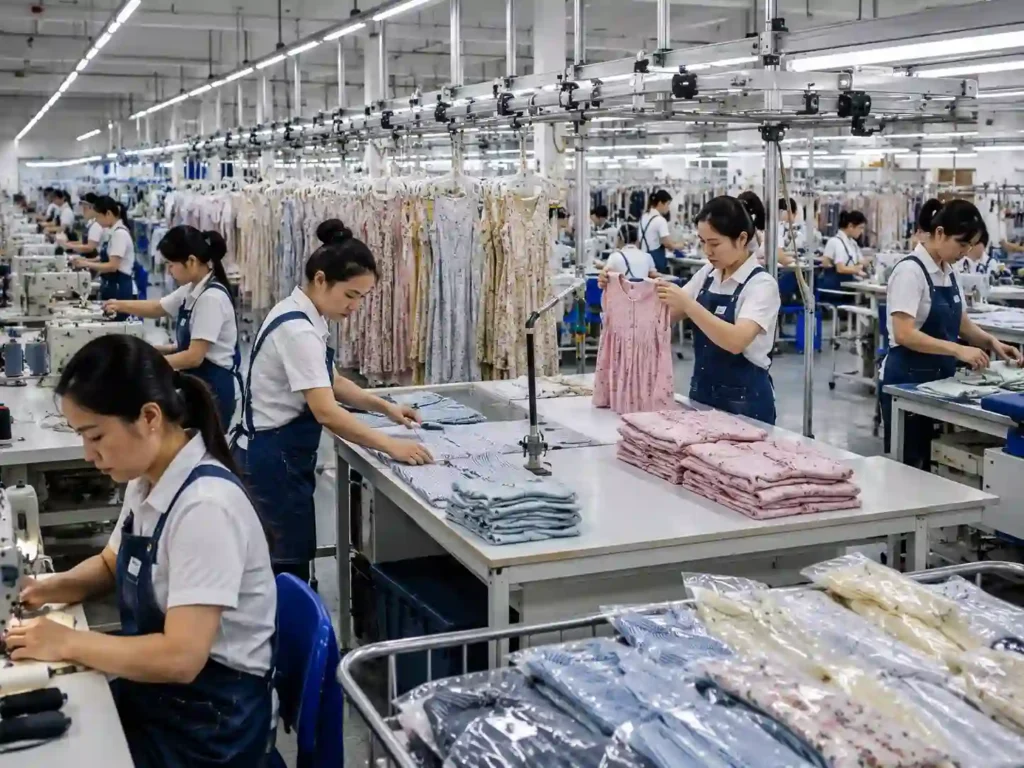
Suppose the line needs 45 completed units per hour, but the invisible-zipper operation can process only 38. The queue before that station grows by about seven units each hour. After six hours, roughly 42 partially completed dresses may be waiting. The planner can then consider a trained second operator, a task split, a better attachment, smaller bundles, or a method change supported by a controlled trial.
Adding labor is not always the correct response. If the previous station sends inconsistent seam allowances, the zipper operator may be spending time correcting upstream variation. A bottleneck should be diagnosed before resources are moved. The goal is to increase the flow of accepted garments, not merely to move people around the line until the hourly report looks temporarily better.
Accepted Daily Output
Sewing quantity and accepted quantity should be reviewed separately. A line may report 400 completed pieces, but if 35 require repair, first-pass accepted output is only 365. Gross output can therefore create a false sense of progress when defects are simply being transferred to a repair team, final inspection area, or later shift.
Daily production control should track gross sewn quantity, inline defects, repair quantity, first-pass acceptance, finished quantity, packed quantity, and the remaining balance. These numbers reveal whether departments are moving together. When sewing reports 400 pieces, pressing reports 310, inspection releases 280, and packing completes 250, the order is not progressing at 400 shipment-ready pieces per day.
Consider two lines. Line A sews 420 pieces, sends 30 to repair, and releases 390 on the first pass. Line B sews 405, sends eight to repair, and releases 397. Line B has lower gross output but creates more accepted garments, less repair work, and a more stable packing flow. For delivery planning, its useful capacity is stronger.
The healthiest daily target connects the complete order flow. Cutting should feed enough accurate panels, sewing should release work at a controlled pace, inspection should prevent repair queues from aging, and packing should complete the required size and barcode ratios. Capacity becomes dependable when these figures support one another rather than when a single department reports an impressive number in isolation.
How Is Monthly Factory Capacity Calculated?
Monthly factory capacity is calculated by combining realistic daily output across compatible production lines and available working days. Existing orders, holidays, maintenance, line changeovers, product mix, learning curves, finishing capacity, and reserved production slots must be deducted before the factory determines how much additional work it can reliably accept.
Working Days and Line Availability
The simplest monthly calculation is monthly capacity = realistic daily output × available production days. If the earlier line produces 357 dresses per day and has 26 genuinely available working days, its calculated sewing capacity is 9,282 pieces for that month, before additional limits from finishing, packing, or a changing product mix are applied.
The phrase genuinely available matters. If another order occupies the first four days and one day is required to clear work-in-progress, change thread, reset machines, train critical operations, and approve the first pieces, only 21 days remain. At the same daily rate, capacity falls to 7,497 pieces. The line has not lost capability; the booking window has changed.
- Separate calendar days from scheduled working days and remove known holidays or shutdown periods.
- Identify days already committed to orders in production, confirmed future programs, and repeat-order reservations.
- Allow realistic time for line clearing, machine adjustment, training, pilot production, and first-piece approval.
- Confirm whether finishing and packing from the previous order continue after the sewing line changes to the next style.
Monthly capacity is therefore a scheduling result rather than a machine-count result. In a busy factory, some lines are completing current orders, others are entering new styles, and several may be reserved for replenishment programs. Presenting every line as fully open throughout the month produces a large number but does not provide a reliable production window for a new project.
Multiple Lines and Product Fit
When several sewing lines are involved, each line should be calculated separately. Multiplying one average daily output by the total number of lines is often misleading because lines differ in operator count, machine configuration, product specialization, supervisor experience, efficiency history, current workload, available days, and quality performance. The line must fit the product, not simply appear on the factory layout.
A team organized for stretch bodycon dresses may not be the right choice for woven eveningwear. A line familiar with chiffon resort dresses may still need time to stabilize on a structured corset product. If three available lines can produce 380 woven midi dresses, 420 knit mini dresses, and 210 lined party dresses per day, their combined 1,010-piece output applies only to that product mix and those assumptions.
It does not mean the factory can produce 1,010 pieces per day of any single style. The lines may also share cutting, pressing, QC, or packing resources. Sewing can be distributed successfully while finishing becomes overloaded. The production plan must therefore check whether shared departments can support the combined rate and whether special machines, folders, or skilled operators are duplicated across the proposed lines.
The safest allocation gives each style to a line with relevant experience and enough uninterrupted time to recover its learning loss. Large orders may use several lines, but technical methods, approved samples, measurements, and quality points must remain aligned. Capacity gained by adding lines can be lost again if different teams create inconsistent construction that requires sorting, repair, or separate inspection standards.
Multi-Style Collections
A seasonal collection should be planned in standard minutes rather than total pieces. Piece quantity alone hides the workload created by different fabrics and constructions. Ten thousand basic knit dresses and ten thousand lined, boned, embellished dresses are not equivalent orders, even if their purchase quantities look identical on a summary sheet.
| Dress Type | Illustrative SAM Range | Main Capacity Influence |
| Basic stretch mini dress | 12-20 minutes | Few operations, repeatable handling, higher potential line output |
| Simple unlined woven dress | 18-28 minutes | Moderate construction and pressing requirements |
| Lined midi dress | 28-42 minutes | Added lining, zipper, measurement, and finishing work |
| Ruched mesh party dress | 35-55 minutes | Stretch control, alignment, appearance checks, and repairs |
| Corset dress | 45-75 minutes | Cups, boning, panels, lining, fit accuracy, and specialist operations |
| Embellished evening dress | 70-120+ minutes | Slow handling, specialist work, surface inspection, and protective packing |
These ranges are planning illustrations, not universal standards. Actual SAM must be established from the approved product, production method, equipment, fabric, quality requirements, and the factory’s controlled time study. A similar-looking dress can fall outside the range when its internal structure, embellishment, finishing, or inspection requirements are different.
Consider a collection with 5,000 knit dresses at 18 SAM, 4,000 lined midi dresses at 36 SAM, and 2,000 corset dresses at 60 SAM. The workload is 90,000, 144,000, and 120,000 standard minutes respectively, or 354,000 standard minutes in total. The corset style represents only 18.2% of the pieces but consumes about 33.9% of the standard sewing workload.
This is why a smaller collection can occupy more factory time than a larger program of basic styles. The same logic applies to short production runs. A 20,000-piece order split across two styles gives each line time to stabilize, while the same quantity divided across 40 styles creates repeated changeovers, smaller bundles, more approvals, and less time at stable efficiency.
Gross and Open Capacity
Gross capacity describes the production potential under stated conditions, while open capacity is what remains after commitments are deducted. A practical relationship is open capacity = gross available capacity − committed capacity − reserved capacity. The remaining figure should then be matched to the required product category and delivery window.
Committed and reserved time can include orders already running, confirmed programs awaiting line entry, repeat-order reservations, seasonal accounts, maintenance, holidays, staff training, line changes, and finishing work from previous orders. A factory with 100,000 pieces of regular monthly output may have only a fraction of that capacity open for a new booking, and availability may be stronger for one category than another.
Multi-factory production can expand capacity, but allocation must remain controlled. Dividing one style across too many production units can create differences in measurements, seam appearance, pressing, and finishing. Safer arrangements often assign complete styles, clearly separated colors, or controlled delivery batches to suitable production units, supported by one approved sample, one technical standard, and centralized critical quality requirements.
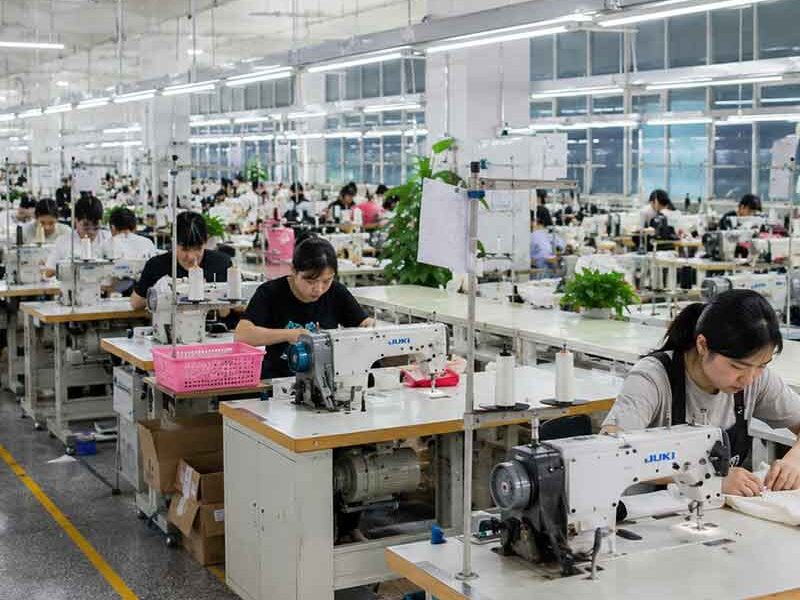
Jinfeng Apparel’s documented production framework includes 6 owned women’s fashion factories, more than 10 long-term satellite production partners, 18+ sewing lines, and 6+ flexible production lines. Its regular monthly womenswear capacity is stated at 100,000+ pieces, while actual allocation depends on style complexity, fabric, order structure, current booking, and schedule. The value of the network lies in matching appropriate production resources to each product rather than treating every garment as an interchangeable unit.
What Reduces Actual Dress Output?
Actual dress output is reduced by complex construction, difficult fabrics, short production runs, frequent changeovers, operator learning, poor line balance, material delays, machine downtime, defects, repairs, and downstream bottlenecks. Necessary inspection also consumes time, but removing quality controls usually creates greater losses through rework, rejected goods, inconsistent packing, and delayed shipment.
Construction Complexity
Every design feature consumes production minutes. Some details add only a small operation, while others change the complete manufacturing sequence. Full lining, cups, boning, multiple bodice panels, heavy ruching, pleats, ruffles, cut-outs, adjustable straps, invisible zippers, lace placement, layered mesh, reinforced slits, and hand-applied embellishment all require extra handling, accuracy, machines, or inspection.
A corset dress is slower not simply because it looks detailed. It normally contains more pattern pieces, tighter alignment requirements, additional preparation, and specialist operations. Small panel errors can affect symmetry, cup position, waist fit, side-seam balance, and zipper behavior. The work must often be controlled at several stages because later assembly cannot fully correct an inaccurate early operation.
Complexity also makes line balancing harder. A basic dress may contain many operations with similar cycle times. A structured style can contain several slow specialist tasks surrounded by faster operations, creating queues unless work is divided carefully. The line may need duplicate operations, prepared subassemblies, improved guides, or a different sequence before its planned output becomes stable.
Cost reduction should therefore focus on the operations that consume time rather than only on visible decoration. Removing an outer trim may reduce material cost while leaving the lined bodice, cups, boning, and concealed zipper unchanged. A sound development review identifies which details create customer value, which create manufacturing time, and which can be simplified without damaging fit, appearance, or brand identity.
Fabric Behavior
Fabric changes production speed even when the pattern and operation count remain similar. Stable woven materials are generally easier to spread, cut, bundle, and sew. Slippery satin can shift during cutting and feeding. Chiffon may stretch or move along the edge. Mesh can distort under tension, velvet needs controlled pile direction, and sequin fabric can damage needles, increase seam thickness, and require special surface protection.
- Cutting speed changes when fabric layers shift, stretch, curl, show pile direction, or require lower spreading height.
- Sewing speed changes when feeding is unstable, needles damage the surface, layers slip, or seam puckering becomes visible.
- Pressing capacity changes when heat, pressure, steam, or contact time can create shine, marks, distortion, or color change.
- Inspection and repair increase when the fabric makes holes, pulled threads, stains, shade variation, or seam imbalance more visible.
Stretch direction is especially important for fitted dresses. If panels are cut or joined with inconsistent tension, finished measurements can vary even when the paper pattern is correct. Operators may need to control neckline, shoulder, armhole, side seam, and hem tension throughout production. A line that is fast on a stable ponte fabric may slow considerably when moved to lightweight stretch mesh.
The most attractive material for the final product is not always the easiest material to manufacture. Good capacity planning does not discourage satin, mesh, lace, velvet, or sequin designs. It recognizes their handling requirements early, assigns them to an experienced production unit, allows realistic time for inspection and finishing, and avoids promising the output rate of a simpler fabric.
Changeovers and Learning
Frequent style changes reduce productive time because a line must clear previous work, change thread and attachments, adjust stitch settings, prepare new bundles, review the approved sample, train critical operations, and confirm the first pieces before normal flow begins. The effect becomes larger when a collection contains many short runs and each style reaches stable efficiency only briefly before the next change.
- Machine needles, feet, folders, guides, thread tension, and stitch density may need to change with the next fabric or seam type.
- Operators may need to be reassigned because the new style concentrates work in different specialist operations.
- Quality teams must communicate new measurement points, appearance standards, construction risks, and defect classifications.
- Bundling, size ratios, trims, labels, pressing conditions, and packing instructions may all change even when the garment category remains similar.
Color changes can also lower efficiency when thread, lining, trims, machine settings, or cleaning requirements differ. A change from black to a pale satin may require stronger contamination control and more careful handling. Even if construction remains identical, production must prevent mixed components, wrong shade combinations, and residual dark threads from entering lighter garments.
Repeat orders often stabilize faster because patterns, methods, attachments, operation bulletins, and quality points are already known. However, the repeat should still be reviewed if the fabric, trim supplier, measurements, packing, factory allocation, or order size has changed. Stable capacity is built through controlled repetition. Every unnecessary change interrupts that repetition and consumes part of the available production window.
Defects and Bottlenecks
A bottleneck is an operation or department that cannot keep pace with the required flow. Work accumulates before it, while later operators wait for pieces. Common sewing bottlenecks include invisible-zipper insertion, cup preparation, boning assembly, neckline binding, lace alignment, sleeve setting, ruching, lining attachment, narrow hemming, and final topstitching. External constraints can appear in cutting, embroidery, pressing, inspection, or packing.
Defects create a second production route. Instead of moving directly from sewing to finishing, garments travel to inspection, repair, reinspection, and often pressing again. The repair team consumes labor that could support current production, and repaired garments may re-enter the flow out of sequence, complicating size, color, and packing balance. High gross output with a growing repair queue is not an improvement in real capacity.
- Use first-piece approval to confirm construction, measurements, machine settings, and appearance before volume rises.
- Review pilot output early enough to correct methods before defects are repeated across hundreds or thousands of pieces.
- Track operation-level defects, repair aging, and work-in-progress rather than waiting for the final inspection report.
- Check shade, panel direction, seam appearance, symmetry, zipper flatness, measurements, labels, barcodes, packing ratios, and carton marks at the relevant stage.
Quality checks consume time, but they protect capacity when performed early. Finding an incorrect zipper position after 40 pieces is manageable; finding it after 4,000 can disrupt the entire schedule. The healthier production line is usually the one that creates stable first-pass acceptance, keeps repair levels controlled, and releases garments to finishing in the planned sequence rather than the one reporting the highest stitched quantity.
How Do Brands Verify Real Factory Capacity?
Brands can verify real factory capacity by requesting a style-specific calculation, assigned line plan, provisional or approved SAM, realistic efficiency, current booking window, similar-product records, production milestones, and departmental capacity checks. A credible manufacturer explains assumptions, constraints, quality arrangements, and recovery options instead of relying only on a large monthly piece figure.
Capacity Evidence
A factory does not need to disclose confidential information from other clients to provide meaningful capacity evidence. It should still be able to explain how the proposed output and delivery date were calculated. The strongest response identifies the estimated or approved SAM, line size, working hours, planned efficiency, suitable machines, booking dates, similar-style experience, supporting department capacity, and the assumptions that remain provisional.
- Ask for the estimated daily output and the formula used to reach it, including operators, hours, efficiency, and SAM.
- Confirm the proposed line-entry date rather than discussing only the number of sewing lines in the factory.
- Review whether cutting, special processes, pressing, inspection, and packing can support the same daily flow.
- Request a milestone schedule that connects material readiness, cutting, pilot production, sewing, packing, inspection, and shipment release.
- Discuss the recovery plan for slower start-up, machine failure, material delay, unexpected absence, or a critical operation that falls below target.
A capacity answer becomes more credible when its assumptions are visible. For example, a 32-minute dress assigned to 38 operators at 64% stable efficiency produces an estimated 365 pieces per day. If 8,000 pieces require approximately 22 stable sewing days, the brand can ask how the first days are treated, whether a similar product has run on the line, and whether finishing can release the same quantity.
Be cautious when a firm delivery date is confirmed immediately after one reference image is shown. A preliminary estimate may be possible, but dependable capacity normally requires construction, fabric, quantity, color, size, quality, and packing information. Transparency is more useful than instant confidence. A supplier that explains what still needs confirmation is often providing a stronger operational answer than one that promises everything before the product is defined.
Monthly Claims
A monthly piece claim is useful for understanding production scale, but it should never be treated as a universal promise for every product. A factory reporting 100,000 garments per month may produce a combination of tops, skirts, simple dresses, knit sets, repeat programs, and more complex occasionwear. The number reflects that combined product mix, not the output of one difficult style.
- Clarify whether the monthly number represents sewn pieces, inspected pieces, or fully packed pieces.
- Ask whether it includes owned factories only or also controlled long-term production partners.
- Confirm whether the figure represents a normal month, a peak month, or a particular historical product mix.
- Ask how much suitable capacity is currently open for the required dress category and shipment window.
- Review whether the stated figure includes repeat styles that run faster than new developments.
General factory capacity answers how large the production system is. Order-specific capacity answers whether that system can make the planned product within the required time. Both questions matter, but they should not be confused. The second requires more technical information and is more closely connected to delivery risk, launch planning, warehouse booking, and commercial decisions.
A mature manufacturer should be comfortable saying that actual output changes with product complexity and loading. That qualification does not weaken the capacity claim; it makes the claim more credible. Fixed figures are attractive in marketing materials, but real production is a mix of minutes, skills, materials, approvals, and competing schedules that must be converted into an order-level plan.
Lead-Time Alignment
Capacity and lead time are related but not identical. Capacity measures how much can be produced within a period. Lead time includes everything required before, during, and after bulk sewing, including technical review, fabric and trim approval, PP sample confirmation, material booking, fabric inspection, cutting, pilot production, bulk sewing, inline and final inspection, pressing, packing, final release, and shipment preparation.
- Complete the technical review and close construction, measurement, fabric, trim, label, and packing questions.
- Approve the PP sample and confirm the standard that bulk production must reproduce.
- Book and inspect materials, allowing for color, shrinkage, width, shade, and quantity confirmation.
- Prepare cutting, bundling, pilot production, and first-piece approval before full line output is expected.
- Track bulk sewing, finishing, first-pass quality, packed output, final inspection, and shipment release as separate milestones.
An order that requires 20 sewing days may need a longer total manufacturing window because materials, cutting, inspection, and packing also consume time. For multi-style collections, each style should have its own critical path. A simple knit mini dress may move quickly while a sequin style waits for special fabric or embellishment. One average lead time can hide the product most likely to delay the complete shipment.
A practical schedule should show style, quantity, assigned production unit, material-ready date, cutting date, sewing start, planned daily output, sewing completion, packing completion, inspection date, and shipment release. Split deliveries may help when commercially suitable, but they affect freight cost, warehouse receiving, launch sequencing, and retail allocation. They should be planned early rather than used as a last-minute response to missed capacity.
Factory Planning Review
A professional capacity review begins with the product rather than a promotional monthly figure. The manufacturer needs enough information to understand how the order will use pattern, sampling, cutting, sewing, special processes, inspection, finishing, and packing resources. The most useful submission includes a tech pack or clear sample, target fabric, quantity by style and color, size ratio, construction details, trims, private-label requirements, packing instructions, inspection expectations, and shipment date.
The production team can then estimate or confirm SAM, identify critical operations, match the style with a suitable unit, and determine whether enough uninterrupted time is open. Stretch bodycon dresses, woven resort dresses, satin occasionwear, lace products, and embellished evening dresses require different experience, machines, handling methods, and efficiency assumptions. Total factory scale matters, but product-to-line matching determines how much of that scale becomes useful capacity.
Jinfeng Apparel’s documented manufacturing system includes 6 owned women’s fashion factories, 10+ long-term satellite production partners, 18+ sewing lines, 6+ flexible production lines, 2 sample rooms, 7+ senior pattern makers, 20+ sample machinists, and 15+ QC inspectors. The company states regular monthly womenswear capacity of 100,000+ pieces, while project output is evaluated according to product structure, fabric, order mix, quality requirements, current loading, and delivery schedule.