Skip to content

A floor-length dress looks effortless when it appears on a model, a campaign page or a boutique rack. Inside production, however, it is one of the easiest garments to get wrong. One centimeter too short can make the dress look unfinished. One uneven hem can make a photoshoot sample unusable. One fabric with poor recovery can turn a graceful silhouette into a twisted garment after steaming. For fashion brands, especially occasionwear, resortwear, eveningwear and premium ecommerce labels, floor-length dress manufacturing is not simply about making a longer dress. It is about controlling proportion, drape, fabric direction, lining, hem balance, fit, movement, pressing and packaging from the first tech pack to the final carton.
Floor-length dresses are manufactured through design review, tech pack confirmation, fabric selection, pattern development, sample fitting, size grading, fabric cutting, sewing, finishing, quality inspection, pressing, private-label packing and export delivery. The most important controls are total length, hem balance, fabric drape, lining length, slit height, bust support and bulk size consistency.
This is why experienced buyers do not only ask, “Can you make this dress?” They ask, “Can you make 600, 2,000 or 8,000 pieces that still look like the approved sample?” That question is where real manufacturing capability begins.
What Is a Floor-Length Dress?
A floor-length dress is a long dress designed to fall close to the floor, usually around the shoe line or slightly above it depending on the brand’s fit standard. In manufacturing, it requires tighter control over length, hem balance, fabric drape, lining, walking comfort and finishing than shorter dresses because small errors become highly visible.
Floor-Length vs Maxi Dress
A floor-length dress and a maxi dress are often used together in retail language, but they are not always the same in production. A maxi dress is a broad commercial category. It can be ankle length, near-floor length or slightly above the foot depending on brand style, target market and wearing scenario. A floor-length dress is more exact. It is usually designed to create a formal, elongated silhouette that visually reaches the floor line.
This difference matters because buyers, models and end customers notice length problems immediately. A maxi dress can still look acceptable if it sits a few centimeters above the ankle. A floor-length dress that is 3 cm too short may look unfinished, while one that is too long may drag, stain or create return complaints. In product development, brands should define the intended wearing look before sampling. Is the dress designed for flat sandals, heels, wedding guest styling, eveningwear photoshoots or resortwear? A relaxed beach maxi and a satin evening gown should not use the same length logic.
Common Style Types
Floor-length construction is used across many women’s fashion categories. The most common include evening dresses, formal gowns, prom dresses, bridesmaid dresses, wedding guest dresses, occasionwear dresses, resort maxi dresses, satin gowns, chiffon dresses, lace gowns, mesh dresses, sequin dresses and corset dresses. Each style has its own production risk. A satin floor-length dress needs smooth seams because light reflection exposes puckering. A chiffon gown needs balanced layers because the shell and lining may hang differently.
For fast fashion and premium ecommerce brands, floor-length dresses are also used in seasonal drops because they create strong visual impact in campaign photos. However, they are less forgiving than short dresses. Long panels magnify cutting errors, fabric skewing, shade differences and uneven pressing. A lace dress needs controlled motif placement and comfortable internal seams. A sequin gown needs lining protection so the wearer does not feel scratching at the seams. That is why floor-length dresses need stronger production discipline from the very first sample.
Key Manufacturing Differences
Floor-length dresses are not simply short dresses made longer. The longer the garment, the more visible the production risks become. The hem line, side seam, lining, zipper, slit and fabric direction all influence how the dress falls on the body. For example, a 1 cm uneven side seam on a mini dress may not be obvious after styling. On a floor-length dress, that same small error can pull the entire hem out of balance.
The factory must think about the garment in motion. The customer will stand, walk, sit, turn, take photos and sometimes wear heels. A floor-length dress must look elegant while still being wearable. Good manufacturing balances appearance with practical use. A slightly unstable fabric may look fine as a short skirt but twist or grow when used in a long dress. A lining that is too narrow can restrict walking, even if the outer shell looks beautiful on a hanger.
| Area | Common Industry Range or Checkpoint | Why It Matters |
| Length tolerance | Often around +/-1 cm to +/-2 cm, depending on brand standard and fabric | Prevents visible shortness or dragging |
| Lining length gap | Commonly 2 cm to 5 cm shorter than shell, depending on transparency and design | Prevents lining from showing below hem |
| Slit height | Confirmed by sample size and graded carefully by size range | Controls walking comfort and exposure |
| Hem sweep | Varies by silhouette; narrow slip styles differ from full gowns | Affects walking room and drape |
| Fabric resting | Useful for bias, chiffon, rayon, viscose or heavy embellished fabrics | Helps reduce post-sewing length drop |
| Final pressing | Must match fabric type and surface sensitivity | Prevents shine marks, deep creases and distortion |
Buyer Expectations
Buyers usually judge a floor-length dress from three angles: how it looks in photos, how it fits on the body and how consistently it can be produced in bulk. A dress that looks beautiful in one sample but cannot be repeated across 500 or 5,000 pieces is not a reliable commercial product. Large and mid-sized buyers care about repeatability because their risk is not one bad sample; it is an entire delivery that does not match the approved standard.
A professional production team should be able to discuss the dress beyond appearance. They should understand why the selected fabric behaves a certain way, where the pattern may need support, whether the lining is suitable, how the hem should be finished and how the garment should be packed. These details are what turn a fashion sketch into a stable retail product.

How Does Design Become a Production Plan?
A floor-length dress becomes a production plan when the design is converted into clear technical instructions for sampling and bulk production. This includes the tech pack, fabric standard, measurement chart, pattern rules, construction details, trim list, sample comments, PP sample approval, quality checkpoints and packing requirements.
Design Review
The first step is reviewing the design with production logic. A buyer may send a tech pack, reference image, original sample, sketch, line sheet or moodboard. The factory then studies the silhouette, fabric direction, neckline, waist position, skirt shape, lining, zipper, slit, embellishment and finishing method. This stage is not only about quoting. It is about identifying risk before money is spent on sampling and fabric.
A reference image may look simple, but the real construction can be complex. For example, a clean satin gown may require bias cutting, hidden lining, bust support, invisible zipper control and delicate pressing. A lace floor-length dress may need motif matching and lining color selection. A mesh dress may need stretch direction control and transparency review. If the factory asks about lining, heel height, target fit, fabric weight or size grading, it usually means they are thinking practically.
Tech Pack Essentials
A strong tech pack reduces misunderstanding between brand and factory. For floor-length dresses, it should include the front and back sketch, reference photos, fabric details, lining instructions, measurement chart, construction notes, trim list, colorway, size range, label placement and packing requirement. The measurement chart is especially important. It should clearly state where the total length is measured from because high point shoulder, center front, center back, waist seam and hollow-to-hem are not interchangeable.
Brands should also specify the intended fit. Is the dress relaxed, slim, body-skimming, structured or dramatic? Should the hem touch the floor, sit above the shoe or allow easy walking? Is the customer expected to wear heels? These decisions influence pattern length, slit height and hem sweep. A good tech pack does not need to be complicated, but it must be precise where precision matters. Floor-length dresses leave less room for assumptions because the final silhouette depends on many connected details.
Measurement Planning
Measurement planning should separate body fit from length control. Body fit includes bust, waist, hip, underbust, shoulder width, strap length and armhole. Length control includes total length, side seam length, lining length, slit height, train length and hem sweep. For long dresses, flat measurement is only part of the answer. The garment must also be checked when hanging or worn.
Some fabrics drop after sewing, steaming or resting. Chiffon, rayon, viscose, bias satin and heavy embellished fabrics may behave differently after a few hours on a hanger. A factory that understands this will not rush final hemming on sensitive styles. Brands should also decide how length is graded across sizes. Some brands keep the same length for all sizes. Others add small length changes by size. Some need petite or tall versions. The rule must be agreed before bulk production.
| Production Document | What It Should Include | Practical Use in Bulk Production |
| Tech pack | Sketch, fabric, measurements, construction, trims, labels | Main reference for sample and production |
| Measurement chart | Bust, waist, hip, total length, lining, slit, sweep | Controls fit and size consistency |
| BOM | Fabric, lining, zipper, thread, labels, packaging | Prevents material mismatch |
| Sample comments | Fit corrections, length changes, seam updates | Updates pattern before next sample |
| PP sample record | Final approved garment standard | Reference for cutting, sewing and QC |
| Packing instruction | Folding, polybag, barcode, carton marks | Supports retail and warehouse handling |
Sample Approval
Samples protect both the brand and the factory. A first sample tests whether the design works. A revised sample confirms corrections. A PP sample sets the final standard before bulk production. For floor-length dresses, sample approval should never be rushed simply because the flat sketch looks clear. The sample should be checked on a body or a proper dress form, including front view, side view, back view, walking movement, sitting comfort, zipper tension, lining position and hem balance.
Before approving the PP sample, the buyer should confirm fabric, color, lining, trims, construction, measurements, finishing, label placement and packing method. If any of these are still uncertain, bulk production should wait. Once fabric is cut, corrections become costly and time-consuming. A well-approved sample does more than show the dress. It teaches the production line what the brand expects. It becomes the physical standard for workers, supervisors and QC inspectors.
Which Fabrics Work Best?
The best fabrics for floor-length dresses depend on the desired silhouette, season, price point, drape, opacity, comfort and finishing standard. Satin, chiffon, lace, mesh, crepe, velvet, tulle, organza, rayon, viscose and sequin fabrics can all work, but each requires different cutting, sewing, lining and inspection controls.
Drape and Weight
Drape is one of the most important fabric qualities for floor-length dresses. A long dress needs to fall beautifully from the body without twisting, collapsing or looking stiff. Fabric weight, surface texture, yarn structure, stretch and finishing all affect the final result. Lightweight fabrics such as chiffon and georgette create soft movement but often need lining or layering. Medium-weight satin and crepe can create a clean eveningwear look but may show seam tension if not handled well.
The best fabric is not always the most expensive one. It is the fabric that matches the design, price target, order quantity, body fit and delivery plan. For example, a high-volume ecommerce brand may choose a stable crepe satin because it gives good visual impact while being easier to control than very slippery silk-like satin. A formalwear brand may accept more complex handling if the final look requires lace, tulle or sequins.
Satin, Chiffon and Lace
Satin is popular for floor-length dresses because it gives shine, fluidity and a premium look. But satin is unforgiving. It can show needle marks, seam puckering, fabric snags, pressing shine and direction differences. Cutting direction and sewing tension must be controlled carefully. Chiffon creates soft movement and is widely used for resort dresses, bridesmaid dresses and layered occasionwear. Its biggest challenge is instability because it can shift during spreading and cutting.
Lace adds texture and perceived value, but it brings placement challenges. The factory must consider motif direction, seam joining, lining color, skin comfort and edge finishing. Lace can look cheap if the pattern is cut carelessly or if the lining color does not support the design. These fabrics can all produce excellent floor-length dresses, but they require different production habits. Treating them the same is one of the fastest ways to create sample and bulk problems.
Linings and Opacity
Linings are often essential in long dresses because they affect coverage, comfort, shape and movement. However, the lining should be chosen carefully. A lining that is too heavy can make the dress stiff. A lining that is too narrow can restrict walking. A lining that is too long may show under the shell. A lining that is too light may cling to the body or reveal too much.
For light colors such as ivory, white, champagne, blush, pale blue or light yellow, opacity testing is important. The dress should be checked under normal daylight, studio light and movement. Some fabrics look opaque on a table but become transparent when worn or photographed. The lining length should be planned by style. A formal gown may need full lining. A chiffon maxi may need a shorter inner lining for movement. A mesh or lace dress may use nude, tonal or contrast lining depending on the brand’s design language.
Fabric Risk Control
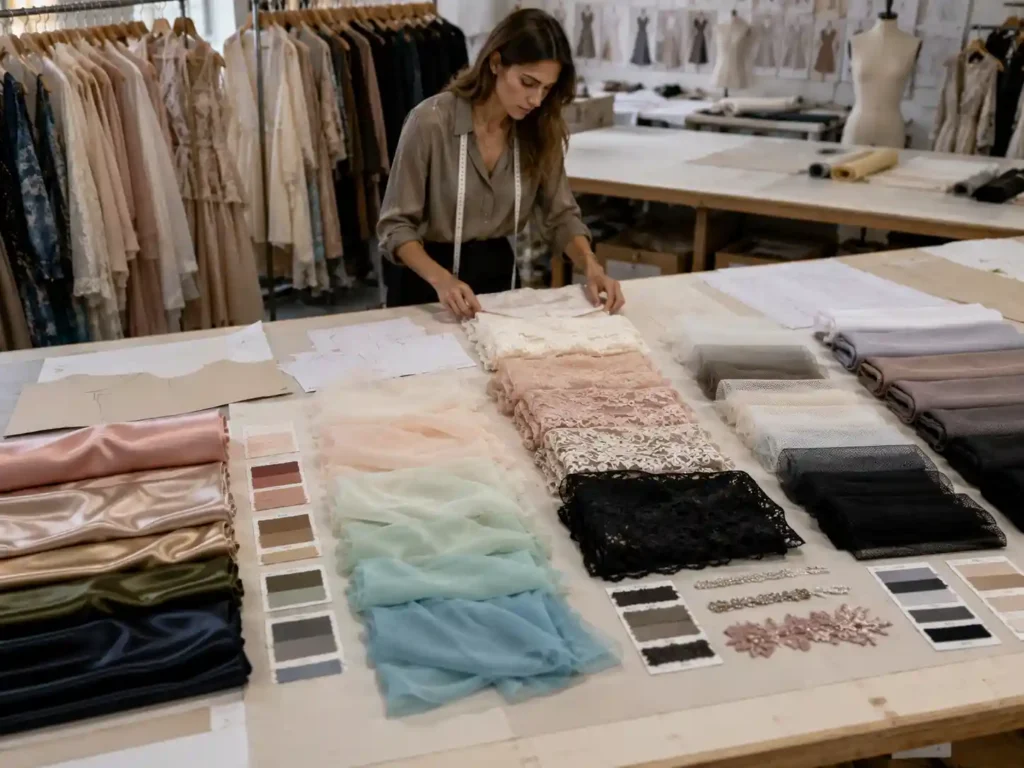
Fabric risk control starts with realistic testing. Before bulk cutting, the factory should check shade, width, defects, shrinkage risk, stretch direction, recovery, hand feel and surface sensitivity. For printed fabrics, direction and placement matter. For velvet, nap direction matters. For sequins, scratch protection matters. For mesh, stretch and recovery matter.
Brands should ask for fabric swatches or lab dips when color is critical. For custom dye or custom print, lead time and minimum quantity may change. For complex fabrics such as lace and sequins, the fabric supplier’s availability can affect production timing. A good supplier will not only say whether a fabric is available. They will explain what that fabric means for sampling, cutting, sewing, pressing, packing and final quality.
| Fabric | Typical Use | Common Risk | Practical Control |
| Satin | Evening, slip, formal dresses | Puckering, snagging, shine marks | Fine needle, tension control, careful pressing |
| Chiffon | Resort, bridesmaid, layered dresses | Shifting, transparency, uneven hem | Stable spreading, lining check, hem balance |
| Lace | Occasionwear, formal dresses | Motif mismatch, rough seams | Placement planning, lining choice, seam comfort |
| Mesh | Party, cut-out, bodycon styles | Stretch distortion, transparency | Recovery check, coverage review, seam stability |
| Sequin | Evening and party gowns | Scratch, weight, sequin loss | Lining protection, reinforced seams, surface QC |
| Velvet | Formal and winter styles | Nap direction, pressure marks | Direction control, gentle pressing, careful packing |
How Are Patterns and Samples Made?
Patterns and samples are made by turning the approved design into cuttable garment pieces, sewing the first sample, checking fit and balance, revising the pattern and confirming a PP sample. For floor-length dresses, pattern accuracy must control total length, skirt sweep, waist position, side seam balance, lining, slit and fabric behavior.
Pattern Structure
The pattern starts with the support point of the dress. A strapless gown, halter dress, slip dress, corset dress and waist-seamed maxi all hang from different areas of the body. This affects how the pattern is built and how the garment behaves when worn. The upper body controls the lower body more than many people expect. If the bust fit is loose, the whole dress may slide downward. If the waistline is too high or too low, the skirt proportion changes.
The skirt pattern must also control grainline, flare, sweep, side seam and center balance. Long panels expose cutting and pattern errors quickly. A slightly twisted grainline can cause the hem to swing to one side. A poorly balanced flare can make the dress look uneven even when measurements are correct. Good pattern making is not just technical drawing. It is the process of predicting how fabric, body shape and movement will interact.
First Sample
The first sample tests whether the design can become a real garment. It does not always need to be perfect, but it must reveal the main production problems. For floor-length dresses, the first sample should show whether the length, drape, fit, lining, slit and overall proportion are moving in the right direction. A buyer should check the sample carefully and give specific comments.
Clear comments help the factory revise quickly. “Reduce front length by 2 cm,” “raise slit by 3 cm,” “add 1 cm at hip,” “shorten lining by 2 cm,” or “change hem finish to narrow rolled hem” gives the sample room useful direction. It is also important to separate design preference from technical defect. A buyer may prefer a lower neckline, while a twisted side seam is a production issue. The first sample is where many future costs are saved.
Fitting Review
The fitting review should test the garment on the body, not only on a flat table. Floor-length dresses must be checked while standing, walking, turning and sitting. The team should review bust support, waist position, hip ease, strap placement, zipper smoothness, lining comfort, slit opening and hem balance. Photos are useful, but videos often reveal more because they show movement problems.
For commercial brands, the fitting review should also consider the target customer. A dress for partywear may need more movement and body confidence. A formal gown may need structure and elegance. A resort floor-length dress may need comfort and easy packing. The pattern should serve the selling scenario, not just the sketch. A dress may look perfect from the front but twist when walking. A slit may look elegant when standing but open too much in movement.
PP Sample Standard
The PP sample is the final approved sample before bulk production. It should represent the exact fabric, color, trims, measurements, construction, finishing and packing standard that the buyer expects. For floor-length dresses, approving a PP sample without checking hem balance and lining behavior is risky. The PP sample should be kept as a physical reference for production supervisors and QC inspectors.
Before bulk starts, the factory should update the pattern, grading, cutting marker, sewing instructions and inspection checklist based on the PP sample. If any detail changed during sampling, it must be reflected in production documents. Otherwise, the factory may accidentally produce according to an old version. A reliable PP sample creates alignment. Everyone involved can see the same final target.
How Are Dresses Cut and Sewn?
Floor-length dresses are cut and sewn through fabric inspection, spreading, marker planning, cutting, bundling, sewing, in-line checking, finishing and pressing. Long panels require careful control of fabric direction, seam tension, lining attachment, zipper setting, slit finishing, hem balance and delicate fabric handling.
Fabric Inspection and Cutting
Before cutting, fabric should be inspected for defects, shade difference, width, stretch direction, print direction, nap direction and surface damage. This is especially important for floor-length dresses because the panels are long and visible. A small defect near the hem or center front can ruin the whole garment. Spreading must match the fabric. Chiffon and mesh can move easily. Satin can slide. Velvet has nap direction. Sequin fabric needs careful cutting and surface protection.
Marker planning affects both cost and quality. A tight marker may save fabric, but poor placement can create twisting, mismatched prints or uneven drape. For long dresses, fabric economy should be balanced with grainline and visual direction. If the dress has a center front seam, side slit, large print or lace border, the marker must respect the design. After cutting, bundles should be organized clearly by size, color and part. Long panels can be confused or damaged if handling is careless.
Sewing Long Panels
Long panels are challenging because fabric weight and movement can affect seam accuracy. If the panel hangs off the sewing table, it may pull and stretch during sewing. If the operator feeds the fabric unevenly, the side seam can twist. If the lining is attached with different tension, the shell may pucker or pull. Machine settings matter. Needle size, stitch length, thread tension and presser foot pressure should match the fabric.
In-line inspection is important. Waiting until the final garment is finished may be too late. Supervisors should check seam smoothness, panel length, zipper flatness, lining attachment, slit finishing and surface damage during production. Long dresses benefit from early correction because one sewing issue can affect the full garment length. Satin may need fine needles and careful tension. Chiffon may require clean seam finishing. Mesh and stretch fabrics need recovery control. Sequins may require trimming or special handling at seam areas.
Zippers, Slits and Linings
Zippers, slits and linings are high-risk areas in floor-length dresses. An invisible zipper must sit flat without ripples. If the back seam stretches during zipper setting, the dress can look poor even if the front is beautiful. Structured gowns may also require zipper reinforcement because tension around the waist and hip can be high.
Slits must be controlled for both appearance and movement. A slit that is too low may restrict walking. A slit that is too high may feel uncomfortable for the target market. The slit angle, seam finishing, reinforcement and lining opening all affect the final result. Linings should move with the shell, not fight against it. If the lining is shorter, narrower or tighter than planned, the outer dress may pull. If the lining is too loose, it may twist or show.
Hem and Finishing
The hem is one of the final and most important checks. Some floor-length dresses need the garment to rest before final hemming, especially if the fabric is bias-cut, fluid, heavy or layered. If the fabric drops after hemming, the finished dress may become uneven. Different fabrics need different hem finishes. Chiffon often uses narrow rolled hems or baby hems. Satin may use clean narrow hems or blind hems depending on the style.
Finishing also includes trimming threads, checking stains, removing loose fibers, pressing, steaming and final appearance review. Pressing should be fabric-specific. Too much heat can damage satin, velvet, mesh or sequins. Too little finishing can leave the dress looking wrinkled and low-value. A floor-length dress is judged from top to bottom. Even if the bodice is beautiful, a poor hem can make the whole garment look cheap.
| Production Stage | Key Check | Common Problem If Missed |
| Fabric inspection | Shade, defects, stretch, direction | Panel mismatch or visible flaws |
| Spreading | Stability and fabric alignment | Skewed cutting or uneven length |
| Cutting | Grainline, marker direction, panel accuracy | Twisted seams or poor drape |
| Sewing | Seam tension, panel handling, lining control | Puckering, pulling or twisting |
| In-line QC | Zipper, slit, side seam, surface damage | Rework discovered too late |
| Finishing | Hem, pressing, thread trimming | Uneven appearance before packing |
How Is Quality Checked Before Shipping?
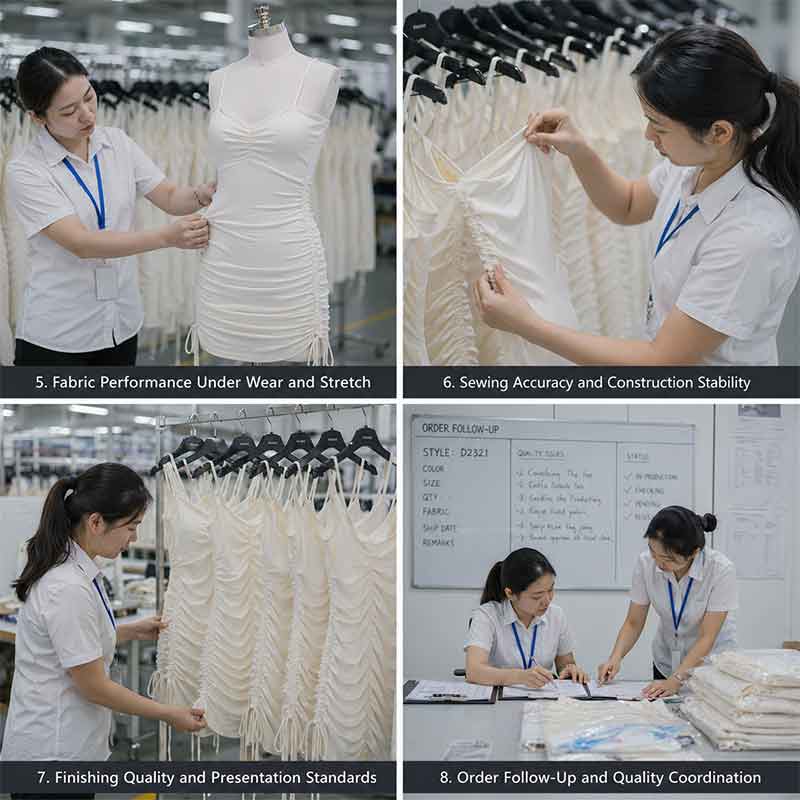
Quality is checked through fabric inspection, cutting checks, sewing inspection, measurement review, appearance inspection, fit comparison, pressing review, packing inspection and final pre-shipment checking. For floor-length dresses, QC must focus on length, hem balance, lining, slit height, zipper, seams, fabric surface, pressing and packaging protection.
Measurement Inspection
Measurement inspection should compare bulk garments against the approved spec and PP sample. For floor-length dresses, inspectors should not only measure bust, waist and hip. They should also check total length, side seam length, center front, center back, lining length, slit height and hem sweep. The measurement method must be consistent. If one inspector measures total length from high point shoulder and another measures from neckline edge, the results will be unreliable.
In bulk production, not every garment may be measured fully, depending on the buyer’s inspection standard. However, high-risk points should be checked more frequently. Length, slit height, zipper and hem balance deserve extra attention because they affect customer experience immediately. If the order includes several sizes and colors, QC should check across the full size and color range. A sample size may be correct while larger sizes or darker colors reveal different issues.
Hem Balance Review
Hem balance should be checked visually and by measurement. The garment should be hung or placed on a suitable form so the inspector can see whether the front, back and sides fall evenly. For some styles, a flat table check is not enough because gravity changes the appearance. The inspector should look for left-right imbalance, side seam pulling, lining showing below shell, uneven curved hems, stretched bias areas and irregular pressing.
Hem balance is especially important for satin, chiffon and formal gowns because photos expose every uneven line. In ecommerce, the product page often shows the dress full-length. Customers expect the received garment to match that image. If the hem looks careless, the entire brand impression suffers. Good QC does not treat the hem as a final minor step. It treats the hem as one of the most visible quality points.
Appearance and Surface Check
Appearance inspection covers stains, holes, snags, loose threads, seam puckering, fabric pulls, color marks, broken stitches, uneven pressing, damaged lace, missing sequins and zipper problems. Floor-length dresses often use delicate fabrics, so surface inspection is critical. Satin should be checked for snags, shine marks and water spots. Chiffon should be checked for pulls, holes and uneven layers. Lace should be checked for broken motifs and rough seams.
The inspector should also check inside the garment. Customers may not see internal construction at first glance, but they feel it when wearing the dress. Rough seam allowances, exposed sequin edges, twisted lining or uncomfortable boning can create complaints. Mesh should be checked for runs and stretching. Sequin fabric should be checked for missing sequins, scratchy inner areas and loose threads. A beautiful outside with an uncomfortable inside is not a well-made floor-length dress.
Pressing and Packing
Pressing and packing are part of quality, not just logistics. A dress can pass sewing inspection and still arrive looking poor if pressing and packing are wrong. Long dresses are sensitive to folds, pressure and surface damage. The finishing team should press or steam according to fabric type. Satin needs careful heat control. Velvet needs protection from pressure marks. Chiffon needs gentle handling. Sequins and embellishments should not be crushed.
Packing should match the buyer’s sales channel. Ecommerce brands may need polybags, barcode labels, SKU labels and carton marks. Premium occasionwear may need protective folding, tissue paper or better carton planning. If dresses are packed too tightly, the hem and bodice can crease heavily. Before shipping, cartons should be checked for correct size ratio, color ratio, label accuracy, carton marks and packing list consistency. A well-made dress should arrive ready for warehouse handling, photoshoot preparation or retail distribution.
How Should Your Brand Start a Floor-Length Dress Project?
The best way to start a floor-length dress project is to prepare your design direction, fabric preference, size range, target quantity, sample needs, label requirements and launch timeline before asking for production evaluation. A professional supplier can then assess feasibility, cost drivers, sampling risks and bulk production controls before fabric is purchased or cut.
Floor-length dresses are manufactured through a controlled chain of decisions: design interpretation, fabric selection, pattern development, sampling, fitting, grading, cutting, sewing, finishing, inspection, pressing and packing. The difference between an average supplier and a professional floor-length dress manufacturer is not whether they can sew a long dress. It is whether they can keep the approved look, length, drape, fit and finishing stable across bulk production.
For fashion brands, the smartest next step is to prepare your design direction and let the factory evaluate feasibility before you lock the collection. A professional review can help you avoid fabric mistakes, length issues, lining problems, unstable hems, uncomfortable slits, poor packaging and costly bulk revisions.
Jinfeng Apparel is a Guangdong-based custom women’s fashion manufacturer serving global fashion brands and mid-to-large custom apparel clients with OEM, ODM, private label, dress development, sampling, bulk production, quality control, packaging and export delivery support. The company focuses on custom dresses, maxi dresses, floor-length dresses, evening dresses, occasionwear, partywear and private-label women’s collections. Send your tech pack, reference image, original sample or line sheet to start a custom floor-length dress development project and receive a professional production evaluation for your next collection.