Skip to content

A fashion collection should never be treated as a room full of equally important designs. Some styles must quietly generate dependable sales month after month. Others must make customers stop scrolling, refresh the visual identity of the brand, and give the marketing team something new to talk about. Problems begin when a brand buys every design as though it has the same demand certainty, selling window, margin potential, and replenishment value.
To divide a collection into core and fashion styles, classify each design by demand stability, full-price sales potential, trend exposure, fit reliability, material continuity, production risk, and reorder potential. Give core styles deeper inventory and planned replenishment; give fashion styles controlled first quantities, focused colorways, and faster post-launch review.
That answer sounds simple until a real collection enters the meeting room. Design loves the corset dress with asymmetric draping. Merchandising trusts the fitted midi that has sold for three seasons. Marketing wants more visual statements. Finance wants fewer markdowns. Production warns that the hero fabric has a high dyeing minimum. At that point, “core versus fashion” is no longer a creative label. It becomes a decision about cash, capacity, launch timing, and whether the brand can still make money after the first excitement has passed.
What Are Core and Fashion Styles?
Core styles are dependable products with stable demand, proven fit, repeatable materials, and realistic reorder potential. Fashion styles depend more heavily on seasonal trends, new silhouettes, novelty fabrics, color stories, or short selling windows. Core products protect continuity and margin, while fashion products create freshness, attention, and new commercial learning.
Core Styles
A core style is not automatically plain, basic, or permanently available. It is a product whose commercial behavior has become reasonably predictable. A fitted black midi dress, for example, may become core after several launches show that customers understand the fit, the return rate remains manageable, the fabric can be reordered, and demand continues beyond one campaign. A simple top that sells only during discount periods would not deserve the same classification.
A reliable core candidate usually has several supporting signals:
- Demand continues across more than one selling period.
- The style sells at full price without constant promotion.
- Size performance, fit comments, and return reasons are understood.
- Approved patterns and measurement charts can be reused.
- Fabrics and trims remain available or have approved substitutes.
- Production quality can be repeated across batches.
- Reorders can arrive before the selling window closes.
- The product remains relevant to the brand’s customer and price architecture.
Core status should be earned through evidence. It should not be assigned because a buyer likes the style, because the design looks safe, or because the product has remained in the range for a long time. A strong core product is valuable because uncertainty is lower. The brand knows who buys it, how it fits, which colors work, which sizes sell, what it costs to reproduce, and how quickly it can be replenished.
Fashion Styles
Fashion styles introduce change. They may use a new neckline, proportion, fabric, print, color, trim, finish, or wearing occasion. Their role is often to make the collection feel current before long-term demand is fully understood.
Common fashion-style signals include a newly emerging silhouette, seasonal print, asymmetric hem, corset structure, cut-out, dramatic sleeve, novelty lace, mesh, sequins, embellishment, untested price point, new fit block, or heavy dependence on one campaign date. These styles are not secondary products. They often attract the first click, create social content, support campaign photography, and give wholesale buyers a reason to review the new range.
The commercial mistake is treating visual impact as proof of demand. A striking dress may receive strong engagement but still sell slowly if customers are uncertain about fit, occasion, styling, or value. Fashion styles therefore need controlled commitment, faster review, and clear exit rules. A useful test should be large enough to reveal real demand but small enough to protect the business if the trend does not convert.
Carryover and Seasonal Core
Carryover, core, and seasonal core are different classifications. A carryover style simply continues from an earlier collection. It may continue because demand remains strong, because delivery was delayed, or because inventory remains. Only the first reason strongly supports core status.
- Permanent core: planned for ongoing sale and replenishment across most of the year.
- Seasonal core: returns during a defined recurring season, such as resort, graduation, or holiday party periods.
- Carryover: continues from a previous delivery, regardless of whether demand remains strong.
- Updated bestseller: a proven silhouette changed through color, fabric, length, or detail.
- Fashion test: a new product with limited demand history.
- Image style: developed mainly for storytelling, editorial use, or campaign impact.
A satin slip dress may be permanent core in black but only seasonal core in a bright print. A successful corset mini may return with a revised neckline, yet the new construction should still be treated as a development risk. Classification should reflect what is truly proven, not what the team hopes will repeat.
Commercial Roles
Core and fashion products answer different commercial questions. Core styles answer: What can we sell repeatedly? Which products deserve deeper size coverage? Which silhouettes support replenishment? Where can we reduce development uncertainty? Fashion styles answer: What makes the new collection feel new? Which trend should we test? Which product can lead the campaign? What might become next season’s commercial winner?
| Planning factor | Core style | Fashion style |
| Demand certainty | Relatively high | Lower or unproven |
| Selling window | Longer or recurring | Often shorter |
| Initial quantity | Usually deeper | Usually controlled |
| Color strategy | Focused on proven demand | Selective and trend-led |
| Reorder plan | Prepared in advance | Conditional on early results |
| Fit history | Proven or refined | New or partly tested |
| Material strategy | Continuity is important | Novelty may be more important |
| Main role | Stable revenue and availability | Newness, attention, and learning |
| Main risk | Overconfidence in an ageing product | Excess stock in an unproven product |
The strongest collections allow the two groups to work together. A fashion neckline may be developed on an approved core body block. A successful trend color may later become a recurring shade. A fashion dress that performs across multiple deliveries may gradually move into seasonal core. Fashion creates learning; core turns proven learning into repeatable revenue.
How Do You Set the Right Mix?
The right core-to-fashion mix depends on sales history, product category, launch frequency, channel, replenishment speed, margin, and inventory risk. Measure the mix by styles, SKUs, units, purchase cost, and planned sales contribution rather than relying on one fixed percentage.
No Universal Ratio
There is no single ideal ratio that works for every fashion business. A replenishment-led retailer may need a higher share of dependable products because customers expect key sizes to remain available. A trend-led ecommerce brand may offer more fashion styles but commit fewer units to each one. An occasionwear label may rely on new silhouettes, while a workwear brand may depend more heavily on continuity.
Planning ranges can help a team begin the discussion, but they should not be treated as universal benchmarks. The right ratio should reflect the percentage of sales from proven products, frequency of product drops, supplier replenishment time, customer expectation for newness, share of sales generated at full price, length of the selling window, available working capital, and the number of channels sharing the stock.
| Brand model | Illustrative core unit share | Illustrative fashion unit share | Main planning concern |
| Replenishment-led retail | 65%–80% | 20%–35% | Size availability and continuity |
| Established ecommerce brand | 50%–65% | 35%–50% | Newness without excessive returns |
| Trend-led online fashion | 30%–45% | 55%–70% | Fast testing and short trend life |
| Seasonal occasionwear | 35%–55% | 45%–65% | Event timing and demand peaks |
| Wholesale-led collection | 40%–60% | 40%–60% | Sample width versus confirmed orders |
These ranges are examples for planning discussion, not fixed industry rules. A brand should compare any proposed mix with its own full-price sales, markdowns, return rate, reorder speed, cash position, and category maturity. The ratio may also change during the year. A summer resort drop may carry more fashion products than a transitional delivery, while a mature dress category may be core-heavy and a newly launched category may require more controlled experimentation.
Styles, SKUs, and Units
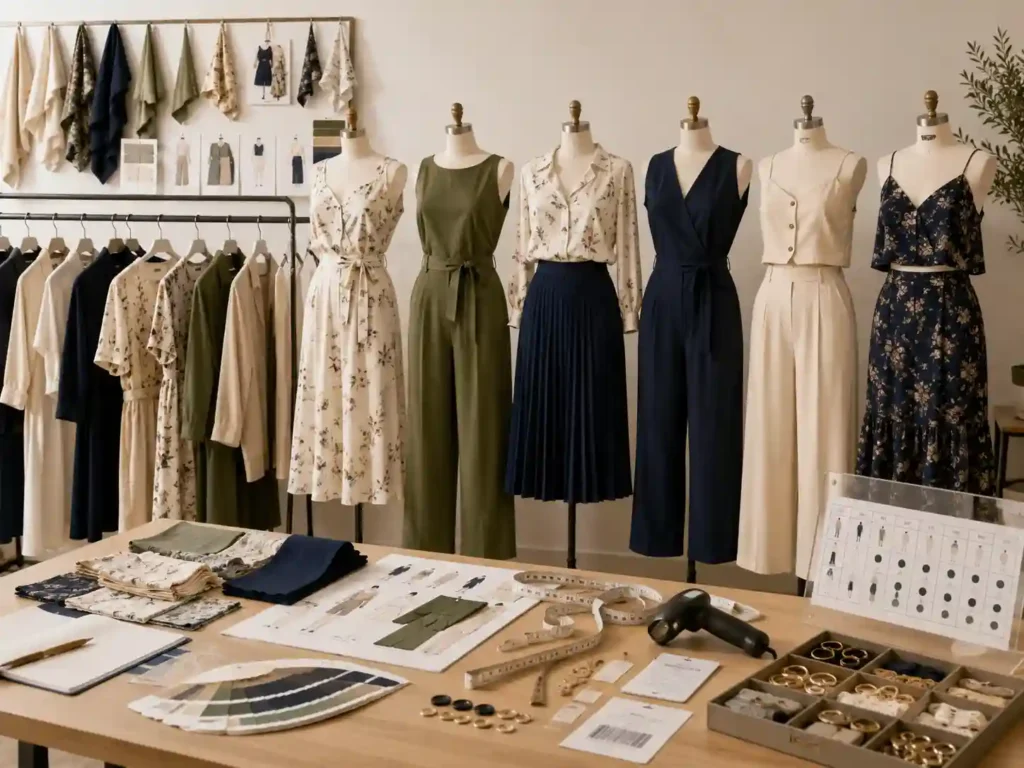
A collection can be fashion-heavy by style count and core-heavy by inventory investment. Consider a 20-style dress collection containing six core styles and fourteen fashion styles. By style count, the collection is 30% core and 70% fashion. Now assume each core style receives 1,200 units and each fashion style receives 200 units. Core inventory becomes 7,200 units, fashion inventory becomes 2,800 units, and the unit mix is 72% core and 28% fashion.
Both descriptions are correct; they simply measure different risks. Style share measures design variety. SKU share measures operational complexity. Unit share measures physical inventory exposure. Purchase-cost share measures cash commitment. Planned revenue share measures commercial expectation. Gross-margin share shows where profit is expected to come from.
A practical line plan should show at least six views: percentage of total styles, total SKUs, total units, purchase cost, planned revenue, and planned gross margin. Without these views, design, merchandising, buying, finance, and production may believe they agree while discussing different versions of the collection.
Channel Impact
Sales channels change how much fashion risk a business can carry. A direct-to-consumer brand can launch a style, observe customer behavior quickly, and redirect marketing spend toward products that convert. It may also face high paid-traffic costs, volatile demand, and rapid trend decay. A wholesale brand often develops a wider sample range than it finally produces, reducing finished-goods exposure but increasing sample-development cost.
A retail chain needs reliable availability across locations. One style may require enough inventory to support many stores, making unproven fashion depth more dangerous. Marketplace businesses need tighter barcode, SKU, packaging, listing, restock, and customer-review control. Occasionwear brands may need greater visual novelty, yet their selling windows are tied to weddings, graduation, holidays, and event calendars.
The essential questions are: How quickly can real demand be observed? How quickly can the product be reproduced? How expensive is unsold stock in this channel? How damaging is a stockout? Can inventory move between regions or channels? The slower the feedback and replenishment cycle, the more carefully fashion quantities should be controlled.
Category and Season
Different categories need different core-to-fashion structures. A stretch jersey bodycon dress may be suitable for repeat production because the fabric, fit block, and construction remain consistent. A printed chiffon maxi may perform every summer but depend on seasonal color and print direction. A sequin mini may have a short holiday peak but deliver strong margin during that window.
- Is the wearing occasion recurring or event-specific?
- Does the product depend on weather or a narrow calendar window?
- Is the fit forgiving or highly sensitive?
- Can the fabric and trims be reordered in the same quality and shade?
- Can the silhouette be refreshed without rebuilding the fit?
- Can the style sell in more than one market, region, or channel?
- Does demand continue after the campaign ends?
A product should therefore not be labeled simply as “core.” It may be core for one market, one channel, one season, or one customer group. The more precisely the role is defined, the more accurate the quantity, timing, and replenishment plan becomes.
Which Styles Belong in Each Group?
Classify styles through consistent commercial and operational evidence. The strongest indicators are full-price sell-through, margin after returns, fit stability, material continuity, reorder speed, trend exposure, and production repeatability. No single metric is strong enough on its own.
Sales Evidence
Total sales can be misleading. A product may appear successful because it received more stock, stronger homepage placement, paid advertising, influencer exposure, or a larger discount. Fair comparison requires rate-based and quality-based measures.
- Full-price sell-through and weekly sales velocity
- Conversion rate and customer acquisition source
- Overall return rate and fit-related return rate
- Markdown percentage and gross margin after returns
- Sales by size, color, channel, and region
- Stockout timing and lost-sales risk
- Repeat-order history and reorder conversion
- Sales concentration around one campaign or promotion
Suppose two dresses each sell 800 units. Dress A sells 800 of 1,000 units mainly at full price with a manageable return rate. Dress B sells 800 of 1,500 units, but half the volume occurs after a 40% markdown. The same sales volume does not indicate the same core potential. Dress A shows stronger demand quality; Dress B may still carry excess stock and weak margin.
Selling speed also requires context. A limited event dress available for four weeks should not be judged in the same way as a year-round midi available for six months. The question is not only “How much did it sell?” It is “Why did it sell, at what margin, and can the result be repeated?”
Margin and Reorder Value
A high-volume style can still be a weak core product. Some garments carry hidden costs through high returns, fabric wastage, difficult inspection, hand-finishing time, special packaging, expensive freight, repairs, quality claims, shade variation, or long replacement lead times. Core assessment should look at contribution after these costs, not only the difference between retail price and factory price.
Reorder potential is equally important. A dress cannot operate as a dependable core product when its lace is discontinued, its hardware requires a large minimum, or its fabric production takes longer than the remaining selling window. A strong core product normally has an approved pattern, stable measurement chart, repeatable fabric, identified trims, clear sewing methods, known inspection points, workable reorder quantity, and realistic reorder timeline.
Commercial success without supply continuity may create a one-time bestseller, but not a reliable core program. The best core products are not only wanted by customers; they are also operationally repeatable at the required quality, cost, and speed.
Risk Signals
Fashion classification is often driven by uncertainty, not appearance. A simple dress may still be high risk if it uses a new fit block, unfamiliar fabric, untested price point, or new customer occasion. A visually complex garment may be more predictable if it uses a proven body shape and known materials.
- No direct history for the silhouette or wearing occasion
- New bust, waist, hip, or length proportion
- High fit sensitivity or difficult grading
- Short trend life or limited-use color
- Custom dyeing, printing, lace, hardware, or embellishment
- Labour-intensive sewing or high production variation
- Dependence on one campaign or event date
- Uncertain customer price acceptance
- Limited reorder capability within the sales window
Risk becomes more serious when several new variables appear together. A new silhouette in a proven fabric is easier to manage than a new silhouette combined with a new fabric, new supplier, new price point, new trim, and new size range. Experienced teams often keep some variables stable by applying a trend-led neckline to an approved block, using a seasonal color in a proven fabric, or introducing a new skirt shape with a familiar bodice.
Style Scorecard
A scorecard does not replace judgment, but it makes trade-offs visible. Each proposed style can be rated from one to five, with higher scores indicating stronger core potential.
| Factor | 1 point | 3 points | 5 points |
| Demand evidence | No history | Similar product history | Repeated direct history |
| Full-price margin | Weak or promotion-led | Acceptable | Strong and consistent |
| Fit confidence | Untested | Similar block tested | Approved fit repeated |
| Fabric continuity | One-off or uncertain | Alternative available | Reliable repeat supply |
| Reorder speed | Too slow for season | Possible with risk | Fits selling window |
| Production repeatability | High variation | Manageable | Stable and documented |
| Trend exposure | Very high | Moderate | Low |
| Brand relevance | Weak connection | Suitable | Strong signature fit |
An illustrative interpretation might classify 34–40 points as a strong core candidate, 27–33 as seasonal core or commercial carryover, 19–26 as a controlled fashion style, and 8–18 as an image style or high-risk test. The thresholds should be adjusted to match the brand’s economics. An image style may still deserve development when it leads a campaign, supports press coverage, or communicates a new direction. The scorecard should inform the decision, not make it automatically.
How Should Width and Depth Differ?
Core styles usually need greater unit depth, stronger size coverage, proven colors, and planned replenishment. Fashion styles usually need more design width, fewer speculative colorways, and controlled first quantities. Match inventory commitment to demand confidence without making the test too small to produce useful information.
Core Depth
Core depth should be based on forecast demand, replenishment time, expected service level, and the cost of a stockout. A style may justify deeper buying when weekly sales are stable, full-price performance is strong, size ratios are understood, fabric supply is dependable, the pattern is approved, quality can be repeated, and reorders can arrive in time.
Depth should not be distributed evenly without evidence. Assume a core dress is planned for 2,000 units and historical color demand is 50% black, 25% navy, 15% burgundy, and 10% seasonal color. An equal split would place 500 units into every color. A demand-based allocation would place approximately 1,000 black, 500 navy, 300 burgundy, and 200 seasonal units.
Size allocation should follow the same principle. A bodycon mini, loose resort maxi, structured corset dress, and stretch jumpsuit should not use the same size curve. Core buying is deeper, but it should remain evidence-led. The goal is not simply to hold more inventory; it is to maintain availability where profitable demand is most likely to occur.
Fashion Depth
Fashion depth should be large enough to support a real launch but small enough to limit exposure before demand is proven. The right first quantity depends on expected traffic, campaign budget, selling window, price point, supplier minimum, number of colors, number of sizes, similar-style history, reorder time, and material availability.
A very small quantity is not always a useful test. If key sizes sell out in the first few days, the brand may not learn whether the style had sustainable demand or merely insufficient stock. A controlled fashion launch often works better with one or two focused colors, a commercially realistic size curve, enough stock to support planned traffic, a defined review date, a pre-agreed reorder decision, and reserved materials where possible.
A hero campaign style may require more depth than an ordinary fashion test because marketing investment creates its own demand expectation. Inventory and promotion should be planned together. A style should not receive a six-figure campaign budget while being stocked too shallowly to convert the resulting traffic.
Color and Size Risk
Every additional color and size creates more SKUs, but it does not automatically create more sales. A dress offered in six colors and six sizes creates 36 SKUs. If the manufacturing minimum is 200 pieces per style and color, six colors may require at least 1,200 garments before the size split is considered. That may be reasonable for a proven core dress but too much for an untested fashion silhouette.
A practical color structure separates proven commercial colors, supporting neutrals, seasonal colors, and experimental campaign colors. Not every fashion style needs all four. SKU reduction is often more useful than cutting every option to an impractical quantity. Removing two weak colors may provide better availability in the remaining sizes and produce cleaner sales information.
The same applies to size ranges. A style with 20 units in each of ten sizes may look inclusive on paper but fail commercially if the quantity cannot support real demand in the key sizes. The better objective is not maximum assortment width. It is useful choice with dependable availability.
Split Production
Split production can reduce initial risk when the supply chain is prepared before launch. The percentages below are planning examples rather than fixed rules.
| Production stage | Share of forecast demand | Purpose |
| First production run | 55%–65% | Support launch and initial sales |
| Reserved fabric capacity | 20%–30% | Allow faster replenishment |
| Flexible balance | 10%–20% | Adjust colors, sizes, or channels |
| First review point | 14–28 selling days | Compare demand with plan |
Split production works only when preparation is complete. The manufacturer may need to retain approved patterns, measurement files, fabric references, trim codes, construction details, packaging instructions, quality standards, and carton specifications. Materials with long lead times may still need to be reserved in advance.
A small emergency reorder can carry a higher unit cost, disrupt production scheduling, or create shade variation. The decision should compare the carrying cost and markdown risk of excess inventory with the higher cost and timing risk of later replenishment. Replenishment is a planned supply-chain capability, not an emergency solution created after stock has already run out.
How Do Development Plans Differ?
Core and fashion styles should not follow identical development paths. Core products require repeatable fit, documented materials, and production consistency. Fashion products need stronger early risk assessment, focused sample testing, and firm approval deadlines. Allocate development time according to complexity, commercial value, material lead time, and launch sensitivity.
Sampling Priority
Sampling effort should follow risk rather than label. A proven core style may need only a controlled update when the pattern, fabric, grading, and construction remain unchanged. A fashion style with corsetry, boning, draping, asymmetric seams, cut-outs, lace placement, mesh transparency, or mixed stretch behavior usually needs more development attention.
- Silhouette balance and garment proportion
- Bust, waist, and hip measurements
- Movement and wearing comfort
- Fabric recovery, opacity, and lining behavior
- Seam stability and zipper performance
- Hem balance and drape
- Grade rules across the size range
- Construction repeatability in bulk production
- Appearance after pressing, folding, and transit
A sample should answer specific questions. “Make it better” is not a useful fit comment. Clear comments identify the location, required change, and expected result: raise the front neckline by 1.5 cm, reduce the waist circumference by 2 cm, shorten the lining by 3 cm, or move the side seam 1 cm toward the back. Specific comments reduce misunderstanding and unnecessary sample rounds.
Fabrics and Trims
Fabric and trim decisions can change the entire core-to-fashion plan. A brand may want 200 garments in a new color, but the fabric supplier may require a dye lot large enough for far more. A custom print, lace, logo hardware, zipper color, elastic, lining, or branded package may each have a separate minimum.
- Is the fabric available in stock colors?
- What is the custom-dye, print, or weaving minimum?
- Can several styles share the same material?
- Can trims be standardized across the range?
- Is shade continuity critical for reorders?
- Does the fabric require testing for shrinkage, colorfastness, or stretch recovery?
- Is an approved substitute available?
- Can leftover material be used in another style?
Core products benefit from continuity. A slightly cheaper material is not always the better choice when it cannot be reordered. Fashion products may justify unique materials, but their unit plan should reflect the real material minimum. Developing six fashion styles in six unrelated fabrics may create more financial exposure than developing the same number of styles around two coordinated fabric groups.
For custom production, standard MOQ may begin at 200 pieces per style and color, while custom weaving, dyeing, printing, special lace, hardware, embellishment, and packaging can create separate supplier-level minimums. Material planning is part of collection architecture, not a sourcing task that begins after design approval.

Tech Pack Control
A tech pack should explain both how to make the garment and what role the garment plays in the collection. It should include front and back technical sketches, construction details, measurement chart, grade rules, bill of materials, colorways, fabric specification, trim specification, label and packaging details, target cost, planned quantity, launch date, reorder potential, critical fit points, quality requirements, and approved substitutions.
The product role should also be clear: permanent core, seasonal core, carryover, fashion style, or image style. That context changes sourcing decisions. A core dress may need a fabric with dependable future availability, even if another option is slightly cheaper today. A fashion dress tied to a campaign may prioritize delivery certainty over theoretical replenishment.
Version control is essential when many styles develop at the same time. Every measurement update, fabric approval, trim change, and fit correction should carry a date or version number. Uncontrolled comments spread across email, chat, and unmarked photos create avoidable errors. A single approved source of truth protects both the brand and the manufacturer.
Lead-Time Decisions
A product can be commercially attractive and still be unsuitable for the collection if it cannot arrive on time. Lead time may include design clarification, fabric sourcing, lab dips, print strike-offs, pattern development, first sample, fit revision, photo sample, pre-production sample, fabric production, cutting, sewing, inspection, packing, freight, and customs clearance.
Core products can often begin earlier because the pattern and demand are known. Fashion products may begin later because the brand wants more current trend information, yet they frequently require more sampling. That creates a timing conflict. Experienced teams reduce pressure through approved fit blocks, shared fabrics, preselected trims, early material reservations, clear sample deadlines, faster internal approvals, and defined fallback options.
Every style should have a latest safe approval date. After that date, the team should simplify the design, change the delivery, use faster freight, or remove the style. A fashion product arriving after the campaign window is not merely late; it may no longer have the demand required to justify its inventory.
How Do You Review the Mix?
Review the collection after launch using full-price sell-through, gross margin, return rate, stock cover, size availability, color performance, markdowns, and reorder results. Promote fashion styles into core only when both demand and production repeat reliably. Retire core styles when their commercial role weakens.
Key Metrics
The most useful metrics connect demand, inventory, and profit. Track full-price sell-through, weekly sales velocity, gross margin after returns, markdown rate, overall return rate, fit-related return rate, weeks of supply, stockout rate, size availability, color availability, reorder quantity, reorder lead time, and channel contribution.
Review timing should match the product role. A fashion style may need assessment after 7, 14, and 30 selling days. A core style may need monthly availability review, seasonal margin review, semiannual range review, and annual material-continuity review. Waiting until the season ends may be too late to replenish a winner or stop a weak repeat order.
Context matters. A style with 80% sell-through may look successful, but not when most units sold during a major markdown. A slower product may still be commercially healthy if it holds full price, has low returns, and attracts profitable repeat customers. Review should identify the reason behind the result: product design, fit, color, price, timing, inventory, marketing, channel, delivery delay, or product-page quality.
Fashion-to-Core Promotion
A fashion style should become core only when commercial and operational evidence support the move. Useful evidence includes more than one successful delivery, stable full-price sales, acceptable return behavior, consistent fit feedback, reliable margin, demand across more than one campaign, successful reorder execution, material continuity, clear size performance, and continued brand relevance.
The team should also decide which part of the product becomes core. It may be the complete garment, fit block, bodice, skirt shape, neckline, fabric, or wearing occasion. A successful ruched mesh midi does not need to return unchanged forever. The approved body block may become the core asset, while sleeve, color, length, and surface detail change by season.
This approach preserves commercial learning without making the range repetitive. Promotion into core should be documented in the next line plan, with color strategy, forecast depth, replenishment method, material continuity, and production records confirmed before the next launch.
Core Retirement
Core does not mean permanent. A core product should be reviewed when it shows declining full-price sales, greater markdown dependence, rising return rates, repeated size imbalance, lower reorder efficiency, increasing production cost, material discontinuation, loss of brand relevance, cannibalization by a newer style, or excessive customer familiarity.
Some products can be refreshed rather than removed. Possible changes include improving fabric weight, correcting the neckline, adjusting dress length, revising lining, simplifying construction, updating the color offer, or improving packaging. However, superficial changes should not hide deeper problems. A new color will not repair poor fit. A shorter sleeve will not solve an uncompetitive price. A new campaign will not restore demand for a silhouette customers have left behind.
Retirement rules should be agreed before emotional attachment affects the decision. A brand might trigger review when a core style falls below the category’s full-price sell-through target for two consecutive periods or when its return rate materially exceeds the category average. The exact rule should reflect the brand’s economics, but the process should be consistent.
Repeat-Order Learning
Repeat orders create one of the most valuable information libraries in a fashion business. A well-managed repeat program preserves approved patterns, graded measurement charts, fabric references, color standards, trim codes, sewing methods, quality checkpoints, packing instructions, carton information, size ratios, historical quantities, and previous production issues.
This information improves future collections in practical ways. Designers can apply new details to proven blocks. Merchandisers can plan size depth with better evidence. Buyers can consolidate fabrics across several styles. Production teams can focus on known risk points. Quality teams can compare new bulk production with approved history.
A future collection should not begin with an empty page. It should begin with a clear review of what the previous collection proved, what it failed to prove, and which information is strong enough to guide the next commercial decision. That is how a brand gradually turns trend testing into a reliable product system.
Plan Your Next Collection
Jinfeng Apparel is a Guangdong-based custom women’s fashion manufacturer supporting global fashion brands and mid-to-large apparel clients with OEM, ODM, private-label development, fabric and trim sourcing, pattern making, sampling, bulk production, quality control, packaging, and export coordination. Since 2008, the company has developed a production network of six owned women’s fashion factories and more than ten long-term satellite production partners. Standard MOQ starts from 200 pieces per style and color, subject to fabric, color, trim, construction, packaging, and production requirements. NDA-based cooperation and protection of unpublished designs are supported.