 Skip to content
How Does Lace Placement Affect Dress Cost?

Your trusted Women’s Apparel Manufacturer from China
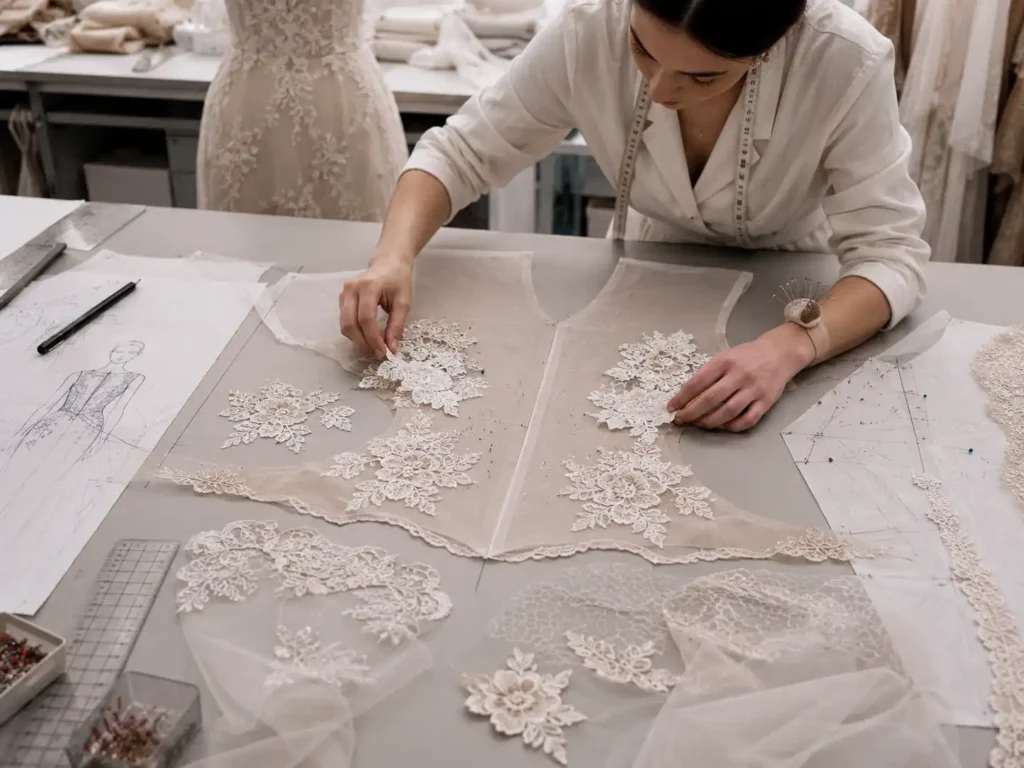
ace is one of the fastest ways to make a dress feel more refined, romantic, and retail-ready. A plain satin mini dress can look sharp on its own, but once lace is placed across the bodice, shaped around the neckline, added to sleeves, or used as a scalloped hem, the whole product changes. The dress looks more designed. It photographs better. It may justify a higher retail price. But on the factory side, lace is rarely just a decorative add-on. It affects cutting, sewing, lining, fitting, grading, pressing, inspection, and sometimes the production schedule.
Lace placement affects dress cost because it changes material usage, cutting waste, sewing time, motif matching, lining control, and quality inspection. The most expensive placements are usually the bodice, neckline, sleeves, zipper area, waist, side seams, and scalloped hem because these areas demand better symmetry, cleaner fit, and more careful bulk production control. |
This is where many fashion brands get surprised. Two lace dresses may look similar in a reference image, yet one can be far easier to produce than the other. The difference often hides in small details: whether the floral motif must sit at the center front, whether the scalloped edge must run around the hem, whether the lace stretches with the lining, and whether the same placement can be repeated across all sizes. A good manufacturer does not simply quote lace by the yard. It reviews how the lace behaves inside the full dress construction.
What Makes Lace Placement Expensive?
Lace placement becomes expensive when a decorative idea changes the way a dress is cut, sewn, lined, inspected, and graded. Cost rises when lace must be centered, mirrored, matched to seams, used on curves, or placed on high-visibility areas such as the bust, neckline, sleeves, waist, zipper, or hem.
Placement Is a Production Decision
In dress manufacturing, lace placement is not only a design choice. It is a production instruction. A sketch may show lace beautifully sitting across the bodice, but the factory has to decide how that lace is cut, how it follows the body, how it joins the main fabric, how it is lined, and how it will look after pressing and packing.
A simple lace overlay on a flat front panel may be easy to repeat in bulk. Lace positioned across the bust, around a neckline, over corset seams, or along a scalloped hem usually needs more control. The pattern maker may need to mark the exact motif position. The cutter may need to adjust fabric layout. The sewing line may need to slow down to avoid stretching, puckering, or damaging the lace.
That is why two dresses using the same visible amount of lace can have very different costs. One may be cut like a normal panel. The other may need careful visual matching, more manual sewing, extra inspection, and higher fabric allowance. The cost difference is not random. It comes from how much production control the placement requires.
Fabric Cost Is Only One Part
Many buyers first calculate lace cost by asking how much lace is used per garment. That is useful, but it is only the first layer. The bigger cost question is how much usable lace is needed after accounting for repeat, direction, scalloped edges, cutting restrictions, and defects.
For example, a dress may visibly use only a small amount of lace at the neckline. But if that lace uses a specific floral border and must sit evenly on both sides, the cutting team may need to waste extra length to find the correct motif position. If the same lace is placed randomly, the cost may be lower. If it must be mirrored, centered, or matched, the cost rises.
A practical costing review usually separates lace into four parts: visible usage, cutting waste, sewing time, and quality risk. Ignoring any one of these can lead to a sample that looks good but becomes too expensive for bulk production.
Cost Factor | Lower-Cost Condition | Higher-Cost Condition | Typical Cost Impact |
Lace usage | Small straight trim or panel | Full overlay, large skirt, full sleeve | More material consumption |
Cutting waste | Flexible repeat, no direction | Motif matching, border lace, scalloped edge | Often adds 5-20% extra allowance |
Sewing time | Standard seam attachment | Hand-positioned applique or curved placement | Adds minutes per garment |
QC risk | Hidden or low-tension area | Bust, neckline, zipper, hem, sleeve | More inspection and repair time |
Size grading | Placement can shift slightly | Placement must stay balanced across all sizes | More pattern review needed |
Labor Minutes Add Up Fast
Lace often looks light and delicate, but it can slow down the sewing line. Operators may need to use finer needles, reduce machine speed, control fabric tension, trim excess lace by hand, or align motifs before joining seams. These small steps may not seem expensive on one sample, but they matter in bulk.
If a lace detail adds only 4 minutes per garment, that becomes around 33 extra production hours for a 500-piece order. If it adds 8 minutes, the extra labor becomes more than 66 hours. This does not include inspection, repair, or handling time. In fast fashion, where margins are often planned tightly, a few extra minutes can change the entire cost structure.
This is why experienced manufacturers review lace placement before sampling. The question is not only whether the dress can be made. The question is whether the placement can be repeated cleanly at the target quantity, target price, and required delivery schedule.
Quality Risk Has a Price
Some lace placements are expensive because they create more chances for defects. Lace can stretch, curl, fray, snag, distort, or show uneven tension. When placed in visible areas, even small issues become obvious. A slightly uneven lace edge inside a seam may pass inspection. A slightly uneven lace neckline may make the whole dress look poorly made.
High-risk areas include the center front, bust cups, corset panels, zipper seams, sleeve caps, side cut-outs, and hems. These areas affect both appearance and fit. If lace placement is wrong, the dress may not sit properly on the body, even if the measurements are technically correct.
Good factories price this risk into the development process. They may test the lace with the lining, check stretch recovery, confirm seam tension, and review pressing behavior. These steps protect the buyer from bulk problems, but they also explain why complex lace dresses cost more than plain fabric styles.
Which Lace Areas Cost More?
Lace placed on the bodice, neckline, sleeves, back zipper, waist, side seams, and hem usually costs more because these areas affect fit, symmetry, movement, and product photos. Flat panels are easier. Curved, structured, transparent, or high-visibility areas require more careful cutting, sewing, lining, and inspection.
Bodice and Bust Areas
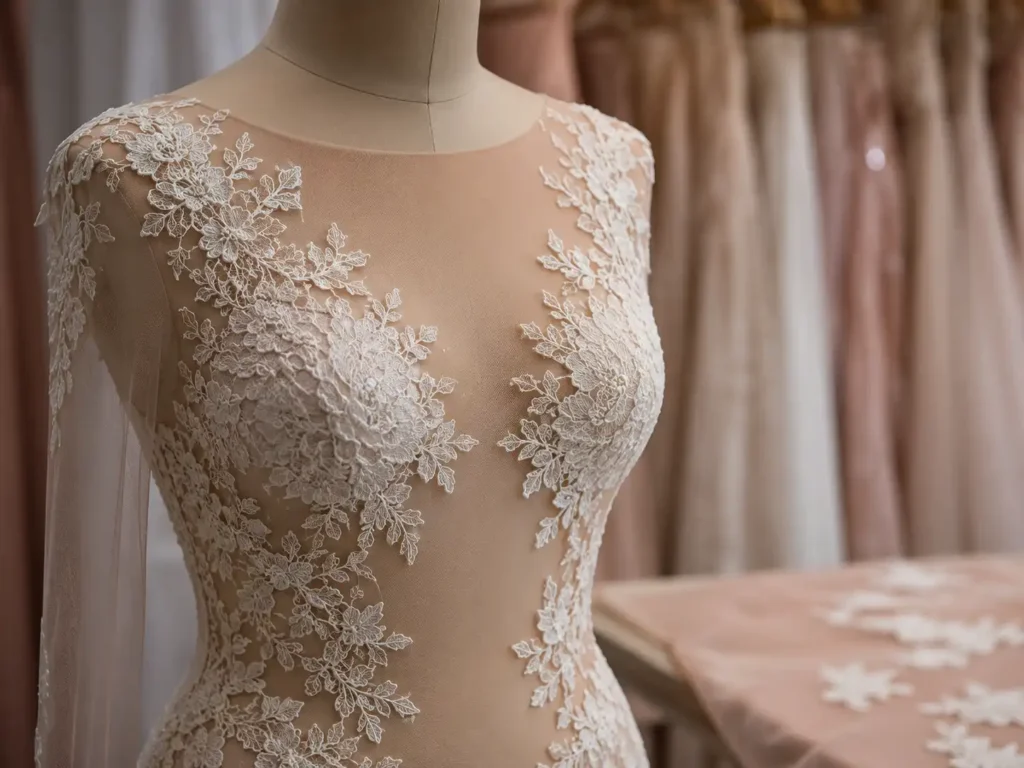
The bodice is usually one of the most expensive places to use lace because it is both highly visible and structurally sensitive. Lace across the bust, corset panels, princess seams, cups, or waistline must follow the shape of the body. If the motif is too high, too low, or off-center, the garment may look unbalanced immediately.
This becomes more complicated when the dress has boning, cups, lining, mesh, satin, or stretch panels underneath. Lace must work with the base fabric, not fight against it. If the lace layer is too tight, it can pull. If it is too loose, it can bubble. If the lining color is wrong, the final look can feel cheaper than expected.
For ecommerce brands, bodice lace has strong commercial value because it appears clearly in front-view product photos. However, it also needs stricter sample approval and bulk inspection. A factory may need to check motif position, seam smoothness, bust balance, and left-right symmetry across every size.
Necklines and Sleeves
Neckline lace costs more when it follows curves or touches the skin. Sweetheart, deep V, halter, off-shoulder, square neck, and asymmetric necklines all require controlled sewing. The lace must lie flat, avoid twisting, and maintain a clean edge after wearing and washing.
Sleeves create a different kind of challenge. Lace sleeves may be sheer, fitted, puffed, flared, or stretch-based. Each version behaves differently. A fitted stretch lace sleeve needs recovery and comfort. A sheer non-stretch lace sleeve needs enough movement allowance. A lace sleeve cap needs clean joining at the armhole, where tension is already high.
These areas also expose thread choice and seam finishing. On transparent lace sleeves, a bulky seam looks messy. On neckline lace, rough edges can irritate the wearer. Small construction choices can decide whether the final dress feels premium or uncomfortable.
Hems and Scalloped Edges
Lace hems can increase cost because they often depend on border placement. When a dress uses scalloped lace at the hem, the factory usually cannot cut the hem freely like a normal fabric edge. The scallop must sit at the finished bottom edge, which limits marker efficiency and increases waste.
This is especially important for midi and maxi dresses. Long skirt panels already consume more fabric. If each panel must use the same lace border, the cutter has fewer layout options. The issue becomes harder when the skirt is flared, curved, or cut in multiple panels.
Scalloped hems also create inspection challenges. Measurement must be clearly defined: should the dress length be measured to the highest point of the scallop, the lowest point, or the average visual hemline? Without clear rules, bulk inspection can become confusing and inconsistent.
Lace Placement Area | Cost Level | Why It Costs More | Common Production Risk |
Flat front panel | Low to medium | Easier cutting and sewing | Minor bubbling or shifting |
Bodice / bust | High | Fit, symmetry, visibility | Off-center motif, puckering |
Neckline | High | Curves, skin contact, edge finish | Wavy edge, rough feel |
Sleeves | Medium to high | Movement and armhole tension | Tightness, twisting, seam bulk |
Back zipper | High | Lace must join cleanly with zipper | Uneven match, zipper waves |
Waistline | Medium to high | Body proportion and seam balance | Misalignment, bulk |
Scalloped hem | Medium to high | Border use and cutting limits | Uneven hem, extra waste |
Zippers, Waistlines, and Side Seams
The back zipper area is one of the most easily underestimated lace cost drivers. A zipper cuts through the back panel, so any lace motif crossing that area may need careful matching. If the lace is thick, embroidered, or beaded, the zipper may not sit flat. If the lace is sheer, the zipper tape and seam allowance may show through.
Waistlines and side seams also matter because they interrupt the lace visually. A floral motif may look beautiful on the front panel but awkward when broken at the waist seam. Side seams can create another problem: if the left and right side do not match visually, the dress may look twisted even when it is sewn correctly.
Good production planning does not always require perfect matching everywhere. But it does require deciding where matching matters and where a small shift is acceptable. That decision should be made before sampling, not after bulk cutting.

How Does Lace Type Affect Cost?
Lace type affects dress cost through material price, cutting behavior, sewing difficulty, stretch control, decoration risk, and inspection standards. Basic machine lace is usually easier to control. Embroidered, corded, beaded, stretch, scalloped, and 3D floral lace often cost more because they require slower handling and stricter quality checks.
Basic Lace vs Decorative Lace
Basic machine lace is usually the most cost-friendly option for fashion dresses. It works well for simple overlays, panels, trims, and partially lined designs. It is generally easier to cut, easier to sew, and more predictable in bulk. For brands that need a lace effect without heavy cost, this is often the safest starting point.
Decorative lace costs more because it adds texture, density, or surface detail. Embroidered lace has raised thread. Corded lace has thicker outlines. Beaded lace has attached decoration. 3D floral lace may include raised petals or layered motifs. These types can create a stronger visual effect, but they also slow down production.
The key question is not whether decorative lace is good or bad. The question is whether the target retail price can support the extra cost. A premium occasion dress may justify embroidered lace on the bodice. A margin-sensitive fast fashion mini dress may need a simpler lace that still photographs well.
Stretch Lace
Stretch lace is common in bodycon dresses, club dresses, fitted sleeves, bodysuit-inspired dresses, and partywear. It can be very useful because it supports comfort and fit. But stretch lace must be controlled carefully. If the lace stretches more than the lining, the outer layer may ripple. If the lining stretches more than the lace, the garment may feel tight or pull at the seams.
Stretch direction is critical. Some lace stretches horizontally only. Some stretches both ways. Some looks stretchy at first touch but has poor recovery after being pulled. For fitted dresses, the factory should check stretch recovery before cutting bulk fabric. Otherwise, the sample may look fine, but the bulk garments may grow in length, twist at side seams, or lose shape after wearing.
Stretch lace also changes measurement logic. A fitted lace dress may need negative ease, but the amount depends on fabric recovery and lining choice. This is why stretch lace styles should not be costed only from a flat sketch.
Embroidered and Corded Lace
Embroidered lace and corded lace usually cost more because the surface thickness is uneven. When sewing through dense embroidery or raised cording, the machine may need slower speed and better tension control. If the thick area crosses a seam, it can create bulk. If it crosses a zipper, it may make the zipper wavy or stiff.
These lace types also need smarter pattern placement. Large flowers, vines, and geometric motifs should not land awkwardly across bust points, waist seams, or cut-outs. The pattern maker may need to position the motif intentionally, which can increase cutting waste.
Corded lace can look expensive and structured, especially for evening dresses and formal occasionwear. But it should be reviewed carefully near seam allowances, darts, armholes, and closures. A small adjustment in placement can reduce sewing difficulty without changing the customer-facing design.
Lace Type | Best Use | Production Difficulty | Cost Notes |
Basic machine lace | Panels, overlays, trims | Low | Good for cost-sensitive fashion styles |
Stretch lace | Bodycon, sleeves, fitted dresses | Medium | Needs recovery and lining checks |
Embroidered lace | Bodice, occasionwear, premium trims | Medium to high | More motif and seam control |
Corded lace | Formal and structured styles | High | Raised areas can create seam bulk |
Beaded lace | Eveningwear, statement details | High | Slow sewing, decoration loss risk |
3D floral lace | Premium visual focus areas | High | Requires careful handling and packing |
Scalloped border lace | Neckline, cuff, hem | Medium to high | Increases cutting restrictions |
Beaded and 3D Lace
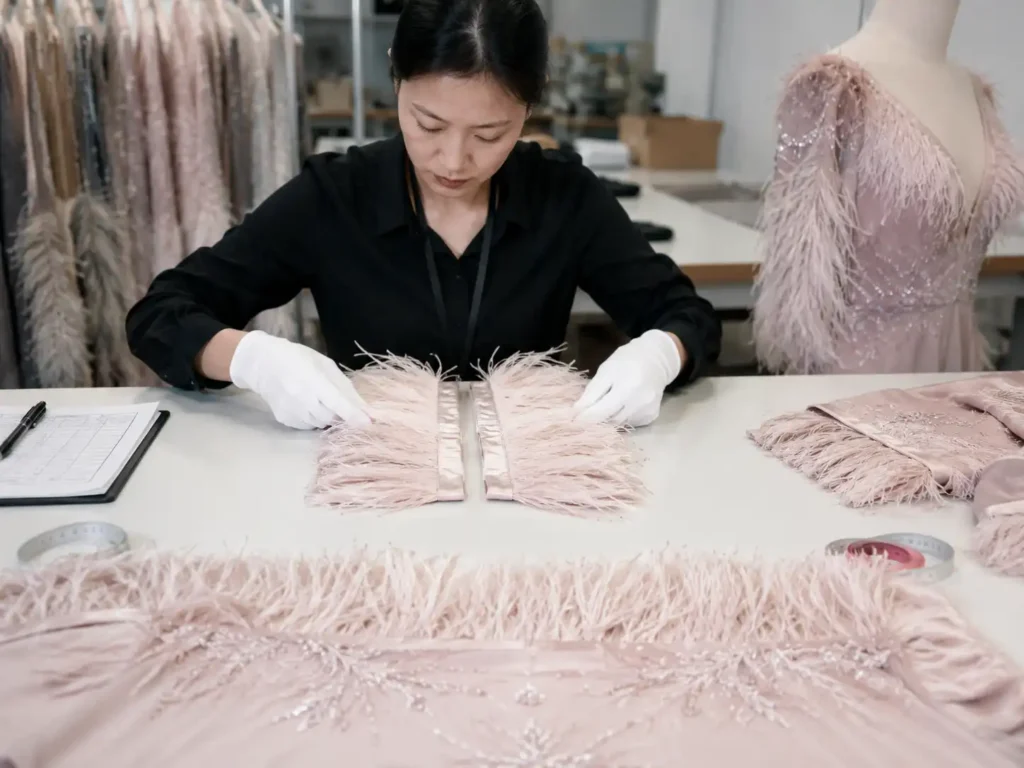
Beaded and 3D lace can raise perceived value quickly, but they are among the riskiest lace types for bulk production. Beads, pearls, sequins, stones, and raised flowers can interfere with sewing. Decoration near seam allowance may need to be removed before stitching and sometimes reattached afterward. This creates extra labor and additional QC points.
There is also handling risk. Beaded lace can snag lining, scratch satin, or press marks into nearby fabric during packing. Heat pressing must be tested carefully because some decorations may loosen, deform, or change appearance under heat.
For commercial fashion brands, beaded or 3D lace should usually be used as a focused detail rather than across the entire garment unless the target price supports it. A small decorated bodice applique may create strong photo impact. Full beaded lace sleeves or a full beaded skirt may look impressive but can make the dress expensive, slow, and more defect-sensitive.
How Do Cutting and Matching Add Cost?
Cutting and matching add cost because lace often has direction, repeat, border edges, and visible motifs. When lace must be centered, mirrored, or aligned across seams, cutters cannot use the fabric as freely as plain cloth. This increases waste, slows cutting, and makes size grading more difficult.
Motif Matching
Motif matching is one of the biggest hidden costs in lace dress production. On a plain fabric, a seam mismatch may not be obvious. On lace, the eye immediately notices if flowers, leaves, geometric shapes, or scallops do not line up. This is especially true at the center front, bust, waist, back zipper, side seams, and hem.
Matching does not always need to be perfect everywhere. The cost depends on the standard required. A casual lace trim may allow flexible placement. A premium lace bodice may need exact center-front motif control. A back zipper may need left and right motifs to meet cleanly. Each level of control changes cutting and sewing time.
For bulk production, motif matching should be defined in the sample comments. If the approved sample has a centered motif, the factory and buyer should confirm whether that placement is required in every size and every garment. Otherwise, the bulk result may look different from the sample even if the sewing quality is acceptable.
Pattern Direction
Lace often has a visible top and bottom direction. Floral lace may flow upward. Border lace may have one finished edge. Geometric lace may look different when rotated. If the design requires all pieces to follow the same direction, cutting efficiency drops.
This is different from many plain fabrics, where pattern pieces can sometimes be rotated to improve fabric usage. With directional lace, the cutting marker becomes more restricted. Large sizes, long skirts, wide sleeves, and multi-panel dresses make this issue more noticeable.
Pattern direction also affects color and shadow. Some lace looks slightly different depending on angle and surface reflection. If one panel is cut upside down, the difference may be visible under studio lighting. For ecommerce brands, this matters because product photos can exaggerate small shade or texture differences.
Scalloped Edge Cutting
Scalloped edge cutting is beautiful but restrictive. The lace border becomes the finished design edge, so pattern pieces must be placed along the scallop. This is common on sleeve cuffs, necklines, hems, and overlays. It can reduce sewing because no folded hem is needed, but it often increases cutting waste.
The main challenge is shape. A scalloped lace border is usually straight, while garment edges may be curved. Necklines curve. Sleeve cuffs may angle. Skirt hems may flare. If the garment edge does not match the lace border naturally, the pattern may need adjustment.
Measurement is another issue. A scalloped hem can create different visual lengths depending on where the measurement is taken. The tech pack should clearly state how finished length is measured. Without that, a dress can pass one inspector’s measurement and fail another’s.
Multi-Size Grading
Multi-size lace production is harder because placement does not automatically scale cleanly. A floral motif that looks balanced on size S may shift on size M, L, or XL after grading. If the design uses lace at the bust, neckline, waist, or hem, each size may need review.
This matters more for brands selling full size ranges. A sample is usually made in one size, but bulk production may include five or more sizes. If the placement rule is unclear, the factory may follow the sample as closely as possible but still produce visual differences across sizes.
To avoid this, buyers should confirm which placements are fixed and which are flexible. For example, the center-front motif may need to stay centered in all sizes, but side panel lace may allow slight shifting. These practical rules help protect both cost and appearance.
Is Lace Placement Worth the Cost?
Lace placement is worth the cost when it clearly improves product value, photography, brand positioning, and retail margin. It is not worth the cost when the detail is barely visible, difficult to repeat, risky in bulk, or too expensive for the target selling price. The best lace use gives strong visual return with controlled production risk.
Visual Value
Lace is worth paying for when customers can see and feel its value quickly. In fashion ecommerce, shoppers make quick judgments from front-view images, close-ups, model videos, and product detail shots. Lace placed at the neckline, bodice, sleeve, waist, or hem can make a dress feel more designed and more premium.
The strongest lace placements often create a clear selling point. A lace bodice can soften a satin skirt. Lace sleeves can make a mini dress feel more refined. A scalloped hem can make a simple silhouette look more finished. A lace back panel can create a strong product-photo moment.
But lace should not be added only because it sounds premium. If the placement is hidden in most photos or does not change the customer’s impression, the cost may not return enough value. Good lace placement should support the product story, not just decorate the garment.
Margin Protection
Lace can reduce margin when the design team sees beauty but the costing team sees hidden production work. A dress may look commercial at sample stage, but if the lace requires high waste, hand positioning, slow sewing, and extra repair, the final landed cost may become too high for the target retail price.
This is especially important in fast fashion, where brands often need to balance trend speed, visual impact, and margin. Not every lace idea needs the highest-cost execution. Some styles need premium lace as the hero detail. Others only need lace effect in a visible area.
A simple way to judge margin risk is to compare cost visibility with customer visibility. If a lace detail costs a lot but is not easy to see in photos, it may be a weak investment. If a lace detail is visible, supports the selling price, and can be produced consistently, it is usually easier to justify.
Sampling Decisions
Sampling is where lace decisions become real. A design may look easy in a sketch, but the first sample will reveal whether the lace stretches, puckers, shifts, scratches, or creates bulk. This is why lace dresses should be reviewed carefully after the first fitting and before bulk quotation is locked.
Buyers should check the sample on a body or mannequin, not only flat on a table. Lace can look smooth when flat but pull strangely when worn. The bodice may twist. Sleeves may feel tight. The neckline may lift. The hem may wave. These are not small details if the dress is sold online and customers expect a clean fit.
A good sample review should include fit, appearance, transparency, comfort, seam quality, and production repeatability. If a lace detail looks good but feels too fragile for bulk, it is better to revise early than to repair hundreds of garments later.
Retail Positioning
Whether lace is worth the cost depends heavily on the product’s market position. A low-price casual dress may not support complex lace placement. A premium party dress, cocktail dress, wedding guest dress, or occasionwear style may need lace to justify its retail price.
The same lace placement can be smart in one market and unnecessary in another. For example, hand-placed lace applique on the bodice may be valuable for a formal dress collection. It may be too expensive for a fast-moving mini dress where customers care more about silhouette and color.
The best approach is to match lace complexity with customer expectation. Use more controlled lace where it strengthens the product’s perceived value. Use simpler lace where the style needs speed, margin, and easy repeat orders.
How Can Brands Control Lace Dress Cost?
Brands can control lace dress cost by simplifying placement, choosing production-friendly lace, reducing unnecessary matching, clarifying tech packs, testing lining and stretch early, and reviewing cost before sampling. The goal is not to remove lace, but to use it where it creates the strongest visual value with manageable waste, labor, and QC risk.
Simplify Without Making It Basic
Cost control does not mean removing all beautiful details. It means making the lace easier to repeat in production. A lace panel can be moved away from a difficult seam. A curved applique can be simplified into a cleaner edge. A full lace overlay can become a focused bodice detail. A complicated scalloped hem can be replaced with a lace trim that gives a similar look.
Small changes can make a big difference. Moving lace slightly away from the zipper can reduce seam bulk. Reducing left-right mirror matching can lower cutting waste. Using lace in flatter areas can improve sewing speed. Choosing a repeat that fits the pattern width can reduce leftover fabric.
The customer may never notice these changes, but the cost sheet will. A production-friendly design often looks just as strong on the product page while being easier to sample, quote, produce, inspect, and reorder.
Choose the Right Lace Early
Choosing lace early is one of the simplest ways to control cost. Many problems happen when a design is sampled with a beautiful lace that later becomes too expensive, unavailable, hard to dye, or difficult to produce in bulk. Once the team falls in love with that sample, changing lace feels like a compromise.
Before sampling, buyers should confirm lace type, width, repeat, stretch, color availability, supplier MOQ, lead time, and dyeing limitations. A slightly simpler lace that is stable, available, and easy to sew may be better than a delicate lace that creates delays and quality issues.
The lace should also match the base fabric. Stretch lace with non-stretch lining can create fit problems. Heavy embroidered lace on thin satin can pull the surface. Beaded lace next to soft mesh can snag. These combinations should be tested early.
Use Tech Packs to Reduce Guesswork
A clear tech pack prevents expensive misunderstandings. For lace dresses, the tech pack should not only list “lace fabric.” It should show where the lace goes, which way the motif runs, how the edges are finished, whether left and right sides must match, and how the garment should be lined.
The tech pack should also include tolerance rules. If exact motif matching is required, say so. If slight variation is acceptable, define the acceptable range. If scalloped lace is used, define how length is measured. If transparency matters, specify lining color and coverage.
Clear instructions help the factory quote more accurately. They also help the buyer compare quotations fairly. One supplier may quote low because they assume flexible lace placement. Another may quote higher because they include motif matching and extra waste. Without a clear tech pack, those two prices are not really comparable.
Cost-Control Method | What It Changes | Practical Result |
Use lace in flatter areas | Reduces sewing difficulty | Faster production and fewer defects |
Limit strict motif matching | Improves marker efficiency | Lower waste allowance |
Avoid heavy lace near zippers | Reduces seam bulk | Smoother back closure |
Confirm lace width before pattern | Improves pattern planning | Less layout waste |
Test lining with lace | Prevents pulling or transparency issues | Better fit and fewer revisions |
Define scallop measurement | Prevents QC confusion | More consistent inspection |
Review cost before sampling | Catches expensive details early | Better margin control |
Review Cost Before Bulk
The best time to control lace cost is before the first sample or immediately after the first sample review. By the time bulk fabric is ordered and cutting starts, most cost decisions are locked. Late changes can cause delays, remakes, and material waste.
A professional factory review should identify which part of the dress is driving cost: lace type, lace placement, cutting waste, sewing time, lining, handwork, or QC risk. Sometimes the expensive part is obvious, such as beaded lace. Other times it is hidden, such as motif matching at the back zipper or scalloped hem placement across multiple sizes.
For buyers, the goal is to ask practical questions early: Can this placement be simplified? Can we use a different lace width? Is exact matching necessary? Will the lace work across all sizes? Is the detail visible enough to justify the cost? These questions protect the design, the margin, and the production schedule.
Ready to Review Your Lace Dress Cost?
Lace can make a dress more desirable, more photogenic, and more valuable, but only when it is placed with production logic. The highest-cost lace details are not always the largest ones. They are often the details that demand symmetry, hand positioning, motif matching, scalloped-edge control, lining adjustment, or strict QC in visible areas.
For fashion brands, the better question is not only “How much does lace cost?” A more useful question is “Which lace placement gives us the strongest visual return for the cost?” That question helps design, sourcing, merchandising, and production teams make decisions together instead of solving problems after the sample is already expensive.
If you are developing lace dresses, party dresses, occasionwear, cocktail dresses, wedding guest dresses, or private-label women’s collections, Jinfeng Apparel can help review your design before sampling. The team can work from a tech pack, reference photo, original sample, sketch, or line sheet, then evaluate lace placement, fabric options, pattern structure, trim details, sample feasibility, and bulk production risk.
Jinfeng Apparel is a Guangdong-based custom women’s fashion manufacturer serving global fashion brands and mid-to-large apparel clients with OEM, ODM, private-label, sampling, bulk production, quality control, packaging, and export delivery support. MOQ starts from 200 pcs per style/color, depending on fabric availability, color development, trims, construction complexity, and production schedule.
Share This Article :

Jerry Lee
Categories

Latest blogs


Table of Contents
Here, developing your OEM/ODM private label clothing collection is no longer a challenge—it’s an excellent opportunity to bring your creative vision to life.

