 Skip to content
What Are the Main Glitter Fabric Manufacturing Challenges in Apparel Production?

Your trusted Women’s Apparel Manufacturer from China

Glitter fabric sells an emotion before it sells a specification. Under showroom lighting, a glitter dress can look instantly festive, premium, and camera-ready, which is why the material appears so often in partywear, club dresses, occasionwear, holiday collections, and statement pieces. On a production floor, however, the same sparkle becomes a chain of technical decisions. The decorative surface has to survive spreading, cutting, sewing, fitting, pressing, packing, transport, and wear without losing the drape, stretch, comfort, or appearance that made the fabric attractive in the first place.
The main glitter fabric manufacturing challenges are controlling shedding, adhesion, cracking, stiffness, stretch compatibility, sewing damage, skin irritation, wash and rubbing durability, and bulk appearance consistency. Reliable production depends on matching the glitter system to the base textile, testing realistic garment stresses, approving a stable pre-production reference, and controlling material lots, construction, quality checks, and packaging through bulk production.
A common problem appears only after everyone thinks the material is approved. A glitter stretch fabric looks perfect as a hanger swatch and even makes an attractive first sample. Then the fitted dress is worn, the hip area expands, the side seam rubs against the body, the zipper is sewn through several decorated layers, and the finished piece is folded into a polybag. The center front still sparkles, but the high-stress areas no longer look the same. That gap between a beautiful swatch and a repeatable garment is where glitter manufacturing really begins.
What Are the Main Glitter Fabric Manufacturing Challenges?
Glitter fabric is difficult to manufacture because the decorative surface must remain visually consistent while the textile underneath bends, stretches, rubs, folds, and passes through normal garment-making processes. The most common risks are shedding, weak adhesion, cracking, stiffness, seam damage, skin discomfort, direction or shade variation, and a visible difference between the approved sample and bulk production.
Glitter Shedding
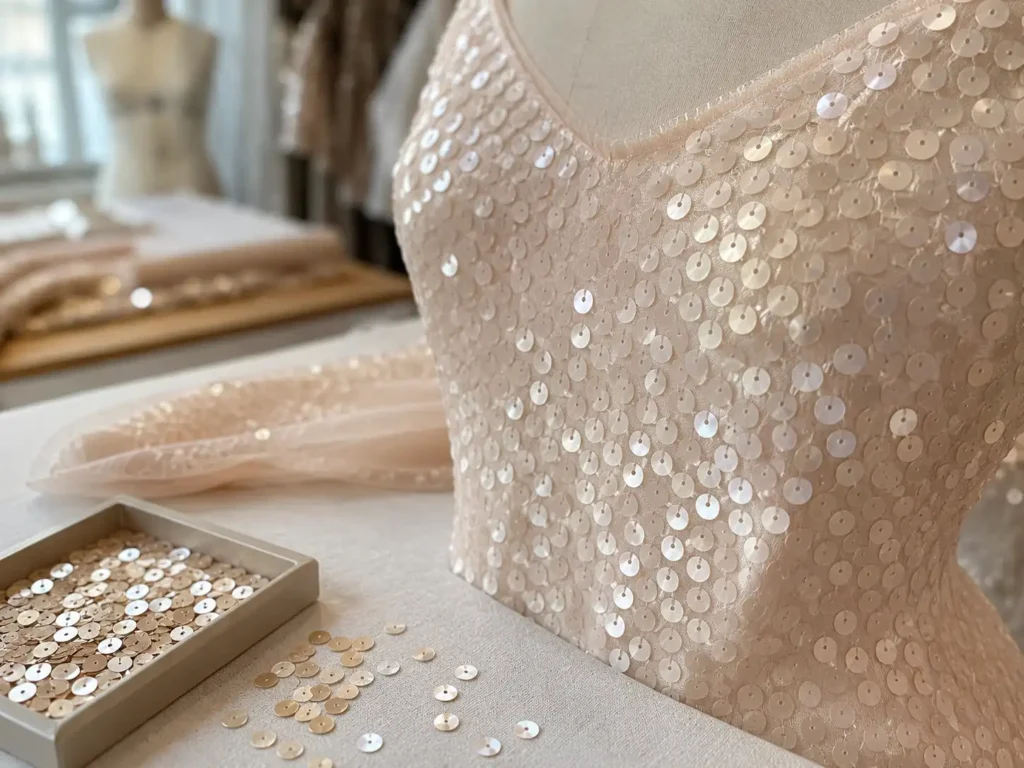
Glitter shedding is often the first defect a product team notices, yet it is rarely caused by a single event. Depending on the fabric construction, reflective particles may be held by a printed or coated binder system, another adhesive layer, or a decorative surface process. Loose particles can be created during finishing, but additional loss may occur when rolls rub during transport, fabric layers move during spreading, blades pass through decorated surfaces, operators turn pieces during sewing, or finished garments rub against themselves during folding and packing.
The location of the shedding matters as much as the amount. A center-front panel can remain visually clean while the underarm, waist, side seam, zipper area, or hip loses sparkle after repeated contact. That is why a quick finger-rub on a small fabric swatch is useful but not enough for commercial approval. A better evaluation follows the material from incoming inspection through sample construction and then checks the finished garment after realistic fitting, movement, folding, and care simulation. The production team should record both visible particle loss and whether the remaining surface still looks acceptably uniform.
Adhesion Failure
Adhesion failure appears when the decorative system cannot maintain a stable bond with the base textile under the stresses required by the garment. A glitter surface may look firmly attached when the fabric is flat, yet open into fine cracks when a stretch panel expands across the bust or hips. In other cases, the finish remains intact during stretching but sheds under rubbing. These are different failure modes, and solving one by simply making the coating harder can create another problem by reducing flexibility and hand feel.
The substrate has a major influence on the result. Smooth polyester, textured knit, open mesh, chiffon-like woven fabric, and dense stable woven fabric do not provide the same surface or movement. A finish that works on a structured party dress may not suit a bodycon silhouette that relies on repeated extension and recovery. Fabric finishing, coating weight, particle density, curing conditions, and the intended care method also change the risk. For that reason, glitter should be approved as part of a specific garment system rather than as an isolated decorative fabric that is assumed to work across different styles.
Hand Feel and Drape
A glitter finish can change more than appearance. Surface coating or particle application can increase stiffness, raise friction, reduce softness, limit stretch, or make a lightweight fabric fall differently around the body. Those changes are easy to underestimate on a small swatch because the hand of a ten-centimeter sample does not show how a full skirt will move, how a fitted bodice will recover, or how several decorated layers will behave where seams, zippers, linings, and facings meet.
This matters particularly for womenswear because many designs depend on the original behavior of the base fabric. Chiffon is chosen for light movement, mesh for transparency and stretch, and jersey for body-following elasticity. If glitter application makes those fabrics substantially firmer, the design may lose its intended silhouette even when the sparkle itself looks excellent. Fabric approval should therefore include drape, extension, recovery, skin feel, lining interaction, and seam bulk. In practice, the best-looking glitter surface is not always the best material for the finished dress.
Bulk Appearance
Bulk appearance is harder to control with glitter because reflected light amplifies small differences. Two rolls may have a similar base shade but look different when particle density, orientation, coating thickness, or surface texture changes. Directional sparkle makes the issue more sensitive because panels cut in opposite orientations can reflect light differently even when they come from the same roll. Under photography, flash, retail spotlights, or stage lighting, variations that were subtle in the cutting room can become obvious.
The safest approach is to check incoming rolls under consistent lighting, identify visual groups, control cutting direction, and avoid mixing obviously different lots within the same garment. For larger orders, roll records and approved fabric references become especially valuable because visual instructions such as “same sparkle as the sample” are too subjective on their own. A brand that expects repeat orders should also preserve the approved material code, shade reference, surface standard, and garment sample so future production can be compared against something more reliable than memory.
Manufacturing Risk | Practical Production Check | Typical Warning Sign | Useful Response |
Glitter shedding | Handle, rub, cut, sew, fold, and recheck | Loose particles or thinning sparkle | Review lot, surface fixation, handling, and care expectations |
Surface cracking | Stretch to realistic garment extension | Fine lines, gaps, or broken film | Reassess finish flexibility or garment ease |
Excess stiffness | Compare drape with intended silhouette | Fabric stands away from body | Reduce surface load or select another base/finish |
Direction mismatch | View panels under the same light | Left/right panels reflect differently | Enforce one-way cutting where necessary |
Lot variation | Compare rolls before cutting | Shade or sparkle density differs | Segregate lots and plan panel matching |
Seam damage | Inspect stitch lines after sewing | Bare line, cracking, or puckering | Adjust seam method, needle, feed, and layer handling |
Which Glitter Fabrics Are Hardest to Manufacture?
The most difficult glitter fabrics are usually those that combine a mobile, delicate, or highly elastic base with a relatively rigid decorative surface. Stretch knits, mesh, lightweight chiffon-like fabrics, tulle, and sheer constructions need extra attention because they can distort during cutting and sewing while the glitter layer must remain flexible, evenly distributed, comfortable, and visually stable on the finished garment.
Glitter Mesh
Glitter mesh combines several manufacturing risks that already exist in plain mesh. The base can be lightweight, transparent, elastic, and sensitive to handling, while the glitter finish adds surface friction and additional weight. If the mesh stretches much farther than the glitter layer, visible gaps or cracking can appear when the garment is worn. If the finish restricts the mesh too much, a pattern developed for ordinary stretch mesh may suddenly feel tighter and create extra tension at necklines, armholes, side seams, or zippers.
Transparency creates another layer of decision-making because seam allowances, lining edges, reinforcement tape, bra cups, boning channels, or internal binding may be visible through the base. Sewing tension and feed pressure also matter because thin mesh can wave or distort if the upper and lower layers do not feed evenly. A good sample review therefore checks opacity, lining color, extension, recovery, neckline stability, seam appearance, surface retention, and skin contact at the same time. Approving glitter mesh only for color and sparkle leaves many of the most expensive production risks unresolved.
Stretch Glitter
Stretch glitter fabrics are demanding because the base textile and decorative surface are expected to move together. On bodycon dresses, fitted mini dresses, catsuits, jumpsuits, and close-fitting tops, actual garment extension can be concentrated across the bust, waist, seat, hips, and thighs. A flat fabric inspection cannot reproduce those conditions. The material may appear perfectly continuous at rest yet open into fine lines when stretched, and repeated cycles can gradually turn those lines into permanent cracks or visible loss of reflective coverage.
Development teams should test the material at the extension expected from the pattern rather than simply pulling it to the highest stretch it can reach. A useful comparison looks at the surface when relaxed, when worn at realistic tension, immediately after release, and after repeated extension. Recovery is equally important because a fabric that stretches but does not return can leave the garment bagged while the glitter surface shows permanent spacing. For fitted fashion, the most useful stretch figure is not the maximum laboratory number; it is the level the garment can repeatedly use without changing fit or appearance.
Lightweight Glitter Fabrics
Lightweight glitter chiffon and similar fabrics can be difficult because the base textile has little structural stability. Layers may shift during spreading, move before the cutting blade reaches them, or distort under sewing pressure. At the same time, even a moderate surface application can change the way the fabric hangs because the decorative layer adds weight and friction relative to the light substrate. Uneven coverage can therefore affect not only sparkle but also the movement of gathers, ruffles, draped panels, bias sections, and asymmetric hems.
Lining should be decided early because it changes opacity, heat, weight, drape, and perceived color. A silver glitter chiffon over nude lining can look very different from the same outer fabric over black or self-color lining. Hem construction also deserves attention because a stiff decorative edge can behave differently from the undecorated base. For dresses designed around fluid movement, a slightly lighter glitter effect that preserves drape can produce a stronger commercial result than the densest possible application.
Base Fabric Choice
There is no universal base fabric that holds glitter best for every garment. Stable woven fabrics generally simplify surface control because they deform less during coating, cutting, and sewing, but they may not deliver the comfort, stretch, or movement a design requires. Highly elastic fabrics give more freedom on the body but place far greater demand on the flexibility and recovery of the glitter system. Sheer bases create beautiful overlays but add transparency, lining, and skin-contact questions.
The practical selection process starts with the silhouette. A structured cocktail dress can tolerate a firmer glitter surface than a draped slip dress. A fitted club dress needs extension and recovery that a loose A-line dress may not require. A sheer evening overlay needs lightness and visual continuity, while a heavily lined bodice can accept more structure. Material approval should therefore record composition, weight, stretch direction, extension, recovery, opacity, drape, hand feel, surface direction, lining requirement, intended care method, and the production risks created by the glitter finish.
Fabric Type | Main Production Risk | Best-Suited Garment Direction | Key Approval Checks |
Stretch glitter knit | Cracking, recovery loss, seam waving | Bodycon, fitted mini, jumpsuit | Extension under fit, recovery, seam behavior, rubbing |
Glitter mesh | Distortion, transparency, surface damage | Overlay, fitted mesh panel, occasionwear | Stretch, neckline stability, lining, seam visibility |
Glitter chiffon | Ply shifting, drape change, edge stiffness | Ruffles, skirts, sleeves, overlays | Drape, layer movement, hem behavior, lining color |
Glitter tulle | Abrasion, stiffness, snagging | Volume skirts, overlays, decorative panels | Hand feel, edge comfort, snag resistance, packing |
Stable woven glitter | Direction and surface consistency | Structured party or cocktail styles | Shade, sparkle direction, seam thickness, pressing |
How Do Shedding and Cracking Affect Durability?
Shedding reduces reflective coverage through friction, while cracking breaks the continuity of the decorative surface when the textile bends or stretches beyond what the finish can tolerate. Both problems can worsen during sewing, fitting, washing, folding, transportation, and repeated wear. Durability is therefore best judged by how the finished garment changes under realistic use rather than by how firmly glitter appears attached to an untouched swatch.
Binder and Flexibility
In printed or coated glitter systems, the bonding layer has to do two jobs that can work against each other. It must retain reflective particles strongly enough to resist normal rubbing, yet remain flexible enough to move with the textile. A very weak film can release particles quickly, but an excessively rigid film can crack when a stretch fabric extends. Adding more binder or making the surface harder does not automatically improve a garment if the result becomes board-like, uncomfortable, or unable to follow body movement.
The correct balance depends on the substrate, coating weight, surface texture, intended silhouette, and care conditions. A low-stretch woven dress places much less mechanical demand on the glitter layer than a close-fitting spandex blend. This is why appearance approval should include controlled flexing and garment-level fitting. If the material is likely to sit across high-extension zones, those areas deserve special review before bulk production. A beautiful fabric that only works while lying flat has limited value for real apparel.
Curing and Processing
Where a glitter effect relies on a cured coating or printed system, process consistency becomes part of product quality. Insufficient curing can leave weak attachment, while excessive heat or treatment time can alter hand feel, shade, elasticity, or the base textile itself. There is no responsible universal temperature or time setting that applies to every glitter fabric because different binders, particles, substrates, and suppliers use different technical systems. The relevant settings should come from the material process and be verified against the finished result.
Garment production can introduce additional heat later through pressing, steaming, fusing, or finishing. A fabric that survives the original decoration process may still react poorly when an operator uses a standard pressing setting developed for plain polyester or knit fabric. Short trials on offcuts or spare panels can identify gloss change, flattening, sticking, discoloration, surface transfer, or reduced stretch before the same problem reaches a finished order. For sensitive decorative fabrics, pressing instructions should be treated as part of the technical package rather than left to operator habit.
Washing and Rubbing
Rubbing happens more often in a glitter garment than a flat swatch suggests. The underarm moves against the side body, sleeves brush the torso, bags contact the hip, thighs can touch while walking, and folded garments rub against themselves inside packaging. Wet friction may produce different behavior from dry friction, and laundering adds water, detergent, movement, temperature, and repeated contact with other surfaces. A surface that looks stable after one dry hand rub can therefore change once several real-world stresses are combined.
Testing should match the care method and product use. A special-occasion dress that is professionally cleaned has different expectations from a frequently washed fashion top, but the care label should reflect tested performance rather than compensate for a finish that was never evaluated. Useful checks can include dry and wet rubbing where relevant, laundering according to the intended instruction, visual appearance after care, localized wear simulation, and inspection of high-contact garment areas. The goal is not to claim that no particle will ever detach; it is to establish whether the appearance remains commercially acceptable for the product’s intended life.
Stretch and Recovery
Cracking is closely linked to recovery because the decorative surface and textile need to return together after extension. A fabric can have generous stretch yet poor recovery, leaving the garment larger after wear and creating permanent gaps between glittered areas. In that situation, the visible defect may look like a coating problem even though the underlying textile behavior contributed significantly. For fitted garments, extension and recovery should therefore be evaluated as one system rather than as separate checklist items.
A practical development trial can compare the fabric at rest, at the actual wearing extension expected from the pattern, immediately after release, and after repeated cycles. Observers should look for whitening, fine cracks, particle loss, permanent distortion, and whether the surface returns to its original visual density. These checks do not replace formal testing when a brand has specified laboratory requirements, but they are extremely useful during sampling because they connect material behavior directly to fit decisions before bulk fabric is committed.
How Does Glitter Fabric Affect Garment Production?
Glitter fabric affects cutting, machine setup, seam construction, fitting, pressing, finishing, and packaging. Decorative particles may shed during cutting, increase friction under the presser foot, create thick seam allowances, or irritate exposed skin. Stretch glitter may also behave differently after sewing. Successful production starts by identifying these risks during sample development instead of trying to repair them after bulk garments are assembled.
Cutting and Direction
Cutting glitter fabric is not only about dimensional accuracy. Some surfaces are visually directional, which means two perfectly shaped panels can still look mismatched if they are cut in opposite orientations. Before marker making, the team should check the fabric from several viewing angles and under the lighting likely to reveal the effect. If the sparkle is directional, one-way cutting may be necessary even though it reduces marker efficiency and raises consumption compared with layouts that freely rotate pattern pieces.
Roll variation creates a second concern. When sparkle density, shade, or surface texture differs between rolls, mixing a front bodice from one visual group with a back or sleeve from another can produce an obvious mismatch in the finished garment. Lightweight or stretch bases also add the risk of ply movement during spreading. Practical controls include identifying roll lots, confirming face direction, stabilizing spreading, inspecting trial cut panels, monitoring fallout on the cutting table, and checking whether the cutting method damages the decorative edge before bulk markers are released.
Sewing and Needles
Sewing forces a needle through the decorative surface thousands of times and compresses the fabric under a presser foot while feed mechanisms move several layers at controlled speed. A dense or abrasive glitter finish can therefore behave very differently from the undecorated substrate. Surface damage can appear beside stitch lines, the top and bottom layers can feed unevenly, and stretch bases can develop wavy seams if tension or pressure is not balanced. Heavy decoration also increases the chance that seam intersections become bulky.
There is no single needle size or machine setting that suits every glitter material. The correct setup depends on the base fabric, coating density, thread, seam type, stretch, and number of layers. Trial sewing should evaluate penetration, skipped stitches, thread breakage, seam puckering, decorative loss, and whether the surface is scratched by machine parts. Zipper areas deserve extra attention because several layers often meet there. Solving these issues during sample construction is far more efficient than discovering them once hundreds of finished seams require repair.
Fit and Seam Stress
A glitter garment can fit differently from the same pattern in an undecorated fabric because the surface treatment may reduce effective stretch, increase stiffness, or change friction against the body and lining. This becomes most visible in bodycon dresses, corset-inspired pieces, fitted jumpsuits, and mini dresses where small changes in extension alter comfort and stress distribution. A pattern that worked in soft jersey should not automatically be transferred to a heavily decorated knit merely because both fabrics have a similar fiber composition.
Fitting should look beyond static bust, waist, and hip measurements. Sitting, walking, raising the arms, bending, and moving through a zipper opening can reveal stress at side seams, under-bust seams, waist joins, center-back seams, and high hip areas. If cracking or surface whitening appears only when the wearer moves, the problem may be solved through a combination of pattern ease, fabric selection, seam placement, lining stretch, or material substitution. Treating the decorative fabric and fit pattern as one development system reduces unnecessary sample rounds.
Comfort and Skin Contact
Glitter fabrics can feel acceptable at the center of a panel yet become uncomfortable where cut edges, seam allowances, and folded sections touch the skin. Armholes, necklines, underarms, shoulder edges, cuffs, and high slits are common sensitivity points because movement repeatedly rubs these areas. A visually successful dress can still generate returns or complaints if the wearer spends the event avoiding normal arm movement because the surface scratches exposed skin.
Lining is one solution, but it adds weight, heat, material cost, sewing operations, and potentially less stretch. In some styles, clean binding, facing, enclosed seam construction, or carefully designed edge treatment can solve localized irritation without fully lining the garment. These decisions need sample validation because comfort changes can also alter appearance and fit. A useful fitting session keeps the garment on the wearer long enough to identify friction rather than checking it only on a mannequin or during a quick measurement review.
How Do Manufacturers Control Glitter Fabric Quality?
Glitter fabric quality is best controlled through a documented sequence: approve the exact material, validate the garment sample, confirm a pre-production reference, inspect incoming bulk fabric, control cutting and sewing, perform inline checks, and inspect the finished garment and packaging. The most useful checkpoints focus on surface retention, appearance consistency, stretch behavior, seam condition, comfort, measurements, and care-related durability.
Fabric Approval
Quality control begins before bulk cutting. The approved glitter fabric should be identified clearly enough that incoming production material can be compared with the same reference used during development. Color and composition are not enough. Surface density, directionality, hand feel, stretch, recovery, opacity, drape, loose particle level, and any important lining interaction should also be reviewed because changes in these properties can affect both garment appearance and construction.
A larger piece of yardage is often more informative than a small swatch because it reveals variation across width and length, while a full sample shows how the material reacts to cutting, seams, pressing, fit, and movement. If bulk fabric arrives in several lots, each lot should be checked rather than assuming the supplier code guarantees identical sparkle. Rejecting, segregating, or planning around an unsuitable roll before cutting is far less disruptive than discovering the difference after front panels, sleeves, and skirts have already been assembled.

PP and Golden Samples
A pre-production sample converts many separate approvals into one physical garment reference. For a glitter style, the PP sample should represent the confirmed outer fabric, lining, trims, seam construction, measurements, fit, zipper treatment, labels, pressing method, and intended surface appearance. If the bulk-intent material behaves differently from an earlier development sample, the difference needs to be resolved before cutting starts rather than accepted as an informal production adjustment.
A Golden sample can then support workmanship, appearance, measurement, finishing, QC, and later repeat orders. Physical samples work best when they are linked to written records such as the approved pattern version, measurement chart, BOM, fabric reference, sewing instructions, trim card, packing method, and critical inspection points. Jinfeng Apparel’s documented womenswear production process uses PP sample approval, Golden samples, production orders, sewing instructions, BOM records, fabric inspection, inline checks, final inspection, and packing requirements. For glitter garments, surface-specific checkpoints can be added to the same control chain without turning the process into a separate system.
Testing and Inspection
Testing should be selected according to the failure modes that matter to the product. A glitter evening dress may need particular attention to rubbing and appearance retention, while a stretch club dress needs stronger focus on extension, recovery, and cracking. A washable fashion piece adds care durability to the priority list. Not every style requires every possible laboratory test, but the test plan should be connected to the garment’s material, use, target market, and brand standard.
Useful evaluations may include dry and wet rubbing where applicable, laundering according to the intended care method, extension and recovery checks, seam trials, attachment or surface-retention assessment, measurement stability, and before-and-after appearance comparison. When a project requires third-party testing or inspection, the company fact base confirms that Jinfeng Apparel can cooperate with recognized testing and inspection providers for fabric tests, garment tests, AQL inspection, and pre-shipment checks. The exact method, standard, sample, and acceptance limit still need to be agreed for each project rather than assumed across all glitter fabrics.
Bulk Consistency
Bulk consistency is built by controlling changes. Many apparel defects begin after a sample is approved because later decisions remain in messages instead of being converted into the current pattern, BOM, measurement chart, sewing instruction, or QC checklist. Glitter styles make this discipline more important because appearance becomes another variable that can drift alongside dimensions and workmanship. If the surface, lining, seam treatment, or pressing method changes, the working production documents need to change with it.
Inline inspection provides the chance to stop a repeated problem before the entire order is complete. If early units show glitter loss beside the zipper, surface cracking at the hip, inconsistent panel direction, or edge irritation at the armhole, continuing the same process simply multiplies the defect. Final inspection should cover ordinary garment requirements plus glitter-specific points, including visible fallout, missing or damaged surface areas, shade and sparkle consistency, seam appearance, zipper function, lining position, edge comfort, measurements, and the condition of the garment after pressing and packing.
Control Stage | Typical Check | Practical Record | Main Risk Controlled |
Fabric approval | Sparkle, shade, hand, stretch, recovery, direction | Approved swatch and material reference | Wrong or unstable fabric entering production |
PP sample | Confirmed fabric, construction, fit, lining, finishing | Signed or approved PP reference | Sample-to-bulk interpretation drift |
Incoming fabric | Roll-by-roll visual and handling checks | Lot and roll identification | Shade, sparkle, or surface variation |
Cutting | Direction, ply stability, panel condition | Cutting and panel-check notes | Mismatched reflection or damaged edges |
Inline sewing | Seam, zipper, surface, fit checkpoints | Inline QC record | Repeated production defects |
Final inspection | Appearance, measurements, function, packing | Final/AQL report as required | Defective garments reaching shipment |
Packing validation | Fold, protection, surface contact | Approved packing method | Abrasion or compression after finishing |
Are Glitter Fabrics Sustainable and Compliant?
Glitter fabrics can raise sustainability and compliance questions because the base textile, reflective particles, coatings, and adhesives may contain different synthetic polymers or chemical components. Compliance cannot be judged from appearance or a marketing name alone. Brands need to identify the material construction, understand how the decorative effect is attached, define the destination market, and request documentation or testing that actually applies to the relevant fabric and production batch.
Glitter and Microplastics
The environmental discussion around glitter largely comes from the fact that conventional reflective particles can be made from synthetic polymer-based materials. When small particles detach during production, wear, care, or disposal, they can contribute to concerns about persistent microplastic release. However, “glitter” is a visual description rather than a complete material specification. Similar-looking sparkle can be produced using different particles, films, metallic effects, mineral components, yarns, foils, or other decorative systems with different environmental profiles.
For product development, this means a fabric card labeled only “silver glitter mesh” does not provide enough information to support a sustainability claim. The sourcing team should understand the substrate composition, what creates the reflective effect, how it is fixed to the textile, and whether the supplier can provide relevant material documentation. Shedding performance also belongs in the sustainabilitydiscussion because a legally permitted decorative system can still conflict with a brand’s durability goals if it releases excessive particles during normal handling or wear.

Material Alternatives
Alternatives to conventional plastic-based glitter can include cellulose-based decorative particles, mineral or metallic-looking effects, metallic yarns, foil finishes, sequins, reflective films, or other surface constructions. None should be treated as automatically superior because changing the decorative technology can create different trade-offs in wash durability, stretch, hand feel, appearance, color range, sourcing availability, processing conditions, cost, and minimum material quantities.
The useful comparison is therefore broader than asking whether a supplier calls something “eco glitter.” Development teams should ask what material creates the effect, whether the environmental claim is supported, how securely it is attached, how it behaves under the intended care method, whether it remains flexible enough for the silhouette, and whether documentation is available for the destination market. Fashion production always involves balancing visual impact, performance, commercial feasibility, and material responsibility. Stronger sustainability language is not a substitute for verified composition and acceptable garment performance.
Market Compliance
Glitter-fabric compliance cannot be reduced to one global rule because requirements vary by destination market, material composition, chemical formulation, product category, and the way the decorative system is supplied or incorporated into the final article. European requirements around intentionally added synthetic polymer microparticles, for example, are more nuanced than the simplified phrase “glitter ban” often used in social posts. Companies selling into regulated markets should check the current legal text and supplier documentation for the exact material rather than applying a blanket assumption to every glitter garment.
Other requirements can involve restricted substances, labeling, fiber-content information, customer-specific chemical standards, care claims, and testing programs depending on the market and product. The most practical approach is to raise these questions during fabric approval rather than immediately before shipment. If a decorative material has to be replaced after production has started, the change can affect color, sparkle, pattern fit, lining, cost, sample approval, and delivery. Early verification protects both production efficiency and the brand’s compliance process.
Supplier Verification
Reliable verification connects documents to the material that is actually being cut. A certificate, declaration, or laboratory report is useful only when the sourcing team understands which supplier, article number, composition, batch, test scope, and validity period it covers. Marketing terms such as “recycled,” “biodegradable,” “non-toxic,” “microplastic-free,” or “eco” should not automatically move from a supplier presentation into product claims without enough supporting evidence for the intended market.
The strongest process combines traceability with project-specific risk assessment. Fabric codes, supplier references, approved swatches, test reports, and production lots should stay linked to the order file. Where external testing is necessary, the test method and acceptance criteria should be defined before samples are submitted. Jinfeng Apparel’s documented policy is to verify certifications and testing by actual supplier, batch, fabric, factory, and project rather than assuming one certificate covers every material. That conservative approach is particularly appropriate for decorative fabrics, where two visually similar glitter surfaces can have very different constructions and compliance profiles.
Glitter fabric is not inherently unsuitable for commercial womenswear, but it leaves less room for casual material decisions. The strongest results come when the sparkle is considered together with the base fabric, silhouette, stretch, lining, seams, skin contact, care method, quality standard, packaging, and destination market. A glitter swatch can win attention in seconds; producing hundreds or thousands of garments that still look and feel like the approved sample requires disciplined development and production control.
For fashion brands, the most useful question is therefore not simply whether a factory can sew glitter fabric. It is whether the development team can identify where the material is likely to fail, test those risks before bulk production, convert approvals into clear production references, and keep the same standard through cutting, sewing, finishing, inspection, and repeat orders. When those controls are in place, glitter becomes a manageable design material rather than an unpredictable surface decoration.
Share This Article :

Jerry Lee
Categories

Latest blogs

Table of Contents
Here, developing your OEM/ODM private label clothing collection is no longer a challenge—it’s an excellent opportunity to bring your creative vision to life.

