
Velvet Fabric Guide for Dress Manufacturing: Which Velvet Should You Choose?

Your trusted Women’s Apparel Manufacturer from China
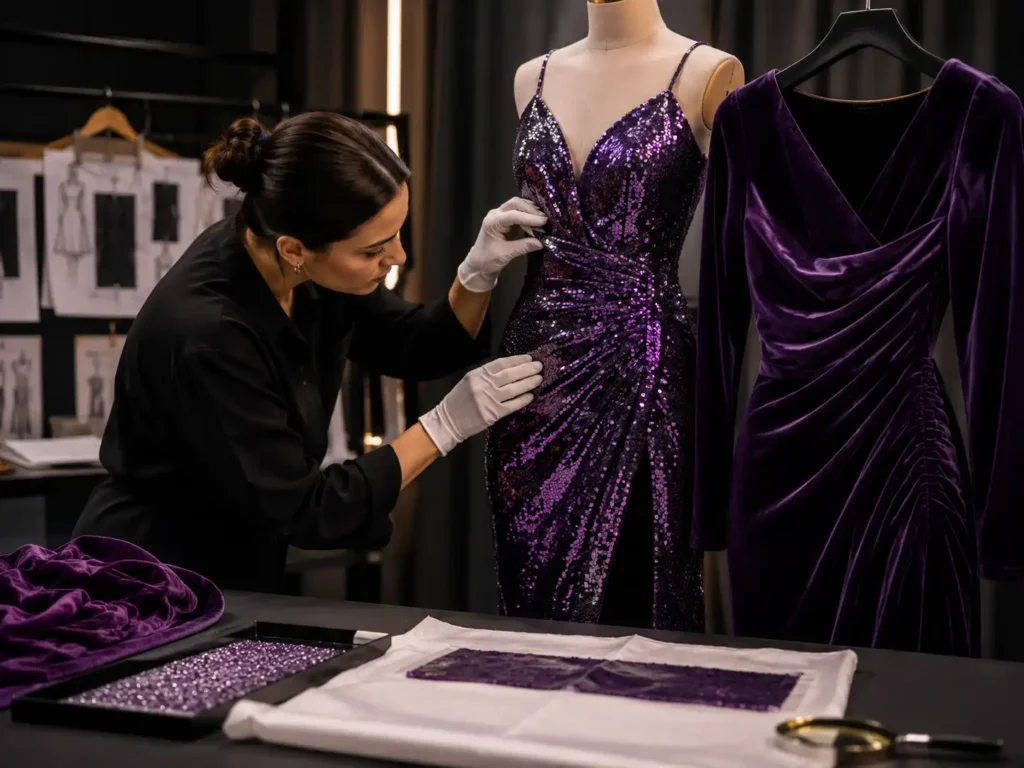
Velvet can make a dress look richer before a single decorative trim is added. Under soft light, its pile creates depth, changes the apparent shade and gives even a restrained silhouette a stronger sense of occasion. That same surface can create serious production problems. A velvet that looks beautiful on a hanger may slip during cutting, show every pressing mark, grow after hanging or appear different from panel to panel once the dress is assembled.
Velvet for dress manufacturing should be selected by fiber content, construction, weight, stretch, recovery, pile direction, drape, color behavior and finishing risk. For most commercial collections, polyester or stretch velvet offers the most practical balance of appearance, repeatability and cost, provided that cutting, sewing, pressing and packing are controlled through approved production standards.
The useful question is not simply whether a velvet feels luxurious. It is whether that exact material can hold the intended neckline, recover over the hip, remain consistent across dye lots and survive production without crushed areas or visible shade breaks. Many velvet failures start with an attractive swatch that was never tested as a complete dress. The sections below follow the decisions that experienced development and production teams make before fabric reaches the bulk cutting table.
What Is Velvet Fabric?
Velvet is a woven or knitted pile fabric with short, dense fibers raised above a supporting base. Its visual depth comes from the way the pile reflects light. For dress manufacturing, velvet must be evaluated by fiber content, construction, weight, pile density, nap direction, stretch, recovery and finishing, rather than by softness or color alone.
Velvet Construction
The defining feature of velvet is its pile. In traditional woven velvet, extra yarns form loops above the ground fabric, and those loops are cut to create a dense surface. This construction usually gives woven velvet a controlled drape, clean vertical fall and relatively stable dimensions. It is commonly selected for evening dresses, cocktail dresses, structured midis and occasion styles where the fabric should move without closely following every body contour.
Knitted velvet uses a knitted base rather than a stable woven ground. It usually stretches more easily across the body and may also stretch lengthwise. This makes it useful for bodycon dresses, ruched styles, fitted sleeves and soft wrap silhouettes. The trade-off is reduced stability. A knit velvet may grow during wear, curl at cut edges or move under the presser foot when the pattern and sewing process are not adjusted for its recovery.
The pile itself also varies. Short, dense pile tends to produce a smoother and more refined surface. A longer or looser pile can look richer but may crush more easily, expose the backing when stretched or show stronger shade changes from different viewing angles. Finishing creates further variation: crushed velvet has an intentionally irregular surface, embossed velvet carries a heat-pressed pattern, and burnout velvet contains transparent motifs where selected fibers have been removed.
Fiber Choices
Velvet is a fabric structure, not a fiber name. It may be made from silk, viscose, cotton, polyester, nylon, elastane or blended yarns. The fiber content affects color depth, drape, care, durability, price and production consistency. Silk velvet is exceptionally fluid and visually rich, but it is expensive and sensitive to pressure, moisture and handling, making it more suitable for limited luxury production than for fast, repeatable commercial programs.
Viscose velvet often provides deep color and elegant movement. It can work well for eveningwear and softly draped dresses, but moisture marks, shrinkage and pile disturbance must be tested carefully. Cotton velvet is generally more matte and structured, so it suits tailored dresses, vintage-inspired silhouettes and winter styles where body is more important than fluid movement. Polyester velvet is widely used because it offers more stable color, practical durability and relatively predictable production behavior.
Polyester-spandex velvet is especially common in fitted fashion because it combines pile appearance with useful stretch. The presence of elastane should not be treated as a complete performance guarantee. Stretch percentage, stretch direction, recovery after repeated extension and the appearance of the pile over the body are more useful than the composition label alone.
Velvet type | Typical weight range | Main characteristics | Suitable dress applications | Key production risk |
Silk velvet | 160-260 gsm | Fluid, rich color, delicate hand | Luxury gowns, draped evening dresses | Pressure marks, high cost, difficult handling |
Viscose velvet | 180-300 gsm | Deep color, soft drape | Cocktail dresses, occasionwear, long dresses | Moisture marking, shrinkage, pile movement |
Cotton velvet | 220-380 gsm | Matte, firm, structured | Tailored dresses, winter minis, vintage styles | Bulk, stiffness, color rubbing |
Polyester velvet | 180-320 gsm | Stable, durable, commercially practical | Party dresses, midi dresses, eveningwear | Heat sensitivity, shine from pressing |
Stretch velvet | 200-320 gsm | Flexible, fitted, comfortable | Bodycon, ruched, wrap and club dresses | Growth, weak recovery, pile separation |
Crushed velvet | 180-280 gsm | Irregular shine, fashion-led texture | Holiday dresses, clubwear, fashion minis | Inconsistent surface effect |
Burnout velvet | 80-180 gsm | Patterned transparency, light structure | Layered dresses, sleeves, occasion overlays | Fragility, transparency, seam distortion |
These ranges are useful for early development, but weight alone does not define performance. Two fabrics at 250 gsm can behave very differently if one has a dense woven base and the other has a loose knitted backing. A useful fabric decision combines the measured specification with a drape test, stretch test, sewing trial and review of the completed sample under realistic lighting.
Velvet and Velour
Velour and velvet are often confused because both have a soft pile. In practice, velour is more commonly knitted, more elastic and more casual in appearance. Velvet may be woven or knitted and is usually associated with stronger color depth, a more directional surface and more formal dress applications. Velour frequently appears in leisurewear, tracksuits, casual fitted dresses and comfort-led fashion rather than structured occasionwear.
The naming used by suppliers is not always consistent. One mill may call a fabric stretch velvet, while another describes a nearly identical construction as fashion velour. Product teams should therefore avoid approving fabric based only on the trade name. The specification should confirm fiber content, construction, finished weight, usable width, stretch in both directions, recovery, pile height, shrinkage and care method.
A physical swatch should also be reviewed under front lighting, side lighting and camera flash. Velvet can look almost flat under one light source and highly reflective under another. The approved swatch and measured fabric data are more reliable than a name printed on a hanger card, particularly when the style will be photographed for ecommerce or sold in several colors.

Nap and Light
Nap is the direction in which the pile naturally lies. When the pile runs downward, velvet often appears smoother and lighter. When it runs upward, the surface can appear darker, denser and richer. There is no single correct direction, but the choice must remain consistent across the garment. A bodice cut in one direction and a skirt cut in the opposite direction can appear to be made from two different colors.
This effect is especially obvious in black, navy, burgundy, emerald and chocolate velvet. The approved direction should be reviewed on the sample under the lighting used for product photography and retail presentation. The direction may also change how the garment feels when touched, so the visual choice should be balanced with comfort and styling expectations.
Nap direction affects consumption because pattern pieces cannot be rotated freely during marker planning. All visible panels normally follow the same direction, which reduces cutting efficiency compared with non-directional fabrics. The correct cost can only be calculated after the pattern, usable width and one-way marker have been confirmed. Treating velvet like a conventional two-way fabric frequently leads to undercosting or visible shade errors.
Which Velvet Is Best for Dresses?
The best velvet depends on the silhouette, required stretch, season, lining plan, target price and intended care method. Stable woven velvet is generally better for structured or fluid occasion dresses, while stretch knit velvet suits fitted designs. The correct choice must support the shape without creating growth, excessive bulk, pile separation or uneven shading.
Match the Silhouette
Fabric selection should begin with the dress shape rather than the fabric swatch. A velvet that works well for a fitted mini may be unsuitable for a full-length evening gown, even when the color and surface appear identical. Bodycon dresses need stretch and recovery. The fabric must extend over the bust, waist and hips without exposing the backing or losing shape after wear.
A practical stretch velvet may provide approximately 20-40% crosswise stretch, but the percentage is only useful when recovery is also measured. A fabric that stretches 40% and returns poorly can perform worse than one that stretches 25% and recovers almost fully. Evening dresses need controlled drape, and a medium-weight woven velvet or stable stretch velvet often provides a better balance than very light fabric that reveals lining edges and body contours.
Corset dresses require internal structure. Velvet should be treated as the fashion outer layer, not as the main support system. The shape normally comes from stable lining, reinforcement, boning channels, bust cups and carefully controlled seam construction. Slip dresses need fluidity but not uncontrolled growth, while wrap dresses need enough flexibility for movement together with a stabilized front edge and neckline.
Dress silhouette | Recommended velvet profile | Practical weight range | Stretch requirement | Main development focus |
Bodycon dress | Knit polyester-spandex velvet | 200-300 gsm | 20-40% crosswise with strong recovery | Hip opacity, seam stretch, garment growth |
Ruched mini dress | Soft stretch velvet | 190-280 gsm | Moderate to high | Ruching balance, bulk and recovery |
Evening gown | Woven or stable knit velvet | 220-320 gsm | Low to moderate | Drape, hem growth, panel shading |
Corset dress | Medium-weight stable velvet | 240-340 gsm | Low or controlled | Internal support, seam bulk, surface smoothness |
Slip dress | Lightweight fluid velvet | 180-240 gsm | Low to moderate | Bias growth, neckline stability, lining |
Winter midi dress | Woven cotton or polyester velvet | 260-360 gsm | Low | Warmth, structure, seam thickness |
Wrap dress | Flexible knit velvet | 200-280 gsm | Moderate | Front edge stability, neckline control |
Puff-sleeve dress | Light to medium woven velvet | 190-270 gsm | Low | Sleeve volume, gathering thickness |
The listed ranges are development references rather than fixed rules. Pile density, backing construction and finishing can make a lighter fabric feel more structured than a heavier one. The safest approach is to test the chosen material in the most demanding area of the style, such as the hip, corset cup, gathered sleeve or full-length skirt, before confirming bulk fabric.
Stretch and Recovery
Stretch is frequently discussed, but recovery is the more important commercial measurement. Recovery describes how closely the material returns to its original dimension after being extended. A simple development check can be completed with a marked 10 cm section. Extend the section to the intended working limit, release it and measure immediately, then measure again after 30 minutes and after several repeated extensions.
This practical check does not replace laboratory testing, but it quickly shows whether the fabric is likely to bag at the seat, waist or elbows. Lengthwise stretch also matters. Four-way stretch can improve movement, but it may cause a long dress to become longer during wear. A maxi style made from heavy four-way stretch velvet can gain visible length because the garment’s own weight pulls the fabric downward.
Surface behavior under stretch must also be reviewed. When pile density is too low, the fibers separate over the hip or bust and expose the backing. This may create a pale or shiny patch, particularly under photography. Seam extension should be tested separately because stitches can break when the seam stretches less than the fabric. Thread, stitch type and seam construction must therefore be developed with the actual production material.
Weight and Drape
Dress velvet often falls between approximately 180 and 350 gsm. Lightweight fabrics create movement but may lack opacity and stability. Mid-weight fabrics are the most versatile for party, cocktail and evening dresses. Heavy velvet provides warmth and structure but can produce thick seams, heavy hems and increased packing pressure. The measured weight is useful, yet it must be read together with pile density and backing construction.
Drape should be tested on a form rather than judged only by hand. A swatch may feel fluid, yet a full skirt can become heavy once several meters are used. The same fabric may behave well in a mini dress but pull downward in a floor-length gown. A tightly knitted backing can support a clean bodycon shape, while a loose backing may stretch unevenly and create waves near seams.
Color also affects perceived weight and surface risk. Dark velvet usually looks visually dense, while pale shades often reveal pile direction, seam impressions and backing more clearly. Ivory, champagne and blush velvet require stronger opacity and pressing checks than black or navy. Evaluating the fabric under side light and flash photography helps reveal problems that are not visible on a flat cutting table.

Lining Decisions
Many velvet dresses benefit from lining, but lining should not be added automatically. The correct decision depends on stretch, opacity, construction and comfort. Woven velvet evening dresses often use lightweight woven lining to support the garment and prevent the backing from catching on hosiery or undergarments. Corset dresses usually need a more structured internal layer that works with reinforcement and boning.
Stretch velvet dresses may use stretch lining, power mesh or partial lining so that the inner and outer layers move together. A rigid lining inside a highly elastic dress can restrict movement and force the velvet to wrinkle. A lining that is too loose can twist independently or show below the hem. The stretch direction of the lining should correspond with the fashion fabric when the outer garment relies on elasticity.
Light-colored velvet should be checked under strong lighting and camera flash. A flat fabric sample may appear opaque, but once stretched over the body it can reveal seam allowances, bra lines or internal support pieces. The lining length should also be confirmed after the garment has rested. If the outer velvet grows after hanging but the lining does not, the layers may pull against each other and distort the hem.
How Do You Manufacture Velvet Dresses?
Velvet dresses require controlled relaxation, one-way cutting, secure panel handling, low-distortion sewing, cautious pressing and protective packing. Nap direction must remain consistent from pattern planning through final inspection. Production methods should be confirmed through sewing trials and an approved pre-production sample before bulk cutting begins.
Pattern and Cutting
Pattern development must reflect the actual fabric construction. Stable woven velvet generally uses conventional wearing ease and shaped seams. Stretch velvet may require negative ease, but the reduction should be based on tested recovery rather than a standard knitwear formula. Pile adds thickness, so curved seams, corset cups, waist joins, collars and zipper areas can become bulky when several layers meet.
Seam allowances may need grading, while certain facings can be replaced with lighter supporting materials. Long garments should be checked for vertical growth because four-way stretch velvet, bias-cut velvet and heavy fluid constructions may lengthen after hanging. During sample development, the dress should rest on a suitable hanger for approximately 24 hours before final hem approval when growth is a realistic risk.
Fabric relaxation is also important. Stable woven velvet may need only several hours after unrolling, while elastic or tightly packed knit velvet may require 12-24 hours in the cutting environment. Single-layer cutting is often safer than double-layer cutting because pile surfaces can shift against each other. It also makes one-way nap control easier, although the process is slower and should be reflected in production planning.
Nap Control
Nap direction should be established during the first sample and documented on every pattern piece. The approved direction must appear on marker instructions, cutting tickets, sewing references and inspection records. Visible components normally follow one direction, including front and back bodice panels, skirt panels, sleeves, waistbands, collars, belts and decorative sections that contribute to the outside appearance.
Small hidden pieces can sometimes be rotated to improve consumption, but only when pile direction cannot affect the outside appearance or garment balance. Roll and dye-lot separation should remain in place throughout cutting. Left and right garment panels are best cut from the same roll whenever possible because mixing pieces from different rolls can create shade differences even when the supplier identifies them as one color.
Cut bundles should remain relatively light. Heavy stacking can create pressure marks before sewing begins. Cut pieces should also be protected from chalk dust, loose threads and adhesive residue because velvet pile traps contamination more easily than smooth fabric. Clear bundle identification prevents matched panels from being separated when multiple sizes, colors and production lines are running at the same time.
Sewing Settings
Velvet does not have one universal machine setting. Needle type, stitch length, presser-foot pressure and thread tension should be tested on the approved bulk fabric. Woven velvet, stretch velvet and burnout velvet may require completely different approaches. The values below are practical trial points, not automatic production standards, because the backing construction and garment stress determine the final setup.
Sewing item | Practical starting point | Main check |
Needle type | Fine universal for stable woven velvet; stretch or ballpoint for knit backing | Holes, skipped stitches, cut fibers |
Needle size | Commonly 70/10-80/12 for lighter fabrics; heavier constructions may need larger | Surface marking and seam strength |
Stitch length | Approximately 2.5-3.0 mm | Puckering, strength, visible sewing track |
Presser-foot pressure | Lower than standard where the machine permits | Layer movement and crushed pile |
Thread tension | Balanced through trial seams | Loose loops, puckering and seam appearance |
Seam allowance | Often 10-15 mm, depending on structure | Fraying, bulk and seam slippage |
Zipper area | Stabilized and basted before final sewing | Rippling, stretching and trapped pile |
Hem method | Blind hem, faced hem, narrow hem or coverstitch by construction | Show-through, weight and stretch |
Layer movement is one of the most common sewing problems. The upper and lower pieces may feed at different rates, causing mismatched seam ends or twisted side seams. Hand basting, temporary machine basting, reduced pressure or a walking foot can help. The operator should not stretch one layer to force the seam ends to meet, because that distortion remains in the finished garment.
Critical seams should be matched at several control points, including the underarm, waist, hip, slit and hem. This takes longer than aligning only the beginning and end, but it prevents cumulative movement. High-stress seams should also be stretched during the trial to confirm that the thread and stitch formation can move with the fabric without breaking or forming visible holes.
Pressing and Finishing
Velvet should not be pressed like ordinary woven fabric. Direct heat and pressure can flatten the pile, create shine or reveal the outline of seam allowances on the face. A velvet board, needle board or thick towel can support the pile while seams are worked from the reverse side. Steam temperature and moisture response should be tested on a cutting scrap before the garment is touched.
The iron should not be moved heavily across the face. In many operations, controlled steam with minimal contact is safer. After steaming, the fabric should cool before it is folded or stacked. Warm, damp velvet can take on permanent pressure marks, particularly when another garment or tool is placed on top of it before the pile has recovered.
Final finishing may involve hanging steam and gentle brushing rather than conventional table pressing. The same method should be documented for all operators because inconsistent handling can create visible differences between garments from the same production lot. Finished dresses should rest before final inspection. Some marks disappear after the pile recovers, while others become more visible after cooling, so immediate inspection alone may not show the final condition.
How Do You Source Velvet for Production?
Velvet sourcing should be based on a written specification covering fiber, construction, weight, usable width, stretch, recovery, pile density, color, shrinkage, strength and care. Bulk fabric must be compared with the approved standard before cutting. Stock velvet offers speed, while custom dyeing offers color control but usually adds material minimums, approvals and lead time.
Fabric Specifications
A description such as black stretch velvet is too vague for production. It does not define the fiber blend, weight, backing, pile density, stretch direction or recovery. A practical fabric specification should record exact composition, construction type, finished gsm, usable width, color reference, pile direction, stretch in both directions, recovery, shrinkage and recommended care. It should also include a physical approved swatch.
Usable width is particularly important. The width printed on the fabric invoice may include damaged or inconsistent edges. Marker consumption should use the actual cuttable width after edge exclusions. Pile density should be reviewed when the dress is stretched because a fabric can look rich on the table but separate over the hip or bust, especially when the backing color contrasts with the pile.
Roll packing should be discussed with the supplier. Velvet packed too tightly may arrive with pressure bands, while folded velvet can develop creases that are difficult to remove, particularly in sensitive viscose or embossed qualities. The specification must become part of the production record. Verbal descriptions are not sufficient when repeat orders, additional colors or future collections are planned.
Stock or Custom Dye
Stock velvet is often the practical choice for seasonal programs with short development calendars. Common colors such as black, navy, burgundy, forest green and chocolate are widely available, allowing samples to begin without waiting for lab-dip approval. A reliable stock fabric with stable test results may offer better commercial performance than an unproven custom quality, even when the custom option appears more exclusive.
Custom dyeing becomes useful when the collection depends on a precise brand color or when several garments must coordinate closely. It may also support future continuity when the volume is large enough to justify material development. The decision should consider planned order quantity, supplier dyeing minimum, development lead time, testing requirements, expected repeat orders, target garment cost and launch deadline.
Custom dyeing does not guarantee perfect repeatability. Each new batch can vary because of yarn, dye conditions and finishing. A new bulk cutting should therefore be reviewed against the approved standard for every order. The practical choice is the option that can be produced consistently within the launch plan, not simply the option described as more customized.
Color and Lot Control
Velvet makes small color differences appear stronger because the pile changes light reflection. A roll that looks acceptable from the front may look noticeably different from the side. Bulk rolls should be inspected under consistent lighting and separated by dye lot. Small pieces can be cut from each roll, placed in the same nap direction and compared side by side before the marker plan is released.
All major panels of one garment should come from the same roll or a closely matched roll group. Sleeves, side bodices and skirt panels should not be mixed casually. Garments made from several rolls should remain traceable through bundle tickets or production records so that a shade issue can be isolated without affecting the entire order.
Color names are not reliable standards. Wine, burgundy and oxblood can describe very different shades. A physical swatch, approved lab dip or recognized color reference should be used as the control. Dark velvet should also be tested for rubbing transfer. A quick dry-rub check with a light cloth can identify obvious risk during development, although formal testing is still required for commercial approval.
Testing Before Cutting
Testing should reflect the fiber, garment structure, care instruction and destination market. Not every order requires the same package, but high-risk velvet should not be approved by appearance alone. Common checks include fiber composition, finished weight, dimensional change, dry and wet rubbing fastness, wash or dry-clean performance, pilling, tensile or bursting strength, seam slippage, stretch and recovery.
Surface-specific checks are equally important. The material should be reviewed after pressing, steaming, hanging and realistic packing pressure. A velvet that passes colorfastness may still develop permanent shine, crushed bands or visible seam impressions. The care method should be tested on the complete garment construction rather than only on a loose fabric square, especially when lining, interfacing or boning is present.
A production sewing trial should reproduce the actual zipper, hem, lining, seam type and most difficult design detail before the full fabric quantity is cut. Standard laboratory reports may not reveal zipper rippling, trapped pile, seam impressions or layer movement. Conditional approvals should be documented clearly, such as approval only for dry-clean care, only with lining or only after stabilizing the zipper area.
How Do You Control Velvet Dress Quality?
Velvet dress quality is controlled through incoming fabric inspection, lot separation, nap management, cutting checks, first-output approval, inline inspection, controlled finishing and protective packing. Inspectors should examine garments under angled light because reversed pile, crushing and panel shading may be difficult to see under flat lighting. The approved pre-production sample should remain the main reference.
Fabric and Cutting Checks
Incoming velvet should be inspected before relaxation and cutting. The inspection should cover width, shade, pile condition, pressure bands, stains, holes, backing distortion and edge damage. Many factories use a four-point fabric inspection system, but the acceptance limit should follow the client’s requirements and the visual sensitivity of the garment. A roll that passes a general defect score may still be unsuitable if a repeated pressure line crosses the usable width.
Roll numbers and dye lots should remain traceable. Once fabric is spread, the cutting team should confirm face direction and nap direction before the marker is placed. A second check immediately before cutting is worthwhile because a reversed marker can affect the entire order. Cutting inspection should also confirm panel pairing, notch position, cut-edge quality, roll identification and replacement-piece control.
Velvet offcuts and loose pile should be removed from the work area regularly. Pile fragments can transfer to light linings, adhesive tapes and finished garments. Cut bundles should not remain under heavy pressure for long periods, and replacement panels should be matched to the original garment roll whenever possible so that a local repair does not create a new shade difference.

Inline Quality
The first completed garments should be inspected before the production line continues at full speed. This first-output review confirms whether the approved sample can be reproduced using the bulk fabric, operators and machines. Side seams should hang straight, waist joins should remain level, zippers should lie flat without rippling, and pile should not be trapped visibly along seam lines.
The bodice and skirt should match in shade when viewed from different angles. Inline measurement checks are important for stretch velvet because the fabric may grow during handling. Measurements taken immediately after sewing can differ from measurements taken after the garment rests, so the inspection method should state whether the garment must relax before measurement.
High-stress areas deserve specific attention, including underarm seams, hip seams, center-back zippers, slit openings, strap attachments, corset necklines, waist seams and ruched side seams. Corrective action should happen early. A pressure setting or handling problem detected after several dozen garments is manageable, while the same issue found after the full order is sewn may be impossible to repair without leaving marks.
Final Inspection
Final inspection should compare the garment with the approved pre-production or Golden sample. Measurements, workmanship, appearance, labels, packing and accessories all need confirmation. Velvet garments should be inspected from the front, back and sides. Side lighting is particularly useful for identifying crushing, reversed nap and seam impressions that remain hidden under flat overhead light.
Inspection stage | Main checks | Practical control |
Incoming fabric | Shade, width, pile, crushing, stains and defects | Separate rolls and record lot numbers |
Relaxation | Tension release, surface recovery and dimensions | Allow fabric to rest before marker planning |
Cutting | Nap direction, panel pairing and accuracy | Use one-way markers and bundle identification |
First output | Fit, measurements, seam appearance and zipper | Approve before full-line production |
Inline sewing | Puckering, slippage, trapped pile and growth | Correct settings and handling immediately |
Finishing | Shine, press marks, stains and pile recovery | Use low-pressure steam and controlled cooling |
Final garment | Appearance, measurements, labels and construction | Compare with the approved sample |
Packing | Folding, pressure, barcode, size and carton data | Follow the approved packing method |
Inspectors should view the full garment on a hanger or mannequin, not only on a flat table. The selected sampling plan should follow the client’s standard, product value and risk level. AQL 2.5 for major defects and AQL 4.0 for minor defects are commonly requested apparel reference points, but critical defects remain unacceptable regardless of the selected sampling level.
The final review should also consider consistency across the inspected group. One dress may look acceptable by itself but appear noticeably lighter beside the remaining units because of nap reversal or roll mixing. Group comparison is especially useful for dark colors, coordinated sets and deliveries intended for the same retail display or campaign.
Packing Protection
Packing is part of velvet quality control. A well-made dress can arrive with permanent marks if it is folded under excessive pressure or packed before residual steam has cooled. The garment should be clean, dry and fully cooled before folding. Tissue, lightweight support material or a wider fold can reduce sharp pressure lines, while decorative buckles, zippers and trims should not press directly into visible velvet surfaces.
Cartons should not be overloaded. Excessive compression can flatten the pile and create panel-shaped marks. Very heavy velvet styles may require fewer garments per carton than lightweight dresses. Hanger packing can be appropriate for high-value gowns, but it increases logistics volume and cost. Flat packing is more efficient when the folding method has been tested through a realistic closed-carton trial.
Dark and light colors should be protected from contamination. Loose pile from black velvet is highly visible on ivory lining or pale garments. Individual polybags, clean finishing areas and color separation help reduce this risk. The final standard is straightforward: the garment should look commercially presentable after unpacking without aggressive steaming, brushing or surface repair at the destination.
A successful velvet dress program begins with a production-ready fabric decision and ends with a garment that retains the approved color, silhouette and surface after delivery. Brand teams should send the intended design, target quantity, size range, preferred color, market, launch date and any available tech pack or reference sample so the material and construction risks can be reviewed before quotation.
Share This Article :

Jerry Lee
Categories

Latest blogs

Table of Contents
Here, developing your OEM/ODM private label clothing collection is no longer a challenge—it’s an excellent opportunity to bring your creative vision to life.

