Skip to content

Many buyers struggle to choose the right polyester dress styles. Picking the wrong mix can slow sales and increase inventory pressure.
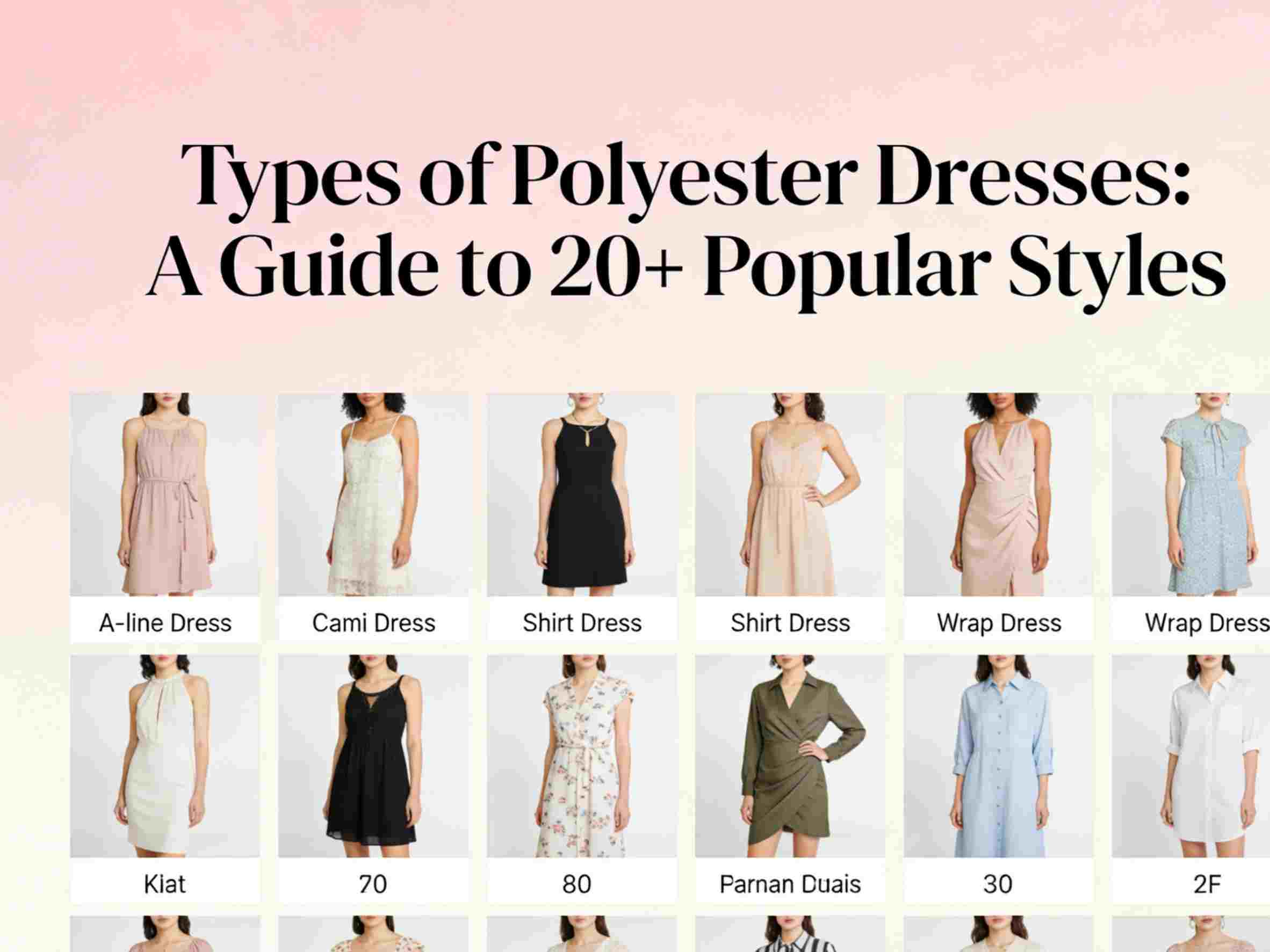
The most common types of polyester dresses include everyday styles like shirt and A-line dresses, fashion-forward styles like slip or bodycon dresses, and occasion styles such as maxi or halter dresses. Understanding these categories helps buyers select styles that match customer demand and seasonal trends.
When I plan a dress collection, I do not just look at design photos. I focus on silhouette, fabric behavior, and the customer who will actually wear the dress.
Which Everyday Polyester Dress Styles Usually Sell Best?
Every collection needs reliable styles that sell consistently.
The most dependable everyday polyester dresses are shirt dresses, A-line dresses, shift dresses, fit-and-flare dresses, and tank dresses because they are easy to wear, easy to size, and suitable for many occasions.
Core everyday styles
- Shirt dress – clean structure and versatile styling
- A-line dress – fitted top with a wider hem, flattering for many body types
- Shift dress – loose straight shape for comfort
- Fit-and-flare dress – defined waist with feminine movement
- Tank dress – simple sleeveless option for summer or layering
Why these styles work
| Style | Key advantage | Risk point |
|---|---|---|
| Shirt dress | Versatile and structured | Fabric too stiff can look flat |
| A-line dress | Flattering silhouette | Poor drape reduces quality feel |
| Shift dress | Comfortable and simple | May look boxy |
| Fit-and-flare | Feminine and classic | Needs balanced proportions |
| Tank dress | Easy casual wear | Armhole fit must be correct |
These dresses succeed because they match daily lifestyle needs while keeping production stable and repeatable.
Which Polyester Dress Styles Are More Trend-Driven?
Trend styles create visual impact and help brands stay fashionable.
Common fashion-forward polyester dresses include slip dresses, bodycon dresses, cut-out dresses, asymmetrical dresses, ruched dresses, and corset-style dresses. These styles attract attention but require careful fabric choice and precise fit.
Typical trend-driven styles
- Slip dress
- Bodycon dress
- Cut-out dress
- Asymmetrical dress
- Ruched dress
- Corset-style dress
Key considerations when sourcing trend dresses
| Style | Main feature | Production challenge |
|---|---|---|
| Slip dress | Elegant drape | Needs fluid fabric |
| Bodycon | Figure-hugging | Requires stretch recovery |
| Cut-out | Bold design | Fit and comfort control |
| Asymmetrical | Unique silhouette | Pattern precision |
| Ruched | Body shaping | Even gathering |
| Corset style | Structured waist | Complex construction |
I treat trend dresses as controlled risks. They bring energy to a collection but should not dominate the entire product mix.
Which Polyester Dresses Work Best for Parties or Formal Occasions?
Occasion dresses often create higher perceived value and stronger visual appeal.
Maxi dresses, halter dresses, one-shoulder dresses, off-shoulder dresses, mermaid dresses, and satin-look slip dresses are popular polyester choices for formal or evening wear because they create movement, elegance, and event-ready silhouettes.
Popular occasion styles
- Maxi dress – long and elegant
- Halter dress – highlights shoulders
- One-shoulder dress – modern asymmetry
- Off-shoulder dress – romantic styling
- Mermaid dress – dramatic fitted silhouette
- Satin-look slip dress – soft shine for evening wear
Important design factors
- Fabric drape and shine
- Clean seams and lining
- Balanced silhouette and movement
Even small details like fabric finish or lining quality can strongly affect how premium the dress looks.
How Can I Organize 20+ Types of Polyester Dresses Efficiently?
When many styles exist, I use a simple structure to compare them.
I usually categorize polyester dresses by length, silhouette, and structure. This method makes it easier to manage more than twenty dress types while keeping a balanced product assortment.
Common polyester dress types
Shirt, A-line, shift, tank, slip, bodycon, wrap, maxi, halter, one-shoulder, off-shoulder, mermaid, smock, tiered, babydoll, tunic, kaftan, ruched, corset-style, and asymmetrical dresses.
Practical comparison framework
| Factor | Examples | Purpose |
|---|---|---|
| Length | Mini, Midi, Maxi | Defines occasion and season |
| Silhouette | A-line, bodycon, straight | Shapes body fit |
| Structure | Soft or structured | Affects drape and comfort |
Using this structure helps me avoid choosing too many similar designs.
Polyester A-Line Dress

Many buyers chase trend dresses first. Then they face sizing issues, weak repeat orders, and short product life. That is why I keep coming back to the polyester A-line dress.
I see the polyester A-line dress as one of the most reliable dress types because it balances shape, comfort, and commercial value. It flatters many body types, works across seasons, and adapts well to prints, solids, casual wear, and more polished collections.
When I review dress ranges, I often find that the A-line dress is not the loudest style. But it is often one of the safest and most repeatable sellers.
What Makes a Polyester A-Line Dress Different From Other Dress Styles?
At first glance, many dresses seem similar. But the A-line shape solves a very specific fit problem in a simple way.
A polyester A-line dress usually fits more closely at the upper body and gradually widens toward the hem. This shape creates balance, gives easier movement, and reduces fit pressure at the hips, which makes it more wearable than many straight or bodycon styles.
Why the silhouette works so well
The strength of an A-line dress is not only visual. It is also functional. I like this shape because it creates a cleaner fit through the waist and upper body, while leaving more space below.
That makes it useful for many customer groups:
- buyers who want a flattering daily dress
- brands that need lower fit risk
- retailers that want broad size appeal
A-Line dress vs other common shapes
| Style | Shape effect | Main strength | Main risk |
|---|---|---|---|
| A-line dress | Narrow top, wider hem | Balanced and flattering | Needs good drape |
| Shift dress | Straight down | Easy comfort | Can look boxy |
| Bodycon dress | Close to body | Strong trend image | High fit risk |
| Fit-and-flare dress | Fitted waist, fuller skirt | Feminine look | More volume and fabric use |
In my view, the polyester A-line dress sits in a very strong middle position. It is more shaped than a shift dress, but less risky than a bodycon dress.
Why Does Polyester Work So Well for A-Line Dresses?
The dress shape matters, but fabric behavior matters just as much. A good A-line design can fail if the polyester quality is wrong.
Polyester works well for A-line dresses because it holds color, supports print clarity, controls cost, and can be developed in different weights and finishes. When the fabric drapes properly, it helps the A-line shape look clean, soft, and commercially attractive.
The real value of polyester in this category
I use polyester often in A-line dresses because it gives me flexibility. I can create very different products from the same base silhouette.
For example:
- matte woven polyester for daily wear
- satin-look polyester for dressier styles
- textured polyester for seasonal collections
- stretch blends for better comfort and fit recovery
What I study before choosing the fabric
Drape
An A-line dress needs movement. If the polyester is too stiff, the hem can look hard and cheap. If it is too thin, the dress may lose shape.
Weight
Lightweight polyester works well for spring and summer. Medium-weight polyester often works better for structured everyday A-line dresses.
Surface finish
The finish changes the whole product position. Matte polyester feels more practical and versatile. Soft sheen looks more dressed-up. Too much shine can reduce the premium feel.
Print performance
Polyester usually carries prints well. That matters because A-line dresses often sell strongly in florals, abstract patterns, and seasonal colors.
My practical conclusion on fabric choice
I never judge a polyester A-line dress only by sketch or photo. I always ask whether the fabric supports the flare in a natural way. If the fabric and silhouette do not match, the dress loses most of its advantage.
What Are the Main Commercial Benefits of a Polyester A-Line Dress?
Some dress styles look exciting. Some dress styles actually keep selling. I see the polyester A-line dress as a style that can do both when it is developed correctly.
The main commercial benefits of a polyester A-line dress are broader body fit, lower return risk, easier seasonal updates, and flexible price positioning. It is one of the few dress styles that can work in casual, office, boutique, and entry-level occasion collections.
Why buyers keep returning to this shape
I notice that A-line dresses often perform well because they are easier for customers to understand. The shape is familiar. The styling is simple. The fit feels less stressful.
That gives the style several business advantages.
Key commercial strengths
| Benefit | Why it matters |
|---|---|
| Broad body appeal | Helps more customers feel comfortable |
| Easier sizing | Reduces fit complaints |
| Good repeat potential | Easy to refresh with new colors and prints |
| Versatile styling | Fits many channels and markets |
A deeper look at why this helps sell-through
1. Lower fit pressure
A-line dresses do not cling too much at the lower body. That often makes the dress feel safer for online shoppers.
2. Strong repeat logic
I can update one successful A-line block in several ways:
- new sleeve shape
- new print
- new neckline
- shorter or longer length
This keeps the range fresh without rebuilding the full style from zero.
3. Easier market adaptation
An A-line dress can shift between different customer needs more easily than many other silhouettes. A modest market may prefer midi length and fuller coverage. A younger boutique may want mini length and sharper prints.
4. Better balance between style and practicality
This is one reason I rate it highly. It does not rely only on trend energy. It also works in real daily use.
I think the polyester A-line dress keeps its value because it solves both fashion and fit at the same time. Many styles are strong in one area only. This one usually performs across both.
How Can I Make a Polyester A-Line Dress Look More Premium and Professional?
The A-line shape is reliable, but basic execution is not enough. Small details decide whether the dress feels cheap or well-developed.
To make a polyester A-line dress look more premium, I focus on fabric handfeel, seam cleanliness, hem flow, lining when needed, and balanced proportions. The silhouette is simple, so every construction detail becomes more visible and more important.
Details that raise product value
Fabric handfeel
Customers may not use technical language, but they notice handfeel fast. A softer and smoother polyester usually creates a better first impression.
Clean seam finishing
Because the shape is simple, bad sewing stands out quickly. I watch for:
- puckering
- twisted side seams
- uneven hemline
- poor zipper insertion
Hem movement
The hem is a key visual point in an A-line dress. It should fall cleanly and move naturally. A weak hem finish can destroy the elegance of the silhouette.
Neckline and shoulder balance
Even in a relaxed dress, the top area must sit correctly. If the shoulder is off or the neckline pulls, the entire dress looks wrong.
Premium vs basic execution
| Element | Basic result | Better result |
|---|---|---|
| Fabric | Thin or overly shiny | Soft, stable, controlled finish |
| Hem | Flat or stiff | Smooth and fluid |
| Seams | Visible tension | Clean and neat |
| Shape | Generic flare | Balanced proportion from bust to hem |
My honest view
A polyester A-line dress does not become premium just because the shape is classic. It becomes premium when the factory controls the small things well. In this style, details are not decoration. They are the product.
Polyester Wrap Dress

Many buyers like wrap dresses, but many still choose the wrong version. That can lead to weak fit, more returns, and lower repeat orders.
I see the polyester wrap dress as one of the most practical dress types because it combines waist definition, flexible fit, and broad market appeal. It works well in casual, office, vacation, and occasion lines, but the final result depends heavily on drape, closure design, and sizing balance.
When I review this style, I do not only look at the wrap shape. I also check how the fabric falls, how the waist closes, and how the dress performs on different body types.
Why Is the Polyester Wrap Dress So Popular in Women’s Fashion?
The wrap dress stays popular because it is easy to wear and easy to understand. Many customers know right away how it should look on the body.
I find that the polyester wrap dress sells well because it creates a defined waist, flatters many body shapes, and fits many use cases. It is one of the few styles that can feel feminine, practical, and commercial at the same time.
Why this style keeps working
- It gives shape without feeling too tight
- It suits many age groups
- It works in prints and solids
- It fits both casual and dressy collections
What I think matters most
| Feature | Why it helps | Risk point |
|---|---|---|
| Wrap front | Creates waist shape | Can open too much at bust |
| Adjustable tie | Adds fit flexibility | Tie position may shift |
| V-neckline | Looks feminine and clean | May feel too deep |
| Soft drape | Improves movement | Cheap fabric ruins effect |
I think this style stays strong because it solves two problems at once. It gives visual shape, and it still feels easy to wear. That balance is hard to replace with other silhouettes.
What Are the Main Types of Polyester Wrap Dresses?
Not every wrap dress works the same way. I always separate true wrap styles from wrap-look styles before I judge commercial value.
The main types of polyester wrap dresses include true wrap dresses, faux wrap dresses, midi wrap dresses, maxi wrap dresses, ruffle wrap dresses, and long-sleeve wrap dresses. Each type serves a different customer need, price level, and season.
Common wrap dress types
- True wrap dress – full adjustable wrap closure
- Faux wrap dress – fixed wrap look with less adjustment
- Midi wrap dress – balanced and commercial
- Maxi wrap dress – longer and more fluid
- Ruffle wrap dress – softer and more romantic
- Long-sleeve wrap dress – better for transitional seasons
Quick comparison
| Type | Best use | Main strength |
|---|---|---|
| True wrap | Flexible fit | Better size adjustment |
| Faux wrap | Easier production | More stable closure |
| Midi wrap | Daily wear | Broad market appeal |
| Maxi wrap | Vacation or occasion | Strong movement |
| Ruffle wrap | Feminine styling | More visual detail |
| Long-sleeve wrap | Autumn or office | More coverage |
I usually treat the midi wrap dress as the safest choice. It has the best balance between trend, practicality, and repeat sales.
What Should I Check in the Dive Deeper Analysis of a Polyester Wrap Dress?
This is where I get more careful. A wrap dress may look simple in photos, but the technical details decide whether it performs well or fails in real use.
When I analyze a polyester wrap dress deeply, I focus on drape, closure stability, neckline control, waist position, fabric weight, and grading. These points directly affect comfort, appearance, return rate, and production consistency.
Fabric drape is the first issue
A wrap dress depends on movement. If the polyester is too stiff, the wrap front looks bulky and the skirt loses flow. If the fabric is too thin, the dress may cling, expose body lines, or feel weak.
What I usually compare
- Soft woven polyester for fluid movement
- Polyester crepe for a cleaner daily look
- Polyester blends with slight stretch for better comfort
I always match the fabric to the target use. A casual wrap dress can use a lighter handfeel. An office wrap dress often needs more structure.
Closure design changes the whole result
Many people think all wrap closures are similar. I do not agree. The tie position, internal button, and overlap width all change the fit.
Common closure problems
- Bust opens during movement
- Waist tie sits too high or too low
- Inner tie pulls the side seam
- Overlap is too narrow for larger sizes
These problems often lead to returns. The customer may say the fit is wrong, but the deeper reason is usually poor wrap engineering.
Neckline control is often underestimated
The V-neck is one of the strongest selling points of a wrap dress. At the same time, it is one of the biggest risk areas.
| Area | Good result | Poor result |
|---|---|---|
| Bust coverage | Secure and flattering | Gaping or exposure |
| Neckline depth | Feminine and balanced | Too deep or awkward |
| Shoulder balance | Smooth drape | Pulling and twisting |
I often see brands copy the look of a wrap dress without solving neckline stability. That creates a product that looks good on a model but not in daily wear.
Waist placement affects body perception
A wrap dress should define the waist in a natural place. If the tie sits too high, the body proportion looks off. If it sits too low, the dress loses shape.
Why this matters
- It changes how tall the customer looks
- It affects comfort when sitting or walking
- It changes how the skirt falls from the waist
This is why I always review wrap dresses on more than one size, not only on a sample size.
Grading is a real professional issue
A polyester wrap dress may fit well in one size and fail in another. This is common in wrap styles because overlap, neckline angle, and tie length all respond differently when sizes grow.
I think this is one of the most overlooked parts of wrap dress development. A style that looks flattering in size small may open too much or pull too hard in larger sizes if grading is not handled carefully.
Which Polyester Wrap Dress Styles Work Best for Different Markets?
The wrap dress is flexible, but I still choose different versions for different buyers. One style does not fit every market.
I usually match polyester wrap dress styles to market needs by length, sleeve type, print direction, and fabric finish. Midi and long-sleeve wraps are safer for broad retail, while ruffle or maxi wraps work better for fashion, vacation, or occasion-driven lines.
My market view
- Boutique market – ruffle wrap, printed wrap, asymmetrical hem
- Mainstream retail – midi wrap, short-sleeve wrap, floral wrap
- Office wear – long-sleeve wrap, solid color wrap, matte finish
- Vacation line – maxi wrap, lighter fabric, brighter print
How I choose more safely
| Market | Best wrap type | Reason |
|---|---|---|
| Broad commercial | Midi faux wrap | Stable and easy to sell |
| Trend-focused | Ruffle or printed wrap | More visual appeal |
| Office | Long-sleeve wrap | Balanced and polished |
| Resort | Maxi wrap | Better movement and mood |
I do not choose a wrap dress only because it is popular. I choose it because the right version matches the buyer, the season, and the customer’s real wearing purpose.
Polyester Shirt Dress

Many buyers want a dress that looks polished but still sells easily. A weak choice can feel too plain, too stiff, or too hard for daily wear.
I see the polyester shirt dress as one of the most practical dress styles because it combines structure, comfort, and easy styling. It works across casual, workwear, and transitional seasons, and it gives buyers a stable option with broad market appeal.
I do not treat the polyester shirt dress as just a basic item. I see it as a flexible category that can move in different directions depending on fabric, fit, and finishing.
What Makes a Polyester Shirt Dress Different From Other Polyester Dress Types?
At first glance, many polyester dresses look similar. In real buying, the shirt dress stands apart because its construction creates a clearer identity.
A polyester shirt dress usually includes shirt elements like a collar, front placket, button opening, cuff, or chest pocket. These details give it more structure than slip, shift, or tank dresses, which makes it look smarter and easier to style.
Key features I look for
- Collar or stand collar
- Front button placket
- Straight or slightly shaped body
- Optional belt or self-tie
- Long sleeve, short sleeve, or sleeveless versions
Why this structure matters
| Feature | Effect on appearance | Commercial value |
|---|---|---|
| Collar | Adds shape and polish | Works for casual and office looks |
| Button front | Makes styling flexible | Easier layering and fit control |
| Belt option | Defines waist | Broadens body-shape appeal |
| Cuffs or sleeves | Adds tailored feel | Helps seasonal variation |
What makes this style strong is not only the look. It is the balance between form and function. A shirt dress looks more intentional than a simple loose dress, but it is still easier to wear than many fitted silhouettes. That middle position is why I see it as a dependable category.
Why Does a Polyester Shirt Dress Usually Perform Well in the Market?
Some dresses create strong images but weak repeat orders. The polyester shirt dress often performs better because it fits daily use.
I find that polyester shirt dresses usually perform well because they are easy to understand, easy to style, and suitable for many age groups. They work for office wear, travel, weekend outfits, and layered looks, which gives them wider selling potential.
Main reasons this style sells
- It looks neat without feeling too formal
- It fits many retail channels
- It works in solids, prints, and stripes
- It is easy to adapt by season
Market strength analysis
| Selling point | Why it helps |
|---|---|
| Versatility | One dress can serve multiple occasions |
| Size tolerance | Straight or belted fits reduce sizing pressure |
| Repeatability | Easy to relaunch in new colors or prints |
| Styling ease | Customers know how to wear it quickly |
I think the shirt dress sells well because it lowers the styling burden. A customer does not need to think too much. She can wear it with flats, sneakers, boots, or heels. That makes the item easier to convert online.
There is also a product planning advantage. I can develop the same base idea into very different price points. A simple straight polyester shirt dress works for entry-level volume. A belted midi version with better buttons and softer fabric can move into a more premium space.
How Does Fabric Choice Change the Quality of a Polyester Shirt Dress?
The style name alone is never enough. Fabric choice can decide whether the shirt dress feels cheap, premium, stiff, or wearable.
Fabric changes the whole result of a polyester shirt dress. A soft polyester crepe gives better drape, a satin finish creates a dressier look, and a crisp woven polyester gives more structure. The wrong fabric can make the dress feel flat or uncomfortable.
Common fabric directions
- Polyester crepe – soft, matte, and easy to wear
- Polyester satin – smoother and more dressed-up
- Light woven polyester – clean and crisp
- Textured polyester – adds surface interest
Fabric comparison
| Fabric type | Main benefit | Risk point |
|---|---|---|
| Crepe | Better drape and softer look | May lack sharpness if too light |
| Satin | More elegant appearance | Can look cheap if too shiny |
| Crisp woven | Strong shirt identity | Can feel stiff |
| Textured polyester | Better visual depth | Texture must stay consistent |
This is where deeper judgment matters. A polyester shirt dress needs enough structure to keep the shirt identity, but it also needs enough movement to still feel like a dress. If the fabric is too rigid, the body can look boxy. If the fabric is too fluid, the shirt details lose their strength.
I pay close attention to three things here. First, I check drape. The dress should move when worn, not stand away from the body in an awkward way. Second, I check opacity. A light polyester may need better density or layering to avoid a low-quality feel. Third, I check surface finish. Matte or lightly textured finishes often look more premium than overly shiny ones in this category.
Which Polyester Shirt Dress Variations Are Most Worth Developing?
A shirt dress is not only one look. Small changes in cut and length can shift the customer group and price position.
The most useful polyester shirt dress variations include mini, midi, belted, oversized, tiered, and utility-inspired versions. These options let me target different markets while keeping the same core shirt-dress identity.
Strong variations to consider
- Midi shirt dress – the safest and most versatile option
- Belted shirt dress – adds shape and a more feminine fit
- Oversized shirt dress – more relaxed and trend-led
- Tiered shirt dress – softer and more casual
- Utility shirt dress – pockets and structure for a stronger look
Variation analysis
| Variation | Best for | Main watchpoint |
|---|---|---|
| Midi | Broad commercial market | Length balance |
| Belted | Waist definition | Belt placement |
| Oversized | Fashion casual market | Proportion control |
| Tiered | Softer lifestyle look | Too much bulk |
| Utility | Stronger visual identity | Heavy appearance |
I usually see the midi belted version as the most stable. It gives shape, keeps modest coverage, and works across more seasons. Oversized versions can feel more modern, but they need stronger proportion control. If the shoulder drops too much or the body gets too wide, the dress can lose polish.
Tiered and utility versions need even more judgment. Tiered styles can soften the shirt look, which helps in resort or casual markets. Utility versions bring a more structured mood, but too many pockets, tabs, or seams can make the dress look heavy. So the design needs editing, not just detail addition.
What Technical Details Should I Check Before Approving a Polyester Shirt Dress?
A shirt dress may look simple, but weak execution shows quickly. Small technical problems can damage the whole style.
Before approving a polyester shirt dress, I check collar shape, placket alignment, button spacing, sleeve balance, hem shape, and belt position. These details affect both fit and visual quality, and they often decide whether the dress looks clean or careless.
My main technical checklist
- Collar sits flat and clean
- Front placket stays straight
- Buttons do not pull at bust level
- Sleeve and cuff proportions feel balanced
- Hem shape matches the silhouette
- Belt loops and waist position are correct
Why these details matter
| Detail | Common issue | Result |
|---|---|---|
| Collar | Poor stand or collapse | Looks low-end |
| Placket | Twisting or uneven sewing | Front looks messy |
| Bust area | Gaping between buttons | Fit complaints |
| Waist position | Belt too high or too low | Unflattering shape |
This is where I think many buyers underestimate the category. The shirt dress looks familiar, so people assume it is easy. In reality, it combines shirt construction and dress proportion. That means the pattern must solve both upper-body neatness and full-body balance.
For example, button spacing is not a small detail. If the gap is too wide across the bust, the dress opens when worn. That creates return risk. Collar scale also matters. A collar that is too small can look weak, while one that is too large can overpower the dress. Even hem shape needs control. A curved hem gives a more relaxed shirt feeling, while a straight hem can feel cleaner and sharper.
Is a Polyester Shirt Dress a Good Choice for B2B Buyers and Wholesale Collections?
Not every stylish dress makes sense at scale. The shirt dress is usually stronger because it combines commercial safety with room for variation.
Yes, I see the polyester shirt dress as a strong B2B and wholesale choice because it has broad customer appeal, stable repeat potential, and flexible development options. It can work as a basic bestseller or as a trend-updated item with small design changes.
Why I rate it highly for wholesale
- Easy to relaunch in new colors
- Works across casual and smart-casual channels
- Fits broad age groups
- Supports both basic and upgraded versions
For wholesale, I value categories that can stretch without losing identity. The polyester shirt dress does that well. I can simplify it for price-sensitive programs or upgrade it with better trims, texture, or shape for boutique buyers.
The main point is this: the polyester shirt dress is not exciting because it is loud. It is strong because it is adaptable. That gives it lasting value in a market where many dress trends move too fast.
Polyester Shift Dress

Many buyers look at trendy dresses first. Then they miss simple styles that sell longer and fit more customers.
I see the Polyester Shift Dress as one of the most practical dress types because it is easy to wear, easy to style, and easy to adapt across seasons. It also gives buyers a safe option inside a wider polyester dress collection.
I used to think shift dresses were too basic. Then I saw how often they solved fit, pricing, and repeat-order problems better than more complex styles.
What Makes a Polyester Shift Dress Different from Other Polyester Dress Types?
At first glance, many dress types look similar. In real buying work, the shape logic is very different.
A Polyester Shift Dress usually has a straight or slightly loose silhouette, minimal waist shaping, and a clean outline. That makes it different from bodycon, A-line, or fit-and-flare dresses, which rely more on body contour or stronger waist definition.
Core shape features
- Straight silhouette
- Light ease through the body
- Low styling pressure
- Easy day-to-night use
Quick comparison
| Style | Shape focus | Main benefit |
|---|---|---|
| Shift dress | Straight and relaxed | Easy fit |
| A-line dress | Wider hem | More feminine shape |
| Bodycon dress | Close to body | Strong curve focus |
| Fit-and-flare dress | Defined waist | Balanced silhouette |
Why this difference matters
A shift dress does not ask the fabric to do too much. That is one reason I like it in polyester. The style depends less on stretch and more on proportion, drape, and clean finishing. This lowers some fit risk, but it also means I must control shoulder width, bust ease, and dress length very carefully.
What I study before calling it a good shift dress
Silhouette balance
If the body is too wide, the dress looks flat. If it is too narrow, it stops feeling like a real shift dress.
Fabric response
Polyester can look clean in this shape, but only when the fabric has enough softness. If it feels too stiff, the dress loses ease and starts to look cheap.
Why Does the Polyester Shift Dress Work So Well in Commercial Collections?
Some dresses create attention. Some dresses create steady business. I place shift dresses in the second group.
I find the Polyester Shift Dress commercially strong because it is easy to size, easy to repeat, and suitable for workwear, casualwear, and transitional seasons. It also supports prints, solids, textures, and private label updates without changing the core pattern too much.
Why buyers keep using it
- Broad size tolerance
- Lower styling risk
- Good repeat potential
- Works in many price levels
Commercial strengths in real terms
| Factor | Why it helps |
|---|---|
| Fit | Less restrictive than fitted dresses |
| Production | Easier to repeat at scale |
| Styling | Works with belts, jackets, boots, flats |
| Market reach | Fits both younger and mature customers |
The deeper reason it stays relevant
I think the shift dress survives because it solves a daily dressing problem. Many customers want something clean, comfortable, and polished. They do not always want dramatic volume or tight shaping. The Polyester Shift Dress sits in that middle space.
Where it can still fail
Weak fabric choice
A thin polyester can cling in the wrong places. A heavy polyester can make the dress feel boxy.
Poor finishing
Because the design is simple, every flaw becomes more visible. I notice side seam twisting, neckline waviness, and hem imbalance faster in a shift dress than in a more detailed style.
How Should I Evaluate Fabric and Construction for a Polyester Shift Dress?
A simple shape needs stronger technical control. I never treat a shift dress as an easy product just because it looks minimal.
When I evaluate a Polyester Shift Dress, I focus on fabric weight, drape, opacity, seam cleanliness, and neckline stability. These factors matter more than extra decoration because the value of the dress comes from shape clarity and wearing comfort.
My main checkpoints
Fabric weight
I prefer lightweight to medium-weight polyester. It should skim the body, not stick to it.
Surface feel
A matte or softly textured finish often looks more premium than a very shiny one.
Opacity
A shift dress is often unstructured, so poor opacity quickly becomes a quality issue.
Seams and neckline
The cleaner the shape, the more I inspect these details.
Practical checklist
- Does the fabric hang cleanly?
- Does the dress hold shape without stiffness?
- Is the neckline flat and stable?
- Is the hem straight in motion?
My deeper view here
The Polyester Shift Dress depends on restraint. It is not trying to impress with complex cuts. So the product has to win through quiet accuracy. I think that is why this style looks easy on paper but often separates strong suppliers from weak ones.
When Should I Choose a Polyester Shift Dress Instead of Other Polyester Dress Styles?
Not every dress needs to be trend-led. Sometimes I need a style that supports the whole line.
I choose a Polyester Shift Dress when I want a low-risk, versatile option that can sit between casual and polished categories. It is often a better choice than bodycon or highly structured dresses when I need broader customer appeal and easier repeat sales.
Best use cases
- Everyday collections
- Office-casual ranges
- Travel-friendly styles
- Entry price programs
- Private label basics
When I choose it over other styles
| Instead of | I choose shift dress when I need |
|---|---|
| Bodycon dress | Lower fit risk |
| Slip dress | More coverage and structure |
| A-line dress | Cleaner straight shape |
| Corset dress | Easier production and wider appeal |
My final judgment
I do not see the Polyester Shift Dress as boring. I see it as a stable tool inside a smart collection. It gives me flexibility, lowers risk, and supports many customer types. That is why I still treat it as one of the most useful polyester dress styles to know well.
Polyester Fit-and-Flare Dress

Many dress styles look good in photos but fail in real sales. Buyers often choose trend pieces too quickly and overlook shapes that actually perform better over time.
I see the polyester fit-and-flare dress as one of the most dependable dress categories because it combines a defined waist with a balanced skirt shape. It flatters many body types, works across seasons, and adapts well to casual, office, party, and boutique fashion collections.
When I review dress assortments, I often find that this style lasts longer than short-term trends. It gives buyers a safer base while still leaving room for design updates.
What Makes a Polyester Fit-and-Flare Dress Different From Other Dress Types?
At first glance, many dresses look similar. In real product work, the silhouette makes a big difference.
A polyester fit-and-flare dress is defined by a fitted upper body and a skirt that gradually flares from the waist. This shape creates waist definition, visual balance, and easier movement, which makes it more versatile than straight or body-hugging dress styles.
Core structure
- Fitted bodice
- Clear waistline
- Flared skirt
- Balanced volume below the waist
Why the silhouette matters
| Dress type | Shape effect | Main limitation |
|---|---|---|
| Fit-and-flare | Balanced and feminine | Needs correct waist placement |
| Shift dress | Straight and simple | Less body definition |
| Bodycon dress | Tight and shaped | Higher fit risk |
| A-line dress | Wider lower half | Less waist emphasis |
The key is not just the flare. The real value comes from proportion. If the waist sits too high, the dress can look juvenile. If it sits too low, the body balance becomes weak. That is why I always study waist position, skirt spread, and bodice length together instead of treating this style as a simple classic shape.
Why Does Polyester Work So Well for Fit-and-Flare Dresses?
A good silhouette still depends on fabric behavior. Polyester changes how the dress holds shape, moves, and sells.
Polyester works well for fit-and-flare dresses because it supports structure, keeps color well, resists wrinkling, and can be developed in many weights and finishes. The fabric can create either a clean everyday look or a more dressed-up shape depending on construction.
Fabric advantages
- Holds shape better than many soft fabrics
- Supports print and solid color programs
- Easier care for daily wear
- Suitable for volume production
Fabric analysis I pay attention to
| Polyester type | Best result | Risk point |
|---|---|---|
| Lightweight woven | Soft movement | May lose shape |
| Medium-weight crepe | Balanced drape | Needs clean finishing |
| Satin-look polyester | Dressier effect | Can look cheap if too shiny |
| Stretch polyester blend | Better bodice fit | Poor recovery affects wear |
I never judge polyester as one fabric. A fit-and-flare dress needs two things at the same time: body definition above the waist and controlled movement below it. If the polyester is too stiff, the skirt may flare in a harsh way. If it is too soft, the waist area may lose clarity. This is why medium-weight polyester or polyester blends often perform best in this category.
What I check in development
Waist support
The bodice must stay clean and stable. Weak fabric makes the top look loose.
Skirt fall
The flare should open naturally, not stand out awkwardly.
Surface finish
A matte or lightly textured finish often looks more premium than an overly glossy one in everyday collections.
Where Does the Polyester Fit-and-Flare Dress Perform Best in the Market?
Some dresses only work in one narrow category. This one usually performs across more than one channel.
I find that polyester fit-and-flare dresses work best in casual wear, officewear, occasion-lite collections, and boutique fashion lines because the shape feels polished but still wearable. It gives brands a commercially safe style with room for trend updates.
Best market uses
- Everyday boutique collections
- Smart casual officewear
- Spring and summer programs
- Holiday or brunch assortments
- Entry-level occasionwear
Why buyers keep choosing it
| Market need | Why this style fits |
|---|---|
| Broad size appeal | Skirt shape gives more comfort |
| Feminine look | Waist definition adds shape |
| Easy refresh | Prints, sleeves, and necklines can change fast |
| Safer repeat orders | Less risky than highly trend-led dresses |
From a commercial view, this style works because it solves several problems at once. It gives shape without the pressure of a bodycon fit. It feels more polished than a basic shift dress. It also accepts many design changes, such as puff sleeves, square necklines, wrap-effect tops, buttons, belts, and seasonal prints. That flexibility is why I see it in both lower-risk wholesale programs and more fashion-focused boutique lines.
What Technical Details Decide Whether a Polyester Fit-and-Flare Dress Looks Cheap or Premium?
The silhouette is familiar, so small technical choices become more visible. That is where product quality is judged.
The most important details in a polyester fit-and-flare dress are waist placement, seam balance, skirt volume, lining use, and fabric finish. These factors determine whether the dress looks refined and wearable or flat and mass-produced.
Key technical checkpoints
- Accurate waist seam position
- Clean bust shaping
- Even hem line
- Controlled skirt fullness
- Smooth zipper or closure finish
Premium vs weak execution
| Detail | Strong execution | Weak execution |
|---|---|---|
| Waist seam | Natural body balance | Too high or too low |
| Skirt flare | Smooth movement | Bulky or limp shape |
| Fabric finish | Clean and refined | Plastic or shiny look |
| Construction | Stable and neat | Twisting or puckering |
A fit-and-flare dress can fail even when the design sketch looks safe. I often see three common problems. First, the bodice fits tightly but the skirt starts too abruptly, so the transition feels hard. Second, the skirt has too much volume for the fabric weight, which makes the lower half look heavy. Third, the polyester surface looks too artificial, which lowers perceived value at once.
My deeper product view
Proportion creates quality
Many people think fabric alone defines quality. I think proportion matters just as much. A simple polyester fit-and-flare dress with correct shaping can look better than a more expensive dress with poor balance.
Movement affects customer judgment
Customers do not only judge a dress while standing still. They judge it while walking, sitting, and turning. This style must hold shape and still move easily.
Reorder value is important
This dress often becomes stronger on the second order. Once the fit is correct, brands can repeat the block in new colors, prints, or sleeve updates with lower development risk.
Polyester Bodycon Dress

Many buyers like bodycon dresses, but many still choose the wrong polyester fabric. That mistake can cause poor fit, weak comfort, and high return rates.
A polyester bodycon dress is a close-fitting dress that uses polyester-based fabric to shape the body and hold its silhouette. I see it as a high-impact fashion item, but its real value depends on stretch, recovery, opacity, seam control, and target market positioning.
When I review this category, I do not only ask whether the dress looks sexy or trendy. I look at whether the fabric can support the fit in real wear.
Why Is Polyester Commonly Used in Bodycon Dresses?
Polyester appears in bodycon dresses for a reason. It supports both cost control and visual performance in fast fashion and wholesale production.
I use polyester in bodycon dresses because it holds color well, supports smooth surface effects, and works with stretch blends for a body-hugging fit. It also helps control cost, improve durability, and keep the garment visually sharp after repeated wear.
Why polyester works in this category
| Advantage | Why it matters in bodycon dresses |
|---|---|
| Shape retention | Helps the dress keep a close silhouette |
| Color performance | Supports bold shades and prints |
| Surface smoothness | Creates a cleaner fitted look |
| Cost efficiency | Works well for volume production |
What I really check
A bodycon dress needs more than stretch. I check whether the polyester is blended with spandex or elastane, because pure polyester alone often feels too rigid for this shape. I also look at recovery. A fabric may stretch in fitting, but if it does not return well, the dress quickly looks tired.
My practical view
I treat polyester as a strong base fiber, not as the full solution. In this category, the blend, weight, and knit structure matter more than the word “polyester” itself.
What Fabric Qualities Make a Polyester Bodycon Dress Look Better?
A bodycon dress can look premium or cheap very fast. The difference usually starts with fabric behavior, not design sketch.
The best polyester bodycon dresses use fabric with good stretch recovery, medium weight, soft handfeel, and enough opacity. These qualities help the dress contour the body smoothly, reduce transparency issues, and improve comfort without losing structure.
The key fabric qualities I focus on
- Stretch and rebound
- Medium to heavy fabric weight
- Smooth but not overly shiny surface
- Good opacity
- Soft touch against the skin
Why these details change the final result
A bodycon dress sits close to the body, so every weakness becomes visible. If the fabric is too thin, it shows underwear lines and loses confidence value. If it is too shiny, it can look low-end. If it is too stiff, it creates pressure instead of shape.
Fabric comparison
| Fabric quality | Better result | Common risk |
|---|---|---|
| Strong recovery | Clean fitted look | Bagging after wear if weak |
| Medium weight | Better smoothing effect | Too light feels flimsy |
| Matte or soft sheen | More premium appearance | High gloss can look cheap |
| Good opacity | Better confidence in wear | Thin fabric increases returns |
My deeper analysis
I also study how the fabric behaves under movement. A polyester bodycon dress must still work when the customer sits, walks, and turns. Some fabrics look fine when standing still, but stress lines appear quickly in motion. That is why I never judge this category from static photos alone.
What Are the Main Fit Risks in a Polyester Bodycon Dress?
Fit is the biggest success point in this category. It is also the biggest source of returns.
The main fit risks in a polyester bodycon dress are poor stretch balance, overly tight grading, visible seam stress, and wrong body mapping around the bust, waist, hips, and thighs. A strong design can still fail if the fit is not engineered carefully.
The fit problems I see most often
- Bust tension that pulls the neckline out of shape
- Waist fit that feels tight but unsupported
- Hip strain that creates horizontal stress lines
- Hem riding up during walking
- Armhole or sleeve compression in long-sleeve versions
Why bodycon fit is harder than it looks
Many people think bodycon is just “make it tight.” I do not agree. A good bodycon fit needs controlled tension. The dress should follow the body, not fight the body. Too much compression reduces comfort. Too little compression weakens the silhouette.
Fit risk table
| Area | Common issue | Commercial impact |
|---|---|---|
| Bust | Pulling or flattening | Poor comfort and shape |
| Waist | Over-tight pressure | Negative fit feedback |
| Hips | Stress lines | High return risk |
| Hem | Riding up | Weak wear experience |
My deeper analysis
I pay special attention to grading. A polyester bodycon dress may fit well in sample size, but grading errors become obvious in larger sizes. This category needs better size engineering than loose dresses. If the grading is lazy, the product may look good in photos and fail in real sales.
How Do I Judge Whether a Polyester Bodycon Dress Is Right for My Market?
Not every bodycon dress fits every customer. I always connect the style to the market before I approve it.
I judge a polyester bodycon dress by customer age, styling preference, price point, and sales channel. This style usually works best for trend-led, social-first, and occasion-focused markets that value shape, confidence, and strong visual appeal.
Markets where this style often works well
- Young fashion boutiques
- Partywear collections
- Social media driven brands
- Clubwear and event categories
What I ask before choosing this style
Who is the customer?
A younger trend-focused buyer may like bold necklines, cut-outs, and mini lengths. A broader market may need cleaner midi shapes and more coverage.
Where will it be sold?
Online channels need strong imagery, but they also face high return sensitivity. That means fabric quality and fit consistency matter even more.
What price level does it target?
A lower price bodycon dress may still sell if the fabric is dense enough and the fit is clean. A premium version needs better lining, better handfeel, and better finishing.
My practical conclusion here
I do not treat the polyester bodycon dress as a basic item. I treat it as a precision product. When the fabric, fit, and market all align, it can be a strong image builder and a strong seller.
Polyester Sheath Dress

Many buyers know polyester dresses sell well, but they often miss the value of the sheath shape. That mistake can weaken a collection and limit repeat orders.
I see the Polyester Sheath Dress as one of the most commercially useful styles in the wider polyester dress category. It has a close, clean silhouette, works for office and occasion use, and gives buyers a more polished option than loose or trend-heavy dress types.
When I compare 20+ polyester dress styles, I do not only look at trend value. I also look at stability, fit logic, and how easily a style fits different markets.
What Is a Polyester Sheath Dress and Why Is It Different?
Many dress types overlap in photos, so I always define the sheath dress clearly before I judge its value.
A Polyester Sheath Dress is a slim, structured dress that follows the body without heavy flare at the waist or hem. It stands out because it looks neat, professional, and balanced, which makes it stronger than many trend styles in long-term selling.
Core features I look at
- Straight or slightly shaped silhouette
- Clean waist definition
- Narrower hem than an A-line dress
- Smooth surface and sharper outline
How I separate it from similar styles
| Style | Shape | Main difference |
|---|---|---|
| Sheath dress | Slim and clean | More structured and polished |
| Shift dress | Straight and loose | Less body definition |
| Bodycon dress | Tight and close-fitting | More stretch-focused and sexy |
| A-line dress | Fitted top, wider hem | More movement at the bottom |
The sheath dress sits in an important middle position. It is more refined than a shift dress, but less aggressive than a bodycon dress. That makes it easier to place in workwear, smart casual, and modern formal collections.
Why Does a Polyester Sheath Dress Work So Well in Commercial Collections?
Some dresses create attention. Some dresses create stable business. I usually put the sheath dress in the second group.
A Polyester Sheath Dress works well because it offers shape, versatility, and price efficiency at the same time. It can move across officewear, eventwear, and private-label collections, which gives buyers more flexibility than many single-purpose dress styles.
Why I rate it as a strong commercial style
It fits more selling scenes
I can place a sheath dress in:
- office collections
- business casual ranges
- evening capsules
- uniform-inspired programs
That range matters because one pattern idea can support several customer groups.
A sheath dress does not need many extra design details to look valuable. A clean neckline, good seam balance, and the right polyester fabric can already create a strong result.
It supports repeat orders
Trend dresses often rise and fall quickly. A sheath dress has a slower fashion cycle. That makes it safer for repeat production and reorders.
Commercial strengths and risks
| Factor | Strength | Risk |
|---|---|---|
| Versatility | Easy to place in many markets | Can look plain if styling is weak |
| Cost control | Simple shape supports production | Cheap fabric shows quickly |
| Repeatability | Good for repeat orders | Fit consistency must stay stable |
This is why I often treat the sheath dress as a collection anchor. It may not be the loudest style, but it helps the range feel complete and credible.
What Should I Study Deeply Before Sourcing a Polyester Sheath Dress?
This is where many buyers become too superficial. A sheath dress looks simple, but simple styles expose technical mistakes faster.
Before I source a Polyester Sheath Dress, I study fabric weight, stretch level, seam behavior, lining, and grading. Because the silhouette is clean and close to the body, even small errors in fabric choice or pattern balance can damage the final result.
The technical points I focus on most
Fabric behavior matters more than style name
A sheath dress needs controlled structure. If the polyester is too soft, the dress loses shape. If it is too stiff, it feels rigid and cheap.
I usually compare fabric in three ways:
| Fabric type | Effect on sheath dress | Main concern |
|---|---|---|
| Lightweight woven polyester | Smooth and neat | May cling or show lines |
| Medium-weight crepe polyester | Balanced drape and structure | Best all-round option |
| Polyester with spandex | Better movement and fit recovery | Must control overstretch |
Fit is the real test
Because the sheath silhouette sits close to the body, I pay close attention to:
- bust shaping
- waist placement
- hip ease
- back movement
- armhole comfort
A sheath dress can look perfect on a sample size but fail badly in graded sizes. That is why I never judge it only from one photo or one showroom sample.
Construction quality becomes visible fast
This dress has fewer distractions. So the buyer sees every flaw more easily:
- puckered seams
- pulling at the hip
- neckline collapse
- zipper waving
- lining mismatch
In looser dresses, some of these problems can hide. In a sheath dress, they usually cannot.
Lining changes the whole experience
I often see buyers skip lining to reduce cost. That can be a mistake. A lined sheath dress usually feels better, sits better, and looks more premium. It also reduces cling, which matters a lot in polyester garments.
So when I assess professionalism in this style, I do not only ask whether the dress looks smart. I ask whether the fabric, pattern, and finishing all support that smart look under real wearing conditions.
How Do I Use a Polyester Sheath Dress in a Broader Polyester Dress Range?
A single style should not stand alone. I always place it against other dress types to see its real role.
I use the Polyester Sheath Dress as a structured option inside a broader dress range that may also include shift, A-line, wrap, bodycon, and maxi dresses. It helps balance trend items with a more timeless and professional silhouette.
My simple range logic
| Dress type | Role in collection |
|---|---|
| Sheath dress | Polished and structured core style |
| Shift dress | Easy comfort option |
| A-line dress | Flattering feminine basic |
| Bodycon dress | Trend and nightlife option |
| Wrap dress | Soft waist-defined option |
This mix works because each style solves a different customer need. The sheath dress is the one I use when I want the assortment to look sharper and more mature.
Polyester Skater Dress

Many buyers choose polyester dresses by trend photos alone. That often leads to weak repeats, fit issues, and styles that look good online but move slowly in real sales.
I see the polyester skater dress as one of the most commercial polyester dress styles because it blends a fitted top with a flared skirt, which makes it easy to wear, easy to style, and suitable for casual, party, and young fashion markets.
When I review 20+ types of polyester dresses, I keep coming back to the skater dress. It is not the most dramatic style, but it often gives the best balance of fashion, comfort, and sell-through.
What Is a Polyester Skater Dress and How Is It Different from Other Styles?
Many dress categories overlap in photos. I always separate them by silhouette first, not by styling details.
A polyester skater dress usually has a fitted bodice, a defined waist, and a short flared skirt. Compared with bodycon, shift, or A-line dresses, it creates more movement and a younger, more playful shape.
How I define it in product terms
| Style | Bodice | Skirt shape | Main effect |
|---|---|---|---|
| Skater dress | Fitted | Flared | Youthful and balanced |
| Bodycon dress | Fitted | Fitted | Tight and body-focused |
| Shift dress | Loose | Straight | Clean and easy |
| A-line dress | Semi-fitted | Gradual flare | Soft and classic |
Why this shape stands out
I think the skater dress works because it solves two things at once:
- it gives waist shape
- it keeps the lower body easy and comfortable
That makes it easier to sell than very tight dresses. It also feels more energetic than straight silhouettes.
Why Does Polyester Work So Well for a Skater Dress?
Fabric choice decides whether a skater dress feels cheap, stiff, soft, or premium. I never judge the style without judging the fabric behavior.
Polyester works well for skater dresses because it holds color well, keeps shape, supports prints, and can be made in soft or structured versions. This gives me more flexibility in price, season, and design direction.
What polyester adds to this style
Shape retention
The flared skirt needs support. Polyester helps the skirt keep its shape better than many softer fibers.
Print performance
Skater dresses often use florals, ditsy prints, polka dots, or seasonal graphics. Polyester handles these looks well.
Cost control
I can usually develop skater dresses in more price bands because polyester is flexible in sourcing and finishing.
But not every polyester works the same
| Polyester type | Result on skater dress | Risk |
|---|---|---|
| Lightweight woven | Better movement | Can feel too thin |
| Medium-weight woven | Balanced structure | May lose softness |
| Stretch polyester blend | Better bodice fit | Recovery must be strong |
| Brushed polyester | Softer handfeel | May reduce crispness |
The main mistake I see is mismatch. If the fabric is too stiff, the skirt can look bulky. If it is too soft, the flare can collapse and lose the skater shape.
What Makes a Polyester Skater Dress Commercially Strong?
A popular style is not always a profitable style. I care more about repeatability, fit tolerance, and visual appeal across many customers.
A polyester skater dress is commercially strong because it has broad age appeal, gives a flattering waistline, works in many prints and colors, and fits both casual and occasion-based collections.
Why I see strong selling potential in this style
1. It is easier to wear than bodycon
Many customers want shape, but they do not want too much pressure on the hips or stomach. The skater silhouette gives a safer fit impression.
2. It works across many retail moods
I can place it in:
- casual collections
- party edits
- holiday capsules
- back-to-school ranges
- boutique fast-fashion drops
3. It performs well in photos
The waist-and-flare shape creates instant visual clarity. That matters a lot in e-commerce.
A deeper buying view
I do not think the skater dress is only “cute.” I think it is commercially smart because it reduces some common risks.
| Business factor | Why skater dress helps |
|---|---|
| Size flexibility | Flared skirt lowers hip-fit pressure |
| Trend adaptation | Easy to update with sleeves, necklines, prints |
| Repeat orders | Core silhouette supports reorders |
| Visual appeal | Waist contrast helps online conversion |
This is why I often see it as a bridge style. It is more fashion-driven than a shift dress, but safer than a bodycon dress.
What Should I Check When Developing a Polyester Skater Dress?
This style looks simple, but weak execution shows up fast. The waist position, skirt volume, and fabric weight all affect the final result.
When I develop a polyester skater dress, I focus on waist placement, skirt flare, bodice fit, fabric recovery, and hem balance. These details decide whether the dress looks polished or awkward.
My key checkpoints
Waist placement
If the waist sits too high, the dress can look childish. If it sits too low, the skater effect becomes weak.
Skirt volume
Too little volume makes it look plain. Too much volume can make it feel costume-like.
Bodice tension
The top has to hold the body cleanly. A loose bodice ruins the contrast that makes the silhouette work.
Hem shape
The flare must fall evenly. Uneven hems are more obvious in this dress type because movement is part of its appeal.
The most common failure points
- armhole pulling
- waist seam twisting
- skirt flare that starts too wide
- fabric that feels shiny and low-end
- poor stretch recovery in the bodice
My deeper conclusion here
I think the polyester skater dress is strong only when the balance is right. The style depends on contrast: fitted top, open skirt, clean waist, and smooth movement. If one part fails, the whole silhouette loses value very quickly.
How Does the Polyester Skater Dress Compare with Other Popular Polyester Dress Styles?
I never buy styles in isolation. I compare them by use, risk, and customer mood.
Compared with other popular polyester dress styles, the skater dress sits in a very useful middle position. It is more youthful than a shirt dress, more forgiving than a bodycon dress, and more playful than a basic A-line dress.
Quick comparison
| Dress type | Best for | Main strength | Main weakness |
|---|---|---|---|
| Skater dress | Young casual and party wear | Balanced shape | Needs good waist fit |
| Shirt dress | Everyday wear | Easy styling | Less playful |
| Bodycon dress | Night-out market | Strong visual impact | Higher fit risk |
| A-line dress | Broad market | Easy to wear | Can look basic |
| Shift dress | Comfort-led market | Simplicity | Less waist definition |
This is why I keep the skater dress in mind when I want one style that feels fashionable but still commercially stable.
Polyester Maxi Dress

Many buyers want dresses that look elegant but still stay easy to price and produce. That is where many style choices start to get difficult.
I see the polyester maxi dress as one of the most practical long dress categories because it combines visual impact, wide customer appeal, cost control, and flexible styling. It can work for casual wear, vacation, occasion dressing, and trend-driven collections with the right fabric and silhouette.
I used to think a maxi dress was just about length. Later, I found that fabric drape, volume control, and body balance mattered much more than the style name itself.
What Makes a Polyester Maxi Dress Different From Other Polyester Dress Types?
A maxi dress looks simple on paper, but in real buying, it solves a different customer need from shorter silhouettes.
A polyester maxi dress stands out because its full length creates stronger movement, more coverage, and a more elevated look than mini or midi styles. I often use it when I want a dress to feel more fluid, modest, or occasion-ready without making production too complex.
How I compare maxi dresses with other lengths
| Dress length | Main feeling | Best use |
|---|---|---|
| Mini | Youthful and direct | Trend and summer |
| Midi | Balanced and commercial | Daily wear |
| Maxi | Flowing and elevated | Vacation, occasion, modest dressing |
Why length changes the product value
A maxi dress usually gives more visual presence in photos. That matters in e-commerce. It also gives the customer a stronger sense of coverage, which helps the style reach a wider age range.
What I pay attention to first
Drape
A maxi dress needs fabric that moves well. If the polyester is too stiff, the length can feel heavy.
Hem balance
The longer the dress, the more obvious the construction problem becomes. A bad hem line can ruin the whole look.
Proportion
A maxi dress is not only “a longer dress.” The waist position, skirt spread, and upper body shape must stay balanced.
Which Polyester Maxi Dress Styles Usually Perform Best?
Not every maxi dress sells for the same reason. I usually sort them by use case before I make a decision.
The best-performing polyester maxi dress styles are slip maxi dresses, tiered maxi dresses, halter maxi dresses, wrap maxi dresses, and off-shoulder maxi dresses. I choose among them based on whether I need everyday volume, vacation appeal, or a more dressed-up look.
The main polyester maxi dress styles I see most often
- Slip maxi dress
- Tiered maxi dress
- Wrap maxi dress
- Halter maxi dress
- Off-shoulder maxi dress
- Smocked maxi dress
How I read these styles commercially
| Style | Best strength | Main risk |
|---|---|---|
| Slip maxi | Clean and elegant | Needs good drape |
| Tiered maxi | Strong movement | Can look bulky |
| Wrap maxi | Waist definition | Fit control at bust |
| Halter maxi | Vacation appeal | Neck comfort |
| Off-shoulder maxi | Feminine look | Stability at neckline |
| Smocked maxi | Easy fit range | Can look too casual |
My deeper buying logic
I do not group all maxi dresses together. A slip maxi dress targets a very different customer from a tiered maxi dress. One is cleaner and more refined. The other is softer and more relaxed.
For fashion boutiques
I usually look at slip, halter, and off-shoulder styles.
For broad commercial selling
I lean more toward wrap and smocked maxi dresses.
For resort and vacation ranges
Tiered and halter maxi dresses often make more sense.
This matters because the same keyword, Polyester Maxi Dress, can cover very different retail stories.
Why Does Fabric Selection Matter So Much in a Polyester Maxi Dress?
The shape may sell the first click, but the fabric decides whether the customer feels satisfied after wearing it.
Fabric selection matters more in a polyester maxi dress because the longer silhouette amplifies every fabric behavior. I always study drape, weight, surface finish, opacity, and movement before approving the style, since poor fabric choice makes the dress look flat, clingy, or cheap.
The main fabric questions I ask
Does it drape or stand away?
A soft polyester works better for slip and wrap maxi dresses. A more structured polyester may work for tiered styles, but only if the volume stays controlled.
Does it cling too much?
Long dresses can expose static and cling problems more clearly. That affects comfort and perceived quality.
Does it shine too much?
Too much shine can make a polyester maxi dress look lower-end. I usually prefer a softer surface unless the look is clearly for occasionwear.
Quick fabric-performance table
| Fabric behavior | Good result | Poor result |
|---|---|---|
| Soft drape | Elegant movement | Limp or clingy shape |
| Medium weight | Better body and coverage | Heavy feeling |
| Matte finish | More premium look | Less visual energy |
| Controlled sheen | Occasion-friendly | Cheap surface effect |
What many buyers miss
Many people only ask whether the fabric is polyester. I go further. I ask what kind of polyester feel it gives on the body. The wrong handfeel can damage a strong design.
My practical rule
- Slip maxi dress = softer drape
- Tiered maxi dress = light but not too thin
- Occasion maxi dress = smooth finish with enough opacity
That small matching step often decides whether the dress looks premium or average.
How Do I Judge Whether a Polyester Maxi Dress Looks Premium or Cheap?
A maxi dress can look expensive in one sample and weak in another, even when the silhouette is almost the same.
I judge a polyester maxi dress by four things: drape, finishing, proportion, and detail control. A premium-looking maxi dress moves well, fits cleanly through the upper body, keeps balanced volume through the skirt, and avoids common issues like puckering, excessive shine, or uneven hems.
The signs I check first
- Smooth upper-body fit
- Clean seams
- Controlled hemline
- Good lining or enough coverage
- Balanced fullness
The most common reasons a maxi dress looks cheap
| Problem | Why it hurts the style |
|---|---|
| Overly shiny fabric | Reduces premium feel |
| Too much bulk | Makes the dress look heavy |
| Thin opacity | Weakens confidence in wear |
| Uneven gathering | Looks careless |
| Poor grading | Changes shape across sizes |
My deeper analysis on quality perception
A polyester maxi dress usually gets judged from a distance first. That means the overall silhouette matters before any small design detail. If the outline looks clean, the product already feels stronger.
Upper-body control is critical
The neckline, bust, and waist must look stable. If the top area looks weak, the long skirt cannot save it.
Volume must feel intentional
More fabric does not always mean more value. Too much volume can create bulk and raise cost without improving appearance.
Movement must support the story
A vacation maxi dress should feel light and easy. An occasion maxi dress should feel fluid and elegant. The movement must match the selling message.
Who Is the Polyester Maxi Dress Best For in Real Market Terms?
A good style only works when it matches the right buyer and end customer.
I see the polyester maxi dress working best for vacation-led brands, occasion sellers, modest fashion customers, and online boutiques that want strong visual impact. Its long shape gives wide appeal, but the final success depends on matching the right silhouette to the right market.
Where I think this style performs best
- Resort and holiday collections
- Occasion and event dressing
- Modest or comfort-led assortments
- Social-media-driven e-commerce stores
Customer-match overview
| Customer type | Best maxi direction |
|---|---|
| Trend boutique buyer | Slip or halter maxi |
| Resort brand buyer | Tiered or open-back maxi |
| Modest fashion buyer | Long-sleeve or loose maxi |
| Occasion retailer | Satin-look or wrap maxi |
Why this style has long-term value
The polyester maxi dress is flexible. It can be romantic, minimal, relaxed, or more formal. That range gives it better staying power than some short-term trend dresses.
Polyester Midi Dress

Many buyers chase trend dresses first. Then they miss steady sellers that work across more seasons, body types, and price levels.
I see the polyester midi dress as one of the most useful dress styles because it balances comfort, coverage, styling flexibility, and commercial value. It works in casual, workwear, modest, and occasion collections, and it usually gives buyers a safer mix of trend appeal and repeat sales.
I started paying more attention to midi dresses when I saw how often they stayed relevant while shorter and sharper trends changed fast.
What Makes a Polyester Midi Dress Different From Other Dress Lengths?
Dress length changes how a style feels, fits, and sells. That is why I never treat midi as just a middle option.
A polyester midi dress usually falls below the knee and above the ankle, which gives it better versatility than mini or maxi lengths. I find it easier to style, easier to commercialize, and easier to adapt across age groups, markets, and seasons.
Why midi length works so well
| Length | Main strength | Main risk |
|---|---|---|
| Mini | Youthful and trend-led | More seasonal and narrower audience |
| Midi | Balanced and versatile | Poor proportion can look dull |
| Maxi | Elegant and dramatic | Less flexible for daily wear |
What I look at first
A midi dress works because it sits in a safer space between fashion and function. It gives enough coverage for workwear, modestwear, and transitional weather. At the same time, it can still look modern.
I also find that midi length helps reduce trend risk. A bodycon mini can feel very time-sensitive. A polyester midi dress often lasts longer in the market because the shape feels more wearable.
Where many buyers go wrong
Some buyers think all midi dresses are commercially safe. I do not agree. The exact hem position matters. If the dress cuts the leg at the wrong point, it can make the whole silhouette feel heavy. So the length must work with the shape, not just the category name.
Which Types of Polyester Midi Dresses Usually Perform Best?
Not every midi dress solves the same need. I group them by use, not only by design.
The polyester midi dresses I see perform best are shirt midi dresses, slip midi dresses, A-line midi dresses, tiered midi dresses, bodycon midi dresses, and wrap midi dresses. Each style serves a different customer mood, from practical daily wear to trend-led or occasion dressing.
The strongest polyester midi dress styles
- Shirt midi dress for daily and smart-casual use
- Slip midi dress for soft, fashion-led styling
- A-line midi dress for broad body-type appeal
- Tiered midi dress for comfort and volume
- Bodycon midi dress for a sharper, fitted look
- Wrap midi dress for waist definition and flexibility
How I compare them
| Style | Best use | Key advantage |
|---|---|---|
| Shirt midi | Workwear, daily wear | Structured and versatile |
| Slip midi | Fashion, layering, occasion | Soft drape |
| A-line midi | Mainstream selling | Flattering shape |
| Tiered midi | Casual, resort, modest | Comfort and movement |
| Bodycon midi | Party, trend market | Strong body line |
| Wrap midi | Broad commercial use | Adjustable feel |
My deeper view on commercial value
I do not just ask which midi style looks best. I ask which one fills a real gap in the assortment. A shirt midi and a wrap midi may both look wearable, but they speak to different customers.
A shirt midi dress often feels cleaner and more practical. A wrap midi usually feels more feminine and shape-led. A slip midi depends more on fabric drape and styling image. So even within one length, the business logic is different.
That is why I rarely build a midi range with only one mood. I prefer a balanced mix of one safe style, one soft trend style, and one comfort-led style.
Why Does Polyester Work So Well for Midi Dresses?
Fabric choice matters even more when the dress length creates movement. Midi dresses show drape clearly.
Polyester works well for midi dresses because it holds color well, supports many surface finishes, controls cost, and adapts to both soft and structured silhouettes. I use it for midi dresses when I need a balance of appearance, scalability, and easier care.
The main strengths of polyester in midi dresses
- Good print and color performance
- Wide range of fabric textures
- Lower cost than many natural fibers
- Easier care for end customers
- Stable for repeat production
But not all polyester behaves the same way
This is the part many people oversimplify. Polyester is not one single fabric feel. A brushed polyester midi dress will not behave like a satin-look polyester midi dress. A crepe-like version gives another result again.
Soft polyester
I prefer this for slip midi dresses and tiered midi dresses. It gives more fluid movement and a lighter visual result.
Structured polyester
I use this more for shirt midi dresses and A-line styles. It helps hold the shape better.
Stretch polyester blends
I rely on these for bodycon midi dresses. The fabric needs recovery, not just stretch. If it stretches but does not recover, the dress loses shape after wear.
The key sourcing lesson
The success of a polyester midi dress does not come from polyester alone. It comes from the match between fabric behavior and silhouette. That is where many average products fail.
How Do I Judge Whether a Polyester Midi Dress Looks Premium or Cheap?
A midi dress gives the eye more surface area, so weak details become easier to notice.
I judge a polyester midi dress by drape, surface finish, seam quality, lining choice, and proportion. When these details work together, polyester can look polished and commercial. When they fail, the dress quickly looks flat, stiff, or low-value.
The details I check closely
| Factor | Premium effect | Cheap effect |
|---|---|---|
| Drape | Smooth and natural | Stiff or lifeless |
| Shine | Controlled and soft | Too glossy |
| Seams | Clean and flat | Puckered or twisted |
| Lining | Better comfort and shape | Clingy or transparent |
| Proportion | Balanced silhouette | Awkward length or volume |
What usually makes the difference
I find that cheap-looking midi dresses often fail in small ways, not dramatic ways. The hem may turn badly. The side seam may twist. The waist may sit too low. The shine may be too harsh.
Because midi dresses cover more area than many shorter dresses, those issues become more visible. So the product needs cleaner execution.
My deeper rule
I never judge quality from the front image alone. I think about walking, sitting, movement, and size grading. A polyester midi dress can photograph well and still disappoint in real wear. That is why real product judgment must go beyond appearance.
How Should I Choose the Right Polyester Midi Dress for Different Markets?
The same midi dress will not perform the same way in every channel or country. I match the style to the buyer, not just the trend.
I choose a polyester midi dress based on customer age, styling habits, climate, and selling channel. Shirt and A-line midi dresses are safer for broad markets, while slip or bodycon midi dresses usually need a more trend-driven customer and stronger visual merchandising.
A simple market view
- Boutiques: slip midi, wrap midi, bodycon midi
- Volume wholesale: shirt midi, A-line midi
- Modest or comfort-led retail: tiered midi, relaxed midi
- Occasion-focused selling: satin-look slip midi, halter midi
Why this matters
A polyester midi dress is flexible, but flexibility does not mean universality. A style that works in a fashion-forward online store may feel too sharp for a conservative retailer. A loose tiered midi may sell well in resort-driven markets but feel less useful in a more formal assortment.
So I always ask three things:
- Who wears this dress?
- In what setting?
- Why would she choose this over another midi style?
Those questions help me choose better than trend language alone.
Polyester Mini Dress

Many buyers choose mini dresses by trend feel alone. That often leads to weak repeat orders, fit issues, and low product value.
I see the polyester mini dress as a strong fashion item because it combines a short, youthful silhouette with easy care, flexible styling, and efficient production. It works best when I match the right cut, fabric weight, and finish to the target market and season.
When I review this category, I do not just look at the dress length. I study drape, comfort, body fit, and how the style performs in real selling situations.
Why Does a Polyester Mini Dress Sell So Well in Fast Fashion?
Mini dresses move fast when the design matches the customer’s lifestyle and trend mood.
I find that polyester mini dresses sell well because they are visually strong, easy to style, and suitable for many trend directions like casual, party, vacation, and going-out looks. They also support fast production and stable color consistency.
Why I think this category stays commercially strong
A polyester mini dress usually creates quick visual impact. That matters in online selling. The shorter length also makes the dress feel younger and more trend-led.
| Selling point | Why it matters |
|---|---|
| Strong visual appeal | Helps product photos stand out |
| Easy styling | Works with sneakers, heels, or boots |
| Lower fabric use | Supports cost control |
| Trend flexibility | Fits casual and party capsules |
I also think this category performs well because it can shift across seasons. In warm months, it works as a single-piece outfit. In cooler months, I can pair it with jackets or knitwear.
Which Types of Polyester Mini Dresses Are the Most Popular?
Not all mini dresses serve the same customer. I always split them by silhouette first.
The most popular polyester mini dress styles are bodycon, slip, A-line, shirt, wrap, and ruched mini dresses. Each one serves a different need, from daily wear to party dressing, so the right choice depends on the target buyer and brand position.
The main styles I compare
- Bodycon mini dress – close fit, party-focused
- Slip mini dress – light and simple, often more feminine
- A-line mini dress – easier fit, broader appeal
- Shirt mini dress – casual and versatile
- Wrap mini dress – waist-focused and flattering
- Ruched mini dress – trend-led and body-shaping
How I evaluate them
| Style | Best for | Main risk |
|---|---|---|
| Bodycon | Night-out and young markets | Fit complaints |
| Slip | Fashion boutiques | Fabric must drape well |
| A-line | Broad retail use | Can feel basic |
| Shirt | Casual collections | Needs structure balance |
| Wrap | Waist definition | Closure stability |
| Ruched | Trend capsules | Gathering consistency |
I do not treat these as small design changes. I see them as separate commercial tools. A bodycon mini dress and an A-line mini dress may share the same length, but they solve very different customer needs.
What Should I Check in Fabric and Construction for a Polyester Mini Dress?
A mini dress may look simple, but weak fabric choice can ruin the whole product.
When I source a polyester mini dress, I check fabric weight, stretch, opacity, lining, and seam quality first. These factors decide whether the dress feels flattering, comfortable, and premium enough for the target market.
What I study before I approve the style
Fabric weight
If the polyester is too thin, the mini dress can look cheap and reveal too much. If it is too heavy, the shape may feel stiff.
Stretch and recovery
For bodycon or ruched mini dresses, stretch is important. Good recovery helps the dress keep its shape after wear.
Lining and coverage
Because the hem is short, coverage matters more in a mini dress. I check whether the fabric clings, becomes transparent under light, or shifts too much during movement.
Construction details
I pay attention to:
- neckline stability
- zipper smoothness
- seam puckering
- hem finish
- bust shaping
These details affect returns more than many buyers expect. In my view, the shorter the dress, the less room there is to hide construction mistakes.
How Do I Decide Whether a Polyester Mini Dress Fits My Market?
A good style is not enough on its own. I always match the dress to the buyer type and sales channel.
I choose a polyester mini dress based on customer age, wearing occasion, climate, and brand image. Trend-led boutiques may want bodycon or ruched shapes, while broader retailers often do better with A-line, shirt, or wrap mini dresses.
My quick market logic
| Market type | Better mini dress options |
|---|---|
| Young trend boutique | Bodycon, ruched, slip |
| Casual retail | Shirt, A-line |
| Partywear focus | Bodycon, wrap |
| Vacation or resort | Slip, A-line |
I also think about return risk. More fitted mini dresses often need tighter size control. Safer silhouettes usually work better for wider customer groups.
Polyester Slip Dress

Many buyers think a slip dress is too simple to matter. In fact, the wrong fabric, cut, or finish can make it look cheap and hurt sell-through.
I see the polyester slip dress as one of the most practical and commercial dress styles because it combines clean lines, light drape, easy styling, and broad seasonal use. When I choose the right weight, sheen, and fit, it can work for casual, occasion, and layered fashion markets.
I used to think a slip dress was only a trend item. Later, I found that the right version can stay in a collection much longer than many louder styles.
What Makes a Polyester Slip Dress Different from Other Polyester Dress Types?
A slip dress looks minimal, but it depends more on fabric behavior than many other dress styles.
A polyester slip dress stands out because it usually has a softer drape, a cleaner silhouette, and a lighter visual effect than structured polyester dresses. Its value comes from movement, surface finish, and how naturally it falls along the body.
Key features I look at first
- Bias-cut or straight-cut shape
- Fine straps or narrow shoulder line
- Light to medium fabric weight
- Smooth surface with controlled shine
Why this matters in product terms
| Feature | Why it matters | Main risk |
|---|---|---|
| Drape | Creates elegance | Stiff fabric ruins the effect |
| Shine | Adds dressy appeal | Too glossy can look low-end |
| Simplicity | Easy to style | Weak details become obvious |
| Fit line | Flatters many markets | Bust and hip balance must be right |
The slip dress has less room to hide mistakes. A shirt dress can rely on buttons or belts. A slip dress cannot. That is why I pay closer attention to fabric and pattern balance.
Why Do Polyester Slip Dresses Sell So Well Across Different Markets?
A strong slip dress can move across categories more easily than many buyers expect.
I find polyester slip dresses sell well because they are easy to layer, easy to photograph, and easy to reposition for different seasons. The same basic silhouette can work as daywear, occasionwear, vacationwear, or trend-led fashion with only small styling changes.
Where I see the strongest demand
- Boutique fashion collections
- Vacation and resort edits
- Party and date-night ranges
- Layering-focused autumn collections
The deeper reason behind its commercial value
The slip dress works because it sits between basics and fashion. It is not as plain as a tank dress. It is also not as risky as a cut-out or bodycon style. That middle position gives it better flexibility.
How one style serves multiple uses
| Styling direction | Market use |
|---|---|
| With sandals and light jewelry | Casual summer |
| With heels and a sleek bag | Evening or party |
| With a tee or knit layer | Transitional season |
| With boots and blazer | Fashion retail |
This is why I often treat the slip dress as a “multi-role style.” It helps a buyer do more with fewer SKUs.
What Should I Analyze Deeply Before Sourcing a Polyester Slip Dress?
This style looks easy, but I think it needs more technical judgment than many people expect.
Before sourcing a polyester slip dress, I study fabric drape, sheen control, bust shaping, strap stability, and lining choice. These details decide whether the dress feels fluid and premium or flat and synthetic.
Fabric is the first decision, not the last
A slip dress depends on movement. If the polyester is too dry or stiff, the dress loses its soft line. If the fabric is too thin, it may cling, expose seams, or feel weak in quality.
The 5 areas I review most carefully
1. Fabric drape
I want the fabric to fall, not stand away from the body. This is the core of the style.
2. Surface sheen
A little shine can look elegant. Too much shine can make the dress look cheap, especially under flash photography.
3. Bust balance
The bust area often decides fit success. A slip dress with poor bust shaping can gap, pull, or flatten the body.
4. Strap construction
Thin straps look delicate, but weak straps create fitting and durability issues. I check width, adjuster quality, and attachment security.
5. Lining and opacity
Some polyester slip dresses need lining. Without it, the dress may cling too much or lose confidence in wear.
My technical comparison table
| Technical point | Good result | Bad result |
|---|---|---|
| Fabric weight | Fluid and stable | Limp or overly stiff |
| Shine level | Soft and refined | Harsh and plastic-looking |
| Strap build | Secure and neat | Twisting or weak support |
| Bust shaping | Smooth body line | Gaping or pulling |
| Lining | Better comfort | Transparency or cling |
The slip dress is simple in appearance, but not simple in execution. The cleaner the design is, the more every flaw shows.
How Do I Position a Polyester Slip Dress for Different Buyers?
Not every buyer wants the same version of a slip dress. I adjust the product based on channel and customer type.
I position polyester slip dresses differently based on price point, styling purpose, and customer age. A young trend market may prefer mini or ruched versions, while a broader retail market usually needs midi length, softer shine, and more wearable fit.
My simple market split
| Buyer type | Best slip dress direction |
|---|---|
| Trend boutique | Mini, ruched, bolder colors |
| Mainstream retailer | Midi, clean neckline, easy fit |
| Occasion seller | Satin-look, richer tones, lined |
| Resort buyer | Light colors, relaxed drape |
What I have learned from range planning
I do not treat all slip dresses as one category. A black midi slip dress and a ruched mini slip dress may share the same name, but they serve different customers, price logic, and return risk.
That is why I always define the slip dress by these questions:
- Is it casual or occasion-led?
- Is it body-skimming or relaxed?
- Is the shine soft or bold?
- Is the target customer styling it alone or layering it?
These answers help me choose the right version instead of just choosing the most attractive photo.
Polyester Cowl Neck Dress

Many buyers choose trendy dresses too fast. Then the style looks good in photos but sells badly in real life. A polyester cowl neck dress can solve that gap.
I see the polyester cowl neck dress as one of the most practical dress styles because it mixes soft visual detail, easy styling, and broad market appeal. It works across slip dresses, midi dresses, evening dresses, and fashion casual styles, so it fits both trend-led and commercial collections.
When I review dress categories, I do not judge this style by neckline alone. I look at drape, fabric weight, fit balance, and how the neckline behaves after repeated wear.
What Makes a Polyester Cowl Neck Dress Different from Other Neckline Styles?
A neckline can completely change how a dress feels. That is why I treat the cowl neck as a design tool, not just a decoration.
A polyester cowl neck dress stands out because the neckline falls in soft folds instead of sitting flat on the body. This gives the dress more movement, a softer feminine look, and a slightly elevated feel compared with crew neck, square neck, or simple V-neck styles.
Why the cowl neck matters
The cowl neck creates visual depth without heavy trim or extra construction. I like this because the effect feels polished, but the style still stays wearable.
| Neckline | Visual effect | Common use |
|---|---|---|
| Crew neck | Clean and simple | Casual basics |
| V-neck | Sharp and elongating | Day-to-night styles |
| Square neck | Structured and modern | Trend and fitted dresses |
| Cowl neck | Soft and fluid | Slip, party, midi, evening dresses |
What I analyze in this neckline
Drape quality
A cowl neck only works when the fabric falls well. If the polyester is too stiff, the folds look forced. Then the neckline loses its soft value.
Neck depth control
If the drape is too deep, the dress may feel too exposed. If it is too shallow, the cowl effect almost disappears. I always check this balance in sampling.
Strap and shoulder support
The neckline draws attention to the upper body. So strap width, shoulder angle, and back construction matter more than many buyers expect.
This is why I think a polyester cowl neck dress looks simple at first, but actually needs careful product development.
Which Types of Polyester Cowl Neck Dresses Sell Best?
Not every cowl neck dress serves the same customer. I usually divide the style by use case before I decide if it belongs in a collection.
The best-selling polyester cowl neck dresses are usually slip dresses, midi dresses, mini party dresses, maxi evening dresses, and body-skimming occasion styles. These versions sell well because the cowl neckline naturally matches fluid silhouettes and dressier styling.
The most common commercial types
- Cowl neck slip dress – clean and elegant
- Cowl neck midi dress – balanced and versatile
- Cowl neck mini dress – youthful and party-driven
- Cowl neck maxi dress – formal and dramatic
- Cowl neck bodycon dress – more fitted and trend-led
How I compare them
| Style type | Best strength | Main risk |
|---|---|---|
| Slip dress | Soft premium feel | Needs good drape |
| Midi dress | Broad market appeal | Can look plain without styling |
| Mini dress | Strong visual impact | Fit and coverage risk |
| Maxi dress | Occasion value | Hem and lining complexity |
| Body-skimming dress | Feminine shape | Return risk from fit issues |
My deeper buying view
I do not treat all cowl neck dresses as “eveningwear.” That is too narrow. A midi polyester cowl neck dress can work for events, vacations, dinners, and even smart casual retail if the shine level is controlled.
I also notice that this neckline often increases perceived value. The dress may use a simple silhouette, but the draped neck gives it more style interest. That helps brands present the item as more refined without adding too many costly details.
At the same time, I stay careful. If the whole design depends only on the neckline, the dress can feel weak. I usually want one more support element, such as:
- a bias-cut body
- a slim waist shape
- an open back
- a side slit
- a satin-look surface
That combination gives the product a stronger identity.
How Does Fabric Choice Affect a Polyester Cowl Neck Dress?
The fabric decides whether the style looks elegant or disappointing. I think this is the most important technical point in this category.
Fabric choice affects a polyester cowl neck dress more than almost any other design factor because the neckline depends on fluid drape, surface smoothness, and stable weight. Soft polyester satin, charmeuse, and light woven blends usually create the best cowl effect.
Fabrics I usually compare
| Fabric type | Result on cowl neck | My view |
|---|---|---|
| Polyester satin | Fluid and dressy | Best for occasionwear |
| Charmeuse-style polyester | Soft shine and smooth folds | Strong for premium look |
| Light crepe polyester | Softer matte effect | Better for day-to-night |
| Heavy stiff woven polyester | Weak drape | Usually not ideal |
What goes wrong when fabric is wrong
Stiffness
A stiff fabric makes the cowl stand outward instead of falling naturally. That creates a cheap look.
Too much shine
Very glossy polyester can reduce the premium feel. I usually prefer controlled shine instead of mirror-like shine.
Too little weight
If the fabric is too light, the neckline may collapse unevenly. Then the fit looks unstable on the body and in photos.
Poor recovery
If the upper edge stretches out too fast, the neckline shape changes after wear. That becomes a quality problem, not just a design issue.
Why this matters commercially
I often see buyers focus on the sketch and ignore fabric behavior. That is risky with cowl neck dresses. This style sells on movement. If movement is missing, the whole design loses power.
So when I source a polyester cowl neck dress, I do not ask only whether the fabric is soft. I ask:
- Does it fall cleanly?
- Does it hold the neckline shape?
- Does it reflect light in a controlled way?
- Does it still look good after washing and hanging?
That is where the professional difference shows.
When Should I Choose a Polyester Cowl Neck Dress for My Collection?
A good style still needs the right market position. I always match the dress to the customer and selling channel first.
I choose a polyester cowl neck dress when I want a style that feels feminine, slightly elevated, and easy to dress up. It works best for boutique fashion, occasionwear, date-night edits, and trend-led collections that need soft glamour without heavy complexity.
Best use cases
- Boutique fashion collections
- Evening and party capsules
- Vacation and resort edits
- Holiday collections
- Bridesmaid-inspired dress lines
Customer and market fit
| Market need | Why cowl neck works |
|---|---|
| Fashion boutique | Looks refined in photos |
| Occasion retail | Adds elegance without heavy embellishment |
| Young trend market | Feels feminine and social-media friendly |
| Mid-level price point | Gives high perceived value |
My final analysis
I think the polyester cowl neck dress performs best when three things align: the fabric drapes well, the silhouette stays clean, and the target customer wants a slightly dressed-up mood.
It is not the best option for every collection. If the brand is very basic, sporty, or utility-led, this neckline may feel out of place. But for soft fashion, event dressing, and feminine trend stories, it is one of the most efficient styles I can use.
Polyester Halter Dress

Many buyers like the look of a halter dress, but they still worry about comfort, fit, and fabric quality. That gap often leads to weak samples and slow sell-through.
I think a polyester halter dress is a strong option when I want a style that looks clean, feminine, and easy to update across seasons. It works well because polyester supports color, shape, print, and cost control, while the halter neckline adds a sharper fashion identity.
When I review this style, I do not only look at the neckline. I also study drape, neck comfort, armhole balance, and how the dress performs on different body types.
What Makes a Polyester Halter Dress Different From Other Dress Styles?
A halter dress stands out fast because the neckline changes the whole visual focus.
A polyester halter dress is different because it draws attention to the neck, shoulders, and upper back. This gives the dress a cleaner and more elevated shape than many basic dress styles, which is why I often see it used in summer, resort, and occasion collections.
Why the neckline matters so much
The halter shape changes how the dress feels and sells. It is not just a design detail. It affects styling, support, and customer appeal.
My key comparison points
| Style | Main focus | Commercial effect |
|---|---|---|
| Halter dress | Shoulders and neckline | Sharper and more fashion-led |
| Tank dress | Simplicity | Easy and casual |
| Strap dress | Lightness | Soft and feminine |
| Off-shoulder dress | Collarbone | Romantic but less stable |
What I watch in product development
Neck comfort
I check whether the halter pulls too much on the neck. This is one of the first comfort problems in poor samples.
Armhole shape
I make sure the armhole is clean and secure. If it opens too much, the dress loses confidence and wearability.
Back design
A halter dress often needs a strong back view. That is part of its selling value, especially in online retail.
Why Does Polyester Work Well for Halter Dresses?
The fabric choice can decide whether the dress looks refined or cheap.
Polyester works well for halter dresses because it can hold color well, support prints, manage cost, and adapt to different finishes like matte, crepe, chiffon, or satin-look surfaces. This gives me more flexibility when I build the same neckline into different markets and price levels.
The main fabric advantages I see
- Good color depth
- Better cost control
- Flexible surface finishes
- Easy repeat production
- Suitable for casual and occasion styles
Polyester is useful, but not all polyester feels the same
This is where many people stay too general. They say “polyester halter dress” as if every version behaves the same. That is not true. I always separate the style from the fabric construction.
Soft polyester
I use this for flowy halter dresses. It gives movement and a lighter mood.
Satin-look polyester
I use this for evening or party styles. It can look elegant, but too much shine can reduce the premium feel.
Crepe polyester
I like this when I want better texture and a more stable drape.
Chiffon polyester
I choose this when I want layering, softness, and a lighter visual effect.
Fabric risk table
| Polyester type | Best use | Main risk |
|---|---|---|
| Soft woven | Casual and summer dresses | May lack structure |
| Satin-look | Occasion and party dresses | Can look too glossy |
| Crepe | Day-to-night styles | Needs clean finishing |
| Chiffon | Layered and romantic styles | Often needs lining |
The real professional point is this: the neckline may sell the first click, but the fabric decides whether the customer keeps the dress.
Which Types of Polyester Halter Dresses Sell Best?
A halter dress can fit more than one market, so I never treat it as one fixed product.
The best-selling polyester halter dresses are usually maxi halter dresses, satin-look halter slip dresses, casual midi halter dresses, body-skimming halter dresses, and printed resort halter dresses. These styles sell because they match clear wearing moments and strong visual identities.
The main commercial types I see most often
- Maxi halter dress
- Midi halter dress
- Satin-look halter dress
- Body-skimming halter dress
- Printed resort halter dress
Why these versions work
Maxi halter dress
This style feels elegant and easy. It works well for vacation, party, and event dressing.
Midi halter dress
This version feels more wearable in daily life. It usually has broader customer reach.
Satin-look halter dress
This type creates a more dressed-up mood. It often performs well in evening edits.
Body-skimming halter dress
This style gives a stronger fashion look. It needs better fit control and stronger imagery.
Printed resort halter dress
This works best when the print and silhouette support each other. It often performs well in spring and summer drops.
Quick style comparison
| Type | Best for | Risk level |
|---|---|---|
| Maxi halter | Occasion and resort | Medium |
| Midi halter | Everyday fashion | Low |
| Satin-look halter | Eveningwear | Medium |
| Body-skimming halter | Trend-driven market | High |
| Printed resort halter | Seasonal collections | Medium |
I usually build around one safe halter style and one more fashion-led version. That mix gives range without making the collection too narrow.
What Are the Main Fit and Production Risks of a Polyester Halter Dress?
This is where a lot of halter dresses fail. The concept may be strong, but the sample can still be weak.
The main risks in a polyester halter dress are neck tension, poor bust support, loose armholes, weak back balance, and fabric mismatch. I pay close attention to these points because a halter design depends more on engineering than many simple sleeveless dresses do.
The most common problems I check
- Neckline pulls too hard
- Bust area feels unstable
- Armhole opens too wide
- Back shape looks empty or loose
- Fabric does not match the silhouette
Why these issues matter more in halter dresses
A halter dress lifts visual focus upward. That means any fit problem near the neck, bust, or shoulder area becomes easier to notice. In other dress types, small errors may hide better. In a halter dress, they usually do not.
My deeper fit analysis
Support and pressure must stay balanced
If the neck strap carries too much load, the dress becomes uncomfortable. If the bust has too little support, the shape collapses. I need both points to work together.
The back view cannot be ignored
A halter dress often sells from both front and back angles. So I treat the back as part of the core design, not as leftover space.
Fabric weight changes the neckline behavior
A heavier polyester may pull the neckline down. A lighter one may float too much. That is why I test the same shape in more than one fabric option when needed.
Quality control checklist
| Check point | Why I check it |
|---|---|
| Neck seam strength | Prevents tension failure |
| Bust fit | Protects shape and confidence |
| Armhole balance | Improves wearability |
| Lining choice | Helps comfort and coverage |
| Back tension | Keeps silhouette clean |
This is the part that makes the article more professional in my view: a polyester halter dress is not only a style story. It is also a construction story.
How Do I Choose the Right Polyester Halter Dress for Different Markets?
A good halter dress for one market may fail in another one.
I choose a polyester halter dress based on market lifestyle, climate, price level, and styling habits. Casual markets often need easy midi or printed versions, while occasion-led markets respond better to satin-look, maxi, or more body-skimming halter styles.
My market thinking
For casual retail
I prefer softer fabrics, wearable lengths, and simpler styling.
For resort or vacation drops
I look for prints, flow, and open-back or longer silhouettes.
For occasionwear
I focus on drape, finish, lining, and a cleaner neckline shape.
Practical selection table
| Market type | Best halter direction | Why it fits |
|---|---|---|
| Casual boutique | Midi or relaxed halter dress | Easy wear and broader appeal |
| Resort brand | Printed or flowy maxi halter | Strong seasonal mood |
| Occasion seller | Satin-look or elegant maxi halter | Higher visual value |
The real key for me is not asking whether a halter dress is trendy. I ask whether this exact halter version matches the customer’s real use.
Polyester Off-the-Shoulder Dress

Many buyers choose trendy dresses too quickly. Then they face weak fit, low repeat orders, and poor customer feedback after launch.
I see the polyester off-the-shoulder dress as a strong style because it mixes feminine appeal, visual impact, and commercial flexibility. It works in casual, party, vacation, and occasion collections, and polyester helps control cost, color stability, and production consistency.
I started paying more attention to this style when I noticed how often it appeared in summer edits and social content. The neckline looked simple, but the product decisions behind it were not simple at all.
What Makes a Polyester Off-the-Shoulder Dress So Visually Appealing?
This style catches attention fast because it changes the whole upper-body line.
A polyester off-the-shoulder dress looks appealing because it shows the neck, shoulders, and collarbone in a soft way. That makes the dress feel more feminine, more styled, and more photo-friendly than many basic dress shapes.
Why the neckline matters so much
The neckline creates a clear fashion signal. It can make a simple dress look more dressed up without adding heavy trims or complex details.
Key visual strengths
- highlights the shoulder line
- feels romantic and soft
- works well in photos
- adds fashion value to simple silhouettes
| Design point | Visual effect | Risk |
|---|---|---|
| Wide neckline | Elegant and open | May slip too much |
| Ruffle edge | Softer and more playful | Can look bulky |
| Fitted bodice | Clear shape | Needs better fit control |
This is why I do not judge this dress only by trend value. I study how the neckline changes the whole product image.
How Does Polyester Affect the Fit and Performance of an Off-the-Shoulder Dress?
The style looks easy, but fabric choice decides whether it works or fails.
Polyester affects an off-the-shoulder dress by shaping its drape, stretch, recovery, and stability. A soft polyester can improve comfort and flow, while a structured polyester can help the neckline hold its shape more securely.
Why polyester works well here
Polyester gives brands room to adjust the final look. It can feel light, smooth, matte, satin-like, or textured. That makes it useful for different customer levels and seasons.
What I study in production
Neckline stability
The biggest issue is slippage. If the fabric is too soft and the elastic is weak, the dress will not stay in place well.
Fabric recovery
If stretch polyester does not recover well, the neckline can loosen after wear. Then the dress loses shape and customer trust.
Drape balance
A stiffer polyester can support the upper shape. A softer polyester can improve movement. The wrong balance can make the dress look awkward.
| Fabric type | Best result | Main concern |
|---|---|---|
| Stretch polyester | Better body fit | Poor recovery risk |
| Woven polyester | Cleaner structure | Less flexibility |
| Satin-look polyester | Dressier finish | Can look cheap if too shiny |
I always see this style as a fabric-sensitive item. A beautiful sketch means very little if the fabric does not support the neckline.
Which Polyester Off-the-Shoulder Dress Styles Are Most Commercial?
Not every version of this dress has the same selling power.
The most commercial polyester off-the-shoulder dress styles are bodycon, A-line, tiered midi, maxi, and ruched versions. These styles balance fashion appeal with easier wearability, which makes them more suitable for wider customer groups.
Strong commercial options
- Bodycon for party and going-out edits
- A-line for broader body appeal
- Ruched for shape and trend value
- Maxi for vacation and occasion use
- Tiered midi for soft, relaxed styling
How I compare them
| Style | Best for | Commercial value |
|---|---|---|
| Bodycon | Young trend market | High visual impact |
| A-line | Broad customer base | Safer repeat seller |
| Ruched | Fashion-driven edits | Good shape effect |
| Maxi | Resort and events | Higher perceived value |
| Tiered midi | Casual feminine look | Easy styling |
I usually avoid overcomplicated versions first. Cleaner shapes often sell better because the neckline already does most of the visual work.
What Should I Check Before Sourcing a Polyester Off-the-Shoulder Dress?
This style needs more technical review than many buyers expect.
Before sourcing a polyester off-the-shoulder dress, I check neckline construction, elastic quality, sleeve balance, lining, and fabric recovery. These points decide comfort, support, and long-term shape retention.
My main checklist
1. Elastic quality
The elastic must hold firmly without feeling too tight.
2. Sleeve weight
Heavy sleeves can pull the neckline down.
3. Lining and opacity
Light polyester may need lining to avoid transparency and improve comfort.
4. Fit consistency
The upper chest fit must stay stable across sizes.
Common problems I watch for
- neckline slipping during wear
- uneven gathering
- tight upper-arm opening
- weak elastic recovery
- poor bust support
This is where professional judgment matters. The off-the-shoulder look may seem simple, but weak construction quickly turns it into a return problem.
Polyester Ruched Dress

Many buyers choose ruched dresses too fast. Then they find the fit is wrong, the fabric feels cheap, or the style does not match the customer.
I think a polyester ruched dress stays popular because it shapes the body, adds visual detail, and works across casual, party, and occasion markets. When I choose this style well, I can balance trend appeal, comfort, and better price control at the same time.
I started to take this dress style more seriously when I saw how small changes in fabric weight, ruching placement, and length could completely change the selling result.
Why Does a Polyester Ruched Dress Shape the Body So Well?
Ruched dresses look simple at first. But the shaping effect usually comes from smart construction, not only from a tight fit.
I find that a polyester ruched dress shapes the body well because ruching breaks up flat fabric, softens body lines, and creates a more flexible visual fit. This helps the dress look more flattering on different body types than many plain fitted dresses.
How I look at the shaping effect
Ruching adds texture. This texture helps hide tension points around the waist, hip, or stomach area. A plain fitted dress often shows everything too clearly. A ruched dress usually feels more forgiving.
What placement changes the result most
| Ruching area | Main effect | Risk point |
|---|---|---|
| Side waist | Slimmer body line | Can pull unevenly |
| Center front | Hides stomach area | Too much bulk looks heavy |
| Bust area | Adds shape | Can distort fit |
| Hip area | Creates curve | Can feel too tight |
What I always check
- whether the gathers look even
- whether the seam pulls too hard
- whether the dress still looks clean in larger sizes
A ruched design should shape the body. It should not create stress lines or twisted seams.
What Fabric Qualities Matter Most in a Polyester Ruched Dress?
Not every polyester fabric works well for ruching. This is where many average products fail.
I believe the best polyester ruched dress uses fabric with soft drape, enough stretch, and stable recovery. If the fabric is too stiff, the ruching looks bulky. If it is too thin, the dress can look cheap or overly revealing.
My main fabric standards
A ruched dress needs the fabric to gather naturally. The fabric also needs to return to shape after wear. This is why polyester with elastane often performs better than rigid woven polyester in body-hugging styles.
Fabric comparison
| Fabric type | Best use | Main issue |
|---|---|---|
| Polyester jersey | Casual and bodycon styles | Can cling too much |
| Polyester mesh with lining | Party and trend styles | Needs good lining quality |
| Polyester satin | Dressy styles | Harder to ruch smoothly |
| Polyester blend with spandex | Most versatile option | Quality varies a lot |
What I study deeper before choosing fabric
Stretch and recovery
I do not only test stretch. I also check whether the fabric goes back to its original shape. Poor recovery makes the dress look tired after one or two wears.
Thickness balance
A ruched dress needs enough weight to look smooth. But it should not feel heavy. This balance affects both comfort and appearance.
Surface look
A matte surface often looks more modern and premium. A very shiny polyester can make the ruching look too busy.
Which Polyester Ruched Dress Styles Usually Sell Best?
Not all ruched dresses serve the same market. I always separate them by wearing scene and customer mood.
From my experience, the best-selling polyester ruched dress styles are ruched midi dresses, ruched bodycon dresses, side-ruched sleeveless dresses, and long-sleeve ruched dresses. These styles cover the widest mix of daily wear, evening wear, and trend-focused demand.
Strong commercial styles
- Ruched midi dress — balanced and easy to wear
- Ruched bodycon dress — strong trend and party appeal
- Side-ruched sleeveless dress — simple and flattering
- Long-sleeve ruched dress — better for transitional seasons
Why these styles work
The midi version usually has the broadest market. The bodycon version works better for younger trend buyers. Long-sleeve versions often help extend the selling season. Side ruching is often easier to commercialize than full-body ruching.
My product logic
| Style | Main customer value | Selling strength |
|---|---|---|
| Midi ruched dress | Easy elegance | Broad market |
| Bodycon ruched dress | Strong shape | Trend-led |
| Sleeveless side-ruched dress | Clean and flattering | Summer ready |
| Long-sleeve ruched dress | More coverage | Multi-season |
I usually avoid over-designed ruched dresses. When too many extra details enter the style, the dress loses clarity.
What Problems Can Make a Polyester Ruched Dress Look Cheap?
This style can sell very well. But it can also fail very fast when execution is weak.
I usually see a polyester ruched dress look cheap when the gathers are uneven, the lining is poor, the fabric is too shiny, or the tension is too strong. A good ruched dress should look intentional, soft, and balanced, not overly forced.
The most common quality problems
Uneven ruching
If the gathering is not balanced, one side can look fuller than the other. This quickly lowers the perceived quality.
Bad lining choice
A poor lining can create cling, transparency, or extra bulk. That ruins the clean shape of the outer fabric.
Excess shine
Very glossy polyester often makes the dress feel lower-end, especially in fitted styles with heavy gathering.
Too much tension
Over-pulled ruching can make the fabric strain at the seams. This hurts both fit and comfort.
My quick quality checklist
- smooth gathers
- clean seam finish
- stable stretch
- enough opacity
- balanced shine
A ruched dress should look easy on the body. If it looks like the fabric is fighting the wearer, I know the design or fabric choice is wrong.
Polyester Pleated Dress

Many buyers like pleated dresses, but many still choose the wrong fabric or shape. That often leads to weak drape, flat pleats, or dresses that look good only in photos.
I see a Polyester Pleated Dress as a practical and stylish option because polyester holds pleats well, controls cost, and fits many markets. The real value depends on pleat type, fabric weight, silhouette, and how well the dress keeps its shape after washing and wearing.
I learned this from comparing samples that looked similar at first. Some dresses moved well and kept clean pleats. Some lost shape fast and felt cheap in hand.
Why Is a Polyester Pleated Dress So Popular in Women’s Fashion?
Pleated dresses stay popular because they mix style and function in a very simple way.
I think a Polyester Pleated Dress stays popular because polyester can hold permanent pleats better than many other fibers. It also works across casual, office, and occasion wear, so buyers can use one material idea in many product lines.
What makes it commercially strong
- Good pleat retention
- Lower fabric and care risk
- Easy use in solid colors or prints
- Broad age and market appeal
My deeper view
I do not judge pleated dresses by appearance alone. I look at how the pleats behave in motion. A good polyester pleated dress should open and close smoothly while walking. It should not look stiff like paper.
I also check the balance between fashion and function. Pleats add texture, but they also add volume. That means the dress must match the target customer. A young trend market may like sharper movement and shorter lengths. A mature market often wants cleaner midis and softer drape.
| Strength | Why it matters |
|---|---|
| Pleat memory | Helps the dress keep shape |
| Easy care | Useful for daily wear |
| Visual movement | Makes simple styles look richer |
Which Types of Polyester Pleated Dresses Sell Best?
Not every pleated dress performs the same way. Shape matters as much as the pleat itself.
From what I see, the best-selling Polyester Pleated Dress styles are midi pleated dresses, pleated shirt dresses, pleated maxi dresses, and pleated A-line dresses. These shapes are easier to wear, flatter more body types, and work well across different seasons.
Best-selling style groups
- Pleated midi dress – the safest and most versatile
- Pleated shirt dress – practical and structured
- Pleated maxi dress – better for occasion or resort use
- Pleated A-line dress – easy and feminine
My deeper analysis
I usually start with midi length because it gives the best balance. It feels modern, wearable, and less risky than mini or full-length styles. A pleated midi dress can move from officewear to casual fashion with only small design changes.
Pleated shirt dresses are different. They work when the upper body has enough structure to control the volume below. Without that control, the dress can look messy. This is why I pay close attention to waist position, belt use, and button spacing.
Pleated maxi dresses often look premium, but they need better fabric control. If the polyester is too heavy, the skirt pulls down and kills the pleat effect. If the fabric is too light, the dress can look thin and weak.
| Style | Best use | Main risk |
|---|---|---|
| Midi pleated dress | Daily and office wear | Too common without detail |
| Shirt pleated dress | Smart casual | Top and skirt may feel unbalanced |
| Maxi pleated dress | Occasion or resort | Fabric weight issue |
| A-line pleated dress | Broad commercial use | Too much volume at hip |
How Do I Judge the Quality of a Polyester Pleated Dress?
A pleated dress can look attractive online, but quality problems usually appear in real wear.
I judge a Polyester Pleated Dress by pleat consistency, fabric weight, recovery, seam cleanliness, and movement. If the pleats look uneven, collapse easily, or pull strangely at the seams, the dress will lose value very quickly.
What I check first
- Are the pleats even from top to hem?
- Does the fabric fall smoothly?
- Do the side seams interrupt the pleats?
- Does the dress keep shape after handling?
My deeper analysis
Pleat quality starts with regularity. If one pleat is wider or flatter than the next, the whole dress looks off. That problem becomes more obvious in solid colors. I always check the front, side, and back together, because poor factories sometimes keep only the front clean.
Fabric weight matters just as much. Light polyester can create elegant movement, but it may also show lining problems or static. Medium-weight polyester often gives the best control for daily styles. I usually avoid overly thick fabric for fine pleats because it makes the garment bulky.
I also study stress points. Pleats behave differently at the waist, hip, and seam line. If the waist seam is badly placed, the pleats can spread too early and make the body look wider. This is a technical issue, not just a design issue.
Quality checklist
| Check point | Good result | Bad result |
|---|---|---|
| Pleat alignment | Clean and even | Mixed widths |
| Fabric recovery | Returns to shape | Looks crushed fast |
| Seam finish | Smooth and hidden | Pulling or puckering |
| Drape | Fluid movement | Stiff or heavy fall |
What Should I Consider Before Sourcing a Polyester Pleated Dress?
A pleated dress is easy to like, but it is not always easy to source well.
Before I source a Polyester Pleated Dress, I focus on pleating method, fabric composition, target price, and repeat production ability. A good sample is not enough if the factory cannot keep the same pleat quality in bulk orders.
The main sourcing points I use
- Pleat stability in bulk production
- Fabric consistency across dye lots
- MOQ and lead time
- Fit balance after pleating
- Packing method to protect pleats
My deeper analysis
I pay special attention to repeatability. Pleated dresses depend on finishing control, so bulk production is where problems start. One sample may look great, but mass units can show uneven pleats, poor heat setting, or weak recovery.
I also think about the customer’s real use. If the dress is for daily wear, I want easier care and lower wrinkle stress. If it is for boutique fashion, I may accept more complexity for stronger visual impact. The product strategy changes the sourcing choice.
Packing is another issue many buyers ignore. A well-made pleated dress can still arrive looking poor if it is folded the wrong way. So I treat pleat protection as part of product quality, not as a small shipping detail.
Is a Polyester Pleated Dress a Good Choice for Different Markets?
One pleated dress can work in many places, but not in the same way.
I believe a Polyester Pleated Dress is a strong choice for many markets because it offers a good mix of style, practicality, and price control. The key is to adjust length, neckline, color, and pleat scale to fit the target customer.
How I adapt it by market
- Boutique market – softer drape, fashion color, better trim
- Wholesale market – safer midi lengths and classic colors
- Occasion market – finer pleats and longer silhouettes
My deeper analysis
I do not treat all pleated dresses as one category. Fine pleats can feel more elegant and refined. Wider pleats can feel more casual or directional. This small detail changes the whole market position of the dress.
Color also matters a lot. Black, navy, olive, and beige are safer for repeat orders. Bright prints or metallic finishes can work, but they need better trend timing. So I always match the pleat story with the sales channel and price level.
Polyester Tiered Dress

Many dresses look good online but fail in real wear. Buyers often choose the wrong fabric or shape, and that leads to weak sales and easy returns.
I see the polyester tiered dress as a strong commercial style because it combines soft volume, easy movement, and broad customer appeal. It works well in casual, resort, and trend collections, and it gives brands more room to play with print, length, and silhouette.
When I review dress categories, I do not treat tiered dresses as a simple “cute style.” I see them as a shape with clear advantages, clear limits, and strong market value.
What Makes a Polyester Tiered Dress Different From Other Dress Styles?
A tiered dress looks simple at first glance, but its structure changes how the whole garment feels and sells.
A polyester tiered dress stands out because it uses layered horizontal panels to build volume and movement. This makes the dress look softer and more dynamic than a basic A-line or shift dress, while also giving better visual texture and stronger styling identity.
Why the tiered structure matters
The tiered design changes more than appearance. It affects drape, fabric usage, body balance, and even perceived value. I often find that a plain dress becomes more commercial once tiered panels are added in the right place.
Quick comparison
| Style | Main shape | Visual effect |
|---|---|---|
| Shift dress | Straight | Clean and simple |
| A-line dress | Gradual flare | Balanced and classic |
| Tiered dress | Layered volume | Soft and lively |
What I pay attention to
Tier placement
I always check where the first tier begins. If it starts too high, the dress can look bulky. If it starts too low, the layered effect becomes weak.
Volume control
More tiers do not always mean a better dress. Too much fullness can make the silhouette heavy, especially in thicker polyester.
Fabric reaction
Polyester can hold shape better than some soft natural fabrics. This helps tiers stay visible, but it also means poor fabric choice can make the dress look stiff.
Why Does Polyester Work So Well for Tiered Dresses?
The success of this style depends heavily on fabric behavior. The same pattern can look polished or cheap based on the polyester quality.
Polyester works well for tiered dresses because it is light, stable, easy to dye, and able to hold gathered or layered construction. It supports volume without losing shape too quickly, and it also helps brands control cost and repeat production more easily.
The main fabric advantages I see
- good color consistency
- stable production performance
- easier wrinkle resistance
- better shape retention
- wide price range for sourcing
These points make polyester useful for wholesale and repeated seasonal orders.
Deeper fabric analysis
Drape vs structure
This is the first issue I study. A tiered dress needs movement, but it also needs each layer to show clearly. Very soft polyester may collapse too much. Very stiff polyester may make the dress puff out in an awkward way.
Surface finish
Matte polyester usually gives a more wearable and modern result. Very shiny polyester can make a tiered dress feel less refined unless the target market wants a bold resort or party look.
Weight balance
Lightweight polyester often works best for spring and summer tiered dresses. Medium-weight polyester can work for midi or long-sleeve versions. Heavy polyester usually creates too much bulk across gathered seams.
Fabric risk table
| Fabric issue | Result on tiered dress |
|---|---|
| Too stiff | Tiers look bulky |
| Too thin | Dress may feel cheap or transparent |
| Poor recovery | Shape loses freshness after wear |
| Weak stitching support | Gathered seams may distort |
This is why I never judge a polyester tiered dress only by sketch or photo. Fabric behavior decides whether the style feels premium.
Which Polyester Tiered Dress Variations Are the Most Commercial?
Not every tiered dress sells for the same reason. Some are safe volume styles, and some are clearly trend-driven.
The most commercial polyester tiered dress variations are midi tiered dresses, smocked tiered dresses, puff-sleeve tiered dresses, sleeveless resort tiered dresses, and relaxed babydoll tiered dresses. These versions balance comfort, styling flexibility, and broad customer appeal.
The variations I see most often
- Midi tiered dress – the safest and most versatile
- Smocked tiered dress – adds shape at the top
- Puff-sleeve tiered dress – more feminine and trend-led
- Sleeveless tiered dress – strong for warm-weather markets
- Babydoll tiered dress – youthful and easy to wear
How I evaluate commercial potential
| Variation | Best strength | Main caution |
|---|---|---|
| Midi tiered | Broad wearability | Needs balanced volume |
| Smocked tiered | Better waist and bust fit | Smocking quality must be stable |
| Puff-sleeve tiered | Strong fashion image | Can feel too seasonal |
| Sleeveless tiered | Resort and summer use | Armhole fit matters |
| Babydoll tiered | Youth appeal | Can look too childish if proportions are off |
My deeper view
A tiered dress sells best when it matches a clear use case. A midi version works for daily wear, travel, and casual events. A smocked version helps customers who want comfort but still want shape. A puff-sleeve version sells more on image and trend mood.
This is why I do not group all tiered dresses into one category. The neckline, sleeve, and length change the customer completely, even when the tier structure stays similar.
What Are the Main Risks When Designing or Sourcing a Polyester Tiered Dress?
This style looks forgiving, but it actually has several technical and commercial risks.
The biggest risks in a polyester tiered dress are poor volume placement, bulky seam build-up, weak drape, and unbalanced proportions. If these points are not controlled, the dress can look cheap, oversized, or less flattering than intended.
The main problems I watch for
Too much fabric
Tiered dresses naturally use more fabric than simple straight styles. This can improve the look, but it also raises bulk, cost, and sewing difficulty.
Poor seam handling
Each gathered seam adds thickness. If the factory does not manage seam finishing well, the dress can feel rough or sit badly on the body.
Bad proportion control
A tiered dress needs visual rhythm. The length of each panel matters. If one tier is too deep or too short, the dress can lose balance fast.
Common sourcing mistakes
- choosing fabric by price only
- ignoring seam bulk in samples
- adding too many tiers for visual drama
- using the same tier proportion across all sizes
Why grading matters
This is one point many people ignore. A tiered dress in size small may look soft and balanced. The same design in larger sizes may become too wide or too long if the tier proportions are not adjusted carefully. I always review grading because this style can magnify proportion problems.
Is a Polyester Tiered Dress a Good Choice for Different Markets and Buyers?
A good style is not enough on its own. I always check who the dress is really for.
Yes, a polyester tiered dress is a good choice for many markets because it fits casual, resort, modest, and trend-led collections. Its success is strongest when the silhouette, length, and fabric finish are matched to the target customer and local climate.
Market fit overview
| Buyer type | Best tiered version |
|---|---|
| Boutique fashion buyer | Puff-sleeve or smocked tiered |
| Volume wholesaler | Midi relaxed tiered |
| Resort retailer | Sleeveless or maxi tiered |
| Modest fashion buyer | Long sleeve midi tiered |
My market-based view
I find this style especially useful because it crosses age groups better than many trend dresses. Younger customers may choose shorter babydoll versions. Mature customers often prefer midi or long relaxed tiered dresses. That range gives the style strong commercial flexibility.
At the same time, I stay realistic. A tiered dress is not automatically a bestseller. It works best when the brand wants softness, comfort, and movement in the product line. If the whole collection is sharp, structured, and minimal, this style may not fit the brand story.
Polyester Smock Dress

Many buyers chase bold trends, but they often miss easy styles that sell longer. That can lead to unstable orders and weaker repeat sales.
I see the polyester smock dress as one of the most practical dress types because it combines comfort, easy sizing, low styling pressure, and strong cross-season appeal. It works well for casual, resort, maternity-adjacent, and trend-led collections when the fabric and volume are controlled properly.
I started paying more attention to smock dresses when I noticed how often they solved fit issues better than more structured styles. The shape looked simple, but the commercial logic was strong.
What Makes a Polyester Smock Dress Different From Other Polyester Dress Types?
Many loose dresses look similar at first glance. I always separate smock dresses by their construction and volume placement.
A polyester smock dress stands out because it uses gathered or loose volume, usually from the bust, waist, or yoke, to create a relaxed silhouette. Unlike shift or A-line dresses, it depends more on soft fullness than on sharp structure.
Key differences I look at
| Dress Type | Main shape | Core feature |
|---|---|---|
| Smock dress | Loose and gathered | Soft volume |
| Shift dress | Straight | Clean minimal fit |
| A-line dress | Fitted top, wider hem | Controlled flare |
| Babydoll dress | High waist, fuller skirt | Youthful shape |
Why this matters in product planning
A smock dress gives the customer more body ease. That makes it helpful for online selling. It also reduces pressure on exact waist fit. Still, I do not treat it as an “easy” style. The gathering point changes the whole look.
What I analyze first
Gathering position
- Bust gathering creates a softer casual look
- Waist gathering gives more shape
- Yoke gathering can look cleaner and more premium
Volume balance
Too much volume can make the dress look oversized in a weak way. Too little volume can remove the smock identity.
Why Does Polyester Work So Well for Smock Dresses?
The silhouette matters, but the fabric decides whether the style looks soft and wearable or bulky and cheap.
Polyester works well for smock dresses because it is stable in production, holds color well, and can be developed in light, printed, textured, or drapey finishes. The best results usually come from lightweight or medium-weight polyester with controlled softness.
My fabric view on polyester smock dresses
I do not judge polyester as one single fabric. A smock dress behaves very differently depending on the weave, finish, and weight.
| Polyester type | Effect on smock dress | Risk |
|---|---|---|
| Lightweight woven | Airy and soft | May turn sheer |
| Crepe polyester | Better texture and drape | Can feel dry if too harsh |
| Brushed polyester | Softer handfeel | May lose crispness |
| Satin-look polyester | More dressy effect | Can look too shiny |
What I check in sampling
Drape
A smock dress needs fabric that falls naturally. If the fabric is too stiff, the volume sits outward and looks heavy.
Opacity
Because smock dresses often use gathers, the fabric can pull and shift. I check if the dress stays covered in movement and sunlight.
Surface texture
A little texture often improves the look. Flat polyester can make the style feel basic unless print or trim adds interest.
My main sourcing lesson
I have learned that fabric weight is often more important than style sketch in a smock dress. The wrong weight can ruin the silhouette even when the pattern is correct.
Which Polyester Smock Dress Variations Are Most Commercial?
Not every smock dress serves the same customer. I usually break them into practical sub-types before I review them commercially.
The most commercial polyester smock dress variations are mini smock dresses, midi smock dresses, tiered smock dresses, printed smock dresses, and long-sleeve transitional smock dresses. Each one fits a different season, age group, and styling need.
The strongest variations I usually compare
- Mini smock dress – youthful and easy for spring or summer
- Midi smock dress – broader market appeal
- Tiered smock dress – more movement and visual detail
- Printed smock dress – stronger merchandising value
- Long-sleeve smock dress – better for transitional weather
Commercial comparison
| Variation | Best use | Main strength |
|---|---|---|
| Mini smock | Young casual market | Easy trend appeal |
| Midi smock | Everyday broad market | Safer fit and length |
| Tiered smock | Fashion casual | Strong visual movement |
| Printed smock | Boutique and e-commerce | Better hanger appeal |
| Long-sleeve smock | Pre-fall and spring | Longer selling season |
Why midi often wins
I often find midi polyester smock dresses easier to scale. They feel more wearable across age groups. They also carry less risk than very short smock dresses, which can lose balance when the volume is too wide.
Where mini can still work
Mini smock dresses work well when the target customer is younger and trend-aware. But I watch sleeve volume, hem width, and neckline carefully. Too many oversized elements at once can weaken the shape.
What Are the Main Quality Risks in a Polyester Smock Dress?
This style looks forgiving, but it can fail in several technical ways. I never assume a loose dress is easy to produce well.
The main quality risks in a polyester smock dress are poor volume control, stiff fabric behavior, uneven gathering, weak neckline finishing, and inconsistent length proportion. These issues can quickly make the dress look cheap or unflattering.
The biggest risk points I see
1. Bulk instead of softness
If the polyester is too thick, the gathered area can become heavy. Then the dress loses movement.
2. Uneven gathers
Messy gathering makes the front and back look unbalanced. This hurts visual quality fast.
3. Proportion problems
A smock dress needs the right relationship between shoulder, body width, and hem length. A relaxed style can still look awkward if these ratios are off.
4. Neckline weakness
Loose dresses rely on clean openings. If the neckline stretches, twists, or stands badly, the whole garment looks lower grade.
My quick technical checklist
- Is the gathering even on both sides?
- Does the fabric fall instead of puffing out?
- Is the length balanced with the volume?
- Does the neckline stay clean after wear?
These points matter because smock dresses sell on comfort, but they still need visual control.
Who Should Buy or Source a Polyester Smock Dress?
A good style is only useful when it matches the right customer. I always connect the silhouette to real buying behavior.
I think polyester smock dresses are best for buyers who want easy-fit, casual, trend-friendly styles with lower size pressure. They fit boutiques, online retailers, resort lines, and brands that want relaxed feminine products with broad repeat potential.
Best-fit buyer groups
| Buyer type | Why smock dresses fit |
|---|---|
| Boutique buyer | Easy styling and strong display value |
| Online retailer | Lower fit pressure |
| Resort seller | Light and relaxed mood |
| Casual fashion brand | Good repeat potential |
My market view
Smock dresses are strong when the customer wants comfort without giving up style. They are not the best choice for sharp formal dressing, but they work very well in casual, vacation, and soft trend collections.
What I would prioritize
For younger markets
- mini length
- sleeve detail
- soft prints
- tiered shapes
For broader markets
- midi length
- clean neckline
- subtle texture
- controlled volume
Polyester Blazer Dress

Many buyers see blazer dresses everywhere, but many still choose the wrong version. That often leads to weak fit, poor styling, and lower repeat orders.
I see the polyester blazer dress as a structured dress that borrows the look of a blazer. It combines sharp tailoring, easy care, and trend appeal. That is why it works well in fashion retail, partywear, and smart-casual collections.
When I review this style, I do not treat it as just another dress. I treat it as a hybrid product, so the fabric, cut, and finishing all matter more.
What Are the Main Types of Polyester Blazer Dresses?
Not every blazer dress serves the same market. I usually split them by fit, length, and styling purpose.
The most common types of polyester blazer dresses include double-breasted, single-breasted, belted, oversized, bodycon-fit, mini, midi, sleeveless, and wrap-style versions. Each one speaks to a different customer mood and price level.
Common blazer dress types
- Double-breasted blazer dress – strong tailoring feel
- Single-breasted blazer dress – cleaner and lighter look
- Belted blazer dress – more waist definition
- Oversized blazer dress – relaxed and trend-led
- Bodycon blazer dress – sharper and more fitted
- Mini blazer dress – youthful and fashion-driven
- Midi blazer dress – more polished and wearable
- Sleeveless blazer dress – better for warm seasons
- Wrap blazer dress – softer and more flexible fit
Why these types matter
| Type | Main value | Risk point |
|---|---|---|
| Double-breasted | Premium and structured | Can feel bulky |
| Single-breasted | Easy to style | Less visual impact |
| Belted | Flattering waist | Belt placement matters |
| Oversized | Trendy and modern | Easy to lose shape |
| Bodycon | Strong silhouette | Fit tolerance is low |
The key difference is not just appearance. It is how much structure the customer wants, and how formal the final look should feel.
Why Does Polyester Work So Well for Blazer Dresses?
The fabric choice decides whether a blazer dress looks sharp or cheap. I always study fabric behavior before I judge the design.
Polyester works well for blazer dresses because it holds shape, supports tailoring details, resists wrinkling, and offers a more commercial price. It also adapts well to blends, which helps improve stretch, drape, or softness based on the target market.
What polyester does well in this style
1. It supports structure
A blazer dress needs clean lapels, stable shoulders, and a defined front shape. Polyester helps keep these lines more consistent than many softer fabrics.
2. It improves commercial practicality
For many buyers, easy care matters. Polyester is easier to maintain, faster to dry, and more practical for daily fashion use.
3. It works across price levels
A matte woven polyester can look modern and sharp in mid-market collections. A satin-touch or crepe-like polyester can push the style toward a more premium look.
Fabric analysis I usually make
| Fabric feature | Effect on blazer dress |
|---|---|
| High structure | Better tailoring shape |
| Soft drape | More feminine result |
| Stretch blend | Better comfort and fit |
| Matte surface | More premium appearance |
| Excess shine | Higher cheap-looking risk |
A polyester blazer dress fails when the fabric does not match the design. If the fabric is too stiff, the dress looks heavy. If it is too soft, the blazer identity becomes weak.
Which Polyester Blazer Dress Styles Sell Best in Different Markets?
This style is not sold the same way everywhere. I always match it to the buyer, climate, and channel.
In my experience, belted mini blazer dresses, double-breasted styles, and oversized versions often sell best in trend-driven markets, while midi and single-breasted styles work better in more practical or polished collections.
Best-selling directions by market type
| Market type | Stronger style choice | Reason |
|---|---|---|
| Fast fashion | Mini, oversized, belted | Strong photo impact |
| Boutique retail | Double-breasted, wrap | Better brand image |
| Smart-casual market | Midi, single-breasted | Easier daily wear |
| Partywear | Bodycon, mini | Sharper silhouette |
My deeper buying logic
I do not just ask which style is popular. I ask why it is popular.
For example, an oversized polyester blazer dress often performs well online because it looks strong in photos. But it can also create fitting confusion if the customer does not understand the intended silhouette.
A belted version usually has broader appeal. It gives shape, helps size flexibility, and feels easier to wear. That makes it safer for many buyers.
A double-breasted style often looks more premium. But if the front overlap is too thick, the bust area can become bulky. This is a common issue in lower-cost developments.
What I check before selecting the style
- Does the lapel sit flat?
- Does the waist placement look natural?
- Is the hem length right for the target market?
- Does the button placement support the silhouette?
- Does the dress still look clean when worn open or closed?
These points decide whether the style feels polished or awkward.
What Technical Details Make a Polyester Blazer Dress Look More Premium?
A blazer dress can look simple at first glance, but the technical details decide the real value. I focus on these details more than decorative trims.
The most important premium details in a polyester blazer dress are lapel shape, shoulder balance, lining quality, seam cleanliness, button placement, hem stability, and fabric surface. These details directly affect fit, comfort, and perceived quality.
Core technical points
Lapel construction
The lapel is the identity of the blazer dress. If it collapses or twists, the whole garment looks weak.
Shoulder balance
The shoulders must look sharp but not too hard. Too much padding makes the dress look outdated. Too little structure makes it lose authority.
Lining and finishing
A lined blazer dress usually feels more premium. It also improves how the dress moves on the body.
Button and closure function
Some blazer dresses are partly decorative. Others need real security in wear. I always check if the closure is enough for walking and sitting.
Premium check table
| Detail | Good result | Common problem |
|---|---|---|
| Lapel | Flat and crisp | Curling edge |
| Shoulder | Balanced shape | Too stiff or too soft |
| Lining | Smooth wearing | Static or cling |
| Closure | Secure fit | Gaping front |
| Hem | Clean and even | Rolling or twisting |
The biggest mistake I see is over-focusing on the front photo. A blazer dress must also look good from the side and back. That is where weak pattern work shows up fast.
How Should I Choose the Right Polyester Blazer Dress for My Collection?
A good blazer dress is not just trendy. It has to fit the brand, the customer, and the selling channel.
I choose a polyester blazer dress by checking four things first: silhouette, fabric structure, wearing occasion, and customer expectation. When these four points match, the style becomes much easier to sell and repeat.
My simple selection method
- Choose belted or wrap styles for broader fit appeal
- Choose double-breasted styles for stronger fashion image
- Choose midi or single-breasted styles for practical smart-casual use
- Choose stretch polyester blends when comfort matters
- Choose matte surfaces when I want a more premium look
I never choose this style by trend alone. I choose it by how well the tailoring idea and the dress function work together.