 Skip to content
Best Tulle for Dresses: Which Type Should You Choose?

Your trusted Women’s Apparel Manufacturer from China

Tulle looks simple until a dress has to be made from it. A soft sample can turn limp after several skirt panels are joined, while a crisp net that seems too firm in the hand may become exactly right once it is cut into a floor-length silhouette. Transparency changes when layers overlap, color changes against different linings, and a fabric that feels acceptable for a skirt can become irritating around an armhole or neckline. For designers and product teams, choosing tulle is less about finding the most luxurious label and more about matching fabric behavior to the job the dress needs it to perform.
The best tulle for dresses depends on silhouette, volume, softness, stretch, transparency, skin contact, lining, decoration, and production consistency. Soft fine tulle suits flowing layers and illusion details, firmer tulle creates stronger skirt volume, and stretch tulle works better in fitted areas. The right choice is the fabric that reproduces the intended shape and comfort reliably from sample through bulk production.
A useful way to think about tulle is to stop asking which one wins in isolation and start asking what would happen after the fabric is gathered, stretched, lined, embellished, sewn, packed, and worn. That shift changes the whole selection process. A romantic maxi dress, a structured prom skirt, and a sheer fitted bodice may all use something called tulle, yet each one needs a different balance of drape, strength, recovery, mesh fineness, and handling. The following guide breaks those choices down in the same order a dress development team would normally face them.
What Makes Tulle Good for Dresses?
Good dress tulle has the right balance of softness, stiffness, drape, transparency, stretch, recovery, mesh fineness, and surface feel for the intended silhouette. A fabric that works for a voluminous ball gown may fail on an illusion neckline or fitted bodice. The strongest choice is the tulle whose physical behavior supports the dress structure, lining, decoration, comfort, and production method.
What Is Tulle Fabric?
Tulle is a lightweight open-net fabric used to create transparency, volume, floating layers, ruffles, overlays, and illusion effects. Most commercial dress tulles are made from nylon or polyester, although silk and specialty constructions are also available. Lightweight fashion tulles often fall roughly in the 10-30 GSM range, but weight alone does not determine quality. Yarn size, mesh density, finishing, usable width, and stretch direction can change the way a dress hangs just as much as fiber content does.
The important question is what role the tulle has inside the garment. A skirt underlayer needs enough resistance to help create shape, while an outer layer may need a softer hand and cleaner movement. A transparent sleeve has to feel comfortable during repeated arm movement, and an embellished overlay needs enough stability to carry decoration without sagging. Because those jobs are different, approving tulle by appearance alone can be misleading. The fabric has to be judged in relation to the pattern, lining, seam construction, and the amount of material used in the real dress.
Is Tulle the Same as Mesh?
Tulle is part of the broader family of open-net fabrics, but the word mesh covers many more constructions. Stretch mesh, power mesh, lingerie mesh, sports mesh, lining mesh, and decorative mesh can have very different levels of elasticity, recovery, density, strength, and surface texture. Traditional dress tulle is often chosen for airy transparency and volume, while stretch mesh is more useful when a sheer panel must follow the body. Power mesh is stronger again and is usually selected for support rather than for a floating outer layer.
The distinction matters when a dress is developed from a reference photo. A neckline that appears to use simple sheer tulle may actually need an elastic illusion mesh so it can move with the body without opening or pulling. A gathered skirt that looks like mesh may require a much firmer non-stretch net to hold the intended silhouette. Instead of specifying only “soft mesh,” product teams get better results by stating the required performance: fine mesh, low shine, comfortable hand, controlled widthwise stretch, firm recovery, or enough stiffness to maintain skirt volume.
What Should You Compare in Tulle?
Before approving tulle, compare the properties that can change the finished garment: fabric weight, softness, stiffness, drape, stretch direction, recovery, transparency, mesh visibility, shape retention, snag sensitivity, and decoration support. Commercial names such as soft tulle, bridal tulle, or premium tulle are useful shortcuts, but they are not universal specifications. Two suppliers can use the same name for fabrics that behave noticeably differently once gathered, stitched, stretched, or layered over lining.
A small hand swatch is especially easy to over-trust. Fifteen centimeters of fabric cannot show what three meters will do when compressed into a waist seam, how several layers will deepen the color, or whether a floor-length skirt will lose volume under its own weight. A better check combines a flat swatch, a gathered test, a drape observation, and a representative sewn panel. When stretch is involved, measure both extension and recovery rather than simply pulling the fabric by hand. If embellishment is planned, attach a realistic amount to a test panel before deciding the base net is stable enough.
Is There One Best Tulle?
There is no universal best tulle because the ideal material changes with the dress. A very soft net can be excellent for a romantic evening gown and completely wrong for a sculptural mini. A firm tulle can create strong volume in a ball gown but feel harsh on the neckline or underarm. Even expensive tulle can be a poor choice when its behavior fights the pattern, and an affordable synthetic option can perform beautifully when its hand, stiffness, and repeatability match the design.
Cost should also be viewed at garment level rather than by meter price. A lower-priced tulle may require extra layers, additional lining, more reinforcement, or repeated sample corrections. Those hidden operations can erase the initial saving. The more reliable definition of “best” is therefore simple: choose the material that achieves the intended silhouette and comfort with the least unnecessary complexity, then confirm that the same quality can be sourced consistently for the planned production quantity and future repeat orders.
Which Types of Tulle Are Best?
Nylon, polyester, silk, illusion, and stretch tulles serve different dress requirements. Nylon and polyester cover many commercial applications, silk tulle suits delicate premium effects, illusion tulle works well in highly transparent skin-facing areas, and stretch tulle is better for fitted sections that move with the body. Selection should follow silhouette and construction first, then fiber, finish, cost, availability, and repeatability.
Is Nylon Tulle Good for Dresses?
Nylon tulle is widely used because it can be produced across a broad range of softness and stiffness. Softer qualities work well for layered skirts, romantic overlays, and occasionwear, while firmer qualities are useful for ball gowns, prom skirts, sculptural ruffles, and internal volume layers. Its versatility makes it a practical starting point for many dress projects, but “nylon tulle” by itself is not enough information to approve a fabric because finishing and mesh construction can change performance considerably.
Skin contact deserves particular attention. A net that feels acceptable between the fingers can become irritating after several hours around a neckline, waist seam, or underarm. It is also worth checking how the fabric reacts to gathering, steaming, and compression because a stiff finish can soften slightly during handling while a very soft quality may collapse after a long skirt is assembled. Nylon tulle is therefore best treated as a flexible family of options rather than a single material with one predictable behavior.
Is Polyester Tulle Good for Dresses?
Polyester tulle is another common choice for commercial womenswear and is available in soft, medium, and crisp qualities. It can be useful when a collection needs broad color choice, consistent supply, and repeatable handling across more than one production run. Structured polyester nets can support short party skirts or dramatic ruffles, while softer versions can create overlays and layered evening silhouettes without becoming completely limp. The actual finish should always be tested because polyester tulle can range from matte and refined to visibly shiny.
Lighting makes that surface difference easier to see. A fabric that looks calm under factory lights may reflect strongly in studio photography, flash, retail lighting, or evening environments. Black, ivory, nude, and saturated fashion colors are particularly worth checking because transparency and shine can change the visual depth of the garment. For repeat styles, it is also sensible to record the approved fabric article, width, weight, hand feel, and shade reference rather than assuming a supplier will reproduce the same result from the generic description “polyester tulle.”
Tulle Type | Typical Behavior | Common Dress Use | Main Check |
Soft nylon tulle | Light, flexible, moderate drape | Layered skirts, evening dresses | Hand feel and volume |
Crisp nylon tulle | Firmer, shape-holding | Ball gowns, prom skirts | Stiffness and waist bulk |
Polyester tulle | Soft-to-crisp commercial range | Party and occasion collections | Shade and finish consistency |
Silk tulle | Very soft, delicate movement | Premium bridal and eveningwear | Handling and cost |
Illusion tulle | Fine, highly transparent | Necklines, backs, sleeves | Mesh visibility and comfort |
Stretch tulle | Elastic with recovery | Fitted panels, sleeves, ruching | Stretch direction and recovery |
Is Silk Tulle Worth Choosing?
Silk tulle can be worth the additional cost when very delicate movement, refined hand feel, and a softer visual fall are central to the dress. It is associated with premium bridalwear and couture-inspired eveningwear because its value becomes visible in motion rather than simply through fiber content. When an outer skirt layer is supposed to float close to the body or a veil-like overlay needs an exceptionally light impression, a well-selected silk tulle can produce a result that firmer synthetic nets struggle to imitate.
The trade-off is greater handling sensitivity. Cutting, sewing, pressing, packing, and embellishment all need closer control, and dense beads or appliqués can distort a delicate net. Silk tulle makes the most sense when the finished garment clearly benefits from its movement and surface quality. If the fabric is mainly hidden inside a skirt as structural support, a carefully chosen synthetic tulle may be more efficient. The decision is stronger when visual benefit, sourcing risk, replacement availability, and total garment cost are considered together rather than treating silk as an automatic upgrade.
What Are Illusion and Stretch Tulle?
Illusion tulle is selected for highly transparent areas such as necklines, sleeves, shoulders, backs, bodice inserts, and cut-outs where the supporting fabric should visually recede. Fine mesh size, low surface shine, soft hand, and an appropriate skin-adjacent shade matter more here than they do in a skirt underlayer. A coarse or stiff net can remain obvious from normal viewing distance and can also feel uncomfortable at the edge of the neckline or under the arm.
Stretch tulle adds controlled elasticity and is useful in fitted areas that need to move with the body. The key property is not maximum stretch but balanced stretch and recovery. A fabric that extends easily yet remains longer after release can cause necklines to grow, sleeves to sag, or fitted panels to distort. When evaluating stretch tulle, test the actual direction used in the pattern and note how transparency changes under tension. The mesh opening often becomes more visible when stretched, so fit and coverage need to be approved together rather than in separate tests.
Which Tulle Fits Each Dress Style?
Match tulle to the silhouette before choosing it by fiber or price. Ball gowns need shape retention and controlled volume, A-line dresses usually need softer structure, evening and party styles may combine fluid layers with stronger support, while fitted and illusion dresses require stretch, recovery, comfort, and fine transparency. The fabric should support the pattern instead of forcing the pattern to compensate for the wrong material.
Which Tulle Is Best for Ball Gowns?
Ball gowns usually work better with a layered system than with one tulle quality doing every job. Firmer inner layers can provide projection and shape, while softer outer layers create a smoother surface and more graceful movement. The result depends on fabric stiffness, skirt radius, gathering ratio, layer count, lining, and gown length. Simply adding more tulle is not always helpful because excessive layering can make the waist seam bulky and the skirt visually dense rather than light.
A useful sample method is to separate structural and visual layers. Build the inner volume first, then add the softer surface layer and judge the silhouette from several meters away as well as close up. Floor-length skirts should be tested at full length because their own weight pulls downward and changes the behavior seen in a small swatch. For very dramatic styles, several layers may be needed, but the final number should come from the actual fabric rather than a standard recipe copied from another gown.
Which Tulle Is Best for A-Line Dresses?
A-line dresses normally need a more restrained balance of movement and body. Soft to medium-soft tulle often works well because the skirt should leave the waist cleanly without pushing outward like a full ball gown. One or two visual layers may be enough for a light overlay, while extra inner support can be introduced when the design needs more shape. Pattern geometry also matters: a wide circular cut in soft tulle can create more apparent volume than a narrow A-line cut in a firmer net.
The waist area is where over-layering becomes most obvious. Several gathered layers compressed into one seam can visually widen the waist and make a refined design feel heavy. Developers often reduce that bulk by changing the gathering ratio, using shaped panels, moving fullness lower down the skirt, or combining a soft outer tulle with selective internal support. Lining length and sweep should be checked at the same time because a lining that is too narrow or too short can make the outer tulle collapse around it instead of hanging naturally.
Dress Style | Tulle Behavior to Prioritize | Typical Layering Approach | Key Risk |
Ball gown | Firm structure and volume | Structural inner + soft outer layers | Excess weight and waist bulk |
A-line dress | Moderate softness and body | Light to moderate layering | Skirt collapse |
Evening gown | Soft drape and fine mesh | Soft layered overlay | Distortion and snagging |
Prom dress | Controlled volume | Structured inner + softer outer | Heavy construction |
Party mini | Strong shape retention | Fewer, firmer layers | Costume-like stiffness |
Fitted dress | Stretch and recovery | Usually fewer layers | Seam growth |
Illusion bodice | Fine mesh and softness | Single or controlled double layer | Scratchiness and visible mesh |
Which Tulle Is Best for Evening and Party Dresses?
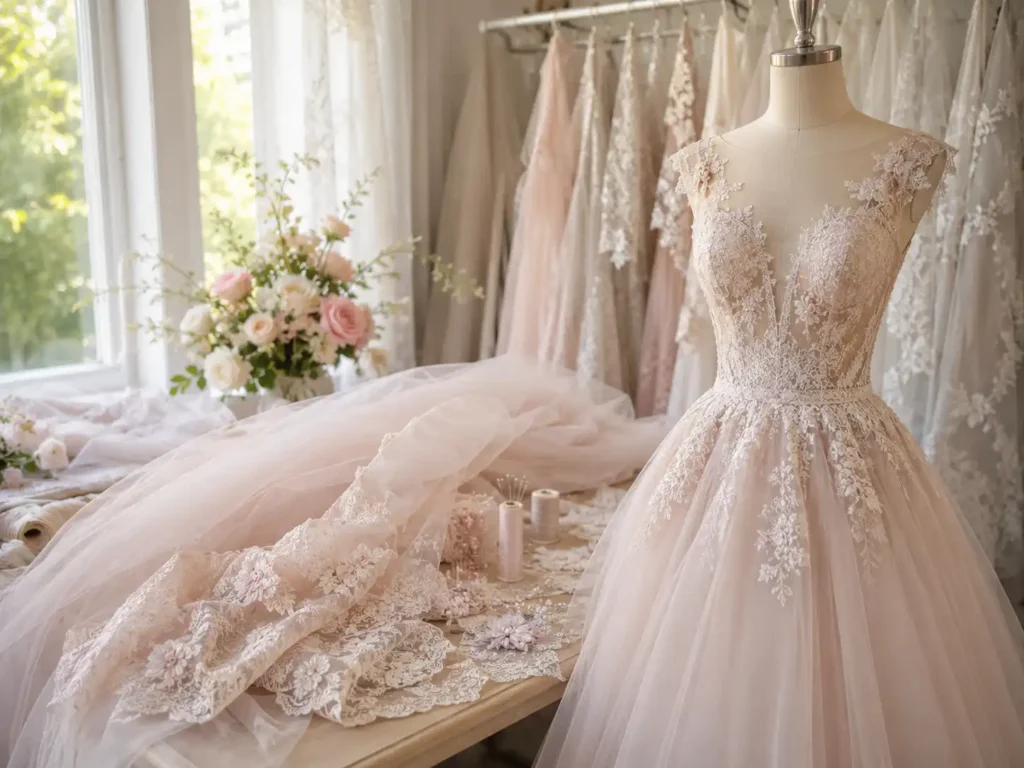
Evening and party dresses cover a wide range of moods, so tulle choice should follow the intended visual attitude. A romantic gown usually benefits from softer tulle with fluid movement, while a short party dress may need a firmer material to hold ruffles, tiers, or a strong mini silhouette. Prom dresses often sit between the two and can benefit from structured inner layers with softer outer layers, giving the skirt enough presence without making every fold look rigid.
Decoration changes the requirement quickly. Embroidery, rhinestones, beads, sequins, and three-dimensional flowers add concentrated weight that can stretch or distort a delicate net. A plain swatch may therefore pass a hand-feel check and still fail once the real decoration is applied. Lighting deserves equal attention because tulle transparency and shine can shift between daylight, studio photography, retail lights, and evening events. For styles sold primarily online, checking the sample on camera is useful because mesh visibility, moiré, and surface reflection may appear more strongly in images than in person.
Which Tulle Is Best for Fitted Dresses?
Fitted dresses need a different tulle logic because the fabric is working directly with body movement. Stretch direction, recovery, seam stability, transparency under tension, and skin feel become more important than volume. A net may have good widthwise stretch but little lengthwise movement, so rotating the pattern can change both fit and appearance. Developers should measure how the fabric behaves in the exact orientation planned for cutting rather than treating stretch as one general number.
Tension also increases transparency because the mesh openings become larger as the fabric extends. A panel that looks adequately covered while relaxed may become much more transparent across the bust, hip, or upper arm. Fitted samples should therefore be tested while walking, sitting, bending, raising the arms, and rotating the torso, not only on a stationary mannequin. If the dress uses a lining, its stretch must be compatible with the tulle; otherwise one layer can restrict the other and create wrinkles, pulling, or unstable seams during wear.
How Do Tulle Properties Affect a Dress?
Tulle properties determine how a dress looks, fits, moves, and feels. Softness and stiffness control drape and volume, stretch and recovery influence fitted areas, transparency changes with tension and layering, and mesh fineness affects how refined or visible the net appears. Two fabrics with the same color and fiber can produce very different silhouettes if their mechanical behavior is not the same.
How Do Softness and Stiffness Change Shape?
Soft tulle collapses easily into smaller folds and tends to move with the wearer, which makes it useful for long overlays, floating skirts, soft tiers, and romantic ruffles. Firmer tulle resists collapse and occupies more space after gathering, creating stronger projection in ball gowns, sculptural minis, and statement ruffles. Neither behavior is inherently more premium. The material looks expensive when its movement matches the design, and it can look awkward when the chosen stiffness fights the intended silhouette.
Gathering ratio makes the difference easier to see. As a development comparison, a 1.5:1 gather creates much less fullness than a 3:1 gather in the same fabric, while also producing less opacity and less waist bulk. The exact ratio should be chosen from the desired silhouette rather than treated as a fixed standard. A representative gathered panel is more informative than a flat swatch because it reveals how much space the fabric occupies, how cleanly the gathers distribute, and whether multiple layers become too thick at the seam.
How Do Stretch and Recovery Affect Fit?
Stretch describes how far the fabric extends, while recovery describes how closely it returns to its original dimensions. For fitted tulle, recovery is often the more important quality because a fabric can feel comfortable during one fitting yet gradually grow around the neckline, waist, elbow, or hip. A simple development check is to mark a measured length, stretch it to the expected garment tension, release it, and compare the new length with the original after several cycles rather than only one pull.
Pattern decisions should follow those observations. A non-stretch pattern cannot simply be transferred to elastic tulle without considering negative ease, seam type, lining stretch, and body movement. The direction of stretch matters as well, because some nets extend mainly across the width and almost not at all along the length. Fitted samples should be worn through ordinary movements rather than judged only in a static pose. If the neckline opens, the sleeve grows, or the side seam twists after movement, the issue may be fabric recovery or pattern orientation rather than sewing quality alone.
How Do Sheerness and Mesh Size Affect Appearance?
Transparency is not fixed. It changes with color, layer count, body tension, lighting, and the surface underneath. A single black tulle layer over pale skin can look extremely sheer, while three overlapping layers appear much deeper and more opaque. Stretch can increase transparency again by opening the mesh. For that reason, tulle should be viewed over the intended lining or representative skin tone rather than against a white cutting table, which can make a fabric appear cleaner and denser than it will look on the body.
Mesh size influences perceived refinement in a similar way. Fine nets tend to recede from normal viewing distance and are useful for illusion necklines, backs, and other areas where the support fabric should be visually quiet. Larger mesh creates a more obvious texture and can become part of the design language. Nude shades deserve careful attention because there is no single universal nude. Collections serving diverse markets may need several base shades, especially when the dress relies heavily on exposed illusion panels that are meant to visually blend with skin.
How Does Tulle Feel Against Skin?
Comfort matters most where tulle touches the neckline, underarm, shoulder, waist, sleeve, back, or upper leg. A small amount of roughness that seems harmless during a quick fitting can become irritating after several hours. Raw edges also deserve attention. Tulle may not fray like a conventional woven fabric, but an unfinished edge can still feel sharp when the finish is crisp, especially around the armhole or neck where the fabric repeatedly rubs against skin during movement.
The inside of an embellished tulle panel can be more uncomfortable than the face because embroidery threads, bead attachments, appliqué backing, and seam allowances create local roughness. These problems are often solved through lining, facing, binding, a softer internal net, or moving the seam away from a sensitive area rather than abandoning the visual fabric completely. Wearability should be checked on the finished sample, not only by touching the raw tulle. A dress that looks delicate but scratches throughout an event is unlikely to feel premium to the person wearing it.
How Should Tulle Be Layered and Lined?
Layer tulle according to opacity, volume, color depth, skirt shape, and garment weight rather than following a fixed layer count. Lining affects coverage, comfort, movement, and perceived color, while gathering and seam construction influence waist bulk and stability. The most reliable construction is established by testing the actual tulle, lining, gathering ratio, and decoration together at garment scale before bulk production.
How Many Tulle Layers Do You Need?
There is no universal layer count because softness, stiffness, color, garment length, and desired opacity all change the result. As a practical starting point, one layer is often used for a very sheer overlay or sleeve, two to three layers can add visual depth without much structure, three to five layers can create moderate skirt fullness, and six or more layers may be used for dramatic occasionwear. These numbers are development ranges rather than rules, because three firm layers can create more projection than eight very soft layers.
Every additional layer also changes the waist seam, color, weight, and movement. Pale tulle can become much more saturated as layers overlap, while multiple gathered layers can make a narrow waist look bulky. For that reason, layer sequence matters as much as layer count. A structured inner tulle can create shape while softer outer layers produce the final surface, allowing the dress to look light without sacrificing volume. The exact order should be documented in the approved sample so production does not accidentally replace three visual layers with two or change the position of the structural layer.
Which Lining Works Under Tulle?
Lining does more than cover the body. It changes the color seen through the tulle, controls comfort, supports the silhouette, and influences how freely the outer layers move. A smooth lightweight lining can help soft tulle slide and flow, while a firmer lining can provide additional structure. When stretch tulle is used over a fitted base, the two materials should have compatible elasticity; otherwise the rigid layer can create pulling or the more elastic layer can bunch and wrinkle around it.
Color pairing can completely change the design. Matching lining and tulle creates a more saturated, unified appearance, while nude lining under colored tulle emphasizes transparency and gives the surface more visual separation. Contrast lining makes the net texture even more obvious. Length and sweep should be intentional as well. A shorter lining under a sheer maxi skirt can be a deliberate fashion effect, but an inconsistent 2-3 cm difference between garments reads as a quality issue. For bulk production, lining and tulle should therefore be approved as a combination rather than as independent materials.
How Should Tulle Be Gathered and Sewn?
Gathering tulle is sensitive to stiffness, layer count, thread tension, and the way fullness is distributed. Uneven gathering can make one side of a skirt visibly fuller than the other and can create hard lumps where several layers enter the waist seam. For lightweight netting, fine needles around size 60/8 to 70/10 and test stitch lengths around 2.0-2.5 mm are common starting points, but the final setup should always be confirmed on the actual fabric, thread, seam, and machine combination.
Production tests should look for skipped stitches, stretched seams, puckering, holes around needle penetrations, twisted layers, feeding differences, and inconsistent gathering. Long skirts also deserve a hanging check because soft layers can settle after assembly and do not always finish at exactly the same length immediately. If several layers need to align at the hem, the sample team should establish when trimming happens and how the garment is supported before measuring. Tulle may look forgiving because the edge does not fray heavily, but uneven hems and distorted waistlines remain highly visible on clean, minimal dress designs.
Do Embellishments Change Tulle Choice?
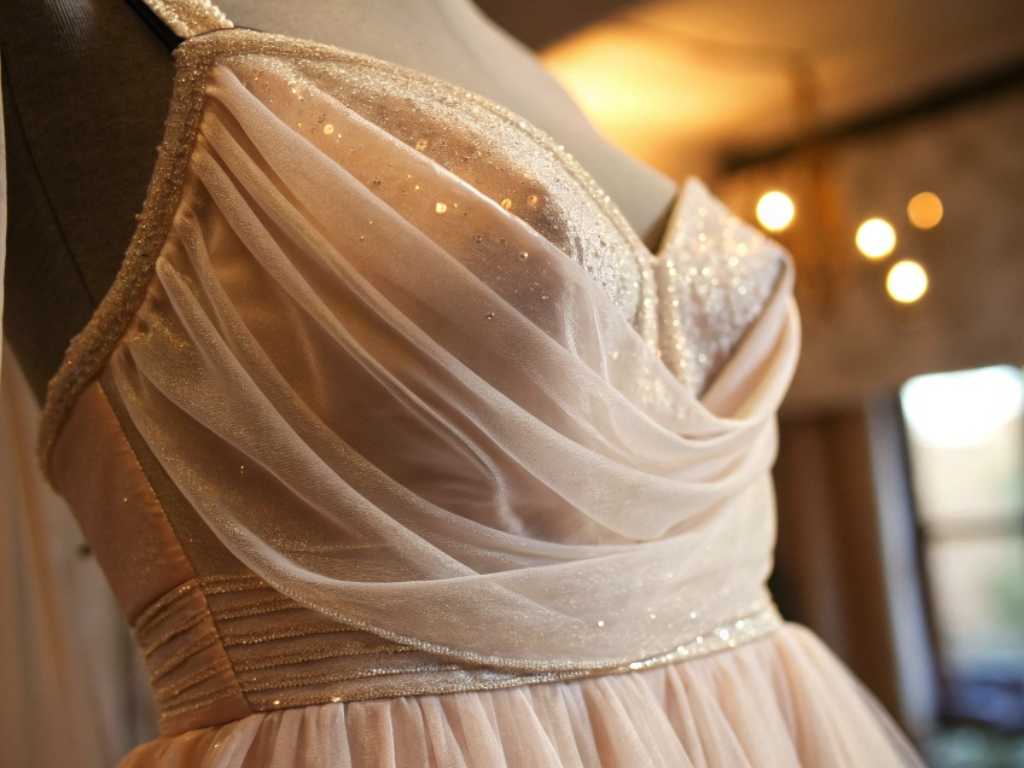
Embellishment can completely change the suitability of a base tulle. Sequins, crystals, pearls, beads, embroidery, lace appliqué, and 3D flowers add local weight and concentrate stress around stitch points. A fine net that looks perfect before decoration may begin to sag or stretch once the real motif density is applied. Heavy decoration near the neckline or shoulder creates a different load from decoration spread across a loose skirt, so placement and weight distribution should be tested together with the base fabric.
Sometimes reinforcement is more efficient than selecting a much heavier visible tulle. A second net layer, concealed tape, organza backing, or local structural panel can support embellished areas while preserving a softer outer surface. The key is to test a representative panel rather than a token sample with one or two motifs. Tulle and organza can both create volume, but organza has a continuous woven surface and usually forms crisper planes, while tulle creates airier volume through an open net. The better option depends on whether the design needs floating transparency or sharper structure.
How Do You Choose Tulle for Production?
Choose production tulle through a controlled sequence: define the silhouette, shortlist suitable fabrics, test them in the real pattern, approve lining and decoration, then confirm bulk consistency before cutting. Commercial selection must also consider usable width, supplier MOQ, color availability, lead time, repeat-order potential, cutting yield, sewing difficulty, quality-control needs, and total garment cost rather than fabric price alone.
How Should Tulle Be Sampled?
A production sample should recreate the conditions that make the tulle important to the design. That means using the intended fabric quality, color, layer count, lining, gathering ratio, stretch direction, seam construction, decoration method, skirt length, and hem treatment wherever those details affect appearance or fit. A simplified sample with only a small piece of the correct tulle may be enough for an early construction check, but it cannot confirm a silhouette that depends on volume, transparency, or the cumulative weight of several layers.
Review the sample while standing and moving. Fitted styles should be tested through sitting, walking, bending, and arm movement, while voluminous skirts should be observed after compression and after the wearer sits down. Photography is useful for ecommerce collections because fine mesh can create stronger visibility, shine, or moiré on camera than it does to the eye. Final approval should leave a clear production reference: fabric article, shade, layer sequence, lining, pattern direction, construction notes, and an approved physical sample. That record is what turns an attractive sample into a repeatable production standard.
What Should Be Checked in Bulk Tulle?
Bulk tulle should be compared with the approved sample before cutting because changes in stiffness, shade, mesh density, stretch, or hand feel can alter the finished silhouette. Useful inspection points include usable width, fabric weight, roll-to-roll shade, surface finish, holes, broken mesh, snags, stains, stretch direction, extension, recovery, and edge distortion. Color alone is not enough; a bulk lot that is slightly softer than the sample can flatten a skirt even when the shade matches perfectly.
Stretch tulle requires additional control because cutting orientation affects fit. Panels cut in mixed directions can create inconsistent tension within the same dress, especially around sleeves, fitted bodices, and side seams. When more than one production line works on a style, the material standard and approved sample need to be clear enough that every unit is judged against the same reference. A simple incoming inspection, documented fabric approval, and early production check are generally far less costly than discovering after assembly that the bulk net no longer behaves like the sample fabric.
How Do Width and MOQ Affect Sourcing?
Fabric width can materially change consumption and seam placement. Many fashion tulles are supplied around 140-160 cm wide, while some bridal and specialty nets can be available in widths near 280-300 cm. Actual width depends on supplier and article, so it should always be confirmed before costing. Wider tulle can reduce joins in large skirts and sometimes improve cutting efficiency, while narrower material may require extra panels or additional seams in full-length gowns and wide circular silhouettes.
MOQ and lead time also vary by color and construction. Stock black, white, ivory, and common fashion shades are often easier to source than custom-dyed colors, while specialty stretch, glitter, embroidered, flocked, or beaded tulles can carry higher supplier minimums and longer development times. Transparent fabrics make color approval especially important because the same dye shade can read differently over various linings. If a style is expected to repeat, availability should be reviewed before launch; a beautiful tulle that cannot be replenished reliably can create a much larger commercial problem than choosing a slightly less unusual but repeatable option.
How Does Tulle Affect Dress Cost?
Tulle cost is not simply the price per meter. Full skirts, circular shapes, high gathering ratios, and multiple layers can multiply material consumption quickly, while dense decoration, shaped illusion panels, reinforcement, several lining layers, difficult waist joins, and long hems increase labor. A low-priced net can therefore produce a high garment cost if the construction needs extra layers or if inconsistent behavior creates more sewing time and sample revisions. Costing should look at the complete dress rather than one fabric line in the bill of materials.
A useful final sequence is silhouette first, fabric behavior second, sample performance third, bulk repeatability fourth, and total cost last. If a project is still between several tulle options, a development team can compare them on the same skirt panel or fitted bodice section before committing to the full sample. Jinfeng Apparel can support this type of fabric comparison, sample validation, and production planning for custom dress projects when a brand wants to keep the intended visual effect while controlling avoidable complexity. The strongest decision is usually the one that still makes sense after the first order becomes a repeat order.
Production Factor | Typical Reference | What It Changes |
Lightweight tulle weight | About 10-30 GSM for many light fashion qualities | Drape, opacity, volume and handling |
Common fashion width | About 140-160 cm | Consumption, panel count and seams |
Wide bridal/specialty width | Sometimes about 280-300 cm | Large skirt cutting and seam reduction |
Gathering comparison | About 1.5:1 to 3:1 as a development range | Fullness, opacity and waist bulk |
Fine-needle trial | Around 60/8 to 70/10 for lightweight nets | Hole size, skipped stitches and damage risk |
Stitch-length trial | Around 2.0-2.5 mm for many light constructions | Seam stability and puckering |
Layer count | From 1 sheer layer to 6+ for dramatic volume | Opacity, color depth, weight and labor |

Conclusion
The best tulle for a dress is the one that solves the garment rather than simply looking attractive on a swatch card. When silhouette, softness, volume, stretch, transparency, lining, decoration, and production behavior are considered together, the fabric choice becomes much more predictable. A soft tulle can create graceful movement, a firmer one can build shape, and a stretch construction can make a fitted sheer panel wearable, but each of those benefits only matters when the surrounding pattern and construction are designed to use it properly.
For brands developing tulle dresses, the safest route is to compare candidate fabrics in a representative garment section, confirm the combination of tulle and lining under real lighting, then preserve the approved fabric article, layer sequence, construction details, and physical sample for bulk production. That process may take a little more work before cutting begins, but it protects the silhouette that customers actually see. When the first successful style is reordered, those records also make it much easier to reproduce the same look instead of starting the material discussion again from zero.
Share This Article :

Jerry Lee
Categories

Latest blogs
Table of Contents
Here, developing your OEM/ODM private label clothing collection is no longer a challenge—it’s an excellent opportunity to bring your creative vision to life.

