 Skip to content
Stretch Dress Fit Recovery Solutions
Stretch dresses need more than high elasticity. Strong commercial fit depends on how fabric stretch, recovery, growth, pattern reduction, garment construction and size grading work together from first sample through bulk production.
Jinfeng Apparel develops stretch dresses for established fashion brands and larger womenswear programs, with fit decisions built around fabric behavior and garment structure rather than stretch percentage alone.
- 2-way and 4-way stretch directionsreviewed according to garment construction and pattern orientation.
- 6 core fit zonescommonly reviewed: bust, waist, hip, neckline, side seam and dress length.
- 7–25 day sampling rangesmay apply depending on style complexity, fabric sourcing and development requirements.
- US, UK, EU and AU size developmentcan be built around brand-specific measurement standards.
- Fit comments can move through First Sample → Fit Sample → Revised Sample → PP Sample → Golden Samplebefore bulk production.
Stretch Does Not Guarantee Fit Recovery
Stretch Without Recovery
Recovery With Controlled Fit
Growth After Movement
Movement repeatedly loads different garment zones. The hip and seat may experience more sustained extension than the neckline, while the waist may relax differently from the bust. A reliable dress therefore needs zone-specific fit review instead of one stretch assumption applied across the entire pattern.
Where Stretch Dresses Commonly Lose Their Fit
Neckline Sagging
Bust Distortion
Waist Relaxation
Hip And Seat Growth
Side Seam Twisting
Dress Length Riding Up
Stretch Dress Styles Developed Around Fit Stability

Jersey Bodycon Dress
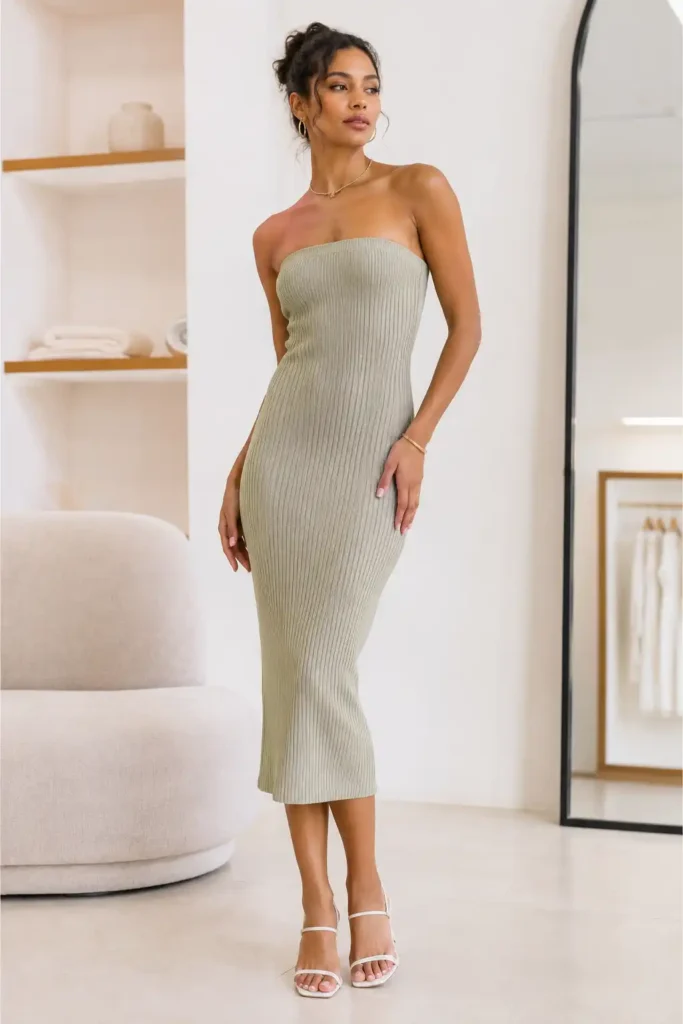
Rib Knit Dress

Ponte Midi Dress
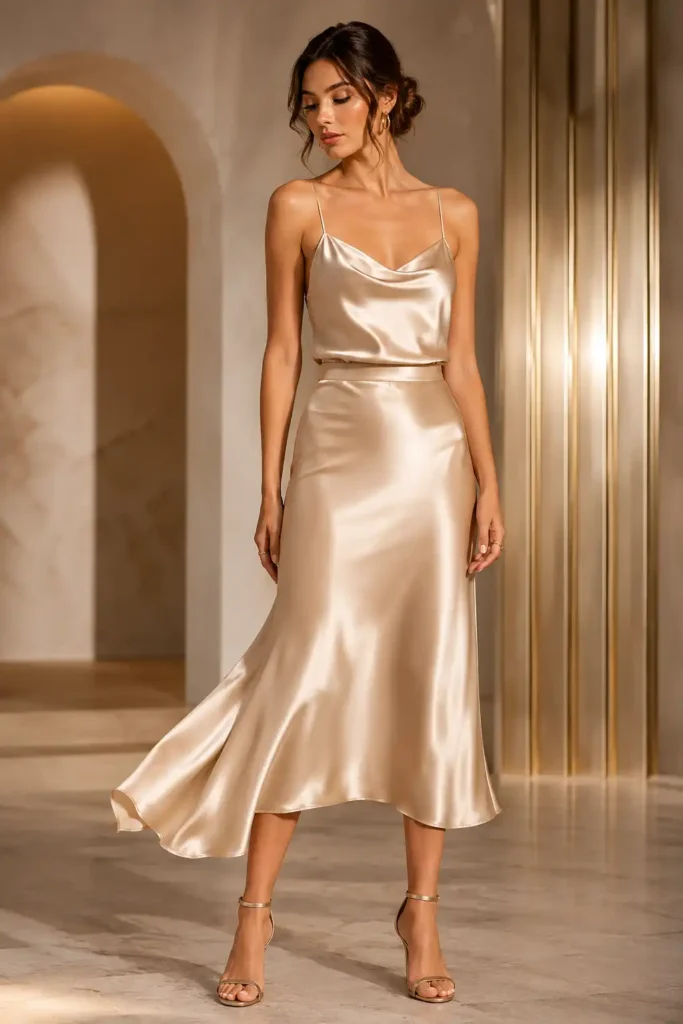
Stretch Satin Dress

Stretch Mesh Dress

Power Mesh Dress

Ruched Stretch Dress

Cut-Out Fitted Dress
Fabric Selection for Stretch Dress Fit Recovery
A fabric should be selected for the intended silhouette, not simply because the specification contains elastane or offers strong hand stretch. Weight, knit structure, recovery, growth tendency, opacity, shrinkage and seam response all influence how a fitted dress performs during sampling and bulk production.
| Fabric Direction | Typical Stretch Dress Use | Recovery Focus | Main Fit Concern | Production Focus |
|---|---|---|---|---|
| Jersey | Bodycon, fitted mini, casual midi | Balanced stretch and return | Waist relaxation, side-seam movement | Relaxing, cutting direction, measurement |
| Rib Knit | Bodycon, casual fitted dress | Growth and neckline recovery | Vertical elongation, hem instability | Rib alignment, size grading, wash change |
| Ponte / Roma | Structured midi, office-to-evening | Support and shape retention | Over-compression or rigid fit | Seam balance, waist shaping, measurement |
| Stretch Satin | Party, cocktail, fitted occasion dress | Limited stretch with controlled recovery | Zipper pulling, bust/hip tension | Cutting direction, seam tension, pressing |
| Stretch Mesh | Cut-out, party, layered fitted dress | Elastic return with transparency control | Edge growth, lining mismatch | Lining compatibility, seam reinforcement |
| Power Mesh | Support panels, fitted inner layers | Higher resistance and recovery | Excess compression, outer-layer distortion | Layer compatibility, panel accuracy |
How Jinfeng Reviews Stretch Fabric Behavior
Material review should answer how a fabric behaves inside a finished dress, not only what composition appears on a supplier specification. Jinfeng considers stretch direction, recovery, growth, shrinkage and interaction with the pattern before approved fit decisions move into bulk production.
Stretch Direction Changes Pattern Behavior
Two-way and four-way stretch qualities distribute tension differently across the garment.
A fabric that stretches mainly across the width may support horizontal body movement while providing much less vertical extension. A four-way quality may move more freely but can also create greater length change if the pattern, garment weight and body tension are not balanced.
Cutting orientation therefore matters. Panels need to follow the intended stretch direction consistently, especially across bodycon front and back pieces, sleeves, mesh panels and fitted lining. Reversing or rotating stretch-sensitive pieces can produce visible differences between left and right garment sections.
Before pattern decisions are finalized, the development team considers:
- Primary stretch direction and secondary stretch direction
- Surface and reverse side identification
- Grain or knit direction
- Fabric weight and hanging behavior
- Whether the garment will carry lining, zippers or structured panels
- Which body zones receive the highest tension
A stretch value without direction is not enough information for pattern engineering.
Recovery And Growth Affect Final Silhouette
Recovery determines whether a material can move back toward its initial form after being extended.
Growth describes the dimensional change that may remain after tension is removed.
A fabric can feel highly elastic during hand stretch while still allowing visible relaxation in a fitted garment.For a bodycon dress, recovery needs to be evaluated against the expected silhouette.The waist may require strong visual definition, while the hip and seat need enough mobility to allow sitting and walking. The fabric therefore cannot be judged by one uniform sensation of “tight” or “soft.”
Development decisions may include:
- Reducing or increasing local pattern ease
- Changing seam placement
- Adjusting lining construction
- Reviewing neckline or armhole stabilization
- Modifying the fit after a wear or movement review
- Rechecking dimensions after sample handling or washing where required
A successful stretch dress is not the smallest garment that can fit on the body. It is a garment that maintains the intended balance between fit, movement and shape retention.
Fabric Changes Can Require Pattern Changes
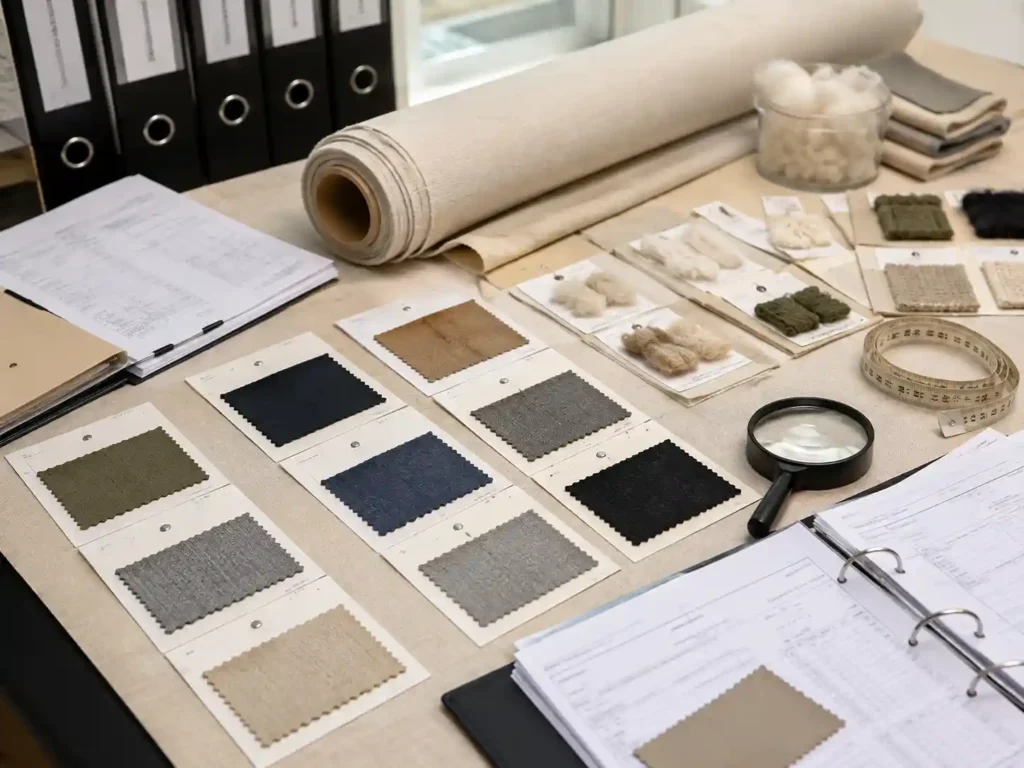
A repeated pattern is useful only when the replacement fabric behaves closely enough to the approved material. Moving from one jersey to another, or from soft jersey to rib, ponte or stretch satin, can change recovery, weight, drape, shrinkage and seam response.
For repeat orders or line extensions, Jinfeng reviews whether the existing pattern can remain unchanged or whether a revised sample is safer. A heavier ponte may need different waist or hip reduction from a lightweight jersey. A softer rib may grow more vertically. A stretch satin may require more attention around zipper construction and seam tension.
The decision should be based on the new fabric rather than assuming an approved pattern automatically guarantees an approved fit.
Pattern Engineering for Stretch Dress Fit
Stretch dress patterns need to account for body proportion, fabric behavior and the intended level of close fit. Jinfeng’s pattern development covers bust, waist, hip, neckline, armhole, strap, length, slit and lining corrections for production-ready womenswear patterns.
Bust Waist And Hip Need Different Decisions
Bust, waist and hip are connected by the same garment, but they do not experience the same movement or tension. Reducing all three measurements by one percentage can produce poor fit even when the sample looks generally close to the body.
The bust influences neckline position, armhole balance and side seam shape. The waist controls visual definition and affects how the garment settles vertically. The hip and seat require movement room while remaining close enough to maintain the silhouette.
Pattern work may therefore include:
- Bust contour and front-body shaping
- Waist reduction or release
- Hip ease or negative ease adjustment
- Back-body balance
- Side seam correction
- Dress length correction
- Lining proportion
- Slit position and opening
A fitted silhouette should be engineered around body zones instead of a single overall reduction.
Necklines Armholes And Openings Need Stability
A stretch dress can fit well through the body and still fail commercially if the neckline gapes, the armhole stretches outward or a cut-out opening becomes larger during wear.
Openings experience repeated handling when the garment is dressed, removed and moved on the body.
Pattern shape, seam construction and fabric recovery need to support those actions.
Stabilization decisions may involve lining, binding, facing, elastic support or a change in the edge pattern, depending on the design.
Strapless, halter, backless, deep-V and cut-out dresses require even more attention because fewer garment areas are available to distribute tension.
Jinfeng’s existing pattern capability includes bodycon fit, stretch fit, strapless structures, low-back dresses, corset-style dresses and other fitted womenswear directions.
Length And Side Seam Balance Show Hidden Fit Problems
Length riding up and side-seam twisting are often symptoms rather than isolated defects.
A dress may rise because the hip is over-reduced, the fabric is pulling horizontally, the hem is too narrow or the stretch balance changes between front and back. A side seam may twist because of fabric torque, cutting direction or unbalanced pattern tension.
During fitting, these issues should be reviewed together with bust-waist-hip measurements rather than corrected only at the visible area.

Negative Ease Must Match Fabric Recovery
More Stretch Needs Context
A fabric with greater extension does not automatically need a smaller pattern.
If the material stretches easily but recovers slowly, aggressive reduction can increase local tension while the garment still becomes loose after prolonged wear.
Body Zones Behave Differently
Sample Fit Confirms The Decision
Calculations provide a starting point, but the actual garment confirms whether fabric and pattern work together. A fit sample allows the team to review pressure, wrinkles, seam position, movement, opening stability and overall silhouette before measurements are locked for bulk.
Fit Recovery Across Sizes and Markets
US Size Development
UK Size Development
EU Size Development
AU Size Development
Extended Size Development
Petite And Tall Adjustments
Stretch Dress Sample Development Before Bulk
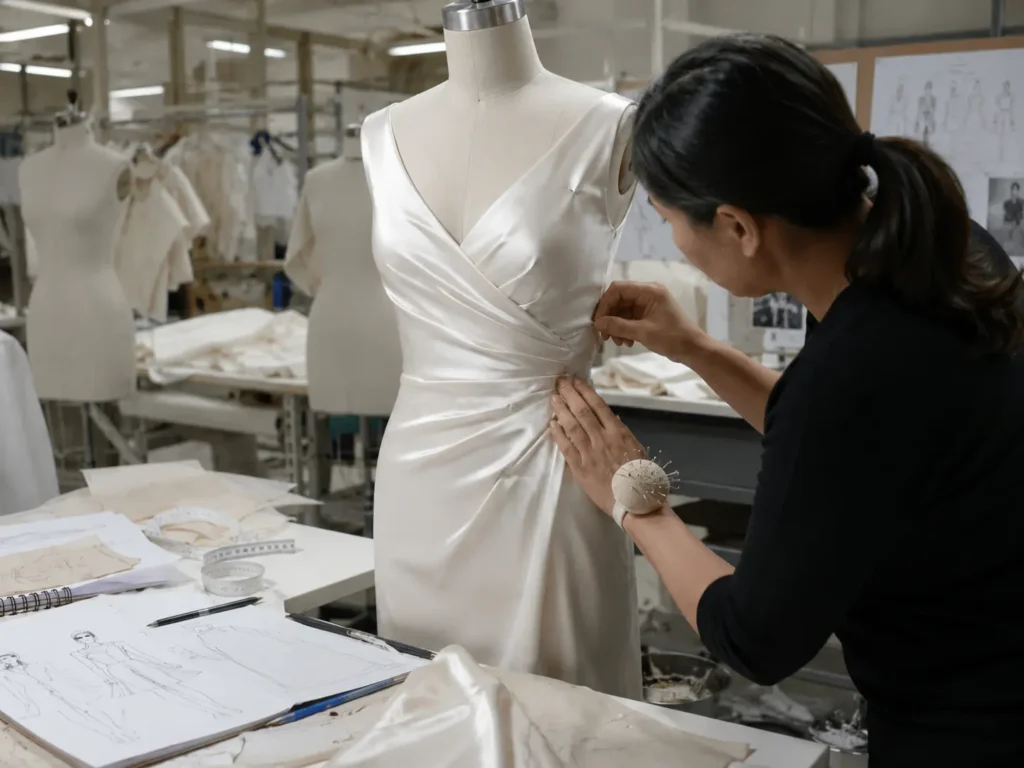
Sampling turns fabric and pattern decisions into a garment that can be evaluated on a body. Jinfeng operates two sample rooms with 7+ senior pattern makers and 20+ sample machinists supporting development from first sample through PP and Golden Sample stages.

Requirement Review

First Sample

Fit Sample
Revised Sample

PP Sample

Golden Sample
What We Check During Stretch Dress Fit Review
A fit review should convert visual comments into measurable production decisions. Instead of relying only on whether a dress “looks tight enough,” Jinfeng reviews critical areas that influence silhouette, movement and repeatability during bulk production.
Bust Fit
Waist Definition
Hip Tension
Side Seam Balance
Neckline Stability
Dress Length
Sample Revision Turns Feedback Into Bulk Standards
A successful revision process does more than alter one sample. Each approved correction should move into updated pattern files, measurement charts, sewing instructions and QC references so the same improvement can be reproduced during bulk production.

Comments Are Classified Before Changes Begin
Fit comments can come from a fitting session, garment measurements, photos, videos, internal product reviews or brand-specific preferences. Before changing a pattern, the development team needs to identify whether the root issue comes from:
- Pattern shape
- Fabric stretch or recovery
- Fabric weight
- Lining interaction
- Seam construction
- Trim position
- Measurement specification
- Size grading
Changing the wrong component can solve one visual issue and create another. For example, reducing the waist may improve definition but increase riding-up if the hip and fabric recovery are not reviewed at the same time.

Pattern And Measurement Records Are Updated
Once a correction is approved, the information should move beyond chat messages or handwritten notes.
Relevant revisions can be transferred into:
- Updated pattern
- Revised measurement chart
- BOM adjustments
- Sewing instructions
- QC checklist
- Packing requirements where relevant
- Approval status
The same pattern information then supports the PP sample and later measurement QC.
For stretch dresses, record accuracy matters because a small change to waist, hip or neckline measurements can materially change the silhouette.

Fabric Replacement Triggers A New Assessment
Replacing a fabric during sampling may change:
- Stretch direction
- Recovery
- Growth
- Drape
- Weight
- Shrinkage
- Opacity
- Seam tension
- Lining requirements
- Bulk costing
A new fabric is therefore reviewed before assuming the existing sample or pattern remains valid. If the change affects fit behavior, another sample round may be required before PP approval.
PP and Golden Samples Lock Production Decisions
PP Sample Approval
The PP sample can confirm approved fabric, color, trims, measurements, sewing, labels, packaging and other production requirements before bulk cutting begins. Fit corrections should already be reflected in the final pattern and measurement chart.
Golden Sample Reference
The Golden Sample becomes a comparison point for production, garment inspection and future repeat orders. Keeping the approved physical sample together with updated technical records helps reduce version confusion across later production stages.
Stretch Dress Bulk Production Control
Bulk consistency depends on process control before and during sewing. Stretch garments can change shape when fabric arrives under tension, rests differently, is cut in mixed directions or is sewn with inconsistent handling. Production therefore needs to preserve the fit already approved during development.
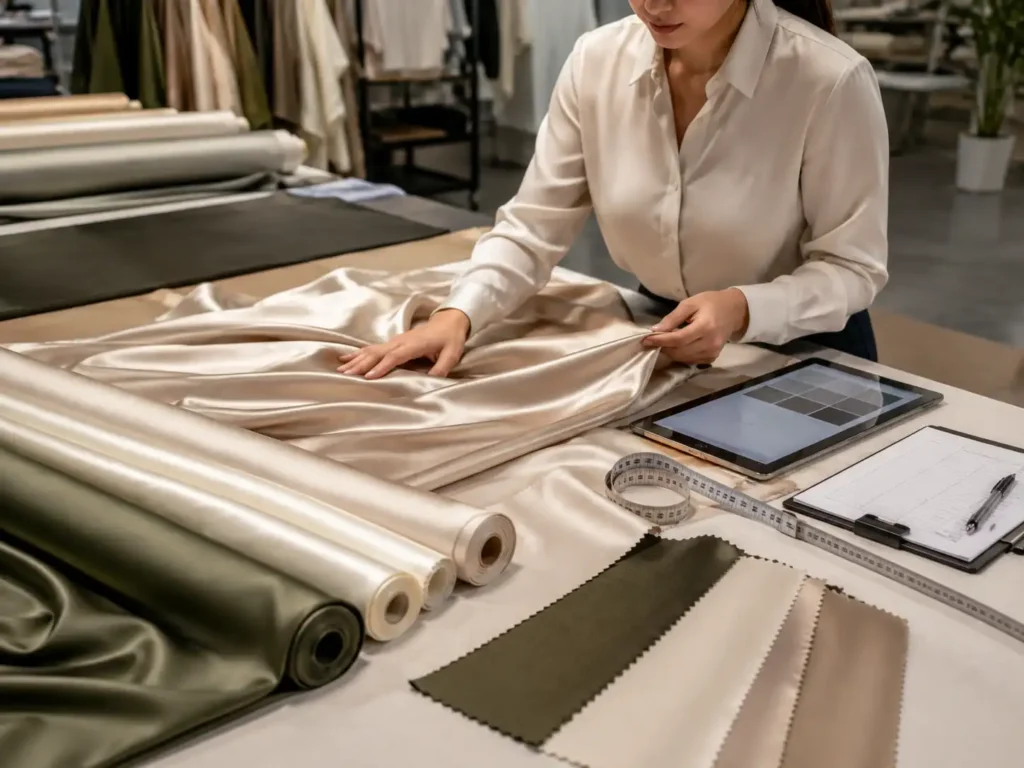
Fabric Relaxing And Cutting Direction
Stretch fabrics can arrive wound or folded under tension. Allowing appropriate relaxing before cutting helps reduce dimensional differences between fabric in the roll and fabric after cutting.
Cutting also needs consistent orientation. For bodycon, rib, mesh and stretch satin styles, incorrect panel direction can create unequal stretch between garment sections. Production control should confirm:
- Face and reverse side
- Stretch direction
- Grain or knit direction
- Panel orientation
- Left-right matching
- Size bundling
The goal is not simply cutting accurately to a paper outline. The fabric needs to behave consistently after panels are released from the cutting table and assembled.
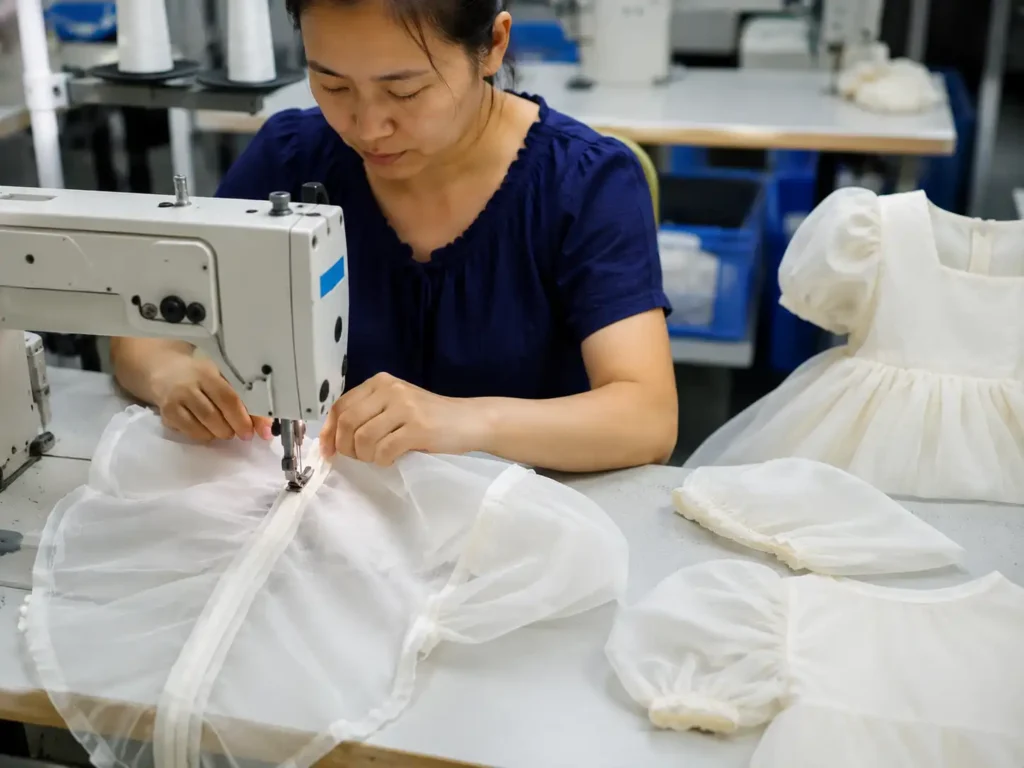
Sewing Tension And Seam Balance
Stretch fabrics respond to handling during sewing. Excessive pulling can lengthen seams, distort necklines or create rippling. Uneven treatment between front and back panels may contribute to twisting.
Production attention can include:
- Seam alignment
- Stitch and seam method
- Side seam position
- Neckline and armhole stability
- Lining alignment
- Zipper flatness where applicable
- Ruching distribution
- Slit construction
- Hem stability
Inline checks are useful because correcting a stretch-related sewing problem after thousands of garments are completed is far more disruptive than addressing it during production.

Approved Measurements Stay Connected To Production
Bulk sewing should follow the approved size chart, pattern and PP/Golden reference rather than visual approximation.
Fit-focused measurement checks commonly include:
- Bust
- Waist
- Hip
- Dress length
- Neckline depth
- Strap length where relevant
- Slit height
- Hem balance
Jinfeng’s production system connects PP approval, sewing instructions, QC checklists and garment measurements to bulk control rather than treating fit as a sampling-only responsibility.
Measurement and QC for Stretch Fit Consistency
Appearance inspection alone cannot confirm fit consistency in a stretch dress. Measurement control needs to compare bulk garments against approved specifications while production teams also monitor seam balance, garment appearance and fabric-related variation.
| Control Point | What Is Reviewed | Main Stretch-Dress Risk | Reference |
|---|---|---|---|
| Incoming Fabric | Fabric identity, surface, behavior and project requirements | Wrong quality or inconsistent behavior | Approved fabric / project records |
| Cutting QC | Direction, panel accuracy, size bundle | Mixed stretch orientation, distorted panels | Final pattern |
| Inline Sewing QC | Seam alignment, neckline, side seam, lining, ruching | Rippling, twisting, stretched openings | Sewing instructions |
| Measurement QC | Bust, waist, hip, length and key style points | Bulk fit drift | Approved size chart / PP sample |
| Garment Inspection | Symmetry, seam balance, appearance, finishing | Visual distortion or fit-related defects | Golden Sample |
| Packing Inspection | Labels, SKU, folding and packing | Version or assortment errors | Packing requirements |
Wash Stability and Fabric Change Risk
Post-Wash Size Stability
Washing can influence length, width, twisting and recovery depending on fiber content, knit structure, finishing and garment construction.
Fit-sensitive areas can include:
- Bust circumference
- Waist circumference
- Hip circumference
- Dress length
- Neckline shape
- Side-seam alignment
Where washing performance is relevant to the product program, size and appearance should be reviewed against the brand’s agreed test or care expectations rather than assuming initial sample measurements remain unchanged.
Same Pattern New Fabric
A successful pattern can often support line extension, but material behavior still needs review.
Changing from jersey to another jersey, from jersey to rib, or from ponte to a lighter knit may alter:
- Recovery
- Stretch direction
- Fabric weight
- Shrinkage
- Drape
- Lining behavior
- Seam response
- Finished measurements
A new color in the same approved fabric may need less development than a completely new fabric construction. The production decision should reflect the level of material change.
Repeat Orders Need Version Control
Repeat programs benefit from retained pattern, measurement, fabric, color, trim, packing, QC and Golden Sample information.
An approved style can then be compared against its existing production standard while still reviewing any new material or construction change.
Jinfeng’s long-term project records can retain patterns, BOM information, fabrics, colors, trims, packing requirements and Golden Sample references for repeat-order support.
Commercial Planning for Stretch Dress Programs
MOQ And Collection Planning
Standard MOQ is 200 pieces per style/color.
Special fabrics, dyeing, printing, trims or packaging may carry separate supplier requirements.
Larger collection programs can combine multiple styles, colors and size ranges while each style/color remains subject to production feasibility and MOQ review.
Cost And Development Decisions
Cost depends on fabric, trims, pattern development, sampling, sewing complexity, QC, packing, wastage and logistics. Fit problems are often expensive to correct after bulk cutting, so fabric and sample decisions should be resolved before production wherever possible.
Jinfeng’s costing approach can consider alternatives with the principle of cost control without weakening brand-level appearance.
Production And Delivery Planning
Jinfeng’s confirmed production resources include 6 owned women’s fashion factories, 10+ long-term production partners, 18+ sewing lines, 6+ flexible production lines and normal monthly capacity above 100,000 pieces, with actual allocation depending on style complexity, material availability, schedule and QC requirements.
Private-label support can include woven labels, size labels, care labels, hangtags, barcode labels, SKU packing, polybags and carton marks. Express, air and sea delivery can be evaluated together with EXW, FOB, CIF, DAP or DDP arrangements according to the project.
Stretch Dress Frequently Asked Questions
Stretch describes how far a fabric can extend. Recovery describes how well the fabric and garment return toward their original dimensions after extension. For a fitted dress, recovery affects whether the waist, hip, neckline and other high-tension areas keep the intended shape after movement and wear.
Possible causes include weak fabric recovery, fabric growth, excessive local ease, incorrect negative ease, fabric-direction issues or pattern imbalance. The problem should be diagnosed by garment zone rather than assuming the entire pattern needs to be reduced.
No. Elastane content alone does not define finished garment performance. Knit structure, yarn, fabric weight, finishing, stretch direction and recovery also influence fit. A higher-stretch quality may still perform poorly if it grows after extension or does not suit the intended pattern.
Negative ease makes the finished garment smaller than corresponding body measurements so the stretch fabric expands on the body. The required amount depends on fabric recovery, weight, lining, garment structure and desired silhouette. One universal negative-ease percentage should not be used for every stretch dress.
Control begins with fabric behavior, then moves into waist and hip pattern decisions, sample fitting and bulk measurements. The hip also needs movement room, while the waist often requires stronger visual definition. Both areas should be reviewed together during fitting.
Possible causes include fabric torque, grain or knit direction, cutting orientation, front-back pattern imbalance or unequal sewing tension. Side-seam position should be reviewed during sample fitting and monitored during cutting, sewing and final garment inspection.
Sometimes, but not automatically. A new fabric can change stretch direction, recovery, weight, shrinkage, drape and seam behavior. Jinfeng reviews the material change first and determines whether the existing pattern can remain or whether another sample is needed.
Fit starts with the brand’s measurement standard and grade rules. Bust, waist, hip, neckline, armhole, strap, length and other key points are reviewed across the intended size range. Jinfeng can develop US, UK, EU and AU sizing according to supplied requirements.
Where wash performance is relevant, garment dimensions and appearance can be reviewed according to agreed project requirements. Attention may include shrinkage, length change, twisting, neckline shape and recovery. The exact method should follow the brand’s product and compliance requirements.
Useful inputs include a tech pack, reference photos, original sample, size chart, fabric information, target market, size range, quantity plan, fit comments and launch date. More complete information allows the development team to assess fabric, pattern, sampling and bulk requirements more accurately.

Send Your Stretch Dress Project for Technical Review
If a current stretch dress loses waist definition, grows around the hip, twists at the side seam, changes length during movement or produces inconsistent fit across sizes, send the available development information to Jinfeng Apparel.
Our team can review the project from fabric behavior, pattern structure, sample status and planned production requirements before recommending the next development step.
For a more accurate review, include as much of the following information as available:
- Tech pack or reference images
- Current sample or sample photos
- Existing size chart
- Fabric composition or fabric swatch
- Preferred fabric direction or handfeel
- Target silhouette and fit comments
- Required size range
- Estimated quantity per style/color
- Target market
- Private-label requirements
- Packaging requirements
- Target launch or delivery window


