 Skip to content
Sequin Dress Quality Control
Control Sequin Loss, Comfort, Fit, Workmanship, and Packing Before Bulk Production
Jinfeng Apparel helps established fashion brands convert high-impact sequin dress concepts into production-ready garments with controlled surface appearance, stable construction, comfortable lining, accurate measurements, reinforced seams, and protective retail packing. Quality planning begins during fabric and style review, continues through sampling and PP approval, and remains active during cutting, sewing, finishing, inspection, packing, and pre-shipment confirmation.
- 15+ QC inspectors covering incoming materials, cutting, sewing, in-line production, finished garments, measurements, and packing.
- 2 sample rooms and 20+ sample machinists supporting complex sequin styles, fit revisions, PP samples, and construction testing.
- 6 owned women’s fashion factories and 10+ long-term production partners allocated according to fabric, embellishment, construction, volume, and delivery requirements.
- 30+ finishing and packing workers supporting anti-scratch folding, individual packing, label checking, barcode checking, carton marks, and shipment preparation.
What Does Sequin Dress Quality Control Include?
Before Production
During Production
Before Shipment
Built for Controlled Sequin Dress Production
6 Owned Factories
10+ Production Partners
18+ Sewing Lines
2 Sample Rooms
20+ Sample Machinists
15+ QC Inspectors
Eight Sequin Dress Defects Brands Should Prevent

Loose Sequins

Missing Sequins

Incorrect Direction
Two-tone, reversible, gradient, and directional sequins can produce obvious color or shine differences when panels are cut or assembled in inconsistent directions. Cutting markers, panel identification, bundle control, and approved direction references help maintain a unified visual surface across the complete garment.

Skin Irritation

Bulky Seams

Broken Stitches
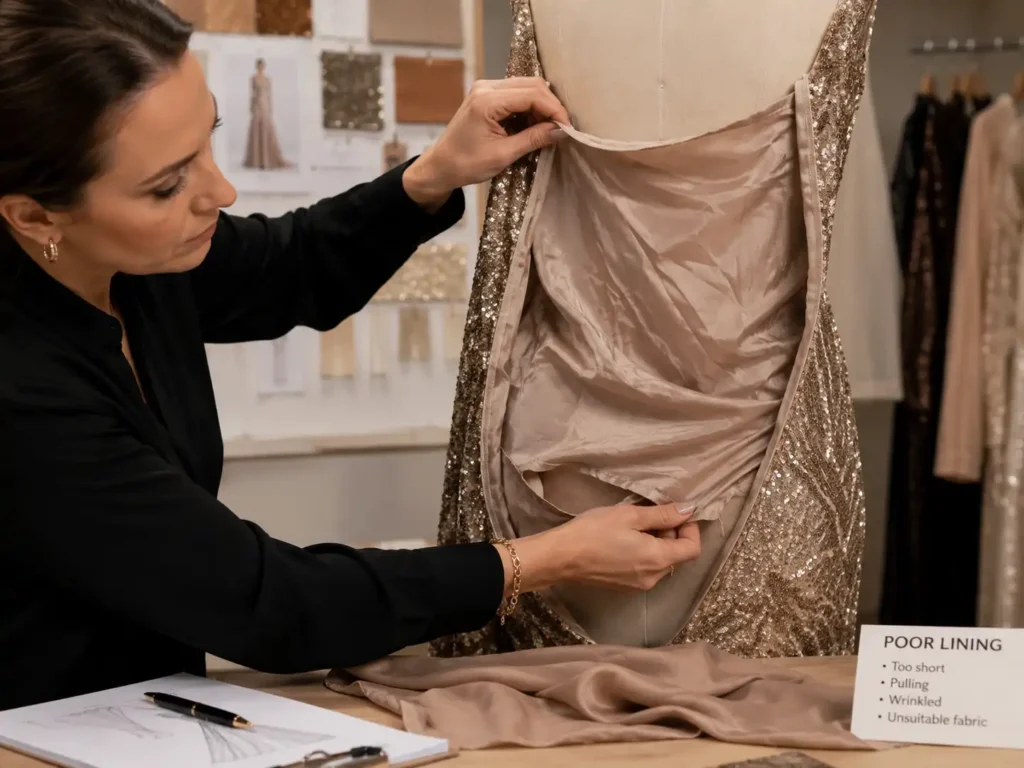
Poor Lining

Packing Damage
Sequin Fabric Selection Changes the QC Standard
The appearance and quality risk of a sequin dress depend on the sequin shape, attachment method, base fabric, density, pattern, color, stretch, and intended silhouette. A bodycon dress made from stretch sequin fabric requires a different quality plan from a structured evening gown made from dense embroidered mesh.
| Sequin Material | Visual and Construction Characteristics | Main Production Risks | Primary QC Focus |
|---|---|---|---|
| Full Sequin Fabric | High surface coverage, strong shine, higher garment weight | Sequin loss, thick seams, difficult pressing, weight distortion | Surface density, seam control, lining, shoulder and waist support |
| Stretch Sequin Fabric | Suitable for bodycon, party, club, and fitted silhouettes | Poor recovery, uneven stretch direction, seam waving, size instability | Stretch direction, recovery, chest-waist-hip measurements, side seams |
| Mesh Base Sequin | Lighter appearance, transparency, flexible decoration layout | Mesh holes, snagging, excessive transparency, weak seam support | Mesh condition, lining coverage, edge security, seam reinforcement |
| Two-Tone Sequin | Reversible or color-changing surface | Direction inconsistency, random color patches, poor recovery after handling | Direction control, panel consistency, surface brushing test |
| Gradient Sequin | Strong photographic effect and color transition | Panel mismatch, broken gradient, left-right inconsistency | Pattern placement, cutting position, seam transition, approved reference |
| Pattern Sequin | Decorative motifs or positioned designs | Motif interruption, asymmetric placement, inconsistent scale by size | Placement, panel matching, grading effect, front-back alignment |
| Local Sequin Trim | Decoration used only in selected areas | Weak attachment, uncomfortable edges, inconsistent placement | Position accuracy, attachment strength, skin-contact review |
| Sequin Embroidery | Machine-embroidered sequin designs on fabric or mesh | Skipped stitches, thread breakage, loose embroidery, base fabric distortion | Embroidery density, thread security, motif shape, base fabric stability |
Quality Control Starts Before the First Sample
Strong sequin dress quality begins before a pattern is cut. Early risk assessment prevents attractive design concepts from becoming uncomfortable, unstable, expensive, or difficult to reproduce in bulk. Jinfeng Apparel reviews the visual goal together with material behavior, pattern structure, sewing method, lining, finishing, quality standards, and packing requirements.
Design and Construction Review
The development team reviews the entire garment structure rather than treating sequins as surface decoration only.
- Sequin coverage and density are checked against the silhouette and garment weight.
- Necklines, armholes, sleeve openings, slits, hems, and cut-out areas are reviewed for skin contact.
- Zipper placement is assessed to avoid thick sequin layers entering the zipper seam.
- Shoulder straps, halter ties, waist seams, and structured areas are reviewed for load and pressure.
- Bodycon, corset, strapless, backless, one-shoulder, and cut-out styles receive construction-specific review.
- Patterned and directional sequins require placement references before cutting.
- Large size ranges are reviewed for motif scaling, support, coverage, and proportion.
Material and Trim Review
Outer fabric, base fabric, lining, zipper, thread, labels, and packaging materials are evaluated as one system.
- Base fabric strength must support the decoration weight.
- Stretch fabrics require direction and recovery confirmation.
- Lining stretch should match the outer shell where movement is required.
- Zipper type, length, tape strength, and position must suit seam thickness.
- Color approval should include sequins, base cloth, lining, thread, zipper tape, and labels.
- Special trims, stones, beads, chains, or mixed embellishments require separate attachment review.
- Fabric and trim availability must be confirmed before sample and bulk planning.
Bulk Feasibility Review
Bulk feasibility includes more than whether a sample can be made.
- Cutting loss is evaluated according to sequin direction, motif position, fabric width, and damaged edges.
- Sewing time is reviewed according to decoration density and seam preparation.
- Inspection time increases when every garment requires detailed surface checking.
- Packing density may need adjustment to avoid compression damage.
- Multi-color programs require batch and shade planning.
- Large style programs require production allocation and shared quality standards.
- Delivery planning begins only after fabric, trims, sample requirements, production capacity, QC, and packing expectations are reviewed together.
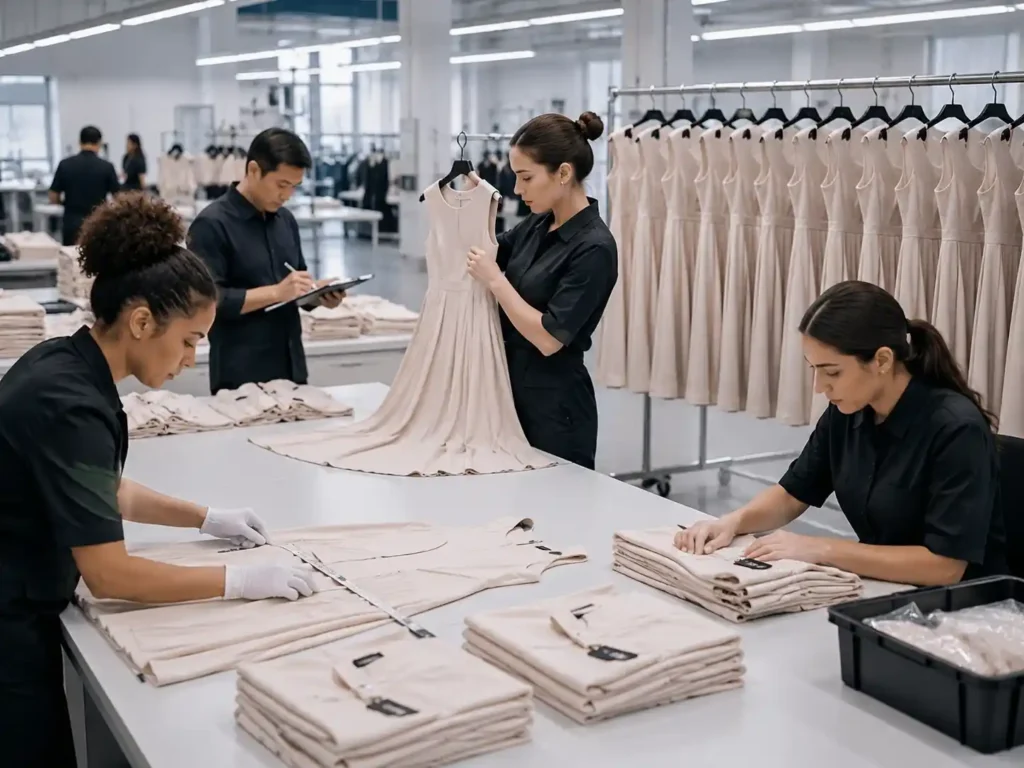
Cutting Control Protects Direction and Surface Consistency
Cutting errors cannot be corrected easily after sewing begins. Sequin material requires controlled spreading, panel direction, marker planning, cutting handling, bundle identification, and edge protection. Directional shine, gradients, motifs, and reversible sequins make panel control especially important.
Fabric Inspection Before Cutting
Incoming material inspection reviews color, width, weight, hand feel, surface condition, sequin security, base fabric condition, obvious missing areas, shade variation, pattern position, stretch direction, and visible damage. Rolls or panels with significant differences should be separated before cutting.
Directional Control
The cutting team follows a defined direction reference when the sequin surface changes appearance according to orientation. Front panels, back panels, sleeves, facings, and other visible parts must follow the approved direction unless the design intentionally uses contrast.
Pattern Placement and Panel Matching
Patterned or gradient sequin material may require placement cutting rather than standard marker efficiency. Key visual areas include the center front, bust, waist, hip, side seam, sleeve, and back opening. Incorrect placement can make an otherwise well-sewn dress appear unbalanced.
Edge and Bundle Protection
Cut edges may release sequins or weaken attachment threads. Cut panels should be handled in a way that reduces rubbing, bending, tangling, and surface damage. Size, style, color, and panel bundles must remain clearly identified to prevent direction and assortment errors during sewing.
Cutting Loss Planning
Sequin fabric often requires higher cutting allowance than standard plain fabric because of direction, motif placement, damaged edges, special panel positioning, and surface protection. Material consumption should be evaluated before quotation and bulk confirmation rather than adjusted after production begins.
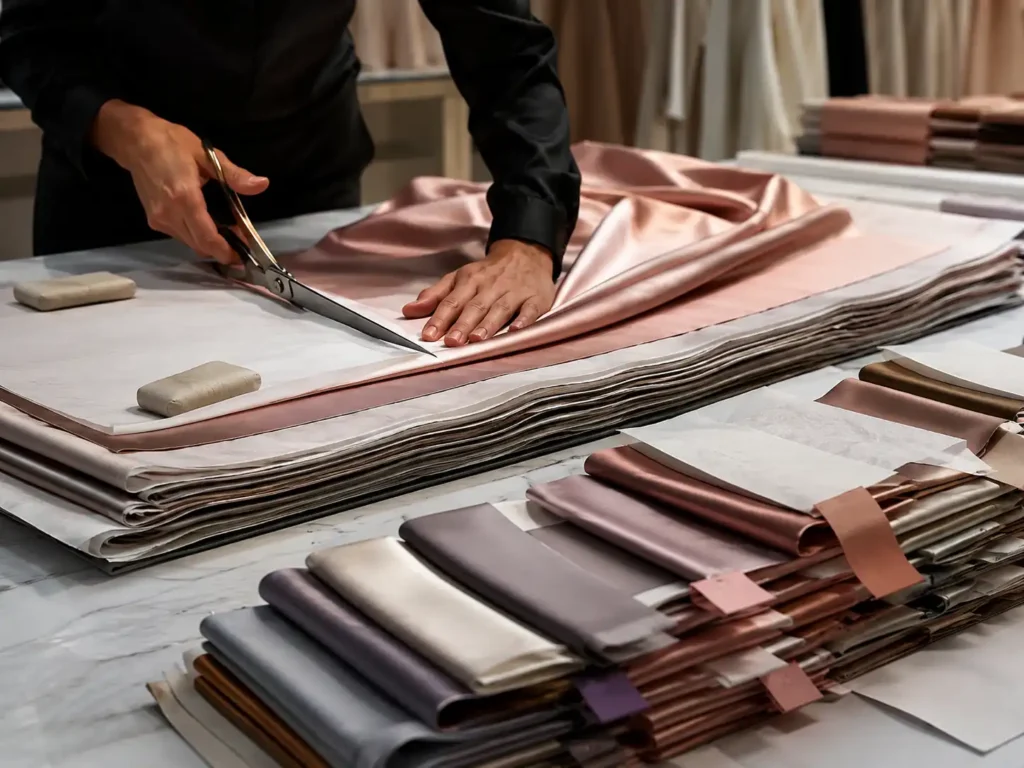
Sewing Control Prevents Bulky and Unstable Seams
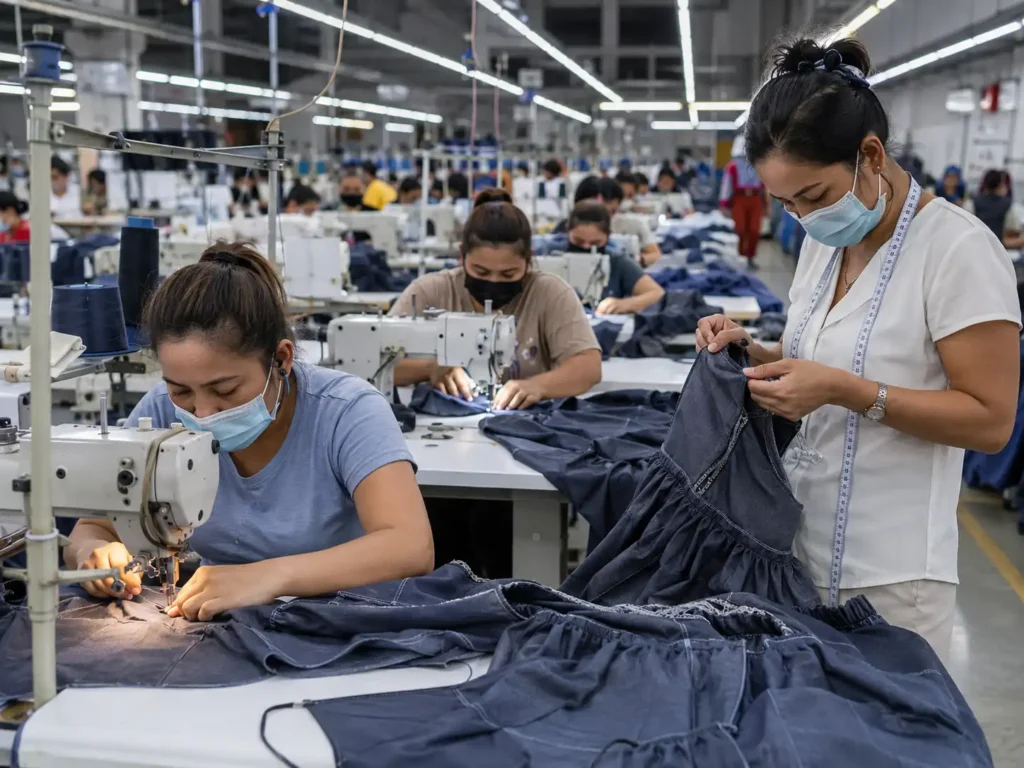
Sequin dress workmanship depends on how the decoration is handled at seams, openings, edges, and stress points. Sewing directly through dense decoration without preparation can produce broken needles, skipped stitches, thick seam allowances, uneven feeding, damaged sequins, and distorted silhouettes. Jinfeng Apparel adjusts the process according to sequin density, base fabric, garment structure, and approved appearance.
Sequin Handling at Seam Allowances
Seam preparation depends on how the sequins are attached and how much bulk the construction can accept.
Possible methods include:
- Removing selected sequins from the seam allowance
- Moving sequins away from the stitching path
- Trimming decoration without damaging attachment threads
- Restoring visible areas after sewing
- Covering exposed thread paths
- Protecting surrounding sequins during pressing
- Checking seam recovery after turning and topstitching
The chosen method must preserve both strength and appearance.
Excessive removal can create visible gaps, while insufficient preparation can make seams thick, uneven, or uncomfortable.
Needle, Thread, and Stitch Control
Needle type, needle size, thread, stitch density, tension, presser-foot pressure, and sewing speed should match the base fabric and decoration system. No single machine setting works for every sequin material.
Inspection should identify:
- Skipped stitches
- Broken threads
- Damaged attachment threads
- Needle marks
- Base fabric holes
- Uneven stitch density
- Seam puckering
- Uneven feeding
- Distorted motifs
- Weak backtacking
Needle management is especially important because broken needle fragments create a serious safety risk. Production records and metal detection arrangements should follow the agreed quality system when required.
Zipper Construction
Invisible and standard zippers are common failure points in sequin dresses. Decoration around the zipper may create excessive thickness, catch in the zipper teeth, distort the center-back seam, or make the zipper difficult to operate.
Zipper control includes:
- Preparing the seam allowance
- Removing or repositioning interfering sequins
- Matching zipper length to the opening
- Maintaining left-right balance
- Keeping the zipper flat
- Checking top and bottom stops
- Testing repeated opening and closing
- Preventing lining from entering the zipper
- Reviewing the garment on a body or form

A Sequin Dress Must Shine Without Scratching
Armhole Comfort
Neckline Comfort
Sleeve and Cuff Comfort
Slit and Hem Comfort
Lining Compatibility
Movement Testing
Quality Is Checked Throughout Bulk Production
Final inspection alone cannot create quality. A reliable sequin dress program uses separate control points so problems are found before they spread across the order. Each stage focuses on different risks and produces information for the next stage.
Incoming Material QC
Cutting QC
Sewing QC
In-Line Inspection
Measurement Review
Finished Garment Inspection
Packing QC
Final Sampling Inspection
Final Sequin Dress Inspection Checklist
A final inspection checklist should match the approved sample, technical file, quality manual, measurement chart, label file, and packing standard. Sequin dresses require surface-specific checks in addition to standard garment measurements and workmanship review.
| Inspection Area | What Is Checked | Examples of Unacceptable Conditions |
|---|---|---|
| Sequin Surface | Density, color, direction, pattern, missing areas, visual consistency | Obvious gaps, wrong direction, broken gradient, mismatched panels |
| Sequin Security | Attachment threads, loose areas, high-friction zones, repaired areas | Continuous loose sequins, weak attachment, visible repair damage |
| Base Fabric | Holes, snags, stretch, distortion, visible damage | Mesh holes, torn base, permanent distortion, severe snagging |
| Seams | Stitching, thickness, allowance, symmetry, surface continuity | Skipped stitches, broken thread, excessive bulk, distorted seams |
| Skin Contact | Underarm, neckline, cuff, slit, hem, internal edges | Sharp edges, exposed decoration, repeated scratching points |
| Lining | Coverage, color, length, stretch, attachment, opacity | Lining exposure, insufficient coverage, twisting, excessive tightness |
| Zipper | Position, flatness, operation, top and bottom finish | Catching, broken teeth, severe arching, trapped lining or sequins |
| Measurements | Bust, waist, hip, length, straps, sleeves, slit, hem | Measurements outside agreed tolerance |
| Appearance and Fit | Balance, silhouette, drape, symmetry, movement | Twisting, uneven hem, poor body balance, unstable neckline |
| Labels and Packing | Main label, size label, care label, hangtag, barcode, folding, protection | Incorrect size, wrong barcode, missing label, insufficient anti-scratch protection |
Defect Classification and AQL Inspection Support
Critical Defects
Critical defects may create a safety or regulatory risk.
Examples can include sharp dangerous components, broken needle fragments, unsafe attachments, contamination, or construction failures that create an immediate hazard.
Final classification should follow the agreed quality manual and applicable market requirements.
Minor Defects
Minor defects do not normally prevent use but still fall below the approved workmanship standard.
Examples may include isolated thread ends, small local marks, minor pressing impressions, or limited cosmetic issues.
Repeated minor defects may indicate a broader process problem and should not be ignored.
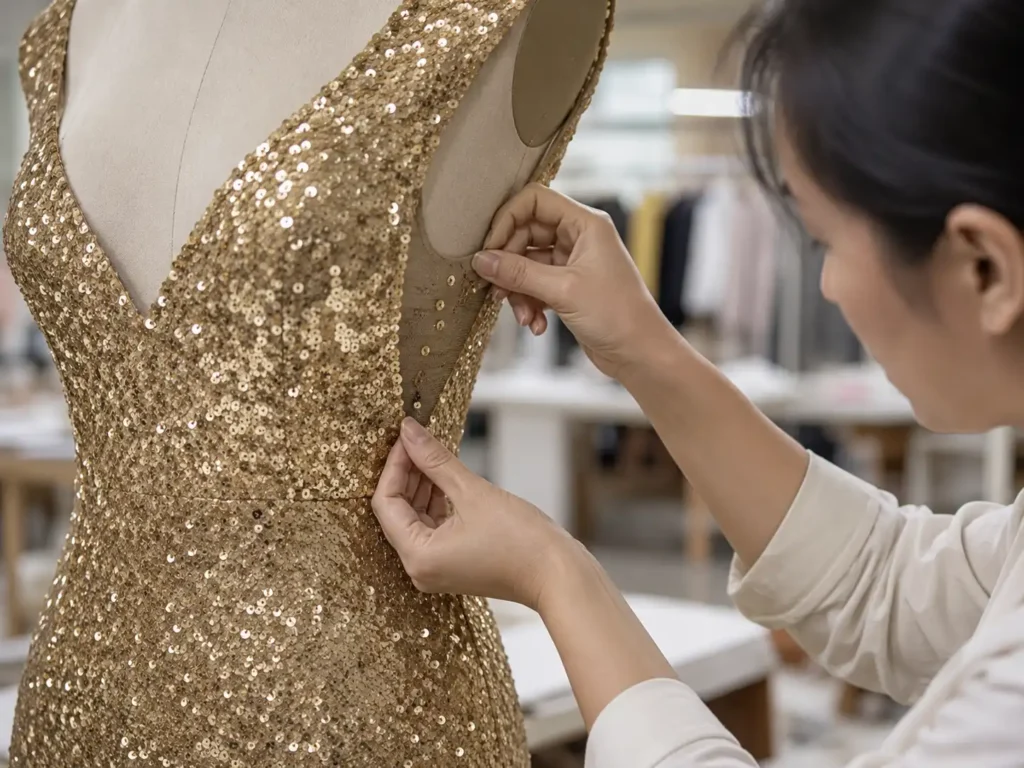
Protect Sequin Dresses Beyond Final Inspection
A sequin dress can pass garment inspection and still arrive damaged when folding, bagging, carton density, or transportation protection is poorly planned. Finishing and packing must protect the decorated surface without creating excessive volume, cost, or warehouse difficulty.
Surface Protection
Protective methods are selected according to decoration density, sequin shape, garment length, lining, and packing route.
Options may include:
- Tissue paper between decorated surfaces
- Anti-scratch protective layers
- Separate individual polybags
- Controlled inside-out folding where suitable
- Additional protection around zippers, chains, stones, or sharp decoration
- Reduced garment compression
- Garment-specific folding boards
- Layer separation inside cartons
Folding Method
Folding should avoid concentrating pressure on heavily decorated seams, bust areas, waistlines, sleeves, and zippers.
Long dresses may need length-specific folding, while structured dresses require shape protection.
A packing trial can confirm whether the garment recovers after unpacking.
Individual Packing
Individual packaging should match the sales and warehouse model.
Available requirements may include:
- Brand polybag
- Warning text
- Vent holes
- Size sticker
- Color sticker
- SKU label
- Barcode label
- Hangtag
- Tissue paper
- Protective insert
- Packing instruction card
Carton Density
Overfilled cartons create pressure and surface friction.
Underfilled cartons create movement and collapse risk.
Packing quantity should be calculated according to garment volume, sequin density, polybag dimensions, carton dimensions, transport route, and warehouse requirements.
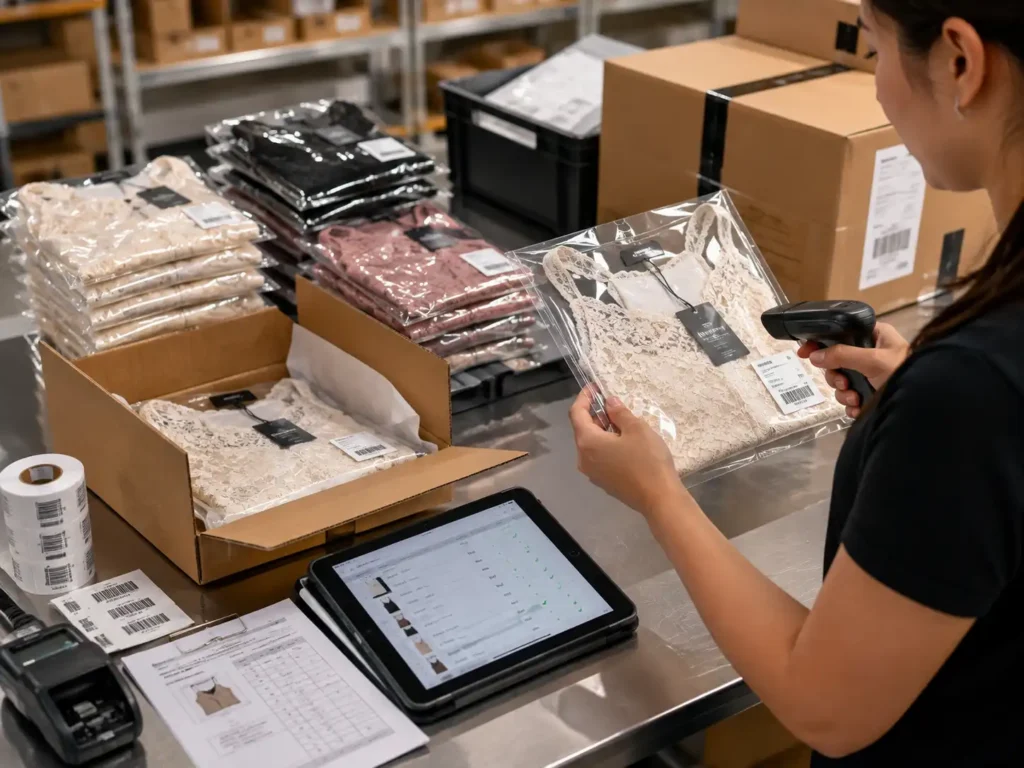
Barcode and Assortment Control
Packing QC should verify:
- Style number
- Color
- Size
- Barcode
- SKU
- Quantity
- Size ratio
- Mixed-carton instructions
- Carton marks
- Gross and net weight
- Packing list consistency

See the Evidence Behind Our QC Process

Fabric Inspection Records

Sequin Surface Checks
In-Line Sewing Checks

Measurement Records
Packing Checklists

Pre-Shipment Review
Sequin Dress Quality Control Frequently Asked Questions

Send Us Your Sequin Dress Quality Requirements
Jinfeng Apparel supports established fashion brands, sourcing teams, product developers, and quality departments that need structured sequin dress development, sampling, bulk production, inspection, private-label packing, and repeat-order records.
A detailed project review allows the development and production teams to identify material, fit, workmanship, comfort, inspection, cost, and delivery risks before formal sampling begins.
For a more accurate assessment, please provide:
- Company and brand information
- Product reference images or tech pack
- Planned number of styles
- Quantity by style and color
- Size range and measurement chart
- Target market
- Sequin fabric or embellishment preference
- Lining and comfort requirements
- Zipper and trim details
- Quality manual
- Measurement tolerance
- AQL requirement
- Critical, major, and minor defect definitions
- Label and barcode files
- Individual packing requirements
- Carton and assortment requirements
- Required launch or delivery date
- Third-party inspection requirements
- NDA request where applicable


