 Skip to content
How to Standardize Ruffles Across Sizes

Your trusted Women’s Apparel Manufacturer from China
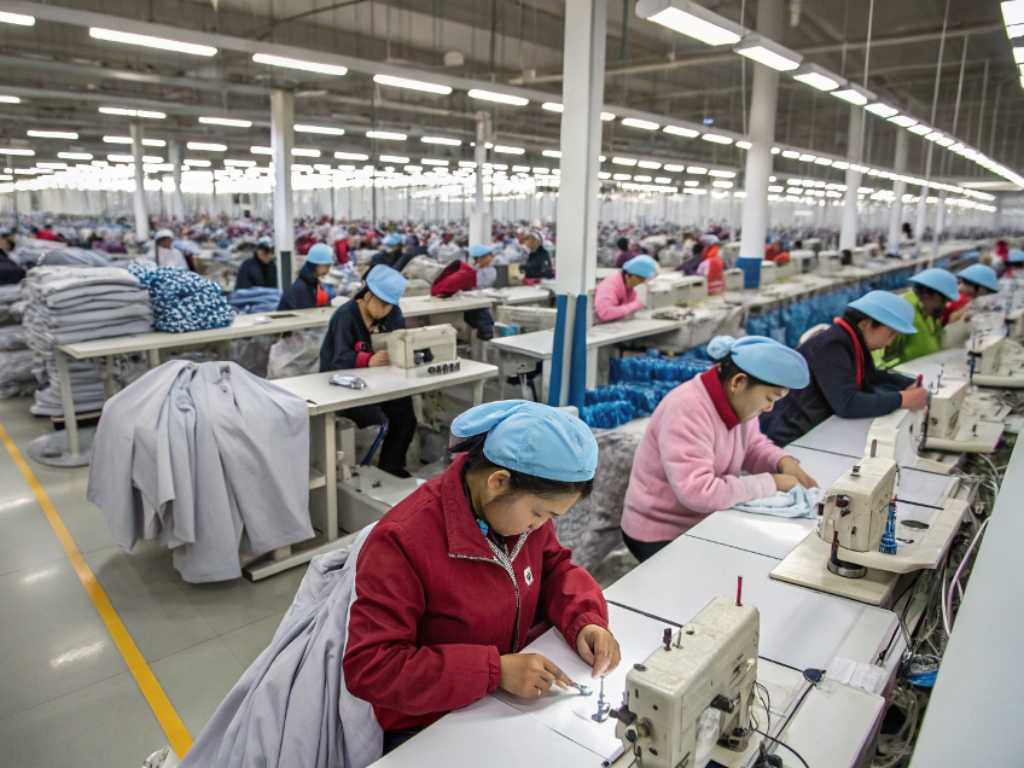
A ruffle looks simple when it appears on a dress sketch. It may be a soft layer around the hem, a romantic shoulder frill, a cascading front detail, or a dramatic tier on an occasion dress. But once the style moves from one sample size into XS, S, M, L, XL and beyond, the simple ruffle can become one of the fastest ways to expose weak grading, unclear tech packs and poor production control. A sample-size ruffle can look balanced in the showroom, then become too crowded on smaller sizes, too flat on larger sizes, uneven after sewing, or different after pressing.
To standardize ruffles across sizes, brands need to control ruffle length, width, gathering ratio, seam placement, fabric behavior, pattern grading rules and QC tolerances together. The goal is not to copy the same ruffle measurement across every size, but to preserve the same visual balance, fullness and design intention after grading, sampling and bulk production.
For fashion brands, this matters because ruffles are emotional details. Customers may not measure the gathering ratio, but they instantly notice when the left sleeve looks fuller than the right, when a hem tier droops, or when the plus-size version loses the charm of the campaign sample. A good ruffle is not only a sewing detail. It is a production system.
Jinfeng Apparel is a Guangdong-based custom women’s fashion manufacturer serving global fashion brands and mid-to-large apparel clients with OEM, ODM, private label, dress development, sampling, bulk production, quality control, packaging and export delivery support. The company works with dresses, skirts, jumpsuits, matching sets and private-label womenswear, including ruffle dresses, chiffon styles, satin dresses, lace pieces, mesh details and occasionwear collections.
What Makes Ruffles Hard to Standardize?
A technical design table with ruffle dress samples in XS, M and XL, pattern pieces, seam measuring tape and fabric swatches, clean fashion studio lighting, professional garment development scene.
Ruffles are hard to standardize because they change with size, fabric, seam length, gathering density, sewing tension and pressing. A ruffle that looks balanced on one sample size can look bulky on smaller sizes or weak on larger sizes. Standardization means keeping the same visual effect across the full size range, not simply copying one measurement everywhere.
Size Changes Affect More Than Body Fit
When a dress is graded from one sample size into a full size range, the bust, waist, hip, armhole, neckline and hem do not all increase at the same speed. A ruffle attached to one of these areas must follow the specific seam it belongs to, not a generic percentage added to every part of the garment.
A hem ruffle usually follows sweep. A neckline ruffle follows curve and face balance. A bust ruffle must respect coverage and proportion. A sleeve ruffle is affected by armhole shape, shoulder width and sleeve opening. If the same ruffle length or width is copied across sizes without checking these relationships, the garment may still measure correctly but look wrong.

In production, the question is not only whether the ruffle became larger or smaller. The real question is whether the customer sees the same design intention in every size. A good smaller size should not look over-decorated, and a larger size should not look like the ruffle detail disappeared.
Fullness Is Visual, Not Just Mathematical
Ruffle fullness is often calculated through a ratio. For example, a 2:1 ruffle means 200 cm of ruffle fabric is gathered into 100 cm of finished seam. That calculation is useful, but it does not automatically guarantee a balanced garment.
A 2:1 ratio in chiffon may look soft and romantic. The same ratio in cotton poplin may look stiff and bulky. A 2:1 ratio on a short neckline ruffle may look too dense, while the same ratio on a long hem tier may look completely normal. Experienced pattern makers treat gathering ratios as a starting point, not a universal rule.
The approved sample gives the first visual standard. The graded size set tells whether the formula still works after the garment grows or shrinks. When a brand skips that review, the bulk order becomes the place where grading mistakes finally show up.
Small Errors Become Visible in Bulk
Ruffles multiply small mistakes. A 0.5 cm placement error on a flat seam may not be obvious, but on a neckline frill, sleeve frill or tiered skirt, the same error can change the garment’s entire look. If the left and right sides are not balanced, the customer will notice before checking any measurement chart.
In bulk production, ruffle inconsistency often comes from unclear notches, uneven gathering distribution, fabric stretching during sewing, inconsistent pressing or operators interpreting the sample differently. These problems are common because ruffles are soft, moving details. They need both measurement control and visual comparison.
For fashion brands, this is where a supplier’s real technical ability shows. Anyone can sew a ruffle onto one sample. The real test is whether the same look can be repeated across sizes, colors and production batches.
The Risk Is Higher in Fashion Styles
Ruffles are common in party dresses, occasion dresses, resort dresses, mesh dresses, chiffon styles, satin styles, lace trims, tiered skirts and romantic tops. These products depend heavily on visual detail. A slightly flat ruffle can make a style look cheaper. A bulky ruffle can make the fit feel wrong. An uneven ruffle can make the garment look poorly controlled.
Fast fashion adds another layer of pressure. Brands need speed, but ruffle-heavy styles still need technical discipline before bulk starts. If the development stage is rushed, the cost usually appears later as rework, delayed shipment, inconsistent product photos or higher return risk.
Ruffle Risk | Common Cause | Control Point |
Too flat on larger sizes | Ruffle length does not scale with attachment seam | Recalculate ruffle length by graded seam |
Too bulky on smaller sizes | High ratio copied without visual review | Check size-set proportion |
Uneven left and right sides | No balance notches or weak sewing guidance | Add notches and compare to PP sample |
Wavy seam | Stretch, tension or fabric shifting | Test stitch setting and handling |
Different look in repeat order | No production record from previous batch | Keep pattern, fabric and QC notes |
Which Ruffle Specs Should Be Controlled?
Close-up of a garment tech pack showing ruffle width, cut length, gathering ratio and tolerance notes, next to a satin ruffle sample and measuring ruler, modern apparel production workspace.
The key ruffle specs to control are finished width, cut width, cut length, attachment seam length, gathering ratio, placement, edge finish, layer drop and tolerance. These details should be recorded in the tech pack, confirmed during sampling and checked during production. Without clear specs, same as sample is usually not enough for consistent bulk quality.
Ruffle Width and Length
Finished ruffle width controls the visual scale of the detail. Cut width controls how much fabric is available before seam allowance, edge finishing and pressing. These two numbers should not be confused.
For example, a finished 5 cm hem ruffle may require a cut width of 6.5 to 7 cm depending on seam allowance and edge finish. A rolled hem may need a different allowance than a clean-finished ruffle. A lined ruffle may need another construction method entirely.
Ruffle length is usually connected to the attachment seam length. If a skirt hem seam is 120 cm and the ruffle ratio is 2:1, the cut ruffle length is around 240 cm before sewing adjustments. If the hem grows after grading, the ruffle length must be recalculated or the fullness will change.
Gathering Ratio and Density
The gathering ratio tells the factory how much fullness to create. It is one of the most important production controls for ruffle consistency. However, the ratio should always be reviewed with fabric type, garment position and size range.
A low ratio can look clean and modern. A higher ratio can look romantic or dramatic. Too much ratio can create bulk, seam tension and pressing problems. Too little ratio can make the ruffle look flat or underdeveloped.
For many women’s fashion styles, the practical range often sits between 1.5:1 and 2.5:1, but this varies by fabric and design. Very lightweight fabrics can sometimes support higher fullness. Crisp or heavy fabrics often need less. The safest approach is to approve the ratio through sample review, then confirm it again in key sizes.
Placement and Symmetry
Ruffle placement should be measured from stable reference points. Depending on the garment, this may include center front, center back, shoulder seam, side seam, waist seam, neckline edge, armhole point or hem edge.
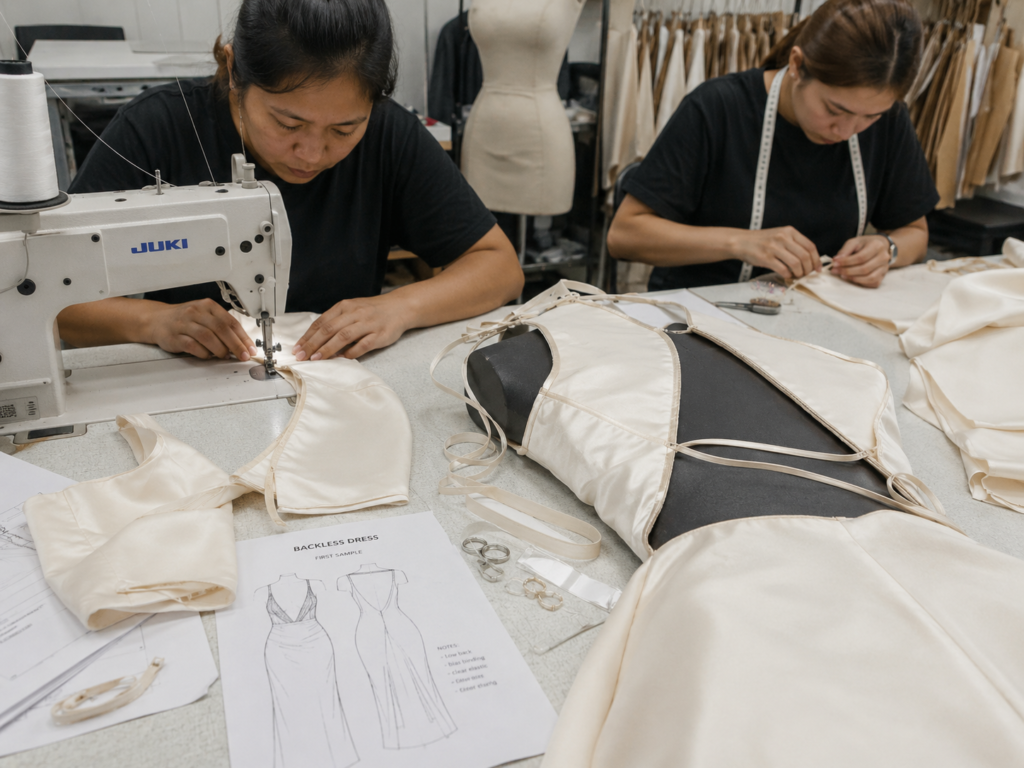
Symmetry matters most when the ruffle is near the face, bust, shoulder, waist or front opening. These areas are visually sensitive. If one side sits 0.8 cm higher than the other, the garment may look twisted even when the body fit is acceptable.
For asymmetrical ruffles, placement becomes even more important. The design may not be symmetrical, but it still needs to be intentional and repeatable. The pattern should include clear reference lines, notches and photos so bulk production does not rely on guesswork.
Tolerances That Make Sense
Ruffles need realistic tolerances. They are fabric details, not rigid components. A tolerance that is too strict can slow production without improving the final garment. A tolerance that is too loose can damage the visual standard.
The best tolerance depends on fabric, price level and ruffle position. A neckline ruffle on an occasion dress needs tighter control than a soft hem ruffle on a casual resort dress. Layered ruffles need specific drop control because uneven layers are easy to see in photos.
Spec to Control | Practical Measurement | Common Tolerance Range | Why It Matters |
Finished ruffle width | Measure at 3 to 5 points | +/- 0.3 to 0.5 cm | Keeps visual scale consistent |
Attachment placement | Measure from seam or key point | +/- 0.3 to 0.6 cm | Prevents crooked or uneven detail |
Layer drop | Measure tier-to-tier distance | +/- 0.5 to 0.8 cm | Keeps layered ruffles balanced |
Left-right balance | Compare both sides flat | Within 0.5 to 0.8 cm | Controls symmetry |
Gathering density | Compare between notches | Visual plus ratio check | Prevents flat zones or bunching |
Edge finish | Check rolling, puckering and loose threads | Visual standard | Protects perceived quality |
How Do Fabrics Affect Ruffle Fullness?
Fabric swatch board comparing chiffon, satin, mesh, lace, cotton poplin and jersey ruffle samples, each labeled with fullness ratio and drape behavior, premium fashion development setting.
Fabric affects ruffle fullness through weight, drape, thickness, stretch, recovery, surface texture and pressing response. The same ruffle ratio can look soft in chiffon, heavy in cotton, unstable in stretch mesh or puckered in satin. Before bulk production, the exact fabric should be tested with the final ruffle construction.
Lightweight Fabrics
Chiffon, georgette, voile and soft rayon can create airy ruffles with good movement. These fabrics are often used for resort dresses, occasionwear, tiered skirts and feminine tops. They usually need enough fullness to avoid looking weak, but too much gathering can make the ruffle cloudy, uneven or hard to control.
Lightweight fabrics also shift during cutting and sewing. Long ruffle strips may stretch or twist if handling is poor. A narrow rolled hem can look beautiful, but it requires consistent machine settings and operator skill. If the edge finish is uneven, the whole garment looks less refined.
For lightweight ruffles, practical control points include cutting direction, notch placement, seam tension, stitch length, edge finish and pressing pressure. Heavy pressing can flatten the ruffle and remove the soft volume that made the sample attractive.
Satin and Smooth Fabrics
Satin gives ruffles a polished and dressy look, especially for party dresses, evening dresses and occasionwear. But satin also exposes mistakes. Puckering, needle marks, tension lines and uneven pressing are easier to see on shiny surfaces.
A satin ruffle usually needs careful testing before approval. If the ratio is too high, the seam may become bulky. If the sewing tension is too tight, the seam can ripple. If pressing is too aggressive, the ruffle may lose shape or show shine marks.
Smooth fabrics also reflect light differently depending on cutting direction. For visible ruffles, inconsistent fabric direction can make panels look like slightly different shades even when they come from the same roll. Cutting direction and shade control should be part of the production instruction.
Mesh, Lace and Sheer Details
Mesh and lace are common in fashion dresses, partywear and feminine tops. They can make ruffles look delicate, but they require special handling. Stretch mesh may grow during sewing. Rigid lace may not gather smoothly. Scalloped lace needs motif control so the edge looks intentional.
Lace ruffles should be reviewed for pattern direction, motif balance and edge usage. If the lace edge is part of the design, the pattern must be planned around the scallop or border. Random cutting can make the garment look cheap even if the sewing is technically clean.
Sheer fabrics also make seam construction more visible. Inside seams, overlock threads and joining points may show through the garment. For premium-looking ruffle designs, the inside construction should be considered early instead of fixed after sampling.
Stretch and Knit Fabrics
Stretch fabrics are tricky because they move during production and after wearing. A stretch mesh ruffle, jersey ruffle or rib-knit frill may look correct on the table but grow when worn. If the ruffle is attached to a bodycon dress, the body panel stretches while the ruffle may react differently.
The production team should check stretch direction, recovery, seam method and tension. In some cases, a lower gathering ratio gives a cleaner result. In other cases, stabilizing tape or a specific stitch type may be needed to prevent distortion.
The key is to avoid uncontrolled stretch. If a ruffle grows during sewing, the finished garment may pass flat measurements but fail on body shape. This is especially important for fitted dresses, off-shoulder styles, sleeve openings and necklines.
Fabric Type | Common Ruffle Ratio Range | Main Risk | Practical Control |
Chiffon / georgette | 1.8:1 to 2.5:1 | Shifting and uneven edge | More notches, soft handling |
Satin / stretch satin | 1.5:1 to 2.2:1 | Puckering and shine marks | Tension test, careful pressing |
Cotton poplin | 1.3:1 to 1.8:1 | Too bulky or stiff | Lower ratio, clean shape |
Rayon / viscose | 1.6:1 to 2.2:1 | Drooping after hanging | Hang test, length check |
Mesh | 1.5:1 to 2.3:1 | Stretch distortion | Control stretch direction |
Lace | 1.3:1 to 2.0:1 | Motif imbalance | Placement and border planning |
Jersey / knit | 1.2:1 to 1.8:1 | Growth during sewing | Recovery and tension control |
How Should Ruffle Patterns Be Graded?
Apparel pattern maker grading ruffle pattern pieces for XS to XL sizes on a CAD screen and paper pattern table, with a ruffle dress sample hanging nearby, technical but elegant.
Ruffle patterns should be graded according to attachment seam length, visual proportion, garment position and fabric behavior. The main garment grade rule should not be copied automatically onto every ruffle piece. A balanced grade keeps ruffle fullness, width, placement and layer rhythm consistent across sizes while respecting fit and body proportion.
Grade From the Attachment Seam
The attachment seam is usually the best starting point for ruffle length. If the seam grows with size, the ruffle length usually needs to grow with it. This helps keep the gathering density consistent.
For example, if a skirt hem seam increases from 130 cm to 140 cm and the approved ratio is 2:1, the ruffle cut length should move from about 260 cm to 280 cm. If the ruffle length remains fixed at 260 cm, the larger size will look flatter. If the ratio is increased without control, the seam may become bulky.
This method works well for many hem ruffles, sleeve openings, waist ruffles and neckline trims. But it still needs visual review because seam length is not the only factor. The ruffle width, fabric weight and garment silhouette also affect how the final size looks.
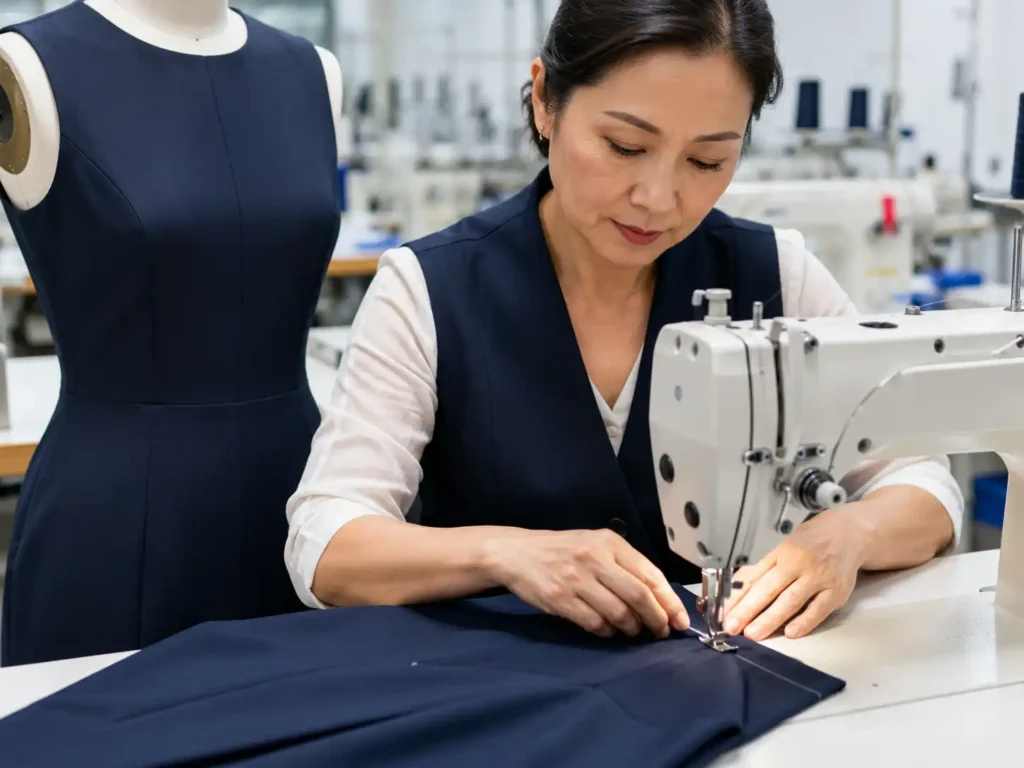
Decide Whether Width Should Scale
Ruffle width does not always need to increase with size. Some ruffles act like trim, while others act like a major design feature. A narrow neckline frill may stay the same across sizes because it frames the face. A hem tier on a maxi dress may need slight scaling because it affects the full silhouette.
The pattern maker should ask what job the ruffle is doing. Is it adding softness? Is it creating volume? Is it shaping the silhouette? Is it hiding a seam? Is it framing a neckline? The answer affects how the width should be graded.
For many commercial dress styles, small width changes can be enough. A 0.3 to 0.5 cm increase between size groups may preserve proportion without making the garment look overdesigned. For delicate details, even that may be too much. This is why size-set review matters.
Control Curves and Layer Drops
Curved ruffles are more difficult than straight ruffles. Necklines, armholes, circular hems and diagonal front ruffles all need careful pattern shaping. If the curve is not graded properly, the ruffle may twist, flare unevenly or pull the base garment out of shape.
Layered ruffles need even more control. Each layer has its own finished drop, attachment seam and fullness ratio. If one layer is off, the whole style looks unbalanced. For tiered dresses, the layer rhythm must stay consistent. The customer should feel that each size belongs to the same collection image.
In production, layered ruffles should be checked before the whole garment is completed. Fixing a tier after all layers are attached can waste time and damage fabric. It is better to catch layer-drop issues during sewing.
Check Key Sizes Before Bulk
For ruffle-heavy styles, checking only one sample size is risky. At minimum, brands should review the base sample and one smaller or larger size when the ruffle is a major design feature. For more complex styles, a size set is safer.
The goal is not to create identical flat measurements across sizes. The goal is to preserve the same visual language. The XS should not look overloaded. The XL should not look under-designed. The garment should feel like the same style on different bodies.
Ruffle Position | Suggested Grading Logic | Main Check Point |
Neckline ruffle | Fixed or lightly graded width; length follows neckline | Face balance and symmetry |
Sleeve ruffle | Length follows sleeve opening; width lightly adjusted | Arm movement and volume |
Hem ruffle | Length follows sweep; width may scale by size group | Skirt proportion |
Bust ruffle | Independent grading based on coverage and bust shape | Fit and modesty |
Waist ruffle | Controlled placement from waist seam | Avoids unwanted bulk |
Tiered ruffle | Each layer graded by seam length and drop | Layer rhythm |
Asymmetric ruffle | Placement points graded carefully | Repeatable design line |
Do Samples Reveal Ruffle Risks Early?
Fit sample review for a ruffle dress on a mannequin, with size set garments on a rack, notes for first sample, fit sample, PP sample and bulk approval, professional sample room.
Yes. Samples reveal ruffle risks when they are used to test proportion, fabric behavior, grading logic, construction method and bulk feasibility. The first sample checks design direction, the fit sample checks body balance, the size set checks grading, and the PP sample locks the final standard before mass production starts.
First Sample
The first sample shows whether the ruffle concept works in real fabric. A sketch may look elegant, but the actual garment may reveal issues with bulk, drape, seam pulling or placement. This is especially common when a design uses chiffon layers, satin ruffles, mesh trims, lace edges or tiered skirts.
At this stage, the goal is not perfection. The goal is to identify whether the construction direction is correct. The sample should answer practical questions: Is the fullness enough? Is the ruffle too heavy? Does the fabric support the design? Does the edge finish look clean? Does the ruffle sit in the right place?
A good first sample review should separate design changes from technical corrections. Make it softer is a design comment. Reduce finished ruffle width from 6 cm to 5 cm and lower the ratio from 2.3:1 to 2:1 is a production-ready correction.
Fit Sample
The fit sample shows how the ruffle behaves on the body. This is where many hidden issues appear. A neckline ruffle may lift away from the body. A bust ruffle may collapse. A shoulder ruffle may restrict movement. A waist ruffle may add volume in an unflattering area. A hem ruffle may tilt if the skirt balance is wrong.
Fit review should include both measurement and visual judgment. A garment can meet the size chart but still look poorly balanced. For example, if the waistline is correct but the ruffle sits too high, the body proportion may look shorter. If the sleeve opening is correct but the ruffle is too dense, the arm may look wider than intended.
The best fit comments are specific. They mention the size, ruffle location, measurement change and expected visual result. This makes the next sample faster and prevents vague comments from becoming expensive production confusion.
Size Set
A size set confirms whether the ruffle grading works. It is especially important for brands selling across broad size ranges or multiple regional markets. A ruffle dress sold in the US, UK, Europe, Australia or Canada may need careful size review because customer body expectations and fit standards can vary.
A practical size-set review does not need to test every size for every simple style. But for ruffle-heavy garments, checking key sizes can prevent major bulk issues. A common approach is to review one base size, one smaller size and one larger size. For more complex occasionwear, brands may check additional sizes.
The size set should focus on visual consistency, ruffle density, width, placement, layer drop and wearing balance. Photos are helpful because they let the design, technical and production teams compare sizes side by side.
PP Sample
The PP sample should become the final production reference. It should use confirmed fabric, confirmed trims, confirmed pattern, confirmed measurements and confirmed construction. For ruffles, the PP sample must clearly show the approved fullness, edge finish, placement and pressing result.
Once the PP sample is approved, the factory should not rely only on written notes. The physical PP sample, measurement sheet and production comments should work together. Operators need to see the standard. QC needs to measure and compare against it.
For Jinfeng Apparel’s custom production model, projects may start from tech packs, reference images, original samples, sketches or line sheets, then move through product development, pattern making, sample making, merchandising, production management, QC, packing and repeat-order support. This sample-to-bulk structure is especially important for ruffle-heavy dresses.
Are Production Rules Enough for Consistency?
Garment production line sewing ruffle details with notches, in-line QC measuring finished ruffle width, PP sample hanging as reference, clean modern women’s apparel factory.
Production rules are necessary, but they are not enough unless they are visible, measurable and checked during sewing. Ruffle consistency depends on clear patterns, notches, operator guidance, in-line inspection, pressing control and final QC records. A written rule only works when the production floor can repeat it garment after garment.
Notches and Balance Marks
Notches are one of the simplest ways to control ruffle distribution. They tell the sewing operator where fullness should be placed. Without notches, one section may become too dense while another section becomes flat.
For a hem ruffle, balance marks often include center front, center back and side seams. For a neckline ruffle, marks may include center front, shoulder points and back neck. For a sleeve ruffle, marks may include underarm, top sleeve and side balance points. The more curved or visible the ruffle is, the more important these marks become.
Notches also help during quality checks. If a ruffle looks uneven, QC can quickly see whether fullness was distributed correctly between marked sections. This reduces arguments and makes correction easier.
Sewing Method and Tension
Ruffle sewing is not only about attaching fabric. Stitch length, thread tension, machine setting and operator handling all affect the final look. Lightweight fabrics can pucker. Stretch fabrics can grow. Satin can ripple. Lace can shift. Mesh can distort.
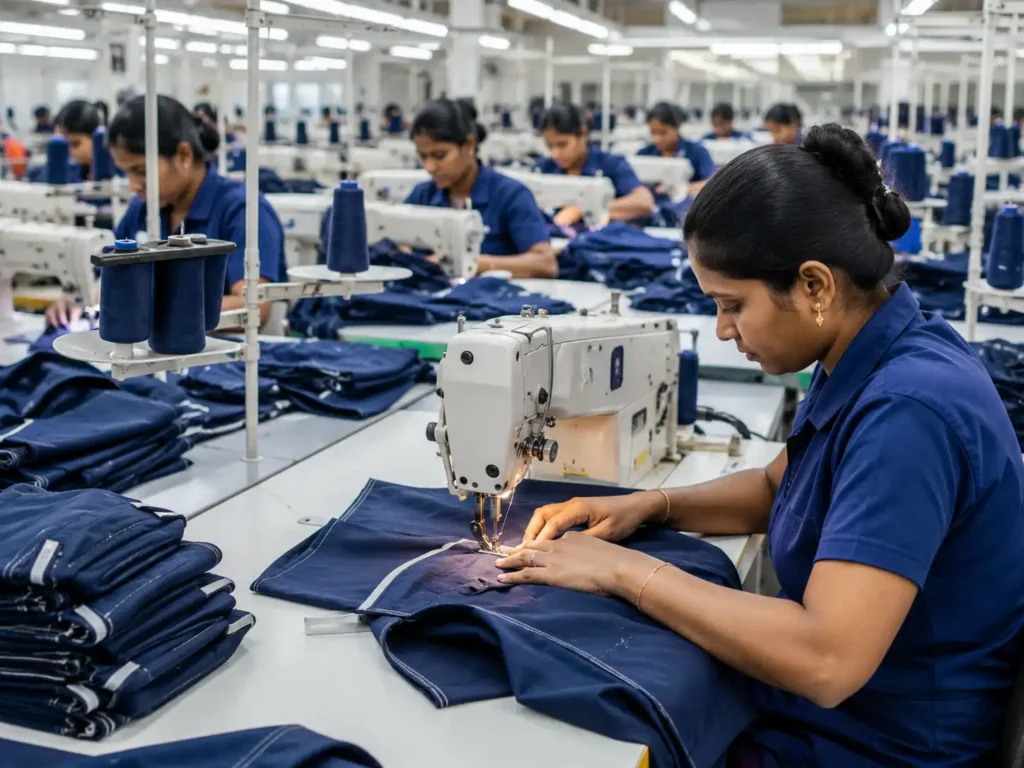
For bulk orders, the production line should test the sewing method before full output. This may include checking gathering stitch tension, seam allowance, overlock quality, rolled hem stability and pressing response. The approved method should then be communicated clearly to operators.
In fast fashion production, speed matters, but uncontrolled speed creates uneven garments. The best sewing rule is the one that can be repeated quickly without losing the visual standard.
Pressing and Finishing
Pressing can improve a ruffle or ruin it. A soft chiffon ruffle may lose its airiness if pressed too flat. Satin may develop shine marks. Mesh may distort under heat. Cotton may need more steam to relax the seam, but too much pressure can change the intended volume.
The pressing standard should be part of the PP sample review. The team should decide whether the ruffle needs light steam, no hard pressing, finger pressing, shaped pressing or only seam relaxation. This is not a small detail. The same sewn ruffle can look different before and after finishing.
Packing should also be considered. A large ruffle folded tightly into a small polybag may arrive crushed. For styles where ruffle volume is a major selling point, packing method should protect the shape as much as possible.
QC Records and Repeat Orders
Final QC should not only check whether a ruffle exists. It should check whether the ruffle matches the approved standard. Finished width, placement, symmetry, layer drop, edge quality and obvious fullness variation should be reviewed.
For repeat orders, records become even more important. If the first order sold well, the next batch should not look like a different interpretation. The factory should keep pattern files, approved sample comments, fabric references, trim records and QC notes. This helps preserve the same ruffle look across seasons and reorders.
A mature production system does not depend on memory. It depends on clear standards, physical references and recorded decisions.
How Can Brands Work With the Right Manufacturer?
Fashion brand product developer discussing a ruffle dress tech pack with a manufacturer, fabric swatches, size chart, sample garment and QC checklist on the table, premium B2B apparel sourcing scene.
Brands can work with the right manufacturer by sharing clear design references, fabric expectations, size range, ruffle specs, sample comments and bulk plans early. The right manufacturer should connect pattern, sample, fabric, sewing and QC teams so the approved ruffle look can be repeated across sizes, colors and production batches.
Prepare Better Inputs
A manufacturer can do better work when the brand provides better starting information. A full tech pack is ideal, but development can also begin from reference photos, original samples, sketches, line sheets, fabric swatches or moodboards.
For ruffle-heavy styles, the most useful inputs include target fabric, size range, sample size, desired fullness, finished ruffle width, ruffle placement, edge finish, order quantity and target market. If the brand has photos of a preferred ruffle look, those photos should be shared with clear comments. For example, we like the soft hem fullness but want a narrower sleeve ruffle is much more useful than make it like this.
Clear inputs reduce sample rounds. They also reduce the chance that the factory builds the wrong structure from the beginning.
Ask Technical Questions Early
Before placing a ruffle-heavy style into bulk production, brands should ask technical questions. How will the ruffle length be calculated across sizes? Will the width be fixed or graded? What ratio is suitable for this fabric? Will a size set be made? How will the factory check gathering density during production?
These questions do not slow down development. They prevent expensive confusion later. A supplier that can explain these points clearly is more likely to control the garment in bulk.
A strong manufacturer should also warn the brand when a design detail may not work well with the chosen fabric, target price or timeline. That kind of feedback is valuable. It shows the factory is thinking beyond one sample and considering actual production.
Align Sample and Bulk Standards
One common problem in apparel production is the gap between sample room and bulk sewing line. The sample may be made by a highly skilled sample maker, while bulk production is handled by line operators under time pressure. Without clear transfer standards, the sample look can drift.
To avoid this, the approved sample should be translated into production instructions. The pattern should include notches. The measurement sheet should list ruffle specs. The PP sample should be available as a reference. QC should know which details are critical. Production should know which areas cannot be adjusted casually.
When the sample team, pattern team, merchandiser, production team and QC team all work from the same standard, ruffle consistency becomes much easier to maintain.
Build for Long-Term Consistency
For brands that produce seasonal collections or repeat successful styles, ruffle standardization should be treated as part of the long-term product record. The factory should keep patterns, size specs, fabric references, trim details, approved sample notes, production comments and QC records.
This is especially useful for dress brands, occasionwear labels, resortwear collections and fashion retailers that may reorder a winning style in new colors or fabrics. The next batch should not restart from zero. It should build from the proven standard.
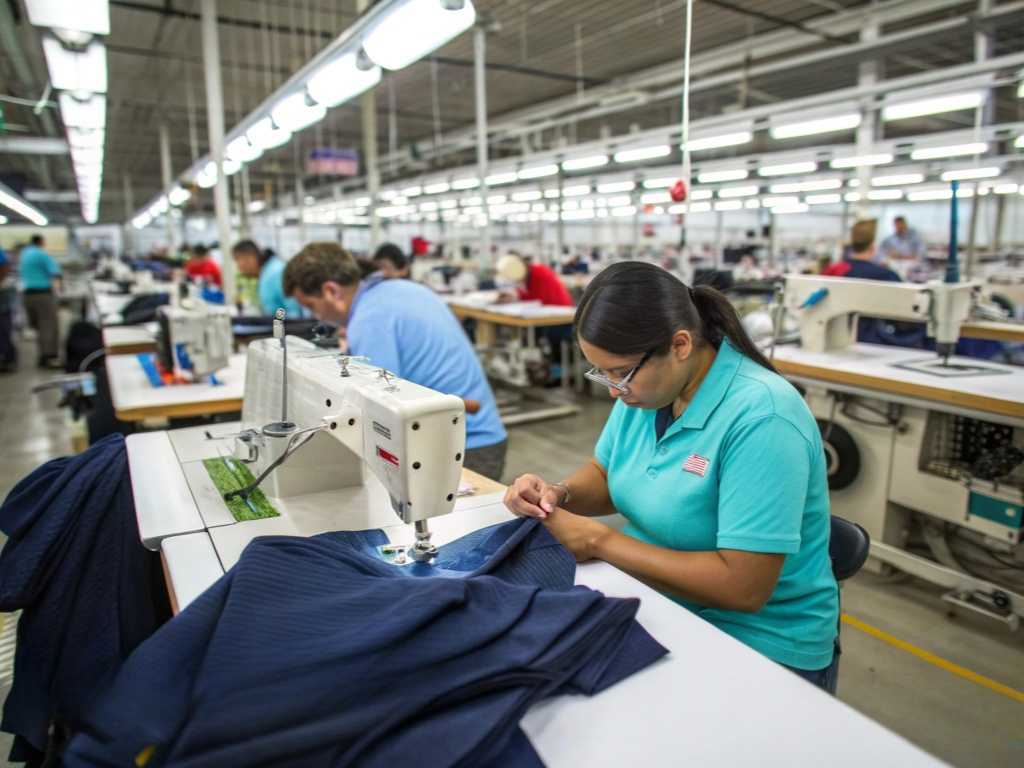
Jinfeng Apparel supports long-term brand cooperation, seasonal collection development, repeat orders and multi-batch production by keeping pattern records, fabric references, trim details, measurement files and packing requirements for future production. For brands building recurring ruffle dresses, occasionwear or seasonal collections, that record-keeping can reduce risk and speed up future development.
Final Thoughts: Ruffles Are Small Details With Big Commercial Impact
Ruffles are not just decoration. In fashion production, they are a test of whether a manufacturer can control design, pattern, fabric, sewing and QC at the same time. A beautiful sample is important, but the real challenge is making the same design language survive across multiple sizes, colors, fabrics and production batches.
For brands, the safest approach is to treat ruffles as a technical detail from the beginning. Define the ruffle ratio. Confirm the fabric behavior. Grade the pattern with intention. Review fit samples and size sets. Lock the PP sample. Check production with measurable standards. Keep records for repeat orders.
When this system works, the customer simply sees a dress that looks right. The ruffle feels soft, balanced and intentional. The campaign sample, online product photo and delivered garment speak the same visual language. That is what turns a fragile design detail into a scalable product.
If your next collection includes ruffle dresses, tiered skirts, chiffon occasionwear, satin party dresses, mesh styles, lace details or multi-size custom dress production, you can send your tech pack, reference photo, original sample or line sheet to Jinfeng Apparel for review. The team can help evaluate fabric behavior, ruffle construction, size grading risk, sampling route and bulk production feasibility before the style moves into production.
Share This Article :

Jerry Lee
Categories

Latest blogs

Table of Contents
Here, developing your OEM/ODM private label clothing collection is no longer a challenge—it’s an excellent opportunity to bring your creative vision to life.
