Skip to content

In the wedding market, a ruffle dress often looks like an easy win. It feels romantic. It moves well in video. It catches attention faster than a plain slip dress. It gives influencer brands something very important: visual energy. But once a brand starts turning that idea into a real product, the real questions show up quickly. Will the ruffle hold its shape after fabric changes? Will the neckline stay in place during wear? Will the dress still feel soft and elegant in production, not just in the first sample? Will the fit work on more than one body type? Will the same style still look right when reordered two months later?
That is why the best-selling ruffle dresses are rarely “lucky” products. They are usually the result of clear product positioning, accurate pattern development, fabric decisions made for real wear, and a factory that understands both visual styling and garment execution. For wedding influencer brands, that matters even more. Customers are not buying this dress for an ordinary day. They are buying it for a date with emotional value: a wedding weekend, rehearsal dinner, destination ceremony, bridal shower, or bridesmaid event. That means expectations are higher. The dress must look beautiful in photos, feel secure while moving, and arrive on time without quality surprises.
A ruffle dress works for wedding influencer brands when it combines three things at once: strong visual appeal, dependable fit, and stable production quality. It should look soft and expressive on camera, feel comfortable and secure during wear, and stay consistent from sample to bulk order. In simple terms, the right ruffle dress is not only attractive. It is commercially workable.
And that is where many collections separate into two very different outcomes. One becomes a real repeat style that customers ask for again. The other gets attention online, but creates fit complaints, delay costs, and reorder hesitation. The difference usually begins much earlier than people think.
What Is a Ruffle Dress?
A ruffle dress is a dress that uses gathered, flounced, tiered, or cascading fabric panels as an important part of the silhouette. In other words, the ruffle is not a small decoration added at the end. It changes how the dress looks, how it moves, how it fits, and how it feels in real wear.
In the wedding and occasion market, this matters a lot. A customer does not usually buy a ruffle dress for an ordinary day. She buys it because she wants the dress to feel more special than a basic slip dress, more expressive than a plain bodycon, and softer than a heavily structured formal dress. That is why ruffle dresses appear so often in wedding guest edits, bridal shower assortments, bridesmaid-alternative collections, and vacation wedding capsules.
For brands, especially influencer-led brands, a ruffle dress is often attractive for one simple reason: it creates emotional value fast. It can make the product feel romantic, feminine, lively, and event-ready within seconds. But for the factory side, a ruffle dress is not just a mood piece. It is a technical garment. The ruffle affects fabric consumption, construction method, pressing, neckline balance, lining choice, and the way the dress behaves during movement.
That is why many brands underestimate this category at first. On the surface, the dress looks soft and effortless. In production, it can be one of the styles where small mistakes become very visible.
What makes a ruffle dress different from a regular dress?
The biggest difference is that the ruffle changes the visual structure of the garment.
A regular dress may rely mostly on:
- neckline shape
- body fit
- hem length
- sleeve shape
- print or fabric surface
A ruffle dress adds another layer of design language. The ruffle can direct attention to the shoulder, bust, waist, hip, side seam, hem, sleeve, or back. It can add softness, volume, or motion. It can also change how the body is read visually.
For example:
| Design Detail | Effect on the Dress |
|---|---|
| Shoulder ruffle | Draws attention upward, adds drama |
| Bust ruffle | Creates softness and a more feminine line |
| Waist ruffle | Can define shape or add volume depending on placement |
| Side cascade ruffle | Adds movement and elongates the body visually |
| Hem ruffle | Makes the dress feel lighter and more romantic in motion |
| Tiered ruffle skirt | Adds fullness and a more playful event feel |
This is why a ruffle dress is often stronger in visual storytelling than a simpler dress. It gives the customer something to notice immediately.
But this also creates a higher standard. If the ruffle is too wide, too flat, too stiff, too limp, or placed in the wrong area, the whole dress can feel wrong. A plain dress may survive minor imbalance. A ruffle dress usually does not.
Which types of ruffle dresses are common in wedding and occasionwear?
In the wedding-related market, ruffle dresses usually fall into a few practical style groups. These groups are useful because they help brands decide not only how the dress should look, but also who it is really for.
Here are some of the most common ruffle dress directions:
| Style Type | Common Use | Main Visual Effect |
|---|---|---|
| One-shoulder ruffle dress | Wedding guest, sunset event, vacation wedding | Bold, feminine, photogenic |
| Hem ruffle midi dress | Garden wedding, daytime event, rehearsal dinner | Soft, elegant, easy to wear |
| Tiered ruffle dress | Bridal shower, resort event, playful guest dressing | Light, youthful, romantic |
| Cascading ruffle maxi | Destination wedding, formal guest wear | Long movement, stronger statement |
| Sleeve ruffle dress | Day-to-evening occasions | Gentle detail, softer styling |
| Bodycon ruffle dress | Partywear, evening wedding events | Sexy, fitted, more fashion-forward |
For brands, this matters because not every ruffle dress solves the same customer need.
A customer shopping for:
- a beach wedding may want fluid movement and lighter fabric
- a city evening event may want a cleaner shape with a stronger finish
- a bridal shower may want a softer and more playful silhouette
- a bridesmaid alternative may want romance without looking too formal or too traditional
So the first useful question is not “Should we make a ruffle dress?”
The better question is “Which ruffle dress fits the moment we want to serve?”
That one decision can shape:
- the silhouette
- the fabric
- the lining level
- the fit approach
- the target price
- the production complexity
Why do customers choose a ruffle dress for weddings?
Customers usually choose a ruffle dress because it helps them look dressed up without feeling overdone.
That is a very important point in wedding-related fashion. Many customers want a dress that feels special, but they do not want to look too stiff, too bridal, too plain, or too heavily decorated. A ruffle dress often sits in a very useful middle position.
It can offer:
- movement without sequins
- romance without lace
- occasion energy without heavy beading
- femininity without overly complicated styling
This is one reason the category performs well across multiple wedding moments.
A ruffle dress can help solve real customer questions such as:
- What can I wear to a garden wedding that feels elegant but not too formal?
- What dress will look good in photos and still feel comfortable for hours?
- What works for a destination wedding without looking too casual?
- What style feels more elevated than a simple slip dress?
- What can I wear that feels romantic but still modern?
For the customer, the appeal is emotional.
For the brand, the appeal is commercial.
For the factory, the appeal has to be matched by technical control.
How does a ruffle dress behave in real wear?
This is where the category becomes more serious.
A customer does not experience a ruffle dress only by looking at it. She experiences it through movement. She walks in it, sits in it, turns in it, packs it for travel, steams it, and wears it through several hours of an event. That is why real-wear behavior matters so much.
A good ruffle dress should do the following well:
| Wear Factor | What the Customer Expects |
|---|---|
| Walking | Ruffle moves naturally, not awkwardly |
| Standing still | Dress still looks flattering, not flat or bulky |
| Sitting | No major pulling, twisting, or discomfort |
| Photos | Silhouette looks balanced from multiple angles |
| Long wear | Neckline and body fit stay stable |
| Travel | Fabric recovers reasonably after packing |
This is also where many weak products fail.
Some dresses look beautiful in still images but create problems such as:
- neckline slipping
- ruffle collapsing
- visible lining tension
- too much transparency
- uncomfortable bulk at the waist or hip
- uneven hem after wear
That is why a ruffle dress should never be judged only from a hanger photo or one fitting pose. It needs to be reviewed in motion and in practical use.
How does ruffle placement change the body shape visually?
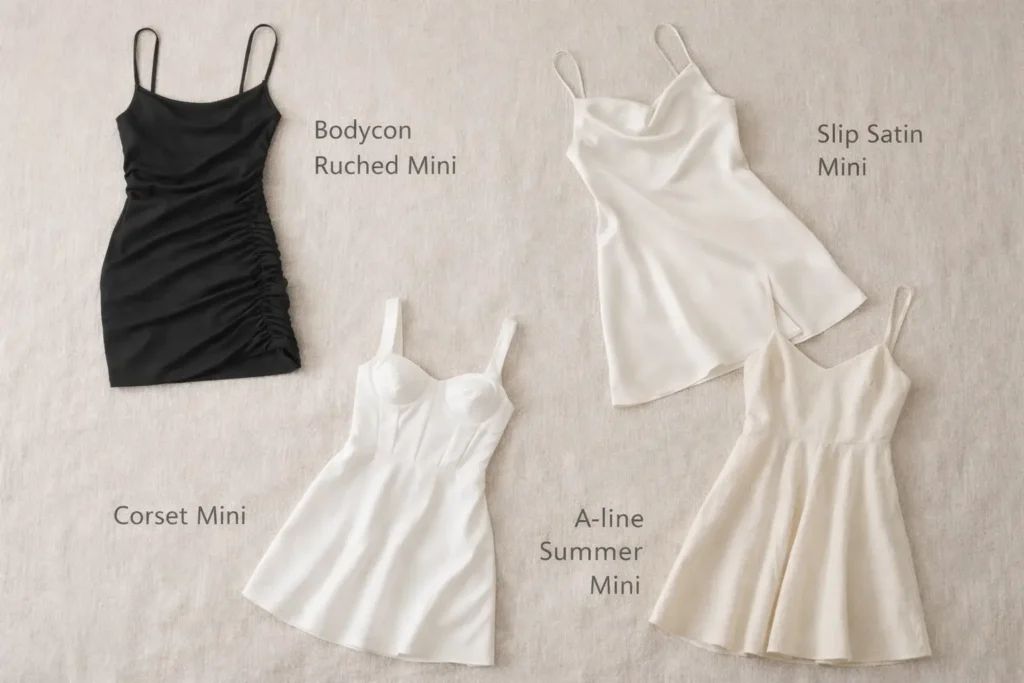
Ruffle placement is one of the most important design decisions in this category because it changes how the body is visually framed.
A well-placed ruffle can improve the overall look of the dress. A badly placed ruffle can make the dress feel heavy, crowded, or unbalanced.
Here is a simple way to understand it:
| Ruffle Placement | Visual Result |
|---|---|
| Upper shoulder | Adds width and drama |
| Along neckline | Softens the upper body |
| Down one side | Creates length and movement |
| At the hem | Adds softness without affecting upper-body fit |
| Around sleeve opening | Makes the dress feel lighter and more romantic |
| Across waist or hip | Can shape or enlarge the area depending on scale |
This matters for product development because the same ruffle style does not flatter every customer in the same way. A dramatic bust ruffle may look strong on one body type but too bulky on another. A side cascade may help lengthen the body visually, while a full tiered shape may add volume that feels playful on one customer and overwhelming on another.
For brands, this is where customer knowledge matters.
For factories, this is where pattern judgment matters.
A good development team should not only ask:
- where should the ruffle go?
It should also ask:
- what should this ruffle do for the body shape?
- should it soften, lengthen, balance, or dramatize?
- will it still work across multiple sizes?
What fabrics are usually used in a ruffle dress?
Fabric choice changes almost everything in a ruffle dress. The same pattern can feel completely different depending on the material.
For wedding and occasionwear, common ruffle dress fabrics include:
| Fabric | Best For | Main Character |
|---|---|---|
| Chiffon | Soft guest dresses, destination styles | Airy, fluid, romantic |
| Georgette | Slightly fuller romantic dresses | Soft with more body |
| Satin | Evening ruffle dresses | Smooth, elegant, dressier |
| Crepe | Cleaner, more controlled ruffle shape | Balanced, refined |
| Mesh overlay | Soft layered occasionwear | Feminine, light, sheer effect |
| Knit | Fitted ruffle dresses | Comfort, stretch, body shape |
Clients often focus first on appearance, but in real development the factory also needs to consider:
- opacity
- drape
- edge finish
- wrinkle behavior
- lining need
- recovery after packing
- batch consistency in production
For example:
- chiffon may give beautiful motion, but often needs careful lining and finishing
- satin may look luxurious, but can show pulling and tension more easily
- crepe may be easier to control, but may not give the same floaty feeling
- knit may improve comfort, but the ruffle behavior will feel different from woven styles
This is why fabric cannot be chosen by mood image alone. It has to support the actual product goal.
How much more fabric does a ruffle dress usually use?
This is one of the most practical questions for brands, especially when they begin costing.
A ruffle dress often uses more fabric than a cleaner dress with the same base length. The reason is simple: ruffles require extra volume. Depending on the design, this additional consumption can be meaningful.
In many developments, ruffles can increase fabric use by roughly:
- 10% to 20% for lighter hem or sleeve ruffles
- 20% to 35% for larger side or neckline cascades
- 30% to 50% or more for tiered or highly layered dresses
This varies by:
- ruffle width
- number of layers
- fabric width
- garment length
- pattern efficiency
A simple comparison may look like this:
| Dress Type | Relative Fabric Use |
|---|---|
| Clean slip-style midi | 1.0x |
| Hem ruffle midi | 1.15x–1.25x |
| One-shoulder cascade maxi | 1.2x–1.35x |
| Tiered ruffle maxi | 1.3x–1.5x+ |
This is why clients should discuss costing early. A dress may look like only a “small design upgrade,” but the fabric consumption and sewing time may be noticeably higher than expected.
What should brands really pay attention to when developing this category?
From a client point of view, the most important thing is not whether the ruffle dress looks pretty in the first image. It is whether the dress can stay attractive through the whole chain:
- design,
- sample,
- fit review,
- bulk production,
- shipping,
- customer wear,
- and reorder.
That means brands should pay close attention to the following points:
| Development Point | Why It Matters |
|---|---|
| Ruffle scale | Too small looks weak, too large looks heavy |
| Fabric behavior | Changes movement, softness, and comfort |
| Lining plan | Affects confidence, fit, and garment stability |
| Neckline security | Important for long event wear |
| Body fit under the ruffle | Determines whether the dress flatters or fights the body |
| Bulk consistency | Protects the approved look in production |
| Event role | Keeps the design aligned with real customer demand |
A ruffle dress is a very strong category when these points are handled correctly. It can become a hero style, a repeat style, or the start of a larger occasionwear line. But if these points are ignored, the same dress can become a source of delays, revisions, and customer complaints.
Why is this category so important for a manufacturer like Jinfeng?
Because this is the kind of product that shows whether a factory really understands women’s fashion beyond basic sewing.
A factory making ruffle dresses for wedding and occasion brands needs to understand:
- silhouette balance
- fabric matching
- sample correction
- fit refinement
- production consistency
- smaller test orders and repeat orders
- delivery timing tied to seasonal launches
This fits well with Jinfeng’s strengths in women’s fashion manufacturing, sample development, and scalable production support. For a client, that matters because a ruffle dress usually needs more than simple assembly. It needs development judgment.
In practical terms, that means clients often need support with:
- turning reference photos into workable samples
- adjusting the silhouette to match fabric reality
- improving fit after first sample
- planning MOQ for launch
- controlling quality in bulk
- preparing for reorders if the style performs well
That is exactly why understanding “what a ruffle dress is” should not stop at the design level.
For a real business, a ruffle dress is not only a romantic style.
It is a product with clear technical demands, clear commercial potential, and clear development value when handled properly.
Why Do Brands Choose a Ruffle Dress?
Brands choose a ruffle dress because it solves several business needs at the same time. It helps a product look more emotional, more event-ready, and more noticeable without always relying on heavy embellishment, expensive surface decoration, or complicated styling. In the wedding and occasionwear market, that is a very useful position.
For many brands, especially wedding guest, bridesmaid-alternative, resort occasion, and influencer-led labels, the real challenge is not simply making a dress. The challenge is making a dress that can attract attention quickly, feel special enough for an event, and still remain wearable enough for real customers to buy with confidence. A ruffle dress often sits right in that middle zone.
It can offer:
- more visual interest than a plain slip dress
- more softness than a structured bodycon
- more movement than a clean satin column
- more occasion feeling without the cost and risk of heavy embellishment
That combination is why so many brands keep returning to this category. It is not only because ruffles are feminine or romantic. It is because they are commercially flexible.
A strong ruffle dress can work across:
- wedding guest collections
- bridal shower edits
- vacation wedding capsules
- rehearsal dinner looks
- partywear drops
- bridesmaid-adjacent assortments
- summer occasionwear stories
That gives one product concept the ability to serve more than one sales angle.
Why does a ruffle dress look stronger in product presentation?
A ruffle dress usually creates a faster visual reaction than a simpler dress because it has built-in movement and shape contrast. Even before the customer reads the description, she can already see that the dress feels more expressive.
That matters because online shoppers often decide very quickly whether a product deserves more attention. In many product grids, the dress has only a few seconds to do its job. A ruffle detail can help the dress stand out in that moment.
From a presentation point of view, a ruffle dress usually offers these advantages:
| Visual Advantage | Why It Helps |
|---|---|
| More movement | Makes the dress feel alive in photos and video |
| Stronger outline | Helps the silhouette stand out in a crowded product grid |
| Softer mood | Supports wedding and occasionwear positioning |
| Better detail visibility | Makes the dress look more considered, not too basic |
| More styling emotion | Helps the product feel special even before the customer reads details |
For brands that rely on:
- homepage banners
- social content
- creator try-ons
- short video ads
- email campaign visuals
- collection landing pages
this matters a lot.
A clean simple dress may still sell, of course. But a ruffle dress often gives the creative team more material to work with. It performs better in movement. It looks stronger in outdoor shoots. It helps the garment feel more event-specific instead of generic.
That does not mean more ruffle is always better. It means the right amount of controlled movement can improve the product’s first impression.
Why does a ruffle dress feel more suitable for wedding and occasionwear?
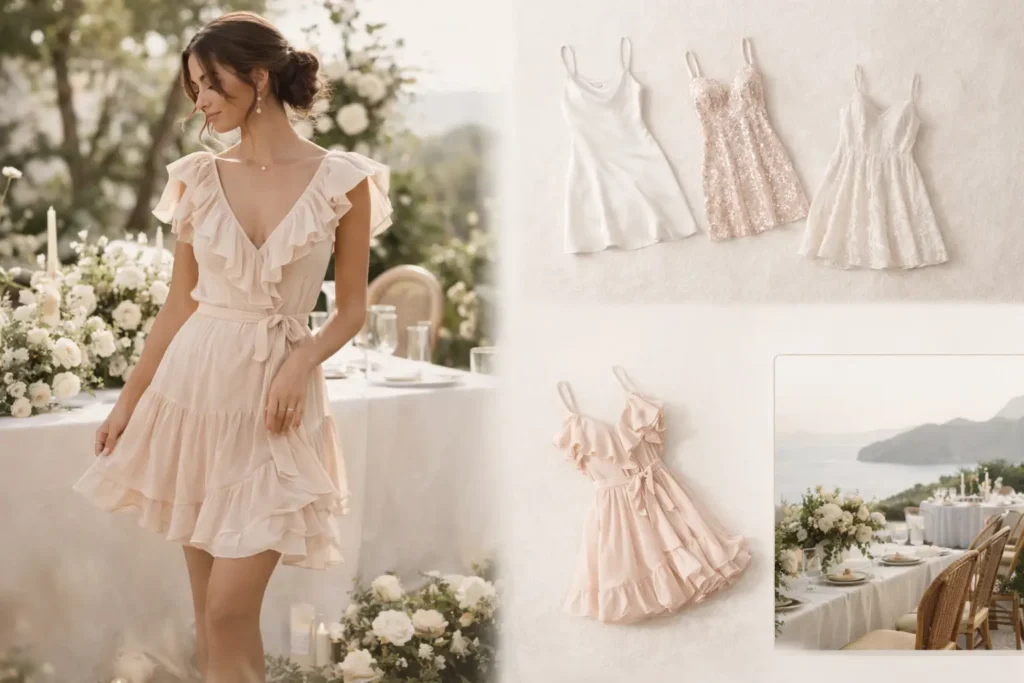
Because customers in this category are usually not shopping for daily basics. They are shopping for a specific moment. That changes what they want from the dress.
A wedding guest or event customer often wants the dress to feel:
- elevated
- feminine
- photogenic
- memorable
- soft or romantic
- appropriate for a special setting
A ruffle dress can answer many of those needs at once.
Compared with other common occasionwear options:
| Dress Direction | Main Feeling | Common Customer Concern |
|---|---|---|
| Plain slip dress | Minimal, elegant | May feel too simple for the event |
| Corset dress | Structured, sexy | May feel restrictive or too formal |
| Sequined dress | High-impact, festive | May feel too heavy or less versatile |
| Lace dress | Romantic, delicate | May feel too traditional or too bridal |
| Ruffle dress | Soft, expressive, event-ready | Must be well balanced to avoid bulk |
This is why brands often choose a ruffle dress when they want a style that feels special without becoming too rigid, too decorated, or too narrow in use.
For example, one good ruffle dress may serve customers looking for:
- a destination wedding guest dress
- a garden wedding outfit
- a bridal shower look
- a summer formal dress
- a vacation event dress
- a bridesmaid alternative
That wider use range gives the product more selling power.
How does a ruffle dress help a brand feel less basic?
One reason brands choose a ruffle dress is that it helps them move away from “just another dress.” In crowded fashion categories, especially online, a brand often needs a clearer design identity. Customers may forget a plain satin midi very quickly unless it has exceptional fit, price, or brand recognition. A ruffle dress has a better chance of being remembered because it carries more shape language.
This matters even more for smaller or growing brands that are trying to build recognition.
A ruffle dress can help a brand communicate:
- softness
- romance
- youthfulness
- femininity
- destination energy
- occasion focus
- social-content appeal
That means the product is not only selling itself. It is also helping sell the brand mood.
A useful comparison looks like this:
| Product Type | Brand Memory Value | Why |
|---|---|---|
| Basic bodycon | Medium | Strong if fit is good, but can feel common |
| Simple satin slip | Medium | Elegant, but harder to make memorable |
| Ruffle dress | High | More shape, more movement, more visual identity |
| Heavy embellished dress | High | Strong impact, but usually less flexible |
| Printed casual midi | Medium | Depends heavily on print and styling |
For brands that want to build a recognizable occasionwear direction, that higher memory value is important. One successful ruffle dress can become the dress customers associate with the label. Later, that can support line extensions into new colors, new fabrics, and new lengths.
Why do influencer-led brands especially like this category?
Because a ruffle dress works well in content, and content often drives demand for influencer-led brands.
A dress with visible movement gives more value in:
- reels
- try-on videos
- creator styling clips
- campaign shoots
- wedding-related mood content
- outdoor and travel visuals
It is easier to show. Easier to style. Easier to make feel emotional.
This does not mean a brand should choose it only for content. But for influencer-led brands, the content advantage is real.
A ruffle dress usually performs well in content because:
- it moves when the model walks
- it catches light at the edges
- it adds softness in still photos
- it creates more shape variation in short video
- it makes even simple posing feel less flat
That gives the same garment more creative output value.
| Content Asset Type | Why a Ruffle Dress Works Well |
|---|---|
| Studio photography | Creates soft dimension and shape |
| Outdoor campaign | Responds well to wind and natural movement |
| Mirror try-on | Looks more dynamic in small spaces |
| Short video ads | Movement helps attract attention quickly |
| Wedding mood edits | Matches the emotional tone naturally |
For brands spending money on content production, that matters. A dress that produces stronger content often supports better campaign efficiency because the creative team can do more with it.
Still, the dress must also work after the customer buys it. That is why the best brands choose this category not only because it looks good in launch content, but because it can hold up as a real product.
Why does a ruffle dress often feel more “worth it” to the customer?
Customers often judge value emotionally before they judge it technically. When they see a ruffle dress, they may feel that the garment has:
- more design effort
- more occasion value
- more styling thought
- more personality
- more visual softness
- more event relevance
That can make the dress feel more worth buying than a simpler silhouette at a similar price point.
This is especially true in wedding-related shopping, where the customer usually accepts that she is buying for a specific moment. She is not always comparing the dress to a daily basic. She is comparing it to the feeling she wants for the event.
A simplified value comparison might look like this:
| Customer Reaction | What Often Creates It |
|---|---|
| “This feels more special.” | Visible movement and softer shape |
| “This looks more expensive.” | Layering, flow, and controlled volume |
| “This feels right for a wedding.” | Romantic silhouette and event mood |
| “This looks better in photos.” | Stronger outline and softer motion |
| “This feels less plain.” | Added design character without heavy trim |
This is one reason the category works well at mid-range price levels. The product can often feel elevated without requiring extremely expensive trims or couture-level techniques. Of course, cost still needs to be controlled carefully, but the customer often reads the design as higher value than a flat simple dress.
Why is this category commercially flexible?
A brand-friendly product is not only a product that looks good. It is a product that can support more than one business need. A ruffle dress is often flexible because it can be sold across different seasons, occasions, and content stories with relatively small changes.
For example, one successful base silhouette may be adapted into:
- solid spring colors
- floral summer prints
- satin evening versions
- softer chiffon destination versions
- shorter bridal shower versions
- darker formal-event versions
That means one style idea can stretch further.
| Commercial Use | How a Ruffle Dress Supports It |
|---|---|
| New customer attraction | Strong first impression |
| Seasonal storytelling | Easy to update in color and fabric |
| Occasion segmentation | Works across multiple wedding-related moments |
| Content production | Strong visual movement |
| Reorders | Good potential if fit and fabric are controlled |
| Line extension | Easy to build related styles from one idea |
This makes the category useful for both new and established brands.
A newer brand may use one ruffle dress as a visual hero to define its mood.
A more established brand may use it as part of a broader occasionwear assortment with different price points and variations.
Why do some brands hesitate before choosing a ruffle dress?
Because the category has clear advantages, but it also has clear risks. A ruffle dress is not automatically easy. The same design feature that adds visual appeal can also create development and production sensitivity.
Brands usually hesitate for practical reasons such as:
- concern about fabric cost
- concern about fit consistency
- concern about neckline balance
- concern about bulk production control
- concern about lead time
- concern about whether the style will reorder well
These are valid concerns.
Here is a simple view of the trade-off:
| Benefit | Risk |
|---|---|
| More visual impact | More construction sensitivity |
| More emotional value | Higher fit expectations |
| Better content performance | More pressure on production consistency |
| Strong occasion positioning | More fabric and labor in some styles |
| Easier brand identity building | More sample correction may be needed |
That is why the category works best when the brand and factory both understand what they are trying to achieve. The goal should not be to add ruffles just because the market likes romantic dresses. The goal should be to create a dress with the right balance of beauty, fit, cost, and repeatability.
What business problems can a ruffle dress help solve?
This is one of the most useful ways to understand why brands choose this category. They are not only choosing a style. They are often trying to solve one or more product problems.
A ruffle dress can help solve these common needs:
| Brand Need | How a Ruffle Dress Can Help |
|---|---|
| The collection feels too plain | Adds movement and stronger identity |
| The campaign needs a hero item | Creates attention faster |
| The brand wants a more feminine occasion look | Supports a softer and more romantic direction |
| The customer wants something event-ready | Feels more special than a basic dress |
| The assortment needs more emotional value | Improves product storytelling |
| The brand wants one style with multiple uses | Works across several wedding-related occasions |
This is why the category keeps appearing in wedding-focused product plans. It helps bridge style and selling. It gives the design team something expressive to build around, while also giving the customer a clearer reason to stop, click, and consider.
When is a ruffle dress the wrong choice?
It is not the right category for every brand or every collection. A ruffle dress may be the wrong direction when:
- the brand identity is very clean and severe
- the target customer wants extremely minimal product
- the price target is too low to support the required fabric and finishing
- the launch timeline is too tight for proper sampling
- the brand has no clear occasion use for the style
- the team is choosing it only because it “looks pretty” without understanding the product needs
That does not mean the category should be avoided. It means it should be chosen with purpose.
A good brand should be able to answer:
- why this ruffle dress?
- for which customer?
- for which event?
- at which price point?
- with which fabric?
- with what reorder potential?
Once those questions are clear, the category becomes much stronger.
Why does this category matter so much for a manufacturer like Jinfeng?
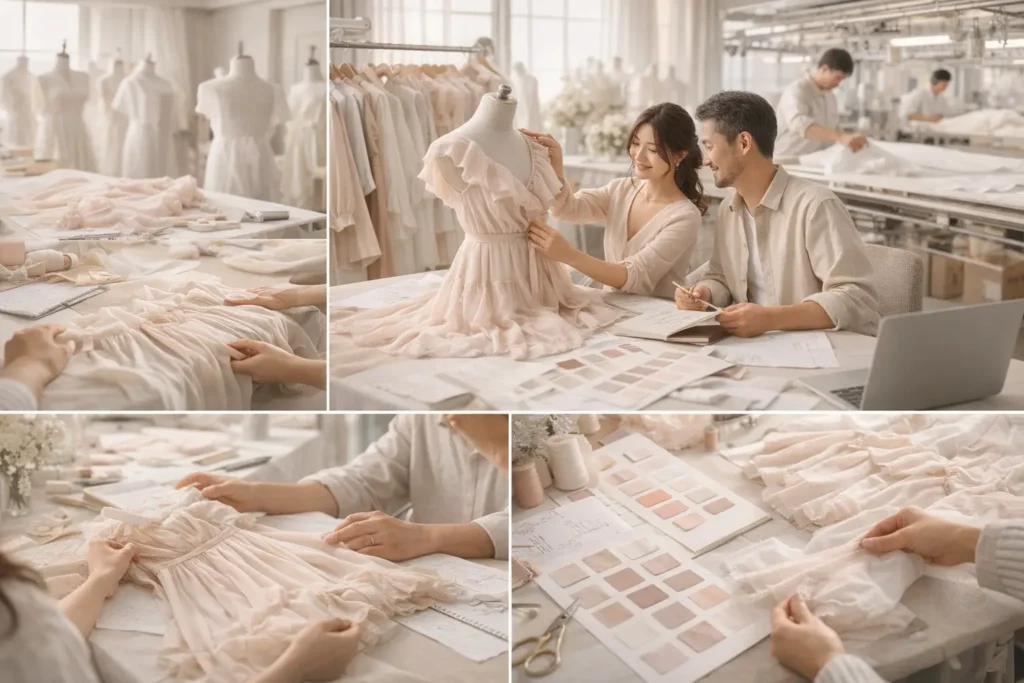
Because it is the kind of product where fashion understanding and manufacturing control need to work together. A ruffle dress is not just about sewing extra volume onto a dress. It requires decisions about silhouette, fabric behavior, fit balance, production consistency, and bulk appearance.
For clients, that usually means they need support in areas such as:
- turning inspiration images into workable styles
- choosing fabrics that match the intended movement
- improving fit after first samples
- managing MOQ for first launches
- keeping bulk production consistent
- preparing for repeat orders if the style performs well
This fits well with Jinfeng’s strengths in women’s fashion, sample development, and scalable production support.
For a wedding or occasionwear brand, that support can make a big difference. The brand may already know the look it wants. What it needs next is a factory that can help turn that look into a product customers will actually trust, wear, and reorder.
That is the real reason brands choose a ruffle dress.
Not only because it is beautiful.
Because when developed well, it can be one of the most useful products in an occasionwear collection.
How Do You Develop a Ruffle Dress?
Developing a ruffle dress is where the product either becomes commercially strong or starts collecting hidden problems that show up later in fitting, production, and customer wear. This category often looks soft and effortless from the outside, but in reality it needs more control than many clients expect. A small change in ruffle depth can change the entire look. A fabric that seems beautiful on a hanger may lose shape once the dress is worn for several hours. A first sample may look close to the reference image, but still fail in neckline security, waist balance, or movement.
For wedding and occasion brands, this stage is especially important because the dress is usually tied to a clear event need. The customer is not buying it as a basic everyday piece. She expects it to feel special, photograph well, fit securely, and arrive ready for a real date on the calendar. That means development is not only about making a sample. It is about removing uncertainty before the bulk order begins.
At Jinfeng, this process is supported by two sample development rooms, seven experienced pattern makers, twenty sample sewers, and sourcing support for fabric and trims. This kind of structure matters because ruffle dresses rarely move from idea to production in a straight line. They usually need interpretation, fitting, correction, and practical adjustment based on fabric reality.
How does a ruffle dress development process usually begin?
Most ruffle dresses begin from one of three starting points:
- a tech pack
- a physical reference sample
- a group of inspiration images with comments
All three can work, but the more usable the starting information is, the more efficient development becomes.
A strong first inquiry usually includes:
- product photos or sketches
- intended use, such as wedding guest, bridesmaid alternative, bridal shower, or evening event
- target fabric direction
- target size range
- estimated first order quantity
- launch timing
- comments on how the dress should feel on the body
That last point is often more important than clients think. Many dresses fail because the reference image shows appearance, but not body behavior. A client may say she wants:
- more movement
- a softer hem
- a cleaner waist
- a more secure bust
- less volume at the hip
- better comfort during sitting
These comments help the factory understand not only what the dress should look like, but what it should do in wear.
A useful early planning table looks like this:
| Development Input | Why It Matters |
|---|---|
| Reference image or sketch | Defines the visual direction |
| Event use | Shapes silhouette and fabric decisions |
| Price level | Helps match construction with cost target |
| Size range | Affects pattern and grading planning |
| Quantity estimate | Helps decide sampling and production route |
| Deadline | Helps build a realistic development calendar |
| Fit comments | Guides how the sample should behave on the body |
When this information is missing, development often becomes slower and more expensive. The factory has to guess more, and that usually leads to more revisions.
How is the first pattern made for a ruffle dress?
The first pattern is one of the most important steps because the ruffle does not sit independently from the base garment. It changes how the base garment works. That means the pattern maker cannot treat the ruffle like a decorative add-on. The base silhouette and the ruffle shape need to be developed together.
The pattern maker usually needs to define:
- the body silhouette
- the position of the ruffle
- the width and depth of the ruffle
- whether the ruffle is gathered, flounced, tiered, or cascading
- how the ruffle attaches to the garment
- how the ruffle affects balance and movement
- where lining or support is needed
For example, a one-shoulder cascade ruffle dress may need attention in these areas:
- shoulder balance
- neckline hold
- bust support
- weight distribution on one side
- skirt movement
- ruffle fall from top to hem
A hem ruffle dress needs a different focus:
- hem proportion
- flare balance
- seam matching
- walking movement
- how the ruffle changes dress length visually
This is why the same reference image can produce very different results depending on who develops the pattern.
A simple breakdown looks like this:
| Pattern Area | What Must Be Solved |
|---|---|
| Bodice | Fit, neckline stability, support |
| Waist | Shape control, bulk control |
| Skirt base | Fall, movement, body proportion |
| Ruffle panel | Volume, softness, visual strength |
| Attachment line | Clean joining without pulling |
| Lining pattern | Comfort, opacity, structure support |
For clients, the practical takeaway is simple: if the pattern stage is weak, later corrections become harder. Fabric changes may improve some issues, but they rarely fix a badly planned shape.
What should a brand prepare before the first sample?
The first sample becomes much more useful when the brand is clear about the product role. Many delays happen because the sample room receives a design idea, but not enough commercial direction.
Before the first sample, a brand should ideally prepare:
| Item | What to Clarify |
|---|---|
| End use | Wedding guest, resort wedding, rehearsal dinner, bridesmaid alternative |
| Customer mood | Soft, romantic, sexy, elegant, playful, refined |
| Fit intention | Body-skimming, fitted, relaxed, softly flowing |
| Length | Mini, midi, maxi |
| Key design point | Shoulder ruffle, hem ruffle, tiered skirt, side cascade |
| Fabric direction | Chiffon, satin, georgette, crepe, knit, mesh |
| Price expectation | Helps keep design realistic |
| Sample priority | Speed, fit accuracy, fabric testing, or silhouette check |
A client does not need to solve everything alone. But if the brand is unclear on basic direction, the sample may answer the wrong question.
For example, these are very different sample requests:
- We want a romantic chiffon maxi for destination weddings with strong movement.
- We want a cleaner midi with a softer hem ruffle for garden wedding guests.
- We want a fitted evening dress with one shoulder ruffle and stronger shape.
All three are ruffle dresses, but the development route is different.
How is fabric chosen for a ruffle dress?
Fabric choice is one of the biggest development decisions because fabric controls how the ruffle behaves. It affects softness, drape, opacity, fullness, edge finish, pressing, comfort, and even how expensive the dress feels.
The same pattern in different fabrics can create very different products.
Here is a practical comparison:
| Fabric | Best Result | Main Risk |
|---|---|---|
| Chiffon | Light movement, romantic softness | Sheerness, edge control, lining need |
| Georgette | Soft with more body | Can still shift if support is weak |
| Satin | Dressier, elegant, fluid shine | Pulling, seam marking, crease visibility |
| Crepe | Cleaner shape, better control | Less airy movement |
| Mesh overlay | Light layered softness | Needs careful lining and support |
| Knit | Comfortable, body-following | Ruffle behavior differs from woven styles |
Clients often choose fabric from mood. The factory has to choose with performance in mind.
A good fabric discussion should answer:
- Should the ruffle float or hold more shape?
- Will the dress need lining?
- Is the fabric too sheer under daylight or flash photography?
- Does the fabric recover after packing?
- Is the fabric stable enough for repeat orders?
- Does the edge finish look clean in this material?
- Does the fabric work for the target price?
This matters because ruffle dresses often use more fabric than expected. Depending on the design, ruffles may increase fabric usage by around:
- 10% to 20% for light hem ruffles
- 20% to 35% for larger side or neckline ruffles
- 30% to 50% or more for tiered, layered silhouettes
That makes fabric choice both a design decision and a costing decision.
How is the first sample evaluated?
A first sample should not be judged only by whether it “looks similar” to the reference. It should be judged by whether it is answering the right product questions.
A useful first sample review usually looks at five areas:
| Review Area | Key Question |
|---|---|
| Silhouette | Does the overall shape feel right for the intended occasion? |
| Ruffle effect | Is the ruffle strong enough, too heavy, or too weak? |
| Fit | Does the dress flatter and stay in place? |
| Fabric behavior | Does the material support the intended movement? |
| Wear practicality | Can the dress work through a real event? |
This is where real testing matters. A ruffle dress should be reviewed not only standing still, but also:
- walking
- turning
- sitting
- lifting the arms
- stepping up and down
- wearing the dress for a longer period if possible
That is because many problems only appear in movement:
- neckline shifts when walking
- ruffle collapses after a few minutes
- lining twists under the outer layer
- waist looks bulky when sitting
- one side pulls lower than the other
- the dress feels too sheer under stronger light
Clients often focus first on beauty, which is natural. But the strongest review comes when beauty and function are checked together.
What are the most common first-sample problems?
Ruffle dresses often show issues in very specific ways. The good news is that many of them can be corrected if they are identified early.
Here are some of the most common first-sample problems:
| Problem | What the Client Notices | Likely Cause |
|---|---|---|
| Ruffle looks flat | Dress feels weak or lacks impact | Ruffle width or fullness too small |
| Ruffle looks too heavy | Dress feels bulky or over-designed | Too much volume or wrong fabric |
| Neckline shifts | Dress feels insecure | Poor support or uneven upper balance |
| Waist feels thick | Dress loses shape | Too much bulk at seam area |
| Hem falls unevenly | Dress looks less polished | Grain issue or wrong distribution |
| Fabric looks cheap in motion | Dress loses occasion feel | Wrong fabric choice or poor finish |
| Outer shell pulls | Dress twists or fits badly | Lining tension or attachment issue |
| Dress looks good only from front | Side or back feels weak | Pattern not balanced in full view |
For clients, the main point is not to panic at the first problem. The first sample is often there to reveal what needs adjustment. What matters is whether the factory can identify the real cause and correct it efficiently.
How are fit corrections made after the first sample?
This is one of the most valuable parts of development. Many brands think fit correction only means tightening here or loosening there. In ruffle dresses, the correction is often more connected.
A single issue may have several possible causes.
For example:
- a neckline that slips may be caused by ruffle weight, not neckline size
- a bulky waist may come from bad ruffle placement, not waist measurement
- a hem that looks wrong may come from grain direction, not length
- bust wrinkling may come from support imbalance, not only bust width
That is why good correction needs technical diagnosis, not only surface comments.
A practical correction process often follows this structure:
| Correction Step | Purpose |
|---|---|
| Review the first sample | Identify the visible issues |
| Separate look issue from structure issue | Avoid solving the wrong problem |
| Adjust pattern or construction | Correct the real cause |
| Re-check fabric suitability | Confirm material is still right |
| Make revised sample | Test the corrected version |
| Review again in motion | Make sure the fix works in real wear |
At this stage, clients often save time by giving more specific comments.
Instead of saying:
- it feels wrong
It helps more to say:
- the ruffle at the shoulder looks too heavy from the side
- the neckline slips when walking
- the waist looks clean from the front but bulky from the side
- the dress feels too transparent under daylight
- the hem does not move enough
These comments help the factory solve the actual issue faster.
How many sample rounds are usually needed?
There is no single number for every style, but most ruffle dresses fall into a practical range.
| Style Complexity | Usual Sample Rounds |
|---|---|
| Simple hem-ruffle style | 1–2 rounds |
| Standard occasion ruffle dress | 2–3 rounds |
| More complex asymmetrical or layered style | 2–4 rounds |
| Very fashion-led or fit-sensitive style | 3–5 rounds in some cases |
At Jinfeng, a standard style may be sampled in around 5 to 7 days, while a more complex occasion dress may take around 7 to 10 days. If revisions are needed, the timeline depends on:
- the size of the correction
- fabric availability
- whether the pattern changes are major or minor
- whether trims or lining methods also need to change
For clients, the important point is not to chase the lowest number of rounds at any cost. The goal should be to reach a stable, production-ready style as efficiently as possible.
One extra revision that solves a serious fit problem is usually far cheaper than discovering the same issue after 500 or 1,000 units are already in production.
How do you know when a ruffle dress is ready for bulk production?
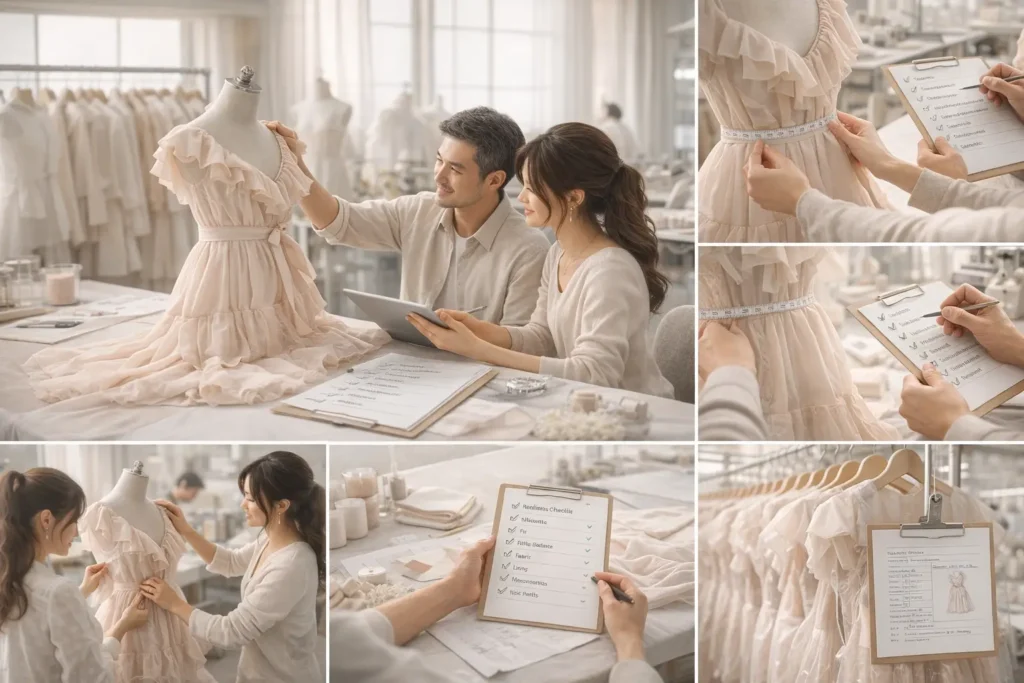
A ruffle dress is ready for production when it has moved beyond “nice sample” and become a controlled product.
That usually means the following points are clear:
| Readiness Check | What Should Be Confirmed |
|---|---|
| Silhouette | Final shape is approved from multiple angles |
| Fit | Dress stays secure and flattering in motion |
| Ruffle balance | Volume and placement are stable |
| Fabric | Material is approved for look, comfort, and repeatability |
| Lining | Opacity and structure needs are solved |
| Construction | Workmanship route is clear for production |
| Measurements | Key specs are locked |
| Risk points | Sensitive areas are documented for production control |
Before bulk begins, many brands also benefit from checking:
- whether the approved sample still works in the intended full size range
- whether fabric supply is stable enough for reorder potential
- whether color choice affects transparency or appearance
- whether the garment packs and recovers acceptably for shipping
This is especially important in wedding and occasion categories, where customers tend to notice visual inconsistency quickly.
What information helps the factory quote and plan more accurately?
Clients often want a fast quote, but the quote becomes more useful when it is based on real product information.
The most helpful information for early planning includes:
| Information | Why the Factory Needs It |
|---|---|
| Style image or tech pack | Defines the design |
| Fabric idea or requirement | Affects material and labor cost |
| Estimated quantity | Affects MOQ route and costing |
| Size range | Helps assess grading and production scope |
| Target market | Helps align quality and finish level |
| Launch timing | Helps plan sample and production schedule |
| Delivery method | Affects overall project timing |
| Special requests | Embroidery, print, lining, support, labels, packaging |
For example, if a client says:
- chiffon maxi ruffle dress
- wedding guest use
- sample size S
- initial order 300 to 500 pieces
- target launch in 8 weeks
- need soft movement but not too sheer
the factory can already begin discussing:
- suitable fabric options
- likely sample timing
- MOQ practicality
- expected production window
- possible risk points
That leads to a much more useful conversation than asking for a price with only one inspiration photo.
Why is this stage so important for a manufacturer like Jinfeng?
Because development is where product success becomes much more predictable.
A manufacturer with strong sample support can help the client:
- translate inspiration into a real garment
- choose more suitable materials
- reduce unnecessary sample mistakes
- improve fit before production
- estimate realistic timelines
- plan first orders more safely
- prepare better for reorders if the style succeeds
This fits well with Jinfeng’s structure in women’s fashion manufacturing. The company is not only sewing finished garments. It is supporting the stages before production that make later production more stable.
For a client, that matters because a ruffle dress is rarely successful by accident. It needs judgment at the development stage.
In practical business terms, good development helps reduce:
- wasted sample cost
- delays from repeated corrections
- fit complaints later
- bulk inconsistency
- missed launch windows
- hesitation about reorders
That is why “How do you develop a ruffle dress?” is not a small design question.
It is one of the core business questions behind whether the product can launch well, wear well, and scale well.
How Do You Produce a Ruffle Dress?
Producing a ruffle dress well is very different from simply sewing a dress with extra fabric attached. In real factory work, a ruffle dress is a control-heavy style. It depends on shape, balance, drape, and consistency. If the cutting is slightly off, the ruffle may twist. If the sewing tension changes, the garment may pull. If pressing is done carelessly, the ruffle may lose softness. If fabric lots vary too much, the second order may not look like the first one.
For clients, this is where many hidden risks begin. The approved sample may look beautiful, but bulk production introduces new realities:
- more fabric rolls
- more workers involved
- longer sewing lines
- more pieces to match
- more variation between units if control is weak
That is why bulk production should not be treated as a bigger version of the sample room. It needs its own management logic.
At Jinfeng, this stage is supported by a broader production system with eighteen production lines, around 100,000 pieces monthly capacity, additional room to scale, follow-up support, and a structure that can handle both fashion-driven women’s styles and repeatable production orders. For a client, that matters because ruffle dresses usually need more than capacity. They need stable execution.
What happens before bulk production starts?
Before production begins, the dress should move through a preparation stage that locks the product clearly enough for the sewing floor to follow it correctly. This is where many future problems can still be prevented.
A proper pre-production stage usually includes:
| Pre-Production Step | Main Purpose |
|---|---|
| Final sample approval | Confirms the exact product to follow |
| Fabric confirmation | Locks material, color, hand feel, and behavior |
| Trim and lining confirmation | Prevents mismatch in look and function |
| Measurement spec approval | Sets the standard size targets |
| Construction review | Clarifies how the style should be sewn |
| Risk-point marking | Identifies areas needing tighter control |
| Production planning | Matches order volume with line capability |
For a ruffle dress, the pre-production stage is especially important because the style may depend on details that do not always appear fully in a spec sheet. Two dresses may have the same body measurements but look different if the ruffle fullness, pressing, or attachment method changes.
This is why the approved standard should be as clear as possible. In practical terms, the factory needs to know:
- where the ruffle starts and ends
- how full it should be
- whether it must stay soft or hold a clearer edge
- which seam areas must not distort
- how the lining should sit under the outer shell
- what visual appearance the brand expects in the final garment
A dress that skips this stage often creates avoidable variation later.
How is fabric checked before cutting?
Fabric checking is one of the first major control points because fabric behavior affects almost everything in a ruffle dress. If the fabric lot has shade difference, surface flaws, different weight, or unusual stretch behavior, the finished garment may lose the look approved in the sample.
For ruffle dresses, fabric inspection usually pays attention to:
- color consistency
- visible defects
- fabric width
- hand feel
- weight stability
- shrinkage behavior
- drape
- recovery after handling
A useful way to think about it is this:
| Fabric Issue | What Can Happen in the Final Dress |
|---|---|
| Shade variation | Panels or ruffles may not match visually |
| Weight variation | Ruffles may hang differently from one batch to another |
| Surface defects | Flaws become obvious on flowing areas |
| Width inconsistency | Changes cutting yield and ruffle dimension |
| Shrinkage difference | Alters final measurements and balance |
| Poor drape | Dress loses softness or movement |
For clients, this matters because ruffle dresses often expose fabric problems more easily than simpler garments. A plain fitted dress may hide some small variation. A ruffle dress usually does not. The way the fabric falls is part of the product.
When the style uses chiffon, satin, georgette, or other movement-led fabrics, pre-checking becomes even more important. If the material is slightly stiffer than expected, the dress may feel heavier. If it is too soft, the ruffle may collapse. If the lining reacts differently from the shell fabric, the dress may twist or bunch during wear.
This is why good factories do not treat all fabric rolls as automatically identical. They verify before cutting.
How is the marker and cutting process handled?
Cutting has a bigger effect on a ruffle dress than many clients realize. Because the style depends on drape and balance, even small mistakes in grain direction, panel accuracy, or layer placement can change how the finished dress falls on the body.
In cutting, the factory usually needs to control:
- grain direction
- panel shape accuracy
- left and right balance
- ruffle panel length and width
- fabric spreading condition
- layer stability during cutting
- matching of visible garment areas
For example, if a cascade ruffle is cut slightly off-grain, it may twist or drop unevenly. If a hem ruffle is not cut consistently, one garment may feel soft and full while another feels flatter or more rigid. If the bodice and lining panels are not aligned properly from cutting stage, later sewing corrections become much harder.
Here is a practical view:
| Cutting Point | Why It Matters |
|---|---|
| Correct grain | Protects drape and balance |
| Accurate ruffle shape | Keeps fullness and visual proportion stable |
| Panel consistency | Helps garments look uniform in bulk |
| Symmetry control | Important for styles with left-right balance |
| Fabric relaxation before cutting | Reduces distortion on delicate fabrics |
| Cut bundle organization | Prevents mixing and sewing errors |
For some ruffle dresses, especially those with asymmetry or multiple layers, cutting discipline matters as much as sewing skill. If cutting is careless, the sewing team may do technically clean work and still produce a garment that looks wrong.
How are ruffles sewn without losing shape?
Sewing a ruffle dress is not only about joining fabric pieces. It is about protecting the intended shape. The factory has to manage how the ruffle is formed, attached, pressed, and balanced across the garment.
In practical production, sewing control usually focuses on:
- ruffle gathering or flounce consistency
- seam tension
- attachment smoothness
- fabric handling on curved areas
- lining integration
- neckline or shoulder stability
- edge finish quality
A ruffle can be formed in different ways depending on style:
- gathered ruffle for softer fullness
- circular or flounced ruffle for more fluid fall
- tiered assembly for layered volume
- cascading ruffle for stronger vertical movement
Each method creates a different production challenge.
| Ruffle Type | Main Sewing Concern |
|---|---|
| Gathered ruffle | Keeping fullness even and not too tight |
| Flounce ruffle | Preserving smooth curve and drape |
| Tiered ruffle | Maintaining even layer distribution |
| Cascading ruffle | Keeping line clean from top to bottom |
For clients, one important point is that the same ruffle style can look very different depending on sewing control. A gathered neckline can feel soft and luxurious when evenly distributed. It can also look cheap or crowded if the gathering is inconsistent. A hem ruffle can feel fluid and premium when the seam is clean. It can also feel stiff if the seam allowance, tension, or pressing is wrong.
That is why the factory usually needs an approved sewing route before line production scales up.
How is neckline and bodice stability controlled?
This is one of the most important issues in a ruffle dress, especially for one-shoulder, off-shoulder, bust-focused, or upper-body decorative styles. The customer may love the look of a dramatic shoulder ruffle or soft neckline detail, but if the upper body does not stay secure, the product quickly creates complaints.
Common stability concerns include:
- neckline slipping
- one-shoulder imbalance
- bust area collapse
- lining shifting under the shell
- ruffle weight pulling the garment off-center
- strap tension imbalance
A useful stability review looks like this:
| Upper-Body Issue | Why It Matters to the Customer |
|---|---|
| Neckline movement | Creates discomfort and constant adjustment |
| Bust instability | Reduces confidence during wear |
| Shoulder imbalance | Makes the dress feel unsafe or awkward |
| Lining shift | Affects fit and visual neatness |
| Side pull | Disturbs the whole silhouette |
To reduce these problems, factories may control:
- support tape or internal reinforcement where needed
- lining attachment method
- seam balance around neckline areas
- accurate strap or shoulder construction
- weight distribution of the ruffle itself
For wedding and occasionwear clients, this point is especially important because the dress is usually worn for a long event. A customer may wear it for four to eight hours or more. If she has to keep adjusting the dress, the product has failed in a very visible way.
How is pressing handled on a ruffle dress?
Pressing has a huge effect on the final appearance of a ruffle dress. It is not just a finishing step. It helps shape how the garment falls, how soft the ruffle looks, and whether the dress feels refined or careless.
Many clients focus on pattern and sewing, but pressing can completely change the result. A well-made dress can still look weak if pressing is poor.
Pressing usually affects:
- ruffle softness
- edge definition
- seam flatness
- hem behavior
- overall silhouette
- packing presentation
Here is why pressing matters so much:
| Pressing Result | Effect on Final Garment |
|---|---|
| Too flat | Ruffle loses life and volume |
| Too harsh | Fabric looks stiff or overworked |
| Uneven pressing | Garments look inconsistent in bulk |
| Poor seam pressing | Dress looks less clean and premium |
| Incorrect hem handling | Movement becomes awkward |
For example, a chiffon ruffle may need softer handling to preserve airy movement. A crepe ruffle may need more controlled pressing to keep the edge clean. A satin style may require extra care to avoid shine marks or pressure lines.
For clients, the important takeaway is simple: pressing is part of the quality, not just part of the packaging process.
How does in-line quality control work during sewing?
In-line quality control means checking the garment while production is still moving, not only after everything is finished. This is especially important for ruffle dresses because many issues become expensive if discovered too late.
In-line checks usually focus on:
- ruffle shape consistency
- seam cleanliness
- left-right balance
- upper-body stability
- body measurement control
- lining behavior
- edge finish
- overall appearance
A typical in-line control flow may look like this:
| In-Line Check Stage | Main Focus |
|---|---|
| Early line setup | Make sure workers follow the approved method |
| First pieces review | Catch setup problems before volume grows |
| Mid-line inspection | Check consistency as production continues |
| Random unit checks | Verify that quality is holding across bundles |
| Measurement checks | Keep fit within approved tolerance |
| Visual review | Confirm the garment still matches the approved look |
For clients, the advantage of in-line control is clear. If the first 20 or 30 pieces reveal a problem, the factory can correct it early. If no one checks until the final 500 pieces are done, the correction cost is much higher.
This is one reason experienced follow-up teams matter. They connect the approved sample to the production floor and help make sure the factory is not only producing quantity, but also protecting the original product standard.
What are the most common bulk production problems?
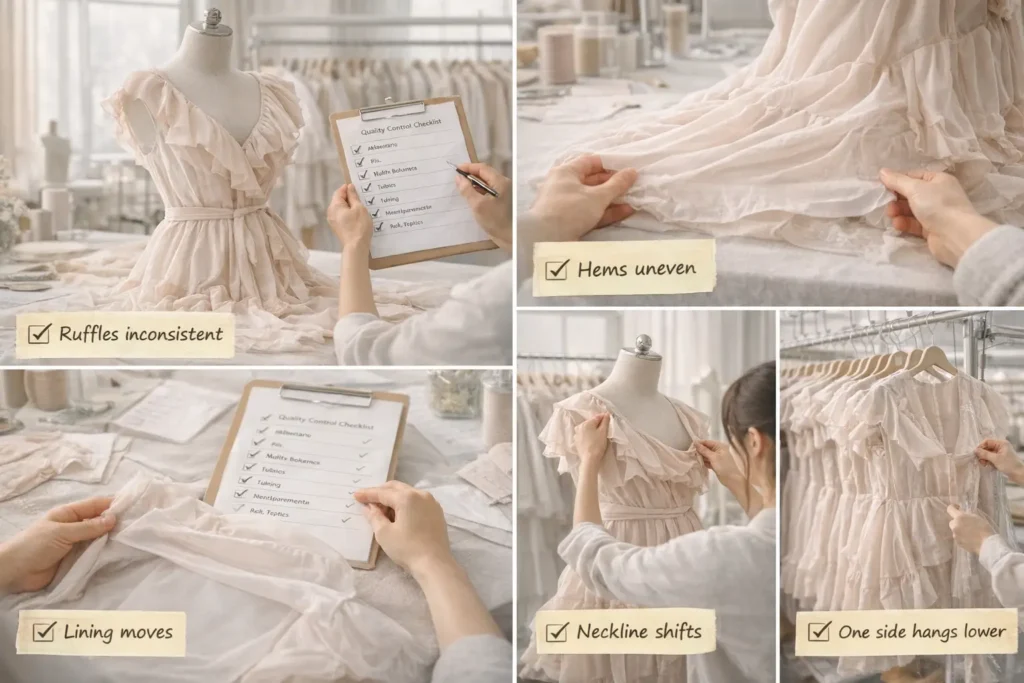
Ruffle dresses usually show problems in a few predictable areas. These are not rare mistakes. They are the normal risk points of the category, which is why clients should watch them closely.
Here are some of the most common production problems:
| Bulk Problem | What the Client Sees | Likely Production Cause |
|---|---|---|
| Ruffles look different across units | Some dresses look fuller or flatter | Inconsistent cutting or sewing control |
| Hem falls unevenly | Dress looks less elegant | Grain issue, cutting error, or poor pressing |
| Neckline shifts in wear | Dress feels insecure | Weak upper-body construction |
| Lining pulls outer shell | Dress twists or bunches | Incorrect lining tension or attachment |
| Dress feels heavier than sample | Lost softness and movement | Fabric batch or construction change |
| Edge finish looks rough | Garment feels lower quality | Poor finishing control |
| One side hangs lower | Silhouette looks wrong | Imbalance in cutting or assembly |
These problems are serious because they affect what the customer actually experiences, not just what the measurement sheet says.
For wedding and occasionwear, visible inconsistency is particularly damaging because the product is usually purchased for a specific date. The customer is often less forgiving of flaws because she has less time to replace the garment.
How are measurements controlled in bulk?
Measurement control is still essential, even though ruffle dresses also require appearance control. The body fit must stay close to the approved standard, especially in these areas:
- bust
- waist
- hip if fitted
- dress length
- neckline opening
- shoulder or strap points
- ruffle placement start and end points
A helpful control chart often includes both fit points and visual points:
| Control Area | Why It Must Be Checked |
|---|---|
| Bust | Affects fit and support |
| Waist | Affects shape and comfort |
| Hip | Important on fitted silhouettes |
| Length | Important for event use and visual proportion |
| Neckline | Important for wear security |
| Ruffle start point | Controls the visual layout |
| Ruffle width/depth | Protects the same fashion effect |
| Hem level | Protects final appearance |
For clients, one important thing to understand is that a ruffle dress may need tighter visual control than some simpler categories. Two garments can technically be “within tolerance” and still not look equally good if the ruffle scale or placement shifts too much.
That is why a strong production team checks both numbers and appearance.
How does the factory handle small orders versus larger orders?
Ruffle dresses can work in different order sizes, but the planning route changes depending on the volume.
At Jinfeng, clients may start with smaller orders such as:
- 200 to 500 pieces for a first launch or test run
- 1,000 to 5,000 pieces for more established collection demand
- 5,000 pieces and above for stronger volume styles or repeat orders
Each order size has different production priorities.
| Order Size | Main Production Focus |
|---|---|
| 200–500 pcs | Flexibility, sample-to-bulk accuracy, careful first run control |
| 1,000–5,000 pcs | Balance of efficiency and consistency |
| 5,000+ pcs | Strong line planning, material control, repeat stability |
Smaller orders often need more careful setup because the brand may be testing the style for the first time. Larger orders need stronger material planning and more stable line management because variation becomes riskier at scale.
For clients, the main point is that the factory should not apply the same production approach to every order size. A small launch order may need extra attention on first-run correctness. A large reorder may need stronger lot consistency and line balancing.
What lead times are realistic for ruffle dress production?
Lead time depends on complexity, fabric readiness, order size, and shipping plan. For many clients, one of the biggest mistakes is planning only the sewing time and forgetting the earlier steps that affect the final schedule.
A practical time structure often looks like this:
| Stage | Working Time Range |
|---|---|
| Initial discussion and quotation | 1–3 days |
| Fabric and trim confirmation | 3–7 days |
| First sample | 5–10 days |
| Sample revision if needed | 5–10 days |
| Bulk production for simpler styles | 15–20 days |
| Bulk production for standard styles | 20–30 days |
| Bulk production for more complex styles | 30–45 days |
| Packing and shipment preparation | 2–5 days |
For shipping, clients may choose:
- express: around 3–7 days
- air freight: around 5–8 days
- sea freight: around 20–35 days
For wedding brands, timing matters even more because the product is often linked to a seasonal event window. Missing the launch window by two or three weeks can weaken the whole selling period.
That is why a better planning question is not:
How fast can the factory sew this?
The better question is:
How fast can this dress move through confirmation, production, finishing, and delivery without losing quality?
How do reorders stay consistent?
A strong reorder depends on repeat control. The factory should not treat the second order like a brand-new product. It should work from the approved standard and preserve the elements that made the first order successful.
Reorder consistency usually depends on:
- same pattern use
- same or closely controlled fabric
- same lining and trim method
- same workmanship route
- same control points during production
- review of any lessons from the first order
A reorder control table may look like this:
| Reorder Point | Why It Matters |
|---|---|
| Fabric continuity | Keeps drape and feel stable |
| Pattern retention | Protects fit and silhouette |
| Construction consistency | Preserves the same look |
| QC focus history | Prevents repeating earlier mistakes |
| Color and shade control | Keeps the collection looking stable |
| Packing method | Protects the same unboxing condition |
For clients, this matters because a reorder is often where the brand starts building real customer trust. If the second run looks different from the first one, the style may lose momentum even if the original launch performed well.
Why is production control so important in a category like this?
Because a ruffle dress sells partly through feeling. It should feel soft, beautiful, event-ready, and easy to imagine in real life. If bulk production strips away that feeling, the dress may still be technically finished, but it is no longer the same product.
That is why production control in this category is not only about avoiding defects. It is about protecting the value the customer saw in the first place.
For a client, good production control helps reduce:
- return risk
- fit complaints
- customer disappointment
- reorder hesitation
- wasted stock from weak first runs
- launch delays caused by preventable corrections
For a manufacturer like Jinfeng, this stage is where development work and factory execution meet. The company’s women’s fashion experience, sample support, production structure, and order follow-up system are useful here because ruffle dresses rarely succeed through sewing alone. They need process control.
In business terms, that means producing a ruffle dress well is not only a factory task. It is part of how the brand protects its product image, launch timing, and future reorder potential.
How Can a Ruffle Dress Brand Scale?
A ruffle dress brand scales when one good-looking style becomes a repeatable business system. That means the dress is no longer treated as a one-time launch or a social-media moment. It becomes a product with stable fit, reliable fabric sourcing, realistic margins, workable lead times, and a clear place inside the collection.
For many wedding and occasion brands, the first ruffle dress gets attention because it looks romantic and moves well in content. But attention alone does not create scale. Scale starts when the brand can answer more practical questions with confidence:
- Can this dress be reordered without changing the look?
- Can the fit stay consistent across sizes?
- Can the style be updated for new seasons without starting from zero?
- Can the factory support both smaller tests and larger repeats?
- Can the margins still work after fabric, labor, and shipping are added?
- Can launch timing stay reliable across wedding seasons?
Those are the real growth questions.
In this category, scaling usually happens in four steps:
| Growth Stage | Main Goal | Main Risk |
|---|---|---|
| First launch | Test product appeal | Choosing style based only on image |
| Product validation | Confirm fit, quality, and customer response | Scaling too early before problems are fixed |
| Reorder stage | Build repeat demand | Inconsistency between first and second order |
| Line extension | Turn one winner into a product family | Adding too many weak variations too fast |
A brand that manages these four steps well has a much better chance of turning a ruffle dress into a long-term category instead of a short-lived hit.
How do brands move from one successful dress to a repeat business?
The first step is to stop thinking only in terms of “best seller” and start thinking in terms of “repeatable product.”
A dress becomes repeatable when several parts are already under control:
- the fit has been corrected after early feedback
- the fabric is stable enough for reorder
- the construction method is clear
- the factory understands the sensitive points
- the launch timing is no longer guesswork
- the dress can be produced again without rebuilding the entire process
Many brands make the mistake of scaling right after the first good sales signal. They increase order size too quickly, add more colors too early, or open too many style variations before the original product is truly stable. That often creates quality drift.
A better approach is to check whether the first dress has passed these four business tests:
| Validation Test | What to Look For |
|---|---|
| Demand test | Did customers respond beyond early curiosity? |
| Fit test | Were returns or complaints manageable? |
| Production test | Did bulk match the approved sample closely? |
| Reorder test | Can fabric, trims, and timing be repeated reliably? |
If the answer is yes in all four areas, the dress is much closer to being a scalable product.
For many brands, a smart pattern looks like this:
- first order: 200 to 500 pcs
- second order after strong response: 500 to 1,500 pcs
- larger repeat only after quality and delivery stay stable
This kind of growth is usually healthier than jumping from a small first run straight to several thousand pieces.
How do brands know if a ruffle dress is worth scaling?
A dress is worth scaling when it performs well not only in exposure, but also in product reality.
A lot of styles look strong in launch content. Fewer styles remain strong after:
- customer fitting
- real event wear
- repeat production
- shipping and packing
- second-order review
That is why brands should judge a scaling decision through a wider lens.
A more useful review table looks like this:
| Decision Area | Good Sign | Warning Sign |
|---|---|---|
| Customer reaction | Customers mention fit, comfort, and confidence | Customers only mention “pretty” but complain about wear |
| Returns | Return reasons are limited and manageable | Frequent issues around slipping, bulk, sheerness, or shape |
| Production | Bulk stayed close to sample | Visible differences between units |
| Margin | Product still works after all costs | Fabric or labor makes scaling weak |
| Reorder ease | Materials and construction are repeatable | Too dependent on unstable materials or tricky handling |
For wedding and occasionwear, the strongest scaling signal is usually this:
customers trust the dress enough to buy it for a real event.
That trust is more valuable than early attention. Event customers are usually more demanding. They need the product to arrive on time and perform in real life. If the dress earns that trust, it has stronger long-term potential.
How do brands scale without losing product quality?
This is one of the most important questions in occasionwear. A ruffle dress often wins because it feels soft, balanced, and expressive. Those qualities are easy to damage when production grows.
Quality usually starts slipping when one of these happens:
- fabric changes without enough testing
- the order grows faster than the control system
- new colors are added without checking transparency or drape
- the factory is pushed too fast on timing
- small construction details are treated like unimportant details
To protect quality while scaling, brands should lock the product more carefully after the first successful run.
The most important points to lock are:
| Locked Item | Why It Protects Scale |
|---|---|
| Base pattern | Keeps the silhouette recognizable |
| Ruffle dimensions | Preserves the dress’s visual identity |
| Fabric quality | Protects drape, feel, and movement |
| Lining method | Keeps wear comfort and shape stable |
| Upper-body support method | Prevents neckline and bust problems |
| Critical workmanship notes | Reduces production variation |
| Approved color standards | Keeps the collection consistent |
Clients often underestimate how much quality drift can happen when only “small” changes are made. For a ruffle dress, a small change in fabric weight or pressing method can be enough to make the product feel different.
That is why growth should not mean constant change. It should mean controlled expansion.
How do brands expand from one style into a full ruffle dress line?
The best way to grow is usually not by inventing ten completely different dresses at once. It is by extending one proven shape in a disciplined way.
Once a core style is working, the brand can build around it in several directions:
- new lengths
- new colors
- seasonal prints
- different fabrics for different event levels
- alternate necklines based on the same fit logic
- simplified or elevated versions at different price points
That creates a product family instead of a random group of styles.
A simple expansion model may look like this:
| Core Product | Extension Option | Purpose |
|---|---|---|
| Maxi chiffon ruffle dress | Midi version | Broader daytime wedding use |
| Solid color hero style | Floral print version | Seasonal refresh |
| One-shoulder style | Strap or halter version | More fit options |
| Statement cascade ruffle | Cleaner soft-ruffle version | Lower-risk volume style |
| Evening satin version | Softer daytime fabric version | Covers different occasions |
This approach helps the brand keep its visual identity while reaching more customers.
It also makes factory development easier. If the base shape is already understood, future styles can move faster because the team is not starting from zero each time.
Which products should stay as hero styles, and which should become core styles?
A growing ruffle dress brand usually needs more than one kind of product. Not every dress should carry the same role.
A healthy assortment often includes three layers:
| Product Layer | Job in the Collection | Example |
|---|---|---|
| Hero style | Builds attention and brand image | Dramatic one-shoulder maxi |
| Core style | Drives steady sales and easier repeats | Midi with softer hem ruffle |
| Test style | Explores new direction with lower commitment | Mini printed event dress |
This matters because many brands overload the collection with too many hero styles. Those dresses look exciting together, but they often create harder buying decisions, more complex production, and weaker reorder stability.
A core style is often less dramatic, but more commercially useful. It may:
- fit more body types
- cost less to produce
- be easier to repeat
- work across more events
- create fewer production problems
A hero style is still valuable. It gives the brand shape and attention. But the brand usually scales faster when hero styles are balanced by core styles that reorder more easily.
How should a ruffle dress brand think about seasonality?
Seasonality matters a lot in this market because wedding demand is not flat throughout the year. Different occasions peak at different times, and brands that plan early usually scale more smoothly.
A simplified seasonality view may look like this:
| Season | Strong Demand Direction |
|---|---|
| Early spring | Bridal shower, garden wedding, softer colors |
| Late spring to summer | Wedding guest, destination weddings, resort occasion |
| Early fall | Outdoor weddings, richer colors, transitional fabrics |
| Holiday period | Partywear, evening occasion, dressier finishes |
This affects several practical decisions:
- color choices
- fabric weight
- dress length
- lining needs
- launch timing
- reorder timing
For example:
- chiffon florals may work well in spring and summer
- deeper satin tones may feel stronger for evening fall events
- shorter playful silhouettes may work better for showers and resort events
- more refined midis may sell across a wider event range
For clients, this means scale is not only about producing more units. It is about aligning product, timing, and event demand more carefully.
How should brands plan quantities when scaling?
Quantity planning is one of the biggest areas where brands either grow carefully or create unnecessary stock pressure.
A useful way to plan is to divide styles into three confidence levels:
| Confidence Level | Suggested Order Logic |
|---|---|
| New concept | Lower first run, test demand carefully |
| Proven strong style | Medium repeat with tighter replenishment planning |
| Established bestseller | Larger order with seasonal updates |
In practical terms, that may mean:
- 200–500 pcs for a new style test
- 500–1,500 pcs for a validated repeat
- 1,500–5,000 pcs or more for a proven volume style
Of course, exact numbers depend on brand size, selling channels, and pricing. But the principle is the same:
increase volume after product confidence rises, not before.
It is also useful to separate “launch quantity” from “total expected seasonal quantity.”
For example:
- launch first: 300 pcs
- watch early sell-through and fit feedback
- place reorder quickly if the product is stable
- avoid taking full seasonal risk upfront unless demand is already proven
This helps protect cash flow and reduces stock problems.
How do pricing and margins affect scaling?
A dress may look highly scalable from the outside, but if the numbers do not work, growth becomes difficult. That is why a ruffle dress should be reviewed not only as a design, but also as a margin product.
Main cost drivers usually include:
| Cost Driver | Why It Matters |
|---|---|
| Fabric consumption | Ruffles often increase usage significantly |
| Fabric type | Chiffon, satin, mesh, and lined constructions vary in cost |
| Labor complexity | More detailed sewing increases labor time |
| Lining requirement | Adds materials and sewing steps |
| Packing and presentation | Occasionwear often needs better finishing and packing |
| Shipping method | Air and express can raise total landed cost |
A useful business question is:
Can this dress stay attractive to the customer while still leaving enough margin after production and shipping?
This is especially important for wedding and influencer-led brands because the product often needs strong imagery, strong quality, and reliable delivery, all at the same time.
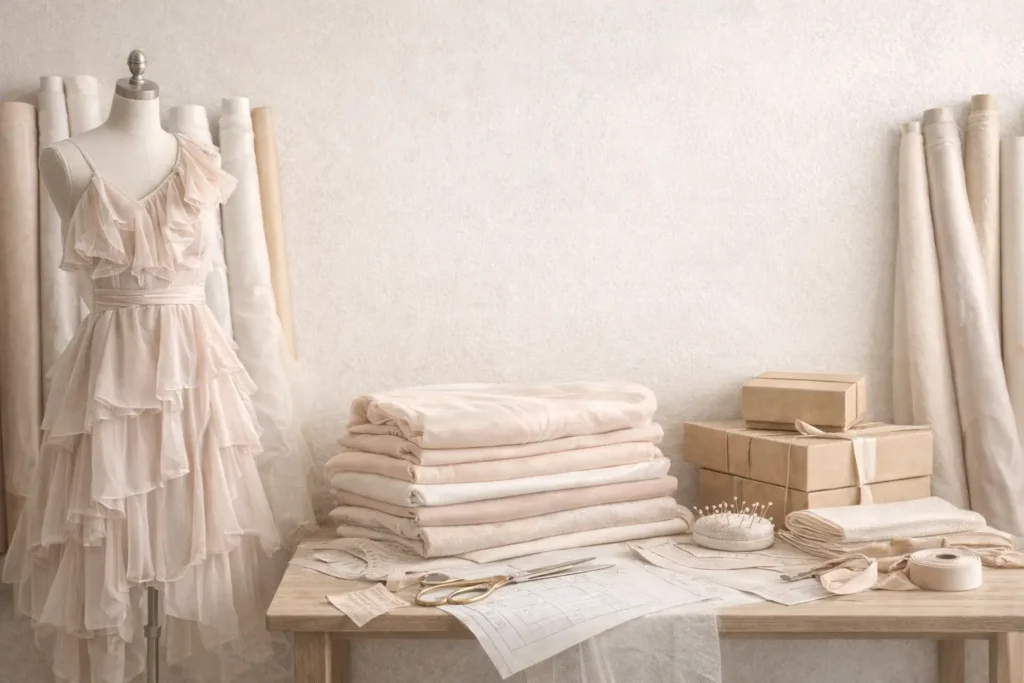
For many brands, the best scaling products are not always the most dramatic ones. They are often the dresses that create a strong emotional response while still keeping:
- fabric use under control
- labor complexity manageable
- reorder materials available
- return risk relatively low
That is one reason a cleaner ruffle midi may sometimes scale better than a very layered dramatic maxi, even if the maxi gets more attention at launch.
How does the right factory help a brand scale faster and more safely?
A strong factory does more than make units. It helps reduce uncertainty as the brand grows.
That support becomes more valuable over time because each production cycle creates knowledge:
- which fabrics worked best
- which fit points needed correction
- which sizes needed extra attention
- which colors behaved differently
- which construction details created problems
- which styles were easiest to reorder
When the same factory keeps learning from the brand’s product history, scaling becomes more efficient.
A reliable manufacturing partner can support growth by helping with:
| Factory Support Area | Why It Matters During Scale |
|---|---|
| Faster sampling | Speeds up new style development |
| Pattern continuity | Protects recognizable fit |
| Material guidance | Reduces risk in new fabric choices |
| Production planning | Matches order size to actual capability |
| Quality control | Protects consistency in repeat runs |
| Shipping coordination | Helps hit launch timing more reliably |
For a client, this means fewer avoidable resets. Instead of rebuilding the process for every new style, the brand can build on what already works.
At Jinfeng, this kind of support is useful because the company combines sample development capability, women’s fashion experience, order-following support, and scalable production resources. That allows brands to start with smaller test runs and grow into more stable repeat production without needing to change manufacturing direction too early.
What are the most common scaling mistakes?
Brands often know how to launch a beautiful product. Scaling usually gets harder because business pressure increases. The most common mistakes are practical, not creative.
Common scaling mistakes include:
| Mistake | What Usually Happens |
|---|---|
| Scaling before fit is stable | More returns and customer dissatisfaction |
| Adding too many variations too fast | Weakens collection focus and control |
| Changing fabric to save cost too early | Product loses its original appeal |
| Ordering too much on first success | Creates stock pressure if repeat demand slows |
| Ignoring reorder preparation | Strong first style becomes difficult to repeat |
| Overloading hero products | Collection becomes visually strong but commercially fragile |
For wedding and occasionwear, these mistakes can be costly because the product is tied to event timing. If a style fails at the wrong time, the brand may miss not only sales, but also the strongest seasonal moment.
That is why steady scaling is usually stronger than dramatic scaling.
What should a growing ruffle dress brand prepare before contacting a factory for larger production?
Before moving into broader scale, the brand should prepare both product information and business information.
The factory usually needs a clearer picture in these areas:
| Needed Information | Why It Helps at Scaling Stage |
|---|---|
| Proven sample or approved bulk standard | Prevents product drift |
| Sales feedback from first run | Helps judge reorder confidence |
| Planned quantity range | Helps line and material planning |
| Seasonal launch date | Keeps schedule realistic |
| Color or fabric extension plan | Helps sourcing preparation |
| Size ratio expectation | Important for production planning |
| Shipping mode | Affects total timing and cost |
| Reorder forecast | Helps decide material strategy |
A brand does not need to have everything perfect. But the better these points are understood, the easier it is to scale without surprises.
Why can Jinfeng be a useful partner for this stage?
Because scaling a ruffle dress is not only a matter of making more garments. It is about keeping product identity, fit, quality, and delivery reliable as the business grows.
Jinfeng can support that process through:
- women’s fashion manufacturing experience
- sample development support
- multiple factory coordination
- eighteen production lines
- monthly capacity around 100,000 pieces
- additional room to expand
- ability to support smaller first runs and larger repeat orders
- shipping support including FOB, CIF, DDP, and split delivery
For a wedding or occasionwear brand, this creates a practical path:
- start with development
- confirm the style
- launch carefully
- review the real response
- then expand with more control
That is usually a healthier route than trying to force scale too early.
What does successful scaling really look like?
Successful scaling is not only bigger order numbers. It usually looks like this:
- one hero dress becomes a recognized product
- repeat orders stay close in look and feel
- fit complaints stay controlled
- new colors or lengths feel consistent with the original
- the factory can support timing without quality falling
- the brand can build more styles from the same product language
- the category becomes part of the brand, not just one campaign
In simple terms, a ruffle dress brand scales when its success becomes repeatable.
That is the real goal.
- A good launch gets attention.
- A good product gets trust.
- A good system gets growth.
For brands building wedding guest, bridesmaid-adjacent, vacation occasion, or romantic event collections, that difference matters. And when the product is developed and produced with enough control, a ruffle dress can absolutely grow from one attractive style into a reliable and profitable category.
If your brand is preparing to grow a ruffle dress line, launch a wedding guest capsule, or expand a proven occasion style into repeat orders, Jinfeng can support the next stage with sample development, bulk production, MOQ planning, and delivery coordination based on your product goals.
Conclusion
A ruffle dress can look soft and effortless, but building one that truly works in the wedding market takes much more than a beautiful sketch. It needs the right silhouette, the right fabric, the right fit corrections, and a factory that can keep the same feeling from first sample to bulk production. For wedding influencer brands, that matters because customers are not only buying a dress. They are buying confidence for a real event, real photos, and a real date on the calendar.
That is why the strongest ruffle dresses usually do more than generate attention. They hold their shape in development, perform well in wear, and stay consistent enough to support repeat orders. When a brand gets that balance right, a ruffle dress can become more than a single seasonal style. It can become a long-term product direction that supports launches, reorders, and future collection growth.
For brands planning a wedding guest line, bridal-event capsule, or custom occasionwear collection, the next step is not just choosing a pretty design. It is choosing a development and production partner that can help turn that design into a stable product.
If you are ready to develop a custom ruffle dress or scale an existing style, Jinfeng can support you from sampling to bulk production, with practical help on fabric selection, fit refinement, MOQ planning, lead time, and delivery. Send your tech pack, reference images, target quantity, and timeline to start the conversation.