 Skip to content
Sew-On vs Hotfix Rhinestones: Which Is Better for Dresses?

Your trusted Women’s Apparel Manufacturer from China

Rhinestones are small details with a surprisingly large effect on fit, production cost, care performance, and customer perception. A dress can look flawless in a sample-room photo and still fail in real use if stones loosen after stretching, a hotfix layer does not bond well to the chosen fabric, or a heavy sew-on crystal pulls a transparent panel out of shape. For fashion brands, the useful question is not simply which method looks more premium. It is which attachment method works with the stone size, fabric construction, garment tension, wearing occasion, planned quantity, target price, and care instructions.
Sew-on rhinestones are usually the safer choice for larger, heavier, or statement stones where mechanical attachment and individual repair matter. Hotfix rhinestones are generally more efficient for numerous smaller flatback stones when the fabric tolerates heat and the process is tested correctly. Neither method is universally stronger; durability depends on the complete system, including fabric, stone weight, placement, pressure, heat, thread, stretch, abrasion, washing, and workmanship.
The most interesting dresses rarely follow one rule from neckline to hem. A stretch-mesh party dress may need hundreds of small crystals across the body, yet use several larger focal stones around a structured bust panel. In that situation, forcing the entire garment into one attachment method can increase cost or reduce reliability. The better approach is to understand where each method performs well, where it becomes risky, and how those decisions should be carried from the first sample into repeatable bulk production.
What Is the Difference Between Sew-On and Hotfix Rhinestones?
Sew-on rhinestones are mechanically fixed with thread through holes or sewable settings, while hotfix rhinestones use a heat-activated adhesive backing. Sew-on stones suit larger, heavier, or statement embellishments; hotfix stones suit repeated small flatbacks and dense sparkle. The practical difference affects labor, fabric compatibility, repairability, stretch behavior, heat exposure, pattern consistency, and the amount of process control required during bulk production.
What Are Sew-On Rhinestones?
Sew-on rhinestones are decorative stones designed with holes, channels, or sewable settings so thread can create a physical connection between the stone and the garment. They are common on evening dresses, partywear, stage-inspired fashion, bridal styles, and statement pieces where the design calls for larger shapes, heavier components, or a three-dimensional surface. Because the attachment is mechanical, the operator can choose stitch direction, reinforce a delicate area, and replace an individual stone later without disturbing an entire decorative field.
The strength of that method still depends on the substrate. A large crystal that works well on a stable corset panel may distort lightweight mesh if its weight is concentrated through two small stitch points. On delicate fabrics, backing, lining, appliqué support, or a carefully chosen stitch route may be needed to spread the load. Sew-on construction therefore should not be interpreted as “always stronger.” The better question is whether the fabric around the stitches can carry the stone during wearing, sitting, bending, packing, and repeated movement.
What Are Hotfix Rhinestones?
Hotfix rhinestones are normally flatback stones with a heat-activated adhesive layer already applied to the reverse side. During production, controlled heat and pressure activate the adhesive so it can bond with a suitable textile surface. This makes hotfix especially useful for high stone counts, repeated motifs, gradients, logos, border patterns, and scattered sparkle where individually sewing every crystal would create excessive handwork. When placement templates or transfers are used, the method can also improve visual consistency from one garment to another.
The important limitation is that hotfix is a process, not simply a product feature. Bond quality changes with the rhinestone supplier’s adhesive system, the actual fabric surface, temperature, pressure, heating time, contact area, and cooling conditions. Two fabrics sold under the same broad name can behave differently because their finishes, stretch, or surface density are not identical. For reliable production, the supplier’s application specification should be treated as the starting point, then verified on the actual bulk-quality fabric before the process is approved.
Are Sew-On and Non-Hotfix Rhinestones the Same?
No. A sew-on rhinestone is specifically designed for mechanical attachment with thread, while a non-hotfix flatback simply means the stone does not carry a heat-activated backing. Many non-hotfix flatbacks are intended to be used with a separately applied textile adhesive. That creates three different attachment systems: mechanical sewing, heat-activated bonding, and separate adhesive bonding. They introduce different risks, including needle stress, heat sensitivity, curing requirements, surface contamination, flexibility changes, and different repair procedures.
This distinction matters in technical files because the word “rhinestone” alone does not tell a factory how the decoration is supposed to be made. A useful specification identifies the stone type, size, color, finish, attachment method, and placement. That level of clarity also makes costing more reliable. A garment with 300 hotfix flatbacks, 12 sew-on statement stones, and a few glue-on components is not one decoration operation; it is a mixed embellishment system with different labor, inspection, and replacement requirements.
Feature | Sew-On Rhinestones | Hotfix Rhinestones | Non-Hotfix Flatbacks |
Attachment | Thread or sewable setting | Heat-activated adhesive | Separate textile adhesive |
Typical scale | Medium to large focal stones | Small to medium repeated stones | Small to medium decorative stones |
Heat required | No | Yes | Usually no |
Labor profile | Higher manual labor per stone | More efficient for repeated layouts | Placement plus adhesive handling |
Repairability | Usually relatively straightforward | More difficult after bonding | Depends on adhesive and substrate |
Main risk | Fabric pull, thread failure, rotation | Incomplete bonding, heat marking | Adhesive compatibility, cure failure |
Best use | Statement decoration and heavy components | Dense sparkle and repeatable motifs | Selected surfaces or special effects |
What Are the Main Practical Differences?
The difference becomes clearer once a design moves from a single sample into production. Sew-on stones increase direct handwork, but they give operators local control and make individual repairs easier. Hotfix reduces individual sewing operations, but the process depends more heavily on stable heat, pressure, placement, and fabric behavior. Stone shape matters as well. Large pear, oval, navette, and irregular decorative components are often better suited to sew-on formats, while smaller round flatbacks are naturally suited to hotfix layouts.
Many successful embellished dresses combine the two methods instead of forcing one method across the entire style. Small hotfix crystals can create the background sparkle, while larger sew-on stones define the neckline, bust, waist, or shoulder as focal points. This approach can reduce unnecessary handwork while preserving the dimensional look of statement crystals. It also allows the product team to control risk by placing heavier stones on more stable construction zones and using lighter stones where the fabric needs to stretch or remain fluid.
Which Rhinestones Are More Durable on Dresses?
Sew-on rhinestones generally provide strong mechanical security for larger or heavier stones, while correctly applied hotfix rhinestones can be highly durable on compatible fabrics. Neither method is automatically stronger in every dress. Long-term performance depends on stone weight, substrate strength, thread or bond quality, placement, stretch, abrasion, washing, and packing. In many failures, the weakest point is the fabric around the attachment rather than the rhinestone itself.

Do Sew-On Rhinestones Stay On Longer?
Sew-on stones can provide excellent retention because the connection does not depend on an adhesive layer. That advantage becomes most valuable when the stone is large enough to create noticeable weight or leverage during movement. A statement component at a shoulder, corset neckline, waist panel, or structured bodice may be better controlled through thread than through a broad adhesive assumption. If the fabric is stable and the stitches are secure, mechanical attachment gives a clear, inspectable connection that can also be repaired when necessary.
The limitation is that secure thread does not guarantee a secure garment. Heavy stones can pull through unsupported tulle, enlarge holes in fine mesh, or create visible dimpling on lightweight satin. Stitch count, thread type, knot security, stone orientation, and backing support therefore matter as much as the existence of sew holes. The most reliable construction distributes force through the fabric rather than concentrating the whole stone load into one fragile point. For premium dresses, it is also worth inspecting the inside surface to ensure knots, settings, and backing do not scratch the wearer.
Are Hotfix Rhinestones Secure?
Hotfix rhinestones can be very secure when the fabric is compatible and the adhesive is fully activated under controlled conditions. The problem is that a weak hotfix bond may look acceptable immediately after pressing. Incomplete adhesive contact, insufficient heat, uneven pressure, or movement before cooling can remain hidden until the garment is stretched, packed, washed, or worn. That is why hotfix quality should be evaluated after cooling and handling rather than only while the stones are still warm.
A reliable test uses the actual production fabric, actual rhinestone, planned placement density, and intended equipment. Testing one stone in an unused corner of a swatch gives less information than testing the real motif because dense layouts can change flexibility and heat distribution. The approved process should also account for seams, lining, surface texture, and any stretch that will occur during wear. A hotfix system that performs well on a flat stable panel may behave differently near a side seam or across a high-extension bodycon zone.
What Causes Rhinestones to Fall Off?
Stone loss is usually a system failure rather than one bad component. For hotfix applications, common causes include insufficient adhesive activation, unsuitable textile surfaces, uneven pressure, excessive stretch, and incorrect care. For sew-on stones, failures often come from weak thread, too few securing stitches, poor reinforcement, or heavy components placed on fragile fabrics. Placement adds another layer of risk because underarms, side waists, hips, seats, and hems experience more friction than a relatively stable center-front panel.
When stones loosen, production teams should investigate the whole chain: stone type and backing, stone weight, fabric construction, attachment method, placement zone, movement, finishing, packing, and care conditions. A heavier thread will not solve a mesh-tearing problem if the real issue is concentrated load. Likewise, increasing hotfix temperature is not a sensible response if the fabric surface itself is resisting bonding or becoming damaged. Root-cause correction is usually more effective than simply making the attachment “stronger” in isolation.
- Check stone specification and backing type before changing the process.
- Compare the failure area with high-friction and high-stretch garment zones.
- Inspect the fabric around the attachment, not only the stone or thread.
- Review packing pressure if stones arrive damaged before the garment is worn.
- Confirm that care instructions match the actual embellished construction.
Do Rhinestones Survive Washing?
They can, but wash performance depends on the complete garment system rather than the rhinestone alone. Water temperature, detergent, agitation, spin speed, drying method, dry-cleaning solvents, stone-to-stone contact, stretch during washing, and the strength of the base fabric all affect durability. Occasionwear may also be designed for gentle hand care or professional cleaning rather than repeated machine washing, so the expected care method needs to be agreed before bulk testing is defined.
The most useful validation is performed on a completed sample because the finished garment includes seams, lining, tension, packing folds, and areas where stones can rub against each other. A loose fabric panel cannot reproduce those conditions. Care labels should then reflect the construction that was actually approved. There is little value in a densely embellished dress that survives the fitting room but cannot tolerate the washing or cleaning method printed on its own label, especially when the garment is intended for repeat wearing rather than a single event.
Which Fabrics Work Best With Each Method?
Hotfix rhinestones work best on fabrics that tolerate the required heat and provide enough surface structure for stable bonding. Sew-on rhinestones are useful when heat is undesirable, when stones are larger, or when mechanical attachment is preferred. Fabric composition alone is not enough to decide. Stretch, surface finish, thickness, transparency, pile, coatings, drape, and local reinforcement can change the performance of the same rhinestone method.
Are Hotfix Rhinestones Suitable for All Fabrics?
No. Hotfix should never be treated as universally compatible with every womenswear fabric. A stable woven with a suitable surface may bond well, while coated, very smooth, highly heat-sensitive, or extremely open textiles may require more caution. Even fabrics with similar fiber content can react differently because finishing processes affect surface energy, absorbency, texture, stretch, and how heat travels through the material. The real test therefore needs to use the exact bulk-quality fabric rather than a generic substitute.
Heat sensitivity is also broader than visible melting. Satin can develop gloss changes or pressure marks; velvet pile can flatten; some stretch fabrics can lose recovery; lightweight materials can shrink or distort locally. Fine mesh may tolerate the temperature yet provide limited surface area for the adhesive. These are reasons to validate the combination rather than reasons to avoid hotfix entirely. A disciplined sample test checks appearance, bond, hand feel, stretch, and recovery after the application has cooled completely and before the method is released to production.
Are Sew-On Rhinestones Better for Delicate Fabrics?
Sometimes, especially when direct heat could mark the surface, but sewing is not automatically harmless. Fine textiles have low resistance to concentrated loads. A large crystal may transfer its weight through only a few yarn intersections, and a needle hole that is insignificant in a compact woven can become noticeable on tulle, organza, or open mesh. The aim is not simply to attach the stone firmly; it is to distribute the load so the fabric does not tear, pucker, or sag around the attachment.
Support can be added through backing patches, hidden lining, reinforced appliqué areas, facing, or transparent stabilization where the design allows it. A useful practical check is to hang the sample for several hours after embellishment and inspect the area again, because gravity-related distortion may not appear immediately at the sewing machine. Skin-side comfort also needs attention. Thread knots, metal settings, and reinforcement materials can be visually hidden while still creating irritation when they sit directly against the body during an event or long evening wear.
How Does Stretch Affect Rhinestone Choice?
Stretch changes almost every assumption about embellishment. If two stones are placed 20 mm apart on relaxed fabric, the distance increases when the garment stretches across the bust, waist, or hips. Dense hotfix patterns can become locally rigid, while large sew-on stones can rotate, pull, or distort the fabric as the garment extends. The most useful test therefore evaluates the rhinestone pattern in the same stretched condition that the garment will experience on the body, not only on a flat cutting table.
For bodycon, stretch mesh, jersey, and power mesh styles, the sample should be reviewed relaxed, moderately stretched, repeatedly stretched and released, and bent through typical movement zones. Stone density can often be reduced in high-extension areas and concentrated on more stable panels. On a corset-bodycon hybrid, for example, a structured center front may support more decoration than the side waist or back panel. This is also why changing fabric late in development can invalidate an earlier rhinestone approval even when the artwork itself remains unchanged.
Which Fabrics Need Extra Caution?
Different fabrics fail in different ways, so “delicate” is not one category. Satin often shows pressure marks before it shows structural damage, while velvet may look crushed even when the stone remains secure. Mesh and tulle can have enough thermal resistance but too little surface area for a reliable bond, and stretch fabrics may pass an initial adhesion test before failing after repeated extension. The table below is best used as a risk-screening guide rather than a substitute for sample testing.
Fabric | Main Hotfix Risk | Main Sew-On Risk | Practical Control |
Satin | Heat or pressure marking | Puckering and visible dimpling | Test under directional light and avoid excess pressure |
Stretch satin | Bond stress during extension | Local distortion around stitches | Test at realistic wearing stretch and recovery |
Fine mesh | Limited adhesive contact area | Hole enlargement and tearing | Keep stones light and reinforce heavier focal pieces |
Power mesh | High elastic movement | Concentrated pull at stitch points | Control stone density and use stable placement zones |
Lace | Uneven surface and openings | Weak or open motifs | Attach to stronger motifs or reinforced areas |
Velvet | Crushed pile and heat marks | Visible stitch disturbance | Protect pile and test pressure carefully |
Organza | Surface marking or local distortion | Needle stress | Use small trials and support larger stones |
Tulle | Low bonding surface | Tearing under heavy stones | Favor lightweight decoration and distributed support |
Jersey | Stretch and recovery stress | Local stretching | Avoid rigid dense motifs in high-extension zones |
The practical lesson is that fabric selection and rhinestone selection should be reviewed together. A trim that works well on a stable satin bodice may be unsuitable on a transparent stretch panel from the same dress. This is particularly important in party and occasionwear, where multiple fabrics are frequently combined in one style and the decoration crosses from opaque structure into sheer or elastic areas.
Which Method Is Better for Different Dress Designs?
Hotfix is often practical for small repeated stones on compatible fabrics, while sew-on stones are better suited to larger focal components, heat-sensitive areas, and details requiring mechanical security. Party dresses, evening gowns, mesh styles, corset dresses, and bodycon garments create different levels of tension and friction. The most reliable approach is to select the method by garment zone rather than standardizing one attachment method across the entire design.
Which Is Better for Party and Evening Dresses?
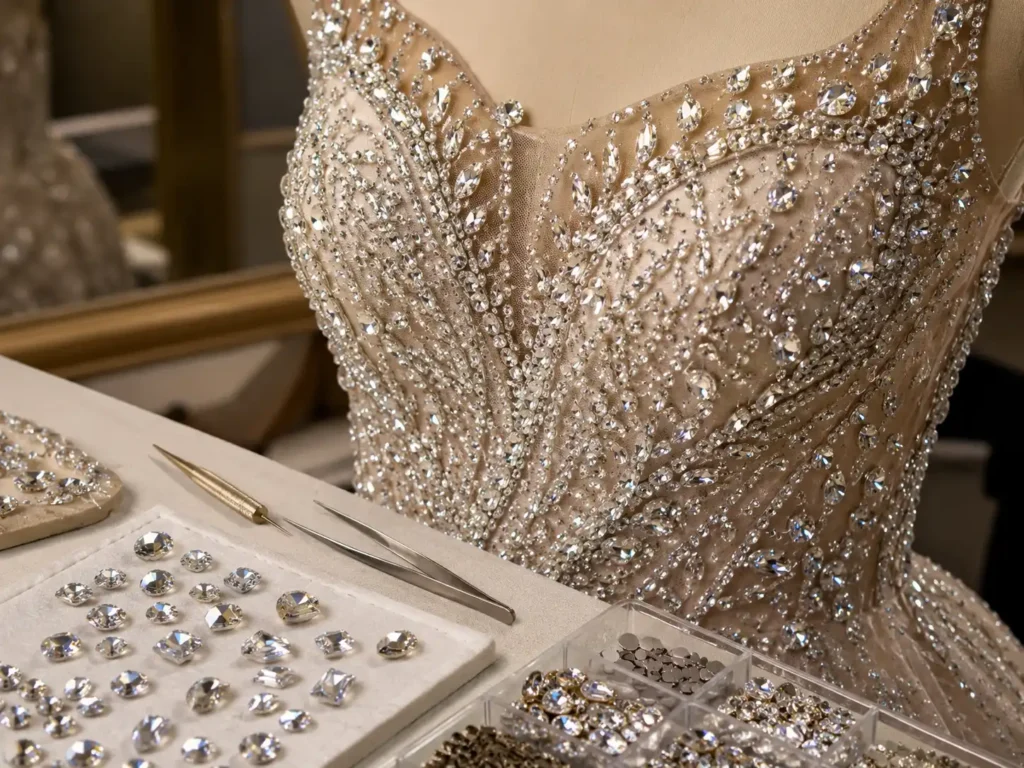
Party dresses often rely on visual density, where hundreds of small reflections can create more camera impact than a small number of large stones. On compatible fabrics, hotfix can therefore be efficient for fitted minis, birthday dresses, festival pieces, and decorative bodices that use repeated flatback motifs. Eveningwear often has a different visual hierarchy. Larger statement components around the bust, waist, shoulder, or neckline can benefit from sew-on construction, while smaller stones fill the surrounding area with controlled sparkle.
A mixed system frequently makes the most sense because it allocates labor where the customer can actually see the value. Instead of hand-sewing several hundred minor crystals, production can reserve sewing for a limited number of focal stones and use hotfix for the background field. This also reduces the risk of asking a heavy stone and a tiny flatback to behave as if they were the same component. The final decision should consider not only appearance but also garment weight, movement, care, and how accurately the decorative pattern must be reproduced across the order.
Which Is Better for Mesh Dresses?
Mesh is demanding because transparency exposes workmanship that would disappear inside an opaque fabric. For hotfix, the challenge is whether the mesh provides enough contact area for the adhesive and whether the stone spacing allows the fabric to stretch naturally. For sew-on stones, the challenge is whether the mesh yarns can support concentrated load without enlarging or tearing. Stone size therefore matters more on mesh than on many stable fabrics, and heavier focal components usually need some form of local support.
Placement can also vary within one dress. A crystal attached over a lined bust panel has much more structural support than the same crystal placed on a transparent waist section. Sample review should check the front and back appearance, skin-side comfort, stone alignment, mesh distortion, stretch recovery, lining visibility, missing stones, and appearance under strong lighting. Mesh styles should be assessed on a body or dress form because the pattern often changes visibly once the fabric is tensioned, especially across bust, waist, hip, and side-seam areas.
Which Is Better for Corset and Bodycon Dresses?
Corset and bodycon styles concentrate tension around the bust, waist, and hips, so rhinestone placement becomes part of garment engineering rather than a purely decorative decision. A boned corset panel may be stable enough for larger sew-on stones, while a nearby stretch-mesh or stretch-satin panel can distort under the same load. Bodycon dresses present the opposite challenge: much of the garment may need to extend substantially during dressing and wear, so a dense hotfix arrangement can create rigid zones if spacing is too tight.
The rhinestone artwork should therefore be reviewed alongside the pattern. Cup edges, side bust, waist compression areas, side seams, hips, center back, zipper zones, and transitions between stable and elastic panels all deserve attention. The best placement keeps heavy decoration away from repeated folding and high-extension zones unless the sample proves that the construction can tolerate it. When a design team supplies the rhinestone artwork at the same time as the fabric and pattern information, many of these conflicts can be corrected before decoration becomes an expensive late-stage revision.
Can Sew-On and Hotfix Rhinestones Be Combined?
Yes, and for many premium embellished dresses this is the most practical solution. Small hotfix flatbacks can create a broad field of sparkle, while larger sew-on stones provide focal points with more depth and visual weight. Medium stones can bridge the transition, and other embellishments such as sequins or bead chains can add texture without forcing every decorative element into the same attachment system. The key is to design the mixture intentionally rather than treating the methods as emergency substitutes for each other.
Mixed construction can also improve cost control. A dress may use 10 to 20 visually important sew-on stones while several hundred small flatbacks are applied more efficiently as a hotfix field. That can preserve a high-value appearance without making the entire style dependent on hand sewing. The technical pack should clearly identify which stones belong to each method, especially when the colors and sizes are similar. Without that distinction, production teams can easily substitute one method for another and create inconsistency between sample, bulk production, and repeat orders.
Which Method Is Faster and More Cost-Effective?
Hotfix is usually faster when numerous small flatback stones are applied in repeatable patterns, while sew-on rhinestones require more labor per component but can be more appropriate for large or high-value focal details. Total cost should include stone price, preparation, labor, equipment, wastage, inspection, repair, and packing protection. The cheapest rhinestone per piece does not necessarily create the lowest-cost or lowest-risk finished dress.
Is Hotfix Faster for Bulk Application?
For high stone counts, hotfix normally has a strong efficiency advantage because several stones can be organized into repeatable motifs instead of being treated as individual sewing operations. A dress with eight large crystals may be perfectly manageable as hand-sewn decoration, while a bodice with several hundred small flatbacks can become a major labor bottleneck if each stone is secured separately. Transfers, placement templates, and controlled heating can reduce positioning time and improve motif consistency across garments.
Speed should still be measured across the complete process. Preparation, placement, heating, cooling, inspection, and repair all consume time. An aggressive process that saves two minutes during application but creates several minutes of rework later is not efficient. The better calculation is total decoration time rather than machine time alone. For larger programs, the bulk method should be demonstrated during sampling so the approved look reflects the process the factory actually intends to use, rather than a slower showroom technique that cannot be reproduced consistently at production scale.
Does Sew-On Require More Labor?
Usually, yes, because every sew-on stone creates a sequence of manual actions: positioning, piercing, stitching, securing, trimming, and inspection. Heavy components may also require backing or reinforcement, which adds more operations. That extra labor is not automatically a disadvantage. A few carefully positioned statement stones can create more perceived value than a large number of smaller decorations, particularly on eveningwear, cocktail dresses, corset bodices, and premium party styles where focal detailing is central to the design.
Cost engineering should therefore focus on where labor creates visible value. The goal is not to eliminate expensive workmanship; it is to avoid spending premium handwork on details that do not improve the finished garment. A design that originally uses 30 large sew-on stones might achieve nearly the same visual hierarchy with 12 focal pieces supported by smaller hotfix stones around them. That adjustment can reduce application time, internal weight, and repair exposure while keeping the intended sparkle and structure of the original design.
How Do Stone Size and Density Affect Cost?
Stone cost is only one part of decoration cost. A design with a few large premium crystals can have high material cost but relatively few attachment operations, while a design using inexpensive small stones may become more expensive because hundreds of pieces need placement, heat application, inspection, and possible repair. Size mix also matters because each additional stone size introduces another trim specification, another picking step, and another opportunity for production teams to mix components during bulk assembly.
The most useful costing discussion therefore starts with measurable inputs: stone count per garment, number of sizes and colors, placement area, motif complexity, attachment method, base fabric, inspection requirements, and packing protection. The same rhinestone can produce very different garment costs when it is used as a simple neckline accent versus a full-bodice gradient. Product teams that lock the decorative artwork early can receive more realistic quotations and avoid late-stage surprises caused by changes in density or component size.
Cost Driver | Lower-Impact Example | Higher-Impact Example |
Stone count | 10-20 focal stones | Several hundred stones per garment |
Size mix | One stone size | Three to five sizes in one motif |
Color mix | One finish | Multiple colors or special finishes |
Placement | Simple neckline cluster | Full bodice gradient or logo pattern |
Attachment | One method | Mixed sew-on and hotfix operations |
Base fabric | Stable woven | Fine stretch mesh or mixed panels |
QC | Basic completeness check | Detailed placement and strength checks |
Packing | Standard folding | Protected packing for heavy embellishment |
Which Method Is Better for Large Production Runs?
Hotfix usually becomes more attractive as the number of small stones increases, provided the fabric is compatible and the process is stable. Sew-on remains practical for large orders when the number of stones per garment is limited, the components are large, or mechanical security is important. The main production challenge with sew-on is labor consistency, while the main hotfix challenge is process consistency. Both methods need clear approved standards so one production line does not interpret the decoration differently from another.
Trim sourcing also matters because rhinestones and specialty decorative components can have supplier-specific minimums and development lead times. A collection can be delayed even when garment sewing capacity is available if the chosen stone color, shape, or finish is not confirmed early. This becomes especially important for seasonal party and occasionwear launches. The most efficient development schedule treats rhinestones as a planned material with its own approval path, rather than as a finishing detail that can be decided after the garment pattern and fabric have already been finalized.
How Should Brands Choose and Control Rhinestones in Production?
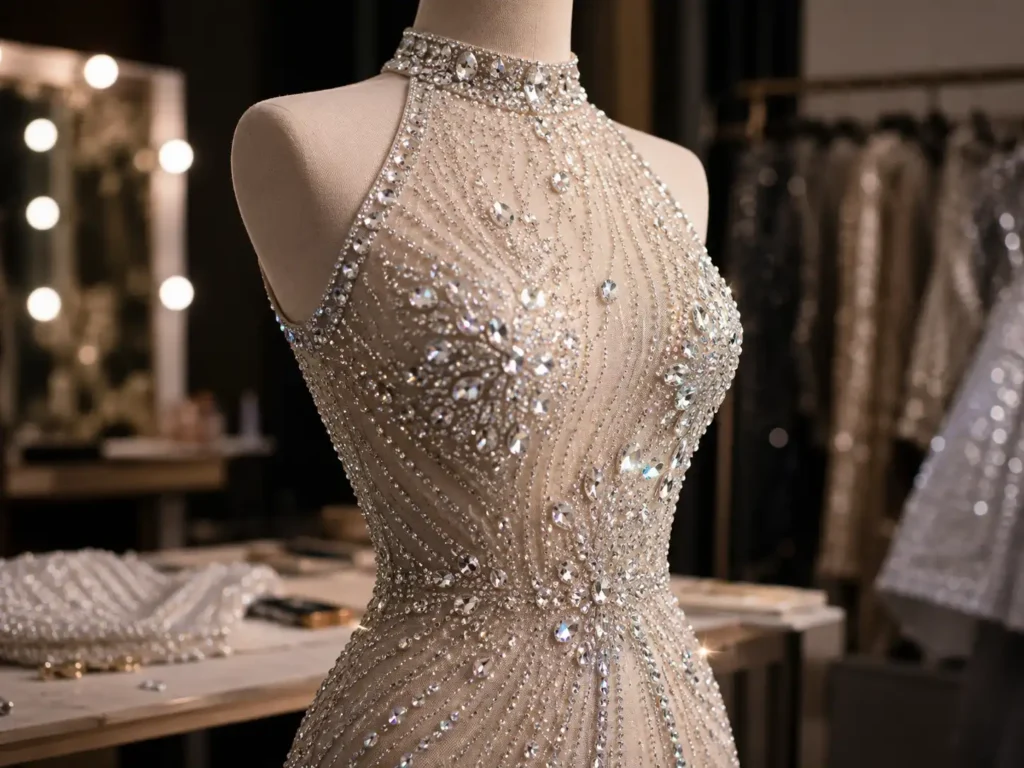
Brands should approve rhinestones as a complete production system rather than a decorative afterthought. Stone type, size, color, finish, attachment method, base fabric, placement artwork, care expectations, and QC criteria should be confirmed during sampling. Bulk production should then follow the approved sample and trim record, with checks for missing stones, placement, attachment security, fabric distortion, comfort, pattern consistency, and protection during packing and transport.
What Should Be Confirmed Before Sampling?
A reference image that says “add rhinestones here” is not enough for reliable development. Before the first sample, the product team should define the stone type, attachment method, size, color, finish, quality level, approximate quantity, pattern, placement, density, base fabric, garment zone, expected care method, and target cost as clearly as possible. Not every field needs to be final on day one, but unresolved decisions should be made visible so the sample room does not quietly replace them with assumptions.
If the design team is choosing between two sizes or finishes, both can be sampled side by side. If the exact density is still open, a controlled test panel can compare two spacing options. This is more efficient than allowing a complete dress to be embellished first and then discovering that the stones feel too heavy, the color is too bright, or the pattern is too rigid on the body. For custom rhinestone projects, supplier minimums and trim development time should also be confirmed early because the decoration can become the critical path for the launch schedule.
How Should Rhinestones Be Shown in a Tech Pack?
The rhinestone page should function like a production map. It needs enough information for another team to reproduce the decoration without relying on memory or a compressed reference photo. Front and back placement views should identify stone reference, size, color, finish, attachment method, motif dimensions, and distances from stable garment points such as center front, neckline, waist seam, side seam, or hem. Complex gradients should show the decorated boundary and explain whether density changes by defined artwork or approved visual reference.
Mixed-size layouts need a clear legend so operators can distinguish each size. Logos, symbols, and geometric motifs require even tighter control because small placement errors become obvious when repeated across hundreds of garments. Technical approval should also be separated from aesthetic approval. A brand may approve sparkle, color, and overall placement while the factory still needs to confirm that the attachment method performs correctly on the selected fabric. Once the sample is approved, those trim and placement details should move into the production record rather than remaining only in email or chat messages.
What Should Be Tested on the Sample?
A useful sample review asks more than whether the dress looks attractive under studio lighting. The team should assess visual placement, stone brightness, size balance, attachment security, fabric distortion, stretch behavior, skin-side comfort, weight distribution, lining interaction, care performance, and packing behavior. Stretch garments should be extended; corset dresses should be closed to realistic wearing tension; long gowns should hang long enough for heavier embellishments to reveal any sagging or fabric pull.
For hotfix, the bond should be checked only after complete cooling, because warm adhesive can create a false sense of security. For sew-on stones, the inspection should include both the stitches and the fabric around them. The approved sample should also represent the intended production method. A showroom sample made with slow hand placement is not a reliable bulk standard if the production team later intends to use transfers or another application process. Sampling is most valuable when it proves both the appearance and the production method.
How Should Bulk Rhinestone Quality Be Checked?
Bulk inspection should compare production against an approved sample and documented trim specification rather than relying on a general judgment that the garment “looks fine.” Inspectors need to confirm the correct stone type, color and brightness, placement, motif completeness, attachment security, surface condition, comfort, fabric appearance, and packing protection. Stretch styles also need a quick check for local distortion when the embellished zone is extended, while heavy sew-on stones should be inspected for stress around the fabric rather than only around the thread.
The first few production units are especially valuable because they reveal whether operators are interpreting the approved sample consistently. Problems found at this stage are cheaper to correct than problems found after hundreds of pieces have been packed. Repeat orders should use the same approved stone specification, placement records, and QC checkpoints whenever possible. This is one reason Jinfeng Apparel treats rhinestones as part of the wider trim-control system rather than as an informal finishing detail; consistency depends on preserving the approved information from sample through bulk and into later repeat production.
Conclusion
Sew-on and hotfix rhinestones solve different production problems, and the best dresses use them according to the demands of the design rather than according to a fixed rule. Sew-on is usually the stronger choice for larger focal components, mechanically secured statement details, and situations where direct heat is undesirable. Hotfix is often more efficient for numerous smaller flatbacks on compatible fabrics, especially when repeated motifs and bulk consistency matter. Mixed construction is often the most balanced answer for complex party, evening, mesh, corset, and bodycon styles.
The practical decision should always connect the rhinestone to the fabric, garment zone, stretch, care method, target cost, and production scale. A stone that looks perfect on a flat sample still needs to survive fitting, movement, inspection, packing, and real wear. When those factors are reviewed together during development, brands can preserve the visual impact of rhinestone embellishment without turning it into an avoidable source of rework, returns, or inconsistent bulk quality. For custom embellished collections, early discussion of the stone system with an experienced womenswear manufacturer can often prevent the most expensive problems before the first bulk panel is decorated.
Share This Article :

Jerry Lee
Categories

Latest blogs
Table of Contents
Here, developing your OEM/ODM private label clothing collection is no longer a challenge—it’s an excellent opportunity to bring your creative vision to life.

