...

One Shoulder Top Manufacturer for Fashion Labels

Custom one shoulder tops developed around asymmetric fit, fabric behavior, retail presentation and repeatable bulk production for established fashion labels.

  • 4 fit zones reviewed before pattern approval: shoulder anchor, neckline angle, bust coverage and exposed-side armhole depth.
  • 3 core approval stages for production readiness: first fit sample, revised sample and PP sample confirmation.
  • 8 one-shoulder QC checkpoints carried from approved sample into cutting, sewing, finishing and packing.
  • MOQ starts from 200 pcs per style/color, with fabric, trim, color and packaging requirements evaluated before quotation.

Jinfeng Apparel supports one shoulder tops from reference images, original samples, sketches, line sheets or complete tech packs. Pattern development, fabric and trim sourcing, sample correction, bulk production, private-label packing and export coordination are managed through a structured womenswear production system in Guangdong, China.

Development Capacity Behind Every One Shoulder Top

Asymmetric tops require more than sewing capacity. Pattern judgment, sample control, production allocation and in-line checking must work as one system, especially when a seasonal range contains multiple fabrics, colors and size sets.

Since 2008

Long-term womenswear development experience supports pattern interpretation, fabric selection, sample correction and production planning for fashion-led collections rather than isolated cut-and-sew execution.

6 Owned Factories

Owned production resources support woven and knit womenswear allocation according to fabric behavior, construction complexity, order volume and launch timing.

10+ Production Partners

Long-term satellite factories expand capacity for multi-style collections and repeat programs while production standards, approval files and QC requirements remain under coordinated management.

2 Sample Rooms

Dedicated sample rooms separate development work from bulk-line pressure, allowing pattern adjustments, construction trials and revision tracking before production release.

7+ Pattern Makers

Senior pattern makers review shoulder position, neckline angle, bust coverage, armhole shape, sleeve balance and grading logic for asymmetric silhouettes.

20+ Sample Machinists

Sample machinists support first samples, fit samples, revised samples, photo-ready samples, PP samples and sealed production references across varied womenswear constructions.

Built for Fashion Labels With Structured Production Plans

The strongest fit comes from brands and product teams with clear collection direction, professional approval steps and planned bulk production. Jinfeng Apparel can enter the project from a detailed tech pack or from an early style reference that still needs manufacturing review.

Brand-Led Development

Suitable programs usually carry defined silhouettes, target retail positioning, fabric direction, size architecture and launch timing. Jinfeng translates those requirements into patterns, samples, measurement files, sewing standards and production-ready specifications while preserving the visual language of the collection.

Multi-Style Collections

Seasonal programs often contain 10-30 styles rather than a single isolated SKU. Styles can be grouped by fabric family, construction type, trim package, launch priority and production route, creating a clearer path from sample review to bulk allocation.

Retail-Ready Delivery

Private-label programs can include woven labels, size labels, care labels, hangtags, barcode stickers, SKU labels, polybags, carton marks and warehouse labels. Packing instructions are confirmed before bulk finishing so garment quality and downstream receiving requirements stay aligned.

One Shoulder Structures Are Not Interchangeable

Closely related necklines may look similar in online images, yet each construction distributes tension differently. Correct classification improves fabric selection, pattern balance, sample comments and final production control.

One Shoulder

One side remains anchored at the shoulder while the opposite side is exposed. Pattern balance depends on the anchor point, diagonal neckline, exposed-side armhole and bust containment. Fitted versions often need stable recovery; draped versions rely more heavily on grain direction and controlled ease.

Off Shoulder

Both shoulders sit outside the neckline. Stability comes from elastic, internal support, neckline shaping or close body fit across the upper chest and back. Replacing an off-shoulder block with a one-shoulder design without rebuilding the pattern often creates twisting and uneven tension.

Cold Shoulder

Shoulder openings are cut into a sleeve or upper bodice while parts of the shoulder seam remain. Opening placement, sleeve mobility, binding and seam strength govern comfort. The structure is less dependent on a single shoulder anchor but more sensitive to opening shape and sleeve balance.

Asymmetric Neckline

A broad family covering diagonal necklines, sculpted cut-outs, one-sleeve designs and irregular drapes. Not every asymmetric top exposes one shoulder. Pattern development begins with the intended visual line, support route, closure method and movement requirement rather than the marketing name alone.

Where One Shoulder Top Development Commonly Fails

Most failures begin at the relationship between pattern geometry and fabric behavior. A visually strong sketch can lose balance once stretch, gravity, body movement and size grading begin to act on the garment.

Neckline Slippage

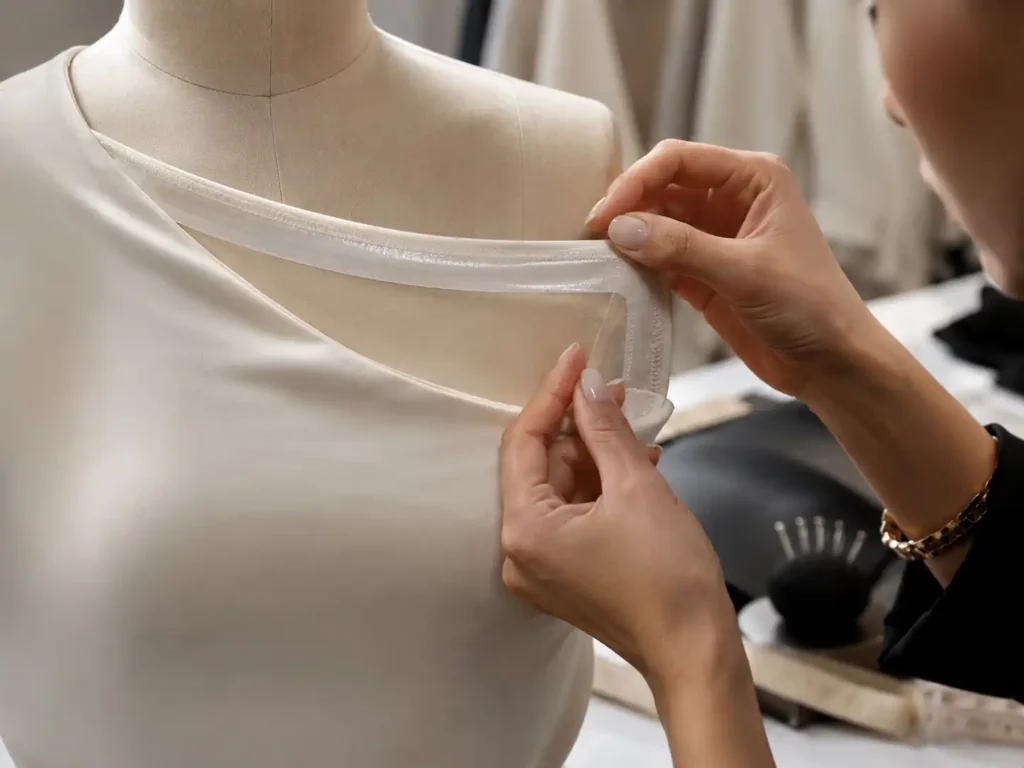
The diagonal neckline moves downward when the shoulder anchor sits too far outward, the neckline is over-stretched during sewing, internal stabilization is missing or the fabric lacks recovery. Fit review checks both the standing position and movement after several minutes of wear.

Uneven Shoulder Pull

Excess tension on the covered shoulder can drag the garment upward, distort the opposite armhole or rotate the side seams. Pattern correction may involve moving the anchor, redistributing neckline length, adjusting underarm shape or changing the internal elastic specification.

Bust Coverage Loss

A low diagonal line can expose more than intended after walking, sitting or lifting the arm. Bust point placement, exposed-side edge height, lining shape and neckline tension are reviewed together instead of correcting only the visible top edge.

Armhole Exposure

An exposed-side armhole that looks acceptable on a mannequin can reveal underwear during movement. Front and back armhole depths, side seam height, fabric stretch and intended bra compatibility are checked during fit comments and size-set review.

Recovery Breakdown

Jersey, rib knit, stretch satin and mesh can relax after repeated dressing. Recovery depends on fiber blend, knit construction, weight, finishing and sewing tension. Stable tape, elastic, double layers or revised negative ease may be required for the chosen silhouette.

Grading Distortion

A diagonal neckline cannot be enlarged uniformly across all sizes. Shoulder width, bust growth, armhole depth and body length change at different rates. Grading rules protect the visual angle while maintaining coverage and mobility from the smallest to the largest approved size.

One Shoulder Top Styles for Fashion Collections

Jinfeng Apparel develops one-shoulder silhouettes across knit, woven, layered and body-contoured constructions. Each style below follows a different pattern, fabric and sewing route, allowing the range to serve going-out, party, occasion, resort and elevated casual collections.

Fitted Jersey Top

A close-fitting jersey one-shoulder top depends on controlled negative ease, strong recovery and smooth edge finishing. Suitable fabrics include medium-weight jersey and spandex blends with stable crosswise stretch. Development checks shoulder pressure, diagonal neckline length, bust containment and hem recovery. A double-layer body can improve opacity and support, although layer tension must remain equal to prevent rippling. Bulk inspection focuses on neckline symmetry against the approved pattern, side-seam rotation, stretch recovery, skipped stitches and measurement tolerance after pressing.

Rib Knit Crop

Rib knit creates texture and flexible fit, making it suitable for cropped casual or going-out styles. Rib direction must follow the approved pattern because rotated panels change stretch and visual alignment. The shoulder anchor should not rely only on raw fabric recovery; neckline binding, self-fabric bands or internal elastic may be needed. Crop length, under-bust position and exposed-side coverage are tested across the size range. Production control includes rib density, shade, relaxation time before cutting, seam waviness and hem stretch.

Ruched Side Top

Ruching adds shape control and visual depth along the side seam, shoulder or diagonal neckline. The pattern must define finished ruched length, gathering ratio and anchoring points rather than leaving the operator to judge by eye. Stretch mesh, jersey and soft woven fabrics can all work, but each needs a different gathering method. Sample review compares left and right body balance, bust level and hem position. Bulk sewing uses marked notches, measured elastic or controlled gathering stitches to maintain consistent density.

Draped Woven Blouse

A draped one-shoulder blouse uses controlled ease rather than body compression. Crepe, satin, rayon blends and soft polyester wovens can create the desired fall. Grain direction, shoulder seam support and hidden opening method determine whether the drape remains elegant or collapses toward the exposed side. The pattern may include pleats, tucks, a facing or a partial lining. Cutting direction, seam handling and pressing temperature become critical because a small distortion changes the entire neckline line.

Mesh Layered Top

Mesh one-shoulder tops can be sheer, partially lined or built over a fitted base layer. Construction planning defines opacity zones, seam placement and edge finish before the first sample. Power mesh adds support, while fine decorative mesh creates softer visual effects but needs careful handling. Fit review checks exposed-side coverage, lining visibility and recovery around the neckline. Bulk control covers mesh holes, snagging, tension marks, seam stretch, layer alignment and clean trimming inside the garment.

Satin Occasion Top

Satin creates a polished occasionwear surface but magnifies cutting, needle and pressing errors. Woven satin versions often need a concealed zipper, side opening or shaped back closure because the fabric offers limited stretch. Stretch satin can support a closer fit but still requires recovery checks. Draped or pleated necklines are marked from the pattern to prevent inconsistent folds. Bulk inspection covers shade, snagging, needle marks, seam puckering, pressing shine, lining exposure and folding methods for packing.

One Shoulder Bodysuit

A bodysuit combines asymmetric upper-body fit with torso length and crotch function. Pattern balance must account for shoulder anchor, bust level, waist shaping, back coverage and vertical stretch. Jersey, power mesh and spandex blends are common, often in double layers. Fit testing includes standing, sitting and arm movement because torso tension can pull the neckline downward. Closure placement, snap security, gusset comfort and size grading need dedicated review before production approval.

Single Sleeve Top

A single long sleeve changes the weight and pull of the covered side. Sleeve cap shape, shoulder seam, neckline angle and opposite armhole must be developed as one structure. Lightweight mesh creates a dramatic look with limited weight, while jersey and rib provide warmer, closer-fitting options. Sample review checks sleeve rotation, elbow mobility, cuff pressure and side-seam alignment. Bulk sewing controls sleeve length, cap ease, shoulder stabilization and the visual angle from neckline to underarm.

Build One Shoulder Tops Into Stronger Collections

A one-shoulder style performs best when color, fabric and proportion connect naturally with surrounding SKUs. Coordinated development also improves material use, campaign styling and repeat-order planning.

Going-Out Collection

Fitted jersey, ruched mesh and satin one-shoulder tops can coordinate with mini skirts, bodycon skirts, tailored trousers and compact matching sets. Repeating one fabric or color family across several SKUs helps the range feel intentional while allowing each silhouette to serve a different styling moment. Pattern development should align waist position, crop length and color standards with the selected bottoms. Shared trims, labels and packing rules can simplify production, but every top still retains its own fit and QC file.

Resort Collection

Soft rib, rayon blends, lightweight jersey and fluid woven fabrics support a relaxed one-shoulder direction for warm-weather capsules. Pairings may include maxi skirts, wide-leg pants, wrap skirts and lightweight matching sets. Transparency, wrinkle recovery, travel packing and colorfastness become more important than heavy structure. Collection planning can group styles by common fabric bases and print families, reducing unnecessary material fragmentation while preserving distinct silhouettes.

Occasion Collection

Satin, crepe, lace, mesh and structured jersey can elevate one-shoulder tops into event-ready separates. Coordinated skirts, trousers and jumpsuits create multiple outfit combinations from one design language. Occasionwear development places greater emphasis on bust support, clean internal finishing, closure security, lining color and pressing quality. Photo-ready samples should be prioritized early enough for campaign work, followed by PP confirmation before bulk materials and labels are released.

Match Fabric Performance to One Shoulder Structure

Fabric choice controls how the neckline holds, how the covered shoulder carries tension and how the exposed side behaves during movement. Visual preference alone is not enough; weight, stretch direction, recovery, opacity, drape and sewing response must support the intended silhouette.

FabricBest UseWeight / StretchManufacturing Control
Stretch JerseyFitted, ruched and double-layer tops160-320 gsm; medium-high stretchConfirm recovery, negative ease, edge stability and side-seam rotation. Relax fabric before cutting.
Rib KnitCropped, casual and fitted silhouettes180-360 gsm; directional stretchControl rib direction, neckline band tension, hem stretch and shade variation.
PonteStructured fitted tops and matching sets220-380 gsm; moderate stretchManage bulk at seams, shoulder pressure, pressing and neckline thickness.
Power MeshLayered, body-contoured and support panels100-250 gsm; high stretchCheck opacity, recovery, seam strength, layer alignment and exposed-edge comfort.
Fine MeshSheer party tops and decorative layers40-120 gsm; low-high stretch by basePrevent snagging, holes, seam tunneling and uneven layer tension.
Stretch SatinFitted occasion tops and draped styles120-260 gsm; low-medium stretchControl shine, snagging, seam puckering, recovery and pressing temperature.
CrepeDraped blouses and clean woven styles120-260 gsm; usually low stretchPlan closures, grain, pleat placement, shrinkage and seam appearance.
LaceOccasion, layered and statement tops70-220 gsm; varies by constructionReview motif placement, lining, edge finish, color matching and damaged areas.

Engineering Stable Fit Across an Asymmetric Neckline

One-shoulder fit is a tension system. Shoulder placement, neckline geometry, bust shape, armhole depth and fabric recovery must support one another. Correcting only the most visible symptom rarely produces a stable result.

Shoulder Anchor and Neckline Angle

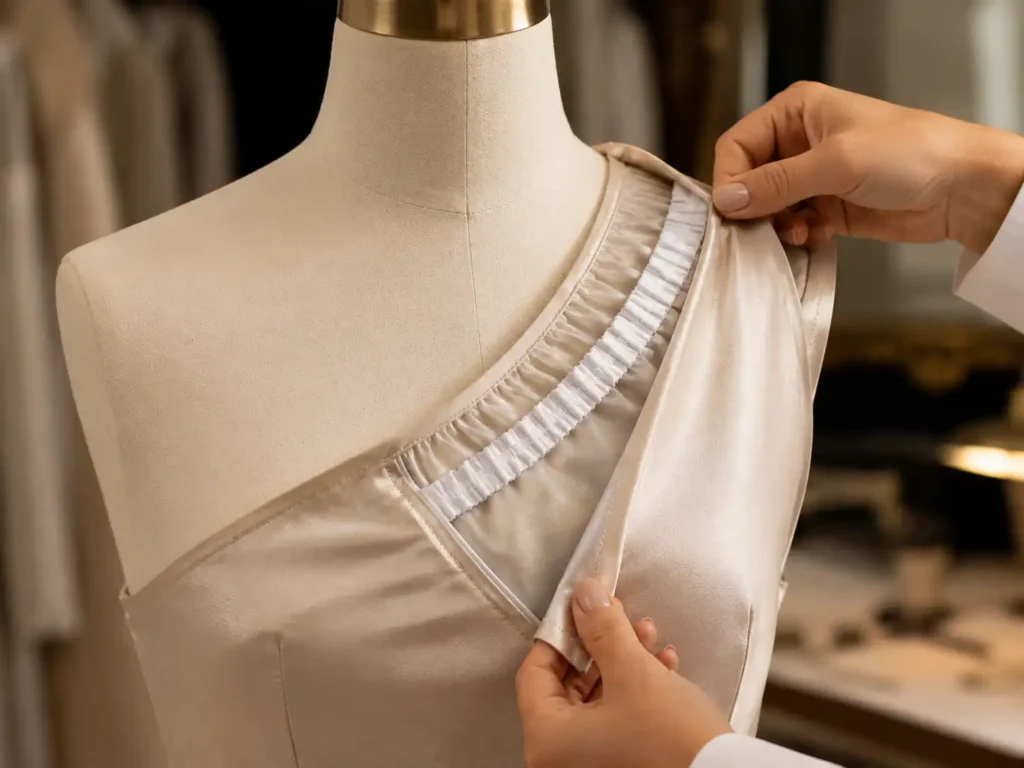
The covered shoulder acts as the main anchor, but the strongest position is not automatically the highest or widest point. Pattern review compares shoulder width, slope, neck base, arm movement and the intended diagonal line. An anchor placed too far outward can slide; one placed too far inward can pull the neckline toward the neck and distort the opposite armhole. The neckline length is measured along the finished sewing line, not only along the raw edge. Binding, facing, elastic or a double-layer finish changes the effective tension. During the first fitting, the garment is observed from front, side and back while the wearer lifts both arms, turns the torso and sits. Comments are converted into precise pattern actions such as moving the shoulder point, shortening the neckline, changing the edge finish or redistributing ease. A revised sample confirms whether the correction works without creating a new pressure point.

Bust Coverage and Exposed-Side Support

The diagonal neckline crosses the upper bust at an angle, making conventional neckline-depth measurements insufficient. Pattern makers compare the bust point, exposed-side edge, front armhole, side seam and lining contour as a connected shape. Coverage must remain aligned with the intended styling and undergarment plan during movement. For fitted jersey or mesh, double layers and controlled negative ease can provide support; for woven satin or crepe, darts, princess shaping, internal tape, lining and a concealed opening may carry the structure. A lower armhole can look visually lighter but may reveal too much during movement, while a higher armhole can cut into the body and pull the neckline. Fit comments should state exact edge movements and measurements instead of broad instructions such as “more coverage.”

Tension Distribution and Recovery

Asymmetric garments often twist when one edge is stabilized and the opposite body area remains too loose. Tension is assessed across neckline, covered shoulder, exposed-side armhole, under-bust area and hem. Stretch fabrics are checked in both directions because a material can have strong width stretch but limited vertical recovery. Edge binding must recover without gathering the shell, and internal elastic must support the neckline without creating visible indentation. Woven designs may require a closure to avoid forcing the garment over the shoulders. Repeated dressing tests reveal relaxation that a single fitting cannot show. When recovery is insufficient, possible actions include changing fabric, increasing layer support, revising neckline length, changing elastic quality or adjusting the pattern ease. The selected solution must remain manufacturable at bulk scale.

Movement and Wear Testing

Static mannequin review is useful for visual balance but cannot replace a live fitting. Wear testing includes raising the arms, reaching forward, turning, walking, sitting and returning to a neutral position. The neckline should recover without continuous adjustment, the shoulder anchor should remain seated and the exposed-side edge should not migrate. Sleeve versions are also checked for elbow bend, cuff pressure and rotation. Comments are recorded by location and action: for example, “neckline drops 12 mm after arm lift” is more useful than “feels loose.” The pattern, elastic specification or sewing method is then revised. A final PP sample should match the approved fit, fabric and trim package before bulk production begins.

Design Details That Define One Shoulder Tops

Design details influence more than appearance. Every drape, gathered section, closure or internal support changes the pattern, sewing sequence, sample review, cost and bulk inspection method.

Draped Neckline

Drape depth is created through pattern volume, grain direction and controlled pleat or tuck placement. Soft crepe, satin and rayon blends work well when the fabric can fall without collapsing. The approved sample should mark fold direction and anchor points so bulk operators do not recreate the drape by eye. QC checks neckline height, fold count, symmetry against the approved reference and pressing marks.

Side Ruching

Ruching can shape the waist, shorten one side or add body contour. Finished length and gathering ratio need measurable standards. Elastic gathering offers repeatability but can change stretch and recovery; thread gathering creates a softer look but requires stronger operator control. Notches, finished measurements and in-line comparison pieces keep density consistent across production.

Single Long Sleeve

A single sleeve adds weight to the covered side and can rotate the bodice if sleeve cap, shoulder seam and neckline are not balanced. Sleeve length, bicep, elbow and cuff measurements need separate tolerances. Mesh, jersey and rib each require different seam and hem methods. First-piece checks verify sleeve rotation and shoulder position before line production continues.

Internal Elastic

Elastic may stabilize the diagonal neckline, exposed-side edge or gathered section. Width, stretch, recovery, softness and sewing ratio must be approved together. Too much tension creates indentation and puckering; too little allows slippage. Bulk control includes elastic lot consistency, cut length, joining method, stitch placement and recovery after pressing.

Anti-Slip Support

Silicone-backed tape or other anti-slip materials can improve stability for selected designs, especially where skin contact is acceptable. Suitability depends on fabric weight, wash requirements, comfort expectations and target market. Support placement should be tested in the sample because excessive grip can pull the neckline or irritate the wearer. Material documentation and care instructions may also need review.

Double-Layer Front

A double front can improve opacity, smoothness and bust support. Shell and inner layer must share compatible stretch and shrinkage. Unequal tension causes rippling, twisting or a visible inner edge. The sewing sequence should secure layers without excessive bulk at the armhole or neckline. Layer alignment and internal cleanliness become dedicated QC points.

Side Zipper

Woven one-shoulder tops often need a concealed side zipper for dressing. Zipper length must allow entry without weakening the side seam or ending at a high-pressure point. The top stop, hook-and-eye support, seam allowance and lining connection affect comfort and appearance. Bulk checks cover zipper smoothness, seam flatness, top alignment and closure security.

Decorative Trims

Rhinestone tape, bead chains, lace edges or sequin details can reinforce the diagonal line. Trim weight must suit the base fabric so the shoulder is not pulled downward. Color, plating, attachment strength, skin contact and spare components should be confirmed during sampling. Placement templates and pull checks improve production consistency.

Grading One Shoulder Tops Across the Size Range

A strong base-size sample is only the starting point. Asymmetric grading protects the visual line and coverage while shoulder width, bust growth, armhole depth and body length change at different rates.

Anchor Point by Size

The shoulder anchor cannot move by the same amount as the bust or body width. Grading rules consider neck width, shoulder slope and intended coverage. A small size may need a tighter anchor without narrowing the neckline excessively, while larger sizes may need extra shoulder support without shifting the design line too far outward. Pattern overlays are reviewed before cutting a size set.

Neckline Angle Control

Keeping the exact same diagonal angle across all sizes can reduce bust coverage in larger sizes or raise the neckline too far in smaller sizes. The target visual line is preserved through controlled point movement rather than uniform scaling. Key neckline points, finished length and exposed-side height are measured against the approved grading plan.

Bust and Armhole Growth

Bust circumference, front length and armhole depth interact strongly in one-shoulder styles. Extra bust room should not simply be added at the exposed side because the neckline may open. Growth is distributed through side seams, darts, princess lines, stretch allowance or panel shaping. Armhole depth is checked with the intended undergarment and movement requirement.

Size-Set Verification

For production programs, representative sizes are sampled or measured according to the agreed size range and risk level. Key points include bust, waist, hem, shoulder position, neckline length, exposed-side edge, armhole depth, sleeve length and body length. Results are recorded against the size chart before final bulk grading is released.

From Style Reference to Approved Production Sample

Sampling is used to create a production-ready standard, not only a visually similar prototype. A simple one-shoulder top can often be sampled in 7-10 days; ordinary womenswear styles generally need 10-15 days, while complex structures may require 15-25 days. Special fabric and trim development follows supplier timing.

Project Review

The development team reviews reference images, tech pack, original sample photos, quantity plan, target fabric, colorways, size range, labels, packaging and launch priorities. Missing information is listed before pattern work begins.

Fabric Direction

Weight, stretch, recovery, opacity, drape, color availability and sourcing MOQ are assessed against the style. Swatches or substitute options can be reviewed when the original material is unavailable or unsuitable.

Pattern Development

Pattern makers establish the covered-shoulder anchor, neckline angle, bust coverage, exposed-side armhole, side seams, sleeve or closure construction and grading logic. Risk points are marked for the sample room.

First Sample

The first sample tests silhouette, construction sequence, fabric behavior and measurement. Visual resemblance alone is not enough; stability, mobility, edge recovery and internal finish are checked.

Revision Record

Comments are translated into pattern, measurement, fabric, trim or sewing changes. Each revision records the requested change, internal action, approval status and effect on cost or schedule when relevant.

PP Approval

The PP sample confirms fabric, color, measurements, construction, labels and packing direction before bulk production release. Later changes are evaluated as formal project changes because they can affect material booking, price and delivery planning.

Manage Ten to Thirty Styles Without Losing Control

Established fashion labels often develop 10-30 styles in one program. A clear grouping and approval system prevents the sample room, fabric team and production teams from treating every style as an unrelated request.

Group by Fabric

Styles using the same jersey, rib, mesh, satin or crepe base can share swatch review, color standards and material booking discussions. Shared fabric does not remove style-specific testing, but it reduces fragmented communication and highlights where a single fabric behaves differently across fitted, draped and layered structures.

Rank Hero Styles

Key launch styles, campaign looks and high-volume SKUs should receive earlier sample priority. The remaining range can follow according to fabric readiness and complexity. Priority prevents easy styles from occupying sample capacity while critical one-shoulder pieces wait for decisions.

Track Approval Status

A line-sheet tracker can record pattern status, sample date, comments received, revision number, fabric approval, trim approval, PP status, quantity and required delivery window. Clear status reduces repeated questions and supports coordinated decisions across design, merchandising and sourcing teams.

Separate Risk Levels

Simple jersey tops, draped woven blouses, lined mesh styles and embellished occasion pieces should not share identical timelines. Risk grouping allows more time for closures, support details, special trims, color matching and size-set review where needed.

Lock Shared Components

Main labels, care labels, hangtags, barcodes, polybags and carton instructions can be managed at program level when artwork and rules are shared. Style-specific label placement and SKU data remain controlled separately.

Plan Bulk Allocation

Approved styles are allocated according to fabric type, construction difficulty, capacity and launch schedule. The system uses 6 owned factories, 10+ long-term production partners, 18+ sewing lines and 6+ flexible lines without treating total capacity as unlimited or interchangeable.

Transfer Approved Samples Into Repeatable Bulk Standards

The handover from sample room to production determines whether the approved fit survives at scale. Final files, materials and workmanship references are assembled before cutting begins.

  • Final Pattern and Grading File: The approved pattern includes the corrected neckline, shoulder anchor, exposed-side armhole, body shape, sleeve or opening and hem. Grading rules and size-chart references are released together so bulk cutting does not rely on an outdated base pattern. Pattern version control matters when several sample rounds have changed different areas.
  • Fabric and Trim Reference: Bulk fabric is matched to the approved quality, weight, stretch, hand feel, color and finish. Trim cards can include elastic, zipper, hook-and-eye, tape, lining, thread, labels and packaging components. Substitute materials require review because even a small elastic or lining change can alter fit and construction.
  • Sewing Standard and First Pieces: Construction instructions identify stitch type, seam allowance, edge finish, gathering ratio, elastic length, closure method, label position and pressing approach. First production pieces are checked against the PP sample before line output increases. Early correction is less disruptive than sorting a completed order.
  • QC and Packing Handover: Measurement points, tolerance, visual checkpoints, trim requirements, pressing rules, label placement, barcode data, packing ratio and carton marks are transferred into production and finishing checks. Production, merchandising, QC and packing teams work from the same approved information rather than separate message threads.

Workmanship Standards for Clean One Shoulder Tops

One-shoulder garments place visible seams and edges close to the neckline, shoulder and upper bust. Clean workmanship must support the structure without creating bulk, waviness or irritation.

Stable Neckline Finish

Binding, facing, lining or elastic finishing is selected according to fabric weight and stretch. The finish should recover to the approved length without puckering the shell or rolling outward. Operators follow approved tension and seam allowance, while in-line checks compare neckline appearance with the PP reference.

Flat Shoulder Seams

The covered shoulder carries more structural load than a balanced two-shoulder top. Seam reinforcement, stitch density and internal trimming are controlled so the shoulder remains strong without becoming rigid or bulky. Mesh and fine jersey require different reinforcement from ponte or woven crepe.

Smooth Side Seams

Asymmetric tension can rotate or ripple the side seams. Cutting grain, differential feeding, seam stretch and pressing are checked together. Ruched designs need a stable finished side length so gathering does not pull the hem or armhole out of position.

Clean Layer Alignment

Lined mesh, double jersey and satin-lining combinations require equalized layer length. The inner layer should not appear at the neckline, armhole or hem. Basting, understitching or controlled joining methods can be used according to the construction.

Secure Closures

Concealed zippers, snaps and hooks should open smoothly and sit flat against the body. Zipper tops are reinforced where needed, and the lining connection must not catch. Bodysuit closures require secure attachment, matched placement and comfort at the gusset.

Controlled Pressing

Pressing supports seam shape and drape but can damage satin, mesh, elastic and textured knits. Temperature, pressure and protective cloth use are matched to the approved fabric. Final garments are checked for shine, flattening, seam impressions, distortion and packing folds.

Quality Control Focused on Asymmetric Construction
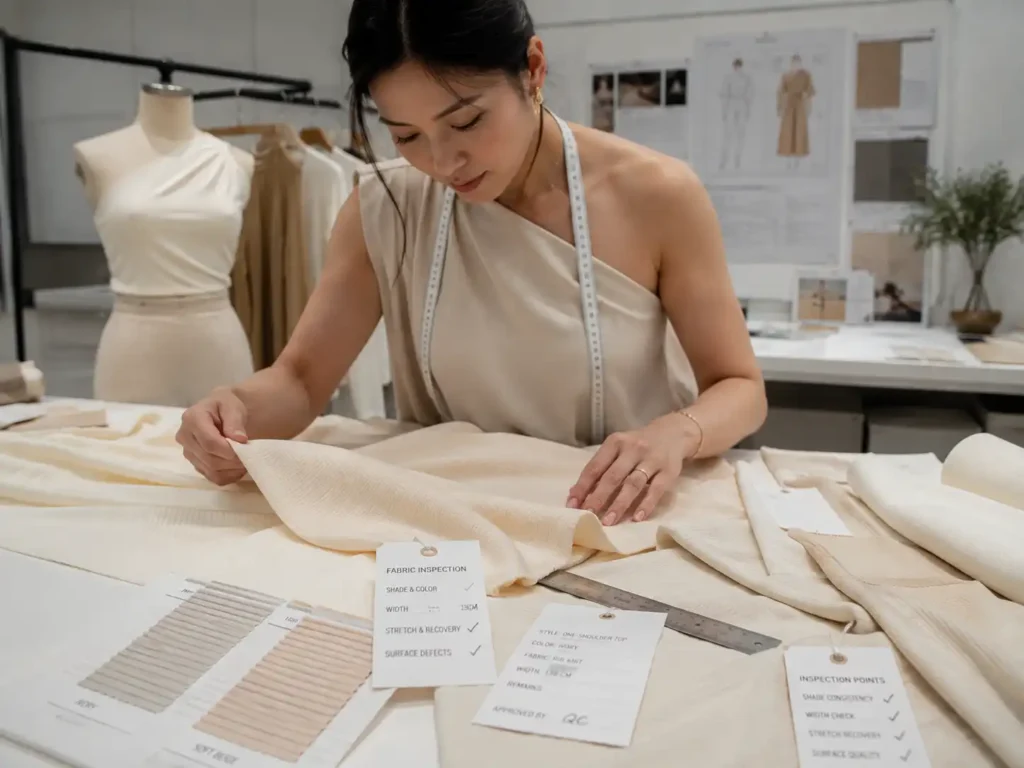
Quality control begins before sewing and continues through final packing. One-shoulder checkpoints are added to the normal garment inspection sequence because small shifts in angle or tension change both appearance and wear security.

Fabric Inspection

Check shade, width, weight, stretch, recovery, surface defects and lot consistency against the approved quality. Stretch fabrics may be relaxed before cutting according to material behavior.

Cutting Direction

Verify grain, nap, rib direction, satin shine direction, lace motif and paired panel accuracy. A reversed panel can create visible shade or stretch differences even when the pattern is correct.

Neckline Angle

Measure and visually compare the diagonal line, anchor position and exposed-side height against the approved sample. Edge length and recovery are checked before finishing hides the construction.

Bust and Armhole

Confirm bust measurement, coverage, exposed-side armhole depth and side-seam height. Fit-critical deviations are corrected early because later pressing cannot solve structural imbalance.

Elastic Recovery

Check elastic quality, cut length, joining point, sewing ratio and recovery. Finished edges should return without permanent stretching, visible gathering or excessive pressure.

Measurement Control

Measure agreed points across selected production stages and final inspection. Tolerance applies to finished garment measurements, not only cut panels. Diagonal neckline and shoulder points receive style-specific definitions.

Visual Workmanship

Inspect skipped stitches, seam puckering, layer misalignment, loose threads, mesh damage, satin snagging, trim placement, zipper flatness and pressing marks under suitable lighting.

Packing Accuracy

Verify style, color, size, labels, barcode, polybag, folding method, pack ratio, carton mark and packing-list consistency. SKU accuracy is treated as part of product quality, not an administrative afterthought.

Private Label, Compliance Support and Design Protection

Brand delivery extends beyond garment construction. Label files, packaging data, material documents and unpublished styles are managed as controlled project information from development through shipment.

Retail-Ready Packing

Jinfeng supports woven labels, size labels, care labels, hangtags, hang strings, barcode stickers, SKU labels, polybags, stickers, thank-you cards, cartons, carton marks and warehouse labels. Placement, artwork, size-color mapping and packing ratios are confirmed before finishing. Barcode and SKU lists are checked against garment labels and packing instructions to reduce receiving errors.

NDA and Design Protection

NDA-based cooperation can cover tech packs, original samples, patterns, line sheets, unpublished designs, label files, packaging files, pricing and order information. Client names, logos, sample images, real order quantities and unreleased styles are not disclosed without authorization. Anonymous process images or internally developed samples can be used when production proof is needed.

Material and Audit Support

Material documentation and testing are handled according to project, target market and actual supplier scope. Composition, shrinkage, colorfastness, pH, formaldehyde, azo, pilling and strength testing can be coordinated through recognized third-party laboratories when required. Factory or material certifications are verified by legal entity, product scope and validity rather than presented as universal coverage.

MOQ, Quotation and Production Planning

MOQ starts from 200 pcs per style/color. Final feasibility and quotation depend on fabric source, color development, trims, construction, size ratio, packaging, quality requirements and production schedule. A lower quantity does not automatically create a shorter timeline when materials or approvals are not ready.

Project InputMOQ EffectCost EffectPlanning Effect
Stock fabric and standard colorUsually supports the base MOQ when supplier stock is confirmedMore stable material costingFaster planning after sample and PP approval
Custom dye or custom weaveFabric mill minimums may raise garment MOQAdds development and dyeing costRequires lab dip, approval and bulk fabric time
Custom printPrint base and color count affect minimumsAdds artwork, screen or digital setupNeeds strike-off or print sample approval
Special mesh, lace or sequinsSupplier stock and motif availability govern MOQLining, placement and handling add costSourcing and testing can extend development
Special trims or closuresTrim supplier minimum may applyMold, plating or custom color may add costApproval and production follow trim supplier timing
Multiple colorwaysMOQ is evaluated per style/colorSmaller color splits reduce cost efficiencyMore approvals and shade control are needed
Complex construction and packingGarment MOQ may remain 200, subject to materialsMore sewing, QC and packing laborLonger sample review and production preparation

One Shoulder Top Manufacturing Frequently Asked Questions

The base MOQ starts from 200 pcs per style/color. Fabric stock, custom color, custom print, special mesh or lace, trims and packaging can carry separate supplier minimums. Quantity is evaluated per style and per color rather than by combining unrelated styles into one total.

Yes. Reference images, sketches, line sheets, original sample photos and complete tech packs can all start the review. More accurate assessment becomes possible when quantity, fabric direction, size range, target market, labels, packaging and delivery goals are included.

Yes. Jinfeng supports jersey, rib knit, ponte, mesh, power mesh, stretch satin, crepe, lace and other suitable womenswear fabrics. Pattern, closure, edge finish and support method are selected according to stretch, recovery, drape, opacity and construction.

Stability is managed through the shoulder anchor, neckline length, fabric recovery, pattern ease, internal elastic, tape, lining or double-layer construction. Live fitting and movement checks are used because mannequin appearance alone cannot confirm recovery during wear.

Simple styles can often be sampled in 7-10 days. Ordinary womenswear styles generally require 10-15 days, while complex structures can need 15-25 days. Special fabrics, custom trims and delayed approvals follow the relevant supplier and review timing.

Yes. Brand-specific size charts can be used. Grading reviews shoulder anchor, neckline angle, bust growth, exposed-side armhole, side seam, sleeve, body length and elastic length rather than applying uniform enlargement to the full pattern.

Yes. Programs with 10-30 styles can be grouped by fabric, construction, launch priority, trim package and production route. A style tracker can record sample status, revision, fabric approval, PP status, quantity and required delivery window.

Yes. Woven labels, size labels, care labels, hangtags, barcode stickers, SKU labels, polybags, stickers, cartons, carton marks and warehouse labels can be supported according to confirmed artwork and packing instructions.

Yes. NDA-based cooperation can protect tech packs, original samples, patterns, unpublished designs, labels, packaging files, prices and order information. Brand identity and unreleased styles are not disclosed without authorization.

Send the style reference or tech pack, target quantity per style/color, fabric preference, color plan, size range, construction details, private-label requirements, quality standards and target delivery window. The team can then review feasibility, sampling, MOQ and cost drivers.

Start Your One Shoulder Top Development

Send Kelly the style information available now, whether it is a complete tech pack, a line sheet, an original sample reference or a group of concept images. Jinfeng Apparel will review the asymmetric structure, fabric direction, trim requirements, sample route, MOQ fit, private-label needs and production planning before issuing a formal next step.

Clear source files help the pattern and merchandising teams identify risk earlier and reduce unnecessary revisions later.

  • Reference image, sketch, tech pack or original sample photos
  • Target quantity for each style and color
  • Preferred fabric, weight, stretch or hand-feel direction
  • Color plan and brand-specific size range
  • Main label, care label, hangtag, barcode and packaging requirements
  • Target launch, delivery destination and nominated forwarder details when available
  • Quality, testing, compliance or warehouse receiving requirements

Tell Us About Your Dress Project

Share your product details, estimated quantity and development requirements. Our team will review your project and provide practical OEM/ODM production feedback.

Premium Women’s Apparel Production for Fashion Brands

From dress sample development to bulk production, JF Apparel supports fashion brands with confidential OEM/ODM manufacturing, reliable quality control and scalable production support.

START YOUR DRESS PROJECT

Ready to Develop Your Next Dress Collection?

Share your design concept, product requirements or sourcing plans with our team. We’ll review your project and provide practical feedback on development, materials, MOQ and production.

7-10 Days

Sample Development

200 PCS

Starting MOQ

Fast Response

Professional Follow-Up