 Skip to content
Off Shoulder Top Manufacturer for Retail Collections
Private-label off shoulder tops engineered for stable fit, coordinated assortments, consistent bulk production and retail-ready delivery.
- Retail programs can be planned across 10-30 styles and 20,000-80,000 pieces, with each SKU separated by style, color, size and delivery priority.
- MOQ starts from 200 pcs per style/color, allowing commercial assortments to balance hero designs, core sellers and coordinated matching pieces.
- Sample planning ranges from 7-10 days for simple tops, 10-15 days for standard constructions and 15-25 days for complex structures or special materials.
- Six owned womenswear factories, 10+ long-term production partners and 100,000+ pcs monthly capacity support multi-style development and repeat retail programs.
Manufacturing Scale Built for Retail Programs
Six Owned Factories
Ten-Plus Production Partners
Two Sample Rooms
Seven-Plus Pattern Makers
Fifteen-Plus QC Inspectors
Monthly Production Capacity
Built for Retail Collection Teams
Fashion Retailers
Multi-Channel Brands
Sourcing Teams
Retail Collection Risks We Control
Neckline Sliding
- Confirm neckline circumference against the intended wearing position.
- Test elastic recovery after repeated stretching.
- Check front, side and back height during movement.
- Record the approved elastic and seam construction for bulk.
Restricted Arm Movement
- Test forward reach, side lift and overhead movement.
- Watch for sleeves climbing above the intended shoulder line.
- Review underarm exposure when the arms are raised.
- Recheck body length after movement because tight sleeves can pull the top upward.
Uneven Sleeve Position
- Pair left and right sleeve components during cutting.
- Mark elastic joins and balance points.
- Compare finished sleeve opening and drop.
- Inspect symmetry on hanger and on-body reference.
Weak Fabric Recovery
- Compare initial and recovered measurements after controlled stretching.
- Confirm stretch direction before marker planning.
- Avoid excessive pressing heat on sensitive elastane blends.
- Retest finished garments after resting, not only immediately after sewing.
Sample-Bulk Drift
- Use one approved pattern version and dated measurement file.
- Match bulk fabric and trims against approved references.
- Define critical operations before line start.
- Compare in-line garments against the PP or golden sample.
SKU Packing Errors
- Reconcile order quantity with the final SKU matrix.
- Approve label and hangtag placement before bulk packing.
- Verify barcode content against the supplied list.
- Match carton marks and packing lists to physical goods.
Off Shoulder Top Collection Options

Bardot Rib Top

Ruched Jersey Top

Puff Sleeve Woven

Ruffle Poplin Blouse

Long Sleeve Fitted

Mesh Party Top

Satin Occasion Top

Corset-Inspired Top
Build a Balanced Retail Collection

Commercial Core Styles
- Use stable fabrics with reliable recovery or dimensional control.
- Keep trim count focused and repeatable.
- Build colors around confirmed dye lots or stock availability.
- Archive pattern, measurement and packing records for replenishment.

Trend Statement Styles
- Prioritize hero styles for first sample and campaign review.
- Confirm high-risk materials before the full collection is locked.
- Define tolerance for hand-applied or placement-sensitive details.
- Protect delicate surfaces during pressing and packing.

Occasion Capsule Styles
- Review transparency in natural and strong artificial light.
- Confirm bust support and neckline security on the target size.
- Test decorative surfaces against skin and adjacent garments.
- Coordinate top length with the planned skirt or trouser rise.

Matching Set Extensions
Matching sets raise collection value by allowing one top to create several looks. A core off shoulder top can be coordinated with a mini skirt, maxi skirt, tailored pant or matching wrap piece. Shared fabric and color improve visual cohesion but require exact shade control, particularly when components are produced on different lines or at different times. Jinfeng Apparel links the top and bottom through common fabric references, color approvals, packing records and coordinated delivery planning.
- Confirm set components from the same approved fabric batch where required.
- Align waist placement and top length during fitting.
- Manage separate style numbers while preserving set identification.
- Plan mixed and separate packing according to retail operations.
Fabric Directions for Off Shoulder Tops

Rib Knit
- Best for commercial core and body-fitted styles.
- Check recovery at neckline and sleeve opening.
- Review wash shrinkage before final grading.
- Avoid excessive elastic tension that creates rippling.

Compact Jersey
- Suitable for ruching, close fit and soft drape.
- Double layers can improve opacity and body control.
- Seam choice should minimize waviness.
- Bulk fabric needs consistent stretch across dye lots.

Ponte Double Knit
- Best for structured fitted shapes and cooler seasons.
- Strong recovery supports stable neckline positioning.
- Control seam thickness around elastic channels.
- Check color fastness and surface shine after pressing.

Power Mesh
- Use lining or double mesh for selected coverage zones.
- Match thread tension to prevent puckering.
- Keep seam edges smooth against skin.
- Confirm color depth in one and two layers.

Stretch Lace
- Confirm motif direction and usable fabric width.
- Review scallop placement before marker approval.
- Match lining color to the intended visual depth.
- Protect delicate lace during sewing and packing.

Stretch Satin
- Keep all cut panels aligned to the approved shine direction.
- Use suitable needles and controlled seam handling.
- Test elastic casing so stitching does not mark the face.
- Pack to reduce crushing and sharp fold lines.

Chiffon and Viscose
- Check opacity before deciding lining coverage.
- Allow fabric relaxation before cutting where required.
- Select narrow hems or binding to match the visual goal.
- Review ruffle balance after hanging and pressing.

Cotton Poplin Blends
- Suitable for puff sleeves and structured flounces.
- Test shrinkage before finalizing measurements.
- Add movement through pattern shape, not excessive neckline elastic.
- Confirm print direction and placement before cutting.
How We Engineer Stable Off Shoulder Necklines
A stable off shoulder neckline is created through a linked system of pattern geometry, fabric behavior, elastic specification, seam construction and movement testing. Solving only one variable rarely produces a repeatable retail result.

Neckline Circumference and Elastic Ratio
The neckline path must follow the intended wearing position across the front upper bust, shoulders, sleeves and back. A pattern drafted too close to the neck will climb during movement; a path placed too low may expose more than intended or depend on excessive elastic tension. Jinfeng Apparel begins by confirming whether the design should sit just below the shoulder point, across the upper arm or lower on the bust line. Front and back neckline depths are then balanced against sleeve attachment and body proportions.
Elastic length is not selected through one universal percentage. The correct ratio depends on elastic type, width, recovery, fabric weight, seam construction and required comfort. A narrow soft elastic may need a different reduction from a firm knitted elastic. During sampling, the elastic is stretched through repeated cycles, sewn into the actual casing or seam, rested, and then reviewed on the garment. The neckline should recover without creating visible ripples, pressure marks or sleeve lift.
For bulk production, the approved elastic receives a defined specification: material, width, color, finished length, join method and placement marks. Cutting and sewing teams need the same record because small elastic-length differences can change fit across hundreds or thousands of units. In-line checks compare finished neckline circumference and visual position against the PP or golden sample rather than judging tension by hand alone.

Front-Back Balance and Sleeve Anchor
Off shoulder fit depends on how the front, back and sleeves share tension. A front neckline that is too long may gape, while a short back neckline can pull the whole garment rearward. Sleeve caps or upper sleeve panels also act as anchors; their angle, depth and gathering affect whether the top remains stable during movement. Jinfeng Apparel reviews horizontal balance lines, side-seam position and neckline height from the front, side and back during fit evaluation.
Sleeve movement is tested separately from neckline appearance. When the wearer raises her arms, the sleeves should not force the neckline above the intended position or pull the body excessively upward. Corrective actions may include changing the sleeve cap, increasing movement allowance, adjusting gathering distribution, refining the underarm curve or changing where the sleeve joins the neckline. Enlarging the entire top is avoided when it would weaken bust fit or create a loose waist.
For puff sleeves and ruffle sleeves, fullness is marked through notches or distribution points so left and right sides remain visually balanced. Woven styles may use elasticized upper sleeves, while fitted knit designs can rely more on fabric recovery and shaped seams. Each construction receives its own measurement and workmanship criteria instead of sharing one generic off shoulder standard.

Anti-Slip Support and Comfort
Anti-slip tape, silicone elastic, stay tape, partial lining and internal support can improve stability, but each component introduces new comfort and quality risks. A silicone strip may grip well yet irritate skin, roll at the edge or become visible through light fabric. Firm elastic can reduce movement but leave pressure marks. Jinfeng Apparel evaluates support components as part of the complete garment rather than treating them as automatic upgrades.
The position of an anti-slip component matters as much as the material. It should follow the stable area of the neckline, remain flat through curves and avoid bulky joins. Stitching tension must not stretch the garment edge or create visible tunneling. For satin, mesh and lace, face-side marking is especially important. A sample is checked after repeated dressing, movement and resting to observe whether the support remains smooth and comfortable.
Inner coverage also supports confidence. Depending on the style, Jinfeng Apparel may review a lined bust panel, shelf layer, cup placement, side-bust shaping, underbust elastic or boning. These elements must be graded with the garment so support does not remain fixed while body proportions change. The final solution balances secure wear, movement, visual cleanliness and production repeatability.

Bulk Reproduction Controls
The approved neckline is converted into measurable production standards before line start. Final files include the dated pattern, graded size chart, elastic specification, trim card, sewing method, placement marks, measurement tolerance, pressing instruction and approved sample reference. High-risk operations are explained during the production handover so the line does not improvise elastic length, stitch type or gathering distribution.
Cutting review confirms fabric direction, relaxation and matched components. Sewing inspection focuses on elastic stretching consistency, join security, neckline waviness, sleeve symmetry, seam allowance and support placement. Measurements are taken after the garment has rested because freshly sewn elastic can temporarily distort the result. Selected garments are also checked through movement rather than only on a hanger or flat table.
If in-line inspection identifies drift, production is paused at the relevant operation instead of waiting for final inspection. The team reviews the pattern, elastic batch, machine handling, operator method and pressing before correction. Repaired garments are rechecked, and the cause is recorded for repeat orders. This process turns an approved sample into a repeatable retail standard rather than a one-off piece produced by a sample machinist.
Fit Measurements and Movement Tests Before PP Approval
Measurement review establishes repeatability; movement testing establishes wearability. Both are required before approving an off shoulder top for retail production, particularly when the collection covers several fabrics, sleeve constructions or size ranges.
| Control Point | Measurement or Test | Main Risk | Approval Focus |
|---|---|---|---|
| Upper bust | Measure at the approved wearing level | Sliding or compression | Stable hold without pressure marks |
| Full bust | Compare garment and body allowance | Gaping or flattened shape | Correct volume and coverage |
| Neckline circumference | Measure relaxed finished edge | Loose edge or excessive tension | Matches approved elastic and pattern |
| Front neckline depth | Measure from defined reference point | Exposure or visual imbalance | Consistent design position |
| Back neckline depth | Compare with front and side height | Garment pulling backward | Balanced horizontal line |
| Sleeve opening | Measure relaxed and stretched | Tight upper arm or sleeve drop | Comfortable hold and recovery |
| Bicep width | Measure at specified level | Restricted arm movement | Required ease by fabric type |
| Body length | Measure before and after arm lift | Top riding upward | Controlled movement and coverage |
| Side lift test | Raise arms to shoulder height | Sleeve climb and underarm exposure | Neckline remains near approved position |
| Overhead test | Raise both arms above head | Severe garment displacement | Acceptable recovery after arms lower |
| Dressing test | Put on and remove repeatedly | Elastic damage or seam stress | Secure joins and recoverable opening |
| Rest recovery | Re-measure after stretching and resting | Permanent growth | Returns within approved tolerance |
Construction Details That Protect Retail Performance

Ruffles and Flounces
- Straight gathers provide regular fullness but can add bulk.
- Circular flounces create movement with less gathering at the seam.
- Narrow hems suit light fabrics; binding or facing may suit firmer qualities.
- Pattern yield and motif placement influence cost on printed fabrics.

Ruching and Drawcords
- Grade gathering quantity with the body pattern.
- Reinforce drawcord openings to prevent tearing.
- Define maximum and minimum finished lengths.
- Keep internal channels smooth and free from twisting.

Lining and Coverage
- Match lining stretch to the shell where both layers must move together.
- Confirm lining color under strong light and photography.
- Avoid excessive seam bulk at the neckline.
- Check lining length after washing or steaming tests.

Cups and Boning
- Confirm cup position during fit review, not only by measurement.
- Select boning type according to structure and flexibility needs.
- Protect skin from hard edges and seam allowance.
- Inspect support components before closing the lining.

Closures and Fastening
- Match zipper color and tape to the approved garment.
- Reinforce high-stress top and waist positions.
- Check hook-and-eye placement for hidden support.
- Test the full size range for dressing access.

Decorative Trims
- Test trims against skin and adjacent fabric.
- Define placement tolerance before line production.
- Check wash or care compatibility where required.
- Include spare or repair planning for complex embellishment programs.
From Design Reference to Production-Ready Top
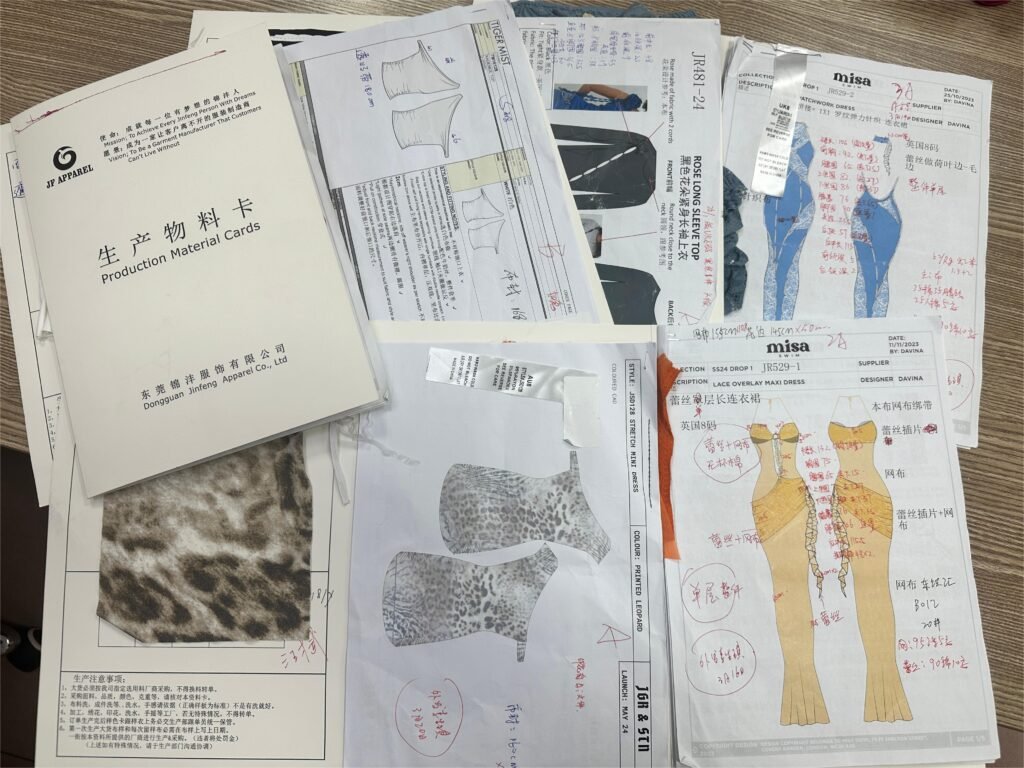
Jinfeng Apparel can start from a tech pack, original sample, sketch, reference image or line sheet. The route changes according to the quality of the input, but every route must reach the same production-ready standard before bulk.
Starting From a Tech Pack
A complete tech pack creates a strong development base when the information is internally consistent. Jinfeng Apparel reviews technical sketches, POM definitions, measurement tables, grade rules, BOM, fabric specifications, trim references, stitch notes, label placement and packing instructions. Conflicts are identified before sampling; for example, a neckline measurement may not match the sketch, or a non-stretch fabric may be paired with pull-on construction.
The review also checks whether the proposed construction can reproduce the intended fit across sizes. Off shoulder tops often need additional information around upper-bust level, front and back neckline depth, sleeve opening, elastic finished length, support components and movement expectation. Missing data is converted into a clarification list rather than guessed during production.
Once decisions are confirmed, the sample team prepares material references, pattern work and a sample plan. Revisions are recorded against the same style number and version. The final approved pattern, measurements and BOM are then linked to PP approval and bulk handover, reducing the risk of different teams working from different files.
Starting From a Reference
Reference images and original samples are useful when the brand has a strong visual direction but incomplete technical files. Jinfeng Apparel first separates visible design features from hidden construction assumptions. A photograph may show an off shoulder line, puff sleeve and ruching, but it may not reveal elastic type, lining, zipper, internal support, fabric weight or size-grade behavior.
The team reviews the target silhouette, wearing position, fabric direction, expected price level, size range and planned order quantity. Where an original sample is available, measurements, seam structure, support components and fabric behavior can be examined more accurately. The aim is not unauthorized copying; development should follow the brand’s own design rights, reference use and requested modifications.
A development proposal can then define likely fabric options, pattern route, sample risks, trim needs and data still required. Initial pricing remains a range until materials, construction and quantities are confirmed. The first sample creates a real product for fit discussion, after which revision comments are converted into measurable pattern and workmanship changes.
Development Review Before Quotation
A professional quotation cannot be locked from one image alone. Jinfeng Apparel reviews fabric composition and weight, lining, elastic, closures, support components, ruching, ruffles, decorative trims, size range, color count, quantity per style/color, private-label packing, testing requirements and delivery terms. Each variable influences material yield, sewing time, sample work, QC and supplier MOQ.
The review helps control cost without weakening brand-level appearance. A high-cost detail may be simplified through a cleaner seam, a more stable fabric, consolidated color planning or a trim alternative. Any optimization must preserve the retail concept, fit and visual hierarchy rather than merely reducing unit price.
After the brief is sufficiently clear, Jinfeng Apparel can provide a structured quote showing product, fabric, lining, trims, quantity, size range, colors, sample fee, MOQ, packaging, trade terms, lead-time basis and exclusions. Final pricing is confirmed after the required material and construction approvals.
Sampling and Approval Process
Fabric Direction
Pattern Draft
First Sample
Fit Review
Revised Sample
PP and Golden Sample
MOQ and Quotation Variables
MOQ starts from 200 pcs per style/color and is calculated by each style and each color, not by the total collection quantity. Material, trim, packing and production variables may create separate supplier minimums or longer development requirements.
| Variable | Standard Position | Possible Impact | Information Needed |
|---|---|---|---|
| Garment MOQ | From 200 pcs per style/color | Each additional color carries its own quantity basis | Quantity by style and color |
| Stock knit or woven | Usually supports standard planning | Availability can change by color and batch | Fabric type, weight, stretch and color |
| Custom dye | Dye-house MOQ applies | Higher material minimum and longer calendar | Pantone, composition and required quantity |
| Custom print | Print process and base-fabric MOQ apply | Setup, strike-off and placement cost | Artwork, scale, repeat and color count |
| Specialty mesh or lace | Supplier stock and motif control | Higher loss, placement and replacement risk | Motif, width, color and stretch requirement |
| Custom elastic or trims | Trim supplier minimum applies | Additional development and lead time | Width, material, color, logo and function |
| Labels and hangtags | Separate material MOQ may apply | Artwork, plate and packing cost | Label files, composition and placement |
| Printed polybags or boxes | Packaging supplier MOQ applies | Added unit cost, storage and schedule | Dimensions, print, barcode and quantity |
| Extended size range | Additional grading and consumption | Fabric usage and fit validation increase | Base size, grade rule and size ratio |
| Urgent delivery | Reviewed by material and capacity | Air freight or split shipment may be needed | Required launch date and priority SKUs |
Plan Production Around the Retail Launch
A launch calendar works backward from the required warehouse or selling date. Samples, PP approval, material booking, bulk production, QC, packing and freight need separate decision gates rather than one broad delivery promise.
Build the Calendar Backward
Retail teams should begin with the latest acceptable warehouse date and subtract freight, customs allowance, packing, inspection, production and development time. A representative 16-week planning framework may reserve weeks 1-2 for brief and fabric direction, weeks 2-5 for first samples, weeks 5-8 for revisions and PP approval, weeks 8-14 for materials and bulk production, and weeks 14-16 for final QC and packing. Freight is then added according to route and destination.
This framework is not a fixed promise. A simple rib-knit collection with available colors may move faster, while custom print, specialty lace, multiple sample rounds or elaborate retail packaging can extend the schedule. Jinfeng Apparel issues a project timeline after reviewing style count, material availability, quantity and launch priorities.
Lock Samples Before Bulk
The most important calendar gate is PP lock. Production should not begin while neckline position, fabric, color, elastic, trims, measurements, labels or packing remain undecided. Late changes can require new material, revised patterns, line retraining or repacking, affecting both cost and delivery. Jinfeng Apparel records approval status by style so one delayed product does not automatically block every other SKU in the collection.
Hero styles, photo samples and market-meeting samples can receive development priority when the schedule is clear. Core repeatable styles may move into material reservation earlier after risk review. Complex mesh, satin or corset-inspired tops are allowed more fit and workmanship validation before their final approval date.
Align Production and Freight
Bulk scheduling includes material arrival, factory allocation, line start, in-line inspection, finishing, packing and shipment release. When a full collection cannot reach the same readiness date, a split strategy may protect the launch: priority styles or selling colors can move first, while remaining units follow through the planned lower-cost route. SKU and carton separation must be established before packing so the shipment split does not create warehouse confusion.
Jinfeng Apparel can coordinate with a brand-appointed forwarder or review available express, air, sea, FOB, CIF, DAP or DDP-by-project options. Transit time and cost remain dependent on destination, route, season, customs and carrier availability. The shipping plan is therefore confirmed as part of the order schedule rather than added after production is finished.
Managing Multi-Style Retail Collections
Style Matrix
- Assign one stable style number from development through shipment.
- Track sample and approval version dates.
- Flag hero, core, matching and replenishment styles.
- Reconcile final quantities before production release.
Fabric Platform
- Consolidate colors where commercially suitable.
- Separate stretch and non-stretch pattern requirements.
- Reserve approved batches for matching-set components.
- Recheck new dye lots for repeat orders.
Color Control
- Maintain one approved color standard per fabric platform.
- Review shell and lining together.
- Keep matching-set components within the approved batch plan.
- Record approved substitutions before bulk use.
Size Grading
- Confirm the base size and target body standard.
- Define grade increments by POM.
- Review neckline and sleeve tension in more than one size where needed.
- Control bulk measurements against approved tolerance.
SKU Mapping
- Use readable style, color and size names.
- Confirm barcode artwork and data before printing.
- Separate channel-specific labels or packs.
- Match carton marks to the final packing list.
Launch Priority
Not every SKU carries equal launch importance. Hero styles drive imagery, core colors support volume, and matching pieces complete merchandising stories. Jinfeng Apparel can organize sample and production priority around the brand’s commercial plan. Priority does not remove technical gates; it helps allocate development attention, material reservation and inspection resources where delay would have the greatest business impact.
- Mark campaign and photo-critical styles early.
- Identify first-delivery colors and size ratios.
- Plan optional air-and-sea splits before packing.
- Keep secondary styles moving without distracting from critical approvals.
Bulk Production and Factory Allocation
Approved samples become reliable retail goods only when patterns, materials, workmanship and packing standards transfer cleanly into production. Jinfeng Apparel manages this handover across owned factories and long-term production partners according to product fit.
PP Handover and Production Files
The production handover begins after PP approval and commercial confirmation. Final files include the dated pattern, graded measurements, BOM, shell and lining references, trim card, elastic specification, sewing method, support details, label placement, packing instruction, QC checklist and approved sample reference. Any open point is listed before line start; verbal assumptions are not treated as production standards.
A pre-production review identifies the operations most likely to affect retail quality: neckline elastic application, sleeve symmetry, ruching distribution, mesh handling, satin pressing, boning insertion, zipper top alignment and label position. The responsible teams receive the same style information so sample, production, QC and packing decisions do not diverge.
Where the collection includes shared fabrics or trims, material allocation is linked to each style and color. This protects matching sets, priority colors and replenishment quantities from accidental consumption by another style. Changes after PP lock are reviewed through a controlled update, including cost and schedule consequences.
Factory Allocation by Product Type
Jinfeng Apparel operates six owned womenswear factories and works with more than 10 long-term satellite production partners. Allocation is based on construction and fabric rather than available space alone. Stretch-knit Bardot tops need teams experienced in recovery, differential feed and elastic control; woven puff-sleeve blouses need clean gathering and narrow-edge workmanship; mesh, lace, satin and corset-inspired styles need more specialized handling and inspection.
The production network includes 18+ sewing lines and 6+ flexible lines. Line choice is reviewed against order volume, style complexity, number of colors, changeover frequency and launch sequence. A large core style may use a dedicated line, while a smaller statement group may be produced on a flexible line capable of handling frequent construction changes.
Approved standards remain under one project system even when styles are allocated across different factories. Pattern version, fabric references, color approvals, QC criteria, packing instructions and shipment priorities are managed by Jinfeng Apparel rather than left to each production unit to interpret independently.
Project Coordination Through Shipment
Twelve-plus merchandisers and order follow-up specialists coordinate information between the brand, sample rooms, material suppliers, factories, QC, packing and logistics. Progress tracking covers sample approval, material readiness, line schedule, in-line status, inspection, packing and shipment documents. The role is not limited to sending updates; merchandisers identify dependencies and escalate decisions that could affect the launch.
Fifteen-plus QC inspectors support the control plan, while 30+ finishing and packing workers support pressing, label checks, folding, polybagging, ratio packing and carton preparation. Final shipment records may include commercial invoice, packing list, carton marks, measurements, gross and net weight, booking details and inspection status according to the trade terms and forwarder requirements.
For repeat orders, archived pattern, measurement, material, trim, label, packing and QC records help restart production efficiently. New colors, changed fabrics or different batches are still reviewed because historical approval does not remove current material and shade risk.

Off Shoulder Top Quality Control
Quality control follows the garment from incoming materials through cutting, sewing, measurement, pressing and retail packing. Off shoulder products receive specific checks for elastic behavior, neckline stability, sleeve symmetry and movement recovery.
Incoming Material and Cutting Control
Incoming inspection reviews shell fabric, lining, elastic, trims, labels and packing materials against approved references. Fabric checks may include color, shade, width, weight, stretch, recovery, handfeel, transparency, defects and shrinkage according to the project. Elastic is compared for width, firmness, color and recovery because an unapproved substitution can alter fit even when the garment pattern remains unchanged.
Before cutting, stretch fabrics may require relaxation according to material behavior. Cutting direction is checked so all panels use the intended stretch and, for satin or velvet-like surfaces, the approved shine or nap direction. Left and right sleeve components are paired where symmetry is sensitive. Printed and lace materials receive placement review when motifs, scallops or directional repeats affect the visible result.
Cut parts are identified by style, color, size and batch. Mixing dye lots or similar colors is controlled through bundling and records. Early measurement checks confirm that the pattern, fabric and cutting process are producing the intended dimensions before large quantities move into sewing.
Sewing and Elastic Control
In-line sewing inspection focuses on the operations that define neckline performance. Elastic finished length, join security, stretch distribution, casing width, seam allowance and placement marks are checked against the approved standard. Operators should not adjust tension by feel from bundle to bundle. Uneven stretching can produce visible waviness, left-right height difference or inconsistent fit across the same size.
Sleeve attachment, gathering, ruffle balance and underarm construction are reviewed for symmetry and movement. Mesh and lace seams are checked for puckering, skipped stitches and rough edges. Satin styles are checked for needle marks, seam impression and shine damage. Corset-inspired designs receive additional review for cup position, boning channels, closure alignment and lining coverage.
When drift appears, the relevant operation is corrected before more units are completed. The team reviews elastic batch, machine setting, operator method, seam construction and pressing rather than treating every defect as isolated rework. Corrected garments are inspected again before production continues.
Measurement and Movement Inspection
Finished measurements are checked against the approved size chart and tolerance. Critical POMs include upper bust, full bust, neckline circumference, front and back neckline depth, sleeve opening, bicep, body length and hem width. Measurements are taken after the garment has rested because elastic and stretch seams can temporarily distort immediately after sewing or pressing.
Selected garments are reviewed on a form or fitting reference where the project requires movement validation. Side arm lift, forward reach, overhead lift, walking and dressing tests reveal risks that flat measurement cannot show. The neckline should recover close to the approved position, sleeves should not climb excessively, and body length should remain commercially acceptable after movement.
Size-set or extended-size review can be added for programs where grading changes support or tension. Results are recorded so repeat orders can compare current production with the original approved standard and golden sample.
Final Inspection and Retail Packing
Garment inspection covers appearance, workmanship, measurements, cleanliness, thread trimming, support components, closures, pressing and presentation. AQL inspection can be applied according to the agreed level, client manual or third-party requirement. Defect classification and measurement tolerance should be confirmed before inspection so acceptance is based on defined standards rather than subjective discussion at shipment stage.
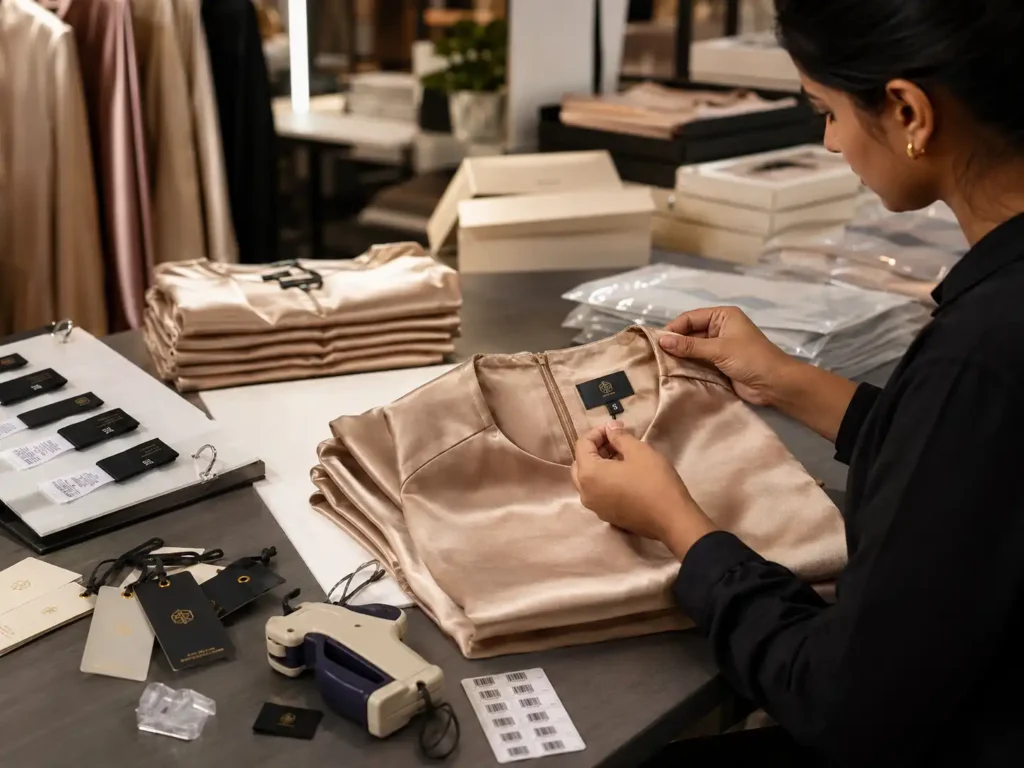
Packing QC verifies main label, care label, hangtag, barcode, SKU sticker, size sticker, folding, polybag, warning text where required, ratio packing, carton quantity and carton marks. Barcode content may be scanned or reconciled against the supplied list for high-risk retail programs. Packed quantities are compared with the order and inspection records before the packing list is finalized.
Shipment release occurs after required inspection and documentation are complete. Photos and records can be provided according to project requirements while protecting brand identity, unreleased designs, barcodes and order information under NDA.
Private Label and Retail-Ready Delivery

Main Brand Label
- Confirm artwork and color before production.
- Review label supplier MOQ and lead time.
- Define placement from a stable reference seam.
- Check skin contact and visibility through the shell.

Care Content Label
- Separate shell, lining and trim composition where needed.
- Confirm size and style identification.
- Review care method against fabric and embellishment.
- Approve label position and orientation before bulk.

Hangtag Presentation
- Confirm front and back artwork.
- Define tag sequence when several tags are used.
- Select an attachment point that protects the garment.
- Reconcile tag quantity against the SKU plan.

Barcode and SKU
- Supply one controlled barcode file.
- Avoid changing style or color names after printing.
- Define whether barcodes sit on hangtags, stickers or polybags.
- Match packed goods to the final digital SKU list.

Polybag and Stickers
- Define fold method before final bag size.
- Protect delicate trims and satin surfaces.
- Position size and barcode stickers for scanning.
- Confirm warning and recycling text by market requirement.

Carton and Packing List
- Confirm carton strength and maximum packing quantity.
- Separate air, sea or channel-specific shipments.
- Reconcile packed quantity before sealing.
- Match physical carton marks with the final documents.
Compliance Support and Brand Protection
Audit Coordination
- Requirements are reviewed by actual production factory.
- Documents are checked for current validity and applicable scope.
- Client-appointed audit or third-party inspection can be coordinated by project.
- No certification is presented as universal across every factory or order.
Material and Testing Support
- Confirm the test standard and target market.
- Verify certificate scope against fabric type and batch.
- Include testing in the launch calendar.
- Final compliance decisions remain with the brand or qualified compliance team.
NDA and Design Protection
Jinfeng Apparel supports NDA-based cooperation and protects tech packs, original samples, patterns, size charts, material plans, trim details, label artwork, packaging files, barcodes, order quantities and unreleased designs throughout development and production. Project images used for internal review are not published without authorization. Anonymous process records or self-developed samples can be used for capability presentation while protecting the brand’s identity and launch information.
- Files are used only for project review, sampling, production, QC and delivery.
- Unreleased styles and brand identifiers are not displayed without approval.
- Pattern and order records are controlled for repeat production.
- Authorized access can be limited according to project needs.
An Off Shoulder Retail Collection in Production
The following anonymized structure reflects the scale and operating pattern of current brand programs: multiple styles, shared fabric platforms, varied complexity, retail packing and a combined launch plan. Brand identity and proprietary design information remain protected.
Project Snapshot and Commercial Structure
A US multi-channel fashion retailer planned an 18-style off shoulder collection totaling 56,400 pieces. The assortment included six rib and compact-jersey core tops, four woven puff-sleeve or ruffle blouses, four mesh and lace party styles, two stretch-satin occasion tops and two corset-inspired hero designs. Individual style quantities ranged from 2,400 to 4,200 pieces across approved colors, while total collection volume remained within the retailer’s 20,000-80,000-piece program range.
The collection used four main fabric platforms and nine retail colors. Sizes ran from XS to 3XL, with different ratios by style and sales channel. Several tops coordinated with skirts or trousers, so shade and delivery alignment mattered beyond the top category itself. The retailer also required main labels, care labels, hangtags, barcode stickers, size stickers, individual polybags and channel-specific carton marks.
Before sampling, Jinfeng Apparel separated the collection into core, trend, occasion and hero groups. Each style received a development priority, fabric status, sample path, PP deadline and production-risk rating. This prevented visually complex pieces from delaying repeatable commercial styles while keeping the launch story coordinated.
Main labels can be woven, printed or otherwise developed according to the brand specification and garment comfort needs. Jinfeng Apparel confirms dimensions, material, fold type, color, logo artwork, placement and attachment method before bulk. An attractive label can still fail when it scratches skin, distorts a light neckline or shows through mesh. A placement sample or PP confirmation helps ensure branding remains clean without weakening comfort or garment appearance.
- Confirm artwork and color before production.
- Review label supplier MOQ and lead time.
- Define placement from a stable reference seam.
- Check skin contact and visibility through the shell.
Development Problems Found Before Bulk
The first sample round identified three connected risks.
One light-rib core style looked correct while standing but the neckline relaxed after repeated arm movement.
A woven puff-sleeve style held its neckline but pulled the body upward because the sleeve cap and elastic tension were working against each other.
One mesh party top showed uneven left-right neckline height after the lining and decorative layer were joined.
For the rib style, the team adjusted neckline pattern length, changed the elastic specification and refined the casing method.
The sample was retested after repeated stretch and rest cycles.
For the woven style, the sleeve anchor, underarm allowance and gathering distribution were revised rather than enlarging the complete body.
For the mesh style, left-right balance marks and layer handling were corrected, and the neckline seam was reduced to control bulk.
Twelve standard and core styles reached approval after two main sample cycles.
Six higher-risk statement styles required a third focused sample or workmanship confirmation.
The final PP package for each style included pattern version, measurements, fabric and trim references, elastic length, workmanship notes, label placement, packing instruction and critical QC points.
Production and Quality Management
The 18 styles were allocated by fabric and construction. Core knit tops moved through lines experienced in stretch recovery and elastic application. Woven styles were grouped around poplin and viscose platforms. Mesh, lace, satin and corset-inspired designs were placed with teams familiar with delicate surfaces, lining, support components and controlled pressing.
Bulk production was planned across a 52-day window after material readiness and PP lock. The schedule included staged material arrival, line starts by style group, in-line measurement, final inspection and retail packing. A style-color-size matrix linked each unit plan with label, barcode, polybag and carton requirements. High-risk operations received early pilot checks before the full line quantity advanced.
Quality control focused on neckline circumference, front-back height, sleeve opening, arm movement, body ride-up, left-right symmetry, elastic recovery, mesh seam flatness, satin surface condition, support placement and closure alignment. Selected sizes from each fabric platform received movement review in addition to measurement. Packing QC reconciled barcodes and quantities against the retailer’s SKU file before cartons were released.
Delivery Structure and Repeat Readiness
The launch plan prioritized six hero and core styles. A first shipment of 7,200 pieces was prepared for air freight to support campaign release and initial store allocation. The remaining 49,200 pieces were packed separately for the planned sea route. Air and sea cartons used distinct marks and packing-list sections so the retailer’s warehouse could receive the two flows without duplicating or misreading inventory.
After shipment preparation, Jinfeng Apparel archived the approved patterns, measurement files, elastic specifications, fabric and trim references, label artwork, packing instructions and QC notes. Repeat production could therefore restart from a controlled standard rather than rebuilding the collection from memory. New colors or changed fabrics would still require shade, material and fit review because repeat-order efficiency does not remove batch-specific risk.
The program demonstrates the operating model required for retail collections: commercial assortment planning, product-specific development, measurable fit correction, factory allocation, bulk QC, SKU control and launch-oriented delivery working as one system.
Off Shoulder Top Frequently Asked Questions

Start Your Off Shoulder Retail Collection
Send Jinfeng Apparel a structured collection brief for a focused development and production review. Kelly will coordinate the initial assessment with the product, sample and merchandising teams, then clarify the information required for fabric direction, sample planning, MOQ, quotation, production schedule, private-label packing and delivery.
More complete files lead to more useful feedback because neckline structure, elastic, sleeves, lining, support, colors, size grading and retail requirements can be reviewed together rather than estimated separately.
Please include:
- Reference images, sketches, original sample photos or tech packs
- Style list and priority products within the planned collection
- Quantity per style/color, not only the total program quantity
- Preferred fabric, weight, stretch, handfeel and color direction
- Size range, base size, grade rule and target market
- Label, hangtag, barcode, polybag and carton requirements
- Required sample type, campaign date and target warehouse date
- Quality manual, measurement tolerance or inspection standard where available

