 Skip to content
Off-Shoulder Dress Development
Develop off-shoulder dresses around real body movement, stable necklines and production-ready fit—not appearance alone. Jinfeng Apparel supports fashion brands from design review and fabric direction through pattern development, sample correction, grading, PP approval and bulk production.
- 2 sample rooms supporting structured dress development and revisions
- 7+ senior pattern makers handling fit, proportion and construction development
- 20+ sample machinists supporting multi-style sample programs
- 15+ QC inspectors covering production and finished-garment control
- Pattern review for neckline position, bust coverage, sleeve relationship and movement
- Development support from tech packs, reference images, original samples and line sheets
Off-Shoulder Development for Established Womenswear Brands
Global Fashion Brands
Ecommerce Fashion Brands
Occasionwear Brands
Partywear Brands
Buying Offices
Sourcing teams often compare several factories at the same time. Clear development records make evaluation easier: fabric direction, pattern status, sample version, revision points, PP status, production readiness, QC focus and packing requirements can be tracked without relying on vague verbal promises.
Designer-Led Collections
Common Problems in Off-Shoulder Dress Development
Neckline Slipping
Neckline Riding Up
Bust Gapping
Uneven Shoulder Line
Restricted Movement
Elastic Tension
Poor Fabric Recovery
Grading Distortion
Off-Shoulder Dress Styles We Develop for Brands

Satin Mini Dresses

Ruched Bodycon Dresses

Knit Off-Shoulder Dresses

Ruffle Off-Shoulder Dresses

Puff-Sleeve Dresses
Puff sleeves introduce extra volume and can transfer more tension to the upper bodice during arm movement. Sleeve head construction, opening size, elastic or cuff method and shoulder positioning should be tested together.
A dramatic sleeve should not make the neckline climb every time the wearer moves.

Mesh Off-Shoulder Dresses

Lace Occasion Dresses
Lace introduces motif placement, edge treatment, transparency and seam-position decisions. An off-shoulder neckline may use a finished lace edge, shaped pattern edge, lining or internal stabilization depending on the design.
Placement needs to remain visually balanced when moving from sample to graded production sizes.

Off-Shoulder Maxi Dresses
Start Development From the Files You Already Have
Detailed Tech Pack
Reference Image
Original Sample
Sketch or Line Sheet
Size Chart
Development Brief
Pattern Engineering Behind a Stable Off-Shoulder Silhouette
Pattern development turns a visual concept into a repeatable production structure. For off-shoulder dresses, the upper bodice cannot be treated as an isolated neckline adjustment. Neckline opening, upper bust, bust projection, shoulder position, sleeves, lining and fabric behavior influence one another throughout fitting and movement.
Building the Upper Bodice Around Body Proportion
Development begins by understanding the intended visual exposure and the fit standard for the target market. Pattern work reviews the neckline line against upper-bust and bust measurements rather than simply lowering a conventional shoulder pattern. A small change in neckline position can alter perceived bust coverage, sleeve position and the amount of tension required to hold the dress securely.
For a structured woven style, the pattern may rely more heavily on shaping, lining, seams, cups, boning or internal support. A stretch-knit style may gain more stability from fabric recovery and controlled negative ease. Both designs can look nearly identical in a fashion sketch while requiring very different paper patterns.
The pattern team also considers where the upper edge sits during normal posture. Too high and the style may read as a wide neckline rather than true off-shoulder. Too low and the garment may become unstable, expose more than intended or demand excessive tension to stay in position.
Development therefore connects visual proportion with measurable control points:
- Upper-bust and bust relationship
- Neckline opening and depth
- Center-front and center-back position
- Side seam and underarm level
- Sleeve opening and attachment point
- Lining and internal support
- Fabric stretch and recovery
- Intended body fit and movement
Balancing Neckline, Sleeves and Bodice Tension
Off-shoulder sleeves are mechanically connected to the upper bodice even when the finished design looks relaxed.
Raising an arm changes the angle and tension of the sleeve. If the pattern allows that force to travel directly into the neckline, the upper edge may move upward. Increasing sleeve width alone can create a different problem by adding excess fabric or weakening the intended silhouette.
Jinfeng reviews the relationship among sleeve opening, sleeve length, upper-arm allowance, attachment position and the bodice edge. The goal is not unlimited arm movement; the goal is an acceptable movement range while retaining the intended visual line.
Pattern balance is also checked left to right. Unequal elastic distribution, sewing variation or seam distortion can make one side sit higher than the other. A development sample should therefore be assessed both by measurement and on-body appearance.
Where elastic is part of the design, elastic length cannot be selected independently. Fabric recovery, upper-edge length, gathering requirement and comfort all influence the specification.
Tightening elastic to cure slipping may produce pressure, puckering or riding-up. Pattern correction is often a cleaner solution than adding more tension.
Converting Fit Approval Into Production Pattern Control
A successful fitting still needs to become a production standard. Approved pattern corrections should be reflected in updated measurements, construction notes and sample records before PP approval.
Jinfeng’s pattern and sample resources include 7+ senior pattern makers, 2 sample rooms and 20+ sample machinists, supporting multi-style development and revision programs. The emphasis remains on traceable development rather than making isolated samples with undocumented changes.
Before a style is treated as production-ready, the development team needs to know which version represents the approved standard, what changed during fitting and whether the approved fabric, trims and construction remain unchanged. Major fabric or structural changes after fit approval may require renewed review because an existing paper pattern does not automatically behave the same way in a different material.

Neckline Stability Without Losing the Off-Shoulder Look
Neckline control is the central technical challenge of many off-shoulder dresses. A successful neckline keeps the intended exposure and clean visual line without excessive pressure, obvious support solutions or constant repositioning during wear.
Control the Position Before Adding Tension
A common reaction to a loose neckline is to tighten elastic. The result may temporarily reduce slipping while creating another problem: edge gathering, visible compression, discomfort or a neckline that pulls upward as the arms move.
Development should first review the position and length of the neckline pattern itself. Upper-bust shaping, center-front curve, side position, back height and sleeve connection can affect stability before any elastic specification is selected.
The intended wearing occasion also matters. A soft resort dress may accept more relaxed movement than a fitted party dress designed to hold a precise upper-body line. A structured satin style may rely on internal support, while a stretch jersey version may rely more on fabric recovery.
Key neckline review points include:
- Intended shoulder exposure
- Center-front height
- Center-back height
- Bust exposure
- Neckline gap
- Side position
- Upper-edge tension
- Elastic or support method
- Edge finish
- Lining position.
Prevent Gapping, Rolling and Edge Distortion
An edge can look correct immediately after sewing but lose shape after pressing, fitting or repeated movement.
Mesh, knit, lace, satin and chiffon react differently to handling and support methods.
Stretch fabrics need recovery assessment because an upper edge that stretches easily but returns poorly can gradually widen. Soft woven fabrics may need stabilization or lining to prevent distortion.
Satin requires careful construction and pressing because puckering and visible seam tension can reduce the clean appearance expected from occasionwear.
Edge-finishing choices may include elastic, facing, lining, binding or other construction methods appropriate to the approved design.
The final method should support the intended appearance rather than becoming visible as a correction.
Lining placement also matters. An inner layer that is too short, too tight or incorrectly anchored can pull the outer shell. An overly loose lining can create its own gapping and movement.
Fit should therefore be judged as a complete garment system.
Test the Neckline During Real Movement
A static front photo cannot fully approve an off-shoulder fit. Fitting should also observe the garment when the wearer changes posture and raises or lowers her arms.
Development review can include:
- Front relaxed position
- Side profile
- Back position
- Arms slightly raised
- Arms returned to rest
- Sitting posture
- Neckline recovery after movement
- Left-right symmetry after movement
A neckline does not need to remain mathematically motionless. Fabric garments naturally move with the body. Approval should focus on whether movement stays within the brand’s accepted fit standard and whether the dress returns close to its intended position without repeated manual adjustment.

Bust Security and Arm Movement Need One Fit System
Bust fit and sleeve mobility cannot be developed independently in an off-shoulder dress. Changes made to improve support can restrict movement, while changes made for comfort can weaken neckline stability. Fit development must balance both outcomes.
Build Security Around the Intended Bust Shape
Bust security starts with proportion, not with adding support components automatically. Upper bust, full bust, under-bust relationship, neckline opening and garment ease need to work together.
A fitted satin dress may require more internal shaping than a soft stretch-knit style. Depending on the approved design, construction can involve lining, bra cups, boning, underwire, anti-slip support or carefully shaped seams. These components are selected only when they serve the product structure.
Development review should pay attention to:
- Upper-bust fit
- Full-bust fit
- Cup position when used
- Under-bust stability
- Neckline exposure
- Side coverage
- Lining coverage
- Center-front balance
- Pressure and comfort
Closing a visible gap by simply reducing the upper edge can compress the bust and alter the silhouette. A better correction may involve changing curvature, repositioning seams, modifying support or adjusting the relationship between bodice and sleeve.
Fit also needs to respect market positioning. A going-out mini, wedding guest dress and formal occasion dress may use different acceptable exposure standards even when all are called off-shoulder dresses.
Check Arm Movement Before Approving the Pattern
The wearer should be able to move naturally within the limits of the design. An off-shoulder silhouette will never behave exactly like a loose T-shirt, but basic motion should not cause severe neckline displacement or uncomfortable sleeve restriction.
Arm movement review looks at several connected areas:
- Upper-arm circumference
- Sleeve opening
- Sleeve angle
- Sleeve attachment position
- Elastic distribution where used
- Bodice side position
- Neckline tension
- Fabric stretch
- Seam allowance and construction
When the wearer raises her arm, the development team watches where the garment begins to pull.
A sleeve that moves upward may pull the neckline with it. A tight bodice can magnify the effect. A very loose sleeve may solve tension while destroying the intended shape.
Corrective work therefore focuses on the point where movement begins rather than changing unrelated measurements.
Fit the Garment in Motion, Not Only in Photos
For remote fitting, clear feedback is more useful than statements such as “too tight” or “neckline feels wrong.” Development moves faster when the brand supplies front, side, back and close-up images along with notes about where pressure or movement occurs.
Useful movement feedback may include:
- Neckline moves upward when arms lift
- Sleeve feels restrictive at upper arm
- Bust opens when arms move backward
- Back neckline sits lower than approved
- One side returns differently after movement
- Elastic feels comfortable but garment still slips
Jinfeng translates feedback into pattern, construction, measurement, material or trim actions and records approved changes before the next sample stage.

Match Fabric Behavior to Off-Shoulder Construction
Fabric selection changes the entire development logic. Stretch, recovery, weight, drape, surface sensitivity, transparency and lining requirements determine how the neckline can be supported and how the dress behaves after fitting, grading and repeated wear.
| Fabric Direction | Visual Strength | Main Development Risk | Off-Shoulder Development Focus |
|---|---|---|---|
| Satin | Smooth, polished occasion appearance | Low stretch, seam puckering, visible tension | Pattern shaping, lining, zipper flatness, edge control and pressing |
| Jersey / Knit | Close fit and comfortable stretch | Poor recovery, neckline growth, body-length distortion | Stretch direction, recovery, controlled ease and neckline stability |
| Mesh | Sheer layering and modern partywear effect | Edge deformation, transparency, snagging | Lining coverage, support layer, edge finish and seam control |
| Lace | Premium texture and occasion detail | Motif placement, transparency, edge inconsistency | Pattern placement, neckline finishing, lining and balanced support |
| Chiffon | Lightweight drape and soft movement | Limited support, shifting layers, transparency | Stable inner structure, lining, seam control and hem balance |
| Velvet | Rich surface and fitted evening appearance | Nap direction, pressure marks, stretch variation | Grain direction, recovery, pattern balance, careful sewing and pressing |
Stretch Is Not Enough
A fabric may have substantial stretch yet weak recovery. For an off-shoulder neckline, recovery determines whether the upper edge returns after being pulled during dressing and movement.
Knit development should therefore compare stretch direction, recovery, weight, hand feel and opacity before finalizing the pattern.
Changing from one knit to another after sample approval can alter neckline fit even when both fabrics are described with similar fiber content. Pattern review may be required after substitution.
Structured Fabrics Need Support Planning
Satin, non-stretch lace and other woven materials do not provide the same forgiveness as jersey. Fit relies more heavily on pattern shaping, lining and internal construction.
Support choices should remain proportional to the design. A lightweight occasion dress should not become unnecessarily heavy because too many corrective components were added. Development aims for the minimum effective structure required to achieve the approved fit and silhouette.
Approve Fabric Before Locking Fit
Fit approval made in one fabric cannot always be transferred directly to another.
A change in weight, stretch, recovery, drape or shrinkage can affect neckline position, bust fit, garment length and movement.
Jinfeng records fabric direction during development and reviews the pattern again when a meaningful material change is introduced before PP approval.
Sampling From First Prototype to Production Approval
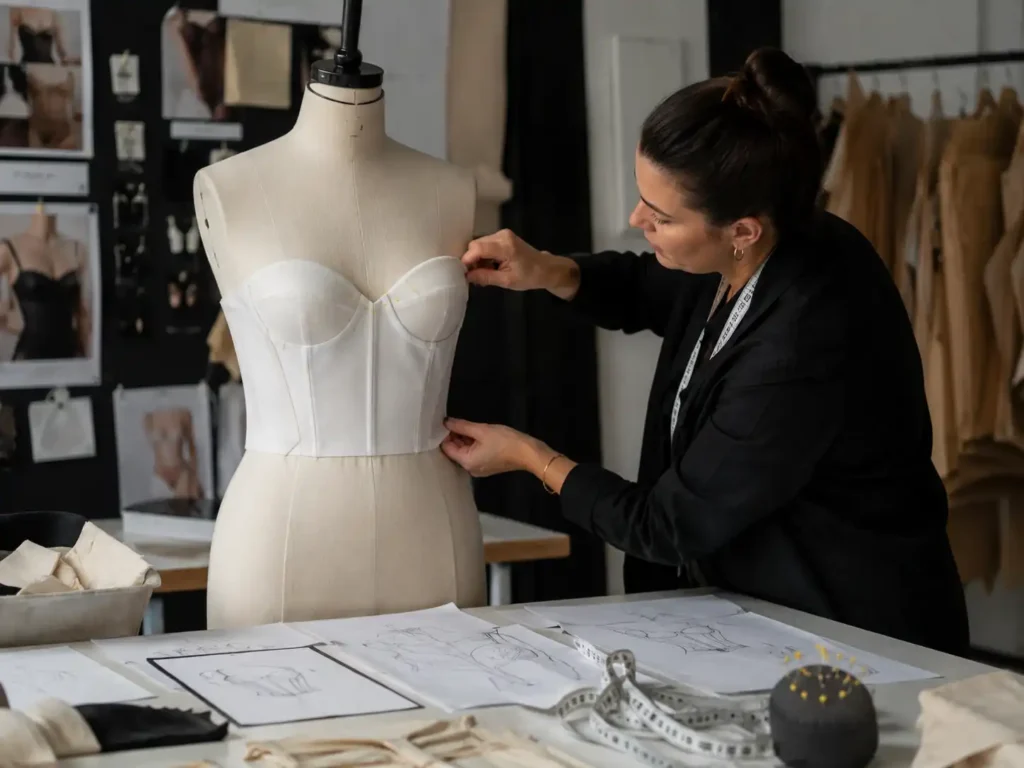
First Sample

Fit Sample

Revised Sample

Photo-Ready Sample

PP Sample
The pre-production sample is the key standard before bulk manufacturing. It confirms the final pattern, approved fabric, trims, measurements, construction, labels, packing requirements and quality expectations. Major changes after PP approval require a new review of production risk, cost and timing.

Golden Sample
Turn Fit Comments Into Controlled Sample Revisions
Sample correction becomes efficient when every comment is converted into a clear technical action. Jinfeng separates pattern, measurement, fabric, trim and construction issues so one correction does not accidentally create a new problem elsewhere.
Replace Vague Comments With Measurable Fit Feedback
“Too tight,” “not sitting right,” or “neckline looks strange” may describe a real issue, but they do not tell a pattern maker what changed on the body.
More useful feedback combines photos, measurements and movement observations:
- Front fitting photo
- Side fitting photo
- Back fitting photo
- Close-up neckline photo
- Garment measurements
- Body or fit-model context where available
- Arm-movement observation
- Exact location of pressure, looseness or twisting
For example, a neckline appearing too high may come from the neckline pattern itself, sleeve tension, bodice length or upper-bust fit. Cutting the neckline lower without diagnosis may create a new gapping problem.
Separate Pattern Problems From Material Problems
A fit issue may not always require a pattern change.
Common revision categories include:
Pattern: neckline shape, side seam, bust shaping, sleeve relationship, waist position or dress length.
Measurement: upper bust, bust, waist, hip, sleeve opening or finished length.
Fabric: stretch, recovery, weight, transparency, drape, shrinkage or hand feel.
Trim: elastic, cups, boning, zipper, hooks, support tape or decorative trim.
Construction: seam method, lining attachment, ruching distribution, zipper installation or edge finish.
Replacing the fabric can alter a previously approved fit. Increasing elastic tension can change movement. Adding lining can change stretch behavior. Every major correction is therefore reviewed in relation to the complete garment.
Record Revisions Before Moving Toward PP
A revision should not exist only in messages or memory. Development records can track sample version, original comments, revision location, measurement changes, pattern impact, fabric impact, trim impact, construction impact, cost impact, timing impact and next action.
The process reduces confusion when several styles are being developed at once. It also makes later PP confirmation more reliable because the final production standard can be traced back to approved corrections.
Once a PP sample is approved, major design or material changes should not be treated as casual adjustments. Pattern, cost, timing and production risk need to be reviewed again before bulk manufacturing continues.

Off-Shoulder Dress Fit Approval Checklist
Use a consistent fit checklist before approving a development sample. The aim is not to force every style into identical measurements, but to confirm that the agreed silhouette, exposure, support and movement remain balanced before grading and PP approval.
| Checkpoint | What to Review | Warning Signs |
|---|---|---|
| Neckline Position | Intended shoulder exposure in relaxed posture | Too high, too low or visually inconsistent |
| Neckline Symmetry | Left and right height and shape | One side higher, twisting or uneven gathering |
| Neckline Gap | Contact around upper bust and side areas | Opening away from body |
| Bust Coverage | Front and side security | Excess exposure or compression |
| Center Front Balance | Vertical positioning and shape | Pulling, collapse or excessive tension |
| Back Position | Back neckline height and stability | Dropping or pulling upward |
| Sleeve Opening | Comfort and proportion | Restriction or excess looseness |
| Arm Movement | Neckline behavior during movement | Severe riding-up or pulling |
| Recovery | Return after movement | Neckline remains stretched or displaced |
| Side Seam Balance | Vertical line and front/back distribution | Twisting toward front or back |
| Lining Position | Coverage and interaction with shell | Lining pulls or shows unintentionally |
| Finished Measurements | Approved POM values | Measurement outside agreed tolerance |
| Dress Length | Front/back balance | Riding up, uneven hem or incorrect proportion |
| Overall Silhouette | Brand-approved visual appearance | Fit correction changes original design character |
Grade Off-Shoulder Dresses Without Distorting the Neckline
Grading is where a successful base-size sample can become an inconsistent size run. Neckline opening, upper bust, bust, sleeve dimensions and garment length need coordinated grade rules rather than simple proportional enlargement.
Protect the Visual Exposure Across the Size Range
A larger size does not automatically require the neckline to grow at the same percentage as bust or body width. Excessive neckline growth can increase exposure and reduce stability. Too little growth can compress the upper body or change shoulder position.
The grading team therefore reviews connected measurements such as:
- Neckline opening
- Upper bust
- Full bust
- Back width
- Sleeve opening
- Upper arm
- Waist
Recheck Support and Movement in More Than One Size
A technically correct mathematical grade may still behave differently on the body.
For close-fitting or highly structured off-shoulder styles, a size-set review may be valuable to confirm whether neckline stability, bust coverage, sleeve opening and movement remain acceptable beyond the base size.
Large changes in bust proportion or upper-arm circumference can affect the balance between bodice and sleeve.
Stretch fabrics also introduce another variable because negative ease and recovery may need different treatment across a wider size range.
The objective is consistent design intent—not identical tension in every size.
Lock Grade Rules Before Bulk Cutting
Approved size charts should define the base size, complete size range, grade rules, measurement points and tolerances before bulk cutting begins.
Once the production pattern is released, uncontrolled changes increase the risk of size inconsistencies across styles or batches.
Development records therefore need to connect final fit approval with the production measurement standard used by cutting, sewing and QC teams.

Move the Approved Sample Into Controlled Bulk Production
A strong development sample is only valuable when its approved details can be repeated in production. Jinfeng connects PP approval with material confirmation, production instructions, in-line control, finished-garment inspection and packing standards.
Lock the Production Standard Before Cutting
Bulk preparation begins after the approved product standard is sufficiently clear. Depending on the project, production records cover style number, fabric, lining, trims, quantity, size range, colors, measurements, construction, labels and packing requirements.
PP sample approval confirms the final pattern, fabric, trims, measurements, construction, labels, packing and QC direction.
Major changes introduced afterward need another assessment because a revised fabric, neckline structure or trim can affect both production feasibility and fit.
Match Production Capacity to Collection Structure
Jinfeng Apparel operates a structured womenswear production system with 6 owned women’s fashion factories, 10+ long-term satellite production partners, 18+ sewing lines, 6+ flexible production lines and 100,000+ pcs monthly capacity.
Capacity is not presented as a reason to rush every project. Its value lies in supporting multi-style, multi-fabric, multi-color and multi-size programs while allowing production planning to match product construction.
Knit-focused styles, woven dresses, occasionwear and complex-fabric products may require different production allocation.
Keep Production Close to the Approved Sample
Before bulk proceeds through all stages, sewing and QC teams need access to the approved standards. In-line checks can identify measurement, sewing, neckline, sleeve or construction issues while production is still underway rather than waiting until finished garments are packed.
Bulk control then continues through finishing, pressing, garment inspection and packing.
The approved sample, measurement sheet and production information work together as reference points rather than relying on visual memory alone.
Quality Control for Off-Shoulder Dress Production
Neckline Symmetry
Neckline Stability
Bust Coverage
Sleeve Position
Fabric Recovery
Measurement Accuracy
Lining Alignment
Finished Appearance
Cost Factors Behind Off-Shoulder Dress Development
Fabric and Lining
Pattern Complexity
Support and Trims
Sewing Construction
Ruching, double layers, delicate mesh, lace placement, complex sleeve construction, hand-applied decoration or special finishing can increase sewing time and quality-control requirements.
Size and Color Program
Quantity and Delivery
Jinfeng Apparel’s garment MOQ starts from 200 pcs per style/color. Special fabrics, exclusive colors, trims, labels or packaging may carry separate supplier minimums. Production timing is evaluated after fabric availability, construction, order structure and delivery requirements are confirmed.
Private Label Packing and Export Delivery Support
Private Label Details
Retail-Ready Packing
Export Delivery
An Off-Shoulder Collection Development Project in Practice
A collection project becomes more demanding when multiple neckline structures, fabrics, colors and size ranges are developed at the same time. The following anonymized project profile reflects the scale of current established-brand programs while protecting design and brand information.
Collection Scope and Initial Development Risks
An established US occasionwear program can involve approximately 18 styles and around 42,000 garments across the full order, sitting within Jinfeng’s current brand-order range of roughly 10–30 styles and 20,000–80,000 pieces per brand program.
The collection direction combined off-shoulder mini, fitted midi and occasion styles using satin, stretch fabrics, lace and mesh effects.
The primary development difficulty was not creating the visual silhouette. It was keeping neckline exposure and upper-body fit consistent across several different constructions.
Typical development risks included:
- Stretch styles returning differently after arm movement
- Satin styles showing bust or neckline gapping
- Sleeve volume changing the pull on the neckline
- Lace or mesh layers requiring different support methods
- Different base constructions needing separate grade rules
- Fit comments accumulating across several styles at the same time
A single correction rule could not be copied across the collection because material and construction behavior differed from style to style.
Pattern, Fit and Sample Correction Approach
The development workflow began by separating styles according to structure rather than treating all 18 as one off-shoulder category.
Stretch-based styles were reviewed for stretch direction, recovery, negative ease and upper-edge tension. Woven occasion styles received greater attention to pattern shaping, bust support, lining and closure construction. Lace and mesh versions required additional review around transparency, neckline finishing and internal structure.
Fitting comments were converted into style-specific revision actions. Where a neckline rode upward during arm movement, the team reviewed sleeve relationship and bodice tension rather than automatically increasing neckline size. Where bust gapping appeared, upper-bust shape and neckline curvature were examined before reducing the entire upper edge.
Sample records separated:
- Pattern corrections
- Measurement changes
- Fabric changes
- Trim changes
- Construction corrections
- Fit approval status
- PP preparation
Grading, PP Approval and Bulk Control
After key fits were approved, production preparation moved toward size grading and PP standards. Neckline opening, upper bust, sleeve opening and dress length were reviewed as connected measurements rather than independent grade points.
PP samples confirmed final pattern, fabric, trims, construction, labels, packing and measurement direction before bulk cutting.
During production, control focused on the details most likely to change the collection’s visual consistency:
- Neckline symmetry
- Bust coverage
- Sleeve position
- Stretch recovery where applicable
- Critical measurements
- Lining alignment
- Zipper and seam appearance
- Pressing and finished presentation
The same collection logic also supports later repeat orders because approved pattern files, measurement records, material references and production notes can be retained for the next color, fabric variation or seasonal continuation.
The value of a development partner becomes most visible at collection scale: managing 18 styles requires more than producing 18 separate samples. The factory needs a repeatable method for turning many fit decisions into controlled production instructions.

Repeat Orders With Protected Development Records
Repeat Production Records
Design and File Protection
Test Launch Repeat
Off-Shoulder Dress Development Frequently Asked Questions
Neckline stability is reviewed through pattern position, upper-bust fit, fabric behavior, support construction and elastic specification where applicable. Tightening the edge alone may create discomfort or riding-up. A development sample is used to identify the actual cause before the pattern or construction is corrected.
The sleeve-to-bodice relationship is reviewed together with sleeve opening, upper-arm allowance, neckline tension and fabric behavior. Movement testing helps show where force is transferred into the neckline. Correcting sleeve angle or pattern balance may be more effective than simply making the neckline larger.
Upper-bust measurement, bust projection, neckline shape, side coverage, lining and support level are developed together. Structured styles may use cups, boning or other support when appropriate, while stretch styles rely more on fabric recovery and controlled fit. The final approach follows the approved design.
Satin, jersey, knit, mesh, lace, chiffon and velvet can all be developed into off-shoulder dresses, but the pattern and support method differ. Fabric selection should consider stretch, recovery, weight, drape, transparency, surface sensitivity, lining requirements and the intended silhouette.
Yes. A reference image can start development, but additional information is normally required to establish a production direction. Useful details include fabric preference, neckline position, dress length, lining, closure, size range, planned quantity, target market and fit preference.
A first sample should confirm the core silhouette, neckline position, bust proportion, sleeve relationship, fabric direction, lining, dress length and construction feasibility. The purpose is to expose technical issues early. A first sample does not need to be treated as the final bulk-production standard.
Brands can provide front, side, back and detail fitting photos together with measurements and specific comments. Jinfeng separates feedback into pattern, measurement, fabric, trim, lining and construction issues, then records the approved revision before making the next sample or moving toward PP approval.
Grade rules consider neckline opening, upper bust, full bust, sleeve opening, waist, hip and garment length as connected dimensions. Jinfeng can work with US, UK, EU and AU standards, XS–XL alpha sizing, extended sizing, plus sizes and brand-specific size charts according to project requirements.
The PP sample confirms the final pattern, approved fabric, trims, measurements, construction, labels, packing and QC direction. Major design, fabric or construction changes after PP approval need another review because they can affect fit, price, timing and production risk.
Send the available tech pack, reference image, sketch, line sheet or original sample along with the intended quantity, size range, colors, fabric preference, launch timing and private-label requirements. More complete information allows a more accurate review of structure, sourcing, sampling, MOQ, costing and production planning.

Start Your Off-Shoulder Dress Development Project
A strong off-shoulder collection begins with clear design information and early technical review. Send Jinfeng Apparel the files already available to your team, and the development team can assess neckline structure, fabric direction, pattern requirements, fit risks, sample planning and production feasibility before the project moves toward bulk manufacturing.
For a more accurate first review, include:
- Product type or collection direction
- Tech pack, line sheet, sketch or reference images
- Size chart and intended size range
- Fabric preference or required fabric performance
- Planned colors
- Quantity by style and color where available
- Target production price when relevant
- Desired launch schedule
- Private-label requirements
- Packaging requirements
- Shipping destination
- Original sample when development is based on an existing approved product


