OEM Dress Production Partner for Multi-Color Collections

Multi-color dress manufacturing for established fashion brands managing coordinated colorways, size ranges, launch dates, retail packaging, and repeat-order programs.

  • Structured for collection programs containing 10-30 dress styles, coordinated fabric groups, and several approved colorways per style.
  • Standard production MOQ starts from 200 pcs per style/color, with size quantities allocated inside each approved style-color combination.
  • Production planning can support collection orders in the 20,000-80,000 pcs range, subject to product complexity, material readiness, approval status, and delivery calendar.
  • Color control covers Pantone or physical standards, lab dips, bulk fabric review, lining and trim matching, PP approval, shade monitoring, SKU packing, and repeat-order records.

Jinfeng Apparel coordinates fabric sourcing, pattern development, sampling, color approval, bulk production, quality control, private-label packing, and export delivery through a structured womenswear manufacturing team in Guangdong, China.

Manufacturing Scale for Multi-Color Dress Programs

Multi-color collections require more than sewing capacity. Development teams must control style files, fabric groups, approved shades, sample status, size ratios, production allocation, quality records, and packing data across the full collection.

Since 2008

Jinfeng Apparel has focused on custom women’s fashion manufacturing since 2008. Long-term experience covers dresses, occasionwear, partywear, bodycon styles, corset structures, satin, mesh, lace, sequin garments, jumpsuits, matching sets, and private-label programs. The team understands how one approved base style becomes several commercial colorways without losing fit, construction, or presentation standards.

Six Owned Factories

Six owned women’s fashion factories provide a stable base for development and bulk production. Collection allocation is planned according to fabric behavior, dress structure, sewing complexity, launch priority, and inspection requirements. Satin slips, corset dresses, mesh styles, sequined products, and clean woven silhouettes are not automatically assigned to the same production route.

Ten Plus Partners

More than ten long-term satellite production partners expand capacity for multi-style and multi-batch programs. Partner allocation is controlled through confirmed patterns, size charts, approved fabrics, trim references, sewing instructions, QC points, labels, and packing files. The model supports collection scale without treating every factory as interchangeable.

Two Sample Rooms

Two sample rooms support first samples, fit samples, revised samples, photo-ready samples, salesman samples, PP samples, and Golden samples. Multi-color programs often require different approval routes for fit, color, lining, trims, transparency, and campaign samples. Separate sample planning helps prevent color approval from delaying pattern correction.

Seven Pattern Makers

Seven-plus senior womenswear pattern makers manage bust, waist, hip, neckline, armhole, strap length, slit height, hem balance, lining coverage, and jumpsuit rise. Final patterns and grade rules are controlled before bulk release so different colors follow the same approved fit standard unless fabric behavior requires a documented adjustment.

Fifteen QC Inspectors

Fifteen-plus QC inspectors cover incoming materials, cutting, sewing, inline checks, measurement, final garments, pressing, packing, and AQL support. Multi-color programs add shade, dye-lot, lining-color, thread-color, zipper-color, SKU, barcode, and carton-breakdown checks to the normal garment inspection flow.

Built for Structured Collection Production

A strong production match begins with a clear line sheet, planned color quantities, defined size ranges, approved commercial standards, and a realistic launch calendar. Jinfeng Apparel works best when development and bulk decisions are documented early.

Collection-Driven Programs

Suitable programs usually contain multiple dress styles, several coordinated colors, private-label requirements, and a planned bulk quantity. Brand teams may provide tech packs, original samples, sketches, reference garments, line sheets, Pantone codes, fabric targets, or previous production standards. Jinfeng Apparel reviews each style as part of the total assortment rather than quoting isolated garments without collection context.
Production planning can cover seasonal launches, occasionwear capsules, party collections, resort edits, ecommerce drops, retail assortments, core-color replenishment, and new-color extensions. Project priorities are ranked by campaign date, sales importance, fabric readiness, fit risk, and production complexity.

Defined Production Inputs

Accurate planning requires confirmed style numbers, color names or codes, quantity per style/color, size ratio, target fabric, lining direction, trim standard, label artwork, barcode file, packing instruction, delivery window, and inspection requirement. Missing inputs create avoidable revisions in material purchasing, sample approvals, costing, production allocation, and carton planning.
Jinfeng Apparel reviews the available files first, identifies unresolved points, and builds an approval route before bulk commitment. Clear boundaries protect collection timing and reduce late-stage changes after fabric, trims, labels, or packaging materials have entered production.

Where Multi-Color Collections Lose Control

Collection risk rises when one style becomes several colors and every color expands into multiple sizes and SKUs. Early controls keep color, fit, workmanship, packing, and delivery aligned across the full assortment.

Unapproved Bulk Shade

A Pantone number alone does not guarantee the final shade on satin, chiffon, jersey, mesh, lace, or lined woven fabric. Fiber content, base fabric, dye method, surface shine, finishing, and lighting can change the visual result. Bulk purchasing should follow an approved lab dip, fabric swatch, or physical color standard rather than a screen image.

Light-Color Transparency

Ivory, white, blush, pale yellow, powder blue, and soft neutral colors can expose seam allowances, cups, boning, labels, pocket bags, or undergarments. Transparency must be reviewed on the selected fabric and lining combination. A fit sample approved in black may still require a separate coverage review in the lightest commercial color.

Fabric Behavior Shifts

Different dye lots or color depths can influence hand feel, stretch, recovery, shrinkage, surface friction, drape, and pressing response. Dark jersey may recover differently from a pale version, while satin sheen can make one shade appear lighter from another direction. Color approval must include garment performance, not shade alone.

Trim Color Mismatch

Zippers, threads, linings, cups, elastic, boning channels, buttons, hooks, straps, labels, and packaging stickers form part of the color system. A correct shell fabric can still look inconsistent when supporting components are too warm, too cool, too bright, or visibly different under retail lighting.

SKU Packing Errors

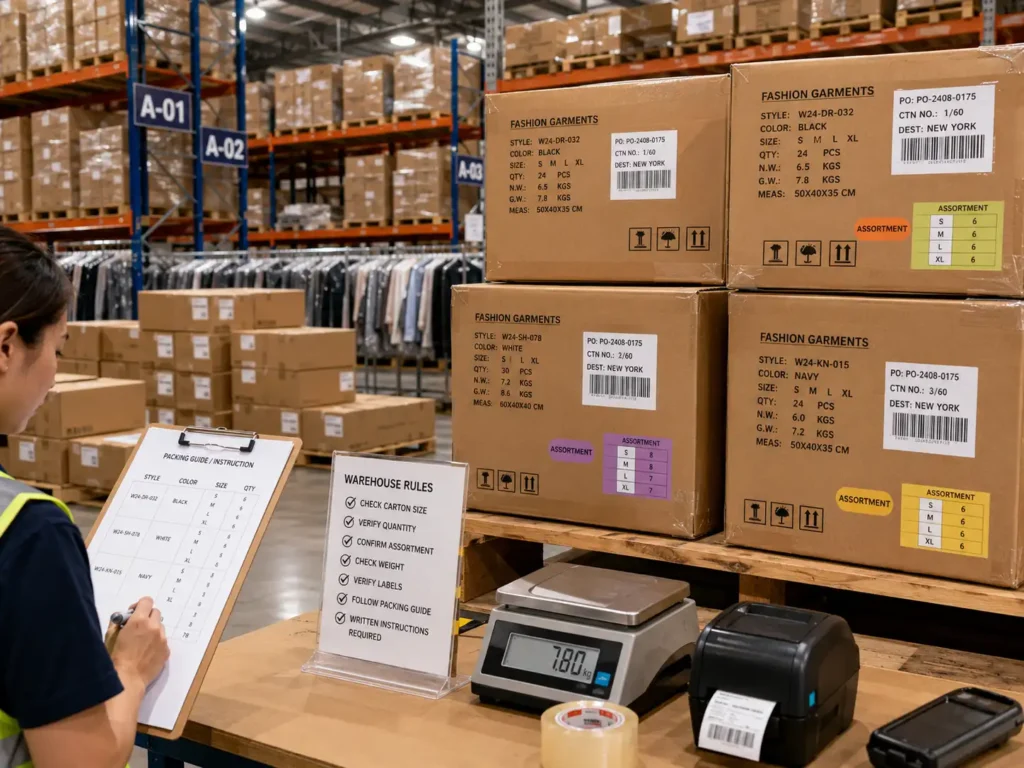
One style offered in four colors and five sizes creates twenty SKUs before any regional barcode or warehouse variation. Incorrect color codes, size stickers, polybag labels, carton ratios, or mixed-color cartons can delay receiving even when garment quality passes inspection. Packing control begins with an approved SKU master file.

Approval Delays

Color development, fit correction, trim sourcing, label approval, and packaging approval often move at different speeds. A collection can miss photography or warehouse dates when decisions are treated as one final approval. Jinfeng Apparel separates workstreams, records status by style and color, and escalates items that block material purchasing or PP release.

Dress Categories Developed Across Coordinated Colorways

Different dress categories react differently to color, fabric, lining, structure, and finishing. Jinfeng Apparel builds colorway plans around the construction and sales role of each product rather than applying one method to every dress.

Mini Midi Maxi

Mini, midi, and maxi lengths require consistent fit and hem balance across all colors. Light shades may need fuller lining coverage; long satin or chiffon styles require direction control and careful pressing; mini lengths require reliable garment length and slit safety. Color planning also considers whether the same fabric weight and opacity remain suitable across the full range.
  • Review: length, hem balance, lining depth, slit height
  • Color risk: transparency, directional shine, dye-lot variation
  • Bulk control: final pattern, grade rule, measurement points

Party Cocktail Dresses

Party and cocktail dresses often combine fitted shapes, ruching, mesh, lace, sequins, rhinestones, cut-outs, and statement trims. Strong colors can highlight puckering, uneven ruching, adhesive marks, or construction asymmetry. Each colorway needs compatible lining, thread, zipper, elastic, and decorative components, especially when bright and dark colors share one collection.
  • Review: silhouette, visual symmetry, camera appearance
  • Color risk: trim mismatch, sequin shade, surface marks
  • Bulk control: placement standards and finishing checks

Occasion Evening Dresses

Occasion and evening dresses may use satin, chiffon, lace, mesh overlays, long hems, draped panels, internal support, and layered lining. Color affects formality, opacity, shine, and visual weight. Deep jewel tones, pale neutrals, and metallic shades may need different sampling evidence even when the pattern remains unchanged.
  • Review: drape, support, layer balance, hem finish
  • Color risk: shine shift, lining contrast, shade bands
  • Bulk control: panel direction, pressing, garment protection

Bodycon Corset Styles

Bodycon and corset dresses depend on stretch recovery, bust shaping, waist control, hip ease, cups, boning, elastic, and lining stability. A fabric offered in several colors must maintain comparable stretch and recovery. Dark and light versions can reveal different seam, cup, and boning impressions on the body.
  • Review: bust, waist, hip, recovery, support
  • Color risk: show-through, stretch variation, lining visibility
  • Bulk control: measurement tolerance and fit checkpoints

Satin Chiffon Dresses

Satin and chiffon bring strong color value but require disciplined handling. Satin reveals directional shade, snagging, pressing marks, seam tension, and surface contamination. Chiffon reveals layer density, transparency, puckering, and color variation between shell and lining. Multi-color production must keep grain direction, panel orientation, lining choice, thread, and finishing aligned.
  • Review: drape, shine, layer count, seam quality
  • Color risk: optical shade shift, transparency, bulk mismatch
  • Bulk control: direction markers and protected finishing

Mesh Lace Sequin

Mesh, lace, and sequin dresses often require several related colors across shell, lining, embroidery, thread, elastic, and trims. Lace motifs can look different on light and dark grounds; mesh transparency changes with color depth; sequin surfaces may reflect surrounding tones. Colorway approval should assess the complete garment rather than a small shell swatch alone.
  • Review: motif placement, coverage, skin exposure, comfort
  • Color risk: component mismatch and reflective variation
  • Bulk control: placement, loss prevention, inspection lighting

Information Needed for a Reliable Collection Review

A complete brief allows the development, merchandising, fabric, pattern, costing, production, QC, and packing teams to evaluate the same collection structure. Early clarity improves quotation accuracy and approval timing.

Line Sheet

Provide style names or numbers, front and back views, color plan, product priority, target launch, and any carryover styles. A line sheet shows how individual dresses connect as a commercial assortment and helps identify shared fabrics, shared trims, repeated pattern blocks, and campaign-critical products.

Tech Packs

Tech packs should include construction notes, measurement charts, grade rules, stitch requirements, label placement, artwork, and packaging instructions where available. Jinfeng Apparel can review incomplete files, but unresolved production details will be listed before sampling or quotation is finalized.

Color Standards

Submit Pantone references, physical swatches, previous garments, approved color cards, or digital targets with the intended fabric base. Physical standards are preferred for sensitive shades, brand colors, satin, lace, mesh, and any program requiring repeat-order consistency.

Quantity Plan

List quantity per style, color, and size. MOQ is calculated by style and color, not by the total assortment. A quantity plan also reveals whether fabric purchasing, trim development, cutting efficiency, production allocation, and packing ratios are commercially workable.

Size Range

Confirm size names, body standard, garment measurements, tolerance, grade rules, and market. Extended sizes may require separate consumption, pattern balance, fit review, and sample verification. Size ratios should reflect sales data rather than equal distribution by default.

Fabric Direction

Share preferred fiber content, weight, stretch, hand feel, drape, opacity, finish, certification needs, and target price. Reference photos without fabric information can produce very different results, particularly for satin, jersey, mesh, lace, chiffon, velvet, and structured woven dresses.

Private Label Files

Provide woven-label artwork, care-label content, size-label system, hangtag files, barcode list, SKU list, polybag sticker format, carton marks, and warehouse labels. Artwork, wording, position, dimensions, and color must be approved before production.

Delivery Calendar

State campaign sample date, PP deadline, bulk ex-factory target, warehouse date, destination, freight plan, and any planned split shipment. A realistic calendar must include material lead time, approvals, production, inspection, packing, export files, and transit.

Select the Right Color Development Route

Colorway strategy changes MOQ, lead time, cost, repeatability, and approval work. The correct route depends on fabric availability, commercial shade importance, total volume, launch timing, and future replenishment plans.

Stock Fabric Colors

Stock colors are the fastest route when the approved shade, fabric quality, weight, stretch, drape, opacity, and availability meet the collection requirement. Jinfeng Apparel checks current stock, lot continuity, minimum cut quantity, replenishment risk, and suitable matching materials before recommending a stock option. Stock colors can reduce dyeing lead time and material MOQ, but availability must be locked before bulk ordering. A color shown during sampling may sell out or be replaced by another lot, so the production reference and reserved quantity should be documented. Stock shades are most effective when the collection calendar is tight and exact proprietary color matching is not essential.
  • Best for: commercial core colors and time-sensitive launches
  • Approval: physical swatch or sample garment
  • Main risk: stock changes between sample and bulk

Custom-Dyed Colors

Custom dyeing is used when a collection requires a specific Pantone, proprietary shade, coordinated brand palette, or repeatable seasonal color. The process normally includes fabric-base confirmation, lab dip development, color review, approved standard, bulk dyeing, shade-band review, and production release. Material suppliers may apply dyeing MOQ above the garment MOQ. Shade behavior also depends on fiber content, fabric construction, finish, and surface shine. Jinfeng Apparel confirms material MOQ, expected lead time, color tolerance, bulk lot plan, and repeat-order feasibility before commitment. Custom dyeing offers stronger color control but needs disciplined approvals and an earlier calendar.
  • Best for: signature palettes and high-volume colorways
  • Approval: lab dip plus bulk-color confirmation
  • Main risk: approval rounds and material lead time

Custom Printed Colorways

Printed dresses require approval of artwork scale, repeat, placement, base cloth, strike-off color, printing method, and garment panel layout. A digital artwork file can appear different after printing because fabric absorbency, surface texture, color profile, and finishing change the final result. For placement prints, panel position must align with the approved garment pattern. For repeat prints, scale and motif direction must remain consistent across sizes. Jinfeng Apparel reviews strike-offs, print hand feel, color fastness requirements, cutting direction, placement tolerance, and supplier MOQ before bulk production.
  • Best for: exclusive motifs and coordinated collection stories
  • Approval: strike-off or printed sample panel
  • Main risk: color shift, placement, and print-material MOQ

Color Approval from Standard to Bulk Fabric

Color approval is treated as a recorded production process. Every decision links the visual standard to a specific fabric base, lot, lining, trim set, garment sample, and production release status.

Establish an Approval Standard Before Dyeing

A reliable color standard begins with more than a color name. “Burgundy,” “sage,” “ivory,” or “navy” can refer to many commercially different shades. Jinfeng Apparel records the Pantone reference, physical swatch, approved garment, fabric construction, fiber content, surface finish, and viewing condition used for evaluation.

Reference hierarchy: A physical approved swatch or garment offers stronger control than a screen image. Pantone information helps define direction, but the selected color must still be reviewed on the production fabric because satin shine, mesh transparency, lace texture, jersey stretch, and chiffon layering can alter perception.

Fabric-base confirmation: Lab dips should be made on the intended fabric quality whenever possible. A shade approved on polyester satin cannot automatically approve the same shade on mesh, lace, lining, or elastic. Each visible component may need a coordinated standard rather than an identical numeric reference.

Viewing conditions: Color decisions should consider natural light, indoor light, photographic conditions, and the final sales environment. Jinfeng Apparel can provide controlled comparison photos, but physical approval remains preferable for sensitive shades. Approval comments are documented as too light, too dark, too yellow, too red, too grey, too bright, or outside the desired depth, allowing the next submission to address a defined issue.

Lock Lab Dips, Shade Bands, and Bulk Release

After a lab dip is approved, the record becomes the reference for bulk dyeing. Approval does not remove all production variation; it creates a defined target and tolerance for evaluating bulk fabric. Jinfeng Apparel links the approved lab dip to the style-color code, material specification, supplier, expected quantity, lining direction, trim set, and required delivery date.

Bulk-color review: Bulk fabric is checked against the approved standard before cutting. The review covers overall shade, lot consistency, width, weight, hand feel, shrinkage, stretch, recovery, defects, surface marks, and colorfastness requirements where applicable. Satin also requires direction review because the same shade can appear different when panels are turned.

Shade-band control: Where a supplier provides shade bands or several rolls vary slightly, acceptable ranges are reviewed before cutting allocation. Rolls from different dye lots should not be mixed casually inside one garment or one visual set. Cutting plans can separate lots by style, color, size, shipment, or production batch when needed.

Release discipline: Cutting starts only after color and material status are approved for production. Any change after PP lock can affect cost, delivery, labels, packaging, and collection consistency. Updated approvals must be recorded rather than handled through informal messages alone.

Match Every Visible Component Across Colorways

A dress colorway is a complete material system. Shell fabric, lining, thread, zipper, support components, trims, labels, and packaging must work together under close viewing, photography, wear, and retail inspection.

Linings and Coverage

Lining selection considers color harmony, opacity, stretch compatibility, hand feel, static, seam visibility, and garment structure. Light shell colors may require tonal lining with enough coverage to hide cups, boning, seams, pocket bags, or labels. Mesh and lace styles may use deliberate contrast, but the result must follow the approved design rather than accidental mismatch.
  • Confirm lining shade and fabric quality
  • Review shell-to-lining color under light
  • Check coverage on body and dress form
  • Reconfirm after any shell-fabric change

Zippers and Threads

Invisible zippers, exposed zippers, sewing thread, overlock thread, and topstitch thread can create visible color breaks. Jinfeng Apparel reviews shade, tape color, teeth or puller finish, seam appearance, zipper flatness, and availability. Matching must also consider whether the component remains visible when the garment stretches, moves, or is photographed closely.
  • Approve zipper tape and puller finish
  • Match sewing and overlock thread
  • Check puckering and zipper waviness
  • Record approved component codes

Support Components

Corset and strapless dresses may contain cups, boning, channels, elastic, clear straps, anti-slip tape, hooks, and internal reinforcement. Light colors can expose internal components, while deep colors may require matching channels and elastic. Material comfort, stiffness, recovery, and skin contact matter alongside color.
  • Review cup shape and cover color
  • Select boning hardness and channel tone
  • Check anti-slip position and comfort
  • Verify support after fit correction

Labels and Packaging

Woven labels, size labels, care labels, hangtags, strings, barcode stickers, color stickers, polybags, tissue, and carton marks must follow the approved style-color-size structure. Packaging colors should support the brand presentation without causing transfer, staining, or identification errors. Each component is checked against artwork, placement, SKU data, and packing instructions.
  • Match label artwork and position
  • Link barcode to style-color-size
  • Confirm color and size stickers
  • Verify carton marks and ratios

Sampling Strategy for Multiple Dress Colorways

Sampling should separate fit approval from color, material, trim, photography, and production approval. A planned sample matrix controls cost and time without overlooking high-risk colorways.

Build the Fit Standard on the Correct Fabric

The first development priority is a reliable garment shape. Jinfeng Apparel uses the relevant sample stage to review bust, waist, hip, neckline, armhole, straps, length, slit, lining, support, movement, and overall appearance. The selected fabric should represent bulk behavior closely enough to validate drape, stretch, recovery, transparency, thickness, and construction.

A black sample may be useful for fit, but it cannot approve coverage for ivory, optical white, blush, or pale mesh. A non-directional fabric cannot fully approve satin panel direction. A temporary trim can help test construction, but it cannot approve final visual quality. Sample status is therefore recorded by purpose rather than treating one garment as approval for every production variable.

Typical development sequence: first sample for design translation, fit sample for body and measurement review, revised sample for corrections, photo-ready or salesman sample for commercial use, PP sample for final production standard, and Golden sample for reference during bulk and repeat orders.

Sample timing depends on style complexity and material availability. Clean dresses may move faster than corset, lace-placement, sequin, hand-finished, or multi-layer styles. Revisions also depend on the completeness and clarity of feedback.

Decide Which Colors Need Full Garment Samples

Not every colorway needs the same physical sample, but risk should determine the decision. Jinfeng Apparel can propose a matrix using full garments, fabric swatches, lab dips, trim cards, lining combinations, or PP color confirmations.

Full-garment samples are usually valuable for: light colors with transparency risk; hero colors used in campaigns; custom-dyed shell and lining combinations; reflective or directional fabrics; contrast-color construction; lace, mesh, sequin, or printed styles; colors using different trims; and any color where visual performance cannot be judged from a small swatch.

Swatch or component approval may be sufficient for: stable stock colors on the same approved fabric; secondary colors using identical lining and trims; or carryover shades with reliable records and current material availability. Final suitability still depends on the garment category and brand standard.

Before PP release, fabric, color, trims, measurements, construction, labels, hangtags, polybags, carton marks, and packing method must be locked. Changes after PP approval require impact review because material orders, production files, costing, and delivery may need revision.

How Color Changes Fabric Performance

Shade development can change more than appearance. Fabric construction, dye depth, finish, and lot conditions can influence opacity, stretch, recovery, drape, shrinkage, hand feel, pressing, and garment comfort.

Opacity and Coverage

Light colors frequently transmit more light than dark colors, exposing lining edges, seam allowances, pocket bags, cups, boning, labels, and body contours. Coverage testing should use the actual shell and lining combination. Mesh, lace, chiffon, and pale satin may require different layering, lining depth, cup color, or seam treatment from the darkest colorway.
  • Check under natural and indoor light
  • Review on body or dress form
  • Compare dry and stretched areas
  • Confirm label and support visibility

Stretch and Recovery

Dyeing and finishing can affect the way stretch fabrics feel and recover. Bodycon dresses, fitted jersey styles, corset panels, mesh inserts, elasticated details, and jumpsuits rely on stable extension and return. Jinfeng Apparel compares fabric direction, stretch percentage, recovery, hand feel, shrinkage, and fitted-garment measurements before assuming all colors behave identically.
  • Confirm stretch direction before cutting
  • Compare dark and light lots
  • Review side seams and hip recovery
  • Recheck measurements after pressing

Drape and Surface

Satin, chiffon, velvet, crepe, rayon, lace, and sequined materials can appear heavier, lighter, shinier, flatter, or more textured by color. Surface reflection can make shade variation look stronger in photographs. Finishing may also influence friction, snagging, wrinkling, or pressing response. Bulk review should consider garment movement and visual effect, not only a flat color card.
  • Assess drape on the intended silhouette
  • Control directional nap or shine
  • Review pressing temperature and marks
  • Protect delicate surfaces in packing

CTA 1: Compare Fabric Behavior
CTA 2: Request Swatch Review

Design and Fit Controls by Dress Structure

The same approved color can reveal different construction risks across silhouettes. Pattern, support, lining, seam, and finishing controls are adjusted to the dress structure and fabric behavior.

Bodycon and Ruched

Bodycon dresses depend on bust-waist-hip balance, stretch recovery, side-seam stability, lining compatibility, and controlled ruching. Light colors expose tension, undergarment lines, seam allowance, and uneven gathers more readily. Dark colors can hide surface issues during quick inspection, so dimensional and construction checks remain essential across every shade.
  • Lock stretch direction and recovery standard
  • Define ruching start, end, and density
  • Check side-seam alignment under tension
  • Measure before and after pressing
  • Review coverage in the lightest color

Corset and Strapless

Corset and strapless styles require cup shape, boning, waist control, anti-slip support, neckline security, and smooth internal finishing. Different colors may use different cup covers, channels, elastic, or lining because internal components must remain invisible. Fabric thickness and stretch also affect support, meaning a colorway cannot be released solely on shell shade.
  • Confirm cup, boning, and channel construction
  • Check neckline stability and underarm coverage
  • Review internal components through shell fabric
  • Test zipper, hook, and anti-slip function
  • Lock PP measurements before bulk

Satin Slip and Draped

Slip and draped dresses rely on grain direction, shoulder-strap length, neckline coverage, bias behavior, seam smoothness, and hem balance. Satin highlights puckering, twisting, pressing marks, and directional color shifts. Each colorway must follow panel orientation and protected handling from cutting through final packing.
  • Mark grain and face direction clearly
  • Control seam tension and zipper flatness
  • Check strap length and neckline security
  • Hang-test long or bias-cut garments
  • Use protective finishing and packing methods

Mesh Lace Sequin

Mesh, lace, and sequin constructions require stable placement, controlled transparency, skin comfort, reinforcement, motif balance, and loss prevention. Color contrast between shell, lining, thread, elastic, and embellishment can strengthen or weaken the intended design. Inspection includes holes, snags, loose sequins, sharp edges, visible joins, and inconsistent placement.
  • Approve lace or sequin placement map
  • Check shell-lining color relationship
  • Reinforce stress points and openings
  • Protect skin-contact areas
  • Inspect under consistent lighting

Organize Multi-Style Production Without Losing Control

A 10-30 style collection requires a working structure for files, fabrics, samples, factories, quality checkpoints, packaging, and delivery. Jinfeng Apparel organizes the assortment before releasing materials or production orders.

Group Styles by Fabric, Risk, and Launch Priority

The first planning layer separates styles by shared materials and construction. Satin styles may share shell colors and lining families; mesh and lace styles may share related tones but require different coverage standards; bodycon jersey styles may use a common stretch base; corset dresses need support-component planning; sequined styles require specialized handling and longer inspection.

Fabric groups: Styles using the same approved base fabric and colors can improve purchasing efficiency, shade coordination, trim planning, and repeat-order records. Shared fabric does not remove the need for separate pattern, construction, and consumption review.

Risk groups: Fit-sensitive, transparent, directional, embellished, long-hem, or internally structured styles receive earlier sampling and stronger PP controls. Commercial carryovers with stable records may move through a shorter review route after current materials are reconfirmed.

Priority groups: Campaign hero products, showroom samples, wholesale-meeting styles, launch-day colors, and warehouse-critical products are identified in the line sheet. Sample and production capacity is scheduled around business importance rather than style number order alone.

Transfer Approved Data into Factory and QC Files

Approved information must move from development into bulk without relying on memory. Jinfeng Apparel creates or follows controlled production references covering final pattern, size chart, grade rule, BOM, fabric standard, color approval, trim card, sewing instruction, label placement, packing instruction, QC checklist, and Golden sample.

Factory allocation: Styles are assigned according to construction, fabric, order volume, delivery window, and quality requirement. Multi-factory production is coordinated through shared approval standards, merchandising follow-up, progress reporting, and inspection points.

Status control: Each style-color combination can be tracked through material status, sample status, PP approval, cutting, sewing, inline inspection, finishing, packing, and shipment preparation. Delayed approvals are identified before they block the entire collection.

Change control: Any post-approval change to fabric, color, measurements, trims, labels, packaging, quantity, or delivery plan is reviewed for cost and timing impact. Updated files replace outdated instructions so production and inspection teams work from the same version.

OEM Workflow from Line Sheet to Delivery

A controlled workflow links every style, color, size, material, approval, production record, packing instruction, and shipment document. Timing is confirmed after the collection scope and material route are reviewed.

StageMain WorkApproval or Output
Collection ReviewLine sheet, tech packs, style-color-size matrix, target quantity, launch calendarDevelopment and quotation plan
Fabric DirectionStock search, custom dyeing route, print route, lining and trim optionsFabric shortlist and MOQ impact
Pattern DevelopmentPattern analysis, measurement review, structure and fit planningFirst pattern and sample instructions
Sample DevelopmentFirst, fit, revised, photo-ready, salesman, or color samplesRecorded sample comments
Color ApprovalPantone or physical standard, lab dip, strike-off, swatch, component matchingApproved color reference
PP LockFinal fabric, color, trims, measurements, construction, labels, packagingApproved PP sample and production file
Bulk ProductionMaterial inspection, cutting, sewing, inline checks, pressing, finishingControlled bulk output
Final QC and PackingMeasurement, appearance, shade, labels, barcode, SKU, polybag, carton checksInspection and packing records
DeliveryPacking list, carton data, commercial files, freight coordination, split shipment where agreedExport-ready delivery

MOQ Planning by Style, Color, and Size

Jinfeng Apparel’s standard garment MOQ starts from 200 pcs per style/color. Material, printing, dyeing, trims, labels, and packaging may carry separate supplier minimums. Size quantities are planned inside each approved style-color combination.

Order StructureMOQ InterpretationPlanning Note
1 style x 1 color x 200 pcsMeets the standard garment MOQSize ratio can be allocated inside 200 pcs
1 style x 2 colors x 200 pcs eachMeets the standard garment MOQTotal 400 pcs; each color is planned separately
1 style x 2 colors x 100 pcs eachNormally below the standard per-color MOQCannot be treated as one 200-pc color quantity
10 styles x 3 colors x 200 pcs each6,000 pcs totalThirty style-color combinations require separate files and SKU planning
Custom-dyed or printed fabricSupplier MOQ may exceed garment MOQConfirm lab dip, strike-off, fabric quantity, and lead time
Special lace, sequins, trims, or packagingSeparate component MOQ may applyReview availability before sample and quotation lock

Quality Control for Shade, Fit, and Packing

Quality control begins before cutting. Multi-color collections add dye-lot, shade, component-color, SKU, and packing controls to the normal womenswear inspection process.

Material and Cutting Controls

Incoming material inspection reviews fabric color, lot identity, weight, width, hand feel, shrinkage, stretch, recovery, colorfastness requirements, defects, stains, satin marks, mesh snags, lace damage, and sequin loss.

Shell fabric is compared with the approved standard, while lining and visible trims are reviewed as a coordinated set.

Cutting control confirms the correct pattern version, size, quantity, grain, face direction, stretch direction, nap, print placement, lace motif, stripe or check alignment, and roll allocation. Directional satin, velvet, brushed surfaces, or reflective materials require clear markers so panels do not create unintended shade shifts after assembly.

Dye lots and shade groups are identified before bundling. Where variation exists, cutting plans can separate rolls by style, size, batch, or shipment. Mixing different shade groups inside one garment is avoided.

Cut panels are checked for defects and grouped with traceable style-color-size references before sewing.

Sewing and Garment Controls

Sewing QC reviews stitch density, seam quality, seam allowance, symmetry, zipper flatness, strap length, ruching placement, lace matching, lining attachment, support construction, slit height, and reinforcement at stress points. Color-sensitive checks include thread mismatch, zipper-tape mismatch, visible lining, exposed cups or boning, color transfer, and decorative-component variation.

Inline inspection identifies recurring issues while production is active. Corrective action is communicated to the line, and affected work is reviewed before output continues. Measurement checks use the approved size chart and tolerance. Fit-sensitive points include bust, upper bust, under bust, waist, high or low waist, hip, length, front and back balance, neckline depth, armhole, straps, slit, and jumpsuit rise.

Final garment inspection reviews measurements, appearance, construction, pressing, shade, stains, holes, loose threads, zipper function, button or hook strength, label position, care-label content, and overall presentation. AQL sampling or third-party inspection can be supported according to agreed requirements; AQL is not represented as a replacement for process inspection.

Packing and Shipment Controls

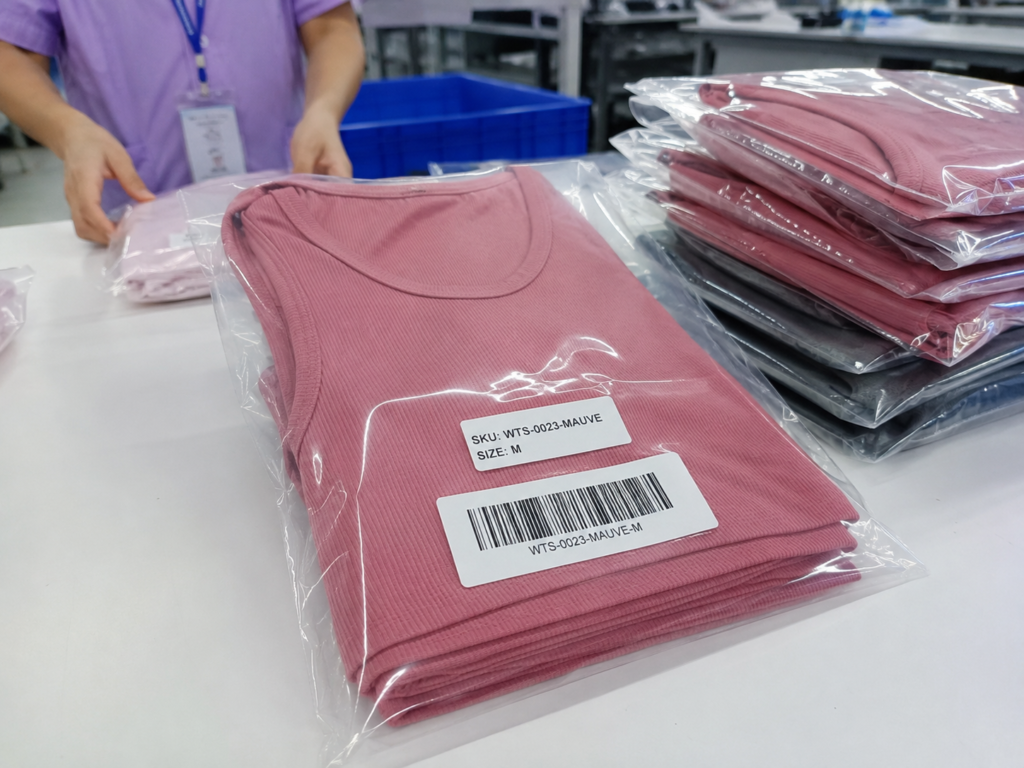
Packing QC verifies style number, color code, size code, barcode, SKU label, size sticker, color sticker, hangtag, care label, folding method, polybag, packing ratio, carton mark, carton number, carton dimensions, and carton weight. Garments are separated and counted according to the approved packing instruction and warehouse requirements.

A style-color-size master file connects product data with labels, barcodes, polybags, cartons, packing lists, and shipment breakdowns. Scanning or data checks can be arranged according to project requirements.

Mixed-color cartons are used only when instructed and clearly documented; otherwise, color and size separation follows the approved carton plan.

Before release, the final garment, packing, quantity, carton marks, style-color-size breakdown, and shipping documents are reviewed together.

Any third-party inspection requirement, appointed forwarder instruction, warehouse label, or receiving rule should be provided before packing begins.

Workmanship Controls for Premium Dress Collections

Color consistency cannot compensate for weak construction. Jinfeng Apparel defines workmanship checkpoints by fabric, silhouette, structure, embellishment, finishing method, and wear risk before bulk sewing begins.

Seam and Stitch Control

Clean seams require suitable stitch type, density, thread, needle, seam allowance, tension, and pressing. Satin and chiffon can pucker; jersey can wave or stretch; mesh can tear; lace can shift; sequins can obstruct stitching. Inspection standards cover seam smoothness, strength, symmetry, allowance consistency, skipped stitches, broken threads, needle damage, and visible thread color.
  • Match stitch method to fabric behavior
  • Control seam tension and allowance
  • Reinforce stress points
  • Inspect visible seams under light

Zipper Installation

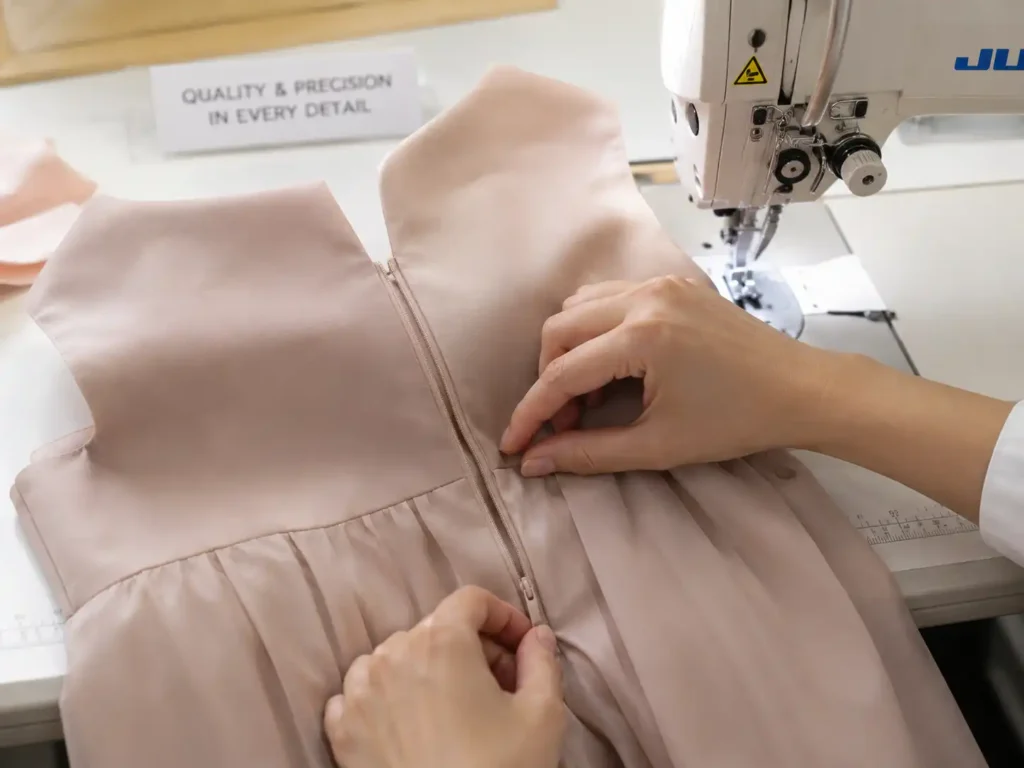
Invisible and exposed zippers must lie flat, operate smoothly, align at waist and seam joins, and match the approved color and finish. Fitted dresses are checked for zipper waviness, seam distortion, top opening alignment, puller quality, and reinforcement. Satin, mesh, lace, and corset styles often require additional stabilization around the zipper area.
  • Confirm zipper length and color
  • Align waist and seam junctions
  • Prevent puckering and twisting
  • Function-test before packing

Ruching and Pleating

Ruching and pleating influence silhouette, symmetry, body coverage, and color reflection. Standards define start and end points, density, direction, spacing, securing method, and relationship to seams or openings. Satin and shiny fabrics can exaggerate uneven gathers, while stretch materials need controlled tension to avoid distortion across sizes.
  • Approve placement on sample
  • Mark reference points
  • Compare left and right balance
  • Check after pressing and wear stretch

Lining Construction

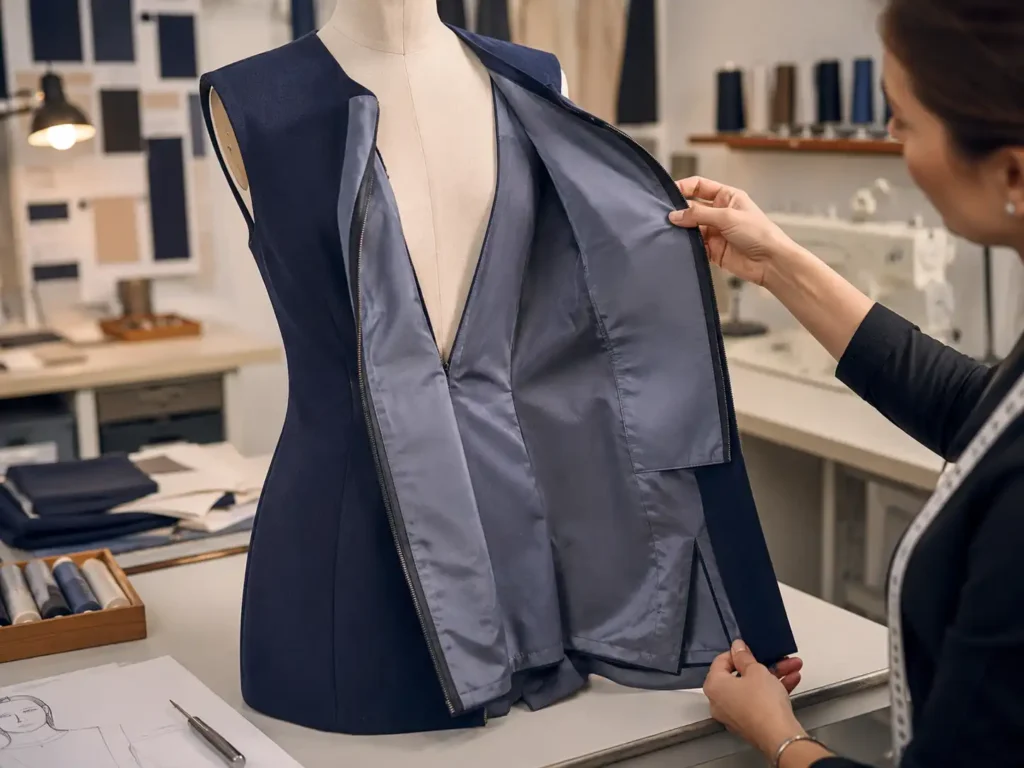
Lining should support opacity, comfort, movement, shape, and internal cleanliness without pulling the shell or appearing at necklines, armholes, slits, hems, or cut-outs. Color, stretch, shrinkage, and seam compatibility are reviewed. Corset, mesh, lace, and light-color dresses may require targeted coverage rather than one standard lining method.
  • Match shell and lining behavior
  • Control lining length and anchoring
  • Hide internal components
  • Review movement and edge exposure

Hem and Slit Finish

Mini, midi, and maxi dresses need accurate length, balanced hems, clean turn-up or narrow hemming, and safe slit construction. Bias, chiffon, satin, and long dresses may require hanging before final leveling. Slit reinforcement, overlap, seam strength, lining relationship, and height are checked against the approved sample and measurement file.
  • Level long or bias hems
  • Control narrow-hem quality
  • Reinforce slit openings
  • Measure finished length consistently

Pressing and Protection

Pressing shapes seams and presentation but can also create shine, flatten texture, stretch edges, mark satin, damage sequins, or distort elastic fabrics. Finishing instructions define temperature, pressure, protection cloth, hanging, cooling, and folding. Delicate surfaces are protected during inspection, transport inside the factory, polybagging, and carton packing.
  • Test pressing on material
  • Protect shine-sensitive surfaces
  • Remove marks and loose threads
  • Pack only after cooling and review

SKU, Barcode, and Packing Accuracy

A multi-color collection becomes a data project at packing stage. Style, color, size, barcode, label, polybag, carton, and warehouse information must agree before shipment release.

Style Color Size Codes

Every garment should connect to an approved style number, color code, and size code. Naming must remain consistent across tech packs, labels, barcode lists, purchase orders, packing instructions, production files, QC sheets, and packing lists. Similar colors require clear internal codes to prevent mix-ups.
  • Confirm master SKU list
  • Remove duplicate or inconsistent names
  • Link codes to physical samples
  • Lock data before label production

Barcode and Labels

Barcode artwork and numeric data are checked against style-color-size combinations. Woven labels, care labels, size labels, hangtags, and stickers must match approved content, position, dimensions, and market requirements. Any revised artwork should carry a clear version so outdated labels do not enter packing.
  • Verify readable barcode data
  • Check care content and size
  • Confirm label position
  • Match hangtag to SKU

Polybag Identification

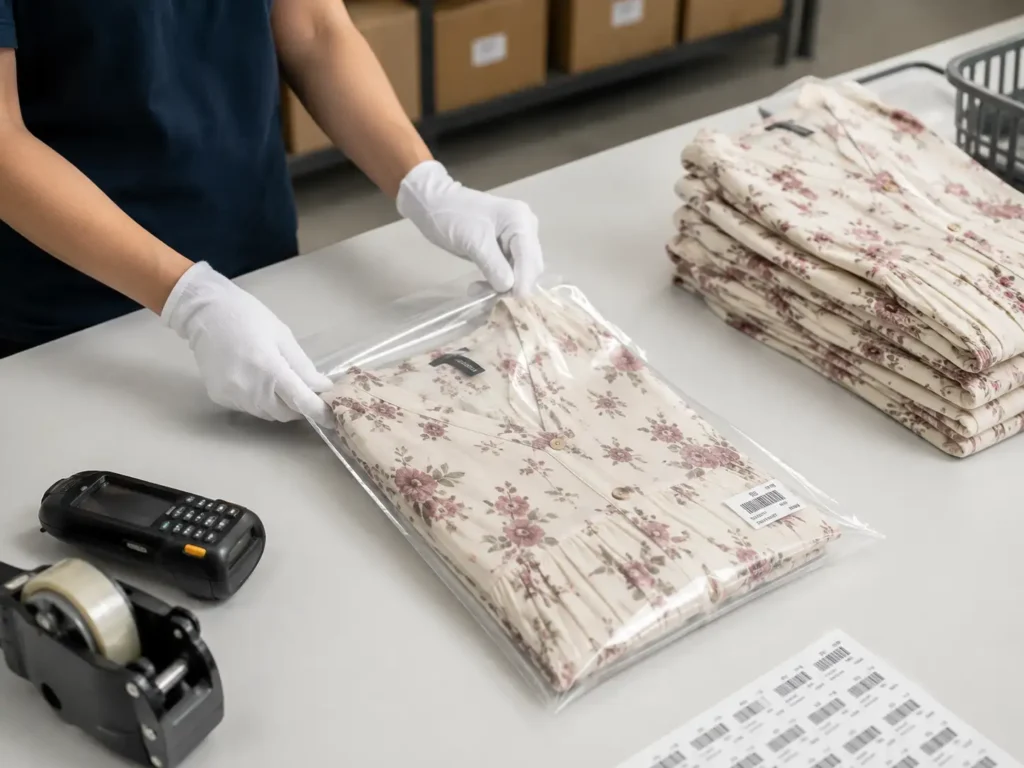
Polybag size, warning text, ventilation, closure, sticker position, color sticker, size sticker, barcode, folding method, and garment protection are reviewed before bulk packing. Delicate satin, sequins, embellishments, structured cups, and long hems may require added tissue, protective layers, or a different fold.
  • Approve packed-garment sample
  • Prevent color or print transfer
  • Keep stickers readable
  • Protect surface and structure

Carton and Warehouse Control

Carton packing follows the approved ratio, pieces per carton, mixed or solid assortment rule, carton mark, carton number, destination, warehouse label, and gross or net weight requirements. The final packing list records style, color, size, quantity, carton count, dimensions, and weights for receiving and freight planning.
  • Check carton assortment
  • Match carton marks to files
  • Record dimensions and weights
  • Support appointed-forwarder documents

Launch Calendar and Multi-Batch Delivery Planning

Multi-color programs are scheduled backward from campaign, wholesale, warehouse, or retail dates. Sample, material, PP, production, inspection, packing, and freight milestones are connected before production capacity is reserved.

Campaign Sample Window

Photo-ready and salesman samples may be required before the full PP and bulk process is complete. Hero styles and campaign colors receive priority according to the line sheet. Sample purpose, required color, size, trim level, photography date, courier destination, and approval status are recorded separately from bulk production approval.

Material Approval Window

Stock reservation, lab dips, strike-offs, lining, zippers, labels, and packaging each require decisions before purchasing or production. Custom-dyed, printed, certified, imported, lace, sequin, or proprietary materials need earlier planning. Delayed color or artwork approval can move the cutting and delivery calendar.

Bulk Production Window

Bulk starts after PP lock and material readiness. Production allocation considers style complexity, color count, quantity, size range, required line, inspection plan, and finishing workload. Multi-factory allocation follows shared files and checkpoints, while style-color status is reviewed through cutting, sewing, finishing, and packing.

Split Shipment Window

Split shipment may support launch priorities, regional warehouses, campaign stock, air-sea combinations, or replenishment plans. Each shipment requires an approved quantity breakdown, carton plan, packing list, labels, documents, freight route, and receiving date. Split delivery is agreed before packing to prevent last-minute carton rebuilding.

Protect and Extend Successful Color Programs

Long-term collection value depends on protected design files and reliable production records. Jinfeng Apparel supports NDA-based cooperation, repeat orders, new-color extensions, and same-pattern development with controlled revalidation.

NDA and Design Protection

Jinfeng Apparel can protect tech packs, original samples, patterns, measurement files, line sheets, color plans, lab dips, trim cards, unpublished designs, labels, packaging files, prices, order information, and launch schedules through NDA-based cooperation. Brand names, logos, unlaunched garments, order quantities, and proprietary materials are not published without authorization. Internal working materials should be shared only with the teams involved in development, production, QC, packing, and delivery. Public case studies are anonymized unless written permission is provided. Files used for repeat orders remain linked to the relevant style and production history.

Repeat and New Colors

Repeat orders can call on final patterns, size charts, grade rules, BOM, fabric references, color records, trims, sewing instructions, labels, packing requirements, QC notes, Golden samples, and after-shipment feedback. Records shorten reconstruction time, but every reorder still requires current fabric availability, lot, price, color, trim, label, barcode, quantity, and delivery confirmation. A new color on an existing pattern requires renewed review of shell fabric, lining, zipper, thread, cups, boning channels, elastic, labels, SKU data, stickers, packing, and bulk shade. A new fabric on an existing pattern may require pattern or measurement adjustment because drape, thickness, stretch, recovery, shrinkage, and seam behavior can change.

Multi-Color Occasionwear Program Case

An anonymized collection program shows how style, color, size, material, approval, factory, QC, packing, and delivery data can be controlled as one production system. Brand identity and unpublished design details remain protected.

Project Scope and Development Plan

bodycon dresses, mesh-lined minis, lace midis, corset dresses, and long evening silhouettes. The final assortment contained 72 approved style-color combinations, with five commercial sizes from XS to XL, creating 360 finished SKUs before warehouse-label variations.

The confirmed bulk quantity was 46,800 pcs. Average allocation reached 650 pcs per style-color combination, with larger quantities placed in black, wine, navy, ivory, and two campaign colors. Materials were grouped into six primary fabric families so shared colors, lining directions, trim sets, and replenishment records could be coordinated without forcing unsuitable fabrics across different silhouettes.

Development began with a priority matrix. Eight hero styles entered first-sample and fit review first because campaign photography had an earlier deadline. Light-color satin, pale mesh, and ivory corset styles received additional opacity and internal-component checks. Color approvals used stock swatches for core black and navy, lab dips for proprietary wine and green shades, and printed strike-offs for two exclusive motifs.

Pattern and sample comments were recorded by style, while color comments were tracked by fabric group. A fit approval in one color did not automatically approve transparency, shine, lining, or trim matching in every colorway. Final PP files locked shell, lining, color, trims, measurements, construction, labels, barcode structure, polybag stickers, carton marks, and packing method.

Bulk Control and Delivery Result

Bulk production was allocated according to product construction rather than evenly divided by quantity. Satin and long draped styles followed direction and surface-protection controls; bodycon products followed stretch and recovery checks; corset styles followed cup, boning, waist, and anti-slip checkpoints; mesh and lace products followed coverage, motif, snagging, and lining controls.

Incoming inspection separated fabric by supplier lot and approved shade group. Cutting bundles carried style-color-size identity. Inline QC focused on zipper flatness, seam quality, ruching placement, lining attachment, strap length, symmetry, and support construction. Final inspection added color difference, stains, pressing marks, loose sequins, mesh damage, measurement tolerance, labels, barcode, SKU, and packing verification.

The 46,800-piece program was packed into color- and size-controlled cartons using the approved SKU master and warehouse labels. Delivery was planned in two batches: the campaign and launch colors moved first, while the remaining commercial colors followed under the same production and packing records. The complete bulk and delivery window ran for 68 days after PP lock, including final material readiness, production, inspection, packing, export preparation, and staged shipment release.

The collection records were retained for replenishment review. A later color extension reused approved patterns and construction files, while new fabric lots, lining, trims, barcode data, and bulk color were revalidated before production.

Multi-Color Collections Frequently Asked Questions

Jinfeng Apparel’s standard garment MOQ starts from 200 pcs per style/color. MOQ is calculated by style and color, not by total assortment quantity. Custom-dyed, custom-woven, printed, certified, imported, lace, sequin, trim, label, or packaging materials may carry separate supplier minimums.
Normally, each color must meet the standard 200-pc style/color MOQ. For example, 100 black and 100 ivory pieces do not normally equal one approved 200-pc color quantity. Material availability, supplier minimums, construction, and collection scale are reviewed before quotation.
Not always. Sample requirements depend on transparency, fabric behavior, dyeing, print, lining, trims, campaign importance, and garment structure. Light colors, custom-dyed materials, contrast construction, reflective fabrics, lace, mesh, sequins, and hero colors often benefit from full-garment evidence.
Custom colors can be developed from Pantone information, a physical swatch, or an approved garment. The route may include fabric-base confirmation, lab dips, review comments, approved standard, bulk dyeing, shade-band review, bulk-color approval, and PP confirmation.
One fit sample can establish pattern direction when all colors use the same fabric behavior and construction. It cannot automatically approve opacity, shine, lining, trim matching, print, dye-lot performance, or internal-component visibility in every color.
Light colors are reviewed for transparency, seam visibility, lining coverage, cups, boning, labels, pocket bags, and undergarment exposure under relevant lighting. The shell, lining, support components, and finished garment should be evaluated together.
A master file connects style number, color code, size code, barcode, labels, stickers, polybags, carton ratios, carton marks, packing lists, and warehouse labels. Packing QC checks product identity and document consistency before shipment release.
Yes, subject to an agreed plan. Shipments can be organized around launch colors, campaign stock, regional warehouses, air and sea routes, or replenishment timing. Each batch requires its own confirmed quantity, carton, label, packing-list, document, and delivery details.
Jinfeng Apparel retains patterns, size charts, BOM, fabric and color references, trim records, sewing instructions, packing files, QC notes, and Golden samples. New lots still require current availability, shade, material, trim, label, and bulk approval checks.
Yes. NDA-based cooperation can protect tech packs, original samples, patterns, color plans, unpublished designs, label and packaging files, pricing, order information, and launch schedules. Public cases remain anonymous unless authorization is provided.

Send Your Multi-Color Collection Brief

Share the collection structure before requesting a final quotation.

Kelly and the Jinfeng Apparel team will review the available files, identify material and approval risks, confirm the appropriate sample route, evaluate MOQ by style and color, and outline the information needed for production planning.
For a focused review, include:

  • Line sheet with style numbers, images, and priority levels
  • Tech packs, original samples, sketches, or reference garments
  • Color list, Pantone references, physical swatches, or approved standards
  • Quantity per style, color, and size
  • Target fabric, lining, trims, and construction requirements
  • Size chart, grade rule, tolerance, and fit standard
  • Label artwork, barcode list, SKU file, and packing instructions
  • Campaign sample date, PP deadline, bulk delivery target, and destination
  • Inspection standard, AQL requirement, or third-party inspection instructions
Multi-Style Production Management​

Tell Us About Your Dress Project

Share your product details, estimated quantity and development requirements. Our team will review your project and provide practical OEM/ODM production feedback.

Premium Women’s Apparel Production for Fashion Brands

From dress sample development to bulk production, JF Apparel supports fashion brands with confidential OEM/ODM manufacturing, reliable quality control and scalable production support.

START YOUR DRESS PROJECT

Ready to Develop Your Next Dress Collection?

Share your design concept, product requirements or sourcing plans with our team. We’ll review your project and provide practical feedback on development, materials, MOQ and production.

7-10 Days

Sample Development

200 PCS

Starting MOQ

Fast Response

Professional Follow-Up