 Skip to content
Multi-Style Collection Development
Structured womenswear collection development for brands managing 10–30 styles across fabrics, fits, samples, production units, and launch schedules.
- Typical brand programs: 10–30 styles with total order plans commonly around 20,000–80,000 pieces across a coordinated seasonal or campaign collection.
- Multi-style development is supported by 2 sample rooms, 7+ senior pattern makers, and 20+ sample machinists working through grouped style priorities.
- 6 owned factories, 10+ long-term satellite production partners, 18+ sewing lines, and 6+ flexible lines support coordinated bulk execution by product risk.
- 12+ merchandisers and 15+ QC inspectors track sample versions, PP approvals, bulk progress, quality checkpoints, private-label packing, and phased shipment.
Built for Collection-Level Development and Production Control
10–30 Style Programs
Multi-Factory Structure
Sampling Capacity
Pattern Control
Project Coordination
More than twelve merchandisers and order follow-up specialists coordinate technical files, fabrics, trims, samples, revisions, production schedules, QC feedback, packing details, and shipment preparation. Multi-style work is easier to control when every style has a clear owner, status, next action, and approval record. Large collection programs can therefore be managed as scheduled projects rather than a long stream of disconnected messages and changing attachments.
Quality Coverage
Collection Programs Suited to Structured Manufacturing Teams
Global Womenswear Brands
Merchandising Teams
Product Development Teams
Sourcing and Buying Offices
Premium Ecommerce Brands
Designer and Occasion Labels
Multi-Style Development Fails When Information Starts Crossing
Style Version Mixups
One style may have a first sample, a fit correction, a revised neckline, a new fabric option, and an updated size chart while another style is already PP approved. Without version control, old measurements or sewing comments can return during bulk preparation. Jinfeng keeps style-specific revision records and approval status so production references the latest confirmed direction. A controlled status sheet also shows which files are current, which comments remain open, and who owns the next action.
- Pattern changes remain linked to style IDs.
- Client comments are converted into measurable actions.
- Approved files replace obsolete versions before bulk release.
Fabric Group Conflicts
- Shared fabrics can be grouped for color and MOQ planning.
- Structure is rechecked when fabric weight or stretch changes.
- Bulk fabric approvals remain traceable by style.
Sample Priority Bottlenecks
Sending every style into sampling at once can overwhelm decision making and delay the products that matter most to a launch.
A better sequence separates hero SKUs, photography-critical pieces, complex structures, and material-ready styles from lower-priority items. Jinfeng can organize sample priority by launch date, fabric readiness, fit risk, photo requirement, and bulk timing. Priority can be reviewed again when material delays, campaign dates, or fit problems change the commercial importance of a style.
- Hero styles move toward approval first.
- Complex items receive earlier risk review.
- Supporting styles follow a controlled queue instead of competing for attention.
Approval Drift
Collections lose control when verbal approvals, screenshots, email comments, and changing files are treated as equivalent standards.
PP approval needs a clear relationship to final pattern, fabric, trims, measurements, construction, lining, labels, and packing. Jinfeng records revision status before moving styles forward and can maintain a Golden sample for high-requirement programs.
The approval trail creates a single reference for development, production, QC, and later repeat orders instead of competing versions.
- Every bulk-relevant change is captured.
- PP status is visible by style.
- Production standards are released only after required approvals are locked.
Production Allocation Errors
- Knit and stretch products enter suitable sewing units.
- Woven and draped dresses follow relevant production experience.
- Complex occasionwear receives focused handling before high-volume replication.
Packing and SKU Mistakes
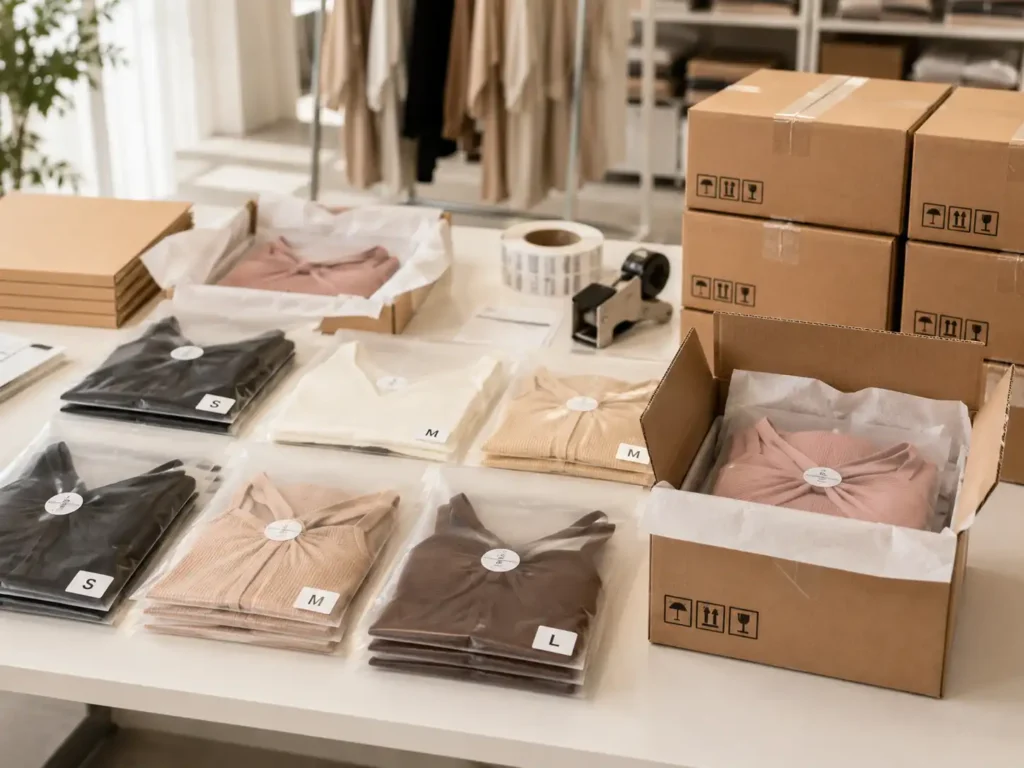
A collection can be technically well made and still fail at warehouse receiving when size labels, barcodes, polybags, carton marks, or color-size ratios are wrong.
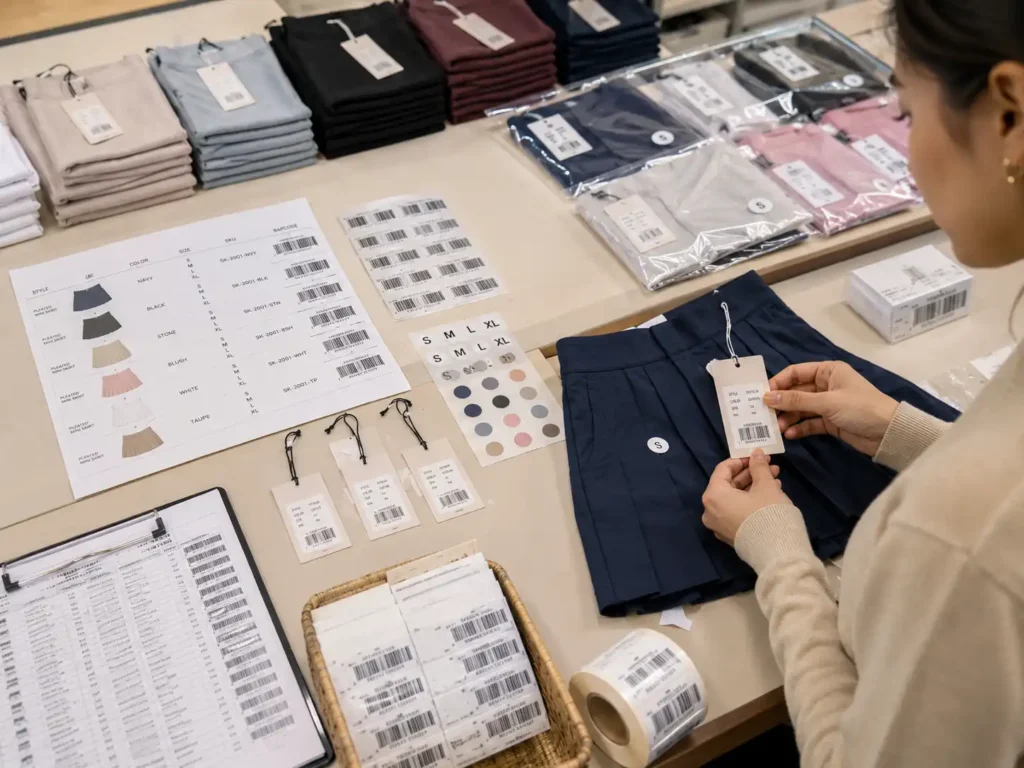
SKU count multiplies quickly as styles, colors, and sizes expand. Jinfeng links packing instructions to style and SKU records and checks labels before shipment.
Packing approval is linked to the final order breakdown, helping the finishing team verify quantities before goods enter cartons or staged shipment.
- Hangtags, barcodes, and size labels are matched to the correct style.
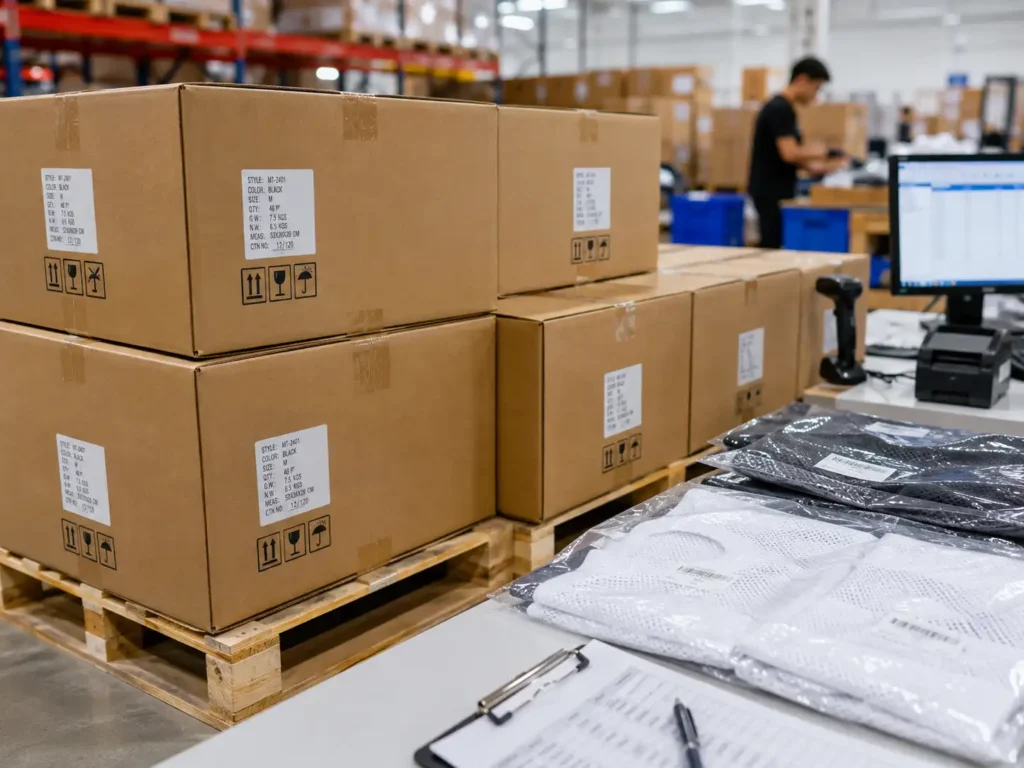
- Carton marks follow agreed packing rules.
- Mixed-size or ratio packing is confirmed before final release.
Build a Collection Map Before Samples Start Moving
A line sheet becomes manageable when styles are converted into development groups, technical priorities, and approval paths. Jinfeng uses product scope, materials, fit risk, quantity, and launch timing to create a working structure before sampling expands. The map becomes the reference for sample, approval, production, QC, and packing status.
Start With a Line Sheet and Style Breakdown
Collection development begins by confirming the product scope rather than opening twenty unrelated sample requests.
Jinfeng reviews the available line sheet, tech packs, reference images, original samples, target quantities, color plan, size range, target price, private-label requirements, launch date, and compliance needs. Every style receives a clear identifier and development route.
The first review separates design information from production information. A strong sketch may communicate appearance but still leave questions around fabric weight, lining, closure, bust coverage, stretch direction, grade rules, or internal support. A complete tech pack can move faster, while an incomplete pack is converted into a requirement checklist before pattern work starts.
Key actions include:
- confirming style count and category mix;
- identifying missing measurements or construction details;
- checking MOQ by style and color;
- marking products that need special trims, printing, dyeing, lace placement, boning, or support structures;
- connecting each style to a launch date or internal priority.
The result is a collection brief with clear development ownership. Work can then move in parallel without confusing individual style decisions with collection-wide standards.
Commercial priorities are recorded alongside technical information. A style intended as a hero item, a repeatable core silhouette, or a supporting collection piece may receive different sampling urgency even when all garments share one delivery window. The early breakdown also helps identify which approvals can be shared and which must remain independent.
Group Styles by Shared Development Variables
Style count alone says very little about development difficulty. Ten satin slip dresses using one fabric family may be easier to coordinate than six unrelated pieces combining corset construction, mesh cut-outs, sequins, jersey, and a tailored jumpsuit. Jinfeng therefore groups styles by the variables that create shared work or shared risk.
Fabric groups can combine styles using the same satin, chiffon, mesh, jersey, lace, lining, or printed base. Structure groups separate stretch-fit garments, draped woven dresses, corset or strapless construction, sheer layered products, jumpsuits, and matching sets. Trim groups bring together common zippers, bra cups, boning, strap hardware, lace trims, rhinestones, labels, and packaging items.
Grouping creates several advantages:
- shared material sourcing becomes easier to plan;
- color and fabric approvals can support more than one style where suitable;
- pattern teams can sequence similar structures efficiently;
- sample issues can be compared across related products;
- production allocation can follow real technical risk;
- cost changes are easier to trace when one shared material affects several styles.
Collection consistency comes from coordinated decisions, not from forcing every garment into identical specifications.
The grouping logic remains flexible as development progresses. If a shared satin is replaced, all linked styles are reviewed for drape, lining, color, price, and schedule impact. If only one neckline or support structure changes, the issue stays isolated to the affected style rather than forcing unnecessary rework across the whole group.
Turn Priorities Into a Working Collection Map
A collection map connects style identity with development status. Jinfeng can organize each style against product category, fabric group, trim group, pattern complexity, sample priority, current sample version, approval status, quantity, factory allocation, QC focus, packing requirement, and planned delivery window. The map becomes the operational reference behind project updates.
Priority is based on commercial and technical factors. Hero SKUs needed for photography can move early. Complex structures may start earlier because they require more fit review. Styles using confirmed stock fabrics can progress while custom colors are still being approved for another group. A style with unresolved lining or trim risk should not be pushed into PP merely to keep a calendar looking fast.
The same map also improves bulk planning. Approved styles can enter material commitment and production preparation while unresolved styles remain in development. Such staged movement reduces the chance that one difficult garment holds an entire collection hostage. It also supports phased delivery when a brand prefers to launch approved groups in sequence rather than waiting for every SKU to finish together.
Collection maps also support internal meetings and client updates because the same style IDs can be used across development, merchandising, QC, packing, and logistics. Clear identifiers reduce ambiguity when several teams discuss similar dresses, colors, or fabric options at the same time.

Build One Collection Across Multiple Womenswear Categories

Mini Dresses

Midi Dresses

Maxi Dresses

Party Dresses

Occasion Dresses

Satin Dresses

Mesh Dresses

Lace Dresses

Bodycon Dresses

Corset Dresses

Jumpsuits
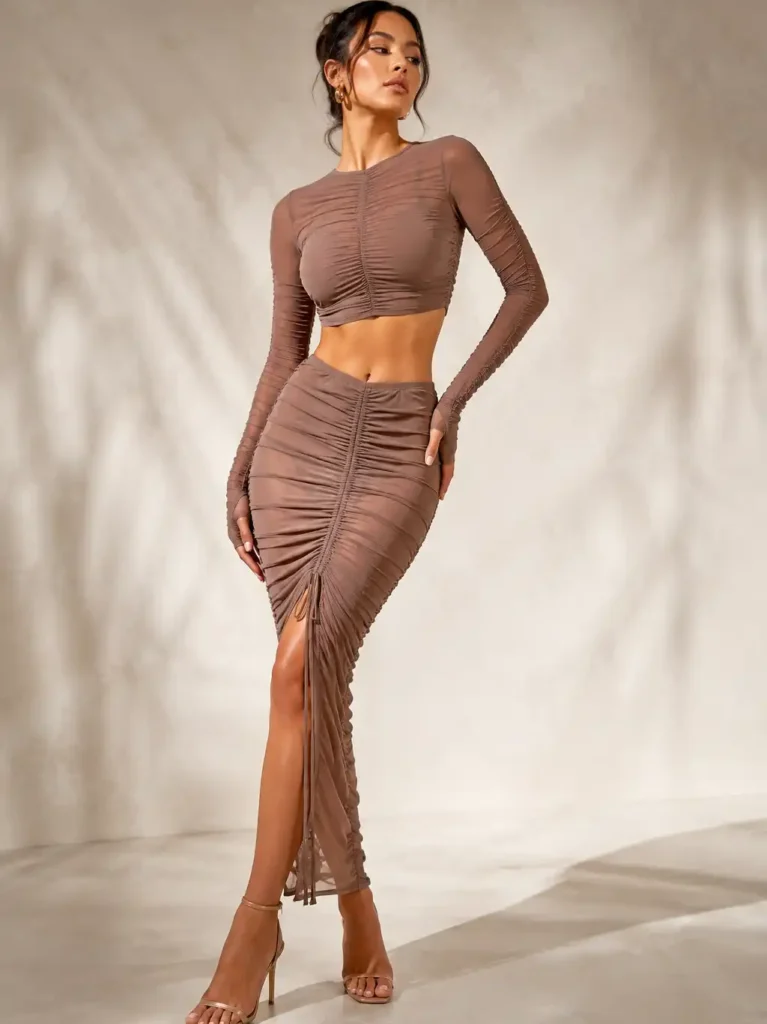
Matching Sets
Group Fabrics Without Losing Style-Specific Performance Control
Shared fabrics can improve collection consistency and material planning, but one fabric may behave differently across silhouettes. Jinfeng reviews hand feel, drape, stretch, transparency, shrinkage, color, lining, MOQ, cost, and bulk risk before grouping styles. Material choices are connected to fit, cost, timing, and repeatability from the beginning.
Create Fabric Families Around Real Garment Behavior
Fabric grouping begins with performance rather than a fabric name printed on a line sheet. Satin, stretch satin, chiffon, mesh, power mesh, lace, jersey, rib knit, ponte, crepe, velvet, sequin fabric, organza, tulle, rayon, viscose, linen blends, cotton blends, denim, suiting, and printed woven fabrics each create different pattern and production conditions.
Jinfeng reviews composition, weight, width, hand feel, drape, stretch, recovery, transparency, shine, shrinkage, wrinkle behavior, color-difference risk, snagging risk, lining requirements, printing suitability, fabric MOQ, lead time, and cost. Styles can then be grouped where shared sourcing genuinely helps. A satin mini and satin midi may share a base fabric, while a stretch satin bodycon style may need different pattern allowances and sewing control.
Useful collection groupings include:
- one satin family across slip, cocktail, and structured styles;
- one mesh family with separate power-mesh and sheer-mesh applications;
- one jersey or ponte family for stretch-fit pieces;
- one chiffon or rayon family for flowing resort styles;
- one lace family with placement rules by silhouette.
Shared sourcing creates efficiency only when garment behavior remains protected.
A fabric family is also connected to its approval status. Sample fabric, approved fabric, bulk fabric, and any replacement option should not be mixed in one record. The separation helps development teams understand whether a fit comment came from construction or from a material that is no longer intended for production.
Control Color, Lining, and Surface Risks Across Styles
Color consistency becomes more difficult when one collection uses several fabrics under one color story.
A black satin, black mesh, black lace, and black jersey can appear different under studio lighting because fiber content, surface texture, transparency, and shine influence visual depth.
A similar issue appears with lining: the same lining shade may disappear under one fabric yet become visible through another.
Jinfeng can review Pantone references, physical color standards, lab dips, fabric swatches, lighting conditions, fabric batches, dye lots, surface shine, lining color, and print color before bulk color approval. For multi-style work, approval records remain linked to the correct fabric group and style.
Special attention is given to satin shade and shine direction, mesh transparency, lace and lining color interaction, print direction, and mixed-material garments. Bulk fabric changes are not treated as simple substitutions. Any change in weight, stretch, drape, transparency, or shrinkage can trigger a pattern, lining, costing, or sample review before production proceeds.
When several shades appear in one collection, Jinfeng can also distinguish core colors from fashion colors and review how the approved shade should look under relevant lighting.
Color decisions remain connected to the correct fabric surface rather than relying on screen images alone.
Use Material Decisions to Improve Cost and Schedule Control
Collection costing is affected by more than sewing time. Fabric MOQ, custom color requirements, supplier lead time, width, consumption, wastage, lining, special trims, placement cutting, printing, and testing requirements can change the economics of several styles at once. Jinfeng uses fabric grouping to identify where shared materials can support a cleaner assortment plan without weakening the intended look.
Cost control may include fabric substitution, construction simplification, trim replacement, cutting-layout planning, color consolidation, size-ratio planning, or split-shipment suggestions. Every option is reviewed against appearance, fit, bulk stability, and launch timing. A cheaper fabric that changes drape or transparency can create more expensive sample revisions and return risk later.
For seasonal collections, early fabric planning also helps identify which styles can use available materials and which require custom development. Material readiness can then become part of sample priority. Brands gain a clearer picture of which products can move quickly, which need extra approval time, and where shared materials create genuine purchasing efficiency.
Material grouping can also reduce unnecessary complexity in the BOM and packing plan. Fewer well-chosen fabric families can simplify color approval, replenishment, and production scheduling, while a deliberate statement fabric can remain reserved for hero products where its added cost creates visible value.

Separate Fit and Construction Risks Before Pattern Development
A collection can look coherent while containing very different engineering problems. Jinfeng separates stretch-fit, draped, structured, sheer, embellished, and one-piece constructions so pattern and sample work follows garment behavior rather than a generic dress process. Different engineering routes can therefore coexist inside one visual collection direction.
Stretch-Fit Styles Need Recovery and Measurement Discipline
Bodycon dresses, jersey dresses, ponte styles, stretch jumpsuits, power-mesh pieces, and some stretch-satin products depend on recovery as much as finished measurements. Two fabrics with the same nominal stretch can behave differently after cutting, sewing, pressing, wearing, or washing. Jinfeng reviews stretch direction, recovery, fabric relaxation, cutting direction, bust-waist-hip proportion, side-seam twisting, neckline deformation, hem movement, and post-wash size stability where relevant.
Pattern control focuses on how the garment sits on the body rather than simply reducing measurements. Bust coverage, waist placement, hip ease, dress length, strap length, armhole shape, neckline depth, and cut-out exposure can all change when fabric tension changes. Sample comments are recorded and converted into updated patterns and measurement records before bulk release.
Within a collection, related stretch styles can share fabric sourcing and some technical learning, but each silhouette still carries its own fit tolerance. Such separation helps prevent one approved bodycon pattern from being copied mechanically into another product with different seam lines, lining, support, or fabric recovery.
Size grading receives the same discipline. A base-size correction must translate carefully into neighboring sizes so waist placement, dress length, neckline depth, and skin exposure do not shift unpredictably. Measurement QC later checks the bulk against the approved graded specification instead of judging fit only from appearance.
Structured and Support Styles Need Internal Engineering
Corset dresses, strapless pieces, deep-neck styles, structured mini dresses, and some occasionwear rely on internal components that are invisible in a line sheet but decisive on the body. Bra cups, boning, anti-slip tape, underwire, lining, seam placement, zipper position, lace-up structures, and bust coverage must work together. Jinfeng reviews support points, cup position, boning placement, neckline stability, waist shaping, comfort, and balance during pattern and sample development.
First samples are used to expose structural problems before they become bulk problems. A cup may sit too high, boning may press the body incorrectly, a strapless neckline may slip, or a zipper may pull the back panel out of alignment. Revised samples can then update pattern shape, support placement, trim specification, and sewing instructions.
For a multi-style collection, structured products normally receive deeper development and earlier risk review. Simpler supporting styles do not need the same sample burden, allowing technical resources to follow real complexity instead of forcing identical timelines across every SKU.
Support components are confirmed together with sourcing feasibility. A visually correct sample still needs bulk-available cups, boning, anti-slip tape, closures, and lining in the approved specification. Changing one component after PP can alter comfort or structure, so replacement decisions require technical review before production.
Draped, Sheer, and Embellished Styles Need Visual Control
Satin, chiffon, rayon, lace, mesh, sequins, ruffles, one-shoulder designs, cut-outs, and long hems can pass flat measurements yet still fail visually. Drape, transparency, motif placement, shine direction, edge stability, asymmetry, lining exposure, sequin comfort, and pressing can alter the final appearance. Jinfeng uses mannequin observation, measurement checks, photo or video feedback, and fitting when required to evaluate how the design behaves beyond a flat table.
Lace requires motif and seam planning; mesh requires transparency and recovery control; satin requires snag, shade, seam, and pressing attention; sequins need protection against loss, skin scratching, and excessive seam thickness. Ruffles and asymmetric details require balance and consistent layer placement.
A collection therefore receives several technical routes under one project schedule. Design cohesion is preserved at the visual level, while manufacturing discipline changes according to the actual garment risk. The result is a collection that looks intentionally related without pretending every product is constructed the same way.
Visual checks also create useful production references. Approved photos, sample notes, placement points, and finishing instructions can show how a drape, lace motif, asymmetric line, or embellishment should read on the finished garment. Such references complement measurements where appearance cannot be defined by numbers alone. Approved visual references also support remote review across merchandising, development, and QC teams.

Set Sample Priority Around Launch and Technical Risk
Hero SKU Priority
Launch Date Priority
Fabric Readiness
Structural Risk
Photo Sample Needs
Bulk Timing
Run Multi-Style Sampling as a Controlled Development System
Sampling is the bridge between collection concept and repeatable bulk standards. Jinfeng manages multiple styles through grouped pattern work, sample status, revision records, material approvals, and PP confirmation rather than relying on memory or scattered message threads. Every status remains linked to a style ID and current approval record.

Move From Technical Review Into First Samples
Before a first sample is made, Jinfeng reviews product category, style structure, fabric direction, trims, target quantity, MOQ fit, target price, launch timing, size chart, labeling, packing, and any market-specific requirement. Available inputs can include a complete tech pack, an incomplete pack, a reference image, original sample, sketch, line sheet, fabric swatch, or target price. The development route changes according to information quality.
Pattern development uses tech pack measurements, size charts, reference proportions, original-sample measurements, fabric stretch, target-market fit, product category, and construction requirements. Critical points can include bust, upper bust, waist, hip, length, strap length, armhole, neckline depth, slit height, crotch length, lining length, seam allowance, and trim placement.
The first sample is then used to test more than appearance. Sample machinists and pattern makers evaluate whether fabric direction, construction, lining, closure, support structures, finishing, and fit can be repeated in bulk. Internal measurement and visual checks are completed before feedback is sent for client review.
When several styles share one fabric or trim, the first sample results can also reveal collection-wide issues early. A satin that feels too light, a lining that changes drape, or a zipper specification that creates bulging can be corrected across the related group before more samples consume time and material.

Track Every Revision by Style and Cause
A multi-style program becomes difficult when comments such as “make it tighter,” “change the fabric,” or “raise the neckline” are not converted into measurable production information. Jinfeng classifies feedback into fit, measurement, fabric, trim, construction, color, visual effect, packing, or cost-related changes. The cause is reviewed before a revised sample is made.
Fit comments can trigger changes to bust-waist-hip proportion, dress length, strap, armhole, neckline, slit, or crotch length. Fabric changes require renewed review of weight, hand feel, stretch, recovery, drape, transparency, shrinkage, color, MOQ, cost, and lead-time impact. Trim changes can affect zipper specification, bra cup, boning, lace trim, rhinestones, labels, or packaging materials.
All bulk-relevant revisions are converted into updated pattern files, size charts, BOM information, fabric or trim approvals, sewing instructions, QC checkpoints, and packing instructions where relevant. The goal is a controlled record, not a chain of remembered conversations.
Revision records also show whether a comment changes only appearance or alters bulk feasibility. Raising a neckline may be a local pattern edit, while changing to a heavier fabric may affect pattern balance, lining, seam method, price, and lead time. The distinction helps teams make decisions with full production impact visible. The same record also shows whether a revised sample must be physically remade before the next approval stage.

Separate Photo, Fit, PP, and Golden Sample Purposes
Different samples answer different questions. A fit sample helps confirm proportion and measurement. A revised sample tests corrected pattern or material direction. A photo sample prioritizes sale-ready visual presentation. A PP sample locks final fabric, trims, measurements, construction, lining, labels, and packing before bulk. A Golden sample can become the final comparison standard for high-requirement production and repeat orders.
Confusing sample purposes creates avoidable risk. A beautiful photo sample should not be treated as the bulk standard if fabric, trims, or measurements are still changing. A PP sample should not remain open to uncontrolled design edits after materials and production preparation begin. Jinfeng therefore keeps approval status visible by style.
For a 10–30 style program, not every garment needs identical sample rounds. Complex or fit-sensitive styles may require additional revisions, while a straightforward supporting style can move with fewer steps. Sampling depth follows risk, keeping the collection controlled without adding unnecessary rounds.
Approval language remains specific. “Looks good” is not treated as equal to PP release when measurements, trim specifications, or packing remain open. Clear approval status protects both sides by showing which elements are confirmed and which still require a decision before production preparation. The final sample purpose is confirmed in writing so internal teams do not apply the wrong reference during bulk preparation.
Move Approved Styles Forward Without Waiting for Every SKU
Collection development does not need to be an all-or-nothing sequence. Once a style has confirmed pattern, fabric, trims, measurements, construction, PP standard, quantity, and packing requirements, Jinfeng can prepare the approved style for material commitment and production scheduling while another style remains under revision.
Staged approval is useful when hero styles, photo-critical products, complex garments, and simple supporting pieces move at different speeds. Project tracking keeps the status clear: development, revised sample, awaiting comment, PP in progress, PP approved, material ready, bulk scheduled, or production running.
Such separation protects the launch calendar without lowering technical standards. Ready products are not held unnecessarily, and unresolved products are not forced into production. For brands using phased launches or split shipments, approval groups can also align with commercial release waves, warehouse windows, or urgent air-freight priorities while the balance moves by sea.
The staged approach also supports inspection and logistics planning. Once an approval group enters bulk, inspection windows, packing files, carton marks, and shipment options can be prepared for the expected completion sequence. Later styles continue development without obscuring the status of products already moving toward delivery. Commercial quantity and shipment priorities can then be updated without reopening technical standards already approved for earlier groups.
Keep Revision and Approval Status Visible by Style
A shared tracker prevents old comments from entering new samples or bulk files. Each style keeps a current technical status, latest approved version, unresolved issue, responsible action, and next approval point before production release. The tracker becomes the shared reference before PP release and later bulk handover.
| Style Status | Main Record | Typical Check | Release Condition |
|---|---|---|---|
| Development Review | Style brief / tech review | Structure, fabric, MOQ, target timing | Required information confirmed |
| First Sample | First pattern + sample notes | Fit, proportion, fabric effect, construction | Client review completed |
| Revision | Revision log + updated pattern | Measurement, material, trim, detail changes | Correction points recorded |
| Photo Sample | Visual sample record | Drape, pressing, fit, image readiness | Photo purpose confirmed separately |
| PP Sample | Final approval pack | Pattern, fabric, trims, measurements, packing | Bulk-relevant standards locked |
| Golden Sample | Sealed comparison sample | Final appearance and workmanship reference | Approved reference archived |
| Bulk Release | Production file set | BOM, sewing notes, QC, packing instructions | Production unit receives current files |
Build the Collection Timeline Around Real Approval Gates
Scope Lock
Fabric and Trims
Pattern Development
Sample Rounds
PP Approval
Bulk Preparation
Production and QC
Packing and Delivery
Plan MOQ by Style and Color, Not Collection Total
Jinfeng’s standard MOQ starts from 200 pieces per style and color. A large collection can be evaluated as one program, but each style-color combination still needs a workable material, cutting, sewing, QC, and packing structure. Clear quantities also improve quotation and material planning before sampling expands across the collection.
| Quantity Plan | Standard Position | Reason |
|---|---|---|
| 1 style × 1 color × 200 pcs | Can be evaluated | Meets the standard starting unit for one style/color |
| 1 style × 2 colors × 200 pcs each | Can be evaluated | Each color reaches the normal production unit |
| 10 styles × 1 color × 200 pcs each | Collection-ready structure | 2,000 pcs total with each style meeting the standard MOQ |
| 10 styles totaling 2,000 pcs unevenly | Review by style/color | Total quantity does not replace per-style/color requirements |
| 1 style × 2 colors × 100 pcs each | Normally below standard | Two colors create separate material and SKU requirements |
| Special fabric / trims / packaging | Project review required | Supplier MOQ or custom development may create separate minimums |
Allocate Each Style to the Right Production Unit
Multi-style production is not a capacity puzzle solved by sending work wherever space appears. Jinfeng allocates styles by fabric, construction, workmanship risk, quantity, approval status, and delivery priority while maintaining unified QC and project coordination. Production routing is reviewed again whenever the approved garment changes materially.
Match Production Experience to Product Structure
Jinfeng operates six owned women’s fashion factories and works with more than ten long-term satellite production partners.
The manufacturing system is organized around product fit rather than the assumption that every factory can make every garment equally well. Woven dresses, knit and stretch products, occasionwear, complex fabrics, jumpsuits, sets, and repeat orders can be directed toward production units suited to the technical profile.
Examples of allocation logic include stretch-focused units for bodycon, jersey, ponte, or stretch jumpsuits; woven-dress units for mini, midi, maxi, satin, crepe, and structured silhouettes; experienced occasionwear units for lace, mesh, sequin, corset, or evening styles; and stable production units for repeat programs with archived patterns and known construction.
Allocation begins after sample and PP information is sufficiently clear. A production unit receives the current pattern, approved materials, trims, construction references, measurement standards, QC focus, and packing instructions. Such routing turns factory capacity into controlled manufacturing rather than simple outsourcing.
Allocation is reviewed again when a style changes materially after sampling. A different fabric, added boning, heavier embellishment, or major construction revision can change the production skill required. The factory plan therefore follows the approved garment rather than the early sketch, keeping technical routing aligned with the final product.
Use Flexible Lines for Multi-SKU Production Organization
Eighteen-plus sewing lines and six-plus flexible production lines support varied womenswear programs. Flexible lines are valuable when a collection contains multiple fabrics, smaller style groups within a larger brand order, several colors, different size ratios, or staggered launch priorities. Flexibility refers to production organization, not a no-threshold ordering model; the standard MOQ remains 200 pieces per style and color unless project conditions require further review.
A flexible line can help coordinate style changes, fabric groups, or phased production without treating every collection as one massive single-style order. Production planning still requires confirmed materials, PP standards, line capacity, and realistic changeover sequencing. Styles with more complex workmanship may need longer line preparation or smaller controlled production groups before scale-up.
The goal is stable output across a diverse assortment. A brand gains the ability to develop and manufacture several products in one coordinated program while Jinfeng preserves the technical differences that matter for quality, labor allocation, and delivery.
Flexible organization also supports repeat styles running beside new development. Proven products can use archived patterns and known workmanship, while new pieces receive deeper production preparation. Combining both types inside one program helps brands replenish existing winners without stopping seasonal development work. The plan is reviewed against current line capacity before final booking.
Keep One QC Standard Across Multiple Production Units
Factory allocation only works when standards remain unified. Jinfeng’s QC system covers incoming materials, cutting, sewing, in-line inspection, finished garments, pressing, packing, AQL inspection support, and client inspection coordination. Product-specific checkpoints are added according to garment risk: satin shade and snagging, mesh transparency, lace placement, sequin protection, bodycon recovery, corset support, jumpsuit crotch length, or maxi hem balance.
Collection-level control also checks shared elements such as approved color, labels, size marking, barcodes, polybags, carton marks, and packing ratios. The approved PP or Golden sample becomes a visual and workmanship reference where required.
Production units therefore operate under a common project structure even when technical execution differs. Jinfeng’s merchandising and QC teams coordinate status, issues, corrective action, and packing release so multi-factory production does not become multi-standard production.
QC findings are also fed back into project records. If one production unit encounters a recurring measurement, trim, or finishing issue, the corrective action can be documented before the same risk appears in another style group. Shared quality management turns separate production locations into one controlled delivery system. Common inspection records also make final client or third-party inspection easier to prepare across several production groups. Corrective actions can be closed against the affected style before packing release, while approved groups continue without unnecessary interruption.

Convert Approved Styles Into Controlled Multi-Style Bulk Production
Bulk execution begins only after relevant approvals are clear. Jinfeng connects PP standards, materials, factory allocation, production instructions, in-line inspection, packing requirements, and delivery priorities so every style can progress without losing traceability. Each bulk group remains linked to its current approval and packing records.
Release Bulk Standards Style by Style
A collection should not enter production under one vague approval.
Each style needs a confirmed relationship between pattern, measurements, fabric, trims, construction, lining, labels, packing, and quantity.
Jinfeng uses PP approval as the main production boundary and can retain a Golden sample for higher-requirement programs. Production files are updated after approved revisions so old sample comments do not travel to the cutting or sewing floor.
Bulk preparation can include final patterns, size grading, BOM information, fabric approval, trim approval, sewing instructions, measurement standards, QC checkpoints, packing instructions, barcode or SKU data, and carton requirements.
Product-specific notes are added where surface, fit, structure, or embellishment needs special control.
Approved styles can move into production preparation in waves. A satin group may be ready while a corset group remains under fit revision. A resort group may enter cutting while custom-color occasion styles wait for final bulk fabric approval.
Controlled release supports progress without lowering approval discipline.
A bulk release also confirms the commercial version of the order: final quantity by style, color, and size; approved unit configuration; any testing or inspection requirement; and the intended shipment route. Technical and commercial records therefore enter production together instead of being reconciled only at packing.
Manage Multi-Style Production by Groups, Not Chaos
Once production starts, style grouping continues to matter. Fabric groups influence material arrival and shade control. Trim groups affect component readiness. Construction complexity affects line allocation and throughput. Color groups influence labeling and packing. Launch priority affects production sequence and possible phased shipment. Jinfeng manages the relationships instead of treating the collection as a list of independent purchase orders.
Bulk progress can be updated through material arrival, cutting, sewing, in-line inspection, finishing, pressing, packing, and shipment preparation. Delays or technical issues can be isolated to the affected style or group, reducing unnecessary disruption to products already running well.
For larger programs, owned factories and long-term satellite partners provide capacity expansion while Jinfeng keeps project coordination, QC standards, packing instructions, and shipment planning under one management structure. Complex styles remain in production units with the required experience, while more repeatable or proven styles can use stable capacity for efficient scaling.
Grouping also supports capacity decisions during peak periods. Styles already proven through repeat orders can use stable production routes, while first-time or technically sensitive styles remain under closer development and QC attention. The production plan can therefore expand without treating risk and volume as the same thing. Production sequence is reviewed against material arrival and final shipment priorities before each group is locked.
Protect Sample-to-Bulk Consistency at Every Transition
The most damaging collection failure occurs when approved samples look strong but bulk garments drift in fit, materials, workmanship, or packing. Jinfeng controls the transition through approved fabric batches, trim consistency, current patterns, measurement standards, sewing references, in-line checks, finished-garment inspection, pressing review, and packing QC. The control points vary by product risk.
A satin style may require shade, shine direction, snag, seam, and pressing checks. Mesh needs transparency, stretch, neckline, and lining control. Lace needs placement and edge consistency. Bodycon pieces require recovery, twisting, and measurement stability. Corset products need cup, boning, anti-slip, and bust coverage checks.
Collection-level consistency does not mean identical inspection for every garment. It means every style is checked against the right approved standard while common branding, SKU, and packing requirements remain consistent across the program.
Finished-garment findings are recorded before packing so corrective work stays linked to the affected style and production lot. The collection reaches final inspection with traceable standards rather than depending on a last-minute visual check to discover problems created much earlier in the process. Packing release follows the same principle: finished styles move only after label, barcode, quantity, and carton requirements match the approved order matrix. The connection between technical standards and commercial packing records protects the final transition from factory floor to warehouse inventory.

One Collection Standard, Six Critical Control Areas
Fabric Batch Control
- Confirm approved fabric reference.
- Separate relevant dye or material batches.
- Escalate substitutions before cutting.
- Recheck pattern or lining impact when material behavior changes.
Measurement Control
- Use the approved size chart and tolerance.
- Link corrections to the current pattern.
- Measure during sample and bulk stages.
- Keep style-specific checkpoints for bodycon, corset, jumpsuit, and fitted silhouettes.
Construction Control
- Compare workmanship against PP or Golden reference.
- Check seam method and stress points.
- Confirm support trims and closures.
- Flag construction drift before the issue spreads across a production lot.
Color Control
- Keep color approvals by fabric group.
- Review bulk shade before full release.
- Separate batches when needed.
- Match labels and SKU information to the correct color code.
Finishing Control
- Review pressing method by fabric.
- Check final drape and symmetry.
- Remove loose threads and surface defects.
- Confirm protective packing where delicate surfaces or embellishments require additional care.
Packing Control
- Match SKU data to style, color, and size.
- Confirm carton breakdown before shipment.
- Check polybag and label placement.
- Support retail-ready or ecommerce-ready packing requirements according to the approved project instructions.
Keep Private Label and SKU Data Accurate Across Styles
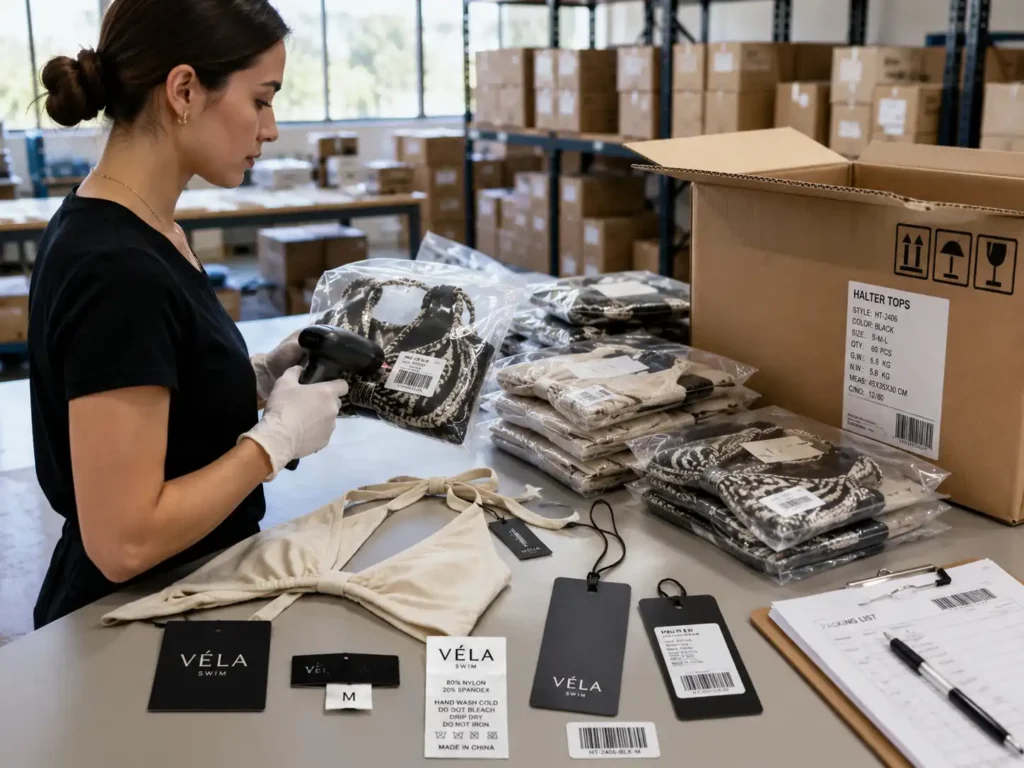
Woven Brand Labels

Size and Care Labels
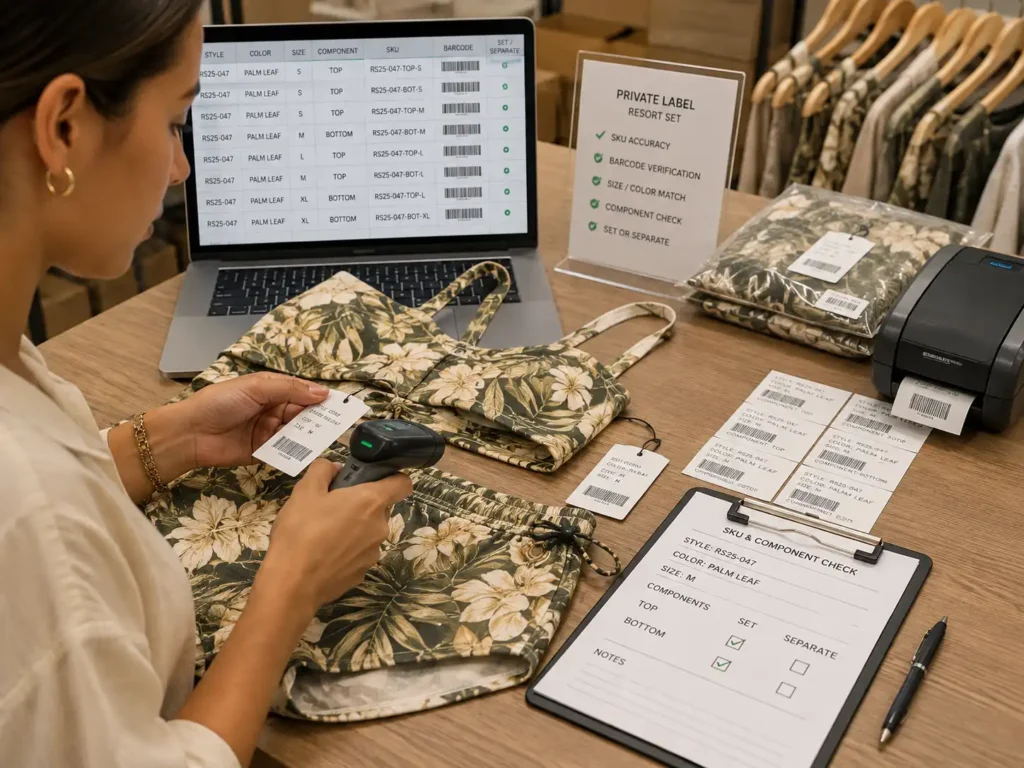
Barcode and SKU
Polybag Standards
Carton Marks

Ratio Packing
Make Collection Progress Traceable Without Exposing Brand Assets
Large collection programs need clear project ownership and controlled information. Jinfeng combines merchandising coordination, development records, production updates, QC feedback, and NDA-based brand protection so teams can share technical files with defined handling rules. The system also supports clear escalation when a major issue threatens schedule or quality.

Use One Project Structure From Launch Through Shipment
Jinfeng’s project management system covers project launch, requirement confirmation, timeline planning, fabric tracking, trim tracking, sample status, revision records, bulk production updates, QC feedback, packing confirmation, shipment arrangement, and after-shipment feedback.
More than twelve merchandisers and order follow-up specialists support the coordination between client teams and internal development, sample, production, QC, packing, and logistics roles.
Project launch confirms company and brand profile, target market, product categories, style count, quantity per style, MOQ fit, available tech packs or line sheets, target price, launch date, NDA requirement, private-label needs, testing or certification requirements, forwarder plan, and long-term program potential.
Internal ownership can then be assigned to development, sampling, production, QC, and logistics stages.
The structure reduces the amount of critical information left inside chat history.
Fabric changes, fit corrections, PP status, production issues, and packing approvals can be logged against the relevant style and project stage, giving mature teams clearer control over a program that may run across several months and many SKUs.
The same structure supports escalation. Routine updates stay with the project team, while major quality, delivery, material, or approval issues can be raised to senior coordination.
Larger programs benefit from clear escalation because unresolved decisions are visible before they threaten the whole launch.

Report Progress at Meaningful Production Milestones
Progress visibility should answer operational questions: Has bulk fabric arrived? Is cutting complete? Which styles are sewing? Which group is under in-line QC? Which styles are finishing or packing? Are carton marks approved? Which shipment is ready for pickup? Jinfeng can provide progress updates around key milestones for important or complex programs rather than promising unnecessary daily reporting for every order.
A multi-style project may show different statuses at the same time.
One group can be PP approved and material-ready, another can be in revised sampling, while a repeat group is already in sewing.
Clear status reporting helps merchandising and sourcing teams coordinate photography, launch calendars, warehouse space, payment milestones, inspection bookings, and freight arrangements.
Issue reporting is equally important.
Material delay, trim shortage, unresolved PP comments, QC findings, packing changes, or logistics constraints should be linked to the affected styles and the next required decision.
Visibility is valuable when it helps a team act, not when it creates more messages.
Milestone reporting can also align with third-party or client inspection planning.
When enough styles reach finished-garment status, inspection can be scheduled against the correct quantity and packing stage. The project team can then coordinate any corrective action before final release to the forwarder.

Protect Tech Packs, Samples, Patterns, and Unreleased Collections
Multi-style collection development often requires early access to commercially sensitive material: tech packs, line sheets, original samples, unreleased designs, pattern information, fabric and trim direction, labels, packaging artwork, quantities, launch timing, and pricing. Jinfeng supports NDA-based cooperation and treats project materials as order-specific information.
Real brand names, logos, tech packs, patterns, unpublished designs, labels, packaging files, order numbers, prices, or contact information are not disclosed without permission. Marketing proof can instead use anonymized project descriptions covering market, product category, style count, order quantity range, fabrics, construction, development challenges, production approach, and delivery result.
Confidentiality also supports long-term cooperation. Archived patterns, size charts, fabric references, trim records, QC notes, packing requirements, and Golden samples can improve repeat efficiency while remaining linked to the relevant brand program. Brand protection becomes part of project management rather than a separate marketing promise.
Access to archived information remains controlled by project purpose. Pattern and material records are kept to support production consistency and later repeats, not to reuse a brand’s proprietary design for unrelated work. The same principle applies to sample images and packaging files created during development. Confidential handling is therefore connected to day-to-day development work, file control, production preparation, and repeat-order archiving. Clear boundaries help established brands share enough technical information for accurate manufacturing without turning proprietary assets into marketing material.
Multi-Style Programs Built Around Real Collection Pressures
Anonymous project examples show how collection management changes when style count, fabric mix, fit risk, SKU complexity, and delivery windows increase. Order figures below reflect the current 10–30 style and 20,000–80,000 piece range typical of Jinfeng brand programs.

US Occasionwear Program — 12 Styles, 24,000 Pieces
An established US occasionwear label developed a 12-style program covering satin mini dresses, satin midi dresses, cocktail silhouettes, one-shoulder pieces, and selected lace details.
Total planned volume was approximately 24,000 pieces across the collection.
The main development pressure came from satin shade consistency, zipper flatness, lining comfort, neckline balance, multi-color bulk stability, and the need to keep photo samples aligned with final PP standards.
Jinfeng grouped the collection by satin base, lining requirements, and structure complexity.
Simpler satin silhouettes moved through pattern and sample review first, while one-shoulder and more fitted products received additional fit attention. Color references and lining combinations were tracked by style, and bulk-relevant comments were converted into updated pattern and sewing instructions before PP approval.
During production, satin handling focused on shade, shine direction, snag prevention, seam appearance, pressing, and packing folds. Labels and barcodes were matched to the correct color and size combinations before shipment. The program demonstrates how a shared material story can support collection consistency without applying one generic pattern or sewing standard to every silhouette.
The collection moved under one launch plan, but technical depth varied by style. The program shows how a brand can keep a unified satin story while using different fit, lining, and construction controls for mini, midi, cocktail, and asymmetrical silhouettes.

European Resortwear Collection — 15 Styles, 36,000 Pieces
A European resortwear brand planned a 15-style seasonal collection of chiffon maxi dresses, rayon and viscose vacation dresses, printed resort silhouettes, halter styles, backless pieces, and slit details, totaling about 36,000 pieces. The collection needed to look light and coordinated while handling several technical risks: transparency, print direction, shrinkage, long-hem balance, lining length, travel packing, and different fabric lead times.
Jinfeng organized the project into chiffon, rayon/viscose, and printed-woven fabric groups. Shared color and print references were managed at material level, while pattern work remained style-specific.
Maxi lengths, slit heights, back coverage, halter balance, and lining proportions were reviewed during sampling. Material readiness influenced sample priority so confirmed groups could move while printed or color-sensitive fabrics completed approval.
Bulk preparation carried approved print direction, shrinkage considerations, lining length, hem standards, and packing methods into production. The assortment was scheduled for phased progress rather than forcing every style into one release date. Fabric, color, and pattern records were retained to support later seasonal extensions and repeat planning.
The project also created a useful repeat base. Approved fabric references, pattern notes, packing details, and QC feedback could be reviewed when the brand prepared later resort extensions, reducing repeated setup work without assuming a new material or color would behave identically.

US Private-Label Seasonal Program — 18 Styles, 52,000 Pieces
A large US private-label apparel program combined 18 womenswear styles and approximately 52,000 pieces across satin, mesh, jersey, lace, and crepe. The range included fitted dresses, occasion silhouettes, stretch styles, and private-label presentation requirements. The main operational challenge was not any single garment; it was coordinating style versions, fabric differences, sample approvals, SKU data, labels, barcodes, polybags, carton marks, inspection timing, and phased shipment under one project calendar.
Jinfeng created style and fabric groups, tracked sample versions and PP status, separated stretch-fit styles from woven and delicate-fabric products, and allocated production according to technical risk. Private-label files were controlled by style and SKU, while packing standards remained consistent across the program. Progress updates covered material arrival, sewing, QC, packing, and shipment preparation for the relevant groups.
The program moved through staged production and delivery rather than waiting for all 18 styles to finish at one moment. Such coordination is central to multi-style development: every style preserves its technical requirements, yet the collection still reaches the market with one controlled brand, quality, packing, and logistics standard.
The collection also required careful handover between development and finishing teams. Barcode, label, and carton data were not added as an afterthought; they were tracked as part of the same style matrix used for samples and production, reducing the risk of sale-ready garments reaching the wrong SKU configuration.
Turn One Collection Into Repeatable Seasonal Programs
Bestseller Replenishment
- Hot sizes and colors can be prioritized.
- Urgent SKUs can be evaluated for air shipment.
- Main inventory can move by sea where timing allows.
- Material cost changes are reviewed before final quotation.
Color and Fabric Extensions
- Compare old and new material behavior.
- Recheck pattern impact.
- Make a revised sample when the change is significant.
- Update fabric and approval records before bulk production.
Next Seasonal Program
- Retain proven fit blocks where suitable.
- Carry forward approved packaging standards.
- Reassess new fabrics and construction risks.
- Use prior QC and after-shipment feedback to improve the next program.
Multi-Style Collection Development Frequently Asked Questions
Jinfeng supports multi-style womenswear programs, with 10–30 styles being a common range for current brand projects. Actual development structure depends on product mix, fabric groups, construction difficulty, sample priorities, quantity, launch timing, private-label requirements, and production scheduling.
The standard MOQ starts from 200 pieces per style and color. Total collection quantity does not replace the per-style/color requirement. Special fabrics, custom colors, trims, printing, testing, or packaging can also have separate supplier minimums that are reviewed during project planning.
Yes. Jinfeng supports collections combining satin, chiffon, lace, mesh, jersey, ponte, crepe, sequin fabric, rayon, viscose, printed woven, and other womenswear materials. Styles are grouped where shared sourcing is useful, while fit, lining, construction, shrinkage, transparency, and QC remain style-specific.
Priority can follow launch date, hero SKU importance, fabric readiness, construction complexity, photo-sample needs, fit risk, and the date a style must reach bulk production. Key styles can move first while lower-priority products continue through a controlled development queue.
No. First sample, fit sample, revised sample, photo sample, PP sample, and Golden sample serve different purposes. Complex or fit-sensitive garments may require additional revisions, while simpler supporting styles can move with fewer rounds once the required technical and visual standards are confirmed.
Each style can maintain revision records covering pattern changes, measurement changes, fabric replacement, trim adjustment, sewing method, client comments, and approval status. Bulk-relevant changes are transferred into updated patterns, size charts, BOM information, sewing instructions, QC checkpoints, and packing records where required.
Yes. Jinfeng uses six owned women’s fashion factories and more than ten long-term satellite production partners. Allocation follows fabric, product category, construction, workmanship risk, quantity, and delivery priority. QC standards and project coordination remain unified across the production system.
Yes, phased or multi-batch delivery can be planned when style approvals, production priorities, warehouse windows, or launch timing require staged shipment. Express, air, sea, and split air-and-sea solutions can be evaluated with client-nominated or factory-recommended forwarders according to the project.
Yes. Jinfeng supports NDA-based cooperation and protects tech packs, line sheets, samples, patterns, fabric and trim direction, private-label files, unreleased designs, quantities, and order information. Real brand assets are not disclosed without permission.
Send a line sheet or style list, reference images or tech packs, estimated quantity per style and color, fabric direction, color plan, size range, target price if available, private-label and packing requirements, launch date, and any testing, inspection, or logistics requirements. Clear inputs improve development and quotation accuracy.

Send Your Collection for a Structured Development Review
A useful first review starts with the collection as a program, not with a request for one generic unit price. Send the styles, quantities, material direction, launch timing, and private-label requirements already available.
Jinfeng will review the product mix, identify fabric and construction groups, check standard MOQ fit, flag styles that may need deeper pattern or sample work, and outline the information required for quotation and development. For collections with different approval dates, the team can also discuss sample priority, PP sequencing, production allocation, QC focus, packing control, and phased delivery.
Clear source files help the development team respond with a more accurate route from line sheet to approved samples and controlled bulk production. The strongest projects usually begin with a clear style list and enough commercial information to connect technical development with the planned launch and order structure.
A line-sheet review also allows early identification of shared fabrics, repeated fit blocks, special trims, and style groups that should be scheduled separately.
- Line sheet, style list, tech packs, reference images, or original sample information
- Estimated quantity per style and color, including planned size range and color breakdown
- Fabric direction, target hand feel, stretch, transparency, color, print, or certification requirements
- Private-label labels, barcode, polybag, carton mark, and warehouse packing instructions if available
- Target launch date, preferred delivery window, inspection needs, and nominated forwarder details when known


