 Skip to content
Mesh Jumpsuit Manufacturer
Custom Fashion Mesh Jumpsuits for Partywear, Clubwear, Occasionwear, and Premium Ecommerce Collections
Jinfeng Apparel develops production-ready mesh jumpsuits for established fashion labels and large apparel programs that need more than a visually attractive sample. Every project is reviewed around transparency, stretch direction, lining coverage, torso length, crotch depth, waist placement, closure engineering, and bulk repeatability.
- Complex mesh jumpsuit samples normally require about 15-25 days, depending on fabric, trims, structure, and revision scope.
- 2 sample rooms, 7+ senior pattern makers, and 20+ sample machinists support fit-focused development.
- MOQ starts from 200 pcs per style/color, subject to fabric, color, trims, construction, packaging, and schedule.
- 6 owned women’s fashion factories and 10+ long-term satellite partners support multi-style and multi-batch programs.
Manufacturing Depth Behind Complex Mesh Jumpsuit Programs
Development Infrastructure
Production Network
Quality Organization
Built for Fashion Mesh Jumpsuits, Not Generic One-Pieces
Best Fit Programs
- Partywear and clubwear collections
- Occasionwear and evening capsules
- Premium ecommerce product drops
- Fashion retail and boutique-chain programs
- Sourcing teams managing multiple styles
- Private-label collections with SKU packaging
Clear Product Boundary
Jinfeng Apparel is positioned around custom fashion manufacturing rather than ready-stock resale or one-piece fulfillment.
Production planning is built for sample approval followed by bulk manufacturing, quality control, private-label packing, and export delivery. Pure fishnet bodystockings, industrial coveralls, and performance gym one-pieces follow different fabric, fit, machinery, testing, and production systems, so they are not presented as equivalent to fashion mesh jumpsuits. Clear product boundaries allow the correct pattern team, mesh source, trim package, factory allocation, and QC method to be selected before sampling begins.
- No generic conversion of a lingerie bodystocking into a fashion jumpsuit
- No assumption that activewear mesh behaves like partywear mesh
- No bulk start without approved materials, measurements, and PP standard
- No quotation based only on a product name without structure review
Six Risks That Can Break a Mesh Jumpsuit
Transparency Drift
Torso Length Error
A jumpsuit’s shoulder-to-crotch relationship cannot be corrected by changing trouser length. A short torso pulls at the shoulder, bust, zipper, or crotch; an excessive torso creates folds around the waist and seat.
Pattern development reviews front and back torso length, waist seam position, rise balance, neckline tension, and the effect of stretch. Fit feedback is recorded through standing, sitting, walking, and arm movement rather than relying on flat measurements alone.
Crotch Discomfort
Crotch depth, front rise, back rise, inseam joining, thigh ease, and seat shape determine whether a jumpsuit can be worn comfortably for several hours. Mesh styles often add pressure because the outer layer follows the body closely.
Jinfeng checks crotch extension, back rise, inseam angle, seam bulk, lining movement, and zipper opening during the fit sample. Critical measurements are then included in the size chart and bulk QC points.
Weak Stretch Recovery
Mesh Surface Damage
Bulk Standard Drift
Mesh Jumpsuit Styles Developed for Fashion Collections

Sheer Bodycon Jumpsuit

Printed Mesh Jumpsuit

Ruched Mesh Jumpsuit

Cut-Out Mesh Jumpsuit
Cut-out styles require edge stability and accurate placement. A cut-out positioned a few centimeters too high, low, wide, or narrow can affect coverage and size grading.|
Construction may use clean-finished mesh edges, binding, elastic, lining, tape reinforcement, or joined solid panels. Pattern review evaluates tension around the opening, movement during wear, seam strength, and how the shape changes from XS to larger sizes. Bulk QC checks symmetry, opening dimensions, edge recovery, and reinforcement quality.

Rhinestone Mesh Jumpsuit

Mesh Panel Jumpsuit

Wide-Leg Mesh Overlay

Structured Mesh Jumpsuit
Selecting Mesh by Transparency, Stretch, and Structure
Mesh selection starts with the intended silhouette and wearing experience, not only fiber composition. Similar-looking fabrics can differ greatly in recovery, opacity, surface strength, drape, print behavior, seam stability, and bulk availability.
Soft Stretch Mesh for Draped and Ruched Effects
Soft stretch mesh works well for body-skimming overlays, sleeves, ruching, draped necklines, gathered side seams, and layered party silhouettes.
The fabric should move smoothly without feeling harsh against the skin, but excessive softness can reduce structural control around the waist, bust, and zipper. Development begins by checking weight, width, hand feel, stretch direction, recovery, transparency at rest, transparency under extension, color depth, shrinkage, and edge rolling.
Fabric and pattern must be reviewed as one system. A soft mesh with greater horizontal stretch may require more negative ease across the bust and hip, while a style with vertical stretch may alter torso length during wear. Ruching ratios are tested with the actual fabric because the same pattern can produce dense folds in one mesh and weak gathering in another. When lining is used, its stretch and recovery must support rather than restrict the outer layer.
Bulk control covers dye-lot consistency, surface snags, holes, width, stretch response, panel direction, and sewing tension.
The selected stitch and seam finish must hold without creating a hard ridge or visible waviness. Soft mesh is usually pressed with limited heat and pressure, so the finishing method is confirmed before production. Approved fabric swatches, layer samples, and seam samples become part of the PP reference.
- Suitable for ruching, drape, sleeves, overlays, and body-skimming shapes
- Main risks: weak recovery, excessive transparency, edge rolling, and seam waviness
- Key approvals: stretched transparency, gathering ratio, lining compatibility, and seam sample
Power Mesh for Compression and Shape Control
Power mesh provides firmer recovery and controlled compression for bodycon silhouettes, sculpted waist panels, bust support sections, inner control layers, and structured fashion one-pieces. Strong stretch alone is not enough. The fabric must recover after repeated extension, remain comfortable against the skin, accept the planned seam construction, and maintain a consistent appearance across sizes. Excessive compression can restrict movement or distort the neckline and crotch, while weak recovery can create loose areas after wear.
Jinfeng reviews stretch percentage in both directions, recovery, weight, width, surface texture, breathability, color, and transparency under body tension. Pattern ease is adjusted around the bust, waist, hip, thigh, torso, and crotch based on fabric behavior. In structured styles, power mesh may work as an inner support layer beneath decorative mesh, rhinestone mesh, or printed mesh. Layer combinations are tested because two elastic materials can create unexpected stiffness or rolling at seam edges.
Sewing trials assess stitch elasticity, seam extension, thread breakage, needle marks, and bulk at joined areas. Waist seams, center-back zippers, crotch seams, and inner support panels receive particular attention. Size grading is not treated as simple enlargement; pressure and coverage are reviewed across the intended size range. Bulk QC checks recovery, seam stretch, measurements, lining position, and distortion after handling.
- Suitable for control panels, inner support, sculpted waists, and fitted party silhouettes
- Main risks: over-compression, seam breakage, neckline pulling, and size-dependent pressure
- Key approvals: recovery test, movement fit, layered construction, and graded measurement review
Double-Layer Mesh for Controlled Sheerness
Double-layer mesh can reduce exposure while retaining a light, dimensional appearance. It is often used across the body, bust, upper thigh, sleeves, or selected panels when a fully opaque lining would change the design. Two layers do not automatically solve transparency. Layer direction, color, stretch, seam allowance, and movement must be tested because the layers may shift, twist, trap tension, or create darker seam zones.
Development confirms whether both layers use the same mesh or a combination of decorative outer mesh and softer inner mesh. Grain and stretch directions are marked so panels recover evenly.
The pattern may need separate allowance for the outer and inner layers, especially around ruching, curved seams, cups, waist joins, and zippers. Basting, joining, or controlled anchoring methods are selected according to the style rather than fixing every layer at every seam.
Transparency is reviewed under neutral light, strong front light, and stretched wear conditions. Color is also important: a nude inner layer can change the appearance of a black or printed outer mesh, while a tone-on-tone layer can deepen shade and reduce visual texture. Bulk inspection checks layer alignment, trapped folds, seam shadow, twisting, and whether one layer extends beyond another at openings or hems.
- Suitable for controlled sheer bodies, bust sections, sleeves, and premium layered effects
- Main risks: layer shifting, darker seam lines, restricted stretch, and uneven edge finishing
- Key approvals: layer direction, color pairing, anchoring method, and stretched-light review
Printed and Embellished Mesh for Visual Impact
Printed and embellished mesh carries the greatest visual opportunity and some of the highest production risk. Printing can alter hand feel, stretch, recovery, and color when the fabric is extended. Rhinestones, sequins, beads, flocking, metallic effects, or embroidery can add weight, reduce elasticity, irritate the skin, and complicate cutting or seam placement. Every added process must be evaluated with the final base mesh rather than approved from an isolated decoration sample.
For printed mesh, artwork scale, repeat, direction, color saturation, registration, panel placement, and stretched appearance are reviewed. A motif placed across the bust or hip can distort differently from the same motif on a sleeve. For embellishment, Jinfeng reviews stone size, spacing, attachment method, heat tolerance, weight, edge clearance, seam clearance, and replacement tolerance. Interior contact areas may require backing, lining, softer placement, or revised decoration density.
Cutting plans account for motif placement and decorated zones. Sewing samples confirm whether presser-foot pressure, needles, and seam routes damage the finish. Bulk inspection checks missing elements, weak attachment, color variation, print defects, distortion, and surface contamination. Packing trials confirm how garments are folded, separated, protected, and carton-packed without transferring marks or puncturing adjacent mesh.
- Suitable for campaign pieces, party drops, festival capsules, and statement evening programs
- Main risks: print distortion, decoration loss, added weight, skin discomfort, and packing damage
- Key approvals: stretched print, decoration map, attachment test, seam route, and protective packing
Jumpsuit Fit Starts With Torso and Crotch Control
A jumpsuit must align the upper body, waist, rise, hip, thigh, and leg in one continuous pattern system. Strong fit requires measurement logic, real-wear feedback, and fabric-specific grading rather than a flat sketch alone.
Torso Length, Rise Balance, and Entry Method
Shoulder-to-crotch length is the structural center of a jumpsuit. A garment can match bust, waist, and hip measurements yet remain unwearable when the torso is too short or too long. Jinfeng reviews front torso length, back torso length, front rise, back rise, crotch extension, waist position, seat shape, and inseam joining. Stretch mesh adds another variable because vertical extension may lengthen the body during wear, while supportive lining or a center-back zipper may limit that movement.
Fit samples are assessed in standing, sitting, walking, bending, and arm-raised positions. Tension marks around the shoulder, neckline, bust, zipper, crotch, and seat show where balance needs correction. A backless or halter style may shift more load to the neck or waist. A strapless upper body may require internal support so the lower garment does not pull it downward. Long sleeves can also affect torso mobility when the armhole and shoulder are close-fitting.
The entry method is engineered around both design and wearability. Center-back zippers, invisible zippers, front openings, hook-and-eye closures, snaps, or stretch pull-on structures require different opening lengths and reinforcement. A zipper that is too short can make dressing difficult; a zipper extending through a high-tension zone can create waviness or failure. Final approval records opening length, zipper type, reinforcement, and top closure.
Key measurements may include shoulder-to-waist, shoulder-to-crotch, front rise, back rise, inseam, waist position, and total length. Tolerances are set according to the approved size chart, fabric elasticity, and construction. The PP sample and Golden sample become references for production and measurement QC.
Bust, Waist, Hip, and Size Grading
Mesh jumpsuits often rely on close fit for visual impact, making bust, waist, hip, and thigh balance central to both appearance and comfort. The upper body may be sheer, lined, ruched, corseted, cut out, or supported with cups. The lower body may be bodycon, flared, straight, or wide-leg. Each combination changes ease distribution and how the garment moves across the torso.
Jinfeng develops patterns from the supplied target-market size chart, brand block, original sample, or agreed measurement set. US, UK, EU, AU, alpha sizing from XS-XL, extended sizing, petite, tall, and plus-size adjustments can be developed according to the project standard. Grading is not treated as uniform enlargement. Neckline depth, cut-out position, cup placement, waist seam, crotch depth, thigh ease, leg opening, and decoration placement may need controlled grade rules.
Bust fit is reviewed around coverage, upper-bust tension, underbust position, cup location, neckline security, and lining. Waist fit defines visual proportion and links directly with torso and crotch length. Hip and seat fit must remain smooth without pulling the center-back seam or restricting sitting. For wide-leg styles, adequate hip ease must be preserved while the waist remains clean. For bodycon styles, negative ease must follow actual fabric recovery.
Fit comments are translated into pattern changes and measurement updates. Photo-only comments such as “waist looks low” or “crotch feels tight” are converted into measurable actions before a revised sample is made. Final graded measurements are checked against the approved base size and brand-specific rules before bulk cutting.
Movement, Seam Placement, and Bulk Measurement
A mesh jumpsuit must look controlled in campaign photography and remain comfortable during real movement. Movement testing identifies whether the neckline opens, the waist rises, the crotch pulls, the hip becomes transparent, the thigh restricts walking, or the zipper distorts. Stretch can hide a pattern problem during a brief fitting, so the garment is checked after repeated sitting, walking, bending, and dressing.
Seam placement affects comfort and durability. Center-front, center-back, side, waist, princess, inseam, and crotch seams may be visible through mesh or felt against the skin. Seam allowances, lining, elastic, tape, binding, and decoration must be planned so high-friction areas remain smooth. For rhinestone or sequin mesh, decoration clearance is kept around crotch, underarm, zipper, and seam zones where bulk or skin irritation would increase.
Bulk QC uses the approved measurement chart and product-specific checkpoints. Common checks include bust, waist, hip, thigh, shoulder-to-crotch, front rise, back rise, inseam, total length, sleeve length, neckline, armhole, zipper length, and leg opening. Measurements are compared with agreed tolerances rather than an unrealistic zero-error promise. Elastic and non-elastic sections may follow different control logic.
The pattern, size chart, grade rule, PP sample, Golden sample, fabric reference, and QC notes are retained for repeat production. A new mesh, new color process, or major construction change still requires review because stretch, recovery, thickness, and transparency can alter fit even when the style number remains unchanged.

Design Details Translated Into Stable Bulk Production

Controlled Ruching
- Confirm gathering percentage before PP approval
- Keep elastic and thread specifications consistent
- Check symmetry and tension by size
- Prevent excessive bulk at crotch and zipper joins

Stable Cut-Out Edges
Cut-out edges require a finishing method that protects shape without creating hard, rippled, or stretched openings.
Options may include self binding, elastic binding, lining turn, clean finish, tape support, or joined solid-fabric panels. Pattern grading controls opening position, coverage, and symmetry so the design remains wearable across sizes.
- Review opening dimensions on the body
- Test edge recovery after movement
- Reinforce high-tension corners
- Confirm seam allowance and finish in the tech file

Corset Support
- Lock cup shape and size by approved sample
- Specify boning length, type, and placement
- Control lining and mesh tension around support seams
- Check sitting comfort and neckline security

Rhinestone Placement
- Keep decoration clear of critical seams and closures
- Test stretch after application
- Confirm replacement tolerance and inspection method
- Use protective folding or separation where required

Sequin Integration
- Review scratching risk on underarm and inner leg
- Clear or protect seam allowances
- Confirm replacement and missing-sequin criteria
- Test packing to avoid surface transfer

Custom Printing
- Approve physical strike-off or fabric sample
- Review artwork at body tension
- Confirm placement tolerance for key motifs
- Account for fabric and printing MOQ

Zippers and Closures
- Confirm zipper length from fit sample
- Stabilize high-tension zones without blocking stretch
- Match tape and puller color to the approved trim card
- Inspect operation before and after pressing

Elastic Waist Details
Elastic may support waist shaping, ruching, cut-outs, cuffs, backs, or internal support.
Width, stretch, recovery, softness, seam method, and joined length determine comfort and appearance.
Jinfeng tests whether the elastic rolls, twists, marks the body, changes transparency, or loses recovery during wear.
- Record elastic width and approved supplier reference
- Set joining and insertion methods
- Check pressure across size grading
- Verify recovery in finished garments
Complex Mesh Jumpsuit Sampling Before Bulk Production
Sampling is a manufacturing validation stage, not a visual formality. Mesh transparency, torso balance, crotch comfort, support, decoration, seam behavior, labels, and packing must be converted into an approved production standard before fabric is cut in volume.
Style, Fabric, and Construction Review
Development can start from a tech pack, original sample, sketch, line sheet, reference image, size chart, fabric swatch, or trim card. The first review identifies the product category, intended wearing occasion, silhouette, fabric direction, coverage level, lining map, stretch requirement, support structure, closure, decoration, size range, planned quantity, packaging, and launch window. Missing information is listed before pattern work begins.
Mesh and jumpsuit risks are assessed together. A visually similar substitute fabric may change recovery, drape, transparency, print behavior, seam appearance, and pattern ease. A heavy rhinestone layout may require a firmer base or revised placement. A corset upper body may need internal support that changes entry method and torso length. An unlined bodycon design may need double mesh or strategic paneling to achieve the intended coverage.
Initial costing is based on the actual structure rather than a misleading product-name estimate. Fabric, lining, trims, pattern work, sample sewing, embellishment, printing, labels, packaging, inspection, and quantity all influence the project. When the design cannot be executed reliably within the proposed material or cost direction, alternatives are discussed before sample resources are committed.
Complex mesh, sequin, corset, evening, and jumpsuit samples normally require about 15-25 days, depending on material availability, pattern complexity, decoration, custom color, special trims, and review scope. The schedule begins after the required information and sample payment are confirmed.
Fit Sample, Revision, and Measurement Control
The first sample establishes design interpretation and exposes construction risks. Internal review checks measurements, visual balance, mesh surface, seam tension, lining, zipper, decoration, pressing, and workmanship before photos, video, or physical shipment. Fit comments are most effective when they combine measurements, marked images, model feedback, and clear priorities.
Jinfeng organizes revision points by pattern, measurement, fabric, trim, sewing, decoration, and finishing. A request such as “make the body longer” is separated into front torso, back torso, rise, waist position, crotch extension, and overall balance. “More coverage” may affect lining height, mesh layers, neckline, side seam, bust panel, or brief shape. Each approved change is recorded so later samples do not lose earlier decisions.
Samples may include first sample, fit sample, revised sample, photo-ready sample, salesman sample, pre-production sample, PP sample, and Golden sample according to the project. A photo-ready sample serves marketing timing, while a PP sample locks bulk production details; the two are not automatically interchangeable. Material substitutions or late design changes may require a new review because they can alter fit, cost, MOQ, and schedule.
Measurements are checked against the approved chart, including bust, waist, hip, shoulder-to-crotch, front and back rise, thigh, inseam, total length, sleeve, neckline, armhole, zipper, and leg opening where applicable. The revised pattern and measurement chart are updated together.
PP Approval and Golden Sample Handover
PP approval confirms the production package: final fabric, color, print, lining, trims, measurements, pattern, grade rules, construction, seam finish, decoration, label placement, hangtag, polybag, folding, carton mark, and packing method. Changes after PP lock may affect material purchasing, cost, production allocation, and delivery timing, so they require formal review rather than informal chat approval.
The Golden sample represents the agreed visual and construction benchmark. It works with the final pattern, BOM, trim card, size chart, sewing instruction, packing guide, and QC checklist. Production and quality teams use the same reference so development decisions do not disappear during factory handover. Critical mesh and jumpsuit points are highlighted: transparency, layer direction, lining map, seam tension, torso length, crotch depth, waist position, decoration security, zipper flatness, and measurement tolerance.
Before bulk start, fabric and trims are checked against approved references. Material arrival, inspection, relaxation where needed, cutting plans, panel direction, print placement, production method, inline checkpoints, final inspection, and packing are scheduled. Brands can also nominate third-party inspection or provide a specific AQL and measurement protocol.
A project reaches production readiness only when open issues are closed or documented with an agreed action. Blindly starting bulk from an unapproved first sample is avoided because small errors in mesh coverage or jumpsuit balance become expensive at scale.

From Tech Pack to Bulk Mesh Jumpsuit Production
Project Review
Fabric Direction
Pattern Development
First Sample
Fit Revision
PP Approval
Pre-Production Setup
Bulk and Inline QC
Packing and Delivery
Quality Control for Mesh, Fit, and Embellishment

Incoming Mesh Inspection
- Shade and dye-lot review
- Snag, hole, and contamination check
- Stretch and recovery comparison
- Transparency under extension
- Print or decoration base inspection

Cutting Inspection
- Correct stretch direction by panel
- Matched left-right pieces
- Controlled printed motif placement
- No defects inside visible panels
- Accurate cut size before sewing

Sewing and Seam Check
- Stretchable seams without breakage
- Flat zipper and waist joins
- Smooth lining and layer alignment
- Reinforced high-tension points
- Clean inner finishing for skin contact

Measurement and Fit Review
- Base-size and graded-size verification
- Torso and crotch checkpoints
- Waistline and hip balance
- Consistent measurement method
- Corrective action for out-of-tolerance pieces

Decoration Security
- Placement compared with approved map
- Attachment and stretch review
- Missing-element inspection
- No sharp contact at underarm or inner leg
- Protection during folding and packing

Pressing and Packing QC
- Product-safe finishing method
- Clean surface and correct shape
- Accurate label and barcode placement
- Protective folding for mesh and decoration
- Correct carton quantity and marks
Capacity for Multi-Style and Multi-Batch Brand Programs
Multi-Style Development
- Style-by-style development status
- Shared fabric and trim grouping
- Sample priority by launch role
- Separate risk review for complex constructions
Scalable Production Allocation
- Factory matching by product and fabric
- Capacity review after PP approval
- Separate planning for decoration and special processes
- Inline QC coverage aligned with production location
Repeat and Multi-Batch Delivery
- Repeat-order record retrieval
- New-color and new-fabric review
- Priority allocation by style, color, or size
- Packing and barcode continuity across batches
Private Label Mesh Jumpsuits Ready for Brand Delivery
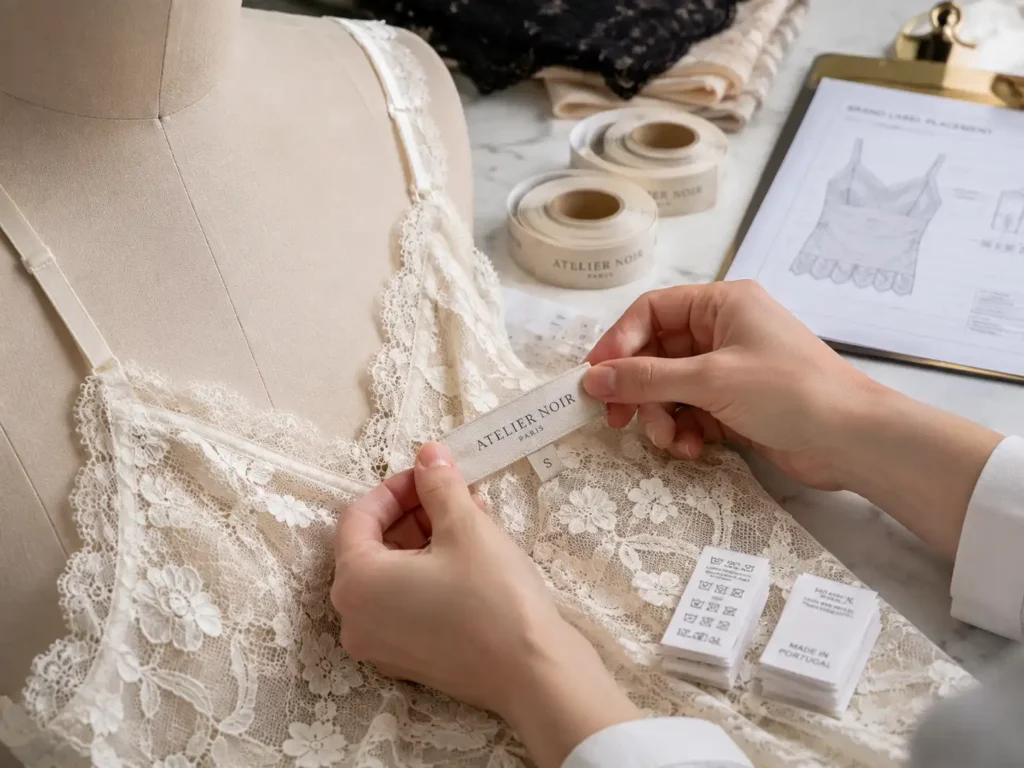
Woven Brand Labels
- Artwork and size approval
- Comfortable label material
- Placement aligned with lining and neckline
- Correct brand identity on every garment

Care and Size Labels
- Size and market coding
- Fiber and care text confirmation
- Placement that avoids visible distortion
- Bulk check against approved artwork

Hangtags and Attachments
- Paper and finishing selection
- Safe attachment location
- Correct string, seal, or fastener
- Tag content matched to style and SKU
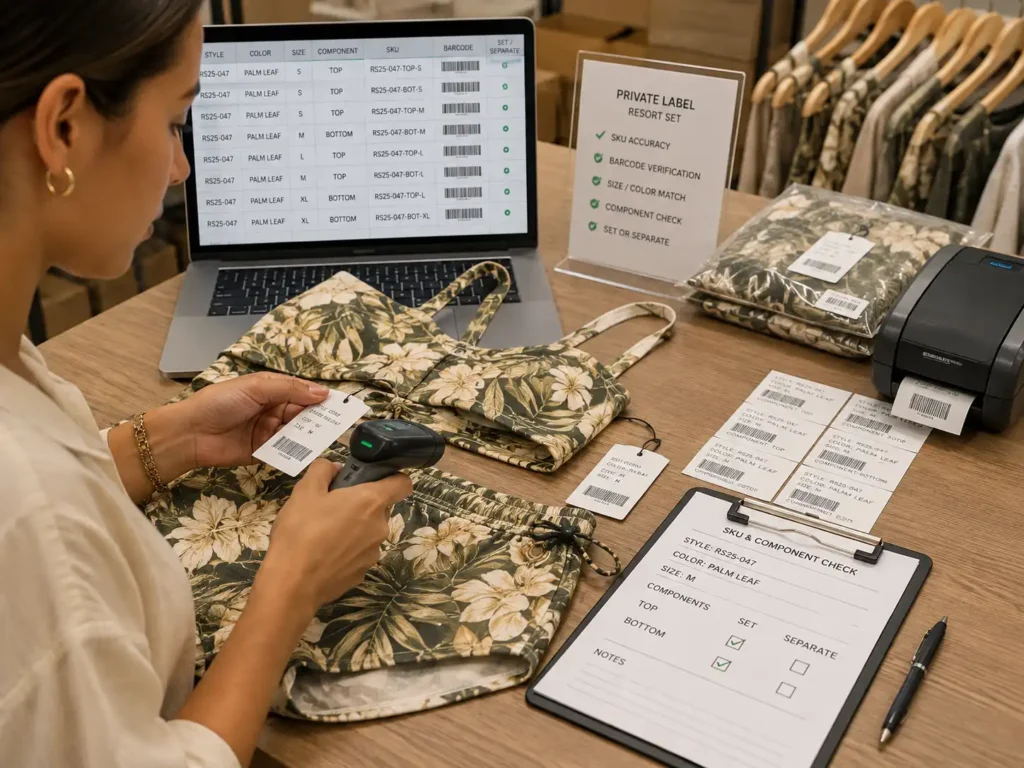
Barcode and SKU Labels
- Style/color/size mapping
- Barcode file control
- Polybag and carton label alignment
- SKU separation for warehouse receiving

Polybags and Folding
- Garment-safe folding sequence
- Protection between decorated surfaces
- Suitable bag dimensions and warning text
- Consistent presentation on arrival
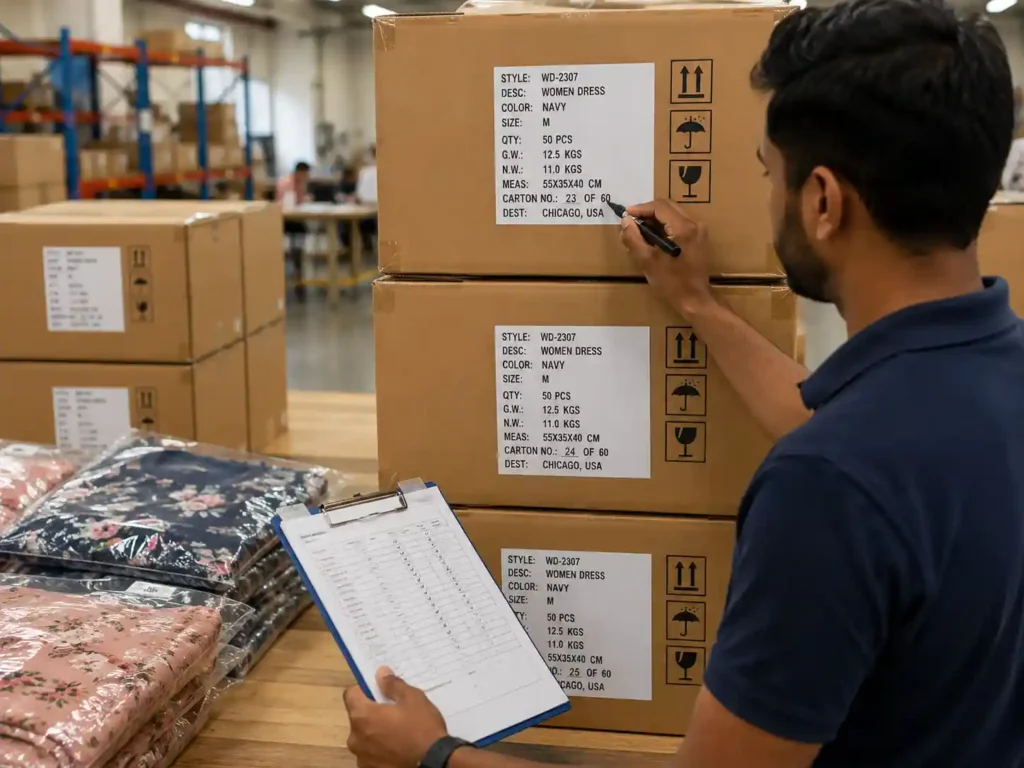
Cartons and Carton Marks
- Agreed pieces per carton
- Clear marks without exposing confidential data publicly
- Correct assortment by SKU
- Shipment records matched to packing lists
MOQ and Cost Factors for Mesh Jumpsuit Production
MOQ starts from 200 pcs per style/color for suitable projects. Final feasibility and quotation depend on material supply, color, print, decoration, structure, size plan, packaging, testing, production allocation, and delivery requirements.
| Cost or MOQ Factor | Manufacturing Impact | Information Needed Before Quotation |
|---|---|---|
| Stock stretch mesh | More likely to support the standard MOQ when color, quantity, width, hand feel, and batch availability are confirmed | Preferred mesh type, color, stretch, transparency, and quantity per style/color |
| Custom-dyed mesh | Dye-house minimums, lab dips, color approval, dye-lot control, and longer material preparation may raise MOQ | Pantone or physical color standard, target quantity, lining color, and launch window |
| Custom-printed mesh | Base fabric, artwork, print method, strike-off, repeat, placement, and printing minimums affect cost and MOQ | Artwork file, repeat scale, color count, placement expectation, and quantity |
| Double mesh or lining | Additional fabric use, cutting, joining, coverage mapping, and seam handling affect cost | Lining area, layer count, color, stretch, opacity, and desired hand feel |
| Rhinestone or sequin work | Decoration map, material grade, application time, loss allowance, inspection, and protective packing add cost | Stone or sequin reference, density, placement, quality level, and test requirement |
| Corset or support structure | Cups, boning, power mesh, lining, hook-and-eye, pattern time, and fit revisions increase development work | Support level, cup direction, neckline, closure, internal construction, and size range |
| Size range and grading | Extended sizing, petite, tall, or market-specific grading require more pattern and fit review | Target market, full size chart, base size, grade rules, and size ratio |
| Multi-color assortment | MOQ is calculated per style and color; separate colors also require fabric, lining, zipper, thread, label, and SKU control | Quantity by color, approved standards, size ratio, and replenishment plan |
| Private-label packing | Labels, hangtags, barcodes, polybags, cartons, and warehouse rules have separate development and supplier requirements | Artwork, barcode files, packing guide, carton marks, destination, and warehouse rules |
| Testing and audit support | Fabric or garment tests, certified materials, third-party inspections, and audit documents affect time and cost | Market, required standard, test method, factory requirement, certificate scope, and deadline |
Design Protection and Project-Based Compliance Support
NDA and Design Protection
- NDA review before sensitive file transfer
- Controlled access to development records
- No publication of unreleased styles without authorization
- Anonymous project evidence where appropriate
Fabric and Garment Testing
- Confirm standard and test method before quotation
- Verify supplier, fabric, color, batch, and certificate scope
- Include testing cost and lead time in the project plan
- Use third-party laboratories when required
Audit and Documentation Support
Factory information, production process, QC records, packing process, social-compliance documentation,
Sedex-related records, BSCI-related documents, SMETA-related review, and client audit coordination can be discussed for the factory allocated to the program. Availability must be confirmed against the current factory, record date, client protocol, and order plan. Jinfeng avoids presenting every production location as holding the same audit status because responsible sourcing decisions require accurate, project-specific records.
- Factory allocation confirmed before document review
- Current records checked for scope and validity
- Client-appointed audits coordinated by project
- Production and packing evidence prepared with confidentiality controls
Mesh and Fit-Sensitive Womenswear Project Evidence
Large fashion programs require more than one successful prototype. The following anonymous program summaries show how multi-style mesh and jumpsuit risks can be organized through material grouping, sample waves, PP approval, bulk QC, packing, and repeatable records. Brand identities and original design files remain confidential.

US Partywear Mesh Jumpsuit Program - 18 Styles, 42,600 Pieces
An established US partywear label planned an 18-style mesh jumpsuit and statement one-piece program totaling 42,600 pieces across black, chocolate, wine, cobalt, and selected printed colorways. The assortment included sheer bodycon jumpsuits, ruched mesh styles, rhinestone layouts, corset-upper designs, mesh-and-jersey paneling, and two wide-leg overlay silhouettes. Sizes covered XS-XL, with several styles extending into a wider brand-specific range.
The first risk review separated the collection into four construction groups: soft stretch mesh, power-mesh support, custom printed mesh, and embellished mesh. Shared materials were grouped to improve color and trim consistency, while styles with corset structures, heavy rhinestone placement, or complex cut-outs followed separate sample paths. Complex samples required approximately 16-25 days according to material and decoration readiness. Photo-critical styles entered the first sample wave, followed by commercial core silhouettes and extended-color versions.
Fit review focused on shoulder-to-crotch length, front and back rise, waist position, bust coverage, hip transparency, zipper opening, and sitting comfort. Two bodycon styles initially showed excessive tension at the back rise and neckline. The pattern team increased back-rise balance, revised torso distribution, and adjusted lining length without loosening the waist silhouette. A rhinestone style required reduced decoration density near the underarm and inner thigh to improve comfort and seam security.
Before bulk, each style received a PP package containing final pattern, size chart, grade rules, approved mesh, lining reference, trim card, decoration map, label placement, folding method, and QC checklist. Bulk production was arranged in approval waves rather than releasing all 18 styles together. Inline QC concentrated on mesh damage, seam waviness, crotch and torso measurements, zipper flatness, missing stones, lining exposure, and color consistency. Packing used protective layers between embellished surfaces and SKU-specific polybag labels for warehouse receiving.
The final program was organized into two delivery groups aligned with the launch calendar. Pattern, BOM, color, trim, measurement, decoration, packing, and QC records were retained for replenishment and new-color review. The main result was not only delivery of 42,600 garments, but a repeatable development structure for future mesh one-piece capsules.

European Ecommerce Mesh Collection - 24 Styles, 67,200 Pieces
A European premium ecommerce fashion label developed a 24-style mesh-led collection totaling 67,200 pieces, combining 11 jumpsuits, 7 mesh dresses, and 6 coordinating tops and skirts. The assortment used printed stretch mesh, double-layer tonal mesh, soft ruched mesh, power-mesh inner control, and solid stretch jersey for strategic coverage. The size architecture followed EU sizing with a wider range on selected commercial styles.
Development was organized around three seasonal drops rather than one release. The first drop prioritized campaign jumpsuits and printed hero styles; the second focused on commercial black, brown, and neutral bodycon products; the third expanded winning constructions into new prints and coordinated separates. Fabric grouping reduced unnecessary variation, while physical approvals were maintained for print strike-offs, lining colors, stretched transparency, and mesh recovery.
The largest technical issue involved printed artwork distortion across high-stretch hip and thigh zones. Artwork scale and pattern placement were revised so focal motifs remained balanced when worn. A double-layer style developed twisting between the outer and inner mesh near the waist and crotch. Layer direction, anchoring points, and seam handling were updated, followed by a revised fit sample. Several wide-leg styles required separate outer-overlay and inner-trouser patterns to control drape, coverage, and walking movement.
The PP process locked print, layer direction, lining coverage, stretch, measurements, labels, barcodes, and ecommerce folding. Bulk QC sampled base and graded sizes for bust, waist, hip, torso, rise, inseam, and total length. Print direction, left-right motif balance, lining exposure, seam tension, and barcode accuracy were tracked by style. Priority campaign quantities were separated from the main stock flow so packing and delivery could follow the three-drop launch structure.
Records from the first approved styles were used to speed later color and print extensions, while every new fabric or print base still received stretch, transparency, and pattern review. The 67,200-piece program demonstrates how mesh jumpsuits can sit inside a coordinated commercial collection rather than remain isolated statement pieces.
Mesh Jumpsuit Manufacturer Frequently Asked Questions
Send Your Mesh Jumpsuit Project for Review
- Reference images, sketch, tech pack, or original sample
- Quantity per style and per color
- Preferred mesh, transparency, stretch, and lining direction
- Target market and complete size range
- Torso, crotch, fit, support, and coverage expectations
- Print, rhinestone, sequin, zipper, cup, boning, or trim details
- Main label, care label, hangtag, barcode, and packing requirements
- Target launch date, delivery destination, and inspection requirements


