 Skip to content
How Should Dress Lining Change by Construction? Bodycon, Satin, Lace, Sequin and Corset

Your trusted Women’s Apparel Manufacturer from China

A lining may be almost invisible when a customer looks at a finished dress, yet it can determine whether that dress feels comfortable after two hours of wear, stretches correctly over the hip, stays opaque under bright photography, hangs cleanly from the waist, or keeps a corset bodice stable when the wearer moves. This is why experienced product developers do not start with the question, “What is the best lining fabric?” They start with the construction of the dress and the job the inner layer is expected to perform.
A fitted jersey bodycon dress, a fluid satin slip dress and a boned corset dress may all be described as “lined,” but the same lining specification would rarely suit all three. Lace adds another layer of complexity because the lining affects the visible design, while sequins introduce abrasion, added weight and bulky seam allowances.
Dress lining should change with garment construction. Bodycon dresses generally need stretch-compatible lining; satin needs a smooth inner layer that preserves drape; lace requires deliberate transparency and color control; sequin dresses need skin protection and sensible bulk management; and corset dresses need lining coordinated with cups, boning and structural layers. The correct lining supports the shell rather than quietly fighting it from inside.
The difference often becomes obvious only after the sample leaves the hanger. A satin mini may look perfect during a static inspection, then develop twisting at the hip once a model walks. A bodycon dress may measure correctly but feel much smaller because the lining stops stretching before the shell. A sequin dress mayphotograph beautifully but scratch around the armhole after twenty minutes. These are not minor finishing issues. They are construction issues, and lining is one of the places where they begin
Dress Construction | Main Lining Priority | Typical Risk | Key Development Check |
Bodycon | Stretch and recovery | Ride-up, restricted movement | Stretch direction, hip fit, recovery |
Satin | Drape and smoothness | Cling, ridges, surface distortion | Lining weight, hem, zipper area |
Lace | Coverage and visual layering | Unwanted transparency | Color, motif, lining boundary |
Sequin | Skin protection and bulk | Scratching, thick seams | Underarm, backing, stretch, hem |
Corset | Structural coordination | Pressure and shifting layers | Cups, boning, lining, closure |
What Does a Dress Lining Need to Do?
A dress lining should improve comfort, opacity, movement and internal finishing without changing the fit or drape the designer intended. In some dresses it is mainly a smooth skin-contact layer; in others it controls transparency or supports the shell. The first decision is therefore not which lining fabric looks best, but which functions the finished garment actually needs from its internal construction.
Lining, Underlining and Interlining
A conventional lining normally forms a separate inner layer that covers seam allowances, improves comfort and provides opacity. It may be attached around the neckline, armholes, zipper or waist while remaining relatively free through the skirt. This allows the shell and lining to move somewhat independently, which is useful in many dresses where the outer fabric needs to retain its own drape.
Underlining works differently because it is normally cut to correspond with the shell pattern and joined to that shell before the main garment is assembled. The two fabrics then behave much more like a single composite layer. Lace, delicate woven fabrics and some transparent materials can benefit from this approach because the backing adds coverage or stability without creating a completely separate inner garment.
Interlining usually sits between visible layers and is chosen primarily for support or reinforcement. It becomes especially important in structured bodices, where the visible shell, strength layer, boning system and skin-contact lining may all have separate jobs. Calling every internal fabric “lining” can therefore create confusion during costing and sample development, particularly when a technical pack says “fully lined” but does not define whether the lace needs underlining or the corset needs an additional structural layer.
Stretch, Drape and Weight
Stretch, recovery, drape and weight should be evaluated together because a lining that performs well in one category can still be unsuitable overall. If the outer material stretches easily but the lining resists extension, the wearer experiences the lining as the real limit of the dress. If the shell is fluid but the inner layer is noticeably firmer, the finished garment can lose the movement that made the outer fabric attractive in the first place.
Fabric weight also accumulates once two complete garment layers are combined. A lightweight lining can still change the behavior of a dress after seams, facings, zipper tapes and other internal components are added. For this reason, grams per square meter should be treated as useful material information rather than a complete prediction of finished drape. Two fabrics with similar weight can behave very differently when folded, stretched or sewn.
Surface friction deserves similar attention. When the lining grips the shell instead of sliding naturally beneath it, the layers can climb, twist or pull against each other. This is why an experienced sample room evaluates the shell and lining together rather than approving two individual swatches and assuming they will behave correctly once sewn into the same dress.
Opacity and Visual Control
Opacity changes with stretch, color and lighting, so checking a relaxed fabric against a table is not enough for many fashion dresses. A pale knit may appear opaque before sewing but become significantly more transparent once stretched across the hip. Satin can reveal dark zipper tape or seam allowances under directional lighting, while lace intentionally allows the backing color to become part of the visible design.
For fitted styles, the most useful opacity check is performed while the garment is worn at realistic tension. Light colors such as white, ivory, blush and pastel shades deserve particular attention because internal seams, labels and structural components are more likely to appear through the outer layer. Adding the heaviest possible lining may solve transparency but create a new problem by increasing heat, bulk or stiffness.
Photography can reveal issues that are less obvious during normal indoor viewing. Eventwear, ecommerce dresses and social-media-focused styles should therefore be checked in daylight and under stronger directional lighting before the lining specification is finalized. The goal is not maximum opacity in every dress. The goal is the exact level of coverage the design requires.
Full or Partial Lining
Full lining is useful when the dress needs continuous opacity, cleaner internal finishing or a smoother feel against the body, but it should not automatically be treated as a quality upgrade. Lace dresses may intentionally keep sleeves or upper bodice areas transparent, while opaque stretch bodycon fabrics may need additional coverage only in selected areas rather than through the entire garment.
Different sections of the same dress can also need different solutions. A satin occasion dress may contain a structured, fully finished bodice and a much lighter skirt lining. A corset dress may require several layers through the upper body while the skirt needs only an ordinary inner layer. Treating both areas identically can increase bulk without providing any additional benefit.
Every extra layer also affects fabric consumption, cutting, sewing, pressing and inspection. The practical question is therefore whether the lining solves a specific fit, comfort, transparency or construction problem. When it does, the added layer is useful. When it does not, a lighter or more selective construction can often produce a cleaner finished dress.
Which Lining Works Best for Bodycon Dresses?
Bodycon dresses usually need a lining that can follow the required stretch and recovery of the shell without becoming the restrictive layer. It should provide sufficient coverage and comfort while allowing normal movement through the bust, waist and hip. Stretch direction, recovery, lining length and friction generally matter more than simply choosing a fabric whose fiber label includes elastane.
Matching Stretch and Recovery
A simple development check can begin with a 100 mm marked section of fabric. If that section stretches comfortably to 130 mm, it has extended by 30%. The calculation is straightforward: the extended length minus the original length, divided by the original length, multiplied by 100. This type of check does not replace laboratory testing, but it gives product developers a consistent way to compare several lining candidates before a sample is sewn.
The important number is not the maximum stretch a fabric can survive. What matters is the extension required by the actual pattern. If a fitted dress needs approximately 25% movement across the hip, the lining should reach that extension comfortably in the correct direction rather than becoming noticeably resistant before the shell does. Vertical movement may also matter when the wearer sits or bends, particularly in very close-fitting midi and mini styles.
Recovery should then be checked after the material is released. A lining that remains elongated can gather inside the garment or become visible near the hem after repeated sitting. The most reliable conclusion therefore comes from combining a basic fabric test with a finished-garment wear test rather than relying on fiber content or a supplier description.
Check | Example Development Method | What It Reveals |
Horizontal extension | Mark 100 mm and stretch to the pattern requirement | Whether hip and waist movement are restricted |
Vertical extension | Repeat along garment length | Whether sitting can pull the dress upward |
Recovery | Re-measure after release | Risk of bagging or loose inner fabric |
Shell/lining comparison | Stretch both in matching orientation | Which layer becomes restrictive first |
Wear test | Walk, sit, bend and stand | Ride-up and seam movement |
The numbers in this table are comparison tools rather than universal pass standards. A structured Ponte dress, a jersey club dress and a stretch-satin mini can all be bodycon styles while requiring quite different levels of extension and compression.

Ride-Up and Side Seams
Ride-up is often blamed on the pattern alone, but several factors can contribute at the same time. A lining that is tighter than the shell, a highly grippy inner surface, insufficient hip shaping or a lining hem finishing directly across a high-friction area can all encourage the dress to move upward as the wearer walks. Loosening the entire garment before identifying the actual cause can damage an otherwise good fit.
Side seams provide a useful diagnostic reference. After the wearer sits and walks, those seams should remain reasonably close to their intended vertical position. When both shell and lining rotate, the problem may involve pattern balance, grain orientation or fabric behavior. When the outer shell appears stable but the lining twists underneath, the two layers may have incompatible stretch or friction.
Ruched styles require even more attention because the gathered surface can visually disguise structural movement. The sewing team should check the actual side seam beneath the ruching instead of judging only the finished appearance. A dress can look deliberately gathered while still having a lining that is pulling the structure away from its intended position.
Opacity Under Stretch
Opacity should be checked at the amount of tension the dress experiences on the body. A knit or stretch satin may look completely solid while relaxed and then become noticeably lighter across the bust or hip. This change is especially important for white, pastel and pale neutral colors, where seam allowances and internal labels can become more visible once the shell extends.
A heavier lining is not automatically the best answer. Although it may provide more coverage, it can increase heat, reduce flexibility and change the sleek surface that makes a bodycon style appealing. Lining color, shell color, seam placement and pattern ease should be considered together before additional weight is introduced.
The sample should also be viewed under multiple lighting conditions. Bright fitting-room lights, daylight and ecommerce photography can produce very different transparency results. If the dress is intended for nightlife or event use, the shell should be checked against both lighter and darker backgrounds because strong contrast can reveal areas that look acceptable under ordinary factory lighting.
Pre-Production Fit Checks
A mannequin cannot reproduce the movement that creates most bodycon lining problems, so the sample must be worn. The fit session should include standing, walking, sitting, bending and returning to a neutral position. After that sequence, the team should recheck the bust, waist, hip, side seams, outer hem and lining hem rather than approving the sample immediately after it is put on.
The lining should not become the component that prevents comfortable sitting, pulls the neckline downward or causes the outer skirt to shorten through tension. Recording the distance between the lining and shell hems on the approved sample can also help maintain consistency when production is scaled across multiple sewing lines or colorways.
Jinfeng Apparel’s product-development framework specifically treats bodycon dresses through stretch, recovery, bust-waist-hip proportion, length and side-seam control rather than simply defining them as “tight dresses.” This type of construction-specific control is especially useful when an approved sample must later be reproduced consistently through bulk production.
How Should Satin Dresses Be Lined?
Satin dresses generally need a lining that remains smooth and fluid enough to preserve the shell’s drape. The inner layer should provide comfort and coverage without creating ridges, pulling the satin or making the skirt feel unnecessarily heavy. Lining weight, seam placement, zipper construction and hem length all matter because satin’s reflective surface makes small internal irregularities unusually easy to see.
Preserving Satin Drape
A fluid satin dress depends on movement. If the lining is noticeably firmer than the shell, the garment may hang away from the body, break awkwardly around the hip or lose the soft movement that the designer intended. This is particularly obvious in slip dresses, where the appeal often comes from a light silhouette rather than from structured shaping.
Bias-cut satin requires even more careful coordination because the outer fabric behaves differently from a straight-grain woven layer. A lining that does not allow compatible movement can create diagonal tension, uneven hems or subtle twisting that becomes visible only after the dress has been worn or hung for a period of time. The issue may be wrongly blamed on the shell even when the inner construction is causing the resistance.
A useful evaluation is simply to watch the finished sample from the front, side and back while the model walks and turns. The shell should not appear to float over a stationary lining, and the lining should not pull one side of the skirt higher. For strongly bias-influenced designs, final hem judgment should come only after the garment has had enough time to settle.
Static, Cling and Transparency
Satin can cling to the lining or to the wearer, particularly when synthetic materials create static in dry environments. The result can make a properly fitted skirt appear narrower or more wrinkled than the pattern intended because the outer layer remains attached to the thigh instead of falling naturally. Surface finish and friction therefore matter just as much as whether the lining feels smooth when handled by itself.
Transparency becomes another concern in light-colored satin. Zipper tape, dark seam allowances, facings and abrupt lining boundaries can appear under strong light even when the garment looks fine during ordinary inspection. Because satin reflects directional light, small internal inconsistencies can become surprisingly obvious in photography.
The sample should be viewed in daylight and under stronger artificial lighting, especially if it will be sold online. The shell-and-lining color combination also needs to be tested in the actual fabric rather than chosen from digital color codes alone. A lining that disappears beneath black satin may become clearly visible beneath champagne, ivory or pale pink.
Full and Partial Satin Lining
A formal satin dress often benefits from full lining because the inner layer improves opacity, comfort and finishing, but the entire garment does not necessarily require the same construction. A structured bodice can include lining, cups, facings or reinforcement, while the skirt may need only a lightweight inner layer that preserves movement.
Slip dresses illustrate the trade-off clearly. If the lining is too substantial, the dress stops behaving like a fluid slip and starts behaving like a heavier double-layer garment. The lining still needs enough length to provide coverage, but it should remain safely above the outer hem and should not become conspicuous when a slit opens during walking.
The decision should therefore be made panel by panel rather than from a blanket instruction such as “fully lined.” A technical pack is much clearer when it identifies exactly which panels are lined, how the lining attaches at the waist or neckline, how much shorter it finishes at the hem and whether a slit requires its own separate construction.
Sampling Satin Linings
A satin sample needs more than a measurement review because some of the most important problems are visual rather than dimensional. Run a hand over the exterior to detect internal seam ridges, inspect the zipper under side lighting, and check whether the lining creates tension at the neckline or armhole. Then lift and release the skirt to see whether both layers return to a natural position.
Pressing should be reviewed at the same stage. Heavy seam intersections and zipper areas can imprint through a smooth satin shell, and excessive pressure during finishing may make a hidden internal structure more visible instead of less visible. Packaging can also create fold marks that affect the surface after the garment leaves the factory.
Satin is one of Jinfeng Apparel’s core dress materials, and its documented production controls specifically recognize snagging, color variation, wrinkling, luster direction and pressing as important risks. An internal project record also describes an anonymous U.S. occasionwear program of about 20,000 satin mini and midi dresses where zipper flatness, lining comfort and multi-color bulk stability were key control points.
How Should Lace Dresses Be Lined?
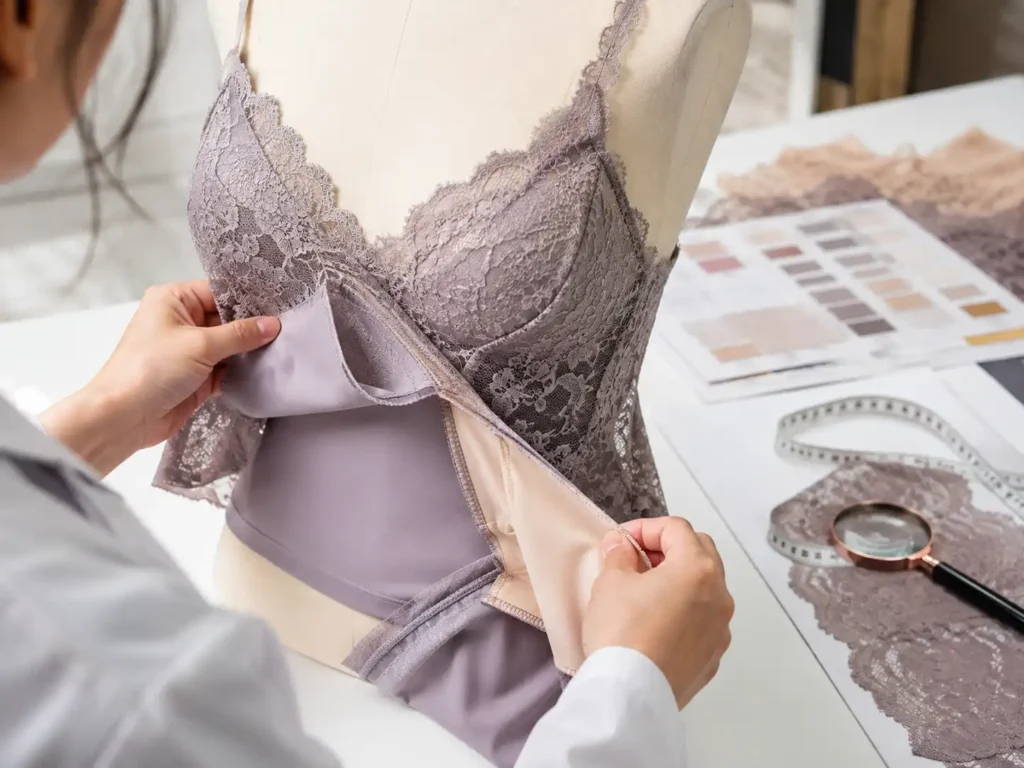
Lace dresses should be lined according to the visual relationship between coverage and transparency. Unlike an opaque shell, lace allows the backing to become part of the visible design, so lining color, placement and construction method can change the finished appearance substantially. Full lining, underlining and selective coverage are all valid approaches when they match the intended motif, fit and sheer areas.
Full Lining or Underlining
Full lining and underlining create different relationships between the inner and outer fabrics. A separate lining gives the lace more independence and creates a smooth internal finish against the skin. Underlining joins the backing to the lace before garment assembly, allowing both layers to behave much more like one fabric while also controlling transparency and stabilizing delicate areas.
A fitted lace cocktail dress may benefit from underlining through the torso because the backing gives the motifs a consistent visual background. An evening dress may use lined body panels while leaving the sleeves or upper chest transparent. Another design may place the lace over a completely separate slip. None of these methods is automatically more premium; they simply produce different effects.
Technical drawings should make the coverage clear. The note “nude lined lace dress” still leaves major questions unanswered. It does not specify whether the upper back is transparent, whether the sleeves remain sheer or whether the nude layer stops at the bust or continues through the skirt. Marking the lined areas directly on front-and-back sketches usually removes more ambiguity than a long paragraph of written instructions.
Lining Color and Transparency
The lining color underneath lace functions almost like a second color in the garment. Matching the backing closely to the lace produces a more solid appearance, while a skin-adjacent shade can make the motifs stand out by creating the visual impression that the lace sits directly over the body. A deliberate contrast can create an even stronger graphic effect.
Color selection should be made with the real lace because dense embroidery, open mesh areas and motif scale all influence how much of the backing appears. A small swatch is useful for an initial direction, but a larger layered panel gives a more realistic impression. Curved areas such as the bust can also change how open lace looks compared with a flat cutting table.
Internal construction becomes particularly important in pale lace. Cup edges, boning, seam allowances and zipper tape can become visible if the backing is not sufficiently opaque or if the internal colors contrast sharply. Multi-color collections should therefore evaluate the lining independently for each colorway rather than assuming one nude shade will work equally well with white, blush, red and black.
Motif Placement and Seams
Lace placement can affect both appearance and fabric consumption because pattern pieces may need to move away from their most efficient marker position to achieve symmetry or motif matching. There is no sensible universal wastage percentage for this because the real requirement depends on motif size, repeat, garment shape and how precisely the design needs to match at major seams.
Center front, center back, neckline, waist and paired bust panels are common areas where mismatched motifs become especially noticeable. The lining influences the result because an open lace section can make a thick or contrasting seam allowance more obvious than expected. A good backing can control this, but only when the internal seam construction is planned with the visible motif.
The approved sample should therefore become the visual placement standard for bulk production. Measurements alone cannot communicate whether a flower motif should be centered over the bust or whether two scalloped edges need to appear symmetrical. Complex lace products benefit from visual reference photography and clear cutting notes in addition to ordinary specifications.
Stretch and Sheer Areas
Stretch lace and non-stretch lace require different lining logic. A fitted stretch-lace dress depends on extension through the bust, waist and hip, so a rigid backing can quietly turn an elastic outer material into a much less flexible finished garment. The lining does not need identical maximum stretch, but it should allow the movement required by the pattern without becoming the obvious limiting layer.
The direction of extension also matters because many lace constructions stretch more across the width than vertically. The lining should therefore be placed according to garment movement rather than simply labeled as “stretch.” A comparative swatch test followed by a fitted sample remains more useful than relying on fiber percentages.
Sheer areas should be mapped before the pattern is completed. A dress might use full coverage through the torso, transparent sleeves and a partially sheer back. Ideally, transitions between lined and unlined areas follow structural seams or visual motifs rather than cutting abruptly across open lace. Jinfeng Apparel’s documented lace controls include motif matching, seam joining, edge finishing and lining, reflecting the way these decisions interact in production.
How Should Sequin Dresses Be Lined?
Sequin dresses generally need lining that separates the wearer from abrasive backing, cut sequin edges and bulky seam allowances while maintaining the intended fit. Stretch sequin fabrics may require stretch-compatible lining, while more structured styles can use a different inner system. The underarm, neckline, side seams, zipper area and hem deserve particular attention because these are common locations for scratching and thickness.
Skin Comfort
Sequin discomfort commonly appears around edges and seams rather than across the flat center of a panel. The underarm, neckline and side seam contain cut decorative elements, concentrated seam allowances and repeated body contact. A soft lining helps, but it cannot completely compensate for sharp sequin edges trapped inside a bulky construction.
A useful sample review begins by running a hand slowly around the internal armhole, neckline and zipper area. The dress should then be worn and moved in, because the body contacts different points while walking, raising an arm or sitting. Sleeveless and strapless styles deserve particular attention since the upper edge and armhole remain in continuous contact with skin.
In some constructions, clearing sequins away from seam allowances before stitching creates a flatter and more comfortable seam. Whether this method is suitable depends on the way the decorations are attached and whether removing them could loosen surrounding work. The important point is that comfort should be designed into the seam construction rather than left for the lining fabric to solve alone.
Stretch Sequin Linings
Sequin materials can be built on stretch mesh, knit or non-stretch woven bases, so the decorative surface does not tell you what the lining needs to do. If the base contributes meaningful stretch to a close-fitting dress, the lining must permit the movement required across the bust, waist and hip. Otherwise, the inner layer becomes the real fit restriction.
The embellishment itself can reduce flexibility. A stretch mesh that extends easily before decoration may become noticeably more resistant once it carries dense sequins and attachment stitches. Sewn seam areas are more restrictive again because several layers and concentrated decoration come together.
For this reason, testing only the unembellished base material provides an incomplete picture. A representative section of the actual sequin fabric should be combined with the proposed lining and, where possible, a sample seam. The finished garment should then be checked while the wearer sits and walks.
Loose sequin shifts, structured cocktail dresses and non-stretch evening gowns do not automatically need elastic lining. As with other constructions, the silhouette determines the functional requirement rather than the decorative category alone.
Bulk, Weight and Visibility
Bulk accumulates quickly in sequin garments. A center-back zipper can contain two embellished seam allowances, lining allowances and zipper tape in one narrow area. A waist join may combine an embellished bodice with an embellished skirt, producing even more thickness. These intersections can affect zipper operation, exterior smoothness and wearer comfort.
Where technically appropriate, decorations can be removed from seam allowances before sewing so that the structural seam is flatter. The lining can then be chosen for comfort and coverage without contributing more thickness than necessary. The exact treatment should be established on the approved sample because different sequin attachment methods respond differently to trimming or clearing.
Weight also matters, especially in floor-length or densely embellished garments. A heavy shell may pull on straps, shoulder seams or a neckline if the internal construction does not distribute the load properly. The sample should be inspected after hanging as well as while worn, since elongated straps and dropping side seams can appear over time.
Lining visibility should finally be checked at slits and hems. Movement can expose an inner layer that remained completely hidden during a standing inspection.
Pre-Production Inspection
A sequin PP sample should be reviewed as a connected system covering comfort, fit, decoration security, seam thickness, lining position and packing. Begin with the wearer: check the underarm, neckline, side seam and zipper during movement. Then inspect the decorative surface around seams to identify unintended gaps, loose sequins or areas where clearance has altered the visible appearance.
The lining should remain in its intended position while the model walks and sits. In mesh-backed sequin styles, the lining may intentionally become the visible background, so color consistency is part of the external appearance rather than merely an internal specification.
Packing should be tested before bulk production because heavily embellished surfaces can snag or press into each other when folded. A garment can leave the sewing line in excellent condition and still arrive damaged if the decoration is compressed incorrectly inside the polybag or carton.
Jinfeng Apparel’s product knowledge treats sequin loss, scratching, broken needles, seam thickness, lining and packing as specific sequin-production risks rather than ordinary sewing issues. That distinction becomes increasingly important as order volume grows because problems are much easier to correct during pilot or inline production than after final inspection.
How Should Corset Dresses Be Lined?
Corset dresses should treat lining as one layer in a complete support system rather than expecting the inner fabric to provide every structural function. A bodice may include a visible shell, stabilizing layer, cups, boning or channels and a separate skin-contact lining. These components must work together so the dress can shape the bust and waist while remaining comfortable enough for normal movement.
Corset Bodice Layers
Corset-inspired dresses do not all require the same number of physical layers, but identifying each function makes construction clearer. The fashion shell provides the visible appearance and may be satin, lace, mesh, velvet or another decorative material. A structural layer adds dimensional stability when the shell itself cannot hold the required shape.
Cups can establish bust shape and coverage, while boning and channels provide vertical support and influence how the waist and upper body are controlled. The final lining covers the internal components and creates a smoother surface against the skin. In simpler fashion corsets, some fabrics may perform more than one function; in more structured occasionwear, the layers are often more clearly separated.
A specification that says only “corset dress, fully lined” therefore leaves major decisions unresolved. The sample room still has to determine whether the fashion fabric can carry tension, whether a strength layer is needed, where the bones sit and how the cups are integrated. Defining these functions in the technical pack makes the first sample more predictable and the quotation more meaningful.
Corset Component | Main Job | Practical Sample Check |
Fashion shell | Visible appearance | Smoothness, grain or motif position |
Structural layer | Stabilizes the bodice | Stretch resistance and seam stability |
Cups | Bust shape and coverage | Volume, height and symmetry |
Boning/channels | Vertical support | Position, length and pressure |
Lining | Skin-contact finish | Wrinkles, softness and coverage |
Closure | Controls opening and tension | Zipper flatness and symmetry |

Support Layer and Lining
The lining and structural layer often need different properties because they serve different purposes. A comfortable inner lining should feel smooth against the body and finish the internal construction cleanly. A supporting fabric may need much greater dimensional stability so it can carry seam tension and help the boning system maintain the intended silhouette.
Using a very soft lining as the only structural layer may allow the bodice to distort. Using a rigid supporting fabric directly against the body can create avoidable discomfort. Separating these roles gives the pattern maker more control and allows each material to perform the job it handles best.
The distinction also matters during fitting. A lining wrinkle across the cup is not always a lining problem. It may indicate incorrect cup volume or a mismatch between the structural and outer patterns. Likewise, pressure at the waist cannot be solved simply by switching to a softer lining if the bodice itself is too tight.
Development works more efficiently when structural fit is corrected first and cosmetic internal finishing is refined afterward.
Boning, Cups and Channels
Boning position affects both support and comfort because each channel creates a relatively rigid vertical line. If a bone finishes in a sensitive area, the wearer may feel concentrated pressure when sitting. If the left and right bones are positioned differently, the bodice can become visibly asymmetrical even when the outer pattern pieces measure correctly.
Cup placement requires similar precision. Small changes in cup height or bust apex position are easy to notice in fitted corset dresses, particularly in strapless designs. The lining must then follow this three-dimensional shape without creating loose folds or pulling the cup away from the body.
The fit session should therefore evaluate cup placement, top-edge stability, boning alignment, waist pressure and closure behavior together. Ask the wearer to sit because the torso shortens and bends differently from the standing position, potentially changing where the bone ends contact the body.
Jinfeng Apparel’s product matrix lists bust, waist, cup shape, zipper and boning position among the key corset-dress controls. These checks illustrate how internal construction and visible fit are closely connected.
Support and Wearability
A fashion corset dress is not improved simply by making the bodice tighter. The objective is to create the intended shape while allowing the wearer to breathe, sit, walk and remain comfortable for the event. Prom, evening and party dresses may be worn for several hours, so a pressure point that seems minor during a short fitting can become a genuine product problem.
Support should be distributed across cup shape, waist pattern, boning, neckline tension and closure. When one area carries too much load, the dress often reveals it through a rippling zipper, a top edge pulling downward, diagonal stress lines or boning that begins to bow away from the intended body line.
A useful fitting session should therefore last longer than the few minutes needed to measure the bust and waist. Ask the wearer to sit, raise both arms, rotate the torso and breathe deeply. Recheck the neckline, cups, zipper and lining afterward. Only when these functions remain stable should the internal finish be approved for production.
For bulk manufacturing, the approved sample should record cup specification, boning position, lining construction and key fit comments so the same internal architecture can be reproduced consistently instead of being interpreted independently on each production line.
A well-chosen dress lining is not an accessory added after the main fabric has been selected. It is part of the engineering of the garment. Bodycon dresses need inner layers that respect stretch and recovery. Satin needs fluidity and an exceptionally clean internal surface. Lace turns lining color and coverage into visible design tools. Sequins demand skin protection and careful seam management, while corset dresses require several internal components to work as one support system.
For brands developing custom dress collections, these decisions are much easier and less expensive to solve during material selection, pattern development and sampling than after bulk cutting begins. Jinfeng Apparel’s documented manufacturing system covers bodycon, satin, lace, sequin and corset dresses as distinct product constructions, with product-specific fit, fabric and QC controls rather than treating every dress through one generic production formula. The principle is simple: when the wearer starts moving, the lining should help the dress perform the way the designer intended, not become the hidden reason it stops working.
Share This Article :

Jerry Lee
Categories

Latest blogs
Table of Contents
Here, developing your OEM/ODM private label clothing collection is no longer a challenge—it’s an excellent opportunity to bring your creative vision to life.

