 Skip to content

High-Low Dresses
Develop custom high-low dresses with controlled hem proportions, fabric-specific construction, sample validation, and bulk-production standards for established fashion and occasionwear programs.
- High-low hem development is controlled through front, side, and back length references rather than a visual guess.
- Chiffon, satin, crepe, organza, tulle, lace, mesh, and sequin directions can be developed around the required drape and occasion.
- 2 sample rooms and 7+ senior pattern makers support pattern development, fit correction, and pre-production confirmation.
- MOQ starts from 200 pcs per style/color, subject to fabric, color, trims, construction, packaging, and production planning.
High-Low Dress Manufacturing Built for Brand Programs
Since 2008
6 Owned Factories
100,000+ Monthly Capacity
2 Sample Rooms
7+ Senior Pattern Makers
15+ QC Inspectors
Built for Established Fashion and Occasionwear Programs
Global Fashion Brands
Occasionwear Brands
Premium Ecommerce Programs
Specialty Retail Programs
Sourcing and Buying Offices
Private-Label Collections
High-Low Dress Directions for Commercial Collections

Wedding Guest High-Low

Prom and Homecoming

Cocktail High-Low

Evening and Formal

Party and Going-Out

Resort and Vacation
High-Low Silhouettes Worth Developing as a Collection

High-Low Maxi

High-Low Midi

Ruffled High-Low

Layered High-Low

Halter High-Low
Halter silhouettes move visual attention upward, which can make a flowing asymmetric skirt feel lighter and more elongated.
Neckline depth, halter angle, neck comfort, bust coverage, armhole exposure, and back opening must be balanced with skirt volume. The pattern should keep the garment stable during movement so the dramatic hem does not compete with an upper body that shifts or pulls during wear.

Strapless High-Low
Strapless high-low dresses often combine a structured upper body with a more expressive skirt. Bra cups, boning, internal support, grip, lining, zipper position, and waist anchoring may all matter.
A heavy or layered rear skirt can pull on the bodice, so the sample has to confirm both support and weight distribution.
The result should feel secure rather than relying on repeated wearer adjustment.

One-Shoulder High-Low
One-shoulder designs add asymmetry above and below the waist, creating a strong visual identity but also increasing balance demands. Shoulder tension, neckline position, armhole exposure, bodice twist, side-seam alignment, and skirt transition should be reviewed together.
Satin, crepe, mesh, and formal woven fabrics can all work, provided the pattern keeps the upper body stable and the hem reads as intentional rather than distorted.

Structured Formal High-Low
High-Low Hem Engineering From Pattern to Finished Dress
A high-low hem succeeds when the front, sides, back, lining, and fabric behavior form one controlled visual curve. Pattern development should convert the designer’s intention into measurable reference points, then verify how the cloth behaves after cutting, sewing, hanging, pressing, and movement.

Front, Side and Back Length Map
High-low development begins by defining more than a single “dress length.” The pattern team needs a measurable map that includes the front center, side reference points, back center, lowest point, and the transition from shorter to longer areas. The visual goal may be a soft arc, a sharp waterfall, a diagonal asymmetry, or a layered drop, but each direction still needs repeatable geometry. When those points are not clearly defined, sample makers may follow the reference image by eye and produce a hem that changes from sample to bulk or from one size to another.
The front length also has to work with movement and the intended occasion. A party style may accept a shorter front, while a wedding-guest or formal design may need more coverage. Side length affects how the garment looks when the wearer turns, and the back must allow movement without excessive dragging or unintended floor contact. For fitted bodices, waist placement influences where the asymmetric curve begins; for gathered or circular skirts, fullness changes how the edge hangs. Pattern notes therefore need to connect hem shape with waistline, skirt volume, seam placement, and fabric direction instead of treating the hem as an isolated detail.

Fabric Relaxation and Hanging Behavior
Light or bias-sensitive fabrics can continue to change after cutting and sewing. Chiffon, satin, rayon, viscose, crepe, and certain layered constructions may relax differently across the front, sides, and back because not every section sits on the same grain direction. A high-low silhouette makes those changes visible because the eye immediately compares multiple hem levels. If trimming or final hemming happens before the fabric has stabilized enough for the selected construction, the finished garment may look balanced at the sewing stage and uneven later.
Sample review should therefore include hanging observation, surface review, and re-measurement where the material or cut requires it. The goal is not to apply one fixed waiting rule to every fabric; the goal is to recognize when relaxation matters and build the required control into the production method. Fabric weight, skirt fullness, layer count, seam construction, and finishing method all influence the result. A stable crepe high-low dress may need a different route from a soft multi-layer chiffon design, while a structured organza back panel may require trimming and pressing focused more on shape retention than on drape.

Lining and Multi-Layer Control
Lining is especially visible in an asymmetric skirt because the outer layer rises and falls across the body. If the lining is cut too long, it can appear below the shell at the front or side. If it is too short, a sheer chiffon, lace, mesh, organza, or tulle outer layer may reveal more leg than the brand intended. The correct lining length depends on transparency, wearer movement, skirt volume, and the design’s visual hierarchy rather than a standard number copied from another dress.
Layered high-low designs require an additional map for each tier. The outer layer, middle layer, lining, ruffle, and any decorative overlay should maintain deliberate spacing through the entire front-to-back transition. Excessive step differences can look accidental; insufficient separation can make expensive layers visually disappear. The sample stage should review the dress from front, side, back, walking, and seated positions where relevant. Hem trimming, edge finishing, static behavior, and packing also need attention because delicate layers can fold upward or distort when compressed, creating a different appearance on arrival from the approved sample.

Size Grading and Movement Balance
A high-low dress cannot be graded only by adding standard increments around the pattern. The visual proportion of the front length, side transition, back drop, waist position, and skirt fullness needs to remain coherent across the approved size set. If the front becomes disproportionately short in larger sizes, or the back drop grows without corresponding changes to the rest of the skirt, the same design can look like a different silhouette. The grading rule should therefore protect both measurements and visual balance.
Fit review also needs to consider the upper body. A halter, strapless, one-shoulder, corset, or fitted waist can change how the skirt hangs because the garment’s anchor points affect overall balance. Movement tests help reveal whether the front rides upward, the side seam rotates, the rear panel pulls backward, or the lining becomes visible during walking. Those observations feed back into pattern correction before PP approval. The final pattern, size chart, grade rule, approved sample standard, and QC measurements then become the reference for bulk production.
Fabrics Shape Every High-Low Hem Differently

Chiffon
Chiffon creates one of the most recognizable high-low effects because the fabric moves easily and makes layered or ruffled edges feel light.
The same softness increases production risk. Cut pieces can shift, transparency may require carefully planned lining, delicate surfaces can snag, and the hem can reveal imbalance quickly. Multi-layer chiffon also needs deliberate spacing so the back remains fluid rather than bulky.
- Best suited to: wedding guest, bridesmaid, prom, resort, layered and ruffle high-low dresses.
- Key controls: fabric slipping, transparency, lining length, layer spacing, hem balance, snagging, pleating, pressing.
- Sample focus: side transition, rear movement, lining visibility, hanging behavior, and edge finish.
- Bulk focus: consistent cutting, matched layers, balanced hemming, surface protection, and anti-crease packing.

Satin and Stretch Satin
- Best suited to: formal, cocktail, party, wedding guest, structured high-low and slip-inspired silhouettes.
- Key controls: shine direction, color consistency, snagging, zipper flatness, seam puckering, pressing temperature, hem appearance.
- Sample focus: drape versus structure, bodice tension, skirt sweep, surface condition, and press response.
- Bulk focus: shade separation, clean handling, seam quality, flat closures, protective finishing and packing.

Crepe
Crepe gives a high-low dress controlled drape with less surface shine than satin, making it useful for cocktail, semi-formal, office-to-evening, wedding guest, and premium retail styles.
Fabric weight matters: lighter crepe can move softly, while heavier versions hold a cleaner outline.
Because the texture is quieter, fit, seam shape, waist balance, zipper installation, and hem precision become more important to the perceived quality.
- Best suited to: cocktail, semi-formal, one-shoulder, A-line and refined high-low midi dresses.
- Key controls: weight, hand feel, drape, wrinkle behavior, waistline, zipper flatness, pressing.
- Sample focus: silhouette clarity, side seam, front-to-back transition, hem fall and movement comfort.
- Bulk focus: consistent fabric hand, measurement stability, clean pressing and repeatable hem shape.

Organza and Tulle
Organza and tulle can create dramatic high-low volume without relying on heavy fabric.
They work well in prom, evening, party, and formal collections where a layered rear skirt or sculpted silhouette is part of the design language. Layer count, stiffness, static, edge trimming, inner comfort, and lining all change the final result. A small change in material stiffness can noticeably alter skirt volume and the shape of the back drop.
- Best suited to: prom, formal, layered, ruffled and statement high-low dresses.
- Key controls: layer count, stiffness, static, volume, edge finishing, lining, hem trimming.
- Sample focus: silhouette from all angles, rear volume, layer spacing, wearer comfort and packing recovery.
- Bulk focus: layer consistency, matched trimming, controlled fullness, clean edges and shape-preserving packing.

Lace and Mesh
Lace and mesh are often used as overlays, panels, sleeves, inserts, or partial skirts rather than the only structural fabric. Their value comes from transparency, surface pattern, and contrast with lining, but those same features expose placement errors. Lace motifs, mesh stretch, lining color, seam alignment, edge finishing, and transparency need to support the high-low silhouette rather than create visual noise around the hem.
- Best suited to: wedding guest, cocktail, party, corset-inspired and mixed-material high-low dresses.
- Key controls: lace placement, holes, fraying, mesh stretch, transparency, lining coverage, seam deformation.
- Sample focus: motif balance, skin exposure, stretch response, edge placement and skirt transition.
- Bulk focus: consistent placement, matched lining, secure edges, controlled stretch and visual symmetry.

Sequin and Embellished Fabrics
- Best suited to: party, holiday, festival, evening and high-visual-impact high-low dresses.
- Key controls: decoration security, seam thickness, needle breakage, skin contact, weight distribution, anti-scratch protection.
- Sample focus: balance between decorated and undecorated areas, comfort, hem fall and rear weight.
- Bulk focus: secure embellishment, clean seams, surface inspection, controlled pressing and protective packing.
Construction Details That Decide the Finished High-Low Look

Lining Strategy
Lining controls transparency, skin comfort, coverage, weight, and the visual cleanliness of an asymmetric skirt. Chiffon, lace, mesh, organza, tulle, and light-colored fabrics often need a lining plan developed alongside the outer shell. The lining may follow part of the high-low curve or use a simpler internal shape, depending on the look and level of transparency.
- Check lining length from front, side and back.
- Confirm color relationship under natural and studio light.
- Review movement so lining does not appear below the shell.
- Check seam and hem bulk where outer and inner layers meet.
- Validate coverage around fitted bodices, slits and openings.

Invisible Zipper Control
Invisible zippers are common in fitted high-low dresses because they preserve a clean side or back seam. Poor installation can create bulging, rippling, mismatched waist seams, difficult opening, or visible color contrast. Satin and other smooth fabrics make those problems especially noticeable. Zipper length and placement should also work with the fit and the point where skirt volume begins.
- Match zipper type and color to fabric.
- Keep seam lines flat through waist and hip areas.
- Check opening smoothness and top closure.
- Avoid distortion where a fuller rear skirt joins the fitted body.
- Include zipper appearance in sample and bulk QC.

Bodice Support
A dramatic rear skirt can change how a dress feels on the body, especially in strapless, corset-inspired, halter, one-shoulder, or fitted designs. Bra cups, boning, underlining, internal seams, elastic, hooks, and shoulder construction may be required to keep the upper body secure. Support should match the garment rather than be added as a generic solution.
- Confirm cup shape and position where cups are used.
- Review boning placement, end protection and comfort.
- Check neckline and armhole exposure during movement.
- Balance skirt weight against the bodice anchor points.
- Verify support again after the final fabric and trim are selected.

Ruffles and Decorative Layers
Ruffles, flounces, pleats, lace edges, sequin panels, and layered overlays can make the high-low transition more expressive, but they also multiply the number of alignment points. Fullness, joining position, grain direction, edge finishing, and left-right balance should be defined before bulk production. Decorative weight can also alter drape, especially when concentrated toward the back.
- Standardize ruffle width and fullness.
- Mark join points and seam directions.
- Compare left and right sides on the worn sample.
- Review layer spacing and edge consistency.
- Protect delicate surfaces during pressing, folding and packing.
Fit and Grading Must Protect the High-Low Proportion
A high-low hem is most successful when the upper body, waist position, skirt volume, and asymmetric drop remain visually connected across the approved size set. Fit correction therefore goes beyond checking bust, waist, and hip measurements; the pattern team must preserve the intended proportion and movement.
Bodice-to-Hem Proportion
The skirt begins from a specific waist or seam position, so a fit correction above the waist can change the perceived hem ratio below it. A halter neckline that pulls upward, a strapless bodice that slides down, or a fitted waist placed too high can make the front look shorter than intended even when the flat hem measurement matches the spec. Fit review should therefore connect neckline, bust, waist, hip, and skirt transition.
During sampling, Jinfeng can review measurement notes, reference photos, fit comments, and the garment on a form or wearer according to the project method. Pattern corrections should be transferred into the revised sample rather than patched only through sewing adjustments.
The aim is a repeatable pattern standard that allows the production line to follow the approved silhouette with less interpretation. For dresses using cups, boning, elastic, or adjustable straps, the support system should also be confirmed before the hem balance is considered final.
Visual Grading Across Sizes
Standard grade rules remain important, but a high-low dress also needs visual grading. The front length should not become disproportionately short as circumference increases, and the back drop should not grow so much that the silhouette becomes heavier in larger sizes. Side transition points should stay in a visually intentional position relative to the body, while ruffles and layers should maintain proportion instead of becoming either crowded or sparse.
The final size chart can include garment measurements relevant to the style along with hem reference points selected for QC. The exact points depend on construction. A simple high-low midi may need fewer controlled points than a layered formal dress with a fitted bodice and long back. When a brand supplies its own grade rules, those rules are integrated into the pattern and sample review. When fit comments reveal a conflict between the numerical rule and the intended visual result, the issue should be resolved before PP approval, not left for bulk production.
Movement and Wear Safety
A high-low dress is designed to move, which means static measurements are not enough. Walking can lift the front, swing the sides, expose lining, rotate a side seam, or pull a rear panel backward. Sitting can also change how much coverage remains at the front and how a ruffle or layered edge rests around the body. Movement checks are especially important for party, wedding guest, prom, and other occasions where the wearer may walk, dance, sit, and be photographed from multiple angles.
Fit review should also look for twisting, zipper stress, neckline movement, strap pressure, and changes in the skirt when the upper body shifts.
The objective is not to make every fashion style conservative; it is to make the chosen level of exposure deliberate and stable.
Once approved, the corrected pattern, size chart, grade rule, PP sample, and QC measurement points form the bulk-production reference.
Sample Development for High-Low Dresses
Sampling converts a visual concept into a production standard. High-low dresses need focused review of hem geometry, fabric behavior, lining, bodice balance, movement, workmanship, and finishing before bulk production. Jinfeng supports development from tech packs, reference images, sketches, line sheets, original samples, and other agreed project materials.

Project Review Before Pattern Work
A productive sample starts with enough information to understand the intended product. The development team reviews style complexity, fabric direction, trim requirements, quantity per style/color, size plan, private-label requirements, and the target selling or launch window. A reference image can communicate the look, while a tech pack or original sample can provide more precise measurements and construction details.
For high-low dresses, the review should identify the intended front length, rear drop, side transition, skirt volume, lining relationship, and any ruffle or layered structure. The team also needs to understand whether the dress should feel fluid, structured, fitted, formal, relaxed, or highly dramatic. Those decisions influence pattern work and material sourcing. Early review reduces avoidable revisions caused by choosing a fabric that cannot hold the intended shape or by leaving key hem points undefined.

First Sample and Construction Validation
The first sample is used to test the design rather than to pretend the project is already finished. A regular dress first sample commonly falls around 10-15 days, while medium-complex dresses, sets, or jumpsuit-level constructions are commonly around 12-18 days. Complex structures such as corset, strapless, lace, mesh, sequin, layered evening or other high-risk designs may require around 15-25 days, depending on material availability and project requirements.
For a high-low style, the first sample should answer concrete questions: Does the front-to-back proportion match the intended look? Does the fabric relax or stretch? Is the lining visible? Does the skirt move cleanly? Are the side transition and rear volume balanced? Does the bodice support the skirt weight? Are ruffles and layers symmetrical? Are closures flat? Those findings provide the basis for revision rather than being hidden by styling or photography.

Revised Sample and Fit Correction
Revised samples usually require around 7-15 days, depending on the correction scope, materials, and construction. The goal is to translate fit notes and visual comments into pattern and construction changes. Jinfeng can work from measurement comments, marked photos, fitting notes, or other agreed feedback. Pattern corrections should be documented so the revised garment represents a new controlled standard rather than a one-off repair by a sample machinist.
High-low revisions may include front length, rear drop, side curve, waist position, ruffle fullness, lining length, zipper position, strap length, bust support, skirt volume, or layer spacing. Material changes may also be tested when the original fabric produces too much weight, transparency, shine, stiffness, static, or movement. The revised sample is then reviewed against the design intent and bulk-production feasibility.

PP Sample and Golden Standard
A PP sample is commonly around 7-15 days when final materials are ready and the project can proceed without unresolved changes. The PP stage should use the approved or final-intent fabric, color, trims, construction, measurements, labels, and relevant packaging details. Once approved, those elements are locked into the production handover so purchasing, cutting, sewing, QC, finishing, and packing are working from the same reference.
The final handover can include the corrected pattern, size chart, grade rule, BOM or trim information, sewing instructions, label placement, packing instructions, QC checklist, and approved sample standard. High-low hem reference points should be clear enough for production and inspection teams to verify the silhouette during bulk. Any later design change should be reviewed for its effect on cost, materials, timing, and consistency before implementation.
Typical Sample Timing by High-Low Dress Complexity
Sample timing depends on fabric availability, construction, trims, revisions, and the level of pattern work required. The ranges below are planning references for development discussions rather than automatic promises for every style.
| Development Stage | Typical Reference | High-Low Dress Example | Main Variables |
| Simple first sample | About 7-10 days | Cleaner woven style with limited trims and straightforward hem | Fabric availability, pattern input, finishing |
| Regular dress first sample | About 10-15 days | Satin or crepe high-low dress with standard lining and closure | Hem curve, fit, zipper, lining, color |
| Medium-complex first sample | About 12-18 days | Ruffle, layered, halter, one-shoulder or multi-panel style | Layering, drape, support, trim sourcing |
| Complex first sample | About 15-25 days | Corset, strapless, lace, mesh, sequin, organza/tulle or evening construction | Internal support, decoration, transparency, layer control |
| Revised sample | About 7-15 days | Pattern, fit, hem, lining or construction correction | Revision scope and material readiness |
| PP sample | About 7-15 days | Final-intent sample before bulk lock | Final materials, labels, packing and approval readiness |
From Approved Sample to Controlled Bulk Production
A good sample does not protect a bulk order unless the approved information is transferred into production. Jinfeng uses the approved pattern, measurements, materials, trims, construction, labels, packing instructions, and QC requirements as the bridge between development and bulk manufacturing.
Sample-to-Bulk Handover
Once the final development direction is approved, the information used by the sample team needs to become production information. A garment cannot rely on the memory of one sample machinist. The handover should include the final pattern, approved size chart, grade rule where applicable, fabric reference, trim information, sewing standard, label placement, packing instructions, and the QC points needed to confirm the product in bulk.
High-low dresses deserve specific notes around the hem. The production team needs to know which points define the front-to-back relationship, how the lining should sit, how layers align, whether fabric relaxation or hanging observation is required, and what final trimming and pressing method is expected. Ruffles, lace placement, sequin areas, or structured rear panels should also be clearly described. The objective is to reduce interpretation between development, cutting, sewing, finishing, and inspection.
PP Lock Before Production
PP approval is the point where fabric, color, trims, measurements, construction, labels, hangtags, polybags, carton marks, and packing method should be sufficiently settled for bulk execution. Late changes can affect material purchasing, cutting plans, sewing operations, price, delivery schedule, and quality consistency. A high-low dress can be particularly sensitive because changing fabric weight, lining, ruffle fullness, or skirt structure may change the way the approved hem hangs.
A controlled PP lock does not prevent brands from making necessary decisions; it creates a formal point for evaluating the impact of those decisions. If a change is requested after approval, the merchandising and production teams can review whether a new sample, revised pattern, additional material, or schedule adjustment is required. Mature programs benefit from that discipline because it is easier to control a documented change than to absorb informal instructions on the line.
Golden Sample and QC Reference
The approved sample standard provides a physical reference for appearance, proportion, construction, and finishing.
For high-low dresses, QC can compare the bulk garment with the approved silhouette while also checking measurable reference points. The sample is supported by written documents because a physical garment alone cannot communicate every size, color, label, packing, and inspection requirement.
The final standard can be retained with pattern, size, material, trim, workmanship, packing, and QC records for repeat orders.
When a brand reorders the same style, adds a new color, or changes fabric, the existing record reduces unnecessary redevelopment while still allowing re-evaluation where the change affects drape, fit, hem behavior, or production risk.

High-Low Dress Workmanship and Production Control
High-low production combines conventional dressmaking with extra control around fabric direction, hem geometry, surface appearance, layers, and finishing. The production route should reflect the style’s material and structure rather than force every design through an identical sewing process.

Cutting and Fabric Direction
Cutting is where many later hem problems begin. Chiffon, satin, crepe, rayon, viscose, organza, lace, mesh, and decorative fabrics each have different stability and surface concerns. Pattern placement should consider grain direction, shine direction, print or motif placement, stretch direction where relevant, and the way a circular or flared skirt introduces bias areas around the hem.
For satin, inconsistent direction can create visible shade or shine differences even when the fabric comes from the same color lot. For chiffon and slippery wovens, cut stability and layer control matter. Lace may require motif planning, while sequins can require protected cutting and seam areas. A high-low silhouette makes those decisions more visible because the skirt presents multiple angles to the eye. Cutting control therefore supports both fit and the final visual flow of the hem.

Sewing and Hem Construction
The sewing method has to respect the selected fabric and edge design.
Fine chiffon may need a light, clean edge; satin needs smooth seams and careful handling; organza and tulle may use layer-specific finishing; lace may need controlled joining; sequin areas require attention to seam thickness and surface protection. Ruffles and flounces need standardized fullness and joining points so the finished skirt does not appear heavier on one side.
The hem should not be treated as the last minor operation. It is a defining visual feature of the garment.
Production instructions should specify the relevant front, side, and back reference points, layer relationship, and finishing expectations. In-line review can catch asymmetry, twisting, exposed lining, uneven ruffles, or seam distortion before a large quantity reaches final inspection.

Pressing and Final Appearance
Pressing can improve a high-low dress or visibly damage it. Satin can show heat marks, shine changes, seam impressions, or surface pressure. Chiffon and organza can distort if handled aggressively. Ruffles can be flattened, and decorative surfaces can be damaged by inappropriate pressure. Finishing teams therefore need material-specific handling rather than a single temperature and pressing method for every dress.
The finished garment should be reviewed for hem fall, wrinkles, seam appearance, zipper flatness, surface cleanliness, and the intended volume. Packing then needs to protect the approved appearance. Long rear hems and layered skirts should be folded with enough control to reduce deep creases and avoid trapping delicate edges or embellishments. For retail programs, labels, barcodes, size identification, carton marks, and packing ratios are checked as part of the final presentation.

Production Coordination
High-low programs can involve multiple styles, fabrics, colors, size ratios, labels, and launch windows. Jinfeng’s production management system includes 12+ merchandisers and order follow-up specialists, 15+ QC inspectors, and 30+ finishing and packing workers. Their value is not simply headcount; it is the handover of approved information between material preparation, production, inspection, finishing, packing, and shipment coordination.
Styles can be allocated according to fabric, construction, complexity, and schedule. Bulk timing is confirmed after PP approval, material readiness, order quantity, color plan, size structure, packing requirements, QC expectations, and logistics arrangement are sufficiently clear.
That approach protects the launch plan without publishing a fixed production lead time that may be unsuitable for a complex seasonal order.
High-Low Dress QC Points Before Shipment
Quality control begins before the finished dress reaches packing. The checkpoints below focus on areas where asymmetric hems, delicate fabrics, layered construction, and occasionwear finishing can create visible bulk-production risk.
| QC Area | What Is Checked | Typical Risk Prevented |
|---|---|---|
| Fabric and color | Surface, shade, direction, defects, hand feel | Shade mismatch, shine variation, visible flaws |
| Cutting | Grain/direction, panel accuracy, motif or layer placement | Twisting, uneven hem, mismatched motifs |
| Front/side/back hem | Approved reference points and visual balance | High-low curve drifting between garments |
| Lining | Coverage, length, color, movement | Lining showing below shell or excess transparency |
| Sewing | Seam quality, puckering, edge finish, ruffle joins | Uneven construction and visual distortion |
| Closure | Zipper flatness, smoothness, hook/eye where used | Bulging, difficult dressing, seam mismatch |
| Fit measurements | Approved garment measurements and key proportions | Size inconsistency and altered silhouette |
| Surface details | Lace, mesh, sequin, trims, snagging, decoration security | Damage, holes, loose decoration, scratching |
| Pressing and appearance | Wrinkle, seam impressions, hem fall, symmetry | Distorted shape or poor retail presentation |
| Packing | Labels, barcode, polybag, folding, carton mark, protection | Warehouse errors, creasing, surface damage |
MOQ and Cost Planning for High-Low Dress Programs
200 Pieces Per Style/Color
Cost Drivers
A clean crepe high-low midi and a layered organza evening dress should not be quoted from the same cost logic.Major drivers include fabric consumption, back-hem length, skirt fullness, lining, layer count, ruffle or pleat construction, cups or boning, lace placement, sequins or embellishment, closures, finishing, QC intensity, labels, packing, and the amount of sample development required.
Cost optimization should protect the intended brand appearance. Options can include reviewing fabric alternatives, simplifying hidden construction, adjusting layer count, selecting a more stable trim, optimizing cut layout, reducing unnecessary color fragmentation, or revising packing. The goal is not to strip away the style; it is to spend budget where the consumer can feel or see the value.
Quotation Inputs
A useful quotation starts with enough project detail to avoid a misleading single number. The sourcing team should provide the style image or tech pack, preferred fabric direction, quantity per style/color, color list, size plan, label and packaging needs, target delivery window, and any required testing or inspection arrangement.
Complex designs should also identify cups, boning, ruffles, layers, lace placement, sequin zones, or special trims. When details are still developing,
Jinfeng can review the style and provide a preliminary direction for materials, sample complexity, MOQ fit, and major cost drivers. Final unit pricing is confirmed only when the relevant fabric, trims, construction, packaging, and order conditions are clear enough for a production-based calculation.
Private Label and Retail-Ready High-Low Dresses

Brand Labels and Care Information
Private-label programs can include woven main labels, size labels, care labels, and other agreed garment identification. Placement should be reviewed during sampling where the label affects comfort, transparency, or appearance. Light chiffon, lace, mesh, and open-back designs may require more thoughtful label positioning than a fully lined structured dress.
- Main label placement can be aligned with neckline and lining construction.
- Size and care labels should remain readable and secure.
- Label colors and materials should fit the garment quality level.
- Final artwork and placement are locked before bulk production.

Hangtags and Barcode Setup
Hangtags, barcode stickers, SKU labels, and related retail information connect the garment to inventory and selling systems. High-low collections often contain multiple colors, size ratios, and similar silhouettes, so identification accuracy matters. Artwork, barcode lists, placement, attachment method, and SKU mapping should be confirmed before packing begins.
- Check style/color/size mapping against the order.
- Confirm hangtag attachment point and trim.
- Verify barcode readability and SKU accuracy.
- Keep retail information separated by style and color during packing.
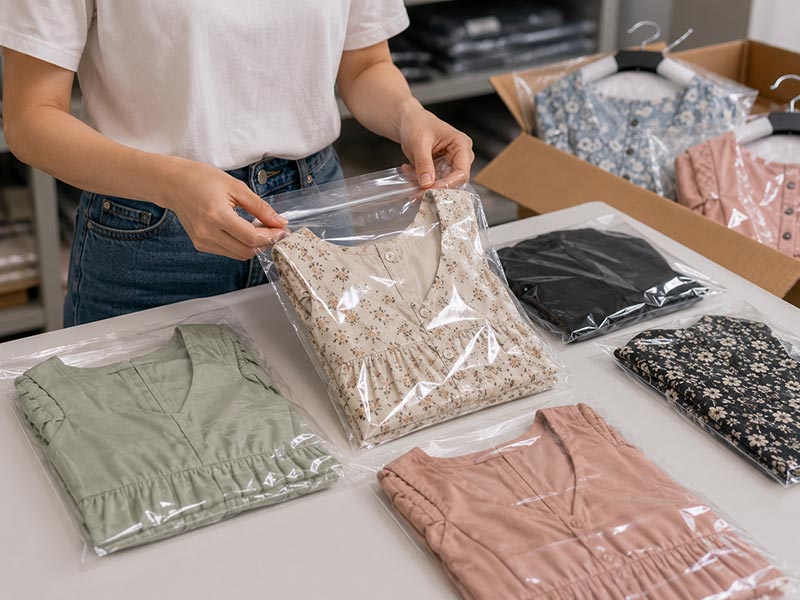
Polybags and Carton Marks
Long rear hems, ruffles, tulle, organza, satin, lace, and sequins may require more careful folding than a basic dress. Packing should reduce crushing, deep crease lines, snagging, and surface abrasion while still meeting the brand’s warehouse method. Polybag labels, carton marks, carton quantities, and packing ratios are then checked against the approved instruction.
- Protect delicate and embellished surfaces from abrasion.
- Fold rear hems and layers to reduce permanent creasing.
- Match polybag identification to style/color/size.
- Confirm carton mark, quantity and packing list information.

Retail-Ready Delivery
Retail-ready delivery combines garment QC with correct identification and packing. Specialty retail and multi-channel programs often need the same style to arrive in precise size ratios, colors, labels, barcodes, and cartons. Jinfeng can coordinate those details within the project file so finishing and packing teams are not working from separate instructions.
- Final garment appearance is reviewed before bagging.
- Labels, hangtags and barcodes are checked against the approved set.
- Packing ratios and carton information follow the order instruction.
- Export and delivery arrangements are confirmed by project rather than treated as one universal method.
Representative High-Low and Occasionwear Program Profiles

US Occasionwear Collection
Program profile: approximately 12-16 styles with a total order in the 24,000-32,000 piece range. The assortment combined chiffon, satin, and crepe occasion dresses, including asymmetric and high-low directions for wedding guest and event dressing. The development focus was not simply to create a dramatic rear hem; the larger task was to keep front length, side transition, lining coverage, color direction, and size consistency aligned across a family of related silhouettes. Sample work was organized around first-sample review, fit and hem correction, material confirmation, and PP standards. Chiffon styles required additional attention to transparency, layer spacing, hem balance, and snag protection. Satin styles placed more pressure on surface handling, zipper flatness, seam appearance, and pressing. Bulk control centered on approved patterns, size charts, fabric references, color separation, in-line workmanship checks, final hem review, private-label details, and packing appearance.
The commercial result of a program at this scale depends on repeatability across the assortment. Development records, approved standards, color information, construction notes, and QC references can be retained for repeat orders, new colors, or adjacent occasionwear styles, reducing the need to rebuild the same product knowledge from zero.

European Premium Ecommerce Drop
Program profile: approximately 18-22 styles with a total order in the 38,000-52,000 piece range.
The collection combined satin, crepe, lace, mesh, and selected layered dresses for cocktail, party, and occasion use. Several styles used asymmetric proportions, ruffles, one-shoulder lines, or fitted bodices where photo-ready appearance and bulk consistency were equally important. Development prioritized fabric behavior, fit, zipper appearance, lining, ruffle balance, and the relationship between the upper-body pattern and the hem. Styles with stronger surface shine or transparency were separated into higher-risk review groups because the same sewing or pressing method could not be applied across every material. Photo-ready samples were expected to reflect the approved visual standard closely enough for campaign preparation while still remaining production-feasible. For bulk, the key was disciplined transfer from the approved sample into cutting, sewing, QC, finishing, labels, SKU identification, and packing. A multi-style ecommerce drop also requires coordination around which styles launch first, which fabrics can be grouped, and where approvals may affect the production schedule. The value of the manufacturing partner is measured by how well the entire assortment is controlled, not only by the first sample of a single dress.

North American Multi-Channel Program
Program profile: approximately 24-30 styles with a total order in the 60,000-80,000 piece range. The assortment combined occasion, party, wedding guest, and fashion dresses across satin, chiffon, lace, mesh, crepe, and decorative materials. High-low and asymmetric silhouettes were managed as part of a broader dress line rather than isolated novelty pieces. The project structure required style prioritization, material grouping, pattern and sample tracking, PP confirmation, bulk allocation, QC, retail labeling, barcode accuracy, size-ratio packing, carton information, and shipment coordination. High-low styles received added attention at the skirt and finishing stages because hem balance, lining length, delicate edges, and pressing can vary more visibly than on a straight hem. Decorative styles also required protection against snagging, abrasion, and embellishment loss during handling and packing. Large multi-style programs benefit from records that remain useful after the first delivery. Final patterns, size charts, material and trim references, sewing notes, label placement, packing instructions, QC observations, and approved sample history can support repeat orders and new color development. Any new fabric, construction, or major color change is still re-evaluated where it may alter fit, drape, appearance, or production risk.
Repeat Orders Start With Controlled Product Records
Pattern and Size History
Fabric, Trim and Color Records
QC and Packing Continuity
Design Files and Unreleased Collections Stay Protected
NDA Before Development
Tech Pack and Pattern Protection
Private-Label and Launch Data
High-Low Dresses Frequently Asked Questions
Yes. Development can begin from a reference image, tech pack, sketch, line sheet, original sample, or other agreed material. A reference image is most useful when it is supported by the intended fabric direction, quantity per style/color, size plan, target market, and key measurements. For a high-low dress, the team also needs to clarify the desired front length, side transition, rear drop, skirt volume, lining, layers, and upper-body structure before the sample can become a reliable production standard.
Chiffon, satin, stretch satin, crepe, organza, tulle, lace, mesh, and selected embellished fabrics can all work. The best option depends on whether the design should feel fluid, structured, sheer, layered, formal, fitted, or highly decorative. Fabric weight and drape influence the high-low curve directly, while transparency, surface sensitivity, stretch, static, and wrinkle behavior affect lining, sewing, pressing, QC, and packing. Material selection should be confirmed through sample development rather than chosen by appearance alone.
The hem is developed through defined pattern reference points rather than visual estimation alone. Depending on the style, those points can include front center, side positions, back center, lowest point, lining length, and layer edges. The sample is then reviewed for drape, hanging behavior, movement, and visual balance. Corrections are transferred into the final pattern and approved standard so bulk production follows the same relationship instead of recreating the curve independently on the line.
Yes. Layered and ruffled styles can be developed with chiffon, organza, tulle, lace, satin, mesh, or other suitable fabrics. The development work should define layer count, length relationship, ruffle width, fullness, joining points, edge finish, lining, and the intended rear volume. Those details are tested during sampling because material stiffness and weight can change the result significantly. Bulk QC then checks layer alignment, left-right balance, edge quality, surface condition, and packing recovery.
Timing depends on construction and material readiness. A regular dress first sample commonly requires around 10-15 days, medium-complex styles around 12-18 days, and complex corset, strapless, lace, mesh, sequin, organza/tulle, layered, or evening constructions around 15-25 days. Revised samples and PP samples commonly require around 7-15 days. Custom fabrics, special trims, testing, or delayed approvals can extend the schedule, so each style is reviewed before a development timeline is confirmed.
Jinfeng’s standard MOQ starts from 200 pcs per style/color, subject to fabric availability, color development, trims, construction, packaging, and production planning. Quantity is calculated by style and color rather than combined across unrelated styles. Custom-dyed fabrics, exclusive prints, special lace, sequin materials, bespoke trims, or custom packaging may carry separate supplier minimums. A line sheet with the planned quantity for each style/color helps the team assess the most efficient material and production route.
Yes. Jinfeng supports multi-style development and production for established fashion programs. Collections can combine high-low maxi, midi, ruffle, halter, one-shoulder, strapless, layered, wedding guest, prom, cocktail, party, evening, and complementary dress directions. Each style/color still needs an appropriate quantity and development plan. For larger assortments, styles can be grouped by fabric, construction risk, sample priority, launch date, and production needs so resources are allocated more effectively.
Grading follows the approved brand size standard while also protecting the visual proportion of the asymmetric silhouette. Front length, side transition, rear drop, waist position, skirt volume, lining, and ruffle or layer spacing may need to be reviewed together. The objective is to keep the style recognizable across the approved size set rather than mechanically extending every edge. Fit comments are transferred into the final pattern, size chart, grade rule, PP standard, and QC reference before bulk production.
Yes. Jinfeng can support woven main labels, size labels, care labels, hangtags, barcode stickers, SKU labels, polybags, carton marks, and other agreed private-label packing requirements. Retail details are confirmed before bulk packing so garment, style/color/size identification, barcode information, and cartons stay aligned. Delicate high-low dresses may also need more careful folding and surface protection, especially when they use satin, lace, tulle, organza, sequins, or long layered rear hems.
Inspection can cover incoming materials, cutting, sewing, garment measurements, front/side/back hem balance, lining length, zipper flatness, lace or mesh condition, decoration security, pressing, appearance, labels, barcodes, packing, and shipment documents according to the project requirements. High-low styles receive extra attention around the asymmetric curve because uneven trimming, bias relaxation, layer mismatch, or poor pressing is easy to see. QC standards are aligned with the approved sample, pattern, size information, and packing instructions.
Start Your High-Low Dress Development Program
Share enough project information for Jinfeng to evaluate the style as a production program rather than a generic dress inquiry. A reference image can start the discussion, while a tech pack, line sheet, original sample information, or size chart allows a deeper review of hem geometry, fabric direction, construction, sampling, MOQ, private label, and bulk-production risk. Established collections can also be reviewed as a group so styles are prioritized by fabric, complexity, launch timing, and order quantity.
Please include where available:
- Company and target market
- High-low dress reference images or tech packs
- Planned quantity per style/color
- Fabric direction or required hand feel
- Color plan and approved size range
- Ruffles, layers, cups, boning, lace, mesh, sequin, or special trim requirements
- Main labels, care labels, hangtags, barcodes, polybags, and carton requirements
- Target sample or launch window
- Testing, inspection, warehouse, or delivery requirements
- Line sheet or supporting files for multi-style programs


