 Skip to content
What Are the Main Fringe Trim Types for Dresses?

Your trusted Women’s Apparel Manufacturer from China
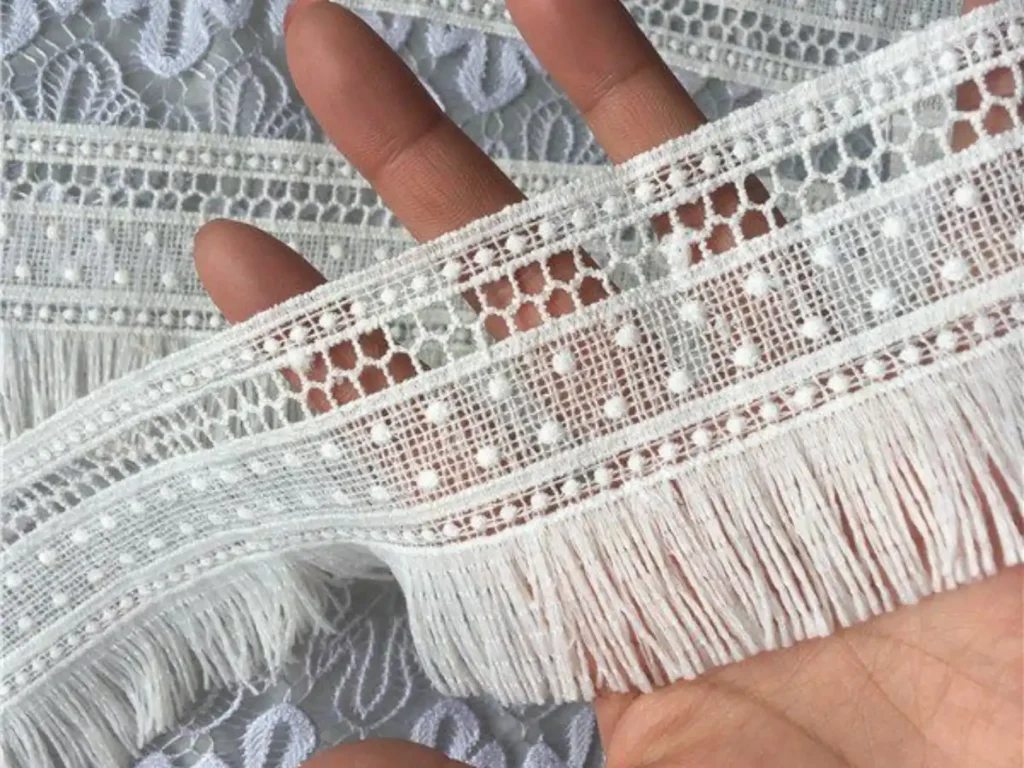
Fringe can make a dress look effortless, but it is one of those details that becomes more technical the moment the garment starts moving. A trim that looks perfect on a hanger may swing too heavily at the hip, pull a soft mesh panel out of shape, scratch the wearer under the arm, or turn into a tangled bundle after packing. For designers, product developers, and sourcing teams, the useful question is not simply whether a fringe looks attractive. It is whether the trim can deliver the intended movement, fit, comfort, and repeatability on the finished dress.
The main fringe trim types used on dresses include chainette, tassel, thread or brush, bullion, beaded, sequin, feather, looped, and layered fringe. Chainette gives fluid movement, tassels create separated rhythm, beads add weight and sparkle, sequins increase reflected light, and feathers create soft volume. The best option depends on fringe length, density, weight, header construction, base fabric, placement, skin contact, sewing method, and bulk-production requirements.
A useful way to think about fringe is to treat it as a moving garment component rather than a decorative afterthought. During one sample review, a long-fringe mini can look clean and glamorous while the model is standing still, then reveal a very different personality after a short walk: rows separate, strands twist, the hem lifts visually, and the side seam starts carrying more weight than expected. Those changes are not necessarily defects, but they must be understood before a design is approved. The sections below compare the main fringe constructions and show how their measurable specifications affect dress design, sewing, quality control, cost, and bulk production.
What Types of Fringe Trim Are Used on Dresses?
Dress fringe is most useful when classified by construction and behavior rather than by sales name alone. Chainette and thread fringe emphasize fluid movement, tassels create more separated decorative rhythm, bullion is denser and more structured, beaded and sequin fringe add weight or reflection, and feathers create soft volume. Layering any of these trims changes coverage, movement, sewing time, garment weight, and the consistency required in production.
Chainette Fringe
Chainette fringe is one of the most common choices for dresses that depend on visible movement. Fine yarn strands hang from a knitted or woven header and respond quickly when the wearer walks, turns, or dances. That makes chainette especially effective on party dresses, dance-inspired minis, fitted bodycon styles, and statement hems. Short lengths behave almost like an edge trim, while longer versions can become part of the silhouette itself and visually extend the garment below the base hem.
The header deserves as much attention as the hanging strands. A firm, non-stretch header may sit cleanly on a stable woven skirt but can restrict a stretch bodycon dress or create rippling if the sewing tension is wrong. During development, it is worth checking finished strand length, header width, yarn sheen, density, recovery after packing, and whether the strands settle naturally after movement. As a practical development reference, lengths around 5-10 cm usually give controlled motion, 10-20 cm create a stronger swing, and 20 cm or longer can become visually dominant. These ranges are not fixed standards; fiber fineness, density, and placement can make a shorter fringe feel heavier than a longer one.
Tassel, Thread, and Bullion Fringe
Tassel fringe is made from grouped hanging elements rather than a continuous curtain of strands. The spacing between tassels becomes part of the design, so tightly spaced tassels create fuller coverage while wider spacing keeps more of the base fabric visible. This construction works well on resort dresses, occasion styles, hems, sleeves, and waist details where individual movement is desirable. Because each tassel reads as a separate element, even small spacing differences can become visible in bulk production, particularly around curved or fitted areas.
Thread or brush fringe produces a softer, finer edge and is useful when the goal is texture rather than theatrical movement. Bullion fringe has a more corded, structured character and tends to look denser and more formal. Two trims with the same advertised length can behave very differently if one uses fine filament yarn while another uses heavier twisted threads. For that reason, product development should compare actual trim samples rather than relying on names alone. Hand feel, yarn thickness, weight per meter, header flexibility, and how quickly the fringe returns to position after movement usually tell more than the category label.
Fringe Type | Common Development Length* | Movement | Relative Weight | Typical Dress Use |
Chainette | 5-30+ cm | High | Light-medium | Party, bodycon, dance-inspired |
Tassel | 3-20 cm | Medium-high | Light-medium | Resort, occasion, hems, sleeves |
Thread / Brush | 2-15 cm | Medium | Light | Cocktail, panels, edges |
Bullion | 3-15 cm | Low-medium | Medium | Formal, structured decorative styles |
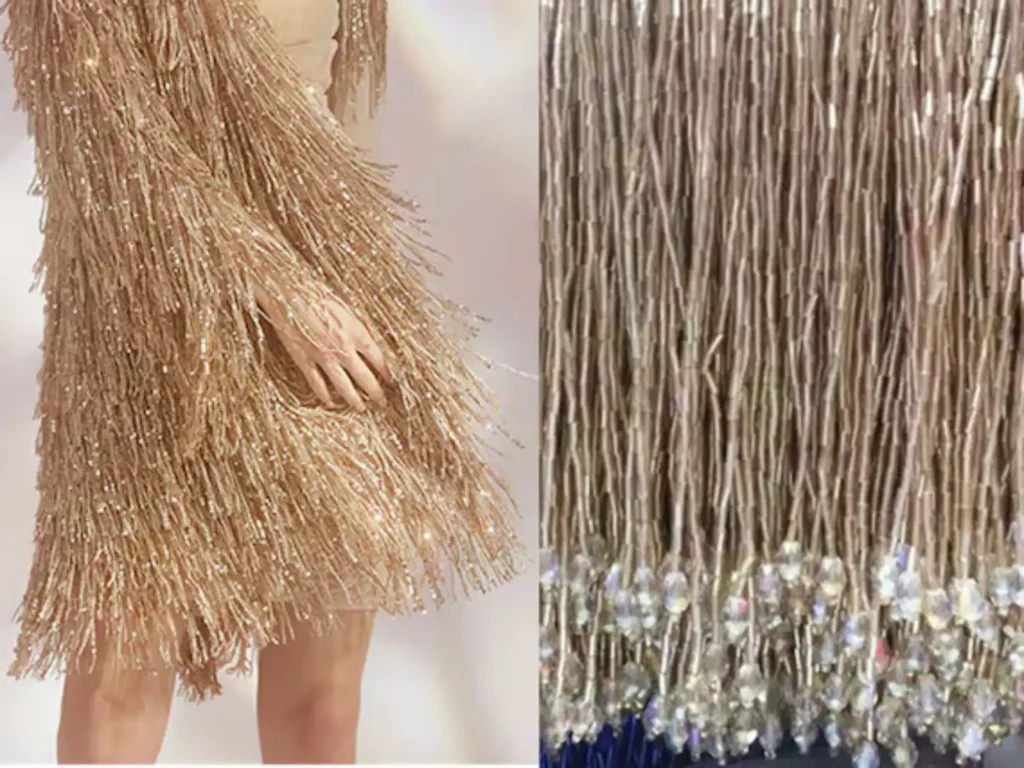
Beaded | 3-25+ cm | Medium-high | Medium-heavy | Evening, occasion, statement dresses |
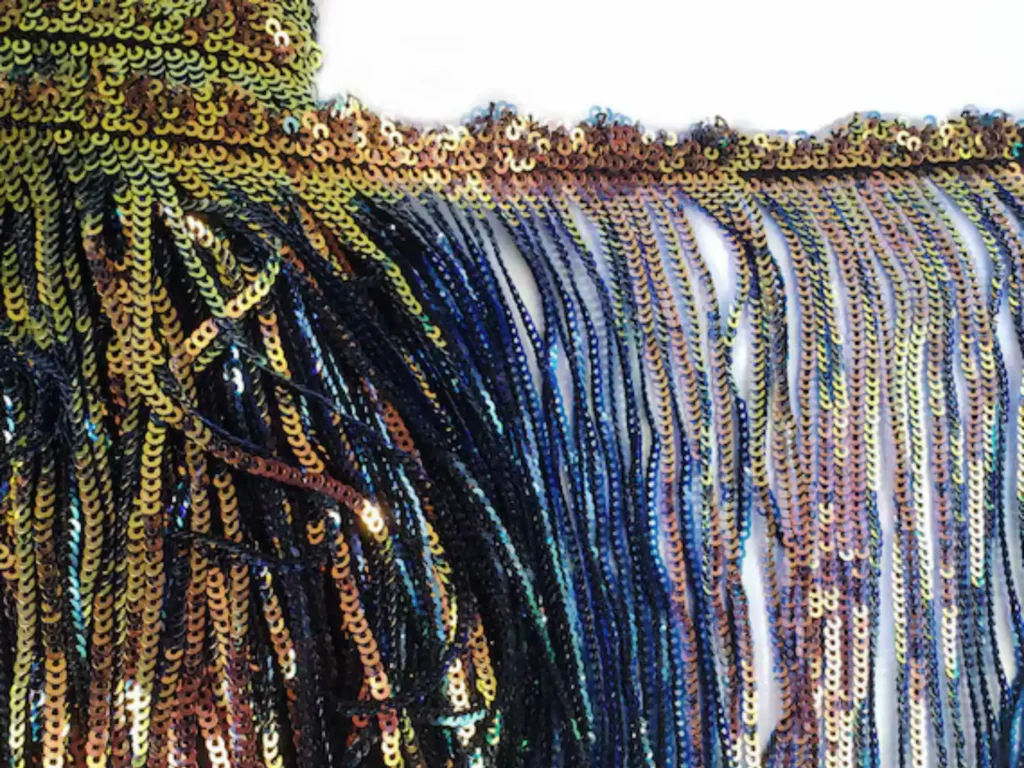
Sequin | 4-25 cm | High | Medium | Party, birthday, performance |
Feather | 5-20+ cm | Soft, irregular | Light | Occasion, party, cuffs, hems |
Beaded and Sequin Fringe
Beaded fringe changes a dress through both movement and mass. Acrylic beads, glass beads, pearls, bugle beads, rhinestone elements, and mixed decorative strands can create a strong eveningwear effect, but the supporting garment must carry the additional weight. The same design that works on a stable crepe or structured bodice may distort a soft mesh panel or lightweight satin. Developers should therefore assess the full trim consumption rather than judging a 20 cm sample card, because several meters of beadwork can change hem drop, seam shape, and wearer comfort.
Sequin fringe emphasizes reflected light rather than only weight. It is particularly effective for party, birthday, holiday, nightlife, and performance styles because every moving strand can catch light independently. The trade-off is abrasion. Sequins may scratch exposed skin, catch on mesh, rub against satin, or snag adjacent decorative components during wear and packing. Both beaded and sequin fringe should be checked for strand security, sharp edges, missing components, color consistency, backing construction, and the way the trim behaves after folding. A glamorous sample can still become commercially difficult if the trim requires constant untangling or repair.
Feather and Layered Fringe
Feather trim creates volume without the dense visual geometry of yarn fringe. It can soften a structured corset dress, add drama to a mini hem, or introduce movement around cuffs and necklines. Its main production challenge is natural variation. Feather length, curvature, density, and direction may not be identical from one section to another, so an approved sample should establish how much variation is acceptable. Demanding perfectly uniform natural-looking feathers can increase sorting and inspection pressure without necessarily improving the design.
Layered fringe is a construction method rather than a single material. Two, three, five, or more rows can be stacked to increase coverage and create independent motion. The effect can be striking, but each extra row adds trim consumption, sewing operations, placement tolerance, garment weight, and packing complexity. A three-row design that achieves the intended visual density may be more stable than a five-row version that adds little visible value. In experienced development, the goal is rarely to maximize decoration. It is to achieve the right movement with the fewest unnecessary variables.
Which Fringe Trim Suits Each Dress Style?
There is no single fringe that works best on every dress. Fitted party and bodycon styles often benefit from flexible chainette or controlled sequin fringe, while evening dresses can carry heavier beadwork when the structure supports it. Resort and softer occasion dresses may suit tassels, thread fringe, or feathers. The most reliable choice comes from evaluating silhouette, dress length, fabric stretch, wearing occasion, movement, comfort, and production risk together.
Party and Bodycon Dresses
Party and bodycon dresses put fringe under unusual mechanical stress because the base garment is often close to the body and may stretch substantially at the bust, waist, and hip. A rigid fringe header can restrict that stretch even when the shell fabric has good recovery. If an operator compensates by stretching the garment during sewing, the seam may contract into waves when it returns to its relaxed state. For this reason, chainette is often a practical choice because it can deliver movement without the heavy load of dense beadwork, but the header still needs to be tested on the actual stretch fabric.
Placement changes the visual result just as much as the fringe type. A hem row emphasizes leg movement, while horizontal rows around the hip create strong lateral motion and can visually add volume. Diagonal rows make the eye travel across the body and can give a simple bodycon silhouette more energy, but their angle must be controlled consistently across sizes. During fitting, the garment should be checked at the intended body dimensions rather than only on a table. A base fabric that stretches 15-25% around the hip can change row spacing, strand separation, and the way the fringe sits against the body.
Evening and Occasion Dresses
Evening and occasion dresses can support a wider range of fringe because their design language often allows more texture, longer proportions, and heavier embellishment. Beaded fringe works well when the aim is controlled movement and a richer surface, while fine chainette gives a cleaner modern effect. Feather trim can soften a structured satin or corset silhouette and is often effective at hems, cuffs, shoulders, and necklines. The main question is not whether the trim looks luxurious, but whether the dress structure can support it without changing fit or drape over time.
Comfort is particularly important in this category because an occasion dress may be worn for several hours. A beaded neckline that feels acceptable during a short sample fitting can become uncomfortable after repeated contact at the underarm, inner arm, waist, or thigh. Heavy fringe on bias-cut satin can also pull the fabric downward gradually, while dense embellishment on soft mesh may stretch the panel vertically. A useful approval fitting includes walking, sitting, rising, turning, and raising the arms. These simple movements reveal scratching, catching, excess noise, seam pulling, and unstable drape long before bulk production begins.
Mini, Midi, and Maxi Dresses
Dress length changes how fringe is perceived. Adding 15 cm of fringe to a 75 cm mini dress changes the visible proportion dramatically, while the same 15 cm on a 130 cm maxi has a much smaller effect. For mini dresses, fringe can become part of the apparent garment length, so teams should decide whether the hanging strands are included when judging coverage and styling. Layered chainette, sequin fringe, and shorter beaded constructions can all work well when the aim is energetic movement rather than a clean static hem.
Midi dresses allow more placement flexibility because there is enough vertical space to position fringe at the hip, knee, hem, or along an asymmetric panel. Maxi dresses require more mobility testing. Long fringe close to the floor may catch on footwear, furniture, or other parts of the garment, and a full maxi skirt can consume much more trim than a fitted mini because the hem circumference is larger. The most reliable test is simple: check the dress while standing, walking, sitting, and turning. If the fringe only looks deliberate in one pose, the design still needs development.
Dance and Movement-Led Dresses
When movement is the main visual feature, fringe acts almost like a secondary fabric. Chainette responds quickly to acceleration and direction changes, which is why it remains common on dance-inspired and performance-led styles. Longer strands create a wider movement arc, while shorter lengths return to a vertical position more quickly. Density and row spacing matter because sparse rows can expose unexpected gaps during rotation, while very dense layers may become heavy enough to slow the movement that the designer wanted to emphasize.
Video review is especially useful for these garments. Static front and back photos can confirm placement, but they rarely show how evenly the rows separate or whether some sections twist and fail to recover. A short movement test can reveal strand tangling, uneven length, gaps between layers, seam distortion, and unexpected interaction with sleeves or zippers. Sleeve fringe deserves particular attention because the arms move faster than the torso, creating more aggressive motion and a greater chance of snagging. For high-movement dresses, trim security and recovery after repeated motion should be part of sample approval rather than left to final inspection.
How Do Fringe Specs Change a Dress?
Fringe specifications can change the silhouette even when the underlying dress pattern stays the same. Length controls swing and visual extension, density changes coverage, weight affects drape, and header construction influences seam stability. A production-ready specification should therefore include more than color and nominal length. Strand structure, density, weight, header width, flexibility, placement, and compatibility with the actual shell fabric all affect the final result.
Length and Density
Fringe length changes both movement and proportion. Short fringe of roughly 2-5 cm usually acts as an edge detail, while lengths around 5-10 cm show more visible swing. At approximately 10-20 cm, the trim begins to influence the perceived silhouette, and lengths beyond roughly 20 cm can become a major design feature. These figures are practical development references rather than universal standards because fine lightweight chainette and dense beaded fringe can behave very differently at the same nominal length.
Density controls how much of the base dress remains visible when the wearer moves. A row that looks almost opaque when the garment is hanging may open significantly during walking or rotation. This is important on layered party dresses where the fringe is expected to provide visual coverage. Density also affects garment weight and trim cost because a fuller construction uses more yarn, beads, sequins, or other decorative material per meter. During sampling, the dress should be reviewed in three conditions: relaxed, worn at normal body dimensions, and moving. If the design looks correct in only one state, the specification is not fully resolved.
Specification | Practical Development Range* | Main Effect | Main Risk |
Fringe length | 2-30+ cm | Movement and visual extension | Tangling, catching |
Header width | About 1-4 cm | Sewing stability | Visibility, bulk |
Row spacing | Commonly 3-15 cm | Coverage and layering | Gaps or excess weight |
Layer count | 1-6+ rows | Fullness and motion | Sewing time, alignment |
Visible row placement | Usually controlled to a few millimeters on approved style | Visual consistency | Crooked or uneven layers |
Weight and Drape
Fringe weight is easy to underestimate because a small hand sample does not represent the mass of a complete garment. If a dress uses four meters of trim, even a difference of 30 grams per meter between two options changes the garment by about 120 grams. Heavily beaded constructions can add much more. This extra mass may lower the hem, stretch soft fabrics, change the recovery of a bodycon dress, or create pressure at the shoulder, waist, or neckline depending on where the trim is attached.
The location of the weight matters as much as the total. Weight concentrated at the hem tends to pull the lower garment downward, while weight across a soft mesh hip panel can distort the panel locally. Before approval, a fully trimmed sample should be allowed to hang for a reasonable observation period and then remeasured. If the hem, neckline, or side seam gradually shifts, the issue is structural rather than cosmetic. In some cases, a slightly more expensive lightweight fringe can reduce reinforcement, sewing difficulty, and fit risk enough to improve the economics of the complete dress.
Stretch and Header Construction
The fringe header connects two materials that may have very different mechanical behavior. A stable woven header attached around a stretch knit can reduce usable extension, making a dress harder to put on even when the pattern is correct. If the fabric is stretched excessively during attachment, the seam may return in a rippled or wavy condition. The solution depends on where the fringe is placed, how much extension the garment needs, and whether the trim header itself has any flexibility.
Header width also affects both construction and appearance. A narrow header can be discreet but offers less room for secure stitching, while a wider header may improve sewing control but become visible through sheer mesh or create a ridge under thin satin. For transparent garments, the internal finish can become part of the visual design because the header, seam allowance, or reinforcement may show through the shell. A sample review should therefore inspect the garment from the inside as well as outside. Twisted headers, bulky reinforcement, rough edges, and exposed stitching can all affect comfort even when the exterior looks clean.
Satin, Mesh, and Sequin Bases
Satin, mesh, and sequin fabrics require different fringe strategies because each fails in a different way. Satin can show needle marks, puckering, seam impressions, and tension differences very clearly. A heavy or rigid header placed directly onto lightweight satin may pull the surface out of shape. Mesh is more sensitive to concentrated load and transparency, so heavy fringe may require reinforcement, lining support, binding, or attachment into a structurally stronger seam rather than directly onto an unsupported mesh panel.
Sequin fabric already has substantial texture and often more weight than a plain base. Adding sequin or beaded fringe increases abrasion and snagging risk because decorative elements can rub against one another during wear and packing. Long strands can also catch between existing sequins and become difficult to release without damage. This is one reason experienced development teams consider the fringe and base fabric together rather than selecting them independently. A visually perfect trim can be the wrong production choice if its header, weight, or surface behavior does not suit the shell fabric.
How Should Fringe Be Placed and Sewn?
Fringe placement should be planned from garment reference points rather than added by eye after the dress is assembled. Hem placement creates strong movement, hip placement changes perceived volume, and sleeve or diagonal placement produces more directional motion. Sewing construction must match both trim weight and base-fabric behavior. Stable fabrics tolerate firmer attachment, while stretch, mesh, satin, and heavily embellished dresses often need more careful tension control or reinforcement.
Hem and Hip Placement
Hem placement looks straightforward because it follows a visible garment edge, but small errors become obvious when the trim travels around the full circumference. Straight hems are easier to control than circular or strongly flared hems, where the header must follow a curved attachment path without puckering or standing away from the fabric. The start and finish points should also be planned so the join does not create a dense lump or an obvious gap at the side or back seam.
Hip placement creates stronger lateral motion and can change the apparent width of the silhouette. A single row gives a clear design line, while several rows can turn the skirt into a moving surface. For layered bodycon styles, the row positions should be linked to stable pattern references such as the waist seam or defined balance marks. Vague instructions like “place around the hip” are not enough for consistent grading. Fringe should also be checked around closures. Long strands near a side or center-back zipper can become trapped during dressing, so the design may need a protected zipper zone or a controlled interruption in the trim.
Layered and Diagonal Fringe
Layered fringe works when the spacing between rows creates the intended overlap during both standing and movement. If a 15 cm fringe is placed every 15 cm vertically, rows may just meet when relaxed but expose gaps when the body stretches or the wearer moves. Reducing the spacing increases coverage, but it also increases garment weight, trim consumption, sewing time, and the chance of tangling. The right balance depends on how much of the base fabric is supposed to remain visible.
Diagonal placement adds another challenge because the trim line changes length across the garment and its visual angle must remain deliberate in every size. Small placement errors accumulate quickly when several diagonal rows are used. Pattern references, notches, removable marking, or templates can help keep the angle consistent. The finishing of row ends also needs attention. When diagonal fringe disappears into a side seam, the transition should look intentional rather than creating a thick bundle of strands. These details are easy to solve during sampling and expensive to correct once operators have already attached hundreds of rows in bulk production.
Stretch Fabric Attachment
Attaching fringe to stretch fabric requires control of both seam tension and finished circumference. One common mistake is stretching the garment too much during sewing, which can create waves after the fabric recovers. The opposite mistake is attaching a rigid trim around an area that must expand during dressing, making the garment feel tighter even though the underlying pattern has not changed. The correct method depends on stitch type, seam construction, header flexibility, and how much extension is required at the final wearing point.
A useful production check is to compare the circumference before and after fringe attachment, then repeat a controlled stretch-and-recovery test. The seam should return close to its original shape without broken stitches, detached strands, or visible rippling. The garment should then be fitted because technical stretch alone does not show whether the trim creates pressure at the bust, hip, arm, or hem. A dress may pass a simple bench test and still feel uncomfortable when the wearer sits or moves. For stretch styles, the trim is part of the fit system, not just a decoration applied after fit has been approved.
Heavy Fringe Reinforcement
Heavy beaded or dense decorative fringe should be supported by the garment structure rather than relying on one exposed seam. Depending on the design, the load can be transferred into a lining seam, waistband, facing, reinforced panel, backing tape, or other internal structure. The challenge is to provide support without creating a stiff ridge that changes the external drape, especially on smooth fabrics such as satin where internal construction can show through easily.
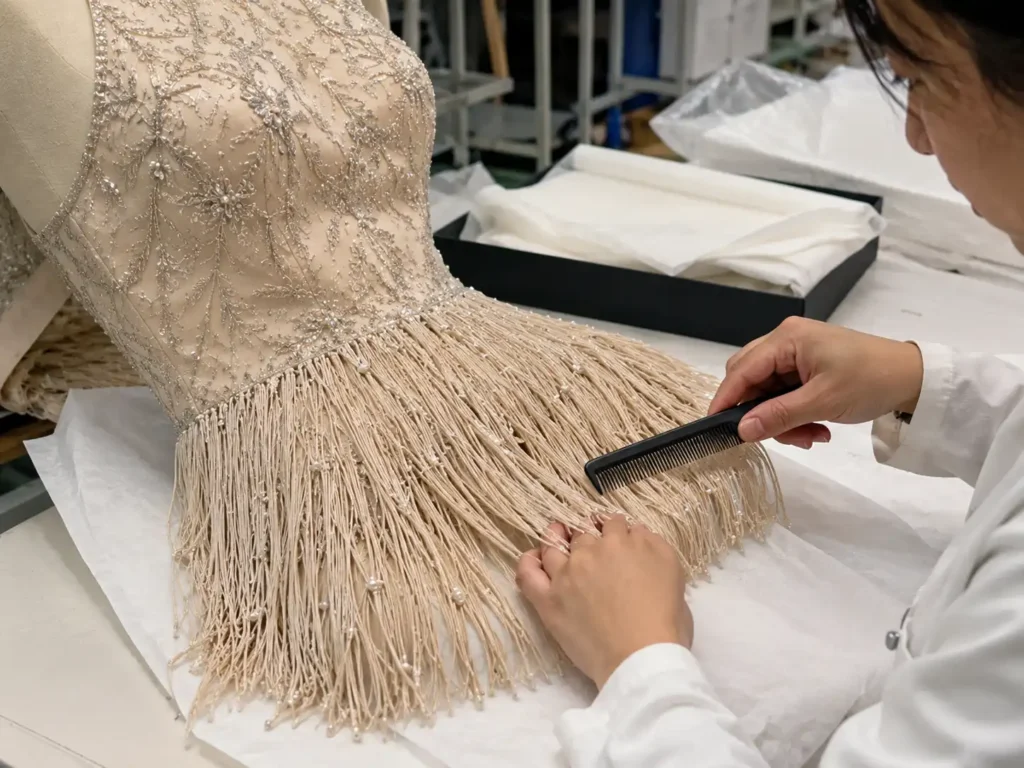
Seam ends and trim joins deserve special attention because they carry concentrated stress and are common failure points. Securing methods should be defined in the sewing specification instead of left to individual operators. A fully embellished sample should also be hung and handled before approval because gravity acts continuously and distortion may develop gradually. A heavy fringe design is not really stable until the complete dress maintains its measurements, seam shape, and intended drape after realistic handling. Solving reinforcement at the sample stage is usually far more efficient than repairing stretched seams during final inspection.
What Quality Problems Occur With Fringe Dresses?
Typical fringe-dress defects include uneven rows, inconsistent strand length, loose attachment, missing beads or sequins, tangling, twisted headers, distorted seams, color variation, scratchy edges, and poor recovery after packing. Effective quality control starts with trim approval, continues during placement and sewing, and ends with movement, measurement, appearance, and packing checks against an approved reference rather than relying on a quick visual inspection at the end.
Uneven Rows and Pull-Out
Uneven fringe can come from inaccurate placement marks, inconsistent trim length, stretching of the base fabric during sewing, or uneven feeding of the trim and garment through the machine. Horizontal rows exaggerate these errors because the eye quickly notices a line that slopes or changes spacing. A few millimeters may look insignificant in one small area but can become obvious when repeated across the full width of a fitted dress or across several layered rows.
Pull-out needs a two-part diagnosis. Individual strands may pull out of the fringe header, or the entire header may detach from the garment. These are different defects and require different solutions. During development, the trim itself should be checked for strand security before the attachment seam is judged. In bulk production, high-risk points include row ends, side seams, high-movement areas, and transitions between different fabrics. A sealed sample, placement diagram, and clear visual standard help inspectors distinguish acceptable natural movement from true production inconsistency. Without a reference, different inspectors may make different decisions about the same garment.
Tangling and Strand Control
Some tangling is natural with long flexible fringe, so the useful quality question is whether the garment can return to an acceptable appearance with normal handling. A dress that requires several minutes of manual untangling every time it comes out of a polybag is likely to create problems in warehousing, retail handling, or ecommerce returns. Long chainette should therefore be reviewed after folding and unpacking, while beaded strands need extra attention because they can wrap around one another and remain locked.
Strand control also matters during sewing. Loose fringe can enter side seams, zippers, overlock stitches, lining attachments, or neighboring decorative rows if operators do not keep it away from the working area. Temporary bundling or controlled positioning can reduce accidental catching. Final inspection is often more accurate after the garment has hung naturally for a short period, allowing compressed strands to settle. Trimming random strands at the end of production should not become the main quality-control method. If many garments need repeated correction, the root issue may be trim consistency, handling, row spacing, or packing rather than isolated workmanship.
Beads, Sequins, and Skin Contact
Decorative fringe should be checked for more than missing components. Broken beads, sharp edges, exposed thread, hard knots, rough backing, and poorly finished strand ends can all affect comfort. Underarms are particularly sensitive because the arm repeatedly rubs against the side of the dress, while necklines, inner sleeves, waist edges, and upper thighs can experience similar repeated contact. A trim that feels harmless when touched once by hand may become irritating after an hour of movement.
Sequin fringe can also damage the garment itself. Rigid edges may rub against satin, mesh, lace, or neighboring sequins, and pressure during packing can leave impressions on smooth surfaces. A practical sample review should include normal movement for more than a few seconds, followed by inspection of both the skin-contact areas and the garment surface. Slight variation in handcrafted or feather-based decoration may be acceptable, but broken strands, exposed sharp elements, missing sections, and obvious length differences should be clearly separated from natural variation in the approved standard.
Packing and Final Appearance
Packing is part of fringe quality because a garment can leave the sewing line in perfect condition and arrive with crushed feathers, tangled strands, bent sequins, or bead impressions. Long chainette should be arranged in its natural direction before folding rather than trapped randomly between layers. Beaded sections may need separation from delicate satin or mesh, while feather trim should not be compressed more than necessary because recovery can be slow or incomplete.
A simple packing trial can reveal problems early. An approved sample is folded using the intended commercial method, packed for a realistic handling period, then reopened and reviewed for tangling, abrasion, crushed decoration, fold lines, twisted headers, and seam distortion. Steam can restore some materials, but it should not be assumed that every warehouse, retailer, or final customer will steam the garment before judging it. The finished product needs to look acceptable at the next real point in the supply chain, whether that is a distribution center, store, fulfillment warehouse, or ecommerce customer’s home.
How Do You Choose Fringe for Bulk Production?
For bulk production, fringe should be treated as a controlled garment component rather than a last-minute decoration. The approved specification should cover type, material, finished length, density, header, color, placement, consumption, attachment, QC requirements, and packing. The trim should be tested on the actual dress because the same fringe can behave very differently on satin, mesh, stretch jersey, sequin fabric, or a structured bodice.
Fringe Specifications
A note that says “15 cm black fringe” is rarely enough for repeatable production. It leaves open questions about whether the 15 cm includes the header, how wide the header is, how dense the strands are, whether the yarn is matte or glossy, how much the header stretches, and which black tone is acceptable. These differences can affect not only appearance but also sewing speed, fit, cost, and the ability to reproduce the style in a repeat order months later.
A good specification combines measurable information with a physical reference. An approved trim card can capture hand feel, sheen, density, and movement in a way written descriptions cannot. The production file should also identify placement, row spacing, sewing construction, and packing method because the same trim can create different results when used on another part of the dress. This level of detail is especially useful for private-label collections with multiple colors or repeated seasonal orders, where relying only on a supplier code can be risky if yarn, bead, or dye lots change.
Specification Item | What to Confirm | Why It Matters |
Fringe type | Chainette, tassel, beaded, sequin, feather | Construction and appearance |
Finished length | Header edge to strand end | Silhouette and movement |
Header width | Actual usable tape width | Sewing and visibility |
Material | Yarn, bead, sequin, feather composition | Weight, feel, sourcing |
Color reference | Approved swatch or color standard | Bulk color consistency |
Density | Visual coverage or strand construction | Opacity and movement |
Stretch behavior | Stable or stretchable header | Fit compatibility |
Placement | Pattern reference and direction | Bulk consistency |
Row spacing | Distance between layered rows | Coverage and weight |
Attachment method | Approved seam construction | Security and appearance |
Packing method | Folding and protection | Recovery after shipment |
Approved reference | Trim card or sealed sample | Repeat-order control |
Consumption and Order Quantity
Fringe consumption should come from the actual placement line on the approved pattern or sample, not from a rough front-view estimate. For one horizontal row, the starting point is the finished attachment length plus the allowance required for joining and handling. Layered garments need each row measured separately because the circumference often changes between the waist, high hip, low hip, and hem. Diagonal placement should also be remeasured after pattern revisions because even a small change in angle can alter the total length.
Consider a fitted dress with four fringe rows measuring 82 cm, 86 cm, 90 cm, and 94 cm. The visible requirement is 352 cm, or 3.52 meters, per garment before any production allowance. At 1,000 dresses, that becomes approximately 3,520 meters. An underestimate of just 5 cm per garment would create a 50-meter shortage across the same order. Size grading adds another variable because larger sizes may require longer rows. For larger programs, weighted consumption based on the actual size ratio is more accurate than applying the size-S requirement to every garment.
Cost and Lead Time
The price per meter is only one part of fringe cost. A simple single-row hem may add relatively little production complexity, while five asymmetric beaded rows can require marking, positioning, reinforcement, several sewing operations, repeated inspection, manual strand control, and protective packing. A cheaper trim can actually create a more expensive garment if the header is difficult to sew, the strands tangle constantly, or the defect rate requires substantial rework.
Lead time follows similar logic. Standard chainette in an available color is usually easier to source than a custom-dyed yarn, special bead combination, unusual fringe length, matched metallic sequin, or custom feather shade. For seasonal fashion, the sourcing decision should therefore consider replenishment and repeatability as well as first-sample appearance. A trim that takes too long to reproduce can become a weak link in a style expected to reorder quickly. The most useful commercial question is not “Which fringe is cheapest?” but “Which option gives the required visual effect with acceptable sourcing, sewing, QC, and repeat-order risk?”
Sample-to-Bulk Consistency
Bulk consistency begins during sample approval. Once the dress is accepted, the information that created the approved result should be transferred into production records rather than left in informal messages or photographs. Fringe length, density, color, placement, row spacing, seam construction, finished measurements, and packing should all have a clear reference. When possible, the same trim source or approved equivalent should be used for bulk, and any substitution should be tested on the actual garment before full production begins.
Repeat orders deserve the same discipline because a supplier code does not guarantee that a later batch will have identical yarn, sheen, density, or dye tone. Comparing the new lot with an approved physical reference is more reliable than trusting the description alone. In custom womenswear development, trim sourcing works best when it is integrated with pattern development, sampling, pre-production approval, bulk QC, and packing rather than handled as a separate purchasing task. Jinfeng Apparel follows this integrated approach across custom dress development, which is particularly useful for fringe-heavy party, occasion, mesh, satin, and sequin styles where small trim differences can become highly visible across a full production run.
A well-developed fringe dress is a balance of movement and control. The trim should feel alive when the wearer walks or turns, but the garment still needs stable measurements, comfortable skin contact, secure attachment, consistent placement, and a packing method that protects the effect after production. The strongest results usually come from making fringe decisions early, alongside fabric, pattern, fit, and construction, rather than adding decoration after the sample is almost finished. When the trim specification, sewing method, fit test, QC standard, and packing plan all point in the same direction, a dramatic fringe design becomes much easier to reproduce from sample to bulk and from one season to the next.
Share This Article :

Jerry Lee
Categories

Latest blogs
Table of Contents
Here, developing your OEM/ODM private label clothing collection is no longer a challenge—it’s an excellent opportunity to bring your creative vision to life.

