 Skip to content
Embellishment Attachment Methods
Engineering Decorative Details for Stable Fashion Garment Production
The right attachment method protects the visual effect of an embellishment without creating unnecessary weight, fabric distortion, skin irritation or bulk-production inconsistency.
- 6 core attachment familiescover most fashion applications: sew-on, hotfix, hand beading, machine embroidery, appliqué/backing and combination attachment.
- Method selection should consider at least 6 variables: base fabric, embellishment weight, placement, stretch, skin contact and garment care.
- High-risk decorated styles should pass through sample validation, PP approval and Golden Sample sealingbefore bulk production.
- Jinfeng Apparel supports development through 2 sample rooms, 7+ senior pattern makers and 20+ sample machinists.
- Decorative components include rhinestones, bead chains, sequins, lace trims and other fashion accessories used across partywear, eveningwear and occasionwear.
- Production programs start from 200 pcs per style/color, subject to fabric, trim, construction and material-supplier requirements.
What Are the Main Embellishment Attachment Methods?
Fashion embellishments are commonly attached by sewing, hand beading, embroidery, hotfix bonding, appliqué or backing structures, and combined attachment methods. No single method is suitable for every garment. Strength, appearance, fabric behavior, stretch, weight and production volume determine which construction should move from sample development into bulk production.
Attachment Method | Common Embellishments | Suitable Uses | Main Strength | Main Risk |
Sew-On | Rhinestones, pearls, beads, chains, patches | Dresses, straps, necklines, structured details | Strong mechanical attachment | Stitch marks, weight concentration |
Hand Beading | Beads, pearls, crystals, sequins | Evening, cocktail, occasionwear | High visual detail and placement control | Labor intensity, consistency |
Machine / Embroidery | Sequins, beads, decorative motifs | Repeat motifs, panels, larger production | Repeatable positioning | Fabric puckering, stitch tension |
Hotfix | Rhinestones, crystals, studs | Partywear, clubwear, localized sparkle | Clean surface with limited stitching | Heat sensitivity, adhesion failure |
Appliqué / Backing | Lace motifs, patches, crystal motifs | Localized decorative panels | Distributes load across a larger area | Edge lifting, stiffness |
Combination Method | Mixed stones, beads, chains, embroidery | Complex premium garments | Balances appearance and security | More production steps and QC points |
Six Factors That Determine the Right Attachment Method
Base Fabric
Embellishment Weight
Placement Area
Stretch and Movement
Skin Contact
Care Requirement
Core Attachment Methods Used in Fashion Garments

Sew-On Attachment

Hotfix Attachment

Hand Beading

Machine Embellishment

Appliqué and Backing

Combination Attachment
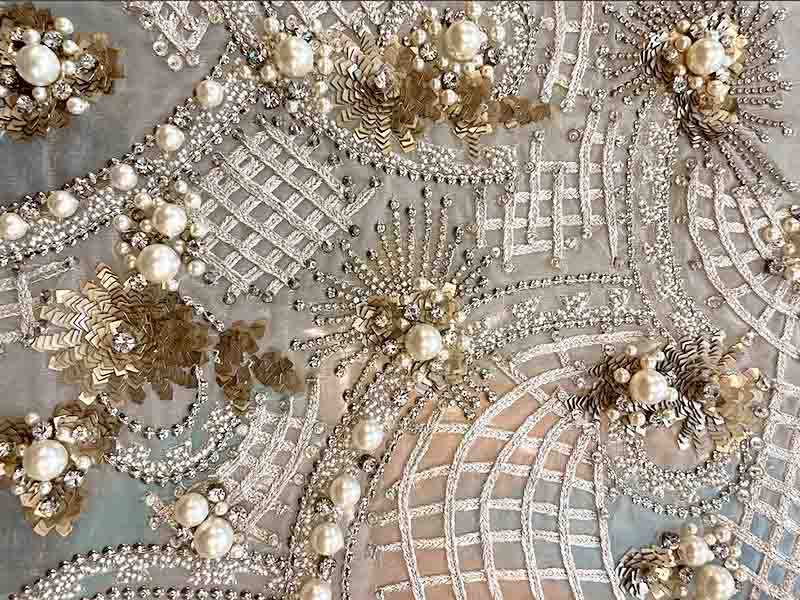
Comparing Attachment Methods for Production Decisions
The visual result is only one part of method selection. Production teams also need to consider repeatability, labor, repairability, stretch compatibility and fabric sensitivity.
A hand-beaded neckline may deliver the best finish for an evening garment but require far more labor than a machine-sequined panel. Hotfix crystals may give a clean surface but depend heavily on temperature and fabric compatibility. Sew-on trims can be highly secure, yet heavy attachment points may pull lightweight fabric.
A useful comparison should therefore look at the full garment, including:
- Durability: how securely the component remains attached during wear and handling.
- Visual finish: whether thread, backing or attachment marks remain visible.
- Fabric sensitivity: whether needle holes, heat or pressure can damage the base.
- Stretch compatibility: whether the decorated area can still recover after movement.
- Labor intensity: how much manual work is required per garment.
- Repairability: whether individual decorative elements can be replaced.
- Bulk repeatability: whether placement and construction can be standardized.
- Cost impact: how material, labor, QC and rework influence unit cost.
For large fashion programs, the preferred method is normally the one that achieves the required appearance while remaining repeatable across the approved quantity.
Rhinestone Attachment Requires More Than Surface Sparkle
Rhinestones are widely used across party dresses, club dresses, festival garments, evening styles and statement fashion. Attachment should be selected according to stone type, base fabric, garment stretch, placement and skin contact rather than appearance alone.

Hotfix Rhinestones on Stable Fabric Areas
Hotfix works best when the fabric can tolerate controlled heat and pressure without glazing, shrinking or losing elasticity.
Localized motifs on bodices, skirts and panels can create strong visual impact with minimal visible stitching. Before approval, the sample team should evaluate:
- surface response to heat;
- adhesion around stone edges;
- fabric discoloration;
- placement accuracy;
- stretch after application;
- cracking or loosening after repeated handling.

Sew-On Rhinestones for Higher Load Areas
Sew-on stones and rhinestone components are often more suitable for shoulder straps, neckline accents, chains and larger decorative units.
Attachment points should distribute weight without pulling the base fabric. Mesh and chiffon may require a supporting layer or reinforced stitch location.
For skin-facing areas, sharp metal backs, rough edges and exposed thread ends need careful review.

Rhinestone Chains and Straps
Rhinestone chains introduce a different load profile from flat stone motifs. A chain used as a shoulder strap carries both decorative weight and garment load.
Key development questions include:
- How much weight is carried by the connection point?
- Is the base fabric strong enough?
- Does the trim rotate or twist during wear?
- Is the metal surface comfortable against the skin?
- Does the attachment need reinforcement inside the garment?
- Could the chain scratch satin, mesh or another panel during packing?
Beads, Pearls and Sequins Need Controlled Stitching Standards
Beads, pearls and sequins create dimensional surfaces, but added weight and repeated attachment points make them more sensitive to workmanship variation. Approved decorative placement should become a measurable production standard rather than an informal visual reference.

Beads and Pearls
Single beads, bead clusters and pearl arrangements may use different stitch routes depending on spacing and weight.
For dense motifs, the thread path should prevent one broken point from releasing a large surrounding section. The production standard should define:
- component size;
- component color;
- spacing;
- motif width and height;
- thread color;
- attachment route;
- backing requirement;
- reinforcement location;
- finished weight where necessary.
Beadwork around the bust or neckline must also be reviewed for drape and skin comfort.

Sequin Attachment
Sequins can be sewn individually, overlapped, embroidered in sequence or supplied as pre-embellished fabric.
Different constructions create different risks. Jinfeng treats sequin garments as higher-risk decorative production because cutting, sewing and finishing involve more than ordinary fabric handling.
- missing sequins;
- loose sequins;
- inconsistent direction;
- thick seam areas;
- broken needles;
- rough underarm edges;
- zipper obstruction;
- lining coverage;
- surface scratching;
- packing compression.
Appliqué, Chains and Decorative Trims Need Different Fixing Logic

Appliqué Motifs

Rhinestone Chains

Metal Chains

Lace and Sequin Trims
Match Attachment Methods to the Base Fabric
Fabric compatibility is one of the most important decisions in embellished garment development. Heat, weight, needle penetration, adhesive and stitch density can change drape, stretch and surface appearance.
| Fabric | Suitable Attachment Direction | Main Risk | Development Focus |
|---|---|---|---|
| Satin | Sew-on, light hotfix after testing, appliqué | Snagging, heat marks, puckering | Surface protection, smooth backing, low distortion |
| Stretch Satin | Flexible sew-on, controlled hotfix | Reduced stretch, stone release | Stretch recovery before and after application |
| Chiffon | Lightweight sew-on, backed appliqué | Tearing, pulling, visible holes | Reinforcement and low component weight |
| Mesh | Sew-on, embroidery, appliqué | Hole enlargement, distortion | Stretch direction and backing |
| Power Mesh | Flexible stitching, controlled motifs | Restricted recovery | Maintain elastic performance |
| Lace | Sew-on, appliqué, localized embellishment | Motif damage, irregular support | Follow lace structure and motif placement |
| Jersey | Flexible stitching, light hotfix testing | Stretch restriction, puckering | Recovery and stitch elasticity |
| Velvet | Sew-on, selected surface attachment | Pile crushing, pressure marks | Direction, pressure and surface protection |
| Organza / Tulle | Lightweight sew-on, embroidery | Tearing, visible distortion | Low weight and transparent backing |
| Sequin Fabric | Local hand attachment, sewn trims | High thickness, snagging | Seam management and surface protection |
Attachment Strength Changes by Garment Placement

Shoulder and Strap Areas

Necklines

Bust Panels

Waist and Hip Areas
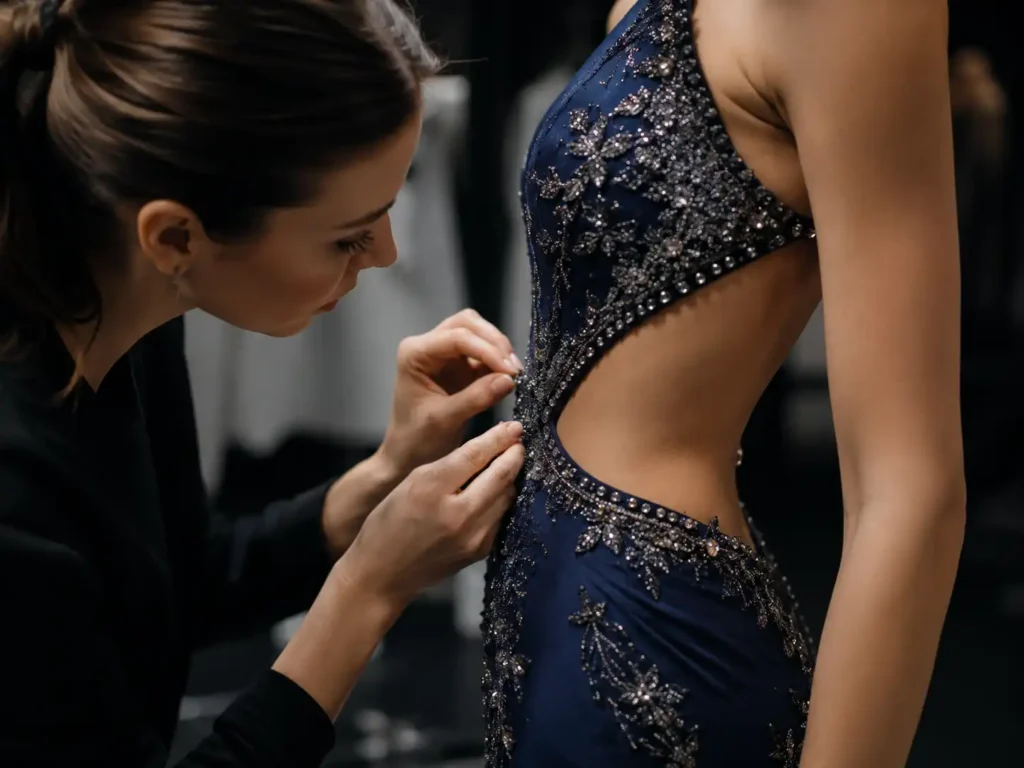
Cut-Out and Side Areas

Hem and Lower Skirt Areas
Common Embellishment Failures in Bulk Production
Falling Components
Fabric Distortion
Skin Scratching
Snagging
Restricted Stretch
Placement Inconsistency
Sample Validation Before Embellished Garments Enter Production
Embellished styles should not move directly from a reference image into bulk production. Sampling must confirm the garment structure, decorative material and attachment method together.
Start with the Complete Design Input
Development can begin from a tech pack, original sample, sketch, reference image or line sheet. The product team should also provide intended fabric, target quantity, color plan, size range and decorative direction.
- stone size;
- backing structure;
- bead weight;
- trim composition;
- attachment method;
- lining requirement;
- internal reinforcement;
- finished garment weight.
Test the Base Fabric and Decorative Material Together
The first attachment trial should verify whether the fabric accepts the proposed method.
For hotfix rhinestones, heat response and adhesion matter.
For sew-on stones or chains, needle penetration and reinforcement matter.
For beadwork, thread route, weight distribution and backing matter.
For stretch fabric, recovery after embellishment matters.
Review the Complete Garment
The final sample should be reviewed in motion and on the body where appropriate.
Important questions include:
- Does the neckline remain stable?
- Do shoulder straps carry the additional load?
- Does the decorated section stretch enough?
- Does the trim scratch the skin?
- Has the drape changed?
- Does the embellishment distort the seam?
- Is the appearance consistent from front, side and back?
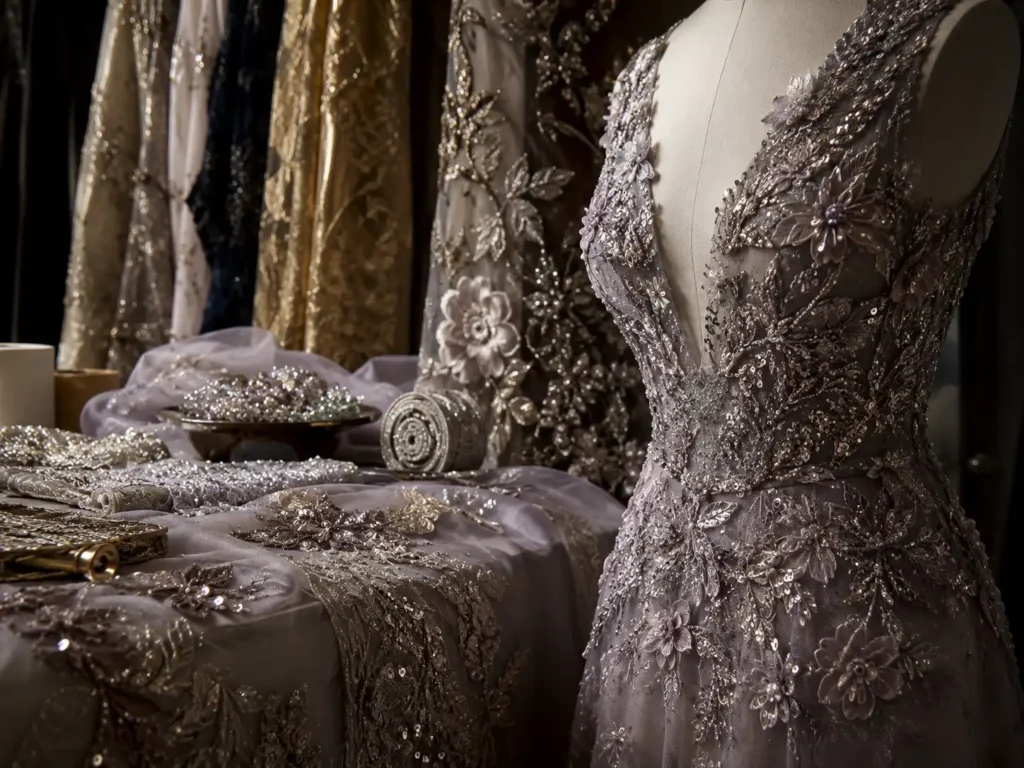
Lock the Final Standard Before Bulk Production
An embellished garment contains more variables than a plain garment. Final approval must therefore lock both garment construction and decoration.
PP Sample Approval
The PP sample should reflect the final combination of:
- fabric;
- color;
- lining;
- trims;
- embellishment type;
- attachment construction;
- placement;
- measurements;
- sewing details;
- labels;
- packing requirements.
Changing a rhinestone, chain, bead size or attachment method after PP approval can affect labor, material purchasing, garment weight and delivery planning.
Golden Sample Reference
The Golden Sample acts as the final physical reference for production and quality checking.
Decoration should match the approved sample in:
- position;
- density;
- color;
- orientation;
- stitch appearance;
- attachment security;
- finished surface;
- garment balance.
A production line should not be asked to interpret decorative intent from a sketch after bulk work has already started.
How Approved Embellishment Details Transfer Into Bulk Production
A strong sample only proves that one garment can be made correctly. Large-scale manufacturing depends on transferring the approved construction into clear production references.
Final Trim and Material Records
Approved decorative materials should be recorded by specification, color, size and application location.
When several components look visually similar, production should still follow the exact approved reference.
Placement References
Decorative motifs need measurable placement references rather than instructions such as “similar to the sample.”
Depending on the style, placement control may include distance from:neckline,center front,shoulder seam,side seam,waist seam,hem,zipper,cut-out edge.
Sewing and Attachment Instructions
Bulk instructions should explain the method used at each location.
A rhinestone chain on the strap may require reinforced sewing, while a crystal motif on the bodice may use an entirely different construction.
First-Piece Production Check
The first finished pieces should be compared against the approved standard before the line continues at full speed.
Early checking prevents a small interpretation error from spreading across hundreds or thousands of garments.
Inline Control
Decorative components should be checked during production rather than waiting until final inspection.
Missing beads, loose chains, shifted motifs and fabric damage are easier to correct before finishing and packing.

Quality Control for Embellished Fashion Garments
Decorative garments require inspection points beyond normal measurement and sewing checks. Jinfeng Apparel uses dedicated QC support within a production system that includes 15+ QC inspectors.

Attachment Security

Missing Components

Placement and Symmetry

Fabric Damage

Skin Comfort

Final Appearance
Protective Packing for Rhinestone, Beaded and Sequin Styles
Finishing is not complete when decoration is attached. Embellished garments remain vulnerable to scratching, compression and snagging during folding, packing and international transport.
Prevent Surface-to-Surface Abrasion
Control Folding Pressure
Protect Sensitive Decorative Areas
Check Before Carton Packing
- decoration remains intact
- no sharp component is exposed against another garment
- garment surfaces are clean
- hangtags and labels do not damage embellished areas
- folding does not distort the finished shape
Cost, MOQ and Lead Time for Embellishment Work
Decorative garments are quoted according to the complete construction rather than the number of visible embellishments alone. Fabric, trim cost, attachment labor, sample development, sewing difficulty, rework risk, QC and protective packing can all affect the final unit price.
Decoration Material Cost
Attachment Labor
Placement Complexity
Fabric Handling
Trim MOQ
Development and Delivery Planning
Fashion Categories That Depend on Strong Embellishment Control

Party Dresses

Club Dresses

Evening Dresses

Festival and Holiday Dresses

Cocktail Dresses

Occasionwear
Representative Embellished Womenswear Programs

Rhinestone Party Dress Program
A fashion brand developed an 18-style party and going-out collection with approximately 42,000 total garments across fitted mini dresses, mesh-panel dresses and rhinestone-detail styles.
The main development issue was not sourcing rhinestones. Several styles placed decoration across stretch mesh, shoulder straps and curved neckline sections, which meant a single attachment method could not be used across the whole collection.
The development team separated the collection into:
- surface crystal motifs;
- reinforced rhinestone straps;
- localized chain details;
- mesh-supported decorative panels.
Sample review focused on stretch recovery, strap loading, skin contact and placement symmetry.
Decorative details were locked during PP approval before the collection moved into bulk production. Inline checking focused on missing stones, attachment points, mesh damage and neckline balance.
Packing instructions separated sensitive rhinestone areas from satin and mesh surfaces to reduce abrasion during transport.
Program Scale: 18 styles
Order Volume: Approx. 42,000 pcs
Main Materials: Stretch mesh, satin, stretch knit
Main Decoration: Rhinestones, chain details
Key Control: Stretch, attachment strength, skin comfort

Sequin Festival Collection
A seasonal fashion program included 24 styles and approximately 68,000 garments, combining sequin mini dresses, party sets, metallic styles and fitted jumpsuits.
The main challenge came from variation between full sequin fabric and localized sequin trim.
Full sequin styles required control over:
- cutting loss;
- sequin direction;
- seam thickness;
- zipper areas;
- underarm comfort;
- lining coverage.
Localized trim styles used controlled decorative placement to preserve sparkle while reducing garment weight and surface abrasion.
The sample team identified several high-risk areas before bulk production, especially side seams, zipper positions and underarm edges.
Production references specified sequin direction, trim position and packing protection. Inline and final QC checked missing sequins, exposed rough edges and damaged surfaces.
Program Scale: 24 styles
Order Volume: Approx. 68,000 pcs
Main Materials: Sequin fabric, mesh, satin
Main Decoration: Full sequins and localized sequin trim
Key Control: Direction, edge comfort, zipper function, packing

Embellished Eveningwear Program
A premium occasionwear collection covered 12 styles and approximately 26,000 garments, including satin evening dresses, lace dresses and bead-detailed formal styles.
Dense decorative areas around the neckline and bodice created additional weight.
Several first samples required adjustment because the original decorative layout changed neckline balance and fabric drape.
Revisions included:
- redistributing bead density;
- reinforcing selected attachment areas;
- adjusting lining support;
- reviewing decorative weight around the bust;
- improving finishing around skin-contact zones.
The approved construction moved into PP and Golden Sample control before production.
Final inspection checked bead security, symmetry, satin damage, neckline stability and hem balance. Protective folding was selected for styles where beadwork could contact smooth satin surfaces during shipment.
Program Scale: 12 styles
Order Volume: Approx. 26,000 pcs
Main Materials: Satin, lace, mesh
Main Decoration: Beads, pearls, localized crystals
Key Control: Weight distribution, neckline structure, surface protection
Built for Brands That Need Development and Bulk Control
6 Owned Womenswear Factories
10+ Satellite Production Partners
2 Sample Rooms
7+ Senior Pattern Makers
20+ Sample Machinists
15+ QC Inspectors
Frequently Asked Questions About Embellishment Attachment Methods

Send Your Embellished Womenswear Project for Review
A useful quotation starts with enough information to understand the garment, not only the decorative component. Jinfeng Apparel reviews the full relationship between fabric, structure, embellishment, placement and production quantity before recommending a development route.
Send a tech pack, original sample, line sheet, sketch or clear reference images. The development team can review attachment feasibility together with fabric direction, trim sourcing, sample requirements, production risks and bulk planning.
For a more accurate first review, include:
- style reference or tech pack;
- target quantity per style/color;
- fabric type or fabric preference;
- rhinestone, bead, pearl, sequin or trim reference;
- decoration location;
- size range;
- target market;
- private-label requirements;
- packing requirements;
- target launch or delivery date.


