
Dress Manufacturer for Technical Design Teams
Structured dress development for brands that manage fit, specifications, revisions and approvals through professional technical design workflows.
- 7+ senior womenswear pattern makers, 2 sample rooms and 20+ sample machinists support pattern, fit and revision work.
- Regular dress first samples usually require about 10-15 days; corset, mesh, lace, sequin and evening styles usually require about 15-25 days.
- 15+ QC inspectors support measurement, workmanship, in-line, final garment and packing checks from approved sample to shipment.
- MOQ starts from 200 pcs per style/color, subject to fabric, trims, construction, color development and production planning.
Technical Capacity Built for Structured Dress Development
Since 2008
7+ Pattern Makers
2 Sample Rooms
20+ Sample Machinists
6 Owned Factories
100,000+ Monthly Capacity
Built Around the Roles Inside Technical Product Teams
Technical Design Directors
Technical Designers
Product Developers
Fit Technicians
QA Managers
Sourcing Managers
Your Team Defines Standards, Jinfeng Executes Them
Brand Technical Ownership
- Approved tech pack and revision number
- Measurement chart and POM definitions
- Grade rules and tolerance requirements
- Fit comments and approval notes
- Label, barcode and packing instructions
Jinfeng Execution Ownership
Jinfeng reviews production feasibility, identifies conflicts, develops or corrects patterns, prepares samples, records revisions, validates materials and translates approved requirements into bulk files. Production is not released until the agreed approval stage is complete. Core outputs:
- Technical question list
- Updated pattern and measurement records
- Sample status and revision notes
- PP and Golden sample references
- Bulk production and QC instructions
Where Technical Dress Development Commonly Breaks Down
Tech Pack Gaps
Version Confusion
Fit Translation
Material Mismatch
Bulk Drift
Slow Escalation
What to Send for an Effective Technical Review

Tech Pack
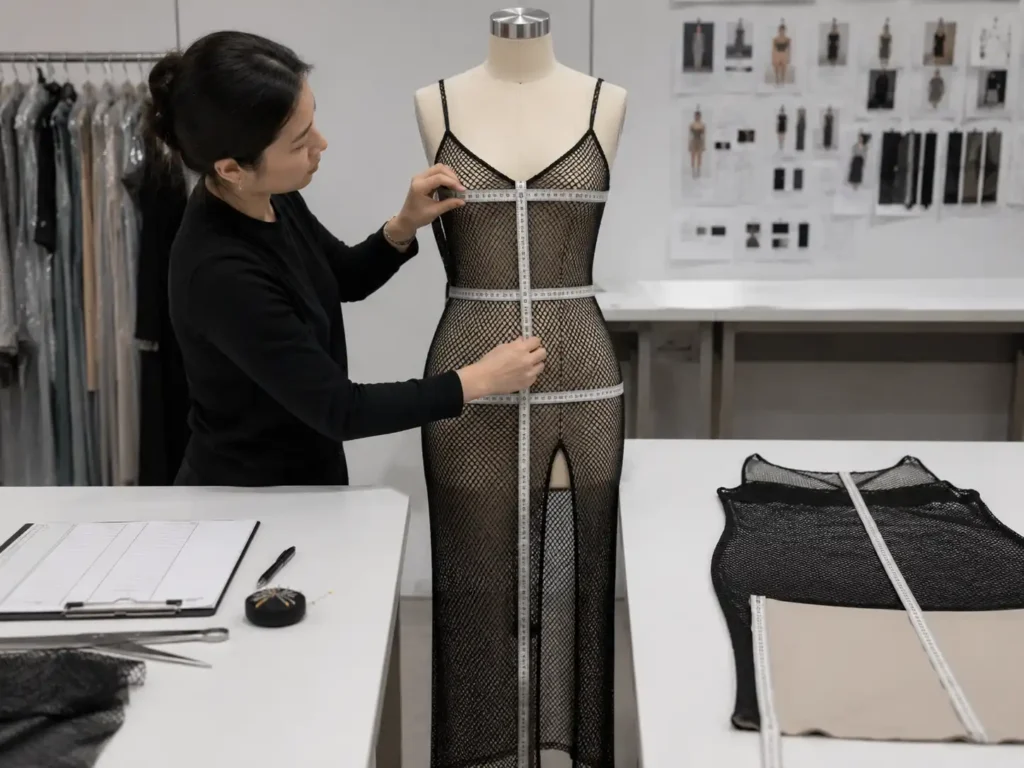
Measurement Spec

BOM and Materials
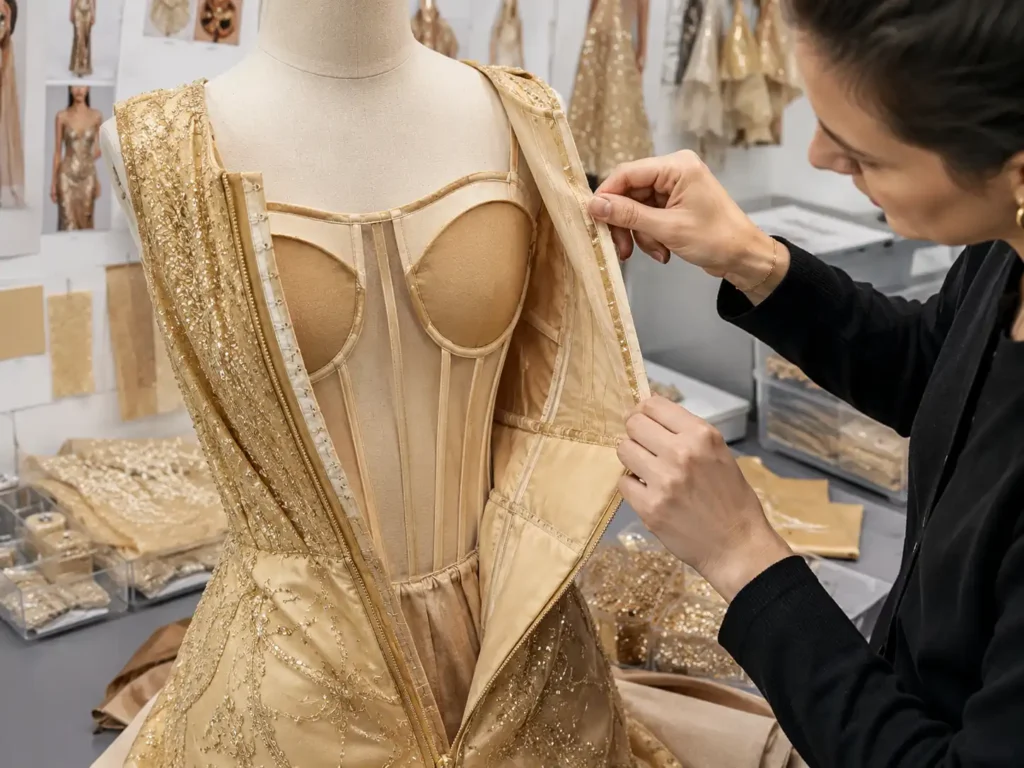
Construction Details

Fit Comments

Program Plan
How We Review a Dress Before Sampling
Sampling begins after technical, material and production risks are visible. A concentrated review saves more time than answering isolated questions after cutting has started.
Technical File Alignment Before Pattern Work
The review starts by comparing flats, construction callouts, measurement charts, BOMs, fit references and any original sample. Each source is checked for internal consistency. A strapless dress, for example, cannot be evaluated only from the front sketch; upper-bust circumference, cup shape, boning, grip elastic, zipper position, lining and neckline depth must support the intended silhouette together.
Document alignment focuses on four areas:
Definition: POM names and measuring methods must match the brand’s internal standard. Similar terms such as body length, high-point shoulder length, front length and center-front length cannot be treated as interchangeable.
Construction: Drawings, notes and BOM components must describe the same garment. A hidden support layer, molded cup, underwire, elastic channel or stabilizing tape needs a defined location and attachment method.
Approval status: Provisional options are separated from locked requirements. Pattern work proceeds against one controlled revision rather than a mixture of current and superseded files.
Open questions: Questions are grouped into fit, construction, material, trim, labeling, packaging, cost and timing. Consolidated review reduces fragmented email cycles and gives the technical department a cleaner decision list.
Production Feasibility and Risk Mapping
A visually strong design still needs a stable manufacturing path. Jinfeng reviews whether fabric behavior, seam placement, internal support and finishing methods can reproduce the approved effect across the full size range. Risk is considered before pattern cutting, not after a failed first sample.
Typical feasibility checks include:
Fabric behavior: Weight, width, stretch direction, recovery, drape, shine, transparency, fraying, snagging and shrinkage affect both pattern allowance and sewing method.
Stress and coverage: Halter neck load, strapless grip, deep-V support, cut-out edge stability, side-bust coverage and slit height are reviewed for wearing safety and size progression.
Bulk repeatability: Hand-applied elements, lace placement, sequin direction, asymmetric ruching and complex pleats are assessed for repeatable production. A detail that looks attractive on one sample may require a positioning guide, template or controlled sequence for bulk.
Commercial effect: Fabric substitutions, trim changes, additional lining, handwork and special packing can change MOQ, sample time and unit cost. Risks are explained before approval so technical and merchandising teams can make one coordinated decision.
Review Output and Sampling Gate
The review closes with a defined sampling brief rather than a general promise to proceed. The brief records the working file revision, selected material direction, unresolved points, planned sample stage and approval owner. For a regular dress, the first sample usually requires about 10-15 days after material and requirements are ready. Complex corset, strapless, lace, mesh, sequin and evening styles usually require about 15-25 days, subject to construction and material development.
A sample is released only when the input is sufficient for its purpose. A fit sample may use a close substitute to validate structure, while a photo-ready or PP sample requires stricter material, color and trim alignment. Separating sample purposes prevents a development garment from being treated as the final production standard.
Jinfeng also confirms whether the project fits the production model. MOQ starts from 200 pcs per style/color. Special fabrics, custom dyeing, printing, lace, sequins, molded trims, packaging or highly split size-color ratios may create separate supplier requirements. Early visibility protects both the technical plan and the launch calendar.

Dress Categories Developed With Technical Design Teams
Different dress constructions require different technical priorities. Jinfeng assigns pattern, sampling, material and QC controls according to silhouette and risk rather than applying one generic workflow.
| Dress Program | Typical Styles | Technical Focus | Main Production Risks | Required Approvals |
|---|---|---|---|---|
| Stretch and Bodycon | Bodycon mini, ruched midi, jersey maxi, cut-out dress | Stretch direction, recovery, negative ease, bust-waist-hip balance, seam stability | Growth, twisting, wavy seams, inconsistent compression, size drift | Fabric test, fit sample, grade review, PP sample |
| Corset and Structured | Corset mini, bustier midi, strapless occasion dress | Cup shape, boning, under-bust, grip elastic, zipper, lining and support balance | Cup gaping, slipping, discomfort, exposed boning, zipper stress | Structure sample, fit review, support trims, PP approval |
| Satin and Slip | Bias slip, cowl-neck mini, satin bridesmaid, draped maxi | Drape, grain direction, seam flatness, shine, lining, pressing and zipper insertion | Snagging, puckering, shade variation, seam impression, uneven hem | Bulk fabric, color, pressing method, Golden sample |
| Mesh and Lace | Mesh ruched dress, lace midi, lined sheer maxi | Transparency, lining coverage, lace placement, edge finish, seam comfort | Exposure, asymmetric motifs, broken lace, rough seams, bulk placement variation | Placement map, lining approval, revised sample, PP sample |
| Sequin and Embellished | Sequin mini, embellished evening dress, beaded party dress | Direction, motif placement, seam clearance, lining, skin-contact protection | Sequin loss, scratching, heavy seams, inconsistent placement, finishing damage | Material panel, placement standard, wear review, final sample |
| Occasion and Maxi | Wedding guest, prom, graduation, evening and formal maxi | Length balance, hem level, train, slit, inner support, movement and packing | Uneven hem, dragging, slit exposure, crushed finish, size-proportion changes | Fit sample, length confirmation, PP sample, packing approval |
Pattern, Fit and Measurement Control for Dresses
Dress fit depends on connected proportions. Jinfeng reviews critical points as a system so a correction improves the garment without creating a new imbalance elsewhere.
Bust, Waist and Hip Balance
Fitted dresses are controlled through more than three circumference numbers. Upper bust, full bust, under bust, waist position, high or low waist, high hip, full hip and body length determine how the garment sits and moves. A smaller waist can pull the side seam forward; added bust room can change armhole coverage; extra hip ease can alter hem balance and slit position.
Pattern review therefore links measurement comments to shape and balance:
Bust shaping: Dart intake, princess seam position, cup volume, neckline tension and side-bust coverage are checked against fabric stretch and intended support.
Waist placement: Natural waist, empire, drop-waist and corset waist positions are assessed against torso length and the visual proportion defined by the design team.
Hip and movement: Bodycon, woven sheath and low-waist styles require different ease. Sitting comfort, walking room, lining and slit function are evaluated together.
Balance: Front and back length, side seam, shoulder or strap position and hem level are checked on body. Measurement compliance alone is not enough when the garment hangs incorrectly.
Neckline, Armhole, Strap and Exposure Control
Fashion-driven dresses often combine open necklines, narrow straps, cut-outs and low backs. Small pattern differences can create underarm exposure, neckline gaping, strap pressure or unstable coverage across sizes. Technical review focuses on the stress path and body coverage instead of treating open details as surface decoration.
Key checks include neckline depth, neckline width, armhole depth, front and back strap position, strap length, side-bust coverage, back opening, grip elastic and internal support. Halter styles are evaluated for neck load and chest stability. Strapless styles require upper-bust control, cup shape, boning and anti-slip support.
Deep-V styles need center-front stability and defined coverage at the bust and side seam.
Fit comments are converted into pattern actions with the affected POMs identified. When a neckline is raised, related changes may be needed at the cup, strap, armhole and front length.
When a strap is shortened, the armhole and bust can lift. Linked actions are recorded to avoid correcting one symptom while introducing another.
Length, Slit, Hem and Size Progression
Mini, midi and maxi dresses carry different safety and balance risks. Jinfeng reviews center-front length, center-back length, side length, waist-to-hem, slit height, train length and lining length against the intended size range. A mini dress can become unsafe if grading adds width without enough length; a maxi can become uneven when bias sections, heavy trims or asymmetric panels stretch differently.
Size progression is reviewed from the approved base size rather than assumed from generic increments. Critical fitted points may need a different grading logic from sweep, ruffle volume or skirt length. Strapless and corset styles also require support components to progress with body measurements, not only shell dimensions.
Measurement reports identify the sample version, measuring condition and deviations from the approved spec. Final grade rules and tolerance requirements remain brand-defined. Jinfeng uses those rules to prepare size-set review, production measurement checkpoints and final inspection references.
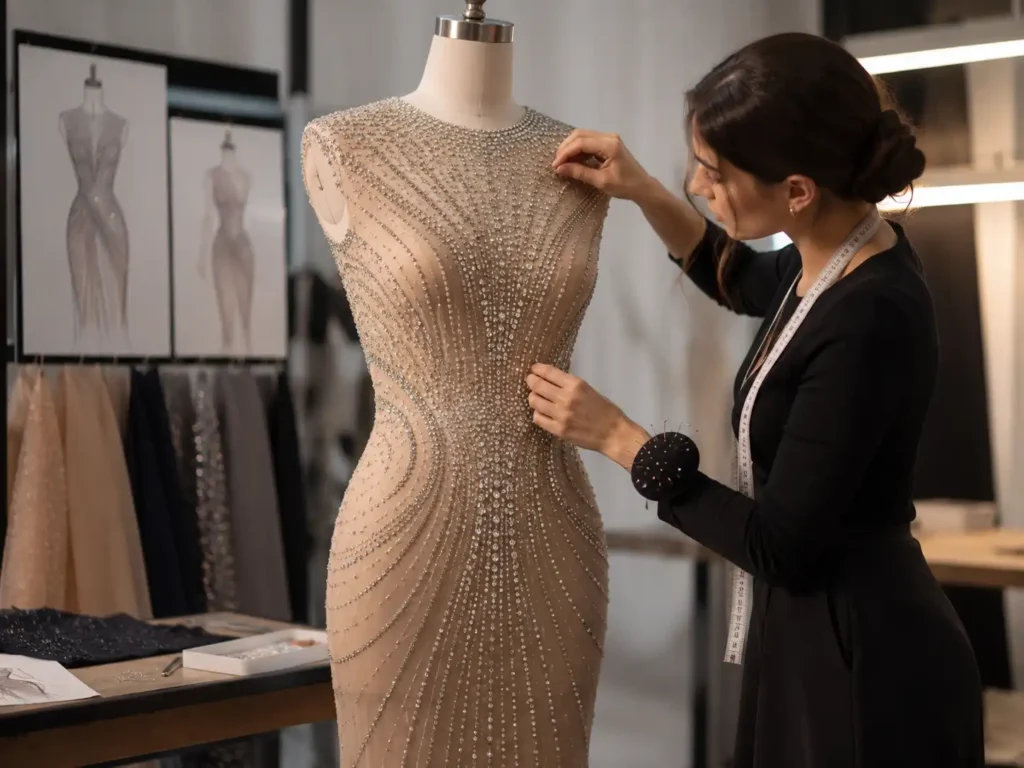
Sample Stages With Clear Revision Accountability
Each sample stage should answer a defined question. Clear stage purpose prevents development garments, photo samples and production approvals from being confused.
First, Fit and Revised Sample Purposes
The first sample validates silhouette, pattern proportion, fabric direction, construction feasibility and initial cost logic. It is not automatically the final bulk standard. A regular dress first sample usually requires about 10-15 days after requirements and materials are ready. Simpler structures may require about 7-10 days, while corset, strapless, lace, mesh, sequin and evening styles usually require about 15-25 days.
Fit samples focus on on-body behavior and measurement relationships. Feedback can include pinned adjustments, photos, POM readings, mobility comments and visual balance. Jinfeng categorizes issues into fit, fabric, workmanship, color, trims, design accuracy, measurement, labeling, packing and cost alignment.
Revised samples are made after approved changes are transferred into updated patterns, measurement charts, material records, trim records and sewing instructions. A verbal “please change the waist” is not treated as a complete revision. The underlying pattern action, affected measurements and sample version must be identifiable.
Photo, Salesman and Presentation Samples
Photo-ready and salesman samples serve commercial presentation, but their purpose differs from fit or PP approval. Color, surface finish, drape, pressing, labels and visual details may receive higher emphasis because the garment will appear in campaign imagery, wholesale review or internal line presentation.
A photo sample may still use a non-bulk material when the final fabric is unavailable, provided the deviation is recorded. A visually accepted garment does not replace technical approval if measurements, construction, bulk fabric or trims remain open. Jinfeng separates aesthetic acceptance from production readiness so a campaign deadline does not silently overwrite unresolved production standards.
For multi-style programs, sample priority can be arranged around campaign dates, hero SKUs, fit risk and material lead time. Not every style needs to move at the same speed. A controlled priority list protects the most important launch milestones while keeping technical review manageable.
PP Sample and Golden Sample Release
The PP sample confirms the final pattern, approved measurements, bulk fabric or approved equivalent, trims, construction, labels and packing direction before production. Changes after PP approval require formal impact review because material booking, cutting or sewing preparation may already be underway.
The Golden sample acts as the sealed physical reference for bulk appearance and workmanship. It works together with the final tech pack, BOM, measurement spec, trim card, sewing instructions and QC checklist. No single garment can carry every production detail without supporting files.
Bulk release is tied to approval status. Open points are listed, responsible reviewers are identified and any conditional approval is recorded. The process gives technical, sourcing, production and QC teams a shared reference rather than relying on memory or scattered messages.
Fabric and Trim Validation Before Sample Approval
Material decisions influence fit, construction, cost and bulk stability. Jinfeng reviews physical behavior and supply conditions before a fabric or trim becomes part of the production standard.
Fabric Weight, Stretch, Drape and Recovery
A fabric name alone does not define performance. Satin can be fluid or structured; mesh can be soft, power-stretch or rigid; jersey can vary in weight, recovery and growth. Jinfeng reviews composition, weight, width, stretch direction, recovery, drape, transparency, shrinkage, shine and surface sensitivity against the intended dress shape.
Bodycon and ruched styles need stable recovery so the garment does not grow during wear. Bias satin needs grain and hanging behavior review before hem approval. Chiffon and light woven fabrics need seam, lining and edge-finish planning. Ponte and heavier jersey require balance between compression, comfort and seam bulk.
Where the original material is unavailable, a substitute is assessed for appearance, hand feel, fit effect, construction impact, bulk availability, MOQ and cost. A substitution is not approved only because color looks similar. Pattern adjustment may be required when stretch, weight or drape changes.
Transparency, Color and Surface Risk
Mesh, lace, chiffon and light satin require deliberate coverage planning. Lining color, lining length, seam allowance, cup visibility and skin-tone interaction affect the final look. Transparency is checked under relevant lighting and stretch conditions, especially at bust, hip and seat areas.
Color control may use Pantone references, physical standards, swatches or lab dips. Satin shine can make the same dye lot appear different under varied lighting and fabric direction. Bulk shade approval, lining coordination and panel orientation reduce visible mismatch. Different production batches still require confirmation because historical approval does not automatically cover a new dye lot.
Snagging, sequin loss, lace damage, pile direction and surface marking are considered during cutting, sewing, pressing and packing. Handling standards are planned before bulk, not added after defects appear.
Functional Trims and Internal Support
Invisible zippers, hook-and-eye closures, cups, boning, underwire, grip elastic, strap sliders, lace trims and decorative elements all influence comfort and repeatability. Selection considers material, size, color, strength, placement, skin contact, MOQ, lead time and bulk supply stability.
Corset and strapless dresses require cup shape, boning stiffness, channel construction, upper-bust tension, grip elastic and zipper support to work together. Slip and halter dresses need strap hardware that adjusts smoothly without slipping or scratching. Lace, beading and sequin trims need edge protection and placement references.
Approved trim cards or physical references are connected to the BOM and sample version. Any replacement is reviewed for appearance, fit, sewing method and cost before being introduced to production.

Construction and Workmanship for Demanding Dress Styles
Complex dress details need construction logic, wearing support and repeatable sewing standards. Appearance is reviewed together with comfort, stress control and bulk consistency.
Corset, Cup, Boning and Support Construction
Corset and bustier dresses combine several load-bearing elements. Cup shape, under-bust position, boning placement, waist reduction, lining, closure and upper-edge support must create the intended silhouette without slipping, gaping or causing pressure points.
Jinfeng reviews the relation between shell pattern and internal structure. Boning length and stiffness are selected according to garment shape and fabric. Channels must secure the bone without exposure or breakage. Cups need correct volume, height and symmetry. Grip elastic or support tape is positioned so the upper edge remains stable without excessive discomfort.
Workmanship checks include left-right symmetry, cup alignment, smooth seam transitions, zipper flatness, hook-and-eye security, lining attachment, boning containment and wear comfort. Structure is validated during sampling because a visual flat-lay check cannot reveal all fit and stress issues.
Ruching, Draping, Pleats and Cut-Out Stability
Ruching and draping are controlled through direction, distribution, anchor points, seam intake and fabric behavior. Uneven tension can create unwanted bulk, asymmetric folds or inconsistent garment length. Production references may include stitch marks, notches, templates or placement measurements so the approved effect can be repeated.
Pleats require fold direction, depth, spacing, pressing and release points to remain stable across sizes. Ruffles need controlled curvature, fullness, edge finish and weight. Cut-outs require defined coverage, reinforcement, edge stability and grading rules so openings do not distort or expose more skin in larger sizes.
Construction approval considers how a detail behaves during wear, not only on the hanger. Stretch, body movement, lining and seam elasticity are reviewed together, particularly around waist, hip, bust and side seams.
Lace, Mesh, Sequin, Zipper and Hem Finishing
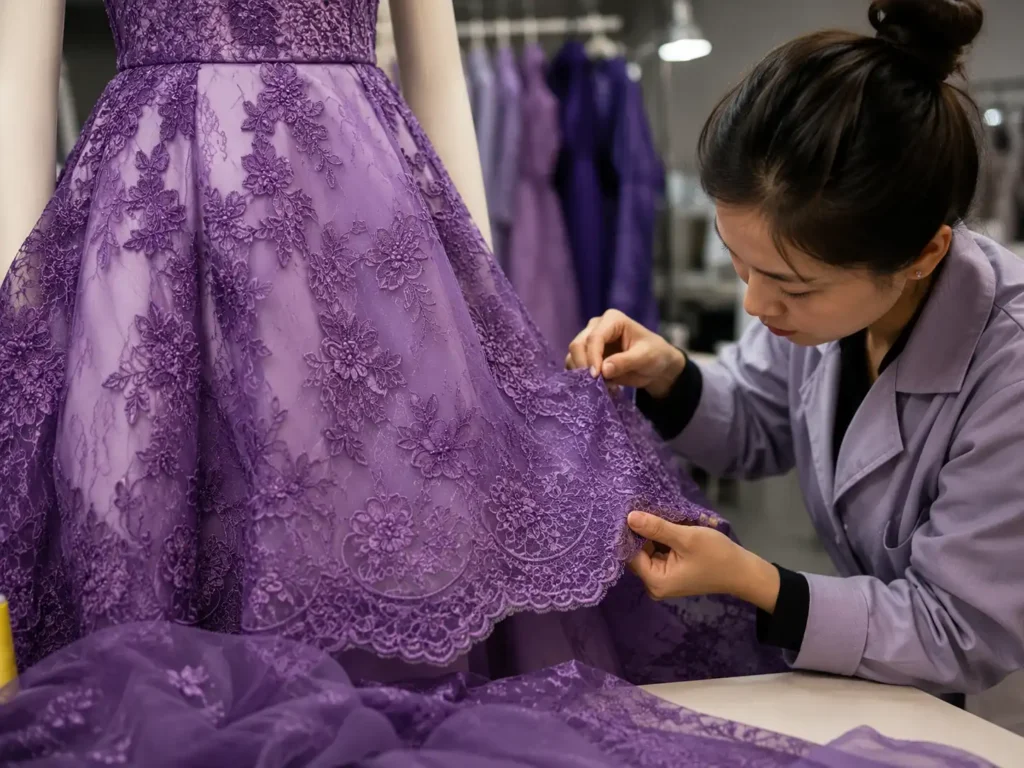
Lace placement is checked for motif direction, symmetry, joins, edge treatment and lining contrast. Mesh needs clean seam handling, stretch-compatible stitching and controlled transparency. Sequin fabrics require seam clearance, protected skin-contact areas, stable embellishment direction and careful pressing.
Invisible zippers are reviewed for color, length, smooth operation, seam flatness, top closure and compatibility with fabric thickness. Satin and bodycon dresses are especially sensitive to zipper bulging or seam impression. Hems are selected according to fabric weight, shape and desired movement; bias or circular hems may require hanging time and final leveling before approval.
Final workmanship standards are translated into visual references and QC checkpoints. Terms such as “clean finish” or “premium sewing” are replaced by measurable expectations covering seam appearance, symmetry, edge finish, pressing, fastening, lining coverage and garment presentation.
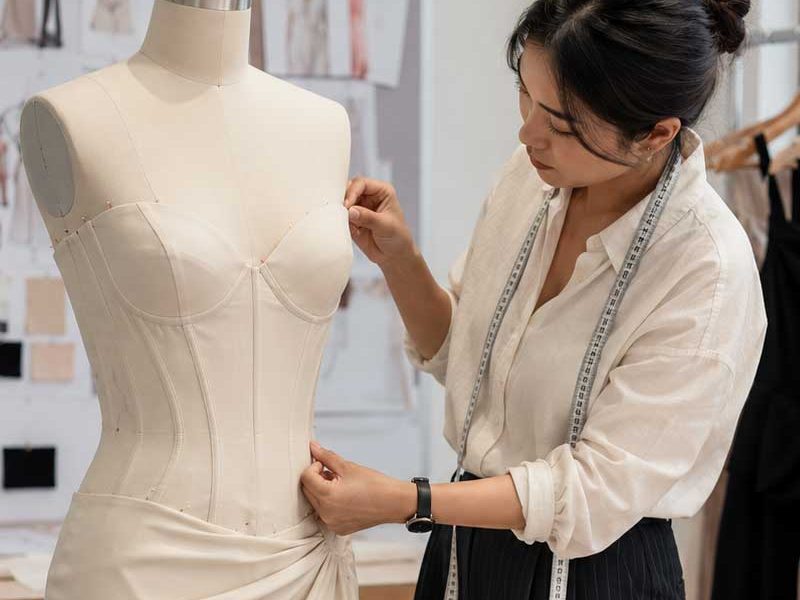
Grading and Size-Set Validation Before Bulk
Base Size Lock
Grade Rule Review
Critical POM Map
Size-Set Samples
Measurement Reports
Final Grade Release
Technical Communication With Controlled Revision Ownership
Single Project Contact
Consolidated Questions
Revision Numbering
Action Ownership
Approval Status
Escalation Rules
From Approved Sample to Production-Ready Specifications
Bulk consistency depends on a complete handover package. The physical sample, final files, material references and QC requirements must describe one locked garment.
Final Pattern, Measurement and Grade Package
The production pattern is released only after approved fit changes are incorporated. Final pattern pieces, notches, grain direction, seam allowance, drill marks and construction references must match the approved sample. Measurement charts and grade rules are linked to the same revision.
Critical POMs receive production measurement checkpoints. The exact list varies by style: a strapless corset dress may prioritize upper bust, cup position, under bust, waist, zipper length and dress length; a bodycon style may prioritize bust-waist-hip balance, stretch behavior, side seam and hem level; a maxi may prioritize body length, waist placement, slit and hem balance.
Pattern records are retained for repeat production. A reorder in a new fabric or color still requires material and shade confirmation because fit and sewing behavior can change even when the pattern remains the same.
BOM, Fabric, Trim and Construction Package
The final BOM identifies shell, lining, interlining, closures, support trims, labels and packaging. Physical swatches, color standards, trim cards or approved supplier references support the written specification. Substitute materials are not introduced without review when they affect appearance, fit, comfort, MOQ or cost.
Construction instructions translate approved workmanship into a sewing sequence. Stitching, seam type, reinforcement, cup and boning installation, zipper insertion, ruching distribution, lace placement, hem method and pressing requirements are defined according to style risk.
Label placement, barcode data, SKU labels, polybag warnings, folding, hanger or flat packing and carton marks are included before packing materials are ordered. Technical accuracy continues beyond sewing because label or packing errors can block warehouse receiving.
PP, Golden Sample and Production Release Gate
The PP sample verifies the final production configuration before cutting. The Golden sample provides the visual and physical workmanship reference. Both are used with files; neither replaces the tech pack, measurement chart, BOM or QC checklist.
Production release confirms material readiness, approved pattern, sample status, quantity by style/color/size, line allocation, QC plan, packing instruction and shipment requirements. Open points are resolved or formally controlled before bulk starts.
Changes after release are reviewed for affected cut goods, material orders, labor, cost and timeline. Controlled change management protects the approved product and avoids introducing unrecorded differences between production batches.

Bulk Production Matched to Style Complexity
Production allocation follows material, construction, quantity and timing. Different dress families need different line experience, handling methods and QC focus.
Factory and Sewing-Line Allocation
Jinfeng operates 6 owned women’s fashion factories, works with more than 10 long-term production partners and manages 18+ sewing lines plus 6+ flexible lines. Allocation is based on woven or knit structure, fabric sensitivity, corset or occasionwear complexity, order quantity, size-color breakdown, finishing load and delivery plan.
A stretch bodycon program requires line experience with recovery, seam elasticity and measurement control. Satin programs need careful cutting, seam and pressing discipline. Lace, mesh and sequin styles require placement, protection and finishing controls. Structured corset dresses need stable internal construction and repeated fit references.
Flexible lines support multi-style, multi-fabric and multi-color programs while maintaining the standard MOQ of 200 pcs per style/color. Flexibility describes production organization, not an unrestricted order structure. Material MOQ, trim availability and highly fragmented size-color ratios remain part of the allocation decision.
Production Milestones and Project Tracking
Bulk planning begins from PP approval, material arrival and confirmed order breakdown. A project timeline identifies fabric and trim readiness, cutting release, sewing start, in-line checks, finishing, final inspection, packing and shipment preparation. Complex collections may move through more than one production wave to protect launch priorities and QC capacity.
Twelve-plus merchandisers and order follow-up specialists coordinate sample records, material status, factory progress, approvals and packing requirements. Fifteen-plus QC inspectors support material, cutting, sewing, measurement, final garment and packing checks. More than 30 finishing and packing workers support pressing, presentation, label verification and carton preparation.
Updates focus on decision-relevant milestones rather than generic progress messages. Delays caused by material approval, late fit changes, replacement trims or packing artwork are identified with the affected styles and revised action plan.
Launch Planning, Packing and Shipment Coordination
Shipping is planned according to launch date, quantity, destination, warehouse requirements and freight strategy. Samples normally move by express courier. Urgent launch quantities can move by air, regular bulk programs by sea, and time-sensitive large orders can use split shipment. A common split structure sends 10-30% of priority quantities by air while the remaining bulk moves by sea, subject to SKU and carton planning.
Jinfeng can work with a brand-appointed forwarder or provide freight options for comparison. Supported terms and routes can include express, air, sea, EXW, FOB, CIF, DAP and DDP by project. DDP availability depends on destination, product, value, labeling, compliance and forwarder route capability.
Packing and export coordination can cover barcode and SKU labels, carton marks, commercial invoice, packing list, carton dimensions, gross and net weight, air waybill or bill of lading coordination and shipment status. Final transit time is confirmed with the selected route and forwarder.
Measurement, Workmanship and Final Quality Control
Quality control follows the approved technical standard from materials through packing. Inspection criteria are style-specific, recorded and connected to the final sample and files.
AQL and Full-Process Control Serve Different Purposes
AQL is a sampling method used for final inspection; it does not replace incoming material checks, cutting checks, in-line inspection or process control. Jinfeng can support brand-defined AQL requirements, internal final inspection and third-party inspection arrangements. The inspection level and acceptance criteria are confirmed by project.
Fit-sensitive points are checked during production so a measurement issue can be corrected before all garments are complete. Workmanship risks such as zipper bulging, exposed lining, asymmetric ruching, lace damage, sequin loss or uneven hems are reviewed at the stage where corrective action remains possible.
Packing QC verifies the technical program beyond the garment. Barcode, SKU, size-color assortment, care label, hangtag, polybag, carton mark and packing-list accuracy are essential for retail and ecommerce receiving.
Control Stage | Technical Reference | Jinfeng Check | Evidence or Record | Risk Controlled |
Incoming Materials | Approved swatch, BOM, color standard, trim card | Fabric appearance, shade, width, stretch, defects, trim identity and quantity | Material inspection record, swatch or photo | Wrong material, shade variation, surface damage, trim mismatch |
Cutting | Final pattern, grain, placement map, size ratio | Marker, direction, lace/sequin placement, bundle identity and cut-part condition | Cutting check, bundle and style identification | Wrong direction, asymmetric placement, size mixing, damaged panels |
Sewing In-Line | Golden sample, construction notes, workmanship standard | Seam, support structure, zipper, ruching, lining, symmetry and operation sequence | In-line findings and corrective action | Repeated workmanship defects and construction drift |
Measurement | Approved measurement chart and tolerance | Critical POMs by style and selected size checks during production | Measurement report by sample or inspection lot | Bulk size drift and uncontrolled fit variation |
Final Garment | Approved appearance, labels and finishing requirements | Workmanship, measurement, pressing, stains, damage, fastening and presentation | Final inspection or AQL report | Visible defects, missing details, poor presentation |
Packing and Shipment | Packing instruction, barcode, SKU and carton plan | Labels, barcode scans, size-color assortment, polybag, carton marks and quantities | Packing check, packing list and shipment photos | Warehouse rejection, SKU error, packing mismatch and document inconsistency |
Protecting Tech Packs, Patterns and Unreleased Designs
NDA Cooperation
Tech Pack Protection
Pattern Protection
Sample Photo Control
Private Label Security
Access and Records
Representative Technical Dress Programs
Anonymous program structures show how technical files, sample priorities, material risks and production waves can be organized without exposing protected brand identities or unreleased designs.

US Occasionwear Program - 18 Styles, 41,600 Pieces
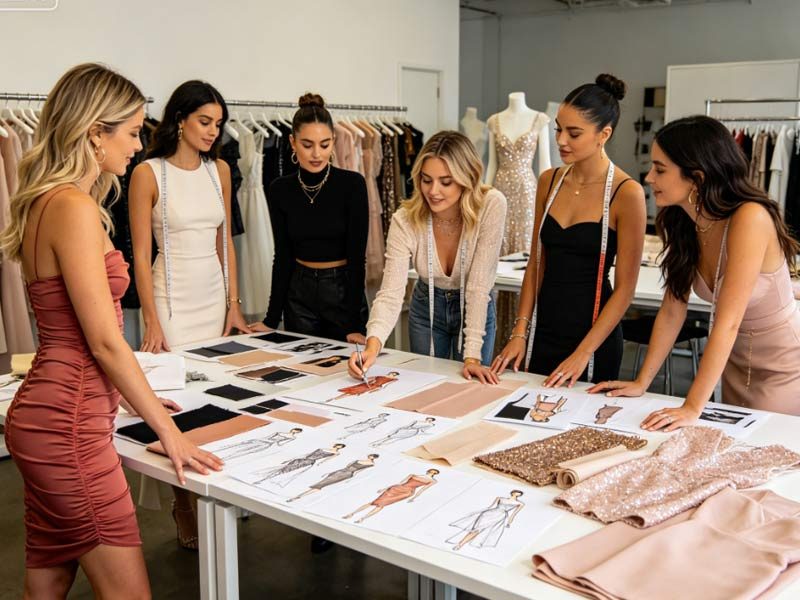
Program profile: An established US occasionwear label developed 18 styles across satin mini dresses, corset midis, mesh-ruched dresses and sequin evening silhouettes. The order totaled 41,600 pieces across three main color families and a US 0-14 size range. Campaign samples and hero styles carried earlier review dates than secondary SKUs.
Technical challenge: Files came from several internal owners and contained different measurement formats. Seven critical POM groups needed alignment across fitted bust, upper bust, under bust, waist placement, hip, strap or neckline position and finished dress length. Satin and mesh styles also required separate lining and transparency decisions, while corset styles required cup, boning and grip-support review.
Development approach: Jinfeng grouped questions by style family, established one active revision per SKU and used first, fit, revised and PP stages according to risk. Shared components were standardized where approved, while fit-sensitive patterns remained style-specific. Production was released in two waves after PP and Golden sample references were locked.
Control outcome: The handover package connected final patterns, measurement charts, BOMs, fabric and trim references, construction instructions and packing data. The program demonstrates how 10-30 style collections can move without forcing every SKU through an identical development path.
US Fast-Fashion Program - 26 Styles, 68,400 Pieces
Program profile: A US fast-fashion dress program included 26 styles totaling 68,400 pieces, with bodycon minis, cut-out midis, halter dresses, satin slips, two jumpsuits and several matching sets. Quantities were divided across five commercial colors and an XS-XL size range, with three launch windows rather than one final delivery date.
Technical challenge: Several styles shared block references but used fabrics with different stretch, recovery and weight. Applying one grade and fit assumption across every material would have created inconsistent compression, neckline stability and garment length. Label, barcode and carton requirements also differed by launch group.
Development approach: Base blocks were reviewed by material family, and critical POMs were reassigned for stretch, satin and jumpsuit categories. Size-set review focused on the smallest, base and largest sizes for selected risk styles. Production allocation used flexible lines for the multi-SKU mix, while priority styles received earlier material booking and PP review.
Delivery approach: The program was divided into three production and packing waves. Priority quantities could be separated for faster freight while the larger balance followed the regular route, with SKU, carton, invoice and packing-list records maintained by shipment.
The structure supports monthly or seasonal drops without losing the approved technical standard.
Frequently Asked Questions for Technical Design Teams

Send Your Technical Package for Project Review
- Latest tech pack revision, measurement chart, BOM and construction details
- Reference sample, fitting photos or dated fit comments when available
- Style count, quantity per style/color and planned size range
- Fabric, trim, color, label, barcode and packing requirements
- Target sample date, campaign date, launch window and shipment preference
- NDA request or internal confidentiality requirements before file transfer


