Dress Manufacturer for Retail Warehouse Receiving Teams
Custom dress development, bulk production and receiving-ready packing for fashion brands supplying retail distribution centers.
- 18+ sewing lines and 6+ flexible production lines support multi-style dress programs with planned color-size allocation.
- 15+ QC inspectors and 30+ finishing and packing workers support garment inspection, label checks, barcode checks and carton release.
- MOQ starts from 200 pieces per style and color; retail label, packaging and material requirements are reviewed separately.
- PO numbers, style codes, colors, sizes, SKU data, pack ratios, carton marks and destination details are checked before shipment release.
Retail Program Capability at a Glance
Since 2008
6 Owned Factories
10+ Production Partners
100,000+ Monthly Capacity
15+ QC Inspectors
Retail Packing Support
Built Around Retail Receiving Responsibilities
Receiving Teams
Vendor Compliance
Sourcing Managers
Supply Chain Teams
Merchandise Operations
Import Logistics
Receiving Problems Often Begin Before Shipping
Wrong SKU Labels
Unreadable Barcodes
Incorrect Pack Ratios
Carton Mismatch
Document Variance

Dress Programs Engineered for Retail Distribution

Mini Dresses

Midi Dresses

Maxi Dresses

Bodycon Dresses

Occasion Dresses

Satin Dresses

Mesh and Lace

Seasonal Collections
Garment Quality Must Be Stable Before Packing
Warehouse-ready packing cannot compensate for unstable fit, fabric or workmanship. Jinfeng controls the dress first, then protects the approved product through labeling, folding, carton loading and shipment release.

Fabric and Color Control
Incoming material review checks color, weight, hand feel, width, shrinkage, color fastness and visible defects according to the material and program requirements. Satin receives shade and snag attention; mesh is checked for holes and stretch direction; lace is reviewed for motif damage and usable placement; sequin fabric is examined for loss and surface risk. When one retail order uses multiple colorways, shade approval and lining or trim matching need to be locked before cutting. Fabric batch records also support repeat-order review when a style returns in a later season.
- Stock fabric can shorten development preparation, but color, quantity, hand feel, width and batch availability still require confirmation.
- Custom-dyed colors add lab dip, bulk shade and minimum-dye-lot considerations before production can be scheduled.
- Custom printed fabrics require approval of base cloth, repeat scale, direction, placement and color performance.

Fit and Measurement Control
Fit-sensitive dresses are managed around bust, upper bust, under bust, waist, hip, high-point shoulder length, strap length, armhole, neckline depth, slit height and lining length.
A first sample verifies structure and direction; revised samples correct fit, fabric, trim or construction; PP approval and Golden sample sealing establish the bulk reference.
Simple dresses commonly move through one first sample and one revised sample. Medium-complexity styles often need one or two revisions, while corset, strapless, evening, sequin, lace and mesh styles commonly need around two revisions depending on the structure.
The goal is not a fixed revision count; the goal is a controlled standard that can be graded and inspected across the approved size range.
Workmanship and Construction
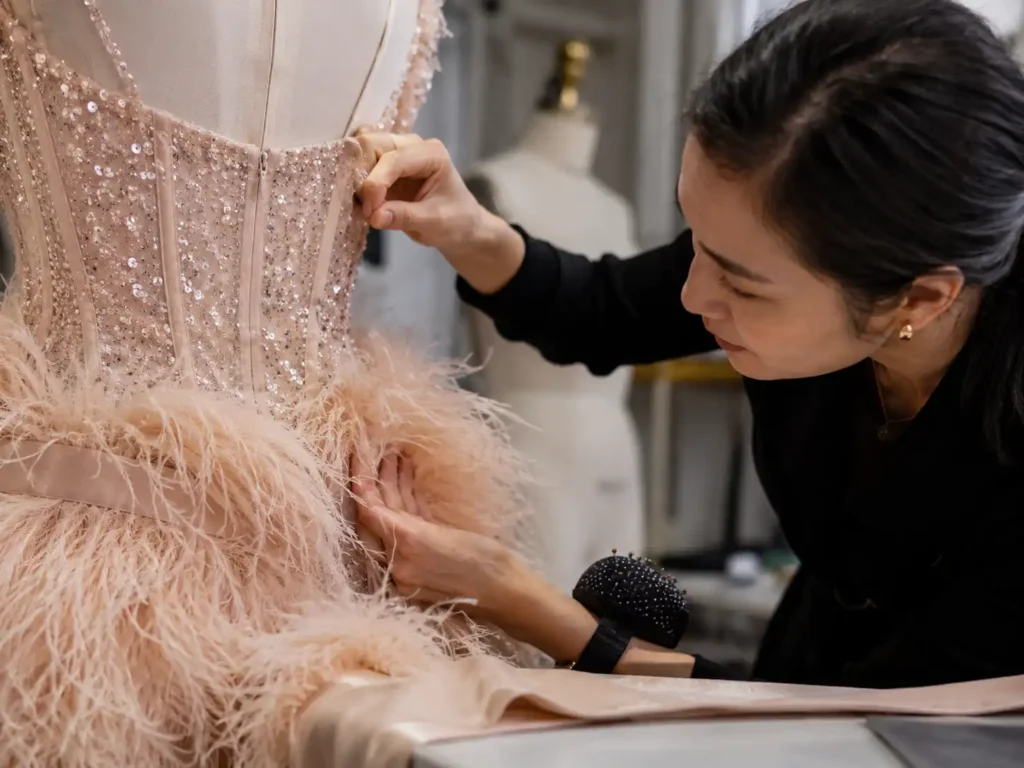
Cutting QC checks pattern version, panel direction, print or stripe placement, panel quantity, size bundling and stretch direction. Sewing QC follows stitch density, seam allowance, symmetry, zipper flatness, strap length, ruching placement, lace matching, lining attachment and slit height.
Garment QC reviews measurements, appearance, pressing, stains, holes, loose threads, closure function, label position and care-label content. Product-specific controls are added for corset cups and boning, satin zipper rippling, mesh neckline recovery, lace placement and sequin protection.

Sample-to-Bulk Consistency
Approved comments are converted into final patterns, measurement charts, BOM records, construction instructions, QC checklists and packing requirements. A pre-production meeting aligns pattern version, fabric, trims, labels, pack method and critical dates before bulk cutting. In-line checks identify drift while corrections are still manageable. Final inspection and packing QC compare finished goods with the approved references rather than relying on memory or informal messages. Repeat orders can call on archived pattern, fabric, trim, label, packing and Golden sample records, with current material availability and pricing reviewed again.
From Tech Pack to Receiving-Ready Delivery
Project Review
Material Direction
Pattern and Sample
PP and Golden
Bulk Production
Packing Preparation
Final Carton Audit
Shipment Handover
Retailer Requirements Are Reviewed Before Packing
Requirement Review
Responsibility Map
Approval Lock
PO, Style and SKU Data Stay Connected
One controlled data chain should connect the approved order to the individual garment, carton and shipping file. Every field needs an owner, use point and verification point.
| Control Field | Source File | Use in Production and Packing | Release Check |
|---|---|---|---|
| PO Number | Purchase order | Separates order, destination and packing records | Carton mark, packing list and invoice reference |
| Style Number | Tech pack / line sheet / PO | Links garment, labels, packing sheet and inspection record | Garment label and carton content |
| Color Name or Code | PO / SKU matrix | Controls cutting bundles, labels and carton split | Color sticker, garment and carton |
| Size | Size chart / order breakdown | Controls grading, production quantity and pack ratio | Size label, sticker and physical count |
| Order Quantity | PO | Plans production, packing materials and carton count | Final quantity reconciliation |
| UPC / EAN / SKU | Approved brand or retailer file | Prints price ticket, barcode or SKU label as assigned | Data match, placement and scan test |
| Pack Ratio | Packing instruction | Creates solid packs, mixed-size prepacks or destination packs | Carton-level ratio audit |
| Carton Sequence | Packing plan | Assigns carton number and destination sequence | Outer mark and packing list |
| Ship-To Location | PO / routing guide | Separates destination labels and handover documents | Warehouse label and forwarder file |
| Delivery Window | Launch and logistics plan | Controls packing approval, inspection and booking milestones | Shipment readiness review |
Retail Labels Are Treated as Product Components

Main Brand Labels
Woven or printed main labels are developed from approved artwork, dimensions, colors, fold style and placement. Custom label suppliers commonly apply minimums around 500-1,000 pieces and typical development can take about 7-15 days, depending on construction and approval. Extra labels can be controlled as spare quantity when agreed.
- Checks: wording, logo shape, color, dimension, fold, placement, sewing security.
Size Labels
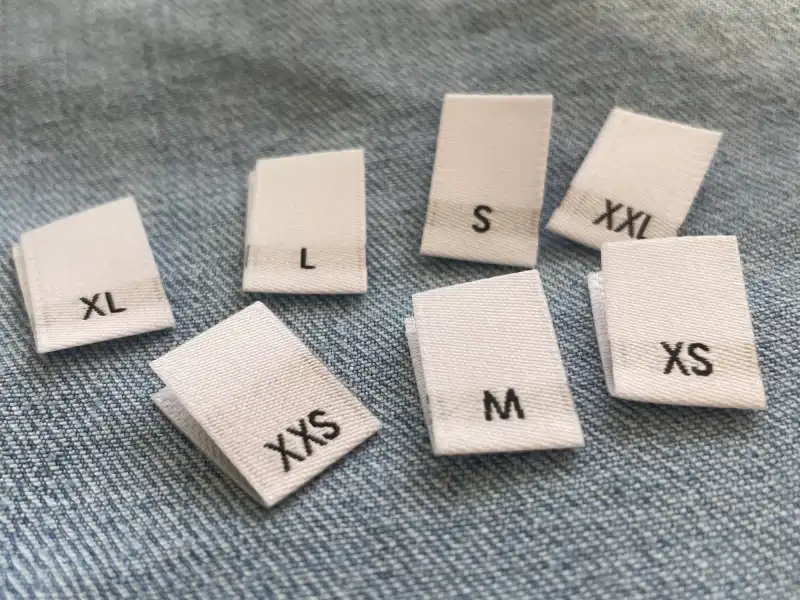
Size labels must match the graded garment and SKU plan. A correct dress carrying the wrong size label can create warehouse and returns errors. Custom size labels commonly follow similar 500-1,000 piece supplier minimums with typical 7-15 day development, subject to artwork and material.
- Checks: size code, market format, quantity, position, bundle and packing match.

Care Labels
Fiber content, care wording, country-of-origin wording and required languages should be supplied or approved by the brand’s responsible compliance team. Jinfeng supports artwork preparation, production, placement and inspection but does not replace the brand’s legal review.
- Checks: approved text, language, print durability, size, position, style and order match.
Hangtags
Hangtags may carry brand story, product information, price ticket, barcode or retailer data. Custom hangtags commonly carry supplier minimums around 500-1,000 pieces and typical preparation of about 7-20 days depending on paper, printing, finishing, string and approval.
- Checks: front-back content, color, hole position, string, barcode relation and attachment point.

Price Tickets
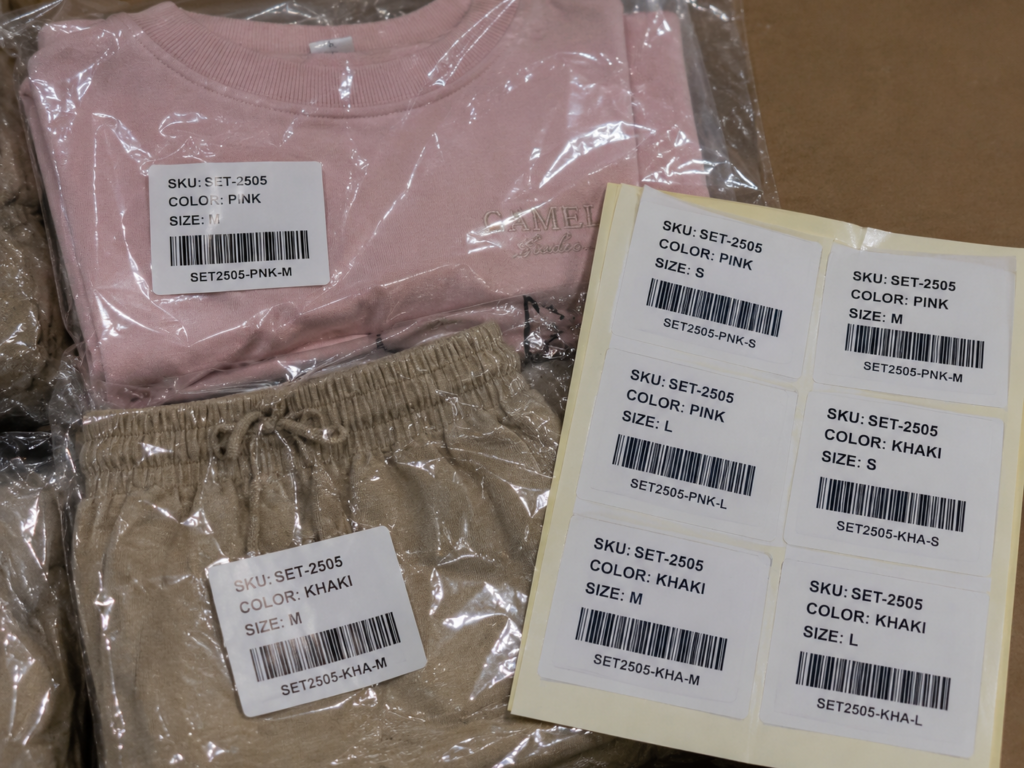
Retail tickets can be applied under an approved data file and placement guide. Each ticket should match style, color, size, retail price or other assigned fields. Variable data needs version control before printing and a sample approval before full application.
- Checks: variable data, print quality, attachment, garment match, removal or security method.

Barcode and SKU
UPC, EAN, internal SKU or retailer labels are printed from approved data supplied or authorized for the program. Jinfeng checks data-to-product mapping, print condition, placement and scan response. Barcode allocation ownership and system transmission remain defined by the project parties.
- Checks: code value, human-readable text, style-color-size match, contrast, placement, scan test.
Packing Structures Follow the Approved Allocation
A dress order can use several carton structures. The approved packing instruction determines whether units remain solid by size, combine into prepacks or separate by destination.
Solid Color and Solid Size
One carton carries a single style, color and size. The structure simplifies identification and counting, but may increase carton quantity and warehouse handling. Jinfeng prepares packing sheets with style, color, size, pieces per carton and carton sequence. Final checks confirm the outer mark matches the physical content before sealing.
Solid Color Mixed Size
One style and color are packed with an approved size ratio. Common examples may include a balanced run such as 1-2-2-1 or a retailer-specific ratio, but no ratio is assumed without written approval. Packing workers use the approved matrix, and QC opens selected cartons to verify each size count and the total quantity.
Prepack and Store Pack
A prepack groups a defined assortment for warehouse or store allocation. One missing or duplicated size changes the entire pack. Each prepack needs a clear pack code, individual item identification, unit count and outer label relationship. Store packs may also require destination or store information supplied by the brand or retailer.
PO-Separated Cartons
When one production program serves several POs or destinations, packing should remain separated according to approved instructions.
Carton numbering, marks, warehouse labels and packing lists follow the destination split.
Combining orders without approval can create receiving and invoice discrepancies even when the total quantity is correct.
Mixed SKU Cartons
Mixed SKU cartons are only used when the receiving rule permits them.
The packing list must show the complete carton content, and the outer label must carry the required identification.
Jinfeng reviews whether the label format, scan workflow and manual carton audit can support the requested mix before packing begins.
Garment Protection
Folding, polybag size, warning text, tissue, protective layers and carton loading are selected around fabric behavior and retail requirements. Satin needs pressure and crease awareness; sequins need surface protection; lace and mesh need snag control; corset structures should not be crushed. Custom printed polybags commonly require 500-1,000 pieces and typical 7-20 day preparation, while export cartons and custom marks commonly require around 3-10 days after specification approval.
Carton Marks Support Fast Warehouse Identification
A carton should communicate enough verified information for transport and receiving without exposing uncontrolled or conflicting data. Marks, labels and physical content must agree.
Carton Identification
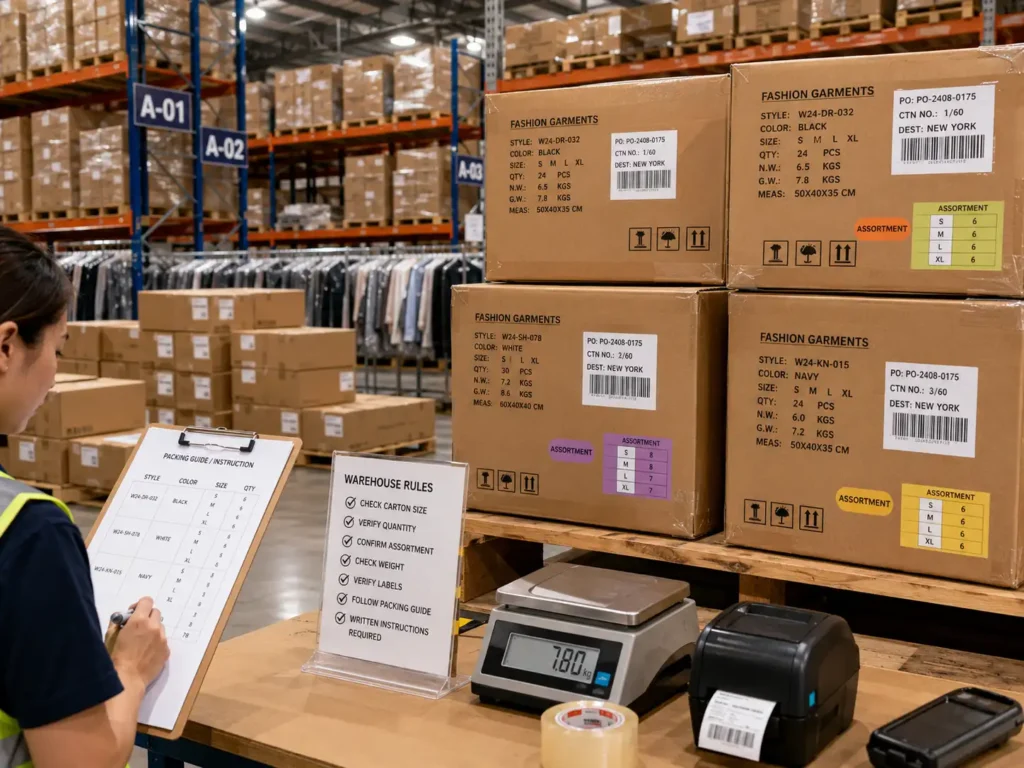
Approved outer marks may include PO number, style, color, size or pack code, quantity, carton number, destination, country of origin wording and handling marks.
Content varies by program. Jinfeng checks the mark against the packing sheet and physical carton before release. Handwritten changes or mixed file versions are avoided because small differences can block receiving reconciliation.
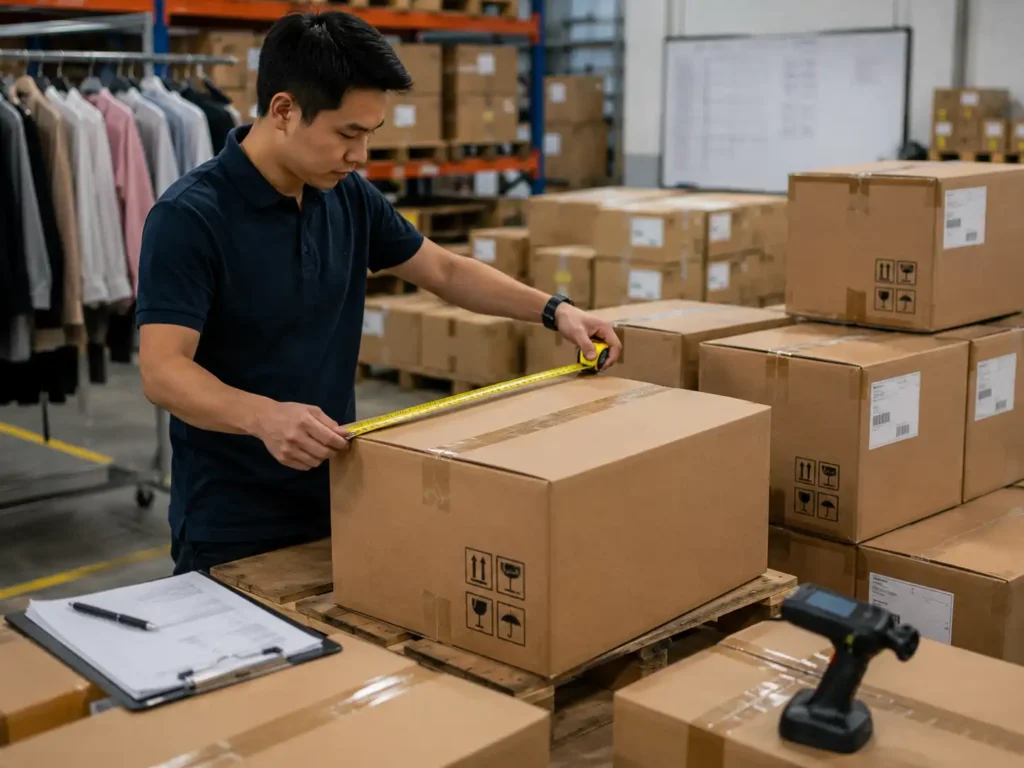
Carton Specification
Carton dimensions, gross weight, net weight, board strength, sealing method and maximum loading are planned around garment volume and logistics requirements. Long maxi dresses, layered occasionwear and corset structures may need different folding or carton density from lightweight mini dresses. Final carton dimensions and weights are recorded for freight booking and packing documents. Over-compression is avoided when it could damage pressing, cups, boning, sequins or surface finish.
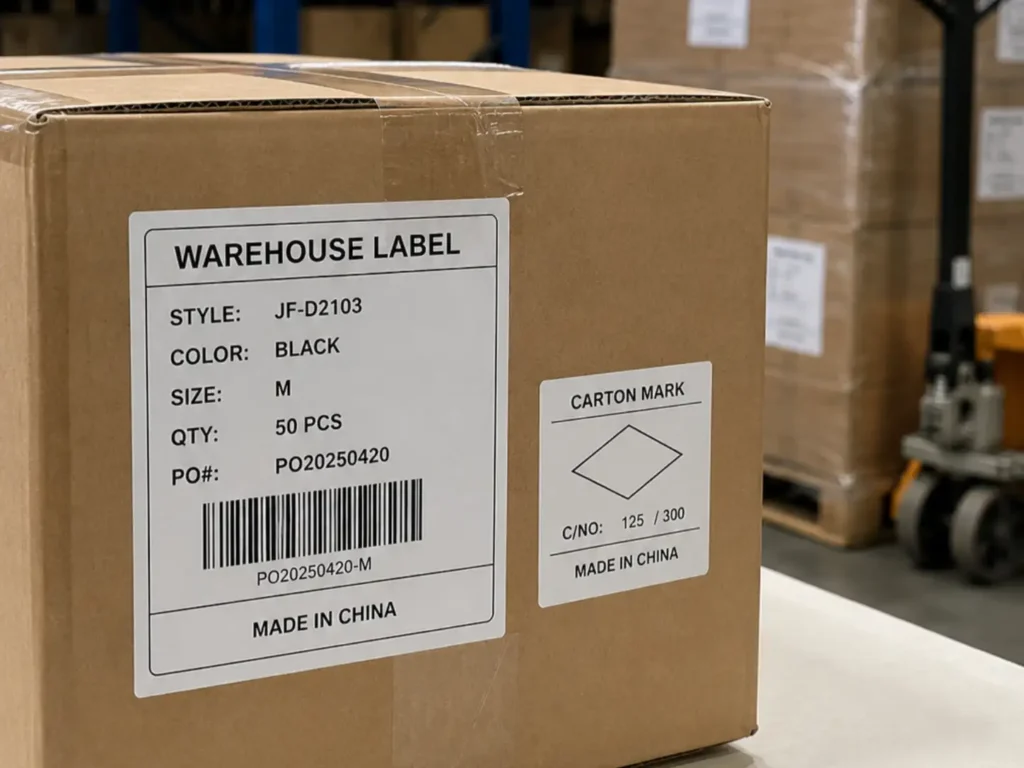
Warehouse Labels
Warehouse receiving labels, UCC-128, GS1-128 or SSCC formats can be evaluated when the brand, retailer or appointed service provider supplies the required data, template and authorization. Jinfeng can support printing, placement and scan checks within the agreed scope. Jinfeng does not invent retailer logistics identities or allocate GS1 numbers without authorized source data. Label ownership, ASN transmission and EDI responsibilities are confirmed before production release.
Barcode Release Uses Three Separate Checks
Data Match
Print and Placement
Scan and Product Match
Packing QC Continues Until the Carton Is Sealed

Label Application

Garment Folding
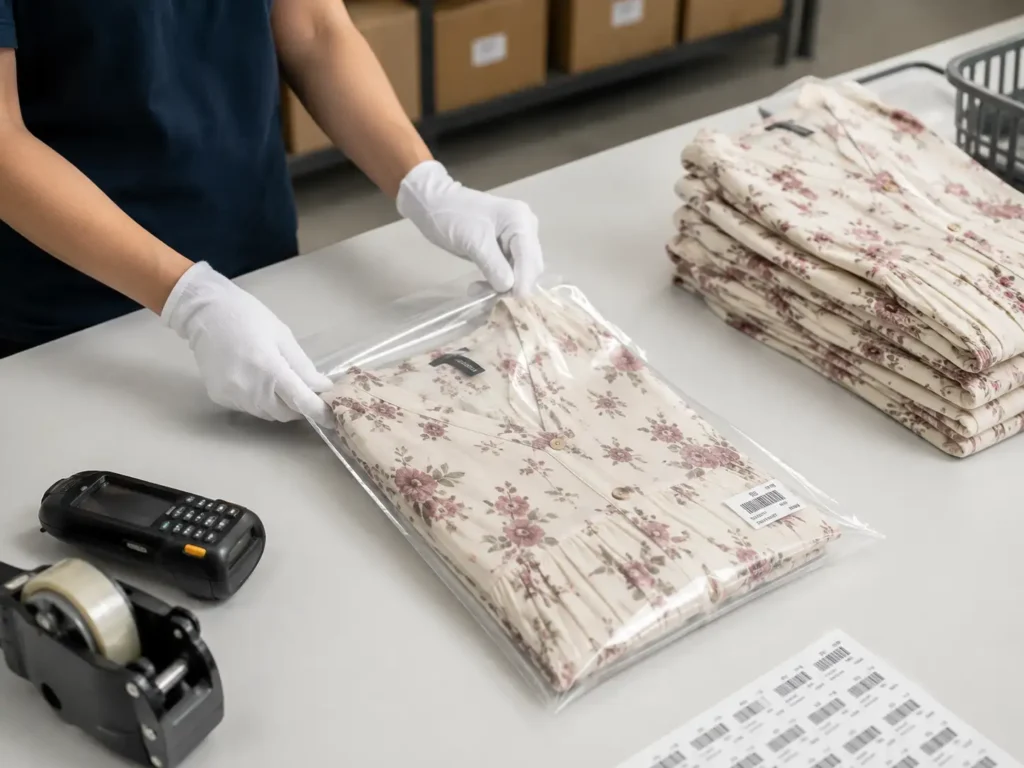
Polybag Identification

Color-Size Count

Outer Mark Check

Final Carton Audit
Shipping Files Match the Physical Cargo
A complete handover links carton data, commercial documents, transport instructions and warehouse destination. Final reconciliation reduces avoidable delays after the goods leave the factory.

Commercial Documents
Jinfeng supports commercial invoices, packing lists, carton marks, bill of lading or air waybill information, certificate of origin by request, HS code support, label information and customs declaration information.
Final tariff classification and import compliance remain subject to the importer and relevant authorities.
Document fields are reconciled with approved order quantities, carton count, dimensions, weights and destination details before release.

Forwarder Coordination
Brands may use a nominated forwarder or evaluate a factory-recommended forwarding option.
Cargo details, pickup address, booking information, cut-off dates, carton count, dimensions, gross weight and required export files are coordinated within the confirmed trade term.
EXW, FOB, CIF, DAP and DDP can be evaluated by project. DDP availability depends on destination, product, importer arrangement and logistics conditions rather than a blanket promise.

Delivery Planning
Express courier can support samples and urgent documents; air freight can support time-sensitive bulk; sea freight supports larger planned programs; split air and sea delivery can be evaluated when launch needs justify it. The most reliable calendar works backward from warehouse receiving date through transit, booking, final inspection, packing approval, production completion, PP approval and material arrival. A lower quantity does not automatically mean a shorter schedule when special fabric, custom labels, complex construction or late approvals remain on the critical path.
Receiving Risks Are Controlled Before Dispatch
Preventable receiving exceptions are addressed through source-file control, product inspection, packing verification and release evidence. Final warehouse acceptance also depends on retailer systems, carrier performance and destination procedures.
| Receiving Risk | Likely Cause | Jinfeng Control | Release Evidence |
|---|---|---|---|
| Wrong SKU | Style-color-size mapping error | Approved SKU matrix and garment-label cross-check | SKU approval and packing check |
| Barcode will not scan | Print contrast, damage or format issue | Sample approval, print review and scan test | Scan record where agreed |
| Correct code on wrong garment | Packing application error | Garment, inner label and barcode match check | Selected unit trace check |
| Size-ratio variance | Counting or pack-sheet error | PO-based packing sheet and carton count audit | Carton audit record |
| Carton mark mismatch | Wrong label or carton sequence | Outer mark matched to physical content | Carton photo and packing list |
| Quantity variance | Production, packing or reconciliation gap | Multi-stage quantity tracking and final count | Final quantity sheet |
| Missing retail ticket | Late artwork or application miss | Approval deadline and packing checklist | Ticket checklist and inspection |
| Document mismatch | Late change not reflected in files | One final file reconciliation before release | Approved packing list and invoice |
| Wrong destination label | PO or warehouse split error | Destination-specific carton plan and label check | Destination list and carton sequence |
| Product damaged in carton | Compression, snagging or poor fold method | Product-specific folding and carton-density review | Packed unit and carton audit |
Capacity Is Allocated by Style and Packing Complexity
18+ Sewing Lines
6+ Flexible Lines
2 Sample Rooms
12+ Merchandisers
30+ Packing Workers
Multi-Batch Delivery
Records Protect Repeat Orders and Brand Data
Production Records
Packing Records
NDA Protection
Retail Receiving Dress Manufacturing Case Studies
Retail-ready production requires more than finished garments. Successful delivery depends on accurate SKU data, barcode control, carton identification, packing compliance, and shipment records that allow warehouse teams to receive products efficiently.

Case Study 1: Retail Distribution Center Delivery for a Multi-Style Dress Program
A North American fashion brand supplied dresses through multiple retail distribution centers and needed a manufacturing partner capable of handling:
- Multi-style production
- Retail labeling
- Warehouse receiving requirements
- Delivery coordination
Program scope:
- 18 dress styles
- 48,600 pieces
- XS-XXL size range
- 4 color groups
- 3 warehouse destinations
Product categories:
- Satin dresses
- Bodycon dresses
- Occasion dresses
- Resort dresses
Receiving Challenge
The brand’s previous production process created warehouse difficulties.
Main issues:
SKU Data Problems
Including:
- Incorrect color codes
- Missing size identification
- Barcode mismatch
Carton Problems
Including:
- Incorrect carton marks
- Mixed quantities
- Packing list differences
Jinfeng Solution
Jinfeng connected production data with warehouse requirements.
SKU Control
Managed:
- Style number
- Color code
- Size code
- Barcode
- Packing ratio
Packing System
Created:
- PO packing sheet
- Carton breakdown
- Carton marks
- Warehouse labels
Result
The brand achieved:
- Accurate warehouse receiving
- Reduced carton reconciliation
- Better inventory visibility
- Stable retail delivery process
The packing structure became a repeatable standard for future orders.

Case Study 2: Multi-PO Retail Packing Program With Complex SKU Management
A growing fashion brand supplied products to multiple retail accounts with different PO requirements.
The program included:
- Multiple destinations
- Different delivery windows
- Different packing instructions
Program scope:
- 24 dress styles
- 72,000 pieces
- 60+ color-size combinations
- Multiple PO allocations
Packing Challenge
The garments were produced correctly, but the brand needed stronger shipment data control.
Main challenges:
Different PO Requirements
Each PO required:
- Specific quantities
- Specific carton allocation
- Different destination labels
SKU Complexity
The program involved:
- Multiple styles
- Multiple colors
- Multiple sizes
- Different pack ratios
Jinfeng Solution
Jinfeng created a PO-level packing management system.
Data Alignment
Connected:
- Line sheet
- PO
- SKU matrix
- Barcode file
- Packing list
Carton Planning
Controlled:
- Solid-size cartons
- Mixed-size prepacks
- Destination cartons
- Carton sequence
Packing QC
Verified:
- Quantity
- Size ratio
- Barcode
- Labels
- Outer carton marks
Result
The brand achieved:
- Accurate PO fulfillment
- Faster warehouse receiving
- Reduced manual sorting
- Improved retailer confidence
The program supported future multi-account expansion.

Case Study 3: Scaling Retail Distribution With Warehouse-Ready Private Label Delivery
An established womenswear brand expanded from ecommerce sales into retail distribution.
The brand needed manufacturing support for:
- Private labels
- Retail packaging
- Warehouse delivery
- Larger seasonal programs
Program scope:
- 30 dress styles
- 85,000 pieces
- Multiple delivery waves
- Retail-ready packaging
Expansion Challenge
The brand needed to maintain product quality while adding retail requirements.
Main challenges:
Product + Data Connection
Needed alignment between:
- Garment
- Label
- Barcode
- SKU
- Carton
Distribution Growth
Required:
- Multiple warehouses
- Multiple shipment batches
- Accurate inventory allocation
Jinfeng Solution
Jinfeng managed the complete retail preparation process.
Private Label Management
Controlled:
- Main labels
- Size labels
- Care labels
- Hangtags
- Barcode stickers
Warehouse Preparation
Managed:
- Folding method
- Polybag requirements
- Size stickers
- Carton ratios
- Carton marks
Shipment Coordination
Prepared:
- Packing lists
- Commercial invoices
- Carton data
- Forwarder information
Result
The brand achieved:
- Retail-ready product delivery
- Improved warehouse efficiency
- Controlled SKU accuracy
- Scalable distribution capability
The manufacturing system supported expansion from online sales into retail channels.
Frequently Asked Questions About Retail Receiving
Yes. Send the current routing guide, PO instructions, packing manual, label templates and destination rules. Jinfeng reviews the assigned manufacturing and packing scope, identifies missing information and confirms what must be supplied by the brand, retailer, importer, EDI provider or forwarder before approval.
Yes. Packing can be organized by PO, style, color, size, SKU, pack ratio, carton sequence and destination under an approved matrix. Mixed SKU or mixed-size cartons are only used when the receiving rules permit them.
Yes. Jinfeng can print or apply approved UPC, EAN, SKU, price-ticket or warehouse labels within the agreed scope. The brand or authorized party must provide or approve the underlying data. Jinfeng checks data mapping, print condition, placement and selected scan results.
Projects using GS1-128, UCC-128 or SSCC labels can be evaluated when the authorized data, format, placement and system responsibilities are provided. Jinfeng can support printing, application and verification but does not independently allocate retailer or GS1 logistics identities.
Barcode scan checks can be included in the packing control plan. Scan readability is combined with garment-to-label matching because a readable code on the wrong color or size remains an error.
Yes. Solid size, mixed-size prepack, store pack, PO-separated and other approved structures can be managed. Ratios are converted into packing sheets and checked at carton level.
Jinfeng supports commercial invoices, packing lists, carton marks, cargo details, bill of lading or air waybill information, certificate of origin by request, HS code support and customs declaration information. Exact document scope follows the trade term and importer arrangement.
Yes. Jinfeng can coordinate pickup, cargo details, carton count, dimensions, weights, booking information and required export files with a nominated forwarder. Factory-recommended options can also be evaluated when requested.
MOQ starts from 200 pieces per style and color. Multiple styles totaling 200 pieces do not meet the standard MOQ. Special fabrics, colors, trims, tickets, labels and packaging may carry separate supplier minimums.
Yes. NDA-based cooperation can cover tech packs, patterns, samples, size charts, BOMs, label artwork, packaging artwork, barcode and SKU data, warehouse guides, order quantities and unreleased launch information.

Send Your Dress and Warehouse Requirements
Send your dress references or line sheet together with the planned quantity per style and color, size range, target market, fabric direction and launch calendar. For retail receiving review, include the current PO format, SKU matrix, barcode files, label artwork, pack ratio, carton mark template, warehouse guide, destination split and requested delivery window.
Kelly will coordinate an initial review covering style complexity, material route, sample plan, MOQ fit, bulk capacity, private-label preparation, packing controls and shipment handover. Sensitive tech packs, SKU records, barcode data and warehouse instructions can be shared after NDA review. Final quotation and calendar are confirmed after fabric, construction, quantities, labels, packing method, quality standard and delivery terms are sufficiently defined.
- Name and company
- Email and WhatsApp
- Tech pack, line sheet, reference images or original sample details
- Quantity per style and color, size range and color breakdown
- Label artwork, barcode or SKU files and packing requirements
- Warehouse guide, destination details and target receiving date
- Form fields: Name, Tel/WhatsApp, Email Address, Message, Upload Your Files
- Submit button: Submit Project