 Skip to content
Dress Manufacturer for Production Follow-Up Teams
A custom dress manufacturing partner for production teams that need clear ownership, disciplined approvals, measurable progress, early risk escalation, and controlled delivery across multi-style womenswear orders.
- 12+ merchandisers and order follow-up specialists connecting product files, materials, samples, production, QC, packing, and export delivery.
- 15+ QC inspectors covering incoming materials, cutting, sewing, in-line checks, finished garments, pressing, and packing.
- 6 owned women’s fashion factories plus 10+ long-term production partners for style, fabric, construction, quantity, and delivery matching.
- 100,000+ pieces of regular monthly capacity supported by 18+ sewing lines and 26+ flexible production lines.
Jinfeng Apparel manufactures custom dresses, skirts, jumpsuits, matching sets, and private-label womenswear from technical review and sample development through bulk production and shipment coordination. Every project is organized around approved files, named responsibilities, milestone dates, production evidence, and recorded actions rather than vague status messages.
Manufacturing Capacity Behind Every Production Update
Since 2008
Six Owned Factories
Ten-Plus Partners
Twelve-Plus Merchandisers
Fifteen-Plus Inspectors
Monthly Production Scale
Built for Teams Responsible for Bulk Delivery
Production Managers
Production Merchandisers
Sourcing Teams
Vendor Management Teams
QA and Technical Teams
Logistics Teams
Where Dress Production Follow-Up Commonly Breaks Down
Vague Progress Reports
Material Delays
Unclosed Comments
Sample-Bulk Variation
Late Quality Discovery
Shipping Surprises
Is Jinfeng the Right Production Partner?
Strong Project Fit
- Custom production from 200 pieces per style and color, subject to fabric, trim, print, dyeing, and packaging requirements.
- Seasonal collections containing 10-30 styles, several fabric groups, and planned delivery batches.
- Programs requiring sampling, PP approval, bulk production, QC, private-label packing, and export coordination.
- Long-term relationships involving repeat orders, color extensions, collection refreshes, and multi-batch delivery.
Misaligned Requirements
- MOQ is calculated by style and color, not by the combined quantity of unrelated styles.
- Special fabrics, custom dyeing, printing, certified materials, hardware, and packaging can carry separate supplier minimums.
- Production timing begins from confirmed files, approved standards, material readiness, deposit, and agreed line planning.
- Major design changes after approval require a new risk, cost, sample, and schedule review.
From Production Brief to Shipment Release
Project Launch
Requirement Confirmation
Timeline Planning
Material Tracking
Sample Approval
Bulk Follow-Up
Quality Closure
Shipment Release
Clear Ownership Across Every Production Function
Client Contact
Order Merchandiser

Development Team
Material Team
Production Team

QC and Delivery Team
Documents That Keep Every Order Traceable
Production follow-up becomes reliable when every critical decision has a controlled record. Jinfeng uses style-level documents to connect commercial requirements, technical approvals, material status, sample versions, bulk progress, quality findings, packing, and shipment arrangements.
| Stage | Control Document | Core Information Managed |
|---|---|---|
| Project launch | Project Brief | Style list, quantities, colors, size range, target market, launch date, delivery requirement, key contacts |
| Requirement review | Requirement Checklist | Fabric, lining, trims, construction, measurements, testing, labels, packing, inspection |
| Schedule planning | Project Timeline | Planned milestones, approval dates, material dates, production dates, final inspection, cargo collection |
| Fabric control | Fabric Tracking Record | Specification, color, swatch status, bulk booking, expected arrival, actual arrival, inspection result |
| Trim control | Trim Tracking Record | Item specification, artwork, approval, ordered quantity, supplier date, arrival status, shortage risk |
| Sample control | Sample Status Update | Sample type, version, dispatch date, comments, revised date, approval status, responsible owner |
| Change control | Revision Log | Requested change, affected file, pattern update, measurement update, owner, due date, closure evidence |
| Bulk follow-up | Bulk Production Update | Cutting, line loading, sewing output, in-line QC, finishing, pressing, packing, completion quantity |
| Quality control | QC Issue Report | Defect, affected style and quantity, root cause, corrective action, owner, deadline, verification |
| Packing control | Packing Approval Record | Labels, barcodes, SKU stickers, polybags, assortment, carton marks, warehouse labels |
| Shipment control | Shipment Plan | Final inspection, cargo data, booking, cut-off, forwarder contact, pickup, split shipment details |
| Repeat order | After-Shipment Record | Arrival feedback, claims, corrective notes, retained pattern, material, trim, QC, and packing records |
Critical Path and WIP Reporting for Dress Orders
A useful WIP report explains whether the collection can still meet its commercial window. Jinfeng follows planned dates, actual status, dependencies, completion quantities, production evidence, and recovery actions instead of reporting isolated percentages without context.
Build the Timeline Backward
The working schedule begins with the required warehouse or forwarder date and moves backward through final inspection, packing completion, pressing, sewing completion, line start, cutting, PP approval, bulk fabric arrival, trim arrival, and sample approval. Backward planning exposes decisions that must be made early. A custom-color satin, placed lace, printed chiffon, molded cup, special zipper, or branded packaging item can affect the schedule long before a sewing line is booked.
A typical timeline includes planned and actual dates for every style group. Hero SKUs, photo samples, complex constructions, and long-lead materials receive separate priority rather than being hidden inside one collection date. When 10-30 styles move together, the plan is grouped by fabric family, construction family, sample readiness, material readiness, and required shipment batch.
Report Work in Measurable Stages
WIP reporting separates fabric booked, fabric arrived, cutting completed, bundles issued, sewing started, sewing completed, in-line checked, finished, pressed, packed, and released. Quantity is shown where it improves decisions. For example, “6,400 of 8,000 pieces sewn” is more useful than “80% complete” when 900 pieces remain under corrective action and packing material is still late.
Photographs, inspection notes, and production records can support key updates. Evidence is selected to answer a decision rather than to create a stream of unrelated workshop images. A line-start update may show approved sample, operation briefing, bundle identification, and first output. A packing update may show label placement, barcode scan, assortment, carton mark, and sealed carton condition.
Connect Delay to Recovery
A delayed date is followed by cause, impact, recovery option, owner, and next review. Material risk may require an approved substitute, partial color release, or revised line plan. Output risk may require operation balancing, additional line support, or a shipment split. Quality risk may require production hold, sorting, rework, pattern correction, or revised inspection frequency.
Recovery is not described as “we will speed up.” The action must show what changes, which quantity or style is affected, who owns the work, and when the result will be checked. When no responsible recovery is possible, the revised delivery expectation is communicated before the original date becomes impossible.

Fabric and Trim Tracking Before Production Starts
Many delivery problems begin before cutting. Separate tracking for fabric, lining, trims, labels, and packing materials allows production teams to see whether a style is truly ready for PP approval and line loading.
Fabric Status by Style and Color
Fabric follow-up begins with the approved specification: fiber composition, construction, weight, width, stretch, recovery, surface, color, print, finish, and intended garment use. Satin requires attention to shade, snagging, surface pressure, seam appearance, and pressing. Mesh requires controlled transparency, recovery, edge stability, and damage checks. Lace needs placement, repeat, edge, symmetry, and panel yield review. Chiffon needs direction, slippage, shrinkage, print placement, lining compatibility, and hem behavior.
Each fabric color is tracked from swatch or lab dip through approval, bulk booking, expected completion, arrival, and incoming inspection. Dye-lot or batch differences are not hidden inside a single “fabric arrived” status. When a style requires several layers, shell, lining, mesh, power mesh, fusible, and support materials are followed separately because one missing layer can stop sampling or bulk cutting.
Trim and Component Readiness
Dress construction often depends on components that carry more risk than their unit cost suggests. Zippers affect side seams and center-back shape. Boning affects support and balance.
Bra cups influence bust fit and neckline coverage. Elastic affects recovery and wearing comfort. Hooks, buttons, buckles, rings, sliders, and decorative hardware can alter both appearance and production time.
Every component is followed by specification, artwork or sample, approval status, supplier, MOQ, ordered quantity, expected arrival, actual arrival, and inspection result. Brand labels, size labels, care labels, hangtags, hang strings, barcode stickers, SKU labels, polybags, cartons, and warehouse labels are included in the same readiness review instead of being left until garments are complete.
Material Decisions Before Line Loading
Line loading is confirmed only after the required production materials and standards are ready. A partial arrival can support cutting or sewing only when the available quantity, color, size ratio, and shipment plan are clear. If an approved substitute is needed, cost, appearance, performance, testing, sample requirement, and schedule impact are reviewed before release.
For multi-style collections, materials are grouped by shared fabric, lining, zipper, label, and packing requirements. Grouping can reduce duplicate approvals and improve purchasing control, but style-specific details remain separate. A shared satin does not mean every style has the same consumption, lining, reinforcement, or pressing requirement.

Sample Versions Converted Into Bulk Standards
Sampling is a controlled decision process, not a sequence of garments with unclear purpose. Each sample round answers a defined question and updates the production files needed to make the approved result repeatable in bulk.
First and Fit Samples
A first sample verifies design structure, proportion, fabric direction, construction feasibility, and the initial cost logic. It is not automatically the final bulk standard. For a corset dress, the first round may test bust support, cup position, boning layout, waist suppression, closure, lining, and comfort. For a mesh bodycon dress, it may test transparency, stretch, recovery, lining coverage, neckline stability, and seam appearance.
Fit review uses measurements and visual balance together. Bust, upper bust, under bust, waist, high waist, low waist, hip, front length, back length, strap length, armhole, neckline depth, slit height, lining length, and garment length are checked according to the style. A technically correct measurement can still look wrong when the waistline sits too low, the neckline spreads, the hip shape pulls, or the hem falls unevenly.
With 7+ senior pattern makers, 2 sample rooms, and 20+ sample machinists, styles can be grouped by pattern family, fabric family, complexity, launch priority, and sample purpose. A multi-style program receives a priority list so hero SKUs, photo samples, and long-lead fabrics do not become blocked behind less urgent styles.
Revised Samples and Comment Closure
Comments are consolidated before the next sample round. Conflicting notes from design, technical, production, and merchandising functions are clarified because one change can affect another.
Raising a neckline may alter strap length and armhole coverage. Tightening a waist may change zipper behavior and lining ease. Changing from woven satin to stretch satin can affect pattern, grade rule, seam stability, and garment length.
The revision log identifies the requested change, comment source, affected area, updated pattern version, updated measurement chart, updated BOM or workmanship file, sample version, owner, and closure status.
Photographs or marked measurements can support the change, but the production file remains the controlling reference.
PP Sample and Golden Sample
The PP sample confirms the final combination of fabric, color, lining, trims, measurements, construction, workmanship, labels, and packing direction before bulk production. Major design changes after PP approval are treated as a new risk review because they can change material consumption, operation time, cost, capacity, grade rules, and delivery.
The approved PP sample and Golden sample support production briefing and QC comparison. Bulk standards also include the final pattern, size chart, grade rules, BOM, sewing instructions, measurement tolerance, workmanship checkpoints, label placement, and packing instructions. A physical sample alone cannot carry every production detail across multiple lines, sizes, colors, and factories.
Sample timing is quoted after style and material review. A complex sample using custom fabric, special hardware, corset support, placed lace, handwork, or several lining layers requires a different plan from a simple woven dress. The schedule begins when the required files, sample payment, material direction, and key decisions are confirmed.

Bulk Production Milestones Your Team Can Follow

Material Arrival

Cutting and Bundling
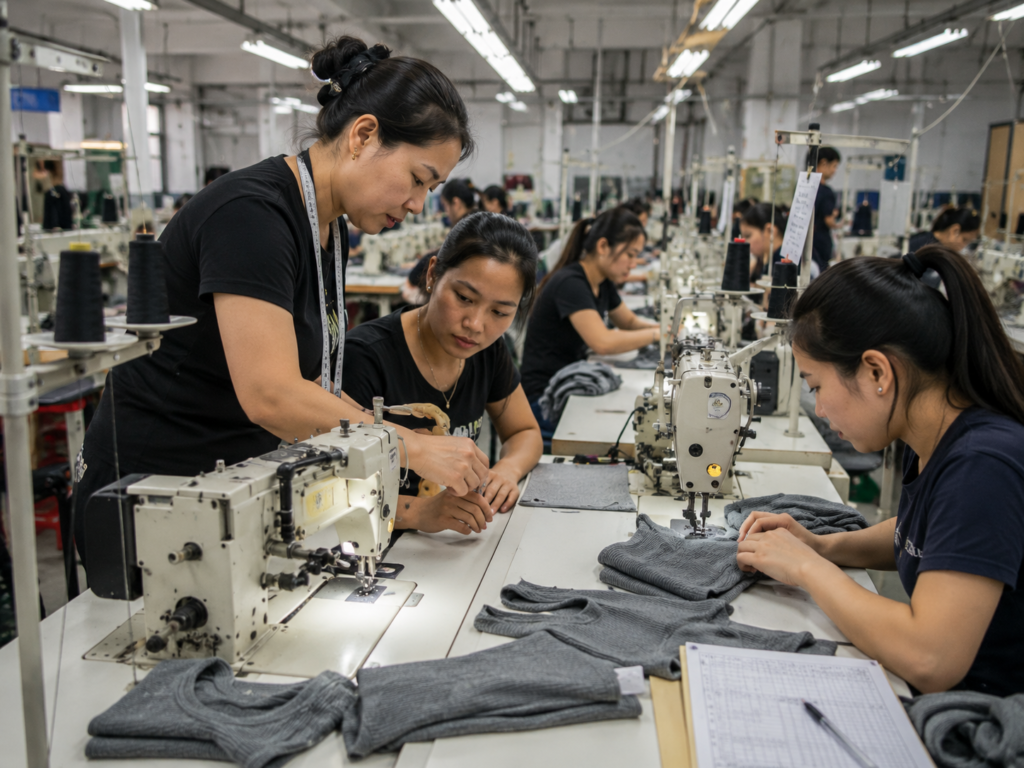
Sewing Line Start

In-Line Inspection

Finishing and Pressing

Packing Completion
Inline Quality Control Before Defects Multiply
Quality control protects delivery when findings are connected to production ownership and corrective action. Jinfeng uses product-specific checkpoints from incoming materials through packing rather than relying on a single final inspection to identify repeated defects.
Measurements and Fit-Critical Points
Dress measurements are selected according to structure and wearing risk. Common checkpoints include bust, upper bust, under bust, waist, high waist, low waist, hip, front length, back length, shoulder width, strap length, armhole, neckline depth, sleeve opening, slit height, lining length, hem circumference, and jumpsuit rise. Measurement tolerance is confirmed by project rather than applying one number to every point and fabric.
Fit-critical areas receive more than tape measurement. A strapless dress can meet bust width but still slip because support, grip elastic, cup shape, boning, or neckline tension is wrong. A bodycon dress can meet hip width but ride up because stretch recovery, length, lining, and hem pressure are not balanced. A maxi dress can meet center length while the hem remains uneven due to bias growth, fabric direction, or pressing.
Workmanship and Appearance Control
Workmanship checks cover stitch formation, seam security, seam allowance, puckering, zipper flatness, left-right symmetry, neckline shape, strap attachment, ruching distribution, lace placement, sequin protection, lining coverage, slit reinforcement, hem balance, label position, and visible surface damage.
Product-specific control matters. Satin is checked for snagging, pressure marks, seam shine, shade, and pressing.
Mesh is checked for holes, skipped stitches, transparency, stretched edges, and lining alignment. Lace is checked for motif balance, panel matching, edge damage, and loose sections. Sequin styles are checked for missing decoration, sharp edges, exposed thread, broken needles, and skin-contact protection.
Corrective Action and Verification
A defect record states the issue, style, color, size, affected quantity, location, suspected cause, immediate containment, corrective action, owner, due date, and verification. Containment may include stopping an operation, separating affected bundles, increasing inspection, holding finished goods, or checking an earlier production batch.
Corrective action is closed only after the revised method has been checked. A verbal instruction is not enough when the pattern, operation guide, machine setting, or workmanship sample also needs revision. For serious or repeated issues, the brand’s production or QA team receives the status, impact, correction plan, and updated delivery assessment.
Final inspection can follow the agreed client standard, AQL requirement, or appointed third-party process. Jinfeng also supports client inspection preparation and access to relevant approved samples, measurement files, packing requirements, and production records.
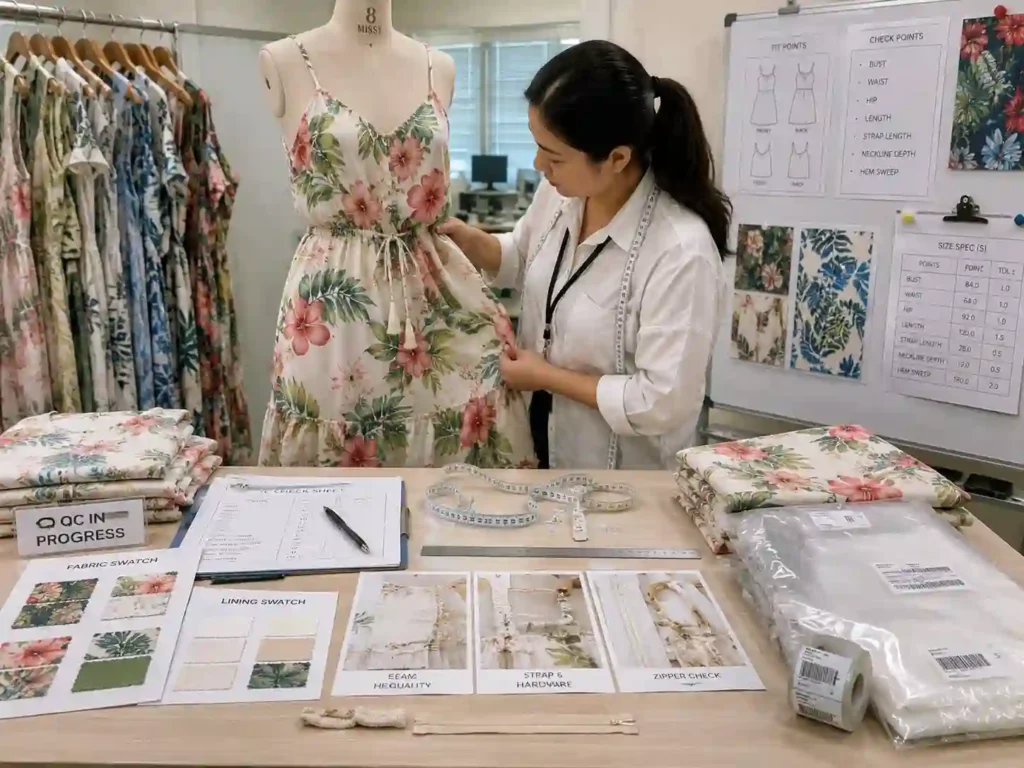
Production Risks Escalated Before Delivery Is Lost
Material Risk
Approval Risk
Production Risk
Delivery Risk
Control Multi-Style Collections Without Losing Detail
Large dress programs fail when dozens of style, color, size, material, sample, and packing decisions are compressed into one order status. Jinfeng divides the collection into controlled groups while preserving style-level ownership and approval.
Group Styles for Execution
A 10-30 style collection is first mapped by fabric family, construction family, trim family, pattern difficulty, sample priority, factory suitability, and required shipment batch. Satin slip dresses can share fabric and pressing knowledge, but a corset satin dress may require a different line, longer operation time, support components, and tighter in-line control. Mesh and lace styles may share lining suppliers while carrying different panel placement and damage risks.
Grouping improves control in four ways. Material purchasing becomes easier to forecast. Similar patterns and operations can be assigned to suitable teams. Sample priorities can be sequenced around photo dates and long-lead materials. Production updates can show meaningful groups without hiding the status of an individual style.
Manage Color and Size Complexity
MOQ is calculated by style and color. A large total collection quantity does not remove supplier minimums for a single color, custom-dyed fabric, special trim, print, certified article, or packaging item. Color consolidation, shared materials, and planned assortment ratios can improve purchasing efficiency without merging unrelated style standards.
Size planning considers the market, base size, grade rules, stretch, structure, garment length, bust support, and expected sales ratio. The production file identifies the size range and quantity ratio for every style and color. Cutting, bundling, in-line measurement, packing assortment, and barcode control use the same approved ratio so a commercial change does not remain isolated in a purchase order.
Set Sample and Production Priority
lead fabrics may require early sampling and PP approval. More stable carryover constructions can follow later. Jinfeng builds a priority sequence with the brand team instead of promising that all 20 or 30 styles will move at the same speed.
Bulk allocation also considers production logic. A style ready early may enter the line while another color waits for fabric, provided shared materials and packing plans remain controlled. A split release can protect the launch only when inspection, SKU, carton, packing list, and freight details are separated clearly.
Keep One Style-Level Record
Each style retains its own code, color list, size ratio, fabric and trim specification, pattern version, sample status, PP approval,
Golden sample, production unit, QC findings, packing instruction, and shipment quantity. Shared collection files support overview reporting, but they do not replace style-level control.
Production Controls for Complex Dress Categories
Jinfeng’s follow-up system is tied to the real risks of fashion dresses. Every category requires different material evidence, sample decisions, sewing checkpoints, finishing methods, and packing protection.

Satin Dresses

Mesh Dresses

Lace Dresses

Sequin Dresses

Bodycon Dresses

Corset Dresses

Jumpsuits
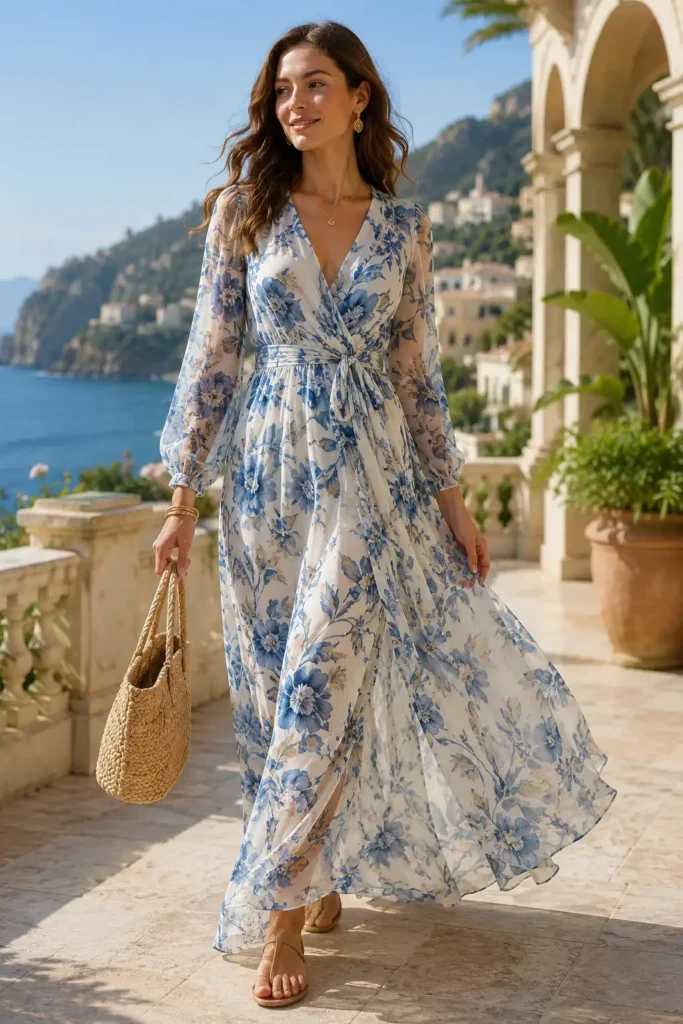
Chiffon and Prints
Packing and Shipment Readiness Before Completion
Label Set Control
Barcode and SKU Verification
Polybag and Folding Method
Carton Assortment
Export Documents
Forwarder Coordination
Production Records Supporting Reliable Repeat Orders
Pattern and Measurement Records
Fabric and Trim Records
Workmanship and QC Records
Packing and Shipment Records
Protecting Designs and Following Client Standards
NDA and Design Protection
Jinfeng supports NDA-based cooperation covering brand names, tech packs, original samples, patterns, line sheets, measurement files, fabric and trim plans, private-label artwork, packaging files, prices, quantities, and unpublished styles.
Client names, logos, samples, production quantities, and unreleased designs are not published without authorization. Public case content is anonymized unless written permission is provided.
Client Quality Standards
Quality execution can follow the brand’s measurement tolerance, workmanship manual, defect classification, AQL requirement, testing plan, inspection checklist, label manual, barcode rule, packing instruction, and warehouse standard.
Requirements are reviewed before quotation and production because additional testing, inspection, documentation, or special packing affects cost and timing.
Audit and Testing Support
A 24-Style Dress Program Followed to Shipment
An anonymized U.S. occasionwear program shows how a production follow-up structure can control a large collection without reducing the order to one completion percentage. The project combined fitted dresses, satin styles, mesh constructions, lace details, and private-label packing across several production groups.
Jinfeng supports NDA-based cooperation covering brand names, tech packs, original samples, patterns, line sheets, measurement files, fabric and trim plans, private-label artwork, packaging files, prices, quantities, and unpublished styles.
Client names, logos, samples, production quantities, and unreleased designs are not published without authorization. Public case content is anonymized unless written permission is provided.
| Project Item | Order Data and Follow-Up Result |
|---|---|
| Collection scope | 24 dress styles across satin, mesh, lace, stretch jersey, and woven occasionwear groups |
| Total quantity | 46,800 pieces, with individual style-color quantities planned above the applicable MOQ |
| Color plan | 2-4 colors per style, including shared black, ivory, wine, navy, and seasonal fashion colors |
| Size range | XS-XL, with style-specific size ratios and separate measurement checkpoints for fitted and structured dresses |
| Sample priority | 8 campaign styles first, 10 commercial core styles second, and 6 lower-priority extension styles third |
| Sample schedule | First-round samples planned in grouped waves; consolidated fit comments returned before revised and PP sample scheduling |
| Bulk structure | Styles allocated by fabric handling, corset or lining complexity, sewing time, and required shipment sequence |
| Main risks | Late custom satin color, cup and boning approval, neckline correction on two fitted styles, and barcode file revision |
| Quality action | Increased in-line checks for neckline, zipper flatness, bust support, lining coverage, slit height, and satin surface damage |
| Shipment plan | First launch batch released separately after final inspection; remaining cartons followed under a second forwarder collection |
Collection Setup

The brand supplied line sheets, tech packs, initial size charts, target quantities, launch dates, packaging guidelines, and a quality manual.
Jinfeng divided the 24 styles into five fabric groups and four construction groups. Satin styles were separated from mesh and lace handling.
Corset and cup-supported dresses were assigned to teams experienced with boning, bust structure, lining, and closure balance.
Eight campaign styles received the first sample priority because photo production and launch assets depended on them.
Ten commercial core styles followed after material direction was stable.
Six extension styles used later sample slots, preventing the entire collection from competing for the same pattern and sample resources.
Risk and Comment Closure

One custom satin color moved later than the original material plan. The affected styles were flagged before bulk line loading. The brand selected a split color release: approved colors continued, while the late color remained outside the first cutting plan. A revised material and production date was issued for the delayed color instead of reporting the whole collection as late.
Two fitted styles showed neckline and underarm exposure during fit review. Pattern changes affected neckline shape, strap position, armhole, lining coverage, and bust support. Comments were closed through revised patterns, updated measurements, a second fit sample, and PP approval. The correction was added to the line briefing and QC checkpoints before cutting.
A barcode artwork revision arrived while packing materials were being prepared. The old file was held, affected labels were separated, and packing release waited for the approved replacement. The action prevented completed garments from entering cartons with obsolete SKU information.
Bulk and Delivery Control

Bulk reporting separated cutting, sewing, in-line inspection, finishing, pressing, and packing by style group. Satin inspections focused on shade, snagging, seam appearance, zipper wave, hem balance, and pressure marks. Structured styles added checks for cups, boning, neckline support, symmetry, and lining. Mesh and lace groups added transparency, panel placement, holes, loose motifs, and edge quality.
The first shipment contained launch-priority styles that had completed final inspection, packing verification, and document review. Remaining styles moved under a second collection after their own quality closure. Carton ranges, SKU quantities, packing lists, and forwarder instructions were separated so the split did not create warehouse confusion.
The project finished with retained patterns, approved measurements, fabric and trim references, QC notes, label files, packing instructions, and shipment records for future repeat orders and color extensions.
Production Follow-Up Frequently Asked Questions
A named client contact and order merchandiser coordinate the project. Development, material, pattern, sample, production, QC, packing, and logistics functions own their respective actions. The merchandiser consolidates status, open decisions, risks, and next steps so the brand team does not need to collect separate updates from every department.
Reports can include a project timeline, fabric tracker, trim tracker, sample status, revision log, PP approval status, bulk production update, QC issue report, packing approval, and shipment plan. The format can be aligned with an existing brand WIP template when the required fields and update responsibilities are agreed at project launch.
Update frequency depends on project stage and risk. A stable pre-production phase may use scheduled weekly reporting, while line start, major material delays, quality containment, packing, or shipment cut-off can require more frequent updates. Critical issues are raised when identified rather than held for the next routine report.
The update identifies the affected material, style, color, required quantity, current status, original date, revised expectation, production impact, and recovery option. Possible actions include substitution review, partial color release, revised line allocation, shipment split, or schedule revision, subject to brand approval.
A PP sample is used to confirm the final bulk standard after fabric, trims, measurements, construction, workmanship, labels, and key comments are closed. Complex dresses, special fabrics, new structures, private-label requirements, and brand quality systems generally require clear PP approval before bulk production.
Approved comments are transferred into the final pattern, measurement chart, grade rules, BOM, sewing instructions, workmanship references, QC checklist, label placement, and packing instructions. A revision is not considered closed while an affected production file still contains the old information.
The affected work is identified and contained. The issue, quantity, cause, action, owner, and verification are recorded. Depending on severity, production may be corrected at the operation, held for sorting, reworked, inspected at a higher frequency, or stopped until the revised standard is confirmed.
Yes. Multi-style programs are grouped by fabric, construction, trim, complexity, sample priority, factory suitability, and shipment sequence. Every style keeps separate records for color, size ratio, pattern version, approvals, production quantity, QC findings, packing, and shipment.
Jinfeng supports client-appointed inspectors and nominated forwarders by project. Inspection standards, access, dates, approved samples, measurement files, packing status, cargo details, commercial documents, warehouse instructions, cut-off times, and pickup arrangements are confirmed before the relevant stage.
Yes. NDA-based cooperation can cover tech packs, samples, patterns, line sheets, labels, packaging, prices, quantities, and unreleased collections. Brand identity and confidential project content are not published without authorization. Public references remain anonymous unless written permission is provided.

Send Your Production Follow-Up Requirements
Send the files already used by your production, merchandising, technical, QA, or logistics teams. A useful review can begin with a tech pack, line sheet, approved sample information, quantity plan, color and size range, target delivery date, current critical path, reporting template, quality manual, packing instructions, or unresolved supplier issue. Jinfeng will review product complexity, fabric and trim readiness, sample status, MOQ fit, production allocation, quality checkpoints, packing requirements, and the information needed to build a traceable follow-up plan.
Provide the following details where available:
- Company name, target market, and responsible production contact
- Number of styles, colors, sizes, and planned quantity per style and color
- Tech packs, reference photographs, original samples, or line sheets
- Current sample stage and outstanding fit or construction comments
- Fabric, lining, trim, label, and packaging requirements
- Required final inspection, AQL, testing, and compliance arrangements
- Target launch, warehouse, forwarder, or cargo collection date
- Preferred WIP format and update frequency
- Client-appointed inspector, nominated forwarder, or warehouse requirements


